

- Industry Size (2025)
- USD 1.7 Bn
- Forecast (2035)
- USD 3.6 Bn
- CAGR (2025 to 2035)
- 8.1%
Smart Baby Monitor Market Size and Share Forecast Outlook 2025 to 2035
The Smart Baby Monitor Market is estimated to be valued at USD 1.7 billion in 2025 and is projected to reach USD 3.6 billion by 2035, registering a compound annual growth rate (CAGR) of 8.1% over the forecast period.
Quick Stats for Smart Baby Monitor Market
- Smart Baby Monitor Market Industry Value (2025): USD 1.7 billion
- Smart Baby Monitor Market Forecast Value (2035): USD 3.6 billion
- Smart Baby Monitor Market Forecast CAGR: 8.1%
- Leading Segment in Smart Baby Monitor Market in 2025: Audio And Video (57.3%)
- Key Growth Region in Smart Baby Monitor Market: North America, Asia-Pacific, Europe
- Top Key Players in Smart Baby Monitor Market: VTech Communications, Inc., Motorola, Inc., Dorel Industries Inc., Panasonic Corp., Samsung Electronics Co. Ltd., Netgear Inc., Lorex Technology Inc., Summer Infant, Inc., Arlo Technologies, Inc., iBaby Labs, Inc., Others
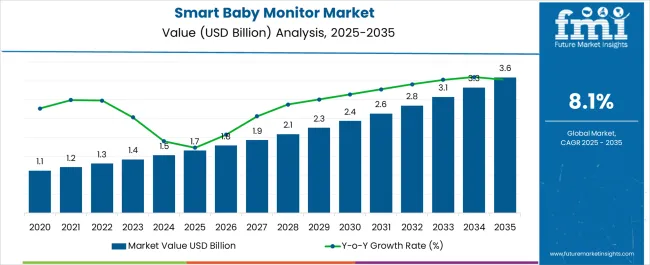
| Metric | Value |
|---|---|
| Smart Baby Monitor Market Estimated Value in (2025 E) | USD 1.7 billion |
| Smart Baby Monitor Market Forecast Value in (2035 F) | USD 3.6 billion |
| Forecast CAGR (2025 to 2035) | 8.1% |
Rationale for Segmental Growth in the Smart Baby Monitor Market
The smart baby monitor market is expanding rapidly as rising parental concerns about child safety and wellness continue to drive adoption. Current dynamics are influenced by growing urbanization, increased disposable income, and higher demand for connected devices that integrate seamlessly with smartphones and smart home systems.
Manufacturers are focusing on product innovation by introducing advanced features such as real-time video streaming, motion detection, and AI-powered alerts to enhance user confidence and convenience. The future outlook is expected to remain positive as technological advancements in wireless connectivity and cloud-based monitoring strengthen accessibility and reliability.
Growth rationale is further supported by the rising trend of nuclear families, remote working lifestyles, and increased e-commerce penetration that facilitate wider product availability Regulatory emphasis on product safety and secure data transmission is also expected to encourage broader acceptance, positioning the smart baby monitor market for consistent revenue expansion and deeper penetration into both developed and emerging regions.
Segmental Analysis
Insights into the Product Segment
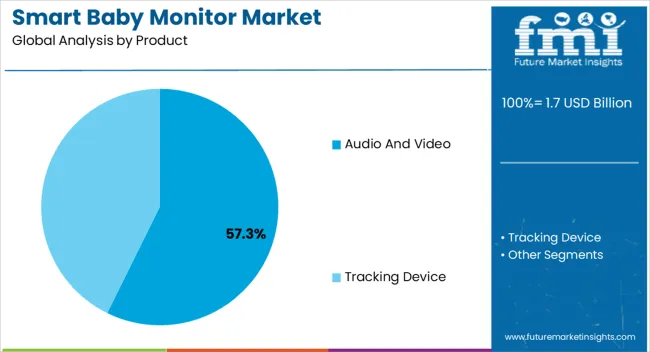
The audio and video segment, holding 57.30% of the product category, has emerged as the leading choice due to its ability to provide comprehensive monitoring solutions that combine sound and visual feeds. Demand has been strengthened by parental preference for real-time visibility and assurance of infant safety.
Technological enhancements, including high-definition cameras, night vision, and integrated sensors, have improved product performance and reliability. The segment’s dominance has been reinforced by its adaptability across both home and travel settings, offering flexibility for end users.
Competitive differentiation has been achieved through smart features such as mobile app integration and voice assistant compatibility, which continue to raise adoption levels The ability to offer peace of mind and multi-device connectivity is expected to sustain the segment’s market share and ensure strong growth prospects over the forecast horizon.
Insights into the Distribution Channel Segment
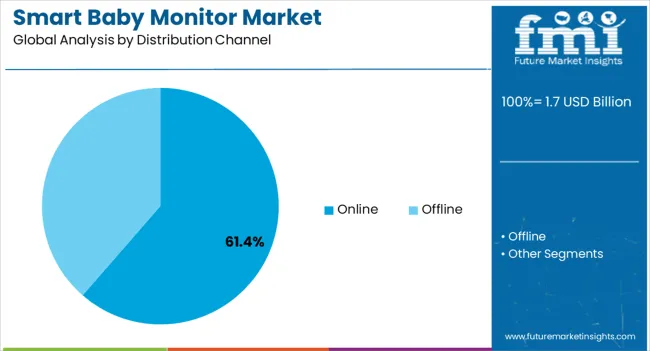
The online distribution channel, accounting for 61.40% of the category, has maintained leadership owing to the convenience, product variety, and competitive pricing offered through digital platforms. E-commerce penetration has enabled greater accessibility, particularly in regions where offline retail networks remain limited.
The segment’s growth has been supported by consumer preference for doorstep delivery, easy return policies, and extensive product reviews that influence purchasing decisions. Online platforms have also become critical in driving product awareness and brand visibility through targeted marketing and promotional campaigns.
Integration of secure payment gateways and subscription-based service models has enhanced consumer trust and repeat purchases As internet connectivity and digital literacy continue to rise globally, the online channel is expected to sustain its dominant position and further strengthen its role as the preferred distribution network for smart baby monitors.
Historical Analysis and Future Outlook of the Smart Baby Monitor Market
| Attributes | Details |
|---|---|
| Smart Baby Monitor Market Value (2020) | USD 1,047.80 million |
| Smart Baby Monitor Market Value (2025) | USD 1,402.40 million |
| Historical CAGR (2020 to 2025) | 7.60% |
The smart baby monitor market registered a CAGR of 7.60% from 2020 to 2025. The market reached USD 1,402.40 million in 2025, from USD 1,047.80 million in 2020. Growing concerns regarding child safety are backing the market expansion. Other factors that push the market growth are as follows:
- Surging population of working parents
- Growing awareness about surveillance devices
- Increasing affordability of these systems
The market is set to expand further in the upcoming decade, along with the rising birth rate across several countries. The market is anticipated to expand at a CAGR of 8.50% through 2035. The market is expected to reach USD 3,334.10 million by 2035. Top market propellers are as follows:
- Rising technological innovations
- Growing nuclear family structure
- Increasing cost of homecare
| Historical CAGR (2020 to 2025) | 7.60% |
|---|---|
| Forecasted CAGR (2025 to 2035) | 8.50% |
Category-wise Insights
Offline Distribution Channel Seizes a Larger Market Share
| Leading Distribution Channel | Offline |
|---|---|
| Market Share (2025) | 66.80% |
The offline distribution channel holds a monopoly in the smart baby monitor market. The segment is expected to account for a massive share of 66.80% in 2025. Customers choose to purchase baby products like smart baby monitors from specialty stores, pharmacies, and supermarkets and hypermarkets. Other popular offline distribution platforms include retail and department stores. The offline sales channel heavily contributes to the global market.
Retail stores like Babies R Us, Sears, Burlington, etc., train their staff regarding baby care products. Thus, these stores are better equipped to help customers select products that are apt for their requirements. To save their time and energy in weighing the pros and cons of each product, customers choose to buy from these stores.
An emerging trend of online sales is predicted to lower the market share of offline distribution channels in the future. The wide availability of product range on online platforms is enhancing the attractiveness of online channels. Additionally, the rising number of online retailers like FirstCry, Amazon, Walmart, Baby Shop, etc., is contributing to this segment’s growth.
Audio and Video-based Baby Monitors are Finding Significant Market
| Leading Product Type | Audio and Video |
|---|---|
| Market Share (2025) | 77.20% |
The audio and video segment is projected to account for a market share of 77.20% in 2025. Parents are increasingly opting for audio and video-based smart monitors that have features like motion sensors, extra receivers, talk-back, night lights, or temperature displays. Due to their convenient price range, parents find audio and video-based baby monitors handy for their use. Players are also constantly coming up with the latest inventions that match the pressing demands of customers.
In March 2025, SpotCam introduced SpotCam BabyCam, which is a cloud-based smart AI baby monitoring camera. Its features go beyond streaming and recording high-resolution video and include built-in intelligent functions. These cover baby tracking, baby crying detection, dangerous zone detection, lullabies, and the automatic creation of baby video diaries.
Country-wise Insights
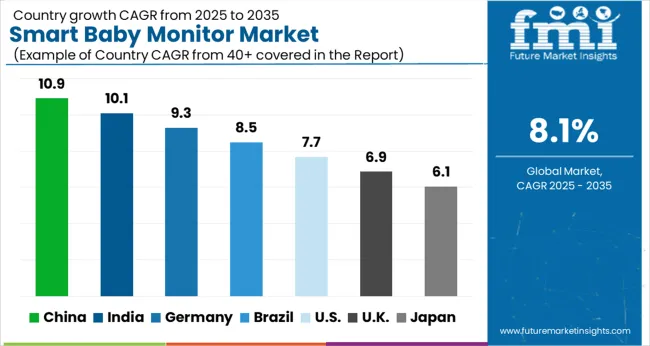
| Countries | CAGR (2025 to 2035) |
|---|---|
| United States | 7.7% |
| Germany | 6.9% |
| China | 10.5% |
| India | 9.3% |
| Australia | 8.8% |
Increasing Adoption of Smart Baby Monitors by Parents in the United States
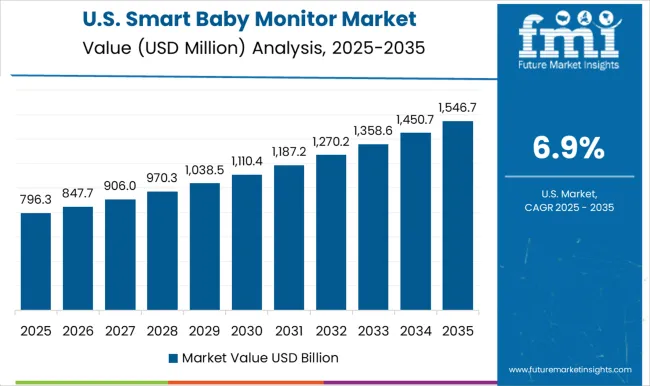
The United States smart baby monitor market is anticipated to register a CAGR of 7.7% through 2035. Developed countries like the United States have been among the initial ones to accept the concept of baby monitors. The leading factors behind this widespread adoption are as follows:
- Increasing population of employed females in the country. This, along with the busy lifestyle, allows for a limited time to devote to parental supervision of children.
- Growing demand for real-time surveillance of kids’ activities to decrease any chances of mishaps or injuries.
All these factors consolidate the market position of the United States in the smart baby monitor market.
Sales of Smart Baby Monitors that Allow for Parental Supervision is Picking Pace in Germany
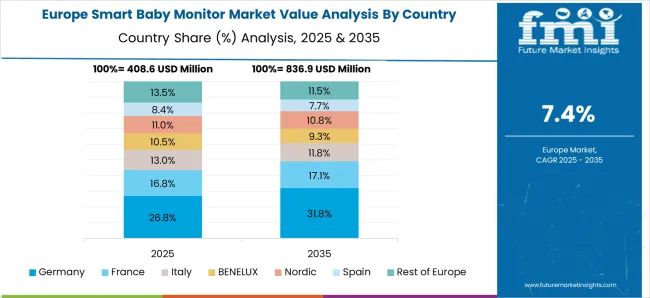
The German smart baby monitor market is anticipated to register a CAGR of 6.9% through 2035. The top factors that are driving investment on these monitors are as follows:
- Parents are seeking convenient gadgets to make child supervision easy.
- Increasing dual-income households in the country is contributing to significant investment in child safety products.
Availability of Cost-effective Smart Baby Monitors in China Raising Product Sales
The market in China is set to experience a robust CAGR of 10.5% through 2035. The market growth is driven by the following factors like:
- Surging proclivity toward smart baby monitors, as caretakers cost more in the long run. As a result, Chinese parents are investing in smart baby monitors that consist of interactive cameras, handy for child/children supervision.
- Domestic players are giving tight competition to international players by developing cost-effective baby monitors. Naturally, smart baby monitors in an affordable price range find high adopters.
China offers a significant market for the business of smart baby monitors due to its robust birth rate. Consequently, players are putting high stakes in the country.
Increasing Female Working Population in India Raising Dependence on Smart Baby Monitors
The India smart baby monitor market is expanding at a CAGR of 9.3% through 2035. Given below are the crucial factors backing the sales of smart baby monitors in the country:
- Increasing number of parents in urban households have extended working hours. This is raising their dependence on remote monitoring systems designed for infants to ascertain their security.
- Key players in the country are launching a range of smart baby monitors that increase the convenience quotient of consumers. By improving their line with better product options and features, players attract relevant customers to invest in these solutions.
High-end Smart Baby Monitors are Finding Significant Utilization in Australia
The Australia smart baby monitor market is anticipated to record a CAGR of 8.80% through 2035. Leading factors supporting the market growth are mentioned below:
- Growing trend of conscious parenting is encouraging the uptake of smart baby monitors in the country. Additionally, parents in Australia are willing to allocate a portion of their income on superior-quality baby safety products. Thus, contributing to surging sales of smart baby monitors.
- Key players are introducing high-end innovations to capture potential customers.
- Smart baby monitors are being upgraded so that integration with smart home devices becomes easy. This is anticipated to boost demand for smart baby monitors in the country.
Market Roadmap to Succeed in Smart Baby Monitor Market
Leading players in smart baby monitor market are heavily investing in research and development activities. The outcome of this initiative is the addition of cutting-edge functionalities and features in smart baby monitors. Latest technologies like Artificial Intelligence (AI) and Machine Learning (ML) are being employed to offer more personalized and comprehensive monitoring solutions.
Players are also partnering with other market leaders in sectors like technology, healthcare, and retail. The primary motive behind this strategy is to reach widely and securely via robust distribution channels. Partnerships can also result in joint marketing initiatives.
Competitors are enlarging their presence across offline and online retail channels to offer consumers many convenient options. As a result, they are forming strong bonds with eCommerce platforms, specialty baby retailers, and brick-and-mortar stores.
Additionally, companies are partnering with social media personalities, parenting influencers, and healthcare professionals to advertise their products. Such collaborations lead to brand credibility, customer engagement, and improved product visibility.
New Development Shaping the Smart Baby Monitor Market
- In February 2025, bonoch, a budding brand that provides smart childcare products and solutions, introduced a long-range baby monitor. The specialty of this product is that it does not require any Wi-Fi connection. The product is engineered to offer a worry-free experience to parents of young children. The brand has upgraded its frequency solution of 900Mhz and offers a stable connection that reaches 1,800 feet in open space for smooth live streaming.
- In August 2025, Arlo Technologies, Inc., a smart home security brand, revealed its national campaign called Protect Your Everything. The campaign focused on two distinct narratives that touch the current chaotic world and its many associated worries. The ad leverages the associated headspace-occupying anxieties to give viewers a sense of control via smarter protection.
Leading Companies in the Smart Baby Monitor Market are as follows
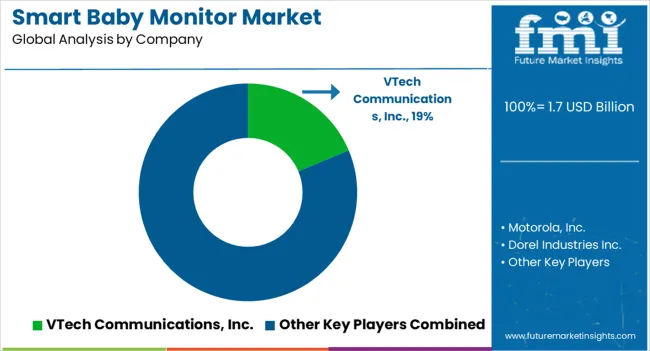
- VTech Communications, Inc.
- Motorola, Inc.
- Dorel Industries Inc.
- Panasonic Corp.
- Samsung Electronics Co. Ltd.
- Netgear Inc.
- Lorex Technology Inc.
- Summer Infant, Inc.
- Arlo Technologies, Inc.
- iBaby Labs, Inc.
- Others
Key Market Segments Covered in Smart Baby Monitor Market Research
By Product:
- Audio and Video
- Tracking Device
By Distribution Channel:
- Offline
- Online
By Region:
- North America
- Latin America
- East Asia
- South Asia and Pacific
- Western Europe
- Eastern Europe
- Middle East and Africa
Frequently Asked Questions
How big is the smart baby monitor market in 2025?
The global smart baby monitor market is estimated to be valued at USD 1.7 billion in 2025.
What will be the size of smart baby monitor market in 2035?
The market size for the smart baby monitor market is projected to reach USD 3.6 billion by 2035.
How much will be the smart baby monitor market growth between 2025 and 2035?
The smart baby monitor market is expected to grow at a 8.1% CAGR between 2025 and 2035.
What are the key product types in the smart baby monitor market?
The key product types in smart baby monitor market are audio and video and tracking device.
Which distribution channel segment to contribute significant share in the smart baby monitor market in 2025?
In terms of distribution channel, online segment to command 61.4% share in the smart baby monitor market in 2025.
Preview the report firsthand - request a free sample
Get SampleGet the brochure for pricing and purchase details.
Get PDFTable of Content
- Executive Summary
- Global Market Outlook
- Demand-side Trends
- Supply-side Trends
- Technology Roadmap Analysis
- Analysis and Recommendations
- Market Overview
- Market Coverage / Taxonomy
- Market Definition / Scope / Limitations
- Market Background
- Market Dynamics
- Drivers
- Restraints
- Opportunity
- Trends
- Scenario Forecast
- Demand in Optimistic Scenario
- Demand in Likely Scenario
- Demand in Conservative Scenario
- Opportunity Map Analysis
- Product Life Cycle Analysis
- Supply Chain Analysis
- Investment Feasibility Matrix
- Value Chain Analysis
- PESTLE and Porter’s Analysis
- Regulatory Landscape
- Regional Parent Market Outlook
- Production and Consumption Statistics
- Import and Export Statistics
- Market Dynamics
- Global Market Analysis 2020 to 2024 and Forecast, 2025 to 2035
- Historical Market Size Value (USD Million) Analysis, 2020 to 2024
- Current and Future Market Size Value (USD Million) Projections, 2025 to 2035
- Y-o-Y Growth Trend Analysis
- Absolute $ Opportunity Analysis
- Global Market Pricing Analysis 2020 to 2024 and Forecast 2025 to 2035
- Global Market Analysis 2020 to 2024 and Forecast 2025 to 2035, By Product
- Introduction / Key Findings
- Historical Market Size Value (USD Million) Analysis By Product , 2020 to 2024
- Current and Future Market Size Value (USD Million) Analysis and Forecast By Product , 2025 to 2035
- Audio And Video
- Tracking Device
- Y-o-Y Growth Trend Analysis By Product , 2020 to 2024
- Absolute $ Opportunity Analysis By Product , 2025 to 2035
- Global Market Analysis 2020 to 2024 and Forecast 2025 to 2035, By Distribution Channel
- Introduction / Key Findings
- Historical Market Size Value (USD Million) Analysis By Distribution Channel, 2020 to 2024
- Current and Future Market Size Value (USD Million) Analysis and Forecast By Distribution Channel, 2025 to 2035
- Online
- Offline
- Y-o-Y Growth Trend Analysis By Distribution Channel, 2020 to 2024
- Absolute $ Opportunity Analysis By Distribution Channel, 2025 to 2035
- Global Market Analysis 2020 to 2024 and Forecast 2025 to 2035, By Region
- Introduction
- Historical Market Size Value (USD Million) Analysis By Region, 2020 to 2024
- Current Market Size Value (USD Million) Analysis and Forecast By Region, 2025 to 2035
- North America
- Latin America
- Western Europe
- Eastern Europe
- East Asia
- South Asia and Pacific
- Middle East & Africa
- Market Attractiveness Analysis By Region
- North America Market Analysis 2020 to 2024 and Forecast 2025 to 2035, By Country
- Historical Market Size Value (USD Million) Trend Analysis By Market Taxonomy, 2020 to 2024
- Market Size Value (USD Million) Forecast By Market Taxonomy, 2025 to 2035
- By Country
- USA
- Canada
- Mexico
- By Product
- By Distribution Channel
- By Country
- Market Attractiveness Analysis
- By Country
- By Product
- By Distribution Channel
- Key Takeaways
- Latin America Market Analysis 2020 to 2024 and Forecast 2025 to 2035, By Country
- Historical Market Size Value (USD Million) Trend Analysis By Market Taxonomy, 2020 to 2024
- Market Size Value (USD Million) Forecast By Market Taxonomy, 2025 to 2035
- By Country
- Brazil
- Chile
- Rest of Latin America
- By Product
- By Distribution Channel
- By Country
- Market Attractiveness Analysis
- By Country
- By Product
- By Distribution Channel
- Key Takeaways
- Western Europe Market Analysis 2020 to 2024 and Forecast 2025 to 2035, By Country
- Historical Market Size Value (USD Million) Trend Analysis By Market Taxonomy, 2020 to 2024
- Market Size Value (USD Million) Forecast By Market Taxonomy, 2025 to 2035
- By Country
- Germany
- UK
- Italy
- Spain
- France
- Nordic
- BENELUX
- Rest of Western Europe
- By Product
- By Distribution Channel
- By Country
- Market Attractiveness Analysis
- By Country
- By Product
- By Distribution Channel
- Key Takeaways
- Eastern Europe Market Analysis 2020 to 2024 and Forecast 2025 to 2035, By Country
- Historical Market Size Value (USD Million) Trend Analysis By Market Taxonomy, 2020 to 2024
- Market Size Value (USD Million) Forecast By Market Taxonomy, 2025 to 2035
- By Country
- Russia
- Poland
- Hungary
- Balkan & Baltic
- Rest of Eastern Europe
- By Product
- By Distribution Channel
- By Country
- Market Attractiveness Analysis
- By Country
- By Product
- By Distribution Channel
- Key Takeaways
- East Asia Market Analysis 2020 to 2024 and Forecast 2025 to 2035, By Country
- Historical Market Size Value (USD Million) Trend Analysis By Market Taxonomy, 2020 to 2024
- Market Size Value (USD Million) Forecast By Market Taxonomy, 2025 to 2035
- By Country
- China
- Japan
- South Korea
- By Product
- By Distribution Channel
- By Country
- Market Attractiveness Analysis
- By Country
- By Product
- By Distribution Channel
- Key Takeaways
- South Asia and Pacific Market Analysis 2020 to 2024 and Forecast 2025 to 2035, By Country
- Historical Market Size Value (USD Million) Trend Analysis By Market Taxonomy, 2020 to 2024
- Market Size Value (USD Million) Forecast By Market Taxonomy, 2025 to 2035
- By Country
- India
- ASEAN
- Australia & New Zealand
- Rest of South Asia and Pacific
- By Product
- By Distribution Channel
- By Country
- Market Attractiveness Analysis
- By Country
- By Product
- By Distribution Channel
- Key Takeaways
- Middle East & Africa Market Analysis 2020 to 2024 and Forecast 2025 to 2035, By Country
- Historical Market Size Value (USD Million) Trend Analysis By Market Taxonomy, 2020 to 2024
- Market Size Value (USD Million) Forecast By Market Taxonomy, 2025 to 2035
- By Country
- Kingdom of Saudi Arabia
- Other GCC Countries
- Turkiye
- South Africa
- Other African Union
- Rest of Middle East & Africa
- By Product
- By Distribution Channel
- By Country
- Market Attractiveness Analysis
- By Country
- By Product
- By Distribution Channel
- Key Takeaways
- Key Countries Market Analysis
- USA
- Pricing Analysis
- Market Share Analysis, 2024
- By Product
- By Distribution Channel
- Canada
- Pricing Analysis
- Market Share Analysis, 2024
- By Product
- By Distribution Channel
- Mexico
- Pricing Analysis
- Market Share Analysis, 2024
- By Product
- By Distribution Channel
- Brazil
- Pricing Analysis
- Market Share Analysis, 2024
- By Product
- By Distribution Channel
- Chile
- Pricing Analysis
- Market Share Analysis, 2024
- By Product
- By Distribution Channel
- Germany
- Pricing Analysis
- Market Share Analysis, 2024
- By Product
- By Distribution Channel
- UK
- Pricing Analysis
- Market Share Analysis, 2024
- By Product
- By Distribution Channel
- Italy
- Pricing Analysis
- Market Share Analysis, 2024
- By Product
- By Distribution Channel
- Spain
- Pricing Analysis
- Market Share Analysis, 2024
- By Product
- By Distribution Channel
- France
- Pricing Analysis
- Market Share Analysis, 2024
- By Product
- By Distribution Channel
- India
- Pricing Analysis
- Market Share Analysis, 2024
- By Product
- By Distribution Channel
- ASEAN
- Pricing Analysis
- Market Share Analysis, 2024
- By Product
- By Distribution Channel
- Australia & New Zealand
- Pricing Analysis
- Market Share Analysis, 2024
- By Product
- By Distribution Channel
- China
- Pricing Analysis
- Market Share Analysis, 2024
- By Product
- By Distribution Channel
- Japan
- Pricing Analysis
- Market Share Analysis, 2024
- By Product
- By Distribution Channel
- South Korea
- Pricing Analysis
- Market Share Analysis, 2024
- By Product
- By Distribution Channel
- Russia
- Pricing Analysis
- Market Share Analysis, 2024
- By Product
- By Distribution Channel
- Poland
- Pricing Analysis
- Market Share Analysis, 2024
- By Product
- By Distribution Channel
- Hungary
- Pricing Analysis
- Market Share Analysis, 2024
- By Product
- By Distribution Channel
- Kingdom of Saudi Arabia
- Pricing Analysis
- Market Share Analysis, 2024
- By Product
- By Distribution Channel
- Turkiye
- Pricing Analysis
- Market Share Analysis, 2024
- By Product
- By Distribution Channel
- South Africa
- Pricing Analysis
- Market Share Analysis, 2024
- By Product
- By Distribution Channel
- USA
- Market Structure Analysis
- Competition Dashboard
- Competition Benchmarking
- Market Share Analysis of Top Players
- By Regional
- By Product
- By Distribution Channel
- Competition Analysis
- Competition Deep Dive
- VTech Communications, Inc.
- Overview
- Product Portfolio
- Profitability by Market Segments (Product/Age /Sales Channel/Region)
- Sales Footprint
- Strategy Overview
- Marketing Strategy
- Product Strategy
- Channel Strategy
- Motorola, Inc.
- Dorel Industries Inc.
- Panasonic Corp.
- Samsung Electronics Co. Ltd.
- Netgear Inc.
- Lorex Technology Inc.
- Summer Infant, Inc.
- Arlo Technologies, Inc.
- iBaby Labs, Inc.
- Others
- VTech Communications, Inc.
- Competition Deep Dive
- Assumptions & Acronyms Used
- Research Methodology


