

- Industry Size (2025)
- USD 83.1 Mn
- Forecast (2035)
- USD 126.3 Mn
- CAGR (2025 to 2035)
- 4.3%
Demand for Ascorbic Acid in Japan Forecast and Outlook 2025 to 2035
Demand for ascorbic acid in Japan is expected to grow from USD 83.1 million in 2025 to USD 126.3 million by 2035, reflecting a compound annual growth rate (CAGR) of 4.3%. Ascorbic acid, commonly known as vitamin C, is widely used in the pharmaceutical, food, and cosmetic industries for its antioxidant properties and its essential role in collagen synthesis.
Demand for ascorbic acid in Japan is driven by the growing focus on health and wellness, an aging population, and the increasing use of vitamin C in dietary supplements, skincare products, and functional foods. As consumers become more health-conscious, the demand for high-quality vitamin C products is expected to rise.
Quick Stats of the Demand for Ascorbic Acid in Japan
- Demand for Ascorbic Acid in Japan Value (2025): USD 83.1 million
- Demand for Ascorbic Acid in Japan Forecast Value (2035): USD 126.3 million
- Demand for Ascorbic Acid in Japan Forecast CAGR (2025-2035): 4.3%
- Demand for Ascorbic Acid in Japan Leading Production Method: Reichstein Process (77.0%)
- Demand for Ascorbic Acid in Japan Key Growth Regions: Kyushu & Okinawa, Kanto, Kansai, Chubu, Tohoku, Rest of Japan
- Demand for Ascorbic Acid in Japan Key Players: DSM, CSPC Pharmaceutical Group, Northeast Pharmaceutical Group (NEPG), North China Pharmaceutical Group, Shandong Luwei Pharmaceutical
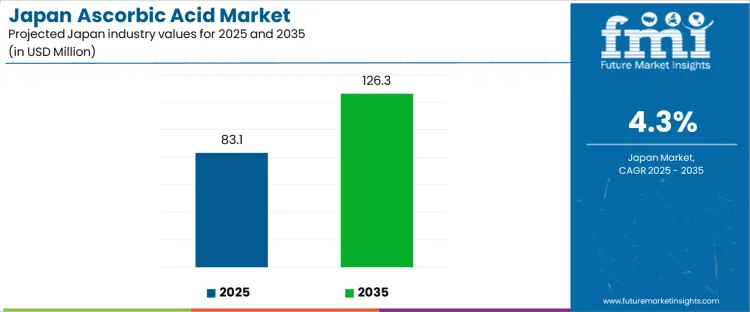
What is the Growth Forecast for the Ascorbic Acid Market through 2035?
Growth is further supported by Japan’s advanced pharmaceutical and food industries, which continue to innovate and develop new products incorporating ascorbic acid for its health benefits. The cosmetic industry is also a significant contributor, as ascorbic acid is increasingly used in anti-aging and skin-brightening formulations. As demand for health supplements and personal care products continues to grow, the market for ascorbic acid in Japan is expected to expand steadily over the next decade.
Absolute dollar opportunity for the ascorbic acid market in Japan shows consistent growth over the forecast period, with a steady increase in market value. Starting at USD 83.1 million in 2025, the market grows gradually, reaching USD 86.6 million in 2026 and USD 90.3 million in 2027. This early phase reflects moderate demand, as ascorbic acid remains a staple ingredient in health supplements, food products, and cosmetics.
From 2027 to 2030, market size continues to increase steadily, reaching USD 94.2 million in 2028, USD 98.2 million in 2029, and USD 102.4 million in 2030. The market’s growth reflects increased adoption across various industries, driven by rising awareness of vitamin C's health benefits. By 2035, the market is expected to reach USD 126.3 million, demonstrating sustained demand fueled by ongoing innovations in product formulations and a continued focus on wellness. Absolute dollar opportunity highlights a steady upward trend, driven by diverse applications of ascorbic acid in Japan’s growing pharmaceutical, food, and cosmetic sectors.
Key Takeaways of Ascorbic Acid Industry in Japan
| Metric | Value |
|---|---|
| Industry Sales Value (2025) | USD 83.1 million |
| Industry Forecast Value (2035) | USD 126.3 million |
| Industry Forecast CAGR (2025-2035) | 4.3% |
What Is Driving the Demand for Ascorbic Acid in Japan?
The demand for ascorbic acid in Japan is driven by increased interest in health, nutrition, and preventive care. Ascorbic acid is widely used in dietary supplements, fortified foods, and beverages to support immune function and general wellness. It is also used in pharmaceuticals and food processing because of its antioxidant properties and role in preservation of food quality. Manufacturers of functional foods, nutraceuticals, pharmaceuticals, and cosmetics rely on ascorbic acid as a stable, well-known ingredient. Demand is supported by a population concerned with healthy aging, urban lifestyles, and awareness of nutrition.
Future demand for ascorbic acid in Japan is expected to grow, as consumer preference for vitamins, supplements, and functional foods continues to expand. Growth will be led by use in dietary supplements, food fortification, and beverage applications. Demand from nutraceuticals and healthcare segments may rise, along with applications in cosmetics and topical formulations. The trend toward convenience nutrition and preventive health will support continued uptake. The long-term outlook depends on how producers meet standards for purity, stability, supply reliability and how dietary and regulatory trends evolve.
What Are the Key Segments in Ascorbic Acid Market in Japan?
The ascorbic acid market in Japan is segmented by form type and production method. Powder/Crystal is the dominant form type, holding 65% of the market share. In terms of production method, Reichstein process leads, accounting for 77% of the market. The demand for ascorbic acid in Japan is driven by its widespread use in the food and beverage industry, pharmaceuticals, and cosmetics, where it is valued for its antioxidant properties and health benefits.
Which Form Type Drives Ascorbic Acid Demand in Japan?
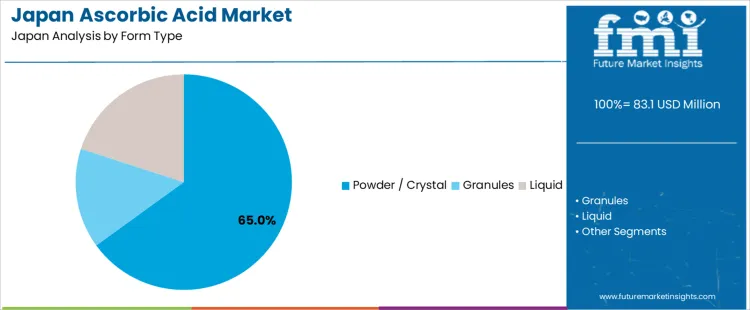
Powder/Crystal form is the most widely used type in the ascorbic acid market, representing 65% of the market share. Ascorbic acid in powder or crystalline form is highly versatile and can be easily incorporated into various products, including dietary supplements, fortified foods, beverages, and cosmetics. The demand for this form is driven by its stability, ease of handling, and compatibility with large-scale production processes. Powder and crystal ascorbic acid are cost-effective, making them the preferred choice for manufacturers in Japan. While granules and liquid forms also play a role in the market, the powder/crystal form remains the dominant choice due to its wide range of applications and efficient use in industrial formulations.
Which Production Method Drives Ascorbic Acid Demand in Japan?
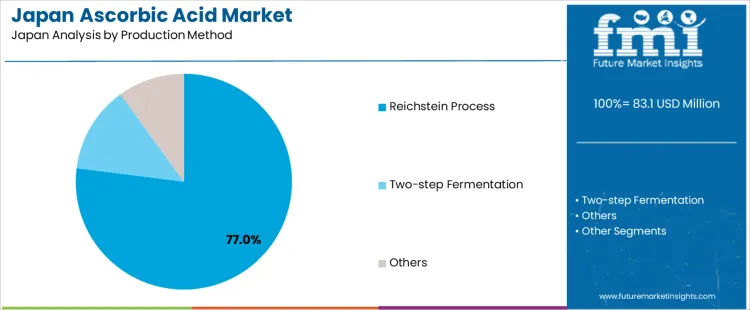
Reichstein process is the most commonly used production method in Japan, accounting for 77% of the market share. This chemical process involves the hydrogenation of glucose to produce ascorbic acid, which remains the dominant method due to its efficiency, scalability, and ability to produce high-purity ascorbic acid. The Reichstein process is well-established and continues to be the preferred method for large-scale commercial production of ascorbic acid. Although alternative methods like two-step fermentation are being explored for their potential advantages, particularly in terms of sustainability, the Reichstein process remains the leader due to its long history of use and reliable results. The high demand for ascorbic acid in Japan for various industrial applications ensures the continued dominance of the Reichstein process in production.
What is the Key Dynamics for Ascorbic Acid Demand in Japan?
Demand for ascorbic acid in Japan is driven by its widespread use in food, beverages, pharmaceuticals, and cosmetics. Ascorbic acid is widely used as a preservative, antioxidant, and essential nutrient in supplements and functional foods. Growing consumer awareness of health and wellness, particularly regarding immune support, is driving demand for vitamin C-enriched products. Rise in dietary supplement consumption and the increasing preference for natural and organic ingredients contribute to the growing demand for ascorbic acid in Japan's market.
What are the Key Drivers for Ascorbic Acid Demand in Japan?
Key drivers include a growing focus on health and wellness among consumers, leading to an increased demand for products that promote immune health and overall well-being. Ascorbic acid is recognized for its ability to support the immune system, which is particularly important in light of the global health concerns. The rise in consumption of functional foods and beverages that include vitamin C as an added benefit is another driver. Furthermore, the pharmaceutical industry's demand for ascorbic acid in the production of medicines, particularly for skin care and anti-aging products, is driving market growth in Japan.
What are the Restraints for Ascorbic Acid Demand in Japan?
Key restraint is fluctuating price of raw materials, such as corn or glucose, which are used to produce ascorbic acid. Price volatility can affect production costs and, ultimately, the retail prices of products containing ascorbic acid. Another constraint is the competition from other antioxidants and vitamin C derivatives that are increasingly being used in the food and pharmaceutical industries. Furthermore, regulatory challenges related to the use of synthetic ascorbic acid in food and beverage products, as well as consumer preference for natural alternatives, may limit the demand for synthetic ascorbic acid in some segments of the market.
What are the Key Trends in Ascorbic Acid Demand in Japan?
Key trends include the growing demand for natural and plant-based sources of ascorbic acid, as consumers seek more sustainable and organic options. The popularity of functional foods and beverages that provide added health benefits continues to rise, with ascorbic acid being a key ingredient in these products. There is also a trend toward innovation in vitamin C formulations, such as more bioavailable and stable forms of ascorbic acid, which are gaining traction in both the food and pharmaceutical industries. Increasing awareness of antioxidants' role in skin health is driving demand for ascorbic acid in cosmetics and skincare products.
What is the Regional Demand Outlook for Ascorbic Acid in Japan?
Demand for ascorbic acid in Japan is expected to grow steadily, with Kyushu & Okinawa leading the way at a projected CAGR of 5.3%. Kanto follows with a growth rate of 4.9%, while Kansai is expected to grow at 4.3%. Chubu is projected to grow at a rate of 3.8%, while Tohoku and Rest of Japan show more moderate growth, with CAGRs of 3.3% and 3.2%, respectively. The growing demand for ascorbic acid in food and beverage products, dietary supplements, and the cosmetics industry is driving the adoption of this essential nutrient across Japan.
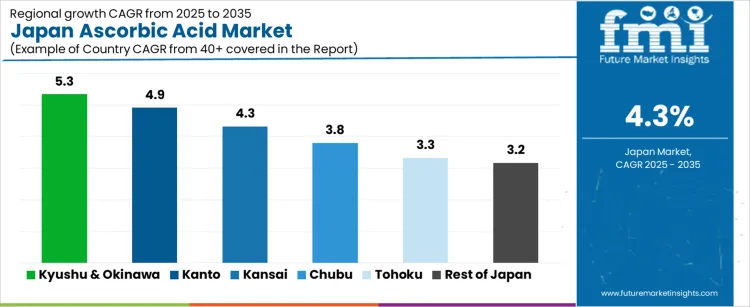
| Region | CAGR (2025-2035) |
|---|---|
| Kyushu & Okinawa | 5.3% |
| Kanto | 4.9% |
| Kansai | 4.3% |
| Chubu | 3.8% |
| Tohoku | 3.3% |
| Rest of Japan | 3.2% |
What is Driving the Growth of Ascorbic Acid in Kyushu & Okinawa?
Kyushu & Okinawa is projected to experience the highest growth in the ascorbic acid market, with a projected CAGR of 5.3%. The region's increasing focus on health and wellness, particularly in dietary supplements and fortified food products, is a key driver of this growth. Ascorbic acid, widely known for its immune-boosting properties, is in high demand in the food, beverage, and pharmaceutical sectors in Kyushu & Okinawa.
Region's growing population of health-conscious consumers is contributing to the increased use of ascorbic acid in daily diets. The rise in consumer awareness about the health benefits of ascorbic acid, coupled with the region’s strong production and distribution networks, is expected to continue driving growth in the market. With an emphasis on promoting healthier lifestyles, the demand for vitamin C-rich products is anticipated to increase steadily in Kyushu & Okinawa.
Why is the Ascorbic Acid Market Expanding in Kanto?
In Kanto, the demand for ascorbic acid is projected to grow at a CAGR of 4.9%. Kanto, with Tokyo at its core, is Japan's largest and most industrialized region, and its demand for ascorbic acid is primarily driven by the growing health and wellness trends in the region. The increasing focus on functional foods, dietary supplements, and beverages that cater to the health-conscious consumer is driving the market for ascorbic acid in Kanto.
Ascorbic acid’s popularity as an immune booster and its widespread use in skincare products are further contributing to its growth. The region’s well-established healthcare sector, coupled with rising consumer awareness about preventive healthcare, is expected to keep fueling the demand for ascorbic acid in various industries. As Kanto continues to embrace healthier lifestyles, the consumption of ascorbic acid is set to rise, especially in the food, supplement, and cosmetics sectors.
How is the Ascorbic Acid Market Growing in Kansai?
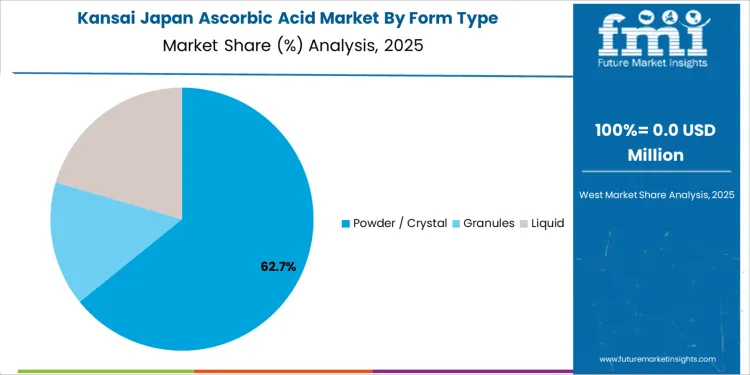
In Kansai, the ascorbic acid market is projected to grow at a CAGR of 4.3%. Kansai, including major cities like Osaka and Kyoto, has a large and growing food and beverage industry, which is a significant driver of the demand for ascorbic acid. As the region continues to embrace health-conscious consumers, there is an increasing demand for products enriched with essential nutrients like vitamin C.
Ascorbic acid is widely used in the production of functional foods, dietary supplements, and skincare products in Kansai, contributing to steady market growth. The region’s emphasis on promoting healthy lifestyles and preventing chronic diseases is helping drive the demand for vitamin C-enriched products. Kansai’s expanding e-commerce platforms for health-related products are further driving the adoption of ascorbic acid, supporting its continued growth in the region.
What is Contributing to the Growth of Ascorbic Acid in Chubu?
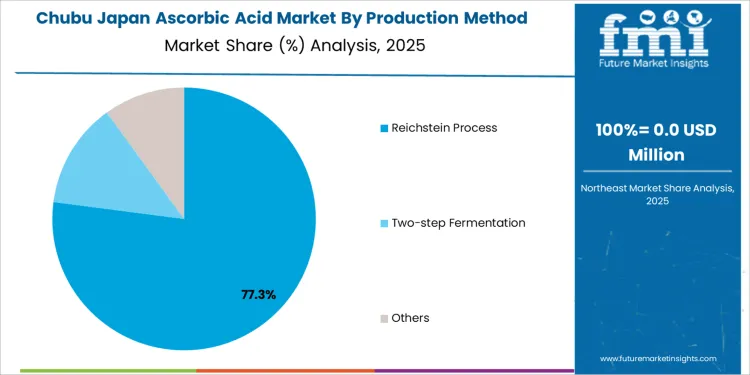
In Chubu, the ascorbic acid market is expected to grow at a CAGR of 3.8%. The region’s industrial base, particularly in the food and beverage sectors, is helping drive the demand for ascorbic acid. Chubu’s growing focus on nutrition, healthy aging, and wellness is pushing demand for products that are fortified with essential vitamins like ascorbic acid. The region’s increasing awareness of the importance of immunity-boosting products, especially as consumers become more health-conscious, is a key factor supporting the market's growth. The rising popularity of dietary supplements and functional foods in Chubu is also contributing to the steady demand for ascorbic acid. As businesses in the region continue to invest in product innovation and health-focused offerings, the market for ascorbic acid is expected to expand gradually.
What is Influencing the Growth of Ascorbic Acid in Tohoku?
In Tohoku, the ascorbic acid market is projected to grow at a CAGR of 3.3%. While the growth rate is more moderate than in other regions, rising consumer interest in health supplements and functional food products is driving steady demand for ascorbic acid. Tohoku’s aging population, which is more inclined to seek products that support immune health, is one of the key drivers of this market. Region’s focus on improving the health and wellness of its population is pushing the demand for products fortified with essential nutrients. The growing acceptance of vitamin C-rich products in Tohoku, particularly in the form of supplements, is expected to contribute to the region’s gradual growth in the ascorbic acid market.
What is Contributing to the Growth of Ascorbic Acid in Rest of Japan?
In Rest of Japan, the ascorbic acid market is expected to grow at a more moderate rate of 3.2%. While demand is smaller compared to more urbanized regions, there is still a growing interest in health supplements and functional food products in these areas. As the importance of health and wellness continues to rise across Japan, the adoption of vitamin C-enriched products, including dietary supplements and fortified foods, is expected to grow. Rest of Japan’s focus on expanding access to health-related products is contributing to the increased availability and consumption of ascorbic acid in rural regions. As more consumers embrace healthy lifestyles, the market for ascorbic acid is expected to continue expanding steadily across these areas.
What is the Competitive Landscape for Demand for Ascorbic Acid in Japan?
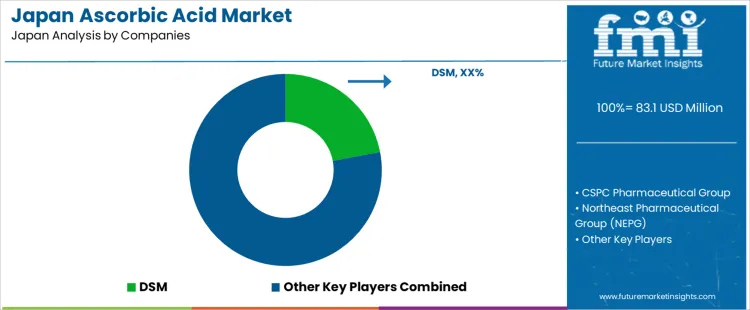
Demand for ascorbic acid (vitamin C) in Japan is growing as consumers and manufacturers increasingly prioritize health, wellness, and nutrition. Ascorbic acid is widely used across food, beverage, dietary supplement, pharmaceutical and cosmetic industries because of its antioxidant properties, immune-support benefits, and role in collagen formation and general metabolism. The trend toward preventive healthcare, functional foods, and clean-label nutrition has driven increased incorporation of vitamin C into fortified foods, juices, supplements and beverages in Japan.
On the supply side several global ingredient and pharmaceutical firms compete to meet this rising demand. According to your list, DSM leads among the identified suppliers with about 22% share. Other notable producers or suppliers include CSPC Pharmaceutical Group, Northeast Pharmaceutical Group (NEPG), North China Pharmaceutical Group, and Shandong Luwei Pharmaceutical. These firms supply ascorbic acid raw material in powder, granule and formulation-ready grades for use in dietary supplements, fortified foods, nutraceuticals, and pharmaceuticals.
Competition among them centers on quality (purity, stability), consistency of supply, capability to meet regulatory and food-safety standards, and cost competitiveness. Suppliers capable of providing high-purity, stable ascorbic acid at scale with reliable supply chains and compliance credentials are best positioned to benefit from increasing demand in Japan and broader Asia-Pacific markets.
Key Players of the Ascorbic Acid Industry in Japan
- DSM
- CSPC Pharmaceutical Group
- Northeast Pharmaceutical Group (NEPG)
- North China Pharmaceutical Group
- Shandong Luwei Pharmaceutical
Scope of the Report
| Items | Values |
|---|---|
| Quantitative Units (2025) | USD Million |
| Form Type | Powder / Crystal, Granules, Liquid |
| Production Method | Reichstein Process, Two-step Fermentation, Others |
| Grade Level | Food Grade, Feed Grade, Pharmaceutical Grade, Industry Grade |
| Application | Food & Beverages, Animal Feed, Cosmetics & Personal Care, Pharmaceuticals, Industrial Applications |
| Companies | DSM, CSPC Pharmaceutical Group, Northeast Pharmaceutical Group (NEPG), North China Pharmaceutical Group, Shandong Luwei Pharmaceutical |
| Regions Covered | Kyushu & Okinawa, Kanto, Kansai, Chubu, Tohoku, Rest of Japan |
| Additional Attributes | Dollar by sales by form type, production method, grade level, application, and region. Includes ascorbic acid quality and purity levels, stability during storage and processing, cost-efficiency of production methods, compliance with food and pharmaceutical safety standards, market share and competitive positioning of key companies, sustainability practices in production, impact on product shelf life, and demand trends in the food, cosmetics, pharmaceutical, and industrial sectors. |
Key Segments in the Demand for Ascorbic Acid in Japan
Form Type
- Powder / Crystal
- Granules
- Liquid
Production Method
- Reichstein Process
- Two-step Fermentation
- Others
Grade Level
- Food Grade
- Feed Grade
- Pharmaceutical Grade
- Industry Grade
Application
- Food & Beverages
- Animal Feed
- Cosmetics & Personal Care
- Pharmaceuticals
- Industrial Applications
Region
- Kyushu & Okinawa
- Kanto
- Kansai
- Chubu
- Tohoku
- Rest of Japan
Frequently Asked Questions
How big is the demand for ascorbic acid in Japan in 2025?
The demand for ascorbic acid in Japan is estimated to be valued at USD 83.1 million in 2025.
What will be the size of ascorbic acid in Japan in 2035?
The market size for the ascorbic acid in Japan is projected to reach USD 126.3 million by 2035.
How much will be the demand for ascorbic acid in Japan growth between 2025 and 2035?
The demand for ascorbic acid in Japan is expected to grow at a 4.3% CAGR between 2025 and 2035.
What are the key product types in the ascorbic acid in Japan?
The key product types in ascorbic acid in Japan are powder / crystal, granules and liquid.
Which production method segment is expected to contribute significant share in the ascorbic acid in Japan in 2025?
In terms of production method, reichstein process segment is expected to command 77.0% share in the ascorbic acid in Japan in 2025.
Preview the report firsthand - request a free sample
Get SampleGet the brochure for pricing and purchase details.
Get PDFTable of Content
- Executive Summary
- Japan Market Outlook
- Demand-side Trends
- Supply-side Trends
- Technology Roadmap Analysis
- Analysis and Recommendations
- Market Overview
- Market Coverage / Taxonomy
- Market Definition / Scope / Limitations
- Market Background
- Market Dynamics
- Drivers
- Restraints
- Opportunity
- Trends
- Scenario Forecast
- Demand in Optimistic Scenario
- Demand in Likely Scenario
- Demand in Conservative Scenario
- Opportunity Map Analysis
- Product Life Cycle Analysis
- Supply Chain Analysis
- Investment Feasibility Matrix
- Value Chain Analysis
- PESTLE and Porter’s Analysis
- Regulatory Landscape
- Regional Parent Market Outlook
- Production and Consumption Statistics
- Import and Export Statistics
- Market Dynamics
- Japan Market Analysis 2020 to 2024 and Forecast, 2025 to 2035
- Historical Market Size Value (USD Million) Analysis, 2020 to 2024
- Current and Future Market Size Value (USD Million) Projections, 2025 to 2035
- Y-o-Y Growth Trend Analysis
- Absolute $ Opportunity Analysis
- Japan Market Pricing Analysis 2020 to 2024 and Forecast 2025 to 2035
- Japan Market Analysis 2020 to 2024 and Forecast 2025 to 2035, By Form Type
- Introduction / Key Findings
- Historical Market Size Value (USD Million) Analysis By Form Type , 2020 to 2024
- Current and Future Market Size Value (USD Million) Analysis and Forecast By Form Type , 2025 to 2035
- Powder / Crystal
- Granules
- Liquid
- Y-o-Y Growth Trend Analysis By Form Type , 2020 to 2024
- Absolute $ Opportunity Analysis By Form Type , 2025 to 2035
- Japan Market Analysis 2020 to 2024 and Forecast 2025 to 2035, By Production Method
- Introduction / Key Findings
- Historical Market Size Value (USD Million) Analysis By Production Method, 2020 to 2024
- Current and Future Market Size Value (USD Million) Analysis and Forecast By Production Method, 2025 to 2035
- Reichstein Process
- Two-step Fermentation
- Others
- Y-o-Y Growth Trend Analysis By Production Method, 2020 to 2024
- Absolute $ Opportunity Analysis By Production Method, 2025 to 2035
- Japan Market Analysis 2020 to 2024 and Forecast 2025 to 2035, By Grade Level
- Introduction / Key Findings
- Historical Market Size Value (USD Million) Analysis By Grade Level, 2020 to 2024
- Current and Future Market Size Value (USD Million) Analysis and Forecast By Grade Level, 2025 to 2035
- Food Grade
- Feed Grade
- Pharmaceutical Grade
- Industry Grade
- Y-o-Y Growth Trend Analysis By Grade Level, 2020 to 2024
- Absolute $ Opportunity Analysis By Grade Level, 2025 to 2035
- Japan Market Analysis 2020 to 2024 and Forecast 2025 to 2035, By Application
- Introduction / Key Findings
- Historical Market Size Value (USD Million) Analysis By Application, 2020 to 2024
- Current and Future Market Size Value (USD Million) Analysis and Forecast By Application, 2025 to 2035
- Food & Beverages
- Animal Feed
- Cosmetics & Personal Care
- Pharmaceuticals
- Industrial Applications
- Y-o-Y Growth Trend Analysis By Application, 2020 to 2024
- Absolute $ Opportunity Analysis By Application, 2025 to 2035
- Market Structure Analysis
- Competition Dashboard
- Competition Benchmarking
- Market Share Analysis of Top Players
- By Regional
- By Form Type
- By Production Method
- By Grade Level
- By Application
- Competition Analysis
- Competition Deep Dive
- DSM
- Overview
- Product Portfolio
- Profitability by Market Segments (Product/Age /Sales Channel/Region)
- Sales Footprint
- Strategy Overview
- Marketing Strategy
- Product Strategy
- Channel Strategy
- CSPC Pharmaceutical Group
- Northeast Pharmaceutical Group (NEPG)
- North China Pharmaceutical Group
- Shandong Luwei Pharmaceutical
- DSM
- Competition Deep Dive
- Assumptions & Acronyms Used
- Research Methodology


