

- Industry Size (2025)
- USD 112.0 Mn
- Forecast (2035)
- USD 142.0 Mn
- CAGR (2025 to 2035)
- 2.4%
Demand for Countertop Pizza Warmers and Merchandisers in Japan Forecast and Outlook 2025 to 2035
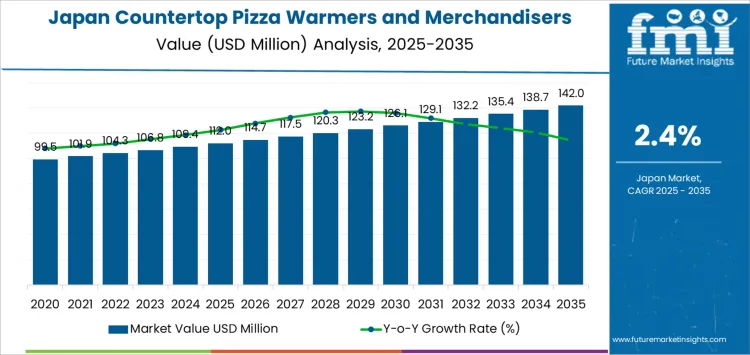
Demand for countertop pizza warmers and merchandisers in Japan is valued at USD 112.0 million in 2025 and is projected to reach USD 142.0 million by 2035, reflecting a CAGR of 2.4%. Historical data from 2020 to 2025 show a rise from USD 99.5 million to USD 112.0 million, driven by steady equipment replacement in commercial kitchens. Restaurants, cafes, and pizzerias account for the majority of installed units due to consistent foot traffic and standardized hot-holding requirements. Electric models account for the largest installed base due to their ease of integration with existing kitchen layouts. Growth during this phase reflects routine capital spending cycles rather than outlet expansion. Equipment demand remains linked to small-format food service operations, where space constraints favor compact warming and display solutions. Operational reliability and temperature consistency remain key purchase criteria.
Demand increases from USD 114.7 million in 2021 to USD 129.1 million in 2031, then advances to USD 142.0 million in 2035 through steady annual additions. Commercial food service continues to account for the dominant share of shipments, supported by chain-store refurbishment programs and stable quick-service traffic. Gas and conveyor-based units retain smaller but consistent roles in high-throughput kitchens. Display models support front counter merchandising in pizzerias and takeaway outlets. Replacement demand becomes the main volume driver after 2030 as unit lifecycles reach renewal thresholds. Pricing movements track material and component input costs rather than volume swings.
Quick Stats of the Demand for Countertop Pizza Warmers and Merchandisers in Japan
- Demand for Countertop Pizza Warmers and Merchandisers in Japan Value (2025): USD 112.0 million
- Demand for Countertop Pizza Warmers and Merchandisers in Japan Forecast Value (2035): USD 142.0 million
- Demand for Countertop Pizza Warmers and Merchandisers in Japan Forecast CAGR (2025–2035): 2.4%
- Demand for Countertop Pizza Warmers and Merchandisers in Japan Leading Type: Electric (38%)
- Demand for Countertop Pizza Warmers and Merchandisers in Japan Key Growth Regions: Kyushu & Okinawa, Kanto, Kansai
- Demand for Countertop Pizza Warmers and Merchandisers in Japan Top Players: Nemco Food Equipment, Hatco Corporation, Vollrath Company, Star Manufacturing International, FWE - Food Warming Equipment Company
What is the Growth Forecast for Countertop Pizza Warmers and Merchandisers in Japan through 2035?
Between 2025 and 2030, demand for countertop pizza warmers and merchandisers in Japan is projected to rise from USD 112.0 million to USD 126.1 million, reflecting an absolute increase of USD 14.1 million and representing about 47.0% of total decade growth. This phase reflects steady expansion of quick service food outlets, convenience store food programs, and in store hot food merchandising. Equipment replacement cycles in urban retail formats support baseline demand. Historical growth depended on store count expansion, while near term performance is shaped by product visibility requirements, space efficient designs, and temperature consistency standards across branded food chains.
From 2030 to 2035, demand is forecast to expand from USD 126.1 million to USD 142.0 million, adding USD 15.9 million and accounting for nearly 53.0% of total growth for the decade. This period reflects wider deployment across non-traditional food venues such as transit retail, fuel stations, and hybrid dining concepts. Integration with digital menu systems and automated holding controls becomes more common. Earlier growth relied on physical store penetration, while future expansion is driven by equipment standardization, higher throughput food service layouts, export linked food branding, and tighter operating efficiency targets across franchised food operations.
Countertop Pizza Warmers and Merchandisers Industry in Japan Key Takeaways
| Metric | Value |
|---|---|
| Industry Value (2025) | USD 112.0 million |
| Forecast Value (2035) | USD 142.0 million |
| Forecast CAGR (2025-2035) | 2.4% |
What Is Driving the Demand for Countertop Pizza Warmers and Merchandisers in Japan Across Historical and Future Growth Cycles?
Demand for countertop pizza warmers and merchandisers in Japan developed with the spread of Western style quick service food during the past two decades. Urban concentration, long working hours, and growth of small footprint retail supported demand for compact heated display equipment. Convenience stores, bakeries, and food courts adopted slice based pizza sales as part of ready to eat assortments. Historical growth depended on steady store openings, rising takeaway consumption, and standardized kitchen layouts. Equipment purchasing focused on durability, ease of cleaning, and stable heat output rather than digital controls. Domestic foodservice equipment makers supplied most units through established distributor networks. Replacement demand formed a consistent base as units followed predictable maintenance cycles within franchise managed outlets across urban locations.
Future demand for countertop pizza warmers and merchandisers in Japan is expected to rely more on operating efficiency, energy control, and food safety compliance. Growth is linked to expansion of prepared food offerings in transport hubs, mixed use developments, and smaller supermarket formats. Evolving hygiene standards raise demand for enclosed display units with controlled humidity and consistent holding temperatures. Historical drivers centered on outlet density and takeaway volume. Future drivers emphasize waste reduction, extended holding quality, and remote performance monitoring. Import competition is likely to increase in premium temperature controlled units while domestic suppliers retain scale in standard models. Capital spending decisions will depend on labor availability, electricity pricing, and franchise refurbishment cycles across urban and regional foodservice networks nationwide.
What Is the Demand for Countertop Pizza Warmers and Merchandisers in Japan by Type and Application?
Demand for countertop pizza warmers and merchandisers in Japan is shaped by compact foodservice layouts, growing slice based serving formats, and rising takeaway consumption in urban areas. Electric units lead by type due to simple installation and consistent heating control within limited kitchen space. Commercial use leads by application because restaurants, cafés, and pizzerias depend on front counter product visibility to drive walk in sales. Procurement is driven by foodservice equipment distributors, franchise operators, and independent food outlets. Import reliance remains present for heating components and control systems. Substitution pressure exists from rear kitchen holding cabinets. Demand stability is supported by steady casual dining traffic and expansion of small format quick service outlets.
Why do electric units’ account for 38% of the demand for countertop pizza warmers and merchandisers in Japan by type?
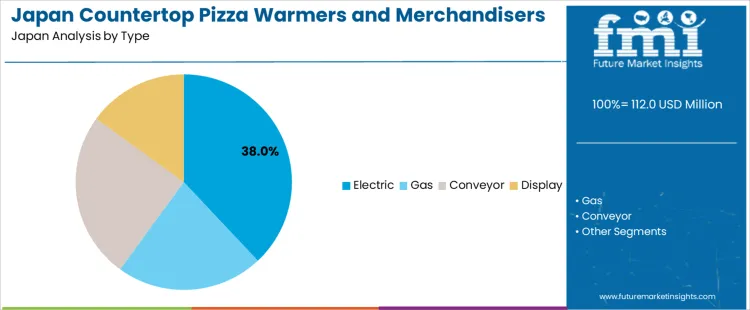
Electric units account for 38% of the demand for countertop pizza warmers and merchandisers in Japan by type, reflecting their suitability for dense retail and foodservice settings. Consumption intensity is driven by cafés, railway kiosks, and compact restaurants that operate without gas infrastructure. Usage remains stable because electric heating delivers consistent temperature control and lower ventilation requirements. Procurement is led by franchise kitchens and single outlet operators with fixed electrical capacity planning. Price sensitivity remains moderate because temperature failure leads to direct product wastage. Specification control emphasizes thermal uniformity, glass insulation performance, humidity retention, and long cycle durability under extended operating hours.
Electric units also generate steady repeat demand through new store openings and routine equipment replacement. Repeat utilization remains predictable due to continuous daily operation across multiple shifts. Buyers favor standardized footprints to match counter layouts and visual merchandising plans. Margin structure remains controlled under competition between domestic appliance brands and imported equipment suppliers. Regulatory exposure centers on electrical safety certification and food contact material compliance. Import reliance persists for thermostats, heating coils, and digital controllers. Substitution pressure from gas powered units remains limited due to ventilation, safety, and installation constraints inside compact retail kitchens.
Why does commercial use represent 25.0% of the demand for countertop pizza warmers and merchandisers in Japan by application?
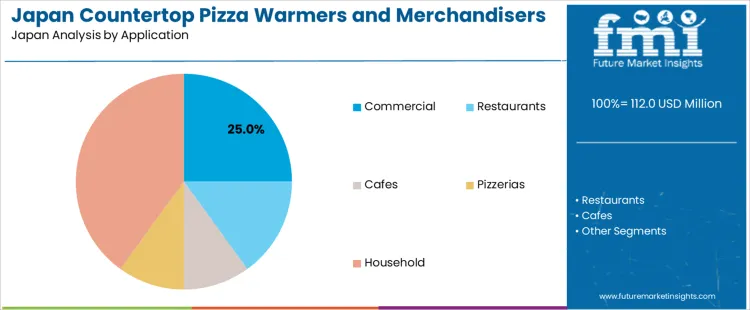
Commercial use represents 25.0% of the demand for countertop pizza warmers and merchandisers in Japan by application, reflecting strong usage across restaurants, cafés, and branded pizzerias. Consumption intensity is driven by constant slice turnover during lunch, evening, and late night service windows. Usage remains stable because countertop display supports impulse ordering and short holding cycles. Procurement is dominated by foodservice chains, specialty pizza outlets, and café operators with grab and go menus. Price sensitivity remains moderate because warmer uptime affects revenue flow and food quality control. Specification control emphasizes door seal integrity, shelf load resistance, and internal lighting clarity for continuous product visibility.
Commercial installations also generate consistent repeat demand through outlet refurbishment cycles and franchise expansion programs. Repeat utilization remains predictable as brands standardize equipment layouts across new locations. Buyers favor uniform equipment models to simplify training and maintenance logistics. Margin structure remains controlled under bulk procurement frameworks. Regulatory exposure centers on hot food holding compliance and sanitation inspections. Import reliance persists for display glass, lighting systems, and digital controls. Substitution pressure from back kitchen warmers remains limited because visible product display remains central to impulse driven pizza sales.
What Is Driving the Demand for Countertop Pizza Warmers and Merchandisers in Japan Convenience Food Display Culture?
Demand for countertop pizza warmers and merchandisers in Japan is shaped by convenience store dominance, compact retail footprints, and impulse ready food consumption. Hot slice programs near cash counters rely on controlled heat, humidity balance, and visual appeal to trigger quick purchase. Train station kiosks, late night food corners, and event venues use small warmers to extend serving windows without full kitchen expansion. Japanese consumers expect consistent temperature and clean presentation even for short shelf life items. Equipment selection favors quiet operation, precise thermostatic control, and slim depth units that fit crowded counters without blocking customer flow today in practice.
How Are Convenience Stores and Small Format Retail Driving Daily Equipment Utilization in Japan?
Japan convenience store operators rotate hot food offerings through limited counter space that demands precise thermal control. Countertop pizza warmers support short batch baking and steady slice turnover during peak commuting hours. Franchise standardization requires identical temperature curves, lighting tone, and glass clarity across national store networks. Staff training emphasizes fast restocking and surface hygiene to maintain purchase confidence. Seasonal promotions introduce pizza variants tied to holidays and sports events that raise short term unit throughput. This operating model links equipment demand to store rollout schedules, renovation cycles, and branded food program updates across regional territories each trading quarter cycle.
Why Do Train Stations, Entertainment Venues, and Events Sustain Merchandiser Demand?
Railway stations, cinema lobbies, bowling centers, and amusement halls create concentrated demand for countertop pizza merchandisers due to high foot traffic and short dwell time. Visitors favor hot handheld foods that require no seating or table service. Merchandisers positioned at ticket exits and gaming zones capture passing demand without staff intensive cooking. Visual access through curved glass and internal lighting raises impulse pickup. Equipment must withstand continuous door opening, vibration, and long operating hours. This environment sustains demand through passenger flow strength, leisure night activity, and weekend family outings within dense commercial clusters across metropolitan transport and event districts nationwide.
How Do Energy Cost, Food Safety Control, and Space Limits Shape Purchase Decisions?
Purchase decisions for countertop pizza warmers in Japan remain sensitive to electricity consumption, fire safety compliance, and counter space constraints. Store managers track daily power load during summer cooling seasons when multiple hot units operate at once. Food safety inspection rules require stable holding temperatures and clear visibility of contents. Units with uneven heat zones face fast rejection from franchise approval lists. Cleaning access and crumb management influence daily labor burden. Compact urban shops reject deep cabinets that disrupt cashier movement. These technical and spatial filters restrict model selection despite steady operator interest across foodservice micro locations throughout urban Japan.
What is the Demand for Countertop Pizza Warmers and Merchandisers in Japan by Region?
| Region | CAGR (%) |
|---|---|
| Kyushu & Okinawa | 3.0% |
| Kanto | 2.8% |
| Kansai | 2.4% |
| Chubu | 2.1% |
| Tohoku | 1.9% |
| Rest of Japan | 1.8% |
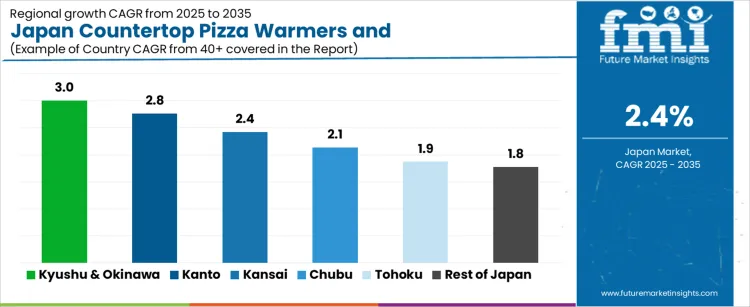
The demand for countertop pizza warmers and merchandisers in Japan is increasing gradually across foodservice focused regions, led by Kyushu and Okinawa at a 3.0% CAGR. Growth in this region is supported by strong tourism activity, higher density of quick service restaurants, and rising adoption by convenience stores offering hot snack formats. Kanto follows at 2.8%, driven by dense urban populations, high store turnover, and steady upgrades in compact food display equipment. Kansai records 2.4% growth, reflecting stable demand from cafés and takeaway outlets. Chubu at 2.1% shows moderate uptake linked to regional food retail expansion. Tohoku and the Rest of Japan, at 1.9% and 1.8%, reflect slower growth shaped by lower outlet density, limited hot food merchandising formats, and longer equipment replacement cycles.
How Is Convenience Store Foodservice Supporting Pizza Warmer Demand in Kyushu and Okinawa?
Demand for countertop pizza warmers and merchandisers in Kyushu and Okinawa is advancing at a CAGR of 3.0% through 2035, supported by steady growth of convenience foodservice, tourism linked snack sales, and compact store formats serving high footfall locations. Island and resort areas rely on ready to serve hot food for quick service dining. Equipment demand remains focused on compact heated display units that fit limited counter space. Growth reflects steady expansion of franchise outlets, rising takeaway food purchases, and consistent replacement cycles across small food retail operators.
- Convenience stores anchor most equipment installations
- Compact counter designs guide equipment selection
- Tourism footfall supports hot snack turnover
- Replacement demand sustains recurring equipment sales
Why Is High Outlet Density Sustaining Pizza Warmer Demand in Kanto?
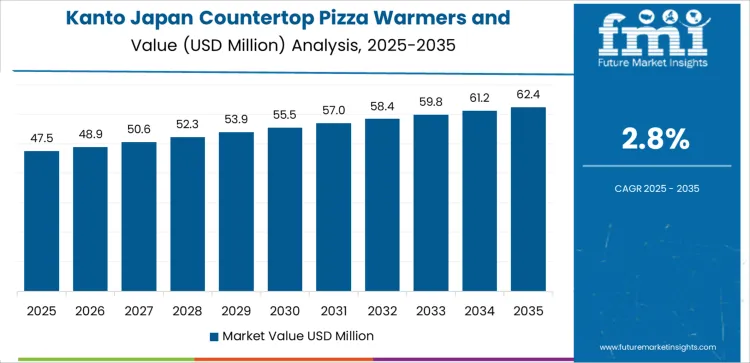
Demand for countertop pizza warmers and merchandisers in Kanto is rising at a CAGR of 2.8% through 2035, driven by dense concentration of quick service restaurants, bakeries, and transport hub food outlets across metropolitan areas. Kanto records strong equipment placement across railway stations, malls, and roadside retail clusters. Demand remains linked to fast food snack sales and impulse purchase behavior. Growth reflects continuous store openings, frequent layout refits, and steady replacement of aging display warming units across franchise operated outlets.
- Transport hubs support high unit deployment rates
- Franchise expansion sustains baseline equipment demand
- Impulse snack sales drive display warmer usage
- Store refits generate periodic replacement cycles
What Is Sustaining Controlled Pizza Warmer Adoption Across Kansai Food Outlets?
Demand for countertop pizza warmers and merchandisers in Kansai is progressing at a CAGR of 2.4% through 2035, supported by stable fast food consumption, steady café expansion, and consistent small restaurant equipment upgrades across Osaka and Kyoto. Kansai shows balanced demand across independent outlets and regional food chains. Equipment demand remains focused on energy efficient countertop warmers for limited menu offerings. Growth remains linked to measured outlet expansion, controlled capital spending by small operators, and routine maintenance driven replacements.
- Independent food outlets guide steady equipment purchases
- Energy efficient warmers gain higher preference
- Controlled outlet expansion shapes moderate demand growth
- Maintenance driven replacements support recurring sales
How Is Value Focused Foodservice Investment Shaping Demand in Chubu?
Demand for countertop pizza warmers and merchandisers in Chubu is advancing at a CAGR of 2.1% through 2035, supported by workforce driven dining activity, steady expansion of roadside eateries, and value focused equipment procurement in Aichi. Chubu shows higher adoption across entry level warming units used in small restaurants and factory adjacent food counters. Demand remains price sensitive with preference for durable basic models. Growth reflects consistent weekday foodservice traffic, stable industrial employment, and recurring demand from small operator equipment upgrades.
- Eateries near industrial zones support unit deployment
- Entry level models dominate purchasing patterns
- Price sensitivity shapes supplier selection
- Weekday dining traffic drives steady utilization
Why Is Limited Outlet Expansion Moderating Pizza Warmer Growth in Tohoku?
Demand for countertop pizza warmers and merchandisers in Tohoku is advancing at a CAGR of 1.9% through 2035, supported by steady casual dining presence, limited new outlet openings, and stable use in bakeries and takeaway counters. Tohoku shows lower concentration of large quick service chains. Equipment demand remains centered on essential hot display needs rather than merchandising focused presentations. Growth remains moderate due to conservative foodservice investment patterns and slower retail expansion across regional urban centers.
- Bakeries and small takeaways anchor equipment use
- Limited new store openings restrict volume expansion
- Essential warming functions drive equipment selection
- Conservative capital spending shapes demand pace
How Is Small City Food Retail Influencing Pizza Warmer Demand in Rest of Japan?
Demand for countertop pizza warmers and merchandisers in Rest of Japan is advancing at a CAGR of 1.8% through 2035, supported by neighborhood food shops, small cafés, and limited but stable takeaway food demand. These areas rely on compact warming units for basic hot snack display. Advanced merchandising features show limited penetration. Growth remains steady and guided by local food retail stability, modest outlet upgrades, and controlled equipment replacement cycles across small scale operators.
- Neighborhood shops sustain baseline equipment demand
- Compact warmers suit small counter spaces
- Limited feature adoption restricts premium unit growth
- Replacement cycles guide steady long term sales
What Is Driving the Demand for Countertop Pizza Warmers and Merchandisers in Japan and Which Companies Shape Foodservice Adoption?
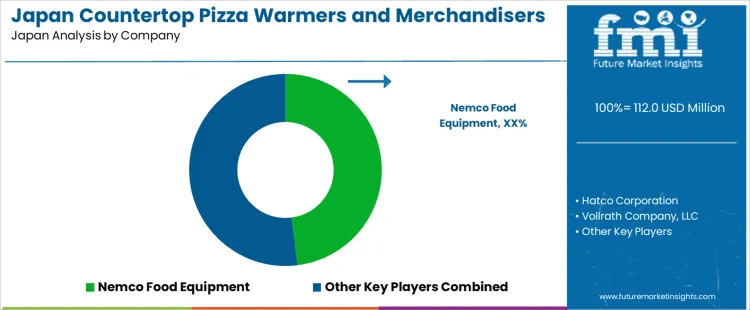
The demand for countertop pizza warmers and merchandisers in Japan is shaped by growth in convenience store hot food programs, expansion of quick service restaurants, and steady traffic in highway service areas and entertainment districts. Panasonic holds a central domestic position through commercial warming and display equipment supplied to major convenience store chains and foodservice operators. Hoshizaki supports demand through heated display cases and holding cabinets used in pizza slices, fried foods, and ready to serve bakery items across urban outlets. These domestic suppliers anchor daily deployment through dense service networks, rapid maintenance response, and strong alignment with Japanese store layout constraints.
Nemco Food Equipment, Hatco Corporation, Vollrath Company, Star Manufacturing International, and FWE participate through imported warmers and countertop merchandisers supplied to international pizza brands and western style casual dining chains operating in Japan. Equipment selection is governed by temperature uniformity, humidity control to prevent crust drying, compact footprint for limited counter space, and energy efficiency under continuous operation. Buyer preference favors machines with simple controls, easy cleaning access, and stable performance during long peak service hours. Demand visibility tracks growth in takeaway pizza formats, night time food consumption near transport hubs, and steady rollout of hot food merchandising across regional convenience store networks.
Key Players in the Countertop Pizza Warmers and Merchandisers Industry in Japan
- Nemco Food Equipment
- Hatco Corporation
- Vollrath Company, LLC
- Star Manufacturing International, Inc.
- FWE - Food Warming Equipment Company, Inc.
Scope of the Report
| Items | Values |
|---|---|
| Quantitative Units (2025) | USD million |
| Type | Electric, Gas, Conveyor, Display |
| Application | Commercial, Restaurants, Cafes, Pizzerias, Household |
| End User | Quick Service Restaurants, Cafes, Pizzerias, Convenience Stores, Other Foodservice Operators |
| Regions Covered | Kyushu and Okinawa, Kanto, Kansai, Chubu, Tohoku, Rest of Japan |
| Countries Covered | Japan |
| Key Companies Profiled | Nemco Food Equipment, Hatco Corporation, Vollrath Company LLC, Star Manufacturing International Inc., FWE Food Warming Equipment Company Inc., Panasonic, Hoshizaki |
| Additional Attributes | Dollar sales by type and application categories, regional demand distribution across major foodservice hubs in Japan, competitive landscape of domestic and imported equipment suppliers, equipment replacement cycle trends across franchise networks, energy usage patterns in compact retail kitchens, food safety and temperature compliance requirements, equipment utilization across convenience stores, transport hubs, and small format food outlets |
Countertop Pizza Warmers and Merchandisers Industry in Japan Segmentation
Type:
- Electric
- Gas
- Conveyor
- Display
Application:
- Commercial
- Restaurants
- Cafes
- Pizzerias
- Household
Region:
- Kyushu & Okinawa
- Kanto
- Kansai
- Chubu
- Tohoku
- Rest of Japan
Frequently Asked Questions
How big is the demand for countertop pizza warmers and merchandisers in Japan in 2025?
The demand for countertop pizza warmers and merchandisers in Japan is estimated to be valued at USD 112.0 million in 2025.
What will be the size of countertop pizza warmers and merchandisers in Japan in 2035?
The market size for the countertop pizza warmers and merchandisers in Japan is projected to reach USD 142.0 million by 2035.
How much will be the demand for countertop pizza warmers and merchandisers in Japan growth between 2025 and 2035?
The demand for countertop pizza warmers and merchandisers in Japan is expected to grow at a 2.4% CAGR between 2025 and 2035.
What are the key product types in the countertop pizza warmers and merchandisers in Japan?
The key product types in countertop pizza warmers and merchandisers in Japan are electric, gas, conveyor and display.
Which application segment is expected to contribute significant share in the countertop pizza warmers and merchandisers in Japan in 2025?
In terms of application, commercial segment is expected to command 25.0% share in the countertop pizza warmers and merchandisers in Japan in 2025.
Preview the report firsthand - request a free sample
Get SampleGet the brochure for pricing and purchase details.
Get PDFTable of Content
- Executive Summary
- Japan Market Outlook
- Demand-side Trends
- Supply-side Trends
- Technology Roadmap Analysis
- Analysis and Recommendations
- Market Overview
- Market Coverage / Taxonomy
- Market Definition / Scope / Limitations
- Market Background
- Market Dynamics
- Drivers
- Restraints
- Opportunity
- Trends
- Scenario Forecast
- Demand in Optimistic Scenario
- Demand in Likely Scenario
- Demand in Conservative Scenario
- Opportunity Map Analysis
- Product Life Cycle Analysis
- Supply Chain Analysis
- Investment Feasibility Matrix
- Value Chain Analysis
- PESTLE and Porter’s Analysis
- Regulatory Landscape
- Regional Parent Market Outlook
- Production and Consumption Statistics
- Import and Export Statistics
- Market Dynamics
- Japan Market Analysis 2020 to 2024 and Forecast, 2025 to 2035
- Historical Market Size Value (USD Million) Analysis, 2020 to 2024
- Current and Future Market Size Value (USD Million) Projections, 2025 to 2035
- Y-o-Y Growth Trend Analysis
- Absolute $ Opportunity Analysis
- Japan Market Pricing Analysis 2020 to 2024 and Forecast 2025 to 2035
- Japan Market Analysis 2020 to 2024 and Forecast 2025 to 2035, By Type
- Introduction / Key Findings
- Historical Market Size Value (USD Million) Analysis By Type , 2020 to 2024
- Current and Future Market Size Value (USD Million) Analysis and Forecast By Type , 2025 to 2035
- Electric
- Gas
- Conveyor
- Display
- Y-o-Y Growth Trend Analysis By Type , 2020 to 2024
- Absolute $ Opportunity Analysis By Type , 2025 to 2035
- Japan Market Analysis 2020 to 2024 and Forecast 2025 to 2035, By Application
- Introduction / Key Findings
- Historical Market Size Value (USD Million) Analysis By Application, 2020 to 2024
- Current and Future Market Size Value (USD Million) Analysis and Forecast By Application, 2025 to 2035
- Commercial
- Restaurants
- Cafes
- Pizzerias
- Household
- Y-o-Y Growth Trend Analysis By Application, 2020 to 2024
- Absolute $ Opportunity Analysis By Application, 2025 to 2035
- Market Structure Analysis
- Competition Dashboard
- Competition Benchmarking
- Market Share Analysis of Top Players
- By Regional
- By Type
- By Application
- Competition Analysis
- Competition Deep Dive
- Nemco Food Equipment
- Overview
- Product Portfolio
- Profitability by Market Segments (Product/Age /Sales Channel/Region)
- Sales Footprint
- Strategy Overview
- Marketing Strategy
- Product Strategy
- Channel Strategy
- Hatco Corporation
- Vollrath Company, LLC
- Star Manufacturing International, Inc.
- FWE - Food Warming Equipment Company, Inc.
- Nemco Food Equipment
- Competition Deep Dive
- Assumptions & Acronyms Used
- Research Methodology


