

- Industry Size (2025)
- USD 843.8 Mn
- Forecast (2035)
- USD 1138.4 Mn
- CAGR (2025 to 2035)
- 3.0%
Demand for Countertop Pizza Warmers and Merchandisers in USA 2025 to 2035
The USA countertop pizza warmers and merchandisers demand is valued at USD 843.8 million in 2025 and is projected to reach USD 1,138.4 million by 2035, reflecting a CAGR of 3.0%. Growth is supported by high convenience food consumption, expanding grab-and-go retail formats, and rising foodservice presence in fuel stations, c-stores, and quick-service restaurants. Operators prioritize equipment that keeps products fresh and visually appealing to maximize impulse purchases.
Electric units represent the leading product type due to simple installation, stable temperature maintenance, and energy-efficient heating elements that preserve product texture over extended holding periods. Compact designs and enhanced window visibility help increase customer engagement in limited-space retail environments. Performance improvements that reduce moisture loss and maintain consistent heating strengthen their adoption in continuous-service operations.
The West, South, and Northeast regions show strong procurement driven by dense food retail networks and active convenience dining culture. Nemco Food Equipment, Hatco Corporation, Vollrath Company, LLC, Star Manufacturing International, Inc., and FWE – Food Warming Equipment Company, Inc. are key suppliers. Their strategies focus on faster heat-up times, improved temperature controls, and durable materials suitable for high-traffic use, as well as expanding distribution partnerships with national foodservice chains.
Quick Stats for USA Countertop Pizza Warmers and Merchandisers Demand
- USA Countertop Pizza Warmers and Merchandisers Sales Value (2025): USD 843.8 million
- USA Countertop Pizza Warmers and Merchandisers Forecast Value (2035): USD 1,138.4 million
- USA Countertop Pizza Warmers and Merchandisers Forecast CAGR (2025–2035): 3.0%
- Leading Type in USA Countertop Pizza Warmers and Merchandisers Demand: Electric Units
- Key Growth Regions in USA Countertop Pizza Warmers and Merchandisers Demand: West USA, South USA, Northeast USA
- Top Players in USA Countertop Pizza Warmers and Merchandisers Demand: Nemco Food Equipment, Hatco Corporation, Vollrath Company, LLC, Star Manufacturing International, Inc., FWE – Food Warming Equipment Company, Inc.
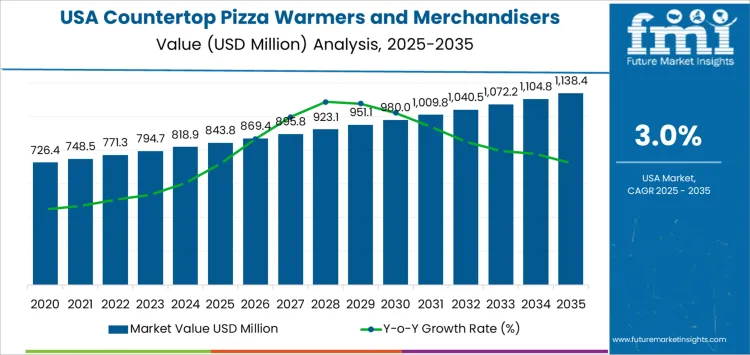
What is the Growth Forecast for Countertop Pizza Warmers and Merchandisers Industry in USA through 2035?
Demand for countertop pizza warmers and merchandisers in the United States follows a clear two-phase trajectory. Early expansion reflects rapid penetration into quick-service restaurants, convenience stores, and food kiosks seeking compact hot-hold solutions that support impulse purchases. Growth increases as operators prioritize convenience-driven food formats and faster service speeds. Equipment upgrades also rise as retailers’ refresh point-of-sale designs to improve food visibility and maintain temperature safety standards.
Later expansion progresses at a more moderated pace. Installations become widespread across key food retail channels. Replacement cycles and incremental efficiency improvements account for a larger share of new unit purchases. Innovation shifts toward energy-efficient heating systems and improved display ergonomics. The late curve emphasizes differentiated features rather than pure footprint expansion. The curve transitions from volume-based acceleration into sustained but steadier adoption. Early gains rely on footprint growth in smaller foodservice outlets. Late gains rely on performance refinement, longer equipment lifecycles, and replacement demand.
USA Countertop Pizza Warmers and Merchandisers Key Takeaways
| Metric | Value |
|---|---|
| USA Countertop Pizza Warmers and Merchandisers Sales Value (2025) | USD 843.8 million |
| USA Countertop Pizza Warmers and Merchandisers Forecast Value (2035) | USD 1,138.4 million |
| USA Countertop Pizza Warmers and Merchandisers Forecast CAGR (2025-2035) | 3.0% |
Why is the Demand for Countertop Pizza Warmers and Merchandisers in the USA Growing?
Demand for countertop pizza warmers and merchandisers in the USA is increasing because foodservice operators, convenience stores and small restaurants seek equipment that holds cooked pizzas hot and visible for walk-in customers or quick-serve orders. These units provide stable warming, display lighting and easy access for grab-and-go purchases, which supports impulse buying and quick meal service. Growth in quick casual pizza outlets, delivery pickup locations and convenience store food programs expands demand for merchandisers that combine warming and presentation. Such devices reduce food waste by maintaining temperature and freshness without over-cooking, improving customer satisfaction while enabling faster service during busy lunch and dinner peaks.
Small pizzerias and takeout counters value countertop units because they occupy limited space yet offer flexible serving capacity. The equipment requires minimal setup and low maintenance compared with full kitchen ovens. Retailers offering ready-to-heat or pre-baked pizza slices also benefit from merchandisers that preserve quality for short-term display. Constraints include energy consumption during extended operation, which can impact utility costs in busy locations. Some operators prefer full-size oven equipment when volume or variety of food items increases beyond pizza. Merchandise appearance can degrade over time if units are not cleaned properly, which affects hygiene standards.
Which Types and Applications Lead Demand for Countertop Pizza Warmers and Merchandisers in the USA?
Demand for countertop pizza warmers and merchandisers in the United States reflects steady foodservice activity and a need to preserve texture and temperature for display-based sales. Operators focus on consistent heat distribution, energy efficiency, and compact placement in limited-space outlets. Usage aligns with grab-and-go programs across high-traffic retail, quick-serve dining, and convenience-focused outlets. The category benefits from expanding hot snack offerings and product visibility requirements across diverse service environments.
By Type, Electric Units Hold the Largest Share
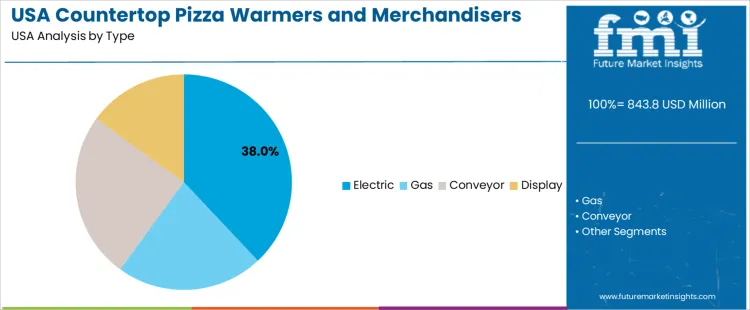
Electric pizza warmers represent 38.0%. Their presence reflects code compliance, suitability for indoor kitchen environments, and simplified utility connections across small and mid-size foodservice formats in the United States. Gas-powered units hold 22.0%, used in operations that prioritize rapid heating cycles and stable thermal retention in higher-volume back-of-house spaces. Conveyor-style systems account for 25.0%. These units support continuous service while maintaining product rotation for high-turnover snack programs. Display cases represent 15.0%. These products keep pizzas visible to consumers, sustaining impulse sales in convenience-driven destinations. Type preferences align with operational patterns, heat uniformity expectations, and spatial planning in both independent and franchise-based service outlets nationwide.
Key Points:
- Electric units fit smaller layouts and routine compliance needs
- Conveyor systems support continuous service and speed of turnover
- Display units reinforce visibility in front-counter placement
By Application, Commercial Use Leads Consumption
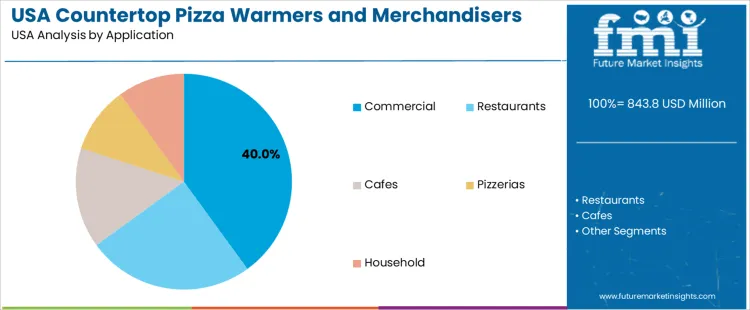
Commercial applications hold 40.0%. This share reflects usage across cafeterias, food courts, campus facilities, and entertainment venues requiring active hot-food merchandising. Restaurants hold 25.0%, supporting table-service and quick-serve models that maintain prepared slices for short waiting periods. Cafes account for 15.0%, adding pizza as a convenience snack alongside beverage service. Pizzerias hold 10.0%, applying warmers to supplement slice-based operations. Household use also stands at 10.0%, limited to compact multifunctional devices. Application distribution follows consistent out-of-home consumption and hot snack merchandising strategies across U.S. dining networks.
Key Points:
- Commercial environments sustain highest turnover and display needs
- Restaurants and cafes add pizza as a fast-service menu item
- Household use remains niche within compact consumer appliances
What are the Key Dynamics in the Countertop Pizza Warmers and Merchandisers Industry?
Growth of convenience-focused foodservice formats, steady demand for grab-and-go pizza and wider equipment adoption in small retail outlets drive demand.
In the United States, quick preparation and impulse purchasing shape foodservice operations in convenience stores, fuel stations, cafeterias and small restaurants. Countertop pizza warmers support continuous holding of ready-to-eat slices at safe temperatures, preserving texture and visibility for walk-in customers. Retailers increase placement near checkout counters to encourage rapid purchase decisions during peak hours. Regional and independent pizzerias maintain equipment units to expand takeout offerings without requiring upgrades to existing kitchen layouts. Food trucks and mobile vendors use compact warmers to maintain product quality during event service. Franchise expansion in convenience-focused formats strengthens recurring procurement as new outlets require standardized holding equipment.
Capital budget priorities, energy consumption concerns and uneven demand in low-traffic locations restrain adoption.
Small operators evaluate each equipment purchase carefully because front-of-house appliances compete with back-of-house investments. Heating equipment contributes to utility costs and operators measure return on equipment that runs for long hours. Limited foot traffic in rural stores reduces turnover for ready-held pizza slices, affecting perceived value of warmers or merchandisers in certain geographic areas. Unit replacement cycles extend when businesses face labor shortages or slower sales periods, lowering short-term demand across independent retail channels. Shelf space constraints also influence purchasing decisions in compact interiors where every countertop appliance must justify its footprint.
Shift toward visible merchandising features, increasing integration of digital temperature control and rising interest in multiproduct holding formats define key trends.
Clear glass enclosures, interior lighting and front-access doors support product display and encourage faster customer decisions. Digital thermostats and humidity management maintain slice quality for longer holding intervals, supporting operational consistency across diverse retail environments. Operators seek flexible units capable of warming pizza slices along with other baked snacks to improve utilization. Temperature-safe packaging for self-serve pizza aligns with contactless retail expectations and supports continuous restocking workflows. Leasing arrangements and energy-efficient components attract businesses that prefer lower upfront commitment. These patterns indicate continued demand for countertop pizza warmers and merchandisers across the United States driven by convenience-oriented foodservice and impulse-purchase behavior.
Analysis of the Demand for Countertop Pizza Warmers and Merchandisers in the USA by Region
Demand for countertop pizza warmers and merchandisers in the United States rises as food-service operators prioritize impulse-purchase visibility, portion-holding consistency, and heat-retention performance in quick-serve environments. Growth reflects expanding convenience retail networks, campus dining, and bakery-cafés centered on fast grab-and-go offerings. West USA leads at 3.5% CAGR, followed by South USA at 3.1%, Northeast USA at 2.8%, and Midwest USA at 2.4%. Procurement decisions focus on energy-efficient models, NSF-compliant construction, merchandising shelf illumination, and compact counter placement that fits small-footprint outlets. Distribution networks supplying food-service equipment to national chains sustain predictable volume movement. Digital food-service ordering prompts operators to maintain hot-hold availability during peak demand windows. Replacement cycles remain stable across chain restaurants and independent operators using heated display solutions for carry-out product sales.
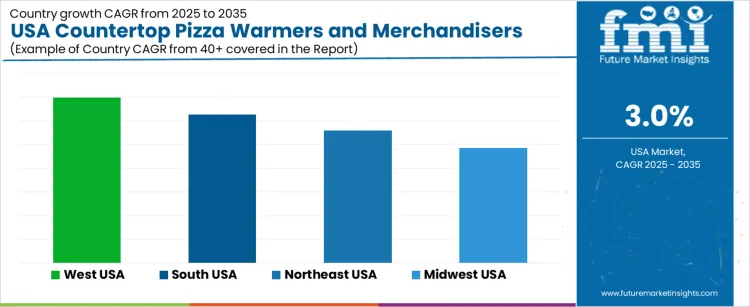
| Region | CAGR (2025-2035) |
|---|---|
| West USA | 3.5% |
| South USA | 3.1% |
| Northeast USA | 2.8% |
| Midwest USA | 2.4% |
How is the West USA driving demand for countertop pizza warmers and merchandisers?
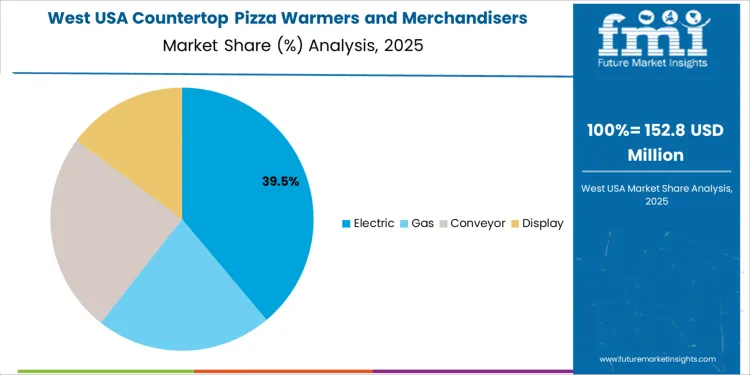
West USA posts 3.5% CAGR, supported by dense networks of quick-service restaurants, theme parks, travel plazas, and convenience retail across California, Nevada, and Washington. Food-service operators maintain high demand for heated hold-and-display equipment that supports rapid consumer throughput. Outdoor recreation and commuter-centric meal habits require consistent ready-to-eat availability, reinforcing the role of countertop warmers in pizza-by-the-slice formats. Regional buyers evaluate durability features such as shatter-resistant display panels and thermostatic accuracy. Energy-efficiency rules influence selection of low-power models that retain heat during extended service hours. Distribution centers near coastal ports enable equipment replenishment aligned with nationwide chain rollouts. Procurement teams assess footprint to maximize serving visibility in compact layouts. Demand remains strong within university dining and entertainment venues where food pickup volume remains sustained.
- Quick-serve and travel venues influencing equipment turnover
- Energy-efficiency rules guiding heating-element specifications
- Logistics advantages sustaining steady supply access
- Compact counter layouts shaping design adoption
How is the South USA shaping demand for countertop pizza warmers and merchandisers?
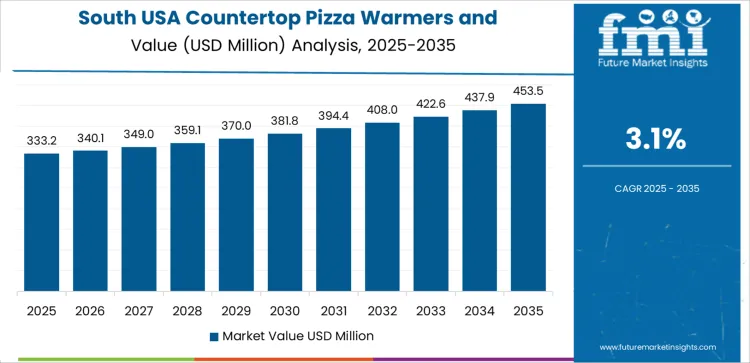
South USA records 3.1% CAGR, driven by rapid expansion of food-service venues in Texas, Florida, Georgia, and North Carolina. Warm climates sustain strong demand for convenience food retail placed across fuel stations, community stores, and coastal tourism sites. National pizza chains integrate heated displays in take-out counters serving suburban and highway locations with high mid-day foot traffic. Operators seek improved humidity-control functions that prevent crust degradation while holding pizzas for extended periods. Distribution networks connecting Gulf Coast ports with large equipment suppliers ensure availability across growing commercial corridors. Universities and stadium complexes manage steady equipment rotation to meet seasonal event schedules. Buyers prioritize cost-efficient models providing reliable performance under continuous use conditions common in regional retail food outlets.
- Convenience retail growth driving consistent equipment usage
- Hold-quality performance shaping unit selection
- Logistics flowing through Gulf corridors maintaining supply
- Stadium and university dining supporting replacement cycles
How is the Northeast USA influencing demand for countertop pizza warmers and merchandisers?
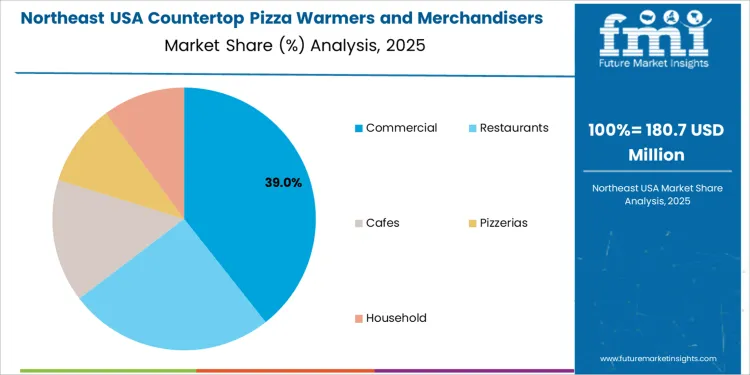
Northeast USA shows 2.8% CAGR, influenced by compact stores and transit-linked food-service operations in New York, Massachusetts, and New Jersey. High commuter volumes increase demand for quick pickup zones using heated displays to maintain product temperature at peak hours. Space-efficient equipment selections remain vital for operators in dense commercial districts where counter size restricts installation. Pizza-focused outlets, bakeries, and delis rely on visual merchandising benefits that increase impulse purchases. Buyers review NSF sanitation compliance and ease-of-cleaning features that support daily turnover. Regional distributors supply replacement parts supporting long equipment life cycles expected within established chains. Tourism and event-driven foot traffic create seasonal sales spikes in waterfront and arena venues where hot-hold readiness contributes to revenue consistency.
- Space constraints guiding compact enclosure adoption
- Sanitation compliance influencing product attributes
- Commuter-driven grab-and-go demand supporting usage
- Replacement parts availability extending device lifecycle
How is the Midwest USA contributing to demand for countertop pizza warmers and merchandisers?
Midwest USA advances at 2.4% CAGR, driven by consistent cafeteria and convenience-store operations serving manufacturing communities across Illinois, Ohio, Michigan, and Wisconsin. Operators value simple-to-maintain units that preserve product warmth during staggered meal hours aligned with shift-based labor patterns. Retailers prioritize dependable temperature-control systems that prevent product waste in lower-volume outlets. Procurement budgets emphasize units with long service life, standardized shelves, and durable door hardware. Distribution coverage across major freight hubs supports timely fulfillment of equipment refurbishments. Event-driven venues expand seasonal deployment for fairs, sports facilities, and community events where ready-to-eat food placement improves sales efficiency. Cost-evaluation frameworks center on reliability and minimal downtime rather than fast expansion.
- Shift-based meal demand influencing thermal-performance needs
- Value-focused purchasing guiding build-quality choices
- Freight corridor access maintaining supply consistency
- Seasonal event usage sustaining moderate equipment rotation
What is the competitive landscape of the demand for countertop pizza warmers and merchandisers in the United States?
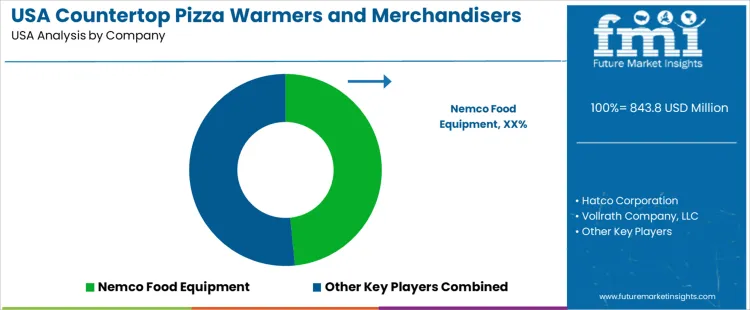
Demand for countertop pizza warmers and merchandisers in the United States comes from quick-service restaurants, convenience stores, cafeterias, bakeries, and stadium concessions. Purchasing decisions relate to holding performance, food-safety certification, space efficiency, easy cleaning, and operating reliability during continuous service hours. Product longevity and service network support influence brand preferences among equipment managers.
Nemco Food Equipment holds an estimated 48.4% share. Strong positioning reflects a wide set of holding cabinets suited to differing pizza sizes, heavy use environments, and transparent merchandising that drives impulse purchases in retail and foodservice channels. Hatco Corporation serves national restaurant operators and institutional kitchens with reliable temperature control and stainless-steel durability. Vollrath Company, LLC reinforces its presence through compatibility with countertop foodservice layouts and established distribution relationships with major equipment dealers.
Star Manufacturing International, Inc. supplies heated display systems used by convenience operators aiming to improve grab-and-go sales with consistent product visibility. FWE Food Warming Equipment Company, Inc. offers specialized holding solutions used in institutional dining and regional restaurant chains that require dependable internal airflow design for crust quality retention. Competitive strengths relate to thermal consistency, NSF compliance, warranty coverage, component serviceability, and footprint optimization for small countertop environments. Companies combining strong after-sales support with portfolio breadth gain a favorable position among U.S. foodservice buyers seeking dependable pizza holding equipment.
Key Players in USA Countertop Pizza Warmers and Merchandisers Demand
- Nemco Food Equipment
- Hatco Corporation
- Vollrath Company, LLC
- Star Manufacturing International, Inc.
- FWE - Food Warming Equipment Company, Inc.
Scope of the Report
| Items | Values |
|---|---|
| Quantitative Units | USD million |
| Type | Electric, Gas, Conveyor, Display |
| Application | Commercial, Restaurants, Cafes, Pizzerias, Household |
| Regions Covered | West USA, South USA, Northeast USA, Midwest USA |
| Key Companies Profiled | Nemco Food Equipment, Hatco Corporation, Vollrath Company, LLC, Star Manufacturing International, Inc., FWE – Food Warming Equipment Company, Inc. |
| Additional Attributes | Dollar sales by type and application segments; adoption patterns in restaurants, pizzerias, and commercial foodservice chains; growth from food-display merchandising trends; product differentiation through heat retention efficiency and countertop compactness; competitive offerings with energy-efficient heaters and illuminated display units. |
USA Countertop Pizza Warmers and Merchandisers Demand by Segments
Type:
- Electric
- Gas
- Conveyor
- Display
Application:
- Commercial
- Restaurants
- Cafes
- Pizzerias
- Household
Region:
- West USA
- South USA
- Northeast USA
- Midwest USA
Frequently Asked Questions
How big is the demand for countertop pizza warmers and merchandisers in USA in 2025?
The demand for countertop pizza warmers and merchandisers in USA is estimated to be valued at USD 843.8 million in 2025.
What will be the size of countertop pizza warmers and merchandisers in USA in 2035?
The market size for the countertop pizza warmers and merchandisers in USA is projected to reach USD 1,138.4 million by 2035.
How much will be the demand for countertop pizza warmers and merchandisers in USA growth between 2025 and 2035?
The demand for countertop pizza warmers and merchandisers in USA is expected to grow at a 3.0% CAGR between 2025 and 2035.
What are the key product types in the countertop pizza warmers and merchandisers in USA?
The key product types in countertop pizza warmers and merchandisers in USA are electric, gas, conveyor and display.
Which application segment is expected to contribute significant share in the countertop pizza warmers and merchandisers in USA in 2025?
In terms of application, commercial segment is expected to command 40.0% share in the countertop pizza warmers and merchandisers in USA in 2025.
Preview the report firsthand - request a free sample
Get SampleGet the brochure for pricing and purchase details.
Get PDFTable of Content
- Executive Summary
- USA Market Outlook
- Demand-side Trends
- Supply-side Trends
- Technology Roadmap Analysis
- Analysis and Recommendations
- Market Overview
- Market Coverage / Taxonomy
- Market Definition / Scope / Limitations
- Market Background
- Market Dynamics
- Drivers
- Restraints
- Opportunity
- Trends
- Scenario Forecast
- Demand in Optimistic Scenario
- Demand in Likely Scenario
- Demand in Conservative Scenario
- Opportunity Map Analysis
- Product Life Cycle Analysis
- Supply Chain Analysis
- Investment Feasibility Matrix
- Value Chain Analysis
- PESTLE and Porter’s Analysis
- Regulatory Landscape
- Regional Parent Market Outlook
- Production and Consumption Statistics
- Import and Export Statistics
- Market Dynamics
- USA Market Analysis 2020 to 2024 and Forecast, 2025 to 2035
- Historical Market Size Value (USD Million) Analysis, 2020 to 2024
- Current and Future Market Size Value (USD Million) Projections, 2025 to 2035
- Y-o-Y Growth Trend Analysis
- Absolute $ Opportunity Analysis
- USA Market Pricing Analysis 2020 to 2024 and Forecast 2025 to 2035
- USA Market Analysis 2020 to 2024 and Forecast 2025 to 2035, By Type
- Introduction / Key Findings
- Historical Market Size Value (USD Million) Analysis By Type , 2020 to 2024
- Current and Future Market Size Value (USD Million) Analysis and Forecast By Type , 2025 to 2035
- Electric
- Gas
- Conveyor
- Display
- Y-o-Y Growth Trend Analysis By Type , 2020 to 2024
- Absolute $ Opportunity Analysis By Type , 2025 to 2035
- USA Market Analysis 2020 to 2024 and Forecast 2025 to 2035, By Application
- Introduction / Key Findings
- Historical Market Size Value (USD Million) Analysis By Application, 2020 to 2024
- Current and Future Market Size Value (USD Million) Analysis and Forecast By Application, 2025 to 2035
- Commercial
- Restaurants
- Cafes
- Pizzerias
- Household
- Y-o-Y Growth Trend Analysis By Application, 2020 to 2024
- Absolute $ Opportunity Analysis By Application, 2025 to 2035
- Market Structure Analysis
- Competition Dashboard
- Competition Benchmarking
- Market Share Analysis of Top Players
- By Regional
- By Type
- By Application
- Competition Analysis
- Competition Deep Dive
- Nemco Food Equipment
- Overview
- Product Portfolio
- Profitability by Market Segments (Product/Age /Sales Channel/Region)
- Sales Footprint
- Strategy Overview
- Marketing Strategy
- Product Strategy
- Channel Strategy
- Hatco Corporation
- Vollrath Company, LLC
- Star Manufacturing International, Inc.
- FWE - Food Warming Equipment Company, Inc.
- Nemco Food Equipment
- Competition Deep Dive
- Assumptions & Acronyms Used
- Research Methodology


