

- Industry Size (2026)
- USD 834.4 Mn
- Forecast (2036)
- USD 1286.2 Mn
- CAGR (2026 to 2036)
- 4.4%
Demand for Eccentric Tip Syringe in Japan Forecast and Outlook 2026 to 2036
The demand for eccentric tip syringe in Japan is valued at USD 834.4 million in 2026 and is projected to reach USD 1,286.2 million by 2036, reflecting a CAGR of 4.4%. The increase from USD 643.5 million in 2020 to USD 834.4 million in 2026 is supported by routine use across hospitals, clinics, research laboratories, and medical institutes. Larger capacities above 10 ml hold the highest share due to frequent use in procedures requiring angled needle alignment. Demand remains tied to regulated handling practices.
From 2027 onward, values rise from USD 871.3 million to USD 1,036.1 million by 2031, then reach USD 1,286.2 million by 2036 through steady annual gains. Hospitals continue to anchor volumes as patient treatment intensity remains high, while clinics and laboratories maintain stable procurement linked to diagnostic workflows. Blood banks contribute consistent demand for controlled sample handling. Growth reflects replacement cycles, procedural consistency, and expanded use of eccentric barrels where precise alignment improves administration.
Quick Stats of the Demand for Eccentric Tip Syringes in Japan
- Demand for Eccentric Tip Syringes in Japan Value (2026): USD 834.4 million
- Demand for Eccentric Tip Syringes in Japan Forecast Value (2036): USD 1,286.2 million
- Demand for Eccentric Tip Syringes in Japan Forecast CAGR (2026 to 2036): 4.4%
- Demand for Eccentric Tip Syringes in Japan Leading Capacity: Above 10 ml (35%)
- Demand for Eccentric Tip Syringes in Japan Key Growth Regions: Kyushu & Okinawa, Kanto, Kansai
- Demand for Eccentric Tip Syringes in Japan Top Players: Novo Nordisk A.S., Terumo Corp., Nipro Medical Corporation, Vita Needle Company, B. Braun Imaxeon Pty
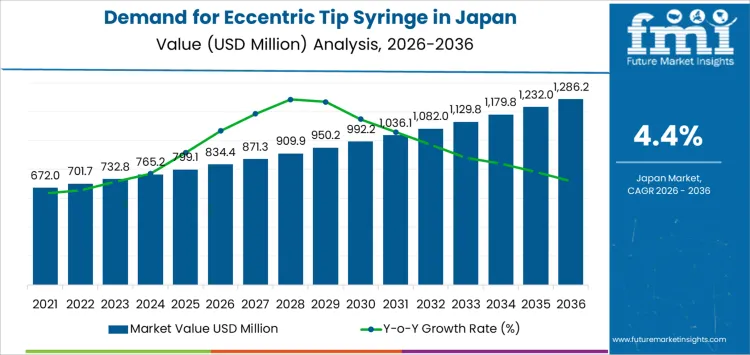
What is the Growth Forecast for Eccentric Tip Syringe in Japan through 2036?
Between 2026 and 2031, demand for eccentric tip syringes in Japan rises from USD 834.4 million to USD 992.2 million, reflecting a significant expansion driven by steady procedural volumes in hospitals, dental clinics, and outpatient centers. Growth in this phase is supported by precision requirements in angled-access applications and consistent replenishment cycles. Earlier demand was linked to routine clinical use, while near term progression reflects broader integration across specialized procedure rooms and improved inventory management practices.
From 2031 to 2036, demand increases from USD 992.2 million to USD 1,286.2 million, marking a sharper upswing as device utilization broadens within surgical fields, infusion services, and high-frequency outpatient procedures. Growth accelerates with rising treatment intensity among aging populations and greater reliance on ergonomic syringe formats designed for controlled delivery. Earlier advances were driven by basic replacement patterns, whereas later expansion reflects wider procedural diversity, increasing case complexity, and expanded availability of high-precision syringe configurations across Japan’s clinical care networks.
Eccentric Tip Syringe Industry in Japan Key Takeaways
| Metric | Value |
|---|---|
| Industry Value (2026) | USD 834.4 million |
| Forecast Value (2036) | USD 1,286.2 million |
| Forecast CAGR (2026 to 2036) | 4.4% |
What Is Driving the Demand for Eccentric Tip Syringes in Japan from 2026 to 2036?
Demand for eccentric tip syringes in Japan has grown alongside expanded use of precision fluid handling in medical, dental, and cosmetic applications. Eccentric tip syringes position the needle off centre, allowing better access to shallow or hard-to-reach injection sites without obstructing the clinician’s view. Hospitals and clinics use them in dermatology, minor surgical procedures, and localized drug delivery where surface alignment matters. Procurement historically focused on syringe accuracy, smooth plunger action, and compatibility with common needle gauges. Suppliers provided a range of volumes to support diverse clinical needs, and quality compliance with medical device standards guided selection.
From 2026 to 2036 demand is expected to strengthen with broader adoption of targeted therapies, minimally invasive procedures, and aesthetic treatments. Growth in outpatient and office-based care drives use of syringes tailored to precise dosing and controlled delivery. Dental practices and pain management clinics value eccentric tips that improve visibility and reduce tissue disruption. Manufacturers innovate with enhanced materials that lower friction, support safer disposal, and integrate with safety shielding mechanisms. Buyers prioritise consistent performance, sterility assurance, and regulatory compliance when choosing products. Demand also reflects training trends in medical education and procedural protocols that emphasize precision and patient comfort during injections.
What Is the Demand for Eccentric Tip Syringes in Japan by Capacity and End User for 2026 to 2036?
The demand for eccentric tip syringes in Japan from 2026 to 2036 is shaped by precision dosing needs, rising outpatient procedures, and continued use of angled syringes for wound care and aspiration tasks. Above 10 ml formats hold the largest capacity share due to broad usage in hospitals for irrigation, fluid withdrawal, and medication preparation. Hospitals lead by end user because most high-volume procedures requiring angled tips occur in inpatient and emergency settings. Procurement is driven by centralized medical supply chains, group purchasing agreements, and standardized kit assemblies. Demand stability is supported by increased procedural throughput and ongoing preference for single-use sterile devices.
Why do syringes above 10 ml account for 35% of the demand for eccentric tip syringes in Japan by capacity from 2026 to 2036?
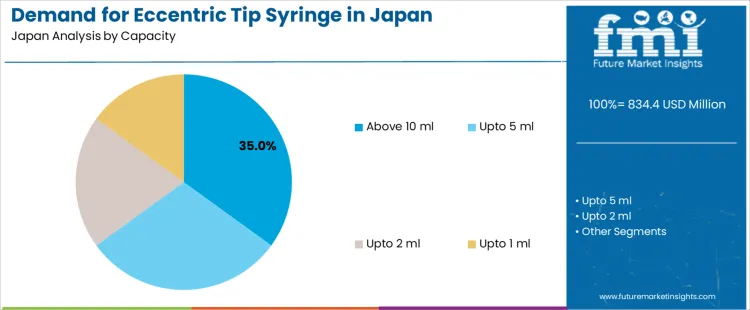
Syringes above 10 ml account for 35% of the demand for eccentric tip syringes in Japan by capacity because larger volumes support irrigation, aspiration, and flushing tasks across hospital departments. Consumption intensity is high in emergency units, surgical wards, and critical care where angled tips provide improved access to wounds and tubes. Usage remains steady as these syringes reduce obstruction risks when drawing viscous fluids. Procurement is led by hospital material managers who standardize sizes across procedure trays.
Demand for larger-capacity eccentric syringes remains predictable from 2026 to 2036 as hospitals perform recurring wound care, catheter maintenance, and postoperative flushing. Repeat utilization stays consistent because these syringes are strictly single-use. Buyers favor syringes with stable gasket performance and easy grip features for gloved handling. Margin structure remains steady under bulk procurement. Regulatory exposure focuses on sterility validation and latex-free material compliance. Import reliance persists for precision-molded plungers and medical-grade polymers. Substitution pressure from straight-tip syringes remains limited where angled positioning is essential for controlled flow and access.
Why do hospitals represent 40.0% of the demand for eccentric tip syringes in Japan by end user?
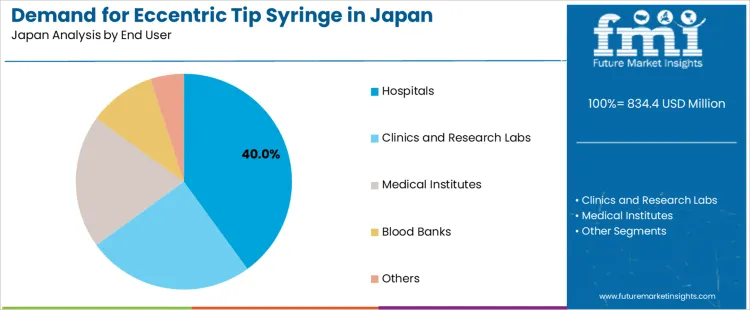
Hospitals represent 40.0% of the demand for eccentric tip syringes in Japan by end user because inpatient care settings conduct a wide range of procedures requiring angled tips for safe access to wounds, tubes, and anatomical surfaces. Consumption intensity rises in surgery units, emergency care, and postoperative wards where irrigation and aspiration are routine. Usage remains steady because hospitals follow standardized protocols that specify eccentric designs for tasks where alignment minimises tissue contact. Procurement is controlled by hospital supply divisions coordinating large multi-department orders. Price sensitivity remains moderate as reliability and sterility outweigh unit cost.
Hospital demand remains consistent through 2026 to 2036 as procedure volumes remain stable and aging populations increase inpatient care needs. Repeat utilization stays predictable because each procedure requires new sterile syringes. Buyers favor products with uniform dimensions that integrate into automated packaging lines. Margin structure remains steady under long-term supply contracts. Regulatory exposure centers on safety standards and traceability of sterile disposables. Import reliance persists for high-grade syringes with refined molding tolerances. Substitution pressure from clinics and research labs remains limited since hospitals perform the highest volume of irrigation and aspiration procedures requiring eccentric tips.
How Is Demand for Eccentric Tip Syringes in Japan Shifting Within Local Clinical and Procedural Settings?
Demand reflects practical needs in Japanese hospitals and clinics that perform procedures requiring precise access to tissue near the skin surface. Outpatient dermatology centers in Tokyo and Osaka rely on eccentric tips for controlled angle injections. Regional dental clinics use them for anesthetic delivery where straight barrels cause obstruction. Nursing teams in home care programs select formats that support stable hand positioning during bedside tasks. These patterns arise from local workflows shaped by Japan’s clinical routines and service structures.
Which Local Medical Practices Are Driving Demand for Eccentric Tip Syringes in Japan?
Drivers come from procedure-focused departments where angled delivery improves safety and visibility. Dermatology units in Sapporo and Fukuoka use eccentric tips for lesion treatments that require low-profile needle alignment. Dental offices across Kanagawa prefer them for injections along narrow oral structures. Home care services coordinated through municipal networks rely on them for injections performed in small living spaces. These settings value improved line-of-sight and positioning, which reinforces local purchasing choices tied directly to routine clinical use.
What Local Constraints Are Slowing Broader Adoption of Eccentric Tip Syringes in Japan?
Barriers arise from procurement patterns shaped by long-term supply agreements that favor standard syringe layouts. Smaller clinics in rural prefectures maintain limited inventories and avoid multiple tip types due to storage costs. Some hospital departments rely on automated dispensing systems that calibrate for central tips, creating resistance to change. Training modules in certain nursing schools focus on conventional syringes, which reduces familiarity with angled variants. These conditions limit broader transition to eccentric tips across facilities with fixed workflows and established purchasing norms.
What is the Demand for Eccentric Tip Syringe in Japan by Region?
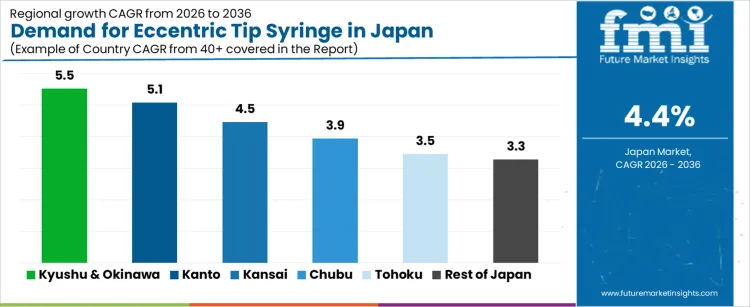
| Region | CAGR (%) |
|---|---|
| Kyushu & Okinawa | 5.5% |
| Kanto | 5.1% |
| Kansai | 4.5% |
| Chubu | 3.9% |
| Tohoku | 3.5% |
| Rest of Japan | 3.3% |
The demand for eccentric tip syringes in Japan is rising steadily across hospitals, clinics, and laboratory settings, led by Kyushu and Okinawa at a 5.5% CAGR. Growth in this region is supported by higher outpatient procedure volumes, wider use in dental and specialty injections, and expanding adoption in regional healthcare networks. Kanto follows at 5.1%, driven by large hospital systems, strong diagnostic activity, and high utilization of precision syringes in therapeutic procedures.
Kansai records 4.5% growth, reflecting stable demand from private clinics, dental chains, and academic medical centers. Chubu at 3.9% shows moderate uptake linked to regional healthcare expansions and laboratory use. Tohoku and the Rest of Japan, at 3.5% and 3.3%, reflect slower growth shaped by smaller healthcare facilities, conservative procurement practices, and longer replacement cycles.
How Are Medical Usage Patterns Supporting Eccentric Tip Syringe Demand in Kyushu and Okinawa?
Demand for eccentric tip syringes in Kyushu and Okinawa is rising at a CAGR of 5.5% from 2026 to 2036 as hospitals, clinics, and outpatient centers use these syringes for procedures requiring angled access and controlled liquid delivery. Healthcare providers adopt eccentric tip formats for wound care, irrigation, and specific injection techniques. Retail medical outlets handle steady inventory movement tied to routine procurement cycles. Regional demand aligns with consistent clinical usage across both urban and island based facilities that require reliable and easy to handle syringe designs suited to varied care environments.
- Clinics use syringes for wound related tasks
- Hospitals procure syringes for routine procedures
- Retail medical outlets support regular stocking
What Factors Influence Eccentric Tip Syringe Adoption Across Kanto?
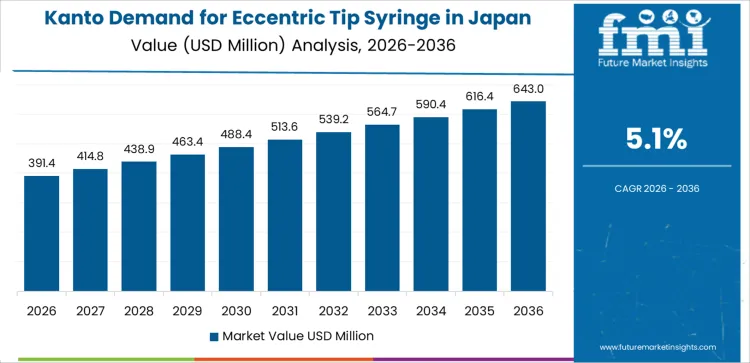
Demand for eccentric tip syringes in Kanto is progressing at a CAGR of 5.1% from 2026 to 2036 as dense medical networks and specialized care centers integrate these syringes into daily operations. Providers use eccentric designs to improve access during angled applications in dermatology, dentistry, and general treatment. Clinics adopt these syringes for irrigation and controlled dispensing tasks. Retail distributors maintain frequent replenishment cycles that support high consumption rates across metropolitan healthcare systems. Growth reflects broad clinical reliance on precise delivery tools.
- Providers use syringes for angled applications
- Clinics adopt syringes for controlled dispensing
- Retail distributors manage rapid turnover
How Is Procedure Diversity Shaping Eccentric Tip Syringe Demand in Kansai?
Demand for eccentric tip syringes in Kansai is increasing at a CAGR of 4.5% from 2026 to 2036 as healthcare settings use angled syringe formats for a range of clinical tasks. Facilities rely on these syringes for irrigation, minor procedures, and topical applications requiring controlled flow. Retail medical suppliers maintain consistent stock movement aligned with stable consumption. Clinics adopt eccentric tip syringes where access constraints limit standard designs. Regional demand follows routine patient care patterns in both suburban and metropolitan treatment centers.
- Clinics use syringes for limited access tasks
- Facilities adopt syringes for irrigation needs
- Retail suppliers sustain steady distribution
Which Conditions Guide Eccentric Tip Syringe Demand Across Chubu?
Demand for eccentric tip syringes in Chubu is trending at a CAGR of 3.9% from 2026 to 2036 as hospitals and small clinics adopt these syringes for precise dispensing and irrigation activities. Providers use eccentric formats in procedures requiring improved access angles. Retail channels manage steady inventory levels shaped by regional ordering habits. Usage spreads across mid sized facilities that require cost effective and reliable syringe options for routine patient care. Growth continues due to consistent clinical applications across varied healthcare environments.
- Providers use syringes for angled access
- Clinics rely on controlled liquid delivery
- Retailers manage measured inventory flow
How Do Regional Care Practices Influence Syringe Demand in Tohoku?
Demand for eccentric tip syringes in Tohoku is moving at a CAGR of 3.5% from 2026 to 2036 as healthcare providers incorporate these syringes into routine wound care, irrigation, and minor procedures. Clinics choose eccentric tip formats for tasks that need simple directional access. Retail medical outlets follow purchasing cycles aligned with regional healthcare usage. Demand remains steady as facilities rely on predictable syringe performance suited to daily treatment requirements across both urban and rural care locations.
- Clinics use syringes for wound irrigation
- Retailers follow regular procurement cycles
- Facilities depend on predictable performance
What Maintains Eccentric Tip Syringe Demand Across Rest of Japan?
Demand for eccentric tip syringes in Rest of Japan is advancing at a CAGR of 3.3% from 2026 to 2036 as widespread clinics and small healthcare operators integrate these syringes into routine care activities. Providers use eccentric designs for controlled dispensing and access constrained procedures. Retail distributors maintain modest but regular stock rotation. Growth reflects recurring medical needs and consistent adoption across dispersed communities where clinics depend on reliable, easy to handle syringe formats for daily treatment tasks.
- Clinics use syringes for daily procedures
- Retailers manage modest reorder patterns
- Facilities rely on practical syringe designs
What Is Driving the Demand for Eccentric Tip Syringe in Japan and Which Companies Shape Clinical Supply
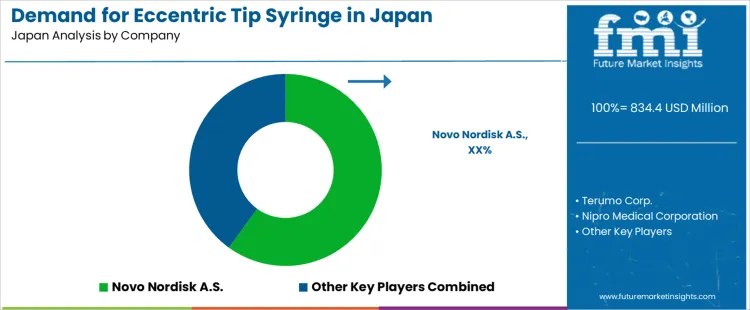
The demand for eccentric tip syringe in Japan is shaped by hospital and clinic needs for precise injection in procedures requiring close skin access and angled delivery. Terumo Corp holds a central domestic position through syringes manufactured with strict dimensional control for use in dermatology, anesthesia, and radiology. Nipro Medical Corporation supports demand through sterile syringes supplied to public hospitals and private clinics with consistent plunger resistance and clear volume markings.
Novo Nordisk A S participates where specialized injection devices are required for chronic care settings. Vita Needle Company reaches niche surgical and laboratory users through small batch stainless steel components. B Braun Imaxeon Pty supports selected imaging and procedural areas through syringes designed for contrast and localized medication delivery.
Product selection in Japan is governed by tip alignment accuracy, material clarity, smooth plunger action, and compatibility with common needle gauges used in procedural zones. Hospitals emphasize predictable performance in tight anatomical areas, especially during aspiration, infiltration, and local anesthesia. Clinics favor syringes that support one handed handling and reduce hand fatigue during repeated use. Buyer preference centers on sterile packaging integrity, latex free construction, and clear lot traceability. Demand visibility tracks dermatology visits, dental anesthetic procedures, interventional imaging growth, and increased use of localized injections in aging populations.
Key Players in the Eccentric Tip Syringe Industry in Japan
- Novo Nordisk A.S.
- Terumo Corp.
- Nipro Medical Corporation
- Vita Needle Company
- B. Braun Imaxeon Pty
Scope of the Report
| Items | Values |
|---|---|
| Quantitative Units (2026) | USD million |
| Capacity | Above 10 ml; Upto 5 ml; Upto 2 ml; Upto 1 ml |
| End User | Hospitals; Clinics and Research Labs; Medical Institutes; Blood Banks; Others |
| Regions Covered | Kyushu & Okinawa; Kanto; Kansai; Chubu; Tohoku; Rest of Japan |
| Countries Covered | Japan |
| Key Companies Profiled | Novo Nordisk A.S.; Terumo Corp.; Nipro Medical Corporation; Vita Needle Company; B. Braun Imaxeon Pty |
| Additional Attributes | Dollar by sales by capacity and end user; sterile packaging and traceability requirements; plunger friction control and gasket performance; tip alignment tolerances for angled procedures; procurement through centralized hospital supply chains; import reliance for medical-grade polymers and precision plungers; safety compliance for latex-free construction; integration with automated tray assembly; usage patterns tied to wound care, irrigation, and outpatient injections. |
Eccentric Tip Syringe Industry in Japan Segmentation
Capacity:
- Above 10 ml
- Upto 5 ml
- Upto 2 ml
- Upto 1 ml
End User:
- Hospitals
- Clinics and Research Labs
- Medical Institutes
- Blood Banks
- Others
Region
- Kyushu & Okinawa
- Kanto
- Kansai
- Chubu
- Tohoku
- Rest of Japan
Frequently Asked Questions
How big is the demand for eccentric tip syringe in Japan in 2026?
The demand for eccentric tip syringe in Japan is estimated to be valued at USD 834.4 million in 2026.
What will be the size of eccentric tip syringe in Japan in 2036?
The market size for the eccentric tip syringe in Japan is projected to reach USD 1,286.2 million by 2036.
How much will be the demand for eccentric tip syringe in Japan growth between 2026 and 2036?
The demand for eccentric tip syringe in Japan is expected to grow at a 4.4% CAGR between 2026 and 2036.
What are the key product types in the eccentric tip syringe in Japan?
The key product types in eccentric tip syringe in Japan are above 10 ml, upto 5 ml, upto 2 ml and upto 1 ml.
Which end user segment is expected to contribute significant share in the eccentric tip syringe in Japan in 2026?
In terms of end user, hospitals segment is expected to command 40.0% share in the eccentric tip syringe in Japan in 2026.
Preview the report firsthand - request a free sample
Get SampleGet the brochure for pricing and purchase details.
Get PDFTable of Content
- Executive Summary
- Japan Market Outlook
- Demand-side Trends
- Supply-side Trends
- Technology Roadmap Analysis
- Analysis and Recommendations
- Market Overview
- Market Coverage / Taxonomy
- Market Definition / Scope / Limitations
- Market Background
- Market Dynamics
- Drivers
- Restraints
- Opportunity
- Trends
- Scenario Forecast
- Demand in Optimistic Scenario
- Demand in Likely Scenario
- Demand in Conservative Scenario
- Opportunity Map Analysis
- Product Life Cycle Analysis
- Supply Chain Analysis
- Investment Feasibility Matrix
- Value Chain Analysis
- PESTLE and Porter’s Analysis
- Regulatory Landscape
- Regional Parent Market Outlook
- Production and Consumption Statistics
- Import and Export Statistics
- Market Dynamics
- Japan Market Analysis 2020 to 2024 and Forecast, 2025 to 2035
- Historical Market Size Value (USD Million) Analysis, 2020 to 2024
- Current and Future Market Size Value (USD Million) Projections, 2025 to 2035
- Y-o-Y Growth Trend Analysis
- Absolute $ Opportunity Analysis
- Japan Market Pricing Analysis 2020 to 2024 and Forecast 2025 to 2035
- Japan Market Analysis 2020 to 2024 and Forecast 2025 to 2035, By Capacity
- Introduction / Key Findings
- Historical Market Size Value (USD Million) Analysis By Capacity , 2020 to 2024
- Current and Future Market Size Value (USD Million) Analysis and Forecast By Capacity , 2025 to 2035
- Above 10 ml
- Upto 5 ml
- Upto 2 ml
- Upto 1 ml
- Y-o-Y Growth Trend Analysis By Capacity , 2020 to 2024
- Absolute $ Opportunity Analysis By Capacity , 2025 to 2035
- Japan Market Analysis 2020 to 2024 and Forecast 2025 to 2035, By End User
- Introduction / Key Findings
- Historical Market Size Value (USD Million) Analysis By End User, 2020 to 2024
- Current and Future Market Size Value (USD Million) Analysis and Forecast By End User, 2025 to 2035
- Hospitals
- Clinics and Research Labs
- Medical Institutes
- Blood Banks
- Others
- Y-o-Y Growth Trend Analysis By End User, 2020 to 2024
- Absolute $ Opportunity Analysis By End User, 2025 to 2035
- Market Structure Analysis
- Competition Dashboard
- Competition Benchmarking
- Market Share Analysis of Top Players
- By Regional
- By Capacity
- By End User
- Competition Analysis
- Competition Deep Dive
- Novo Nordisk A.S.
- Overview
- Product Portfolio
- Profitability by Market Segments (Product/Age /Sales Channel/Region)
- Sales Footprint
- Strategy Overview
- Marketing Strategy
- Product Strategy
- Channel Strategy
- Terumo Corp.
- Nipro Medical Corporation
- Vita Needle Company
- B. Braun Imaxeon Pty
- Novo Nordisk A.S.
- Competition Deep Dive
- Assumptions & Acronyms Used
- Research Methodology


