

- Industry Size (2025)
- USD 73.7 Bn
- Forecast (2035)
- USD 104.2 Bn
- CAGR (2025 to 2035)
- 3.5%
Demand for Kids Recreational Services in Japan Forecast and Outlook 2025 to 2035
The demand for kids recreational services in Japan is expected to grow from USD 73.7 billion in 2025 to USD 104.2 billion by 2035, advancing at a 3.5% CAGR. This growth is fueled by a growing focus on children's health, development, and entertainment, as parents seek structured, enriching activities that promote physical, social, and cognitive development. Services such as sports programs, indoor play areas, theme parks, extracurricular classes, and seasonal camps are becoming more popular as they provide children with opportunities to engage in physical activity, learn new skills, and socialize. Group services, particularly team sports and group play sessions, account for 53% of demand, as they encourage socialization and teamwork, which are critical for early childhood development.
Quick Stats of the Demand for Kids Recreational Services in Japan
- Demand for Kids Recreational Services in Japan Value (2025): USD 73.7 billion
- Demand for Kids Recreational Services in Japan Forecast Value (2035): USD 104.2 billion
- Demand for Kids Recreational Services in Japan Forecast CAGR (2025-2035): 3.5%
- Demand for Kids Recreational Services in Japan Leading Activity Type: Indoor Recreational Activities
- Demand for Kids Recreational Services in Japan Key Growth Regions: Kyushu & Okinawa, Kanto, Kansai, Chubu, Tohoku, Rest of Japan
- Demand for Kids Recreational Services in Japan Top Players: The Walt Disney Company, Universal Studios, SeaWorld Entertainment Inc., Merlin Entertainment Group, BrightPath
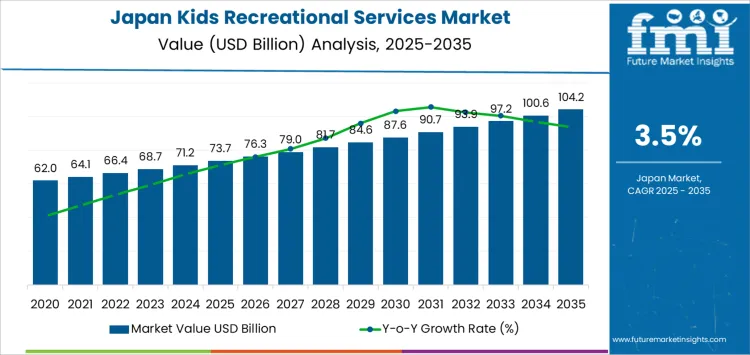
Indoor recreational activities, which cater to Japan’s unpredictable climate, represent a significant portion of demand, offering year-round entertainment. These include play centers, trampoline parks, and creative workshops, providing safe and convenient environments for children to explore and develop. The demand for these services is supported by the growing use of booking platforms and flexible schedules, particularly among busy working parents. Regionally, Kyushu & Okinawa leads with the highest growth rate at 4.4% CAGR, followed by Kanto (4.1% CAGR), which benefits from its large urban population. While growth is steady across Japan, Tohoku and the Rest of Japan experience more moderate increases due to lower population density and fewer large-scale facilities. As families continue to prioritize balanced development for their children, the demand for both physical and educational activities is expected to rise steadily, with key providers like The Walt Disney Company and Universal Studios leading the way through innovative, family-friendly entertainment.
Demand for Kids Recreational Services in Japan Key Takeaways
| Metric | Value |
|---|---|
| Demand for Kids Recreational Services in Japan Value (2025) | USD 73.7 billion |
| Demand for Kids Recreational Services in Japan Forecast Value (2035) | USD 104.2 billion |
| Demand for Kids Recreational Services in Japan Forecast CAGR (2025-2035) | 3.5% |
Why is the Demand for Kids Recreational Services in Japan Growing?
The demand for kids' recreational services in Japan is growing as parents seek more opportunities to engage their children in active and educational activities. Kids' recreational services, including sports programs, indoor play areas, theme parks, and extracurricular classes, have become increasingly popular as parents place a greater emphasis on providing enriching experiences for their children. This demand is fueled by a combination of busy family lifestyles, the desire for socialization opportunities, and the growing awareness of the importance of physical and mental development in children.
A key driver behind this growth is the increasing focus on children's health and development. As sedentary lifestyles and screen time become more prevalent, parents are seeking ways to ensure their children stay active and engaged. Kids' recreational services offer structured environments that encourage physical activity, social interaction, and creativity. From sports leagues to art and music classes, these services provide valuable opportunities for children to explore new interests, develop skills, and improve their overall well-being.
The growing availability of specialized recreational facilities, such as indoor play centers, adventure parks, and family-friendly entertainment venues, is making it easier for parents to find convenient and accessible options for their children. The expansion of these services, combined with a rising demand for high-quality, safe, and fun experiences for kids, is expected to continue driving the sector's growth. As Japanese families prioritize their children's development and leisure, the demand for kids' recreational services is projected to rise steadily through 2035.
What is the Segment-Wise Analysis of Demand for Kids Recreational Services in Japan?
Demand for kids' recreational services in Japan is segmented by service type, activity type, booking channel, age group, and region. By service type, demand is divided into group services and individual services. The demand is also segmented by activity type, including indoor recreational activities, outdoor recreational activities, skill-based activities, seasonal camps and programs, and edutainment and learning activities. Booking channels include online booking platforms, onsite registration, and school/institutional partnerships. Age groups include toddler (1-3 years), preschool (3-5 years), gradeschool (5-12 years), and teens (12-18 years). Regionally, demand spans across Kyushu & Okinawa, Kanto, Kansai, Chubu, Tohoku, and the rest of Japan.
How Do Group Services Lead the Demand for Kids Recreational Services in Japan?
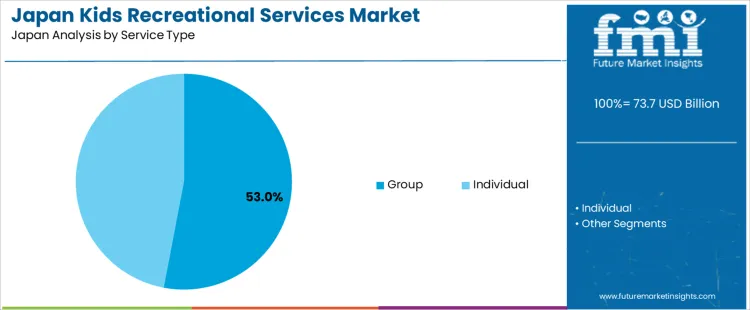
Group services account for 53% of the demand for kids recreational services in Japan, driven by the popularity of social, interactive experiences for children. Group activities, such as group games, team sports, and organized play sessions, provide children with opportunities to build social skills, develop teamwork, and engage in peer interactions. Parents often prefer group activities as they offer children a sense of community and help with socialization, which is particularly important during early childhood development. Group services are also more cost-effective, making them an appealing option for families looking for budget-friendly recreational activities. As more parents in Japan seek activities that promote social bonding and skill development in their children, group services will continue to dominate the kids' recreational services industry, offering a wide range of options to meet the needs of various age groups.
Why Do Indoor Recreational Activities Lead the Demand for Kids Recreational Services in Japan?
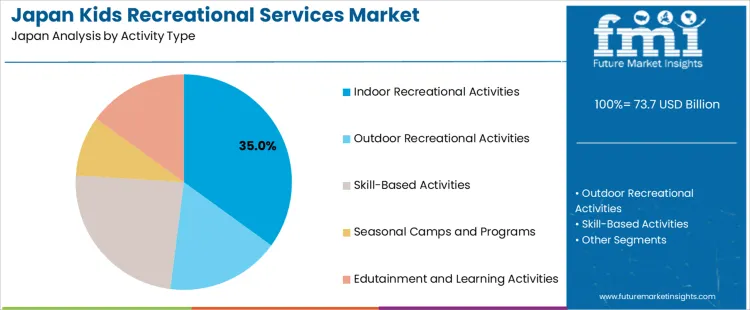
Indoor recreational activities account for a significant share of the demand for kids recreational services in Japan, driven by their year-round availability and suitability for Japan’s climate, which can be unpredictable. Indoor activities, such as play centers, trampoline parks, and creative workshops, are popular for their safety, convenience, and accessibility, especially in urban areas. These activities provide children with a space to explore, engage, and develop physical and cognitive skills in a controlled environment. The demand for indoor recreational activities has been further boosted by the increasing popularity of entertainment facilities and edutainment, where children can have fun while learning. The rise in working parents and the need for activities that can be done during rainy days or winter months has solidified the importance of indoor recreational services. As the demand for safe, weather-proof activities continues to rise, indoor recreational activities will remain a dominant choice for kids' entertainment in Japan.
What are the Key Trends, Drivers, and Restraints in Demand for Kids Recreational Services in Japan?
Demand for kid’s recreational services in Japan including after school programs, indoor play centers, and organized activities is increasing as many parents seek structured, enriching experiences for children beyond regular school hours. As the number of working parents rises and lifestyles become busier, demand grows for services that combine care, socialization, physical activity, and learning. The emphasis on child development physical, cognitive, social supports growth in offerings like sports, arts, play centers, and enrichment classes. Demographic headwinds such as a declining birth rate and overall decreasing child population can limit long term growth potential.
Why is Demand for Kids Recreational Services Growing in Japan?
Increasing participation of both parents in the workforce leads to need for after school and weekend recreational options to support children when parents are unavailable. Many families view structured recreation as valuable for children’s development helping with social skills, physical fitness, and extracurricular learning beyond school curriculum. Urbanization and smaller household sizes also make outside the home recreational activities more attractive than relying on extended family or informal play. In addition, rising disposable incomes among certain segments make parents more willing to spend on quality recreational experiences. Finally, as public and private childcare capacity remains constrained in many areas, private recreational and after school services fill a gap in demand.
How are Technological & Industry Innovations Driving Kids Recreational Services Demand in Japan?
Innovations in service design, facility amenities, and hybrid learning play formats are making recreational services more appealing to Japanese families. Providers increasingly offer a mix of physical activities (sports, gymnastics), creative or educational programs (arts, coding, languages), and indoor play often integrated with safety, hygiene, and parental convenience in mind. Some services combine learning and leisure, giving parents a double benefit: enrichment and care. Improved scheduling flexibility (after school, weekends, short term camps) and convenient access through urban centers or online booking help working parents. In addition, digital tools and platforms may be used to manage registrations, activity tracking, and parental communication improving service quality and trust. These innovations help make recreational services more accessible, reliable, and attractive.
What are the Key Challenges and Risks That Could Limit Kids Recreational Services Demand in Japan?
The most fundamental is Japan’s demographic trend: low birth rate and shrinking child population reduce the base of potential customers over time, making capacity utilization a challenge. Economic pressures and cost sensitivity among families may limit demand for paid recreational services, especially if priced as premium or optional. Regulatory and safety standards especially for indoor play centers, sports facilities, and after school care-raise costs and compliance burdens for providers. Competition from free or lower cost alternatives (public school clubs, community centers, informal play, daycare) may reduce the willingness of parents to pay privately. Finally, in rural or less densely populated areas, demand and population density may be too low to sustain many facilities.
What is the Regional Demand Outlook for Kids Recreational Services in Japan?
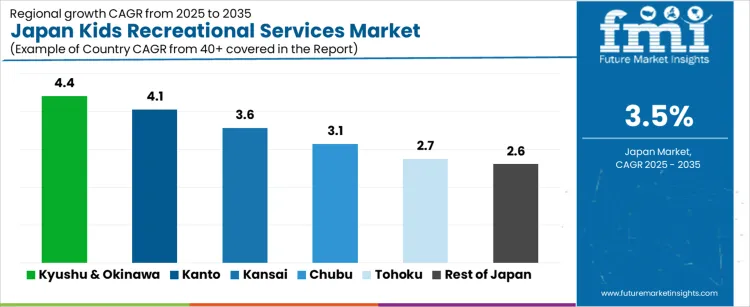
| Region | CAGR (%) |
|---|---|
| Kyushu & Okinawa | 4.4% |
| Kanto | 4.1% |
| Kansai | 3.6% |
| Chubu | 3.1% |
| Tohoku | 2.7% |
| Rest of Japan | 2.6% |
Demand for kid’s recreational services in Japan is growing steadily across all regions, with Kyushu & Okinawa leading at a 4.4% CAGR, driven by the region’s strong culinary culture and consumer preference for pickled foods. Kanto follows with a 4.1% CAGR, supported by the region’s large urban population and the rising demand for deli meats in both foodservice and retail sectors. Kansai shows a 3.6% CAGR, fueled by the region’s growing interest in Western style food products and convenience foods. Chubu experiences a 3.1% CAGR, as demand for pickled products continues to rise with urbanization and changing eating habits. Tohoku and the Rest of Japan see moderate growth at 2.7% and 2.6% respectively, as packed pickles continue to gain popularity in both urban and rural areas.
How is Demand for Kids Recreational Services Growing in Kyushu & Okinawa?
Kyushu & Okinawa leads the demand for kids recreational services, growing at a 4.4% CAGR. The region’s mix of urban and rural areas, plus the tourist friendly island environment (especially Okinawa), makes it attractive for family oriented recreational offerings from indoor play centers to seasonal camps and outdoor adventure activities. Parents and caregivers are increasingly seeking structured, safe and engaging environments for children’s physical, social, and creative development. Given global trends, services like seasonal camps, “edutainment,” arts & crafts, and skill building activities are in demand, a pattern that likely reflects in Japan too. As awareness about the benefits of play based learning and social interaction grows, more families are willing to invest in after school programs, holiday camps, and recreational services. Over time, the industry in Kyushu & Okinawa is positioned for consistent expansion as providers scale up to meet demand.
Why is Demand for Kids Recreational Services Rising in Kanto?
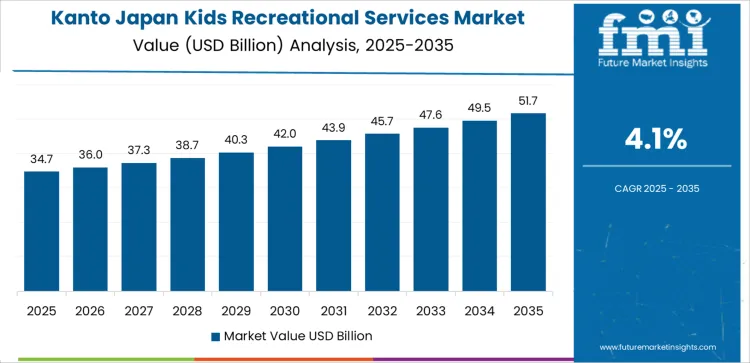
In Kanto home to some of Japan’s biggest urban centres, demand for kids recreational services is rising at a 4.1% CAGR. High population density, busy working parents, and urban lifestyles contribute to the demand for structured, external recreation and enrichment opportunities for children. Services such as indoor activity centres, sports & fitness programs, creative or educational workshops, and after school group activities are likely to be popular. Given limited private/home space in many urban homes, parents value safe, well equipped recreational facilities offering physical exercise, social interaction, and skill development for their children. Also, modern preferences for enrichment and holistic child development beyond academic schooling support this trend. As more families look for balance between work and children’s extracurriculars, Kanto remains a major growth driver for kids recreation demand in Japan.
How is Demand for Kids Recreational Services Expanding in Kansai?
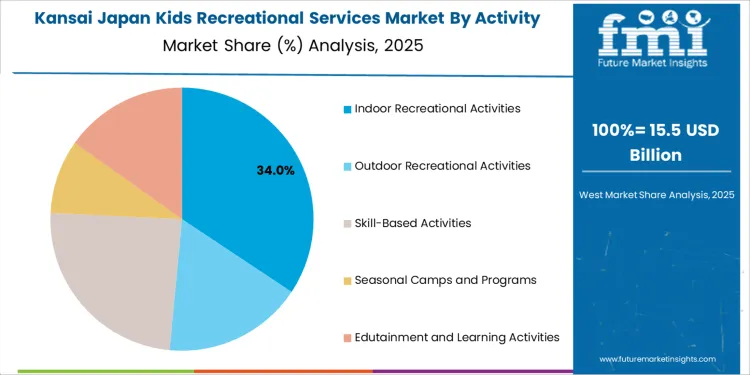
In the Kansai region, demand for kids recreational services is forecast to grow at a 3.6% CAGR. Kansai’s blend of urban and regional cities with cultural, educational, and entertainment infrastructure supports a steady uptake of recreational services for children. Families may prefer mixing traditional leisure with modern enrichment: indoor play zones, sports, cultural and creative workshops, or weekend activities. As awareness around child development, socialization, and balanced lifestyles increases, more households are likely to engage in extracurricular recreation rather than relying solely on school or home based activities. The demand may come from both parents seeking convenience (after school care, weekend programs) and those focused on children’s holistic growth (physical fitness, social skills, hobbies). Over time, recreational service providers may expand offerings to include varied activities from sports and arts to STEM or digital learning camps to cater to evolving preferences.
Why is Demand for Kids Recreational Services Growing in Chubu?
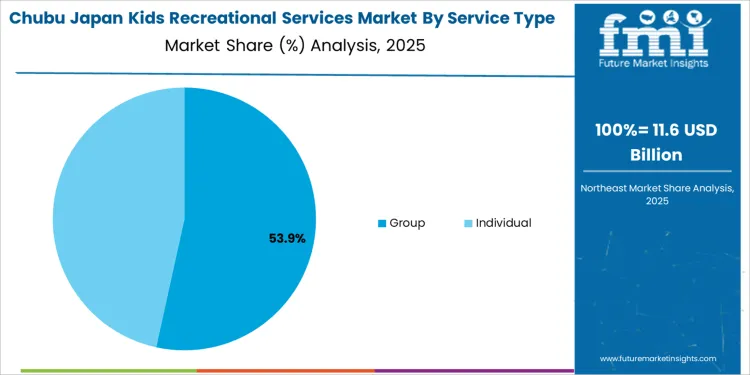
Chubu including urban hubs and smaller cities is expected to see a 3.1% CAGR in demand for kid’s recreational services. As economic activity and urbanization continue, more families may look beyond traditional schooling, seeking supplementary recreational and enrichment services for children. Demand might grow for after school care, weekend activity clubs, indoor play spaces, and creative or sports oriented programs, especially as parents seek convenient, safe, and constructive environments for children. Given potential limitations around available private spaces and the busy schedule of working parents, structured recreational services offer a practical solution. Also, as child development awareness increases, parents may invest in services aimed at socialization, health, physical activity, and holistic growth outside academic settings. Chubu’s moderate but stable growth suggests opportunities for both national chains and local providers to expand their reach.
How is Demand for Kids Recreational Services Expanding in Tohoku?
Tohoku is seeing moderate growth in kids recreational services demand, with a projected 2.7% CAGR. The region with a mix of rural and semi urban areas may see slower adoption compared to major metropolitan regions, given lower population density and possibly fewer large scale recreational facilities. However, there is likely gradual growth in demand driven by increasing parental interest in offering children structured recreational, social, and physical activities beyond home and school. Services such as local indoor play centers, community based sports or arts clubs, and seasonal camps could attract families seeking safe and supervised environments for kids. As awareness of the benefits of play, social interaction, and organized activities spreads, recreational services may slowly expand even in Tohoku. Over time, with improvements in infrastructure and increased availability, the region presents steady potential for growth in the kid’s recreation industry.
Why is Demand for Kids Recreational Services Steady in the Rest of Japan?
In the Rest of Japan (smaller cities, rural areas, less urbanized prefectures), demand for kids recreational services is expected to grow at about 2.6% CAGR. Although adoption is slower compared to urban areas owing to lower population density, fewer large facilities, and more traditional lifestyles there is a gradual shift towards recognizing the importance of structured recreation, social development, and extracurricular engagement for children. Families may increasingly prefer occasional access to indoor play centers, weekend activities, or seasonal camps instead of relying solely on informal play or home routines. As service providers expand their reach via small local centers, mobile events, or community based programs even remote areas could see increased participation. Though growth is modest, this segment offers a foundation for long term incremental expansion as more families adopt modern recreational habits and as accessibility improves.
What is Driving the Demand for Kids Recreational Services in Japan and Who Are the Key Players Shaping the Industry?
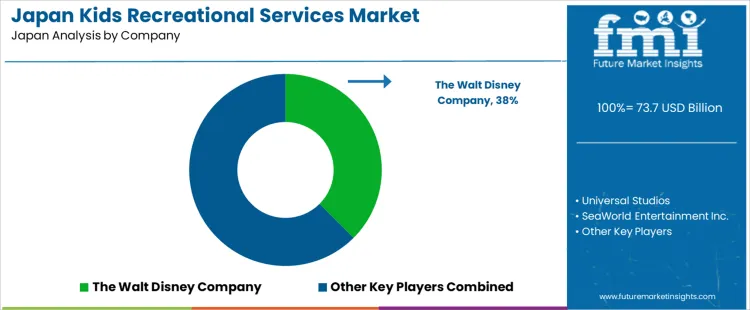
The demand for kids' recreational services in Japan is growing as families increasingly prioritize entertainment and educational experiences for their children. With a focus on fun, development, and safety, recreational services such as theme parks, indoor play areas, and interactive learning centers are becoming more popular. Japan’s family-oriented culture, coupled with busy parents seeking quality, engaging activities for their children, is contributing to the expansion of this sector. The increasing popularity of international entertainment brands and experiences, such as those from global theme parks, further fuels demand. As children’s leisure activities become more sophisticated, the need for safe and enjoyable recreational services continues to rise.
Key players shaping the kids' recreational services industry in Japan include The Walt Disney Company, Universal Studios, SeaWorld Entertainment Inc., Merlin Entertainment Group, and BrightPath. The Walt Disney Company leads the industry with a dominant share of 37.5%, offering world-renowned theme park experiences, including Tokyo Disneyland and Tokyo DisneySea. These companies are driving the demand by providing immersive, family-friendly entertainment experiences that cater to children of various ages. With a focus on innovation, themed attractions, and educational activities, these players continue to expand their influence in Japan’s thriving kids' recreation sector.
The growth of the kids' recreational services industry in Japan is supported by the increasing trend toward experiential leisure activities that combine entertainment and education. As parents seek enriching, memorable experiences for their children, the demand for high-quality recreational services is expected to rise. With ongoing developments in themed attractions and interactive play experiences, the industry is poised for continued growth, offering families in Japan diverse, engaging options for children's entertainment.
Key Players in Japan Kids Recreational Services Demand
- The Walt Disney Company
- Universal Studios
- SeaWorld Entertainment Inc.
- Merlin Entertainment Group
- BrightPath
Scope of Report
| Items | Values |
|---|---|
| Quantitative Units (2025) | USD billion |
| Activity Type | Indoor Recreational Activities, Outdoor Recreational Activities, Skill-Based Activities, Seasonal Camps and Programs, Edutainment and Learning Activities |
| Service Type | Group, Individual |
| Age Group | Toddler (1-3 Yrs), Preschool (3-5 Yrs), Gradeschool (5-12 Yrs), Teen (12-18 Yrs) |
| Booking Channel | Online Booking Platforms, Onsite Registration, School and Institutional Partnerships |
| Region | Kyushu & Okinawa, Kanto, Kansai, Chubu, Tohoku, Rest of Japan |
| Countries Covered | Japan |
| Key Companies Profiled | The Walt Disney Company, Universal Studios, SeaWorld Entertainment Inc., Merlin Entertainment Group, BrightPath |
| Additional Attributes | Dollar sales by activity type and service type; regional CAGR and growth trends; increasing demand for educational and skill-based recreational activities; rise in online bookings; growing focus on safety and child-friendly environments in recreational venues; adoption of seasonal and themed programs; expanding partnerships between schools and recreational centers. |
Japan Kids Recreational Services Demand by Key Segments
Activity Type
- Indoor Recreational Activities
- Outdoor Recreational Activities
- Skill-Based Activities
- Seasonal Camps and Programs
- Edutainment and Learning Activities
Service Type
- Group
- Individual
Age Group
- Toddler (1-3 Yrs)
- Preschool (3-5 Yrs)
- Gradeschool (5-12 Yrs)
- Teen (12-18 Yrs)
Booking Channel
- Online Booking Platforms
- Onsite Registration
- School and Institutional Partnerships
Region
- Kyushu & Okinawa
- Kanto
- Kansai
- Chubu
- Tohoku
- Rest of Japan
Frequently Asked Questions
How big is the demand for kids recreational services in Japan in 2025?
The demand for kids recreational services in Japan is estimated to be valued at USD 73.7 billion in 2025.
What will be the size of kids recreational services in Japan in 2035?
The market size for the kids recreational services in Japan is projected to reach USD 104.2 billion by 2035.
How much will be the demand for kids recreational services in Japan growth between 2025 and 2035?
The demand for kids recreational services in Japan is expected to grow at a 3.5% CAGR between 2025 and 2035.
What are the key product types in the kids recreational services in Japan?
The key product types in kids recreational services in Japan are indoor recreational activities, outdoor recreational activities, skill-based activities, seasonal camps and programs and edutainment and learning activities.
Which service type segment is expected to contribute significant share in the kids recreational services in Japan in 2025?
In terms of service type, group segment is expected to command 53.0% share in the kids recreational services in Japan in 2025.
Preview the report firsthand - request a free sample
Get SampleGet the brochure for pricing and purchase details.
Get PDFTable of Content
- Executive Summary
- Japan Market Outlook
- Demand-side Trends
- Supply-side Trends
- Technology Roadmap Analysis
- Analysis and Recommendations
- Market Overview
- Market Coverage / Taxonomy
- Market Definition / Scope / Limitations
- Market Background
- Market Dynamics
- Drivers
- Restraints
- Opportunity
- Trends
- Scenario Forecast
- Demand in Optimistic Scenario
- Demand in Likely Scenario
- Demand in Conservative Scenario
- Opportunity Map Analysis
- Product Life Cycle Analysis
- Supply Chain Analysis
- Investment Feasibility Matrix
- Value Chain Analysis
- PESTLE and Porter’s Analysis
- Regulatory Landscape
- Regional Parent Market Outlook
- Production and Consumption Statistics
- Import and Export Statistics
- Market Dynamics
- Japan Market Analysis 2020 to 2024 and Forecast, 2025 to 2035
- Historical Market Size Value (USD Million) Analysis, 2020 to 2024
- Current and Future Market Size Value (USD Million) Projections, 2025 to 2035
- Y-o-Y Growth Trend Analysis
- Absolute $ Opportunity Analysis
- Japan Market Pricing Analysis 2020 to 2024 and Forecast 2025 to 2035
- Japan Market Analysis 2020 to 2024 and Forecast 2025 to 2035, By Activity Type
- Introduction / Key Findings
- Historical Market Size Value (USD Million) Analysis By Activity Type , 2020 to 2024
- Current and Future Market Size Value (USD Million) Analysis and Forecast By Activity Type , 2025 to 2035
- Indoor Recreational Activities
- Outdoor Recreational Activities
- Skill-Based Activities
- Seasonal Camps and Programs
- Edutainment and Learning Activities
- Y-o-Y Growth Trend Analysis By Activity Type , 2020 to 2024
- Absolute $ Opportunity Analysis By Activity Type , 2025 to 2035
- Japan Market Analysis 2020 to 2024 and Forecast 2025 to 2035, By Service Type
- Introduction / Key Findings
- Historical Market Size Value (USD Million) Analysis By Service Type, 2020 to 2024
- Current and Future Market Size Value (USD Million) Analysis and Forecast By Service Type, 2025 to 2035
- Group
- Individual
- Y-o-Y Growth Trend Analysis By Service Type, 2020 to 2024
- Absolute $ Opportunity Analysis By Service Type, 2025 to 2035
- Japan Market Analysis 2020 to 2024 and Forecast 2025 to 2035, By Age Group
- Introduction / Key Findings
- Historical Market Size Value (USD Million) Analysis By Age Group, 2020 to 2024
- Current and Future Market Size Value (USD Million) Analysis and Forecast By Age Group, 2025 to 2035
- Toddler (1-3 Yrs)
- Preschool (3-5 Yrs)
- Gradeschool (5-12 Yrs)
- Teen (12-18 Yrs)
- Y-o-Y Growth Trend Analysis By Age Group, 2020 to 2024
- Absolute $ Opportunity Analysis By Age Group, 2025 to 2035
- Japan Market Analysis 2020 to 2024 and Forecast 2025 to 2035, By Booking Channel
- Introduction / Key Findings
- Historical Market Size Value (USD Million) Analysis By Booking Channel, 2020 to 2024
- Current and Future Market Size Value (USD Million) Analysis and Forecast By Booking Channel, 2025 to 2035
- Online Booking Platforms
- Onsite Registration
- School and Institutional Partnerships
- Y-o-Y Growth Trend Analysis By Booking Channel, 2020 to 2024
- Absolute $ Opportunity Analysis By Booking Channel, 2025 to 2035
- Market Structure Analysis
- Competition Dashboard
- Competition Benchmarking
- Market Share Analysis of Top Players
- By Regional
- By Activity Type
- By Service Type
- By Age Group
- By Booking Channel
- Competition Analysis
- Competition Deep Dive
- The Walt Disney Company
- Overview
- Product Portfolio
- Profitability by Market Segments (Product/Age /Sales Channel/Region)
- Sales Footprint
- Strategy Overview
- Marketing Strategy
- Product Strategy
- Channel Strategy
- Universal Studios
- SeaWorld Entertainment Inc.
- Merlin Entertainment Group
- BrightPath
- The Walt Disney Company
- Competition Deep Dive
- Assumptions & Acronyms Used
- Research Methodology


