

- Industry Size (2026)
- USD 19.6 Bn
- Forecast (2036)
- USD 39.8 Bn
- CAGR (2026 to 2036)
- 7.3%
Kids Sports Equipment and Accessories Market Size, Market Forecast and Outlook By FMI
In 2025, the kids sports equipment and accessories market was valued at USD 18.4 billion. Based on Future Market Insights' analysis, demand for kids sports equipment and accessories is estimated to grow to USD 19.6 billion in 2026 and USD 39.8 billion by 2036. FMI projects a CAGR of 7.3% during the forecast period.
Absolute dollar growth of USD 20.2 billion over the decade signals market expansion beyond traditional brick-and-mortar retail channels. Despite raw material cost fluctuations and changing preferences toward multi-sport participation models, manufacturers maintain growth trajectories through product line diversification and age-specific equipment sizing strategies.
Parents and schools are increasingly prioritizing injury prevention through age-appropriate, certified protective gear that aligns with organized youth sports programs and school-level safety mandates. Equipment selection is moving toward sport-specific fit, ergonomic comfort, and lightweight protection to support regular participation without restricting mobility. Product development is responding to this shift through improved impact-absorption materials, adjustable sizing systems, and breathable protective designs, enabling long-term use across growth stages while maintaining consistent safety performance.
The market’s value proposition is increasingly defined by integrated kids’ sports equipment ecosystems that combine protective gear, sport-specific accessories, and fit-adjustable safety solutions. Youth sports brands are expanding omnichannel retail presence while reinforcing safety credibility through certification labeling, age grading, and impact-performance communication. Product range expansions in junior helmets, protective pads, and beginner kits across major sporting goods retailers underscore how child-specific sports protection is moving from occasional specialty purchases into routine, everyday retail buying linked to school sports programs and organized training pathways.
Summary of Kids Sports Equipment and Accessories Market
- Kids Sports Equipment and Accessories Market Definition
- The industry covers age-appropriate athletic equipment and protective gear utilized for youth sports participation including team games, individual training, and recreational physical activity.
- Demand Drivers in the Market
- Rising parental awareness of childhood obesity drives enrollment in organized sports programs.
- School-based athletic initiatives expand equipment purchase requirements for physical education classes.
- Product innovation in adjustable sizing reduces replacement frequency while maintaining safety standards.
- Key Segments Analyzed in the FMI Report
- Product Type: Team Sports Equipment (42%) versus Individual Sports Equipment and protective accessories.
- Distribution Channel: Sporting Goods Stores (38%) versus online retail and department store channels.
- Geography: High-growth Asia Pacific versus mature North American markets.
- Analyst Opinion at FMI
- Rahul Pandita, Senior Consultant for Consumer Products at Future Market Insights, opines, "In the updated version of the Kids Sports Equipment and Accessories Market Report for 2026 to 2036, industry stakeholders will find insights into multi-sport participation patterns that require versatile equipment portfolios. My findings point at safety certification requirements directly impacting product development timelines and price point positioning could restrict market entry for budget-focused manufacturers."
- Strategic Implications/Executive Takeaways
- Shift focus from single-sport specialization to multi-activity equipment bundles.
- Treat youth sports league partnerships as primary distribution strategy rather than supplementary channel.
- Prioritize adjustable sizing mechanisms to extend product lifecycle and reduce parental replacement costs.
- Methodology
- Validated through direct retail sales data and league procurement tracking.
- Zero reliance on speculative youth sports trend forecasting.
- Based on verifiable brand performance metrics and verified distribution agreements.

United States (7.8% CAGR) and United Kingdom (7.2% CAGR) drive market expansion through established youth sports infrastructure and mandatory physical education curriculum requirements. Germany (6.9% CAGR) contributes through club-based training models and government-funded athletic development programs. Emerging markets such as China (8.6%), India (8.3%), and Brazil (7.1%) generate growth through rising middle-class populations and increasing recognition of organized sports participation as developmental priority, while volume expansion accelerates through online retail penetration and branded equipment adoption.
Kids Sports Equipment and Accessories Definition
Kids sports equipment and accessories serve as the primary product category for youth athletic participation, encompassing gear designed for children aged 3 to 14 years across team-based and individual sporting activities. The kids sports equipment and accessories market comprises the global development, production, and distribution of age-appropriate athletic goods including training equipment, protective gear, and performance accessories for recreational and competitive youth sports use.
Kids Sports Equipment and Accessories Market Inclusions
The report includes a comprehensive analysis of market dynamics, featuring Global and Regional Market Sizes (Volume and Value) and a 10-year Forecast (2026-2036). It covers segmental breakdowns by product type (Team Sports Equipment, Individual Sports Equipment, Protective Gear, Sports Apparel), distribution channels (Sporting Goods Stores, Online Retail, Department Stores, Specialty Retailers), and age groups (3-6 Years, 7-10 Years, 11-14 Years).
Kids Sports Equipment and Accessories Market Exclusions
The scope excludes adult sports equipment, professional-grade athletic gear, fitness facility equipment, and institutional bulk procurement contracts. It also omits raw material suppliers, equipment manufacturing machinery, and aftermarket modification services, focusing strictly on finished consumer-ready products designed for youth users and their immediate retail applications. Report does not account for second-hand equipment marketplaces or peer-to-peer rental arrangements with negligible brand differentiation.
Kids Sports Equipment and Accessories Market Research Methodology
- Primary Research: Interviews were conducted with sporting goods manufacturers, youth sports program directors, retail buyers, distribution managers, and pediatric sports medicine specialists across major markets. Athletic equipment consultants clarified sizing standards and safety certification requirements.
- Desk Research: Consumer purchase data from retail analytics platforms, youth sports participation tracking from league databases, and import/export statistics from trade organizations supported market benchmarking.
- Market-Sizing and Forecasting: A hybrid top-down and bottom-up model was developed. Demand was reconstructed from brand sales figures, retail store sell-through data, and league equipment procurement volumes, then validated against manufacturing capacity and distribution network coverage.
- Data Validation and Update Cycle: Outputs undergo variance checks across retail and wholesale datasets, cross-verification with sports industry associations, and structured expert review prior to release.
Segmental Analysis
Kids Sports Equipment and Accessories Market Analysis by Product Type
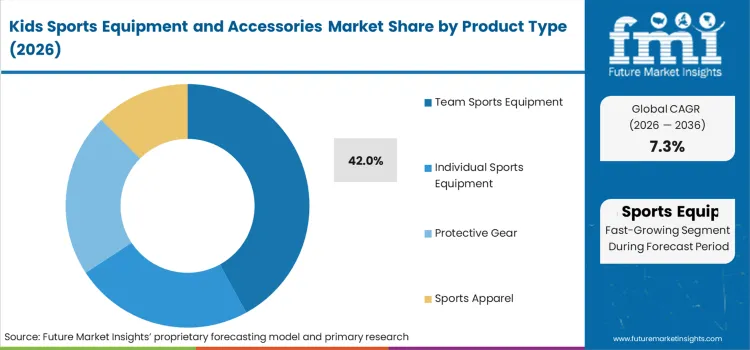
Based on FMI's kids sports equipment and accessories market report, demand for team sports equipment is estimated to hold 42% share in 2026. Growth in demand for team sports equipment comes from manufacturers leveraging standardized sizing across age groups to optimize inventory management while meeting league requirements for regulated gear specifications through partnerships with youth athletic organizations.
- Safety Certification Integration: Companies are adopting impact-resistant materials with certified protection standards, reducing liability concerns across production runs while addressing parental safety priorities that influence purchase decisions among target demographics in recreational and competitive market segments.
- Bundle Packaging Strategy: The product format enables complete starter kit offerings that combine essential equipment pieces, reducing consumer decision complexity while optimizing per-unit margins through bundled pricing structures that support both specialty retail and online direct sales channels.
Kids Sports Equipment and Accessories Market Analysis by Distribution Channel
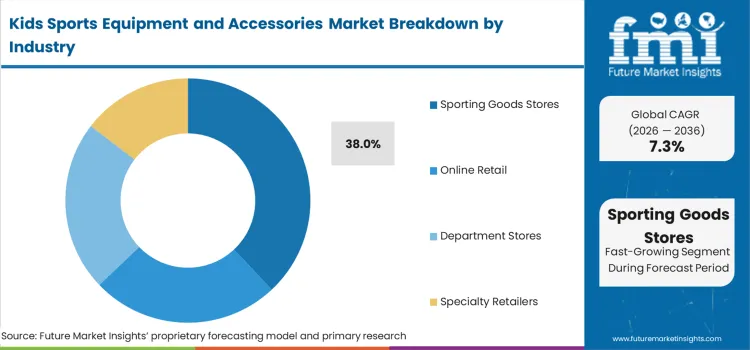
Sporting goods stores hold a 38% market share in 2026, driven by their role as primary consultation points where parents receive sizing guidance and product recommendations from trained staff. This concentration creates market advantages through in-store fitting services and immediate product availability that address parental purchase preferences for youth athletic gear. The segment's integration with local sports league partnerships and team discount programs maintains traditional retail relevance, while specialized product knowledge offers competitive advantages against general merchandise retailers without category expertise.
- Expert Consultation Access: The segment leverages trained staff providing sizing recommendations and safety equipment guidance to maintain consumer trust, particularly for first-time buyers navigating age-appropriate product selection.
- Team Purchase Programs: Stores utilize bulk ordering arrangements and league partnership discounts to capture organized sports team procurement, enabling consistent revenue streams through seasonal equipment replacement cycles.
Kids Sports Equipment and Accessories Market Drivers, Restraints, and Opportunities
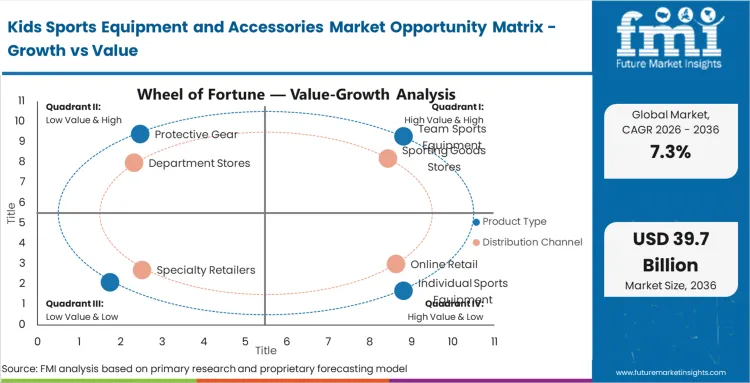
Future Market Insights analysis indicates historical patterns point to an evolving consumer goods category where kids sports equipment transitions from discretionary purchases to essential investments in sports wearables. Estimated valuation in 2026 represents the market's response to increased youth sports participation as parents prioritize structured physical activity, organized league enrollment, and athletic skill development rather than unstructured recreational play.
While demand for traditional single-sport equipment faces competition from multi-activity participation models (market diversification), the health benefits and social development consumers assign to youth sports participation commands repeat purchasing (equipment replacement behavior), resulting in stable revenue growth across product categories. The forecast accounts for the market reaching maturity in developed regions while emerging markets drive volume expansion through first-time organized sports adopters.
- Age Group Targeting: Growth shifts from broad youth categories toward granular age-based sizing systems, using developmental stage research and safety testing protocols to maintain competitive advantages against one-size-fits-all equipment categorization.
- Safety Standard Evolution: Regulations like ASTM (American Society for Testing and Materials) specifications and CPSC (Consumer Product Safety Commission) guidelines establish equipment performance baselines rather than optional recommendations, forcing design modifications from traditional constructions to compliant alternatives.
- Material Cost Management: To maintain margin structures with increasing raw material costs, manufacturers optimize supply chain relationships with synthetic material suppliers to achieve per-unit economics that support retail price expectations and distributor margin requirements.
Regional Analysis
.webp "Top Country Growth Comparison Kids Sports Equipment And Accessories Market Cagr (2026 2036)")
Based on regional analysis, the kids sports equipment and accessories market is segmented into North America, Latin America, Europe, East Asia, South Asia, Oceania and Middle East & Africa across 40+ countries. The full report also offers market attractiveness analysis based on regional trends.
| Country | CAGR (2026 to 2036) |
|---|---|
| United States | 7.8% |
| United Kingdom | 7.2% |
| China | 8.6% |
| India | 8.3% |
| Brazil | 7.1% |
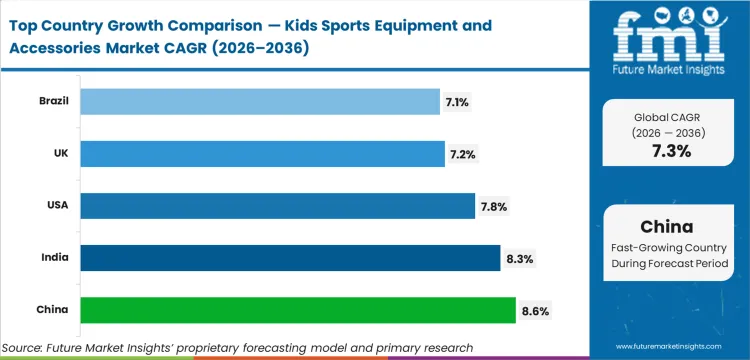
Source: Future Market Insights (FMI) analysis, based on proprietary forecasting model and primary research
North America Kids Sports Equipment and Accessories Market Analysis

North America’s kids sports equipment and accessories market is growing as organized youth leagues expand, schools invest in sports programs, and parents prioritize physical activity to address screen time and childhood obesity. Higher household spending supports frequent gear upgrades, while safety standards and sport-specific equipment needs continue to lift replacement demand across age groups.
- United States: Demand for kids sports equipment and accessories in the United States is projected to rise at 7.8% CAGR through 2036. Growth is driven by travel sports team expansion and increased equipment specialization requirements across age-group divisions.
FMI's report includes detailed analysis of growth in the North American region, along with country-wise assessment that includes the USA and Canada. Readers can find youth sports participation trends, retail channel evolution, and market development based on different product categories and distribution strategies.
Asia Pacific Kids Sports Equipment and Accessories Market Analysis
Asia Pacific represents the fastest-growing regional market, leveraging expanding middle-class populations and government-sponsored youth fitness initiatives to achieve growth rates that exceed mature markets. Li-Ning Company leads in Chinese sports equipment development, Mizuno Corporation and Yonex drive regional product innovation. China is a major manufacturer of sports products such as sports and athletic insoles, helmets, and others.
- China: Leading with an 8.6% CAGR, the market benefits from government investment in youth sports infrastructure and school-based athletic programs, enabling equipment standardization and domestic brand development across urban centers.
- India: Domestic demand accelerates at 8.3% CAGR, supported by cricket equipment familiarity creating foundation for multi-sport participation adoption and local manufacturing using cost-effective production methods.
The full report analyzes the kids sports equipment and accessories market across East and South Asia from 2021-2036, covering youth participation patterns, distribution channel development, and product safety trends in China, Japan, South Korea, India, Singapore, and Australia. The assessment highlights price point strategies that drive regional market penetration.
Europe Kids Sports Equipment and Accessories Market Analysis
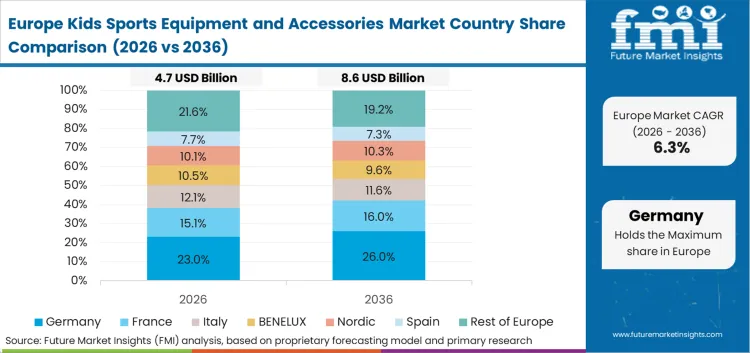
Europe functions as the "club training center," where market development is driven by sports club membership systems and government-funded athletic development programs across Germany, United Kingdom, and France. Leading players include Puma SE (youth athletic footwear), Decathlon SA (multi-sport equipment), and Intersport driving mass-market equipment category growth.
- United Kingdom: Demand for kids sports equipment and accessories in the United Kingdom rises at 7.2% CAGR through 2036, driven by mandatory physical education curriculum requirements and after-school sports club participation.
FMI's analysis of the European kids sports equipment and accessories market includes country-specific assessment covering United Kingdom, Germany, France, Italy, Spain, Netherlands, and Scandinavia. Readers can access detailed youth participation analysis and club-based equipment procurement trends across the European region.
Competitive Landscape for Market Players

Market structure remains divided between global athletic brands with extensive product portfolios and specialized youth equipment manufacturers with limited distribution networks. Primary competitive variables include brand recognition, retail placement quality, and safety certification compliance rather than material innovation or design differentiation.
Companies with direct relationships with youth sports organizations and established retail partnerships demonstrate superior ability to maintain market share while controlling pricing strategies. Licensed league equipment agreements provide market access for mass-market manufacturers while premium brands leverage performance positioning to access competitive youth sports segments.
Product portfolio breadth creates distinct competitive advantages. Companies with multiple age group offerings across sport categories command broader market coverage, while single-sport specialist manufacturers compete primarily on technical performance positioning and safety feature messaging.
Recent Developments
The report includes comprehensive coverage of key industry developments and competitive positioning:
- In December 2025, Latham & Watkins LLP advised DECATHLON PULSE, a fully owned subsidiary of global leading sports brand DECATHLON, on an agreement to acquire a majority stake in Bikeleasing Group. [2]
- In December 2025, Puma inked a deal with the award-winning agency adam&eveDDB for global brand strategy. [3]
- In October 2025, Adidas and GLO Brands B.V. announced long-term partnership to enter the safety footwear market. [4]
- In February 2025, Nike, Inc. and SKIMS rolled out NikeSKIMS, a new brand for women. [5]
- In November 2023, DECATHLON announced the acquisition of Bergfreunde, an online specialist retailer for mountain sports, climbing, and outdoor equipment. [6]
Key Players in Kids Sports Equipment and Accessories Market
- Nike Inc.
- Adidas AG
- Under Armour Inc.
- Puma SE
- Decathlon SA
- Wilson Sporting Goods
- Mizuno Corporation
- Yonex Co., Ltd.
- Li-Ning Company Limited
- Franklin Sports Inc.
Scope of the Report
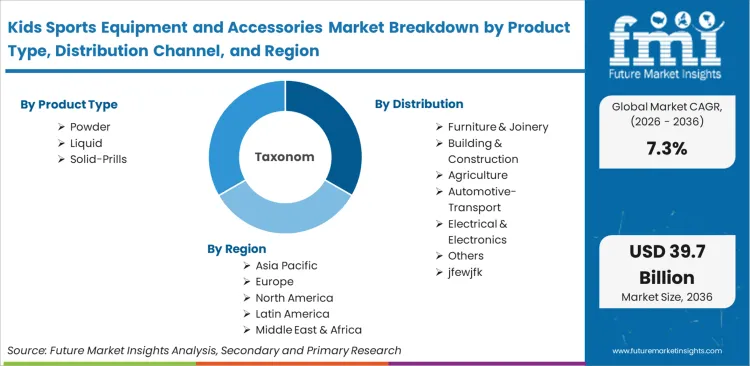
| Metric | Value |
|---|---|
| Quantitative Units | USD 19.6 billion (2026) to USD 39.8 billion (2036), at a CAGR of 7.3% |
| Market Definition | The kids sports equipment and accessories market comprises the global development, production, and distribution of age-appropriate athletic goods including team equipment, individual training gear, and protective accessories designed for children aged 3 to 14 years across recreational and competitive sports activities. |
| Product Type Segmentation | Team Sports Equipment, Individual Sports Equipment, Protective Gear, Sports Apparel |
| Distribution Channel Coverage | Sporting Goods Stores, Online Retail, Department Stores, Specialty Retailers |
| Age Group Segmentation | 3-6 Years, 7-10 Years, 11-14 Years |
| Regions Covered | North America, Latin America, Europe, East Asia, South Asia, Oceania, Middle East and Africa |
| Countries Covered | United States, Canada, United Kingdom, Germany, France, China, Japan, India, Brazil, UAE and 40 plus countries |
| Key Companies Profiled | Nike Inc., Adidas AG, Under Armour Inc., Puma SE, Decathlon SA, Wilson Sporting Goods, Mizuno Corporation, Yonex Co., Ltd., Li-Ning Company Limited, Franklin Sports Inc. |
| Forecast Period | 2026 to 2036 |
| Approach | Hybrid top down and bottom up market modeling validated through retail sales tracking and league procurement monitoring, supported by distribution network verification and youth participation pattern analysis |
Key Segments of Kids Sports Equipment and Accessories Industry Survey
Product Type
- Team Sports Equipment
- Individual Sports Equipment
- Protective Gear
- Sports Apparel
Distribution Channel
- Sporting Goods Stores
- Online Retail
- Department Stores
- Specialty Retailers
- Others (school suppliers, team distributors)
Age Group
- 3-6 Years
- 7-10 Years
- 11-14 Years
Region
- Asia Pacific
- China
- Japan
- South Korea
- India
- Australia
- Singapore
- Thailand
- Rest of Asia Pacific
- Europe
- United Kingdom
- Germany
- France
- Italy
- Spain
- Netherlands
- Scandinavia
- Switzerland
- Rest of Europe
- North America
- United States
- Canada
- Latin America
- Brazil
- Mexico
- Argentina
- Rest of Latin America
- Middle East & Africa
- United Arab Emirates
- Saudi Arabia
- South Africa
- Israel
- Rest of Middle East & Africa
Bibliography
- [1] Latham & Watkins LLP. (2025, December). Latham advises DECATHLON PULSE on acquisition of majority stake in Bikeleasing Group.
- [2] PUMA SE. (2024, December 5). PUMA partners with adam&eveDDB to bring new global brand strategy to life.
- [3] adidas AG & GLO Brands B.V. (2025). adidas and GLO Brands B.V. announce long-term partnership to enter the safety footwear market.
- [4] NIKE, Inc. (n.d.). NIKE, Inc. and SKIMS introduce new brand for women: NikeSKIMS — official announcement.
- [5] Decathlon Group. (n.d.). Decathlon acquires Bergfreunde.
- This bibliography is provided for reader reference and is not exhaustive. The full report contains the complete reference list and detailed citations.
This Report Addresses
- Market intelligence to enable strategic decision making across established and emerging youth sports markets
- Market size estimation and 10-year revenue forecasts from 2026 to 2036, supported by validated retail sales data and league procurement benchmarks
- Growth opportunity mapping across product types and age segments with emphasis on distribution optimization
- Segment and regional revenue forecasts covering team equipment, individual sports gear, protective accessories, and retail distribution networks
- Competition strategy assessment including brand portfolio management, retail partnership requirements, and safety certification compliance
- Product development tracking including adjustable sizing innovations, material selection trends, and regulatory approval processes
- Market access analysis covering distribution agreements, league partnership strategies, and consumer education programs
- Market report delivery in PDF, Excel, PPT, and interactive dashboard formats for executive and operational use
Frequently Asked Questions
How large is the demand for Kids Sports Equipment and Accessories in the global market in 2026?
Demand for Kids Sports Equipment and Accessories in the global market is estimated to be valued at USD 19.6 billion in 2026.
What will be the market size of Kids Sports Equipment and Accessories in the global market by 2036?
Market size for Kids Sports Equipment and Accessories is projected to reach USD 39.8 billion by 2036.
What is the expected demand growth for Kids Sports Equipment and Accessories in the global market between 2026 and 2036?
Demand for Kids Sports Equipment and Accessories in the global market is expected to grow at a CAGR of 7.3% between 2026 and 2036.
Which Product Type is poised to lead global sales by 2026?
Team Sports Equipment is expected to be the dominant product type, capturing approximately 42.0% of global market share in 2026 due to organized league requirements and standardized equipment specifications.
How significant is the role of Sporting Goods Stores in driving Kids Sports Equipment and Accessories adoption in 2026?
Sporting goods stores represent a primary distribution channel, projected to hold approximately 38% share of the total market in 2026 as consultation services and immediate product availability maintain retail relevance.
What is Driving Kids Sports Equipment and Accessories Demand in the United States?
Travel sports team expansion and increased equipment specialization requirements across age-group divisions are driving growth.
What Consumer Trends are Referenced for the United States?
Multi-sport participation models and parental investment in structured athletic development programs are referenced as key consumer behavior shifts.
What is the United States Growth Outlook in this Report?
The United States is projected to grow at a CAGR of 7.8% during 2026 to 2036.
Why is Europe described as Important for Youth Sports Equipment Development in this Report?
Growth is driven by sports club membership systems and government-funded athletic development programs that establish standardized equipment requirements.
What Type of Product Development Dominates in Europe?
Club-based training equipment with age-specific sizing and safety certifications dominates regional market segments.
What is United Kingdom Growth Outlook in this Report?
United Kingdom is projected to expand at a CAGR of 7.2% during 2026 to 2036.
Does the Report Cover China in its Regional Analysis?
China is included within East Asia under the regional scope of analysis.
What are the Sources referred to for analyzing the Market in China?
Youth sports participation data, school athletic program statistics, and domestic brand performance tracking covering purchase patterns, price sensitivity analysis, and equipment preference evolution are cited as primary reference sources.
What is the Main Development Theme Linked to China in Asia Coverage?
Asia Pacific development is associated with government investment in youth sports infrastructure enabling equipment standardization across urban centers.
Does the Report Cover India in its Regional Analysis?
India is included within South Asia under the regional coverage framework.
What is the Main India Related Development Theme in Asia Coverage?
Cricket equipment familiarity creating foundation for multi-sport participation adoption and local manufacturing using cost-effective production methods is emphasized.
Which Distribution Strategies are Strategically Important for Asia Pacific Market Entry?
League partnership models and school-based equipment programs are prioritized for cost-effective brand building across regional markets.
What is Kids Sports Equipment and Accessories and What is It Mainly Used For?
Kids sports equipment and accessories involve age-appropriate athletic gear primarily used for youth sports participation including team games, individual training, and recreational physical activity.
What does Kids Sports Equipment and Accessories Market Mean in this Report?
Kids sports equipment and accessories market refers to global development, manufacturing, and retail distribution of youth athletic goods across various sport categories and age groups.
What is Included in the Scope of this Kids Sports Equipment and Accessories Market Report?
Scope covers equipment by product type, key distribution channels such as sporting goods stores and online platforms, and age segments including early childhood, middle childhood, and pre-adolescent categories.
What is Excluded from the Scope of this Report?
Adult sports equipment, professional athletic gear, fitness facility equipment, and institutional bulk contracts are excluded unless part of youth-specific product offerings.
What does Market Forecast Mean on this Page?
Market forecast represents model-based projections built on retail sales trends and youth participation assumptions for strategic planning purposes.
How does FMI Build and Validate the Kids Sports Equipment and Accessories Market Forecast?
Forecast is developed using hybrid modeling validated through retail point-of-sale data, league procurement tracking, and distribution network verification.
What does Zero Reliance on Speculative Third Party Market Research Mean Here?
Market analysis is based on verifiable sales figures, league partnership agreements, and youth participation data rather than speculative sports trend predictions.
Preview the report firsthand - request a free sample
Get SampleGet the brochure for pricing and purchase details.
Get PDFTable of Content
- Executive Summary
- Global Market Outlook
- Demand-side Trends
- Supply-side Trends
- Technology Roadmap Analysis
- Analysis and Recommendations
- Market Overview
- Market Coverage / Taxonomy
- Market Definition / Scope / Limitations
- Research Methodology
- Chapter Orientation
- Analytical Lens and Working Hypotheses
- Market Structure, Signals, and Trend Drivers
- Benchmarking and Cross-market Comparability
- Market Sizing, Forecasting, and Opportunity Mapping
- Research Design and Evidence Framework
- Desk Research Programme (Secondary Evidence)
- Company Annual and Sustainability Reports
- Peer-reviewed Journals and Academic Literature
- Corporate Websites, Product Literature, and Technical Notes
- Earnings Decks and Investor Briefings
- Statutory Filings and Regulatory Disclosures
- Technical White Papers and Standards Notes
- Trade Journals, Industry Magazines, and Analyst Briefs
- Conference Proceedings, Webinars, and Seminar Materials
- Government Statistics Portals and Public Data Releases
- Press Releases and Reputable Media Coverage
- Specialist Newsletters and Curated Briefings
- Sector Databases and Reference Repositories
- FMI Internal Proprietary Databases and Historical Market Datasets
- Subscription Datasets and Paid Sources
- Social Channels, Communities, and Digital Listening Inputs
- Additional Desk Sources
- Expert Input and Fieldwork (Primary Evidence)
- Primary Modes
- Qualitative Interviews and Expert Elicitation
- Quantitative Surveys and Structured Data Capture
- Blended Approach
- Why Primary Evidence is Used
- Field Techniques
- Interviews
- Surveys
- Focus Groups
- Observational and In-context Research
- Social and Community Interactions
- Stakeholder Universe Engaged
- C-suite Leaders
- Board Members
- Presidents and Vice Presidents
- R&D and Innovation Heads
- Technical Specialists
- Domain Subject-matter Experts
- Scientists
- Physicians and Other Healthcare Professionals
- Governance, Ethics, and Data Stewardship
- Research Ethics
- Data Integrity and Handling
- Primary Modes
- Tooling, Models, and Reference Databases
- Desk Research Programme (Secondary Evidence)
- Data Engineering and Model Build
- Data Acquisition and Ingestion
- Cleaning, Normalisation, and Verification
- Synthesis, Triangulation, and Analysis
- Quality Assurance and Audit Trail
- Market Background
- Market Dynamics
- Drivers
- Restraints
- Opportunity
- Trends
- Scenario Forecast
- Demand in Optimistic Scenario
- Demand in Likely Scenario
- Demand in Conservative Scenario
- Opportunity Map Analysis
- Product Life Cycle Analysis
- Supply Chain Analysis
- Investment Feasibility Matrix
- Value Chain Analysis
- PESTLE and Porter’s Analysis
- Regulatory Landscape
- Regional Parent Market Outlook
- Production and Consumption Statistics
- Import and Export Statistics
- Market Dynamics
- Global Market Analysis 2021 to 2025 and Forecast, 2026 to 2036
- Historical Market Size Value (USD Million) Analysis, 2021 to 2025
- Current and Future Market Size Value (USD Million) Projections, 2026 to 2036
- Y-o-Y Growth Trend Analysis
- Absolute $ Opportunity Analysis
- Global Market Pricing Analysis 2021 to 2025 and Forecast 2026 to 2036
- Global Market Analysis 2021 to 2025 and Forecast 2026 to 2036, By Product Type
- Introduction / Key Findings
- Historical Market Size Value (USD Million) Analysis By Product Type , 2021 to 2025
- Current and Future Market Size Value (USD Million) Analysis and Forecast By Product Type , 2026 to 2036
- Team Sports Equipment
- Individual Sports Equipment
- Protective Gear
- Sports Apparel
- Team Sports Equipment
- Y-o-Y Growth Trend Analysis By Product Type , 2021 to 2025
- Absolute $ Opportunity Analysis By Product Type , 2026 to 2036
- Global Market Analysis 2021 to 2025 and Forecast 2026 to 2036, By Distribution Channel
- Introduction / Key Findings
- Historical Market Size Value (USD Million) Analysis By Distribution Channel, 2021 to 2025
- Current and Future Market Size Value (USD Million) Analysis and Forecast By Distribution Channel, 2026 to 2036
- Sporting Goods Stores
- Online Retail
- Department Stores
- Specialty Retailers
- Sporting Goods Stores
- Y-o-Y Growth Trend Analysis By Distribution Channel, 2021 to 2025
- Absolute $ Opportunity Analysis By Distribution Channel, 2026 to 2036
- Global Market Analysis 2021 to 2025 and Forecast 2026 to 2036, By Region
- Introduction
- Historical Market Size Value (USD Million) Analysis By Region, 2021 to 2025
- Current Market Size Value (USD Million) Analysis and Forecast By Region, 2026 to 2036
- North America
- Latin America
- Western Europe
- Eastern Europe
- East Asia
- South Asia and Pacific
- Middle East & Africa
- Market Attractiveness Analysis By Region
- North America Market Analysis 2021 to 2025 and Forecast 2026 to 2036, By Country
- Historical Market Size Value (USD Million) Trend Analysis By Market Taxonomy, 2021 to 2025
- Market Size Value (USD Million) Forecast By Market Taxonomy, 2026 to 2036
- By Country
- USA
- Canada
- Mexico
- By Product Type
- By Distribution Channel
- By Country
- Market Attractiveness Analysis
- By Country
- By Product Type
- By Distribution Channel
- Key Takeaways
- Latin America Market Analysis 2021 to 2025 and Forecast 2026 to 2036, By Country
- Historical Market Size Value (USD Million) Trend Analysis By Market Taxonomy, 2021 to 2025
- Market Size Value (USD Million) Forecast By Market Taxonomy, 2026 to 2036
- By Country
- Brazil
- Chile
- Rest of Latin America
- By Product Type
- By Distribution Channel
- By Country
- Market Attractiveness Analysis
- By Country
- By Product Type
- By Distribution Channel
- Key Takeaways
- Western Europe Market Analysis 2021 to 2025 and Forecast 2026 to 2036, By Country
- Historical Market Size Value (USD Million) Trend Analysis By Market Taxonomy, 2021 to 2025
- Market Size Value (USD Million) Forecast By Market Taxonomy, 2026 to 2036
- By Country
- Germany
- UK
- Italy
- Spain
- France
- Nordic
- BENELUX
- Rest of Western Europe
- By Product Type
- By Distribution Channel
- By Country
- Market Attractiveness Analysis
- By Country
- By Product Type
- By Distribution Channel
- Key Takeaways
- Eastern Europe Market Analysis 2021 to 2025 and Forecast 2026 to 2036, By Country
- Historical Market Size Value (USD Million) Trend Analysis By Market Taxonomy, 2021 to 2025
- Market Size Value (USD Million) Forecast By Market Taxonomy, 2026 to 2036
- By Country
- Russia
- Poland
- Hungary
- Balkan & Baltic
- Rest of Eastern Europe
- By Product Type
- By Distribution Channel
- By Country
- Market Attractiveness Analysis
- By Country
- By Product Type
- By Distribution Channel
- Key Takeaways
- East Asia Market Analysis 2021 to 2025 and Forecast 2026 to 2036, By Country
- Historical Market Size Value (USD Million) Trend Analysis By Market Taxonomy, 2021 to 2025
- Market Size Value (USD Million) Forecast By Market Taxonomy, 2026 to 2036
- By Country
- China
- Japan
- South Korea
- By Product Type
- By Distribution Channel
- By Country
- Market Attractiveness Analysis
- By Country
- By Product Type
- By Distribution Channel
- Key Takeaways
- South Asia and Pacific Market Analysis 2021 to 2025 and Forecast 2026 to 2036, By Country
- Historical Market Size Value (USD Million) Trend Analysis By Market Taxonomy, 2021 to 2025
- Market Size Value (USD Million) Forecast By Market Taxonomy, 2026 to 2036
- By Country
- India
- ASEAN
- Australia & New Zealand
- Rest of South Asia and Pacific
- By Product Type
- By Distribution Channel
- By Country
- Market Attractiveness Analysis
- By Country
- By Product Type
- By Distribution Channel
- Key Takeaways
- Middle East & Africa Market Analysis 2021 to 2025 and Forecast 2026 to 2036, By Country
- Historical Market Size Value (USD Million) Trend Analysis By Market Taxonomy, 2021 to 2025
- Market Size Value (USD Million) Forecast By Market Taxonomy, 2026 to 2036
- By Country
- Kingdom of Saudi Arabia
- Other GCC Countries
- Turkiye
- South Africa
- Other African Union
- Rest of Middle East & Africa
- By Product Type
- By Distribution Channel
- By Country
- Market Attractiveness Analysis
- By Country
- By Product Type
- By Distribution Channel
- Key Takeaways
- Key Countries Market Analysis
- USA
- Pricing Analysis
- Market Share Analysis, 2025
- By Product Type
- By Distribution Channel
- Canada
- Pricing Analysis
- Market Share Analysis, 2025
- By Product Type
- By Distribution Channel
- Mexico
- Pricing Analysis
- Market Share Analysis, 2025
- By Product Type
- By Distribution Channel
- Brazil
- Pricing Analysis
- Market Share Analysis, 2025
- By Product Type
- By Distribution Channel
- Chile
- Pricing Analysis
- Market Share Analysis, 2025
- By Product Type
- By Distribution Channel
- Germany
- Pricing Analysis
- Market Share Analysis, 2025
- By Product Type
- By Distribution Channel
- UK
- Pricing Analysis
- Market Share Analysis, 2025
- By Product Type
- By Distribution Channel
- Italy
- Pricing Analysis
- Market Share Analysis, 2025
- By Product Type
- By Distribution Channel
- Spain
- Pricing Analysis
- Market Share Analysis, 2025
- By Product Type
- By Distribution Channel
- France
- Pricing Analysis
- Market Share Analysis, 2025
- By Product Type
- By Distribution Channel
- India
- Pricing Analysis
- Market Share Analysis, 2025
- By Product Type
- By Distribution Channel
- ASEAN
- Pricing Analysis
- Market Share Analysis, 2025
- By Product Type
- By Distribution Channel
- Australia & New Zealand
- Pricing Analysis
- Market Share Analysis, 2025
- By Product Type
- By Distribution Channel
- China
- Pricing Analysis
- Market Share Analysis, 2025
- By Product Type
- By Distribution Channel
- Japan
- Pricing Analysis
- Market Share Analysis, 2025
- By Product Type
- By Distribution Channel
- South Korea
- Pricing Analysis
- Market Share Analysis, 2025
- By Product Type
- By Distribution Channel
- Russia
- Pricing Analysis
- Market Share Analysis, 2025
- By Product Type
- By Distribution Channel
- Poland
- Pricing Analysis
- Market Share Analysis, 2025
- By Product Type
- By Distribution Channel
- Hungary
- Pricing Analysis
- Market Share Analysis, 2025
- By Product Type
- By Distribution Channel
- Kingdom of Saudi Arabia
- Pricing Analysis
- Market Share Analysis, 2025
- By Product Type
- By Distribution Channel
- Turkiye
- Pricing Analysis
- Market Share Analysis, 2025
- By Product Type
- By Distribution Channel
- South Africa
- Pricing Analysis
- Market Share Analysis, 2025
- By Product Type
- By Distribution Channel
- USA
- Market Structure Analysis
- Competition Dashboard
- Competition Benchmarking
- Market Share Analysis of Top Players
- By Regional
- By Product Type
- By Distribution Channel
- Competition Analysis
- Competition Deep Dive
- Nike Inc.
- Overview
- Product Portfolio
- Profitability by Market Segments (Product/Age /Sales Channel/Region)
- Sales Footprint
- Strategy Overview
- Marketing Strategy
- Product Strategy
- Channel Strategy
- Adidas AG
- Under Armour Inc.
- Puma SE
- Decathlon SA
- Wilson Sporting Goods
- Mizuno Corporation
- Yonex Co., Ltd.
- Li-Ning Company Limited
- Franklin Sports Inc.
- Nike Inc.
- Competition Deep Dive
- Assumptions & Acronyms Used


