

- Market Size (2026)
- USD 2460.6 Mn
- Forecast (2036)
- USD 4532.9 Mn
- CAGR (2026 to 2036)
- 6.3%
How big is the linear motion shafts market size?
USD 2,460.6 million in 2026 and USD 4,532.9 million by 2036 at a 6.3% CAGR.
Demand for linear motion shafts is projected to expand at 6.3% CAGR between 2026 and 2036, increasing valuation from USD 2,460.6 million in 2026 to USD 4,532.9 million by 2036. Machine builders are expected to treat shaft selection as an uptime and accuracy decision as International Federation of Robotics reported in September 2025 factories installed 542,000 industrial robots in 2024, creating greater need for repeatable axis movement and documented component performance.
India and China buyer groups are set to place greater weight on local application support and shorter supplier response cycles. Germany and Japan accounts are anticipated to examine proof files and tolerance records before vendor change. Press Information Bureau reported in its February 12, 2026 release stating medium-high and high-technology industries accounted for 46.3% of India manufacturing value added, supporting a larger base for precision components used across automated equipment programs.
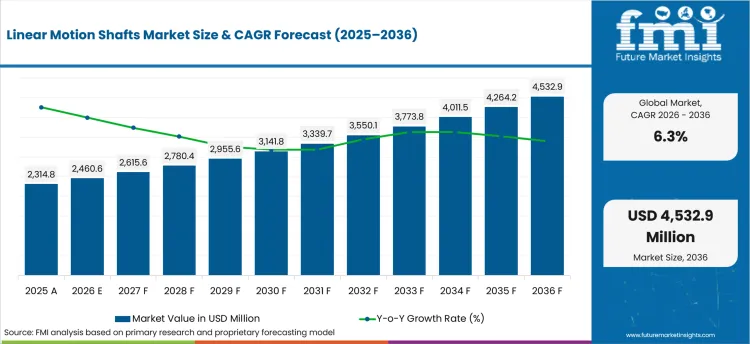
| Metric | Value |
|---|---|
| 2025 Market Size | USD 2,314.8 million |
| 2026 Market Size | USD 2,460.6 million |
| 2036 Market Size | USD 4,532.9 million |
| Forecast CAGR (2026-2036) | 6.3% |
| Accuracy Grade Focus | Precision Grade |
| Precision Grade Share (2026) | 46.0% |
| Diameter Range Focus | 10-25 mm |
| 10-25 mm Share (2026) | 42.0% |
| Application Focus | Machine Tools |
| Machine Tools Share (2026) | 28.0% |
Summary of the Linear Motion Shafts Market
| Market Signal | Commercial Impact |
|---|---|
| Demand and Growth Drivers | Demand for linear motion shafts is shaped by automation uptime and shorter equipment commissioning cycles. Account decisions are expected to reflect dimensional proof and service response across approved purchasing programs.
|
| Product and Segment View | Segment demand is led by accuracy-led shaft selection and mid-range diameter use across repeat equipment programs. Specification work is anticipated to concentrate on shaft formats with documented tolerances and compatible bearing motion.
|
| Geography and Growth Outlook | Country demand is stronger across markets with robot adoption and local component qualification. Supplier gains are likely to reflect replacement readiness and documentation speed.
|
| Competitive Landscape | Competition is likely to focus on shaft quality and application support. Account wins are expected to favor suppliers with proven portfolios and dependable service coverage.
|
| Analyst Perspective | Linear motion shafts are developing into a proof-led component segment linked to accuracy and service confidence. Supplier progress is projected to improve through documentation speed and application guidance aligned with automation and machine-building requirements.
|
Source: Future Market Insights analysis, 2026.
How is the linear motion shafts market segmented?
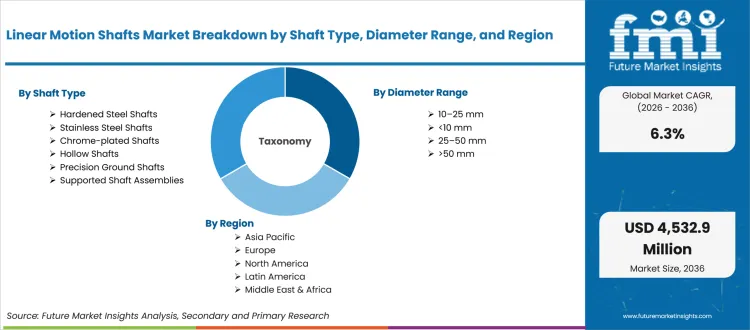
The linear motion shafts market is segmented by shaft type, diameter range, accuracy grade, application, sales channel, and region.
The linear motion shafts industry is segmented by shaft type, diameter range, accuracy grade, application, sales channel, and region. Shaft type coverage includes hardened steel shafts, stainless steel shafts, chrome-plated shafts, hollow shafts, precision ground shafts, and supported shaft assemblies. Diameter range coverage includes below 10 mm, 10-25 mm, 25-50 mm, and above 50 mm. Accuracy grade coverage includes commercial grade, precision grade, and high precision grade. Application coverage includes machine tools, packaging machinery, robotics, medical and lab equipment, and printing or textile machinery. Sales channel coverage includes linear motion distributors, direct OEM, e-commerce/catalog, and MRO replacement. Regional coverage includes North America, Latin America, Europe, East Asia, South Asia, Oceania, and Middle East and Africa.
What supports demand for hardened steel shafts within shaft type?
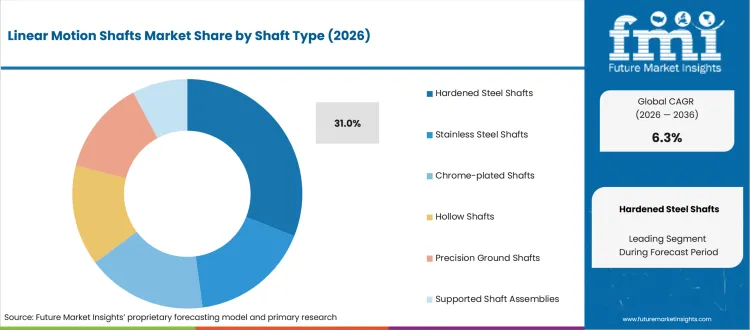
Hardened steel shafts are forecast to support shaft type demand driven by wear resistance and buyer familiarity across routine automation programs. Equipment builders use hardened shaft formats once surface strength and replacement availability affect operating continuity. Association for Advancing Automation reported in its February 6, 2026 release stating North American companies ordered 36,766 robots in 2025, promoting demand for motion components used across automation cells and maintenance cycles.
- Hardened steel shafts are anticipated to capture 31.0% share in 2026, led by durability requirements and repeated use across machine-tool and automation assemblies. Buyers prefer hardened formats once service life and repeat availability support account approval.
- Stainless steel and supported shaft assemblies address specific operating profiles. Hardened steel shafts gain attention once buyers need a practical balance between cost discipline and replacement certainty.
How is 10-25 mm positioned within diameter range demand?
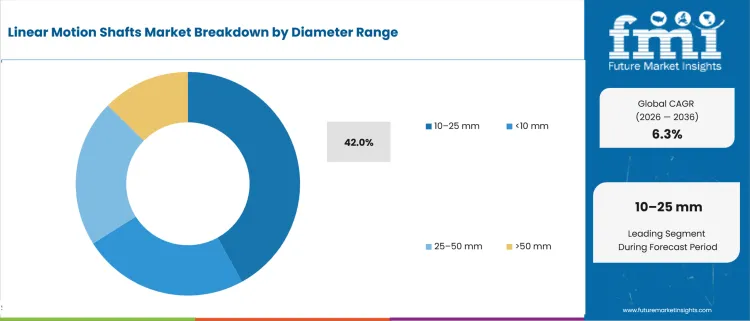
10-25 mm diameter range is estimated to remain central to shaft purchasing as compact machinery and automation modules need shaft sizes balancing load support with design flexibility. Engineering teams compare diameter selection against bearing match and spare-part availability before supplier approval. National Bureau of Statistics of China reported in its June 17, 2026 claiming metal-cutting machine tool output having reached 38 ten-thousand units during January to May 2026, propelling shaft demand linked to precision machining and guided-axis equipment.
- 10-25 mm is expected to hold 42.0% share in 2026, driven by frequent use across compact motion assemblies and mid-load equipment designs. Account teams prefer this range once shaft availability and accessory compatibility reduce design change risk.
- Below 10 mm and above 25 mm ranges serve narrower equipment needs. 10-25 mm range benefits from repeated specification across machine builders and maintenance buyers needing predictable replacement coverage.
What drives precision grade demand within accuracy grade?
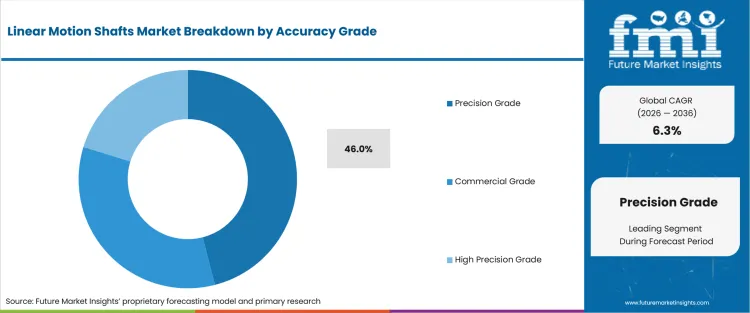
Precision grade shafts are anticipated to support accuracy-grade demand as automated equipment needs stable movement and lower rework risk during commissioning. Machine builders prefer precision grade shafts once tolerance records and acceptance evidence reduce approval delays across motion assemblies. International Federation of Robotics reported in April 2026 for average robot density having reached 177 robots per 10,000 manufacturing employees globally, reinforcing demand for precise motion components used across automated production environments.
- Precision grade is projected to account for 46.0% share in 2026, aided by accuracy requirements across robotics and guided-axis assemblies. Buyer teams prefer precision-grade shafts once documentation supports field acceptance and warranty review.
- Commercial grade and high precision grade serve different cost and performance needs. Precision grade gains preference once buyers need a balanced specification between repeatable movement and approval speed.
How do machine tools influence application demand?
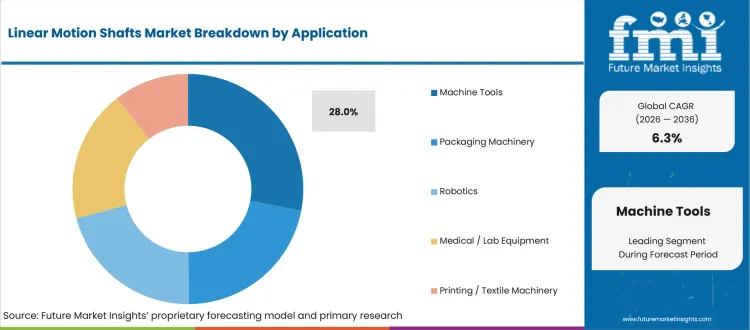
Machine-tool applications are expected to shape application demand as shaft accuracy affects travel stability and repeat production quality. Machine-tool builders examine load response and compatibility with bearings before locking supplier lists. UCIMU-SISTEMI PER PRODURRE reported in its July 15, 2025 announcing Italian machine-tool orders to have increased 22.0% in second quarter 2025, supporting component demand linked to metalworking machinery and axis-control systems.
- Machine tools are estimated to account for 28.0% share in 2026, reflected by shaft use in guided motion and repeatable handling systems. Buyer teams prefer suppliers offering tolerance documents and replacement support during equipment servicing.
- Packaging machinery and printing or textile machinery use linear motion shafts in different duty cycles. Machine-tool use gains review priority once accuracy and shaft finish affect acceptance results.
How do linear motion distributors support sales channel demand?
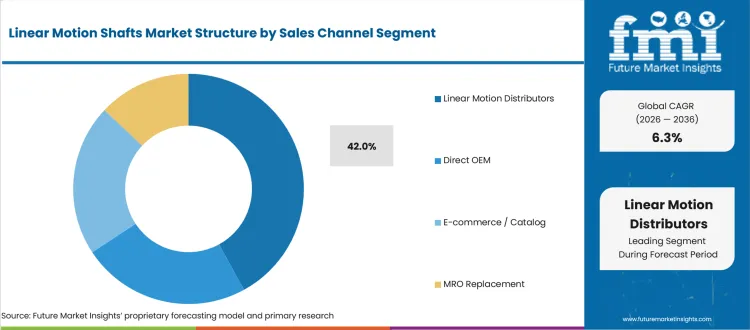
Linear motion distributors are projected to support sales channel demand by giving buyers catalog access and application support for recurring purchases. Smaller machine shops and maintenance teams often need shaft options aligned with existing bearing systems and approved assembly dimensions. Association for Advancing Automation reported in May 2026 stating North American companies ordered 9,055 robots in first quarter 2026, keeping distributor support important for accessory supply and motion-component availability.
- Linear motion distributors are expected to account for 42.0% share in 2026, supported by recurring replacement needs and smaller account orders. Distributor-led access helps buyers compare shaft dimensions and delivery timing without extending equipment downtime.
- Direct OEM and MRO replacement channels address different buying patterns. Distributor channels gain preference once buyers need specification help and dependable replenishment across approved shaft programs.
What are the drivers, restraints, and opportunities in the linear motion shafts market?
Near-term purchases are shaped by accuracy requirements and service-led adoption routes outlined below.
- Driver: Machine builders and automation OEMs are replacing loosely specified shaft sourcing with documented motion components designed to support accuracy and commissioning confidence.
- Restraint: Adoption slows if shaft dimensions or service responsibilities remain unclear during trial approval.
- Opportunity: Retrofit automation and compact machinery programs create demand for suppliers offering application support and dependable shaft documentation.
Buyer interest is supported by industrial automation depth across installed equipment. International Federation of Robotics reported in September 2025 for operational industrial robot stock having reached 4,664,000 units worldwide in 2024, giving motion-component suppliers a larger installed base needing replacement shafts and repeatable axis performance.
Qualification complexity may limit conversion pace during supplier change. Federal Statistical Office of Germany reported on February 6, 2026 stating manufacturing new orders rising 7.8% in December 2025 from previous month, causing equipment buyers to protect approved sourcing records during production scheduling reviews.
Opportunity improves for suppliers serving collaborative and compact automation programs. Association for Advancing Automation reported in February 2026 collaborative robots represented 28.6% of all robots ordered in fourth quarter 2025, increasing need for compact shaft sizes and verified motion parts used in space-limited automation cells.
What country CAGRs are profiled in the linear motion shafts market?
.webp "Top Country Growth Comparison Linear Motion Shafts Market Cagr (2026 2036)")
| Country | CAGR |
|---|---|
| India | 8.2% |
| China | 7.4% |
| South Korea | 5.9% |
| Italy | 5.7% |
| United States | 5.3% |
| Germany | 4.9% |
| Japan | 4.6% |
Source: Future Market Insights, 2026.
How do country-level CAGRs compare in the linear motion shafts market?
Country demand in linear motion shafts is expected to be guided by machine-tool demand and documentation-led qualification. India and China connect demand with manufacturing expansion and local technical response. South Korea and Italy link adoption with robotics density and machine-tool activity. United States, Germany, and Japan keep demand centered on approval records and component reliability.
- India linear motion shafts demand is likely to be shaped by manufacturing upgrading and local supplier support. Press Information Bureau stated in its February 12, 2026 reporting medium-high and high-technology industries having accounted for 46.3% of manufacturing value added, strengthening demand for precise components used in automated equipment. Demand in India is projected to rise at 8.2% CAGR through 2036, supported by precision component needs across automated equipment and local engineering programs.
- China linear motion shafts demand is projected to be influenced by automation output and domestic machinery supply. National Bureau of Statistics of China reported in its April 17, 2026 release industrial robot output reached 237,554 sets from January to March 2026, reinforcing component requirements across automated production equipment. Sales in China are forecast to expand at 7.4% CAGR from 2026 to 2036, reinforced by automated production equipment and local component sourcing.
- South Korea buyers are expected to favor suppliers supporting precise movement and rapid engineering response. International Federation of Robotics stated in its April 8, 2026 release South Korea recorded 1,220 robots per 10,000 manufacturing employees, reinforcing demand for shafts suited to dense automation environments. Adoption in South Korea is predicted to rise at 5.9% CAGR by 2036, aided by dense automation environments and precision manufacturing requirements.
- Italy linear motion shafts purchasing is anticipated to be shaped by machine-tool specialization and export-oriented equipment programs. UCIMU-SISTEMI PER PRODURRE reported in its April 28, 2026 release machine-tool orders increased 3.1% in first quarter 2026 against January to March 2025, supporting component review across machinery builders. Italy is estimated to expand at 5.7% CAGR between 2026 and 2036, underpinned by machining equipment demand and supplier review across machinery builders.
- United States linear motion shaft demand is estimated to progress through general-industry automation and replacement programs. Association for Advancing Automation reported in its February 6, 2026 release North American companies ordered 36,766 robots in 2025, encouraging demand for motion components serving automation cells and maintenance cycles. United States demand is forecast to grow at 5.3% CAGR by 2036, shaped by automation renewal and recurring equipment servicing.
- Germany account demand is anticipated to advance through documentation-heavy equipment channels and controlled supplier substitution. International Federation of Robotics reported in April 2026 Germany reached 449 robots per 10,000 manufacturing employees, sustaining demand for high-accuracy shafts used in industrial automation and machine-building environments. Germany is forecast at 4.9% CAGR by 2036, guided by qualification depth and high-accuracy shaft requirements across machine-building environments.
- Japan keeps linear motion shafts demand close to compact equipment, precision assembly, and long qualification cycles. International Federation of Robotics reported in September 2025 Japan installed 44,500 industrial robots in 2024, sustaining demand for motion parts aligned with precision assembly and automation renewal. Sector in Japan is projected to post 4.6% CAGR during forecast period, influenced by product consistency and acceptance documentation across automation renewal programs.
Who are the notable companies in the linear motion shafts market?
THK, Bosch Rexroth, NSK, IKO, Nippon Bearing, MISUMI, Thomson Linear, HIWIN, PBC Linear, and Schaeffler are expected to shape this market.
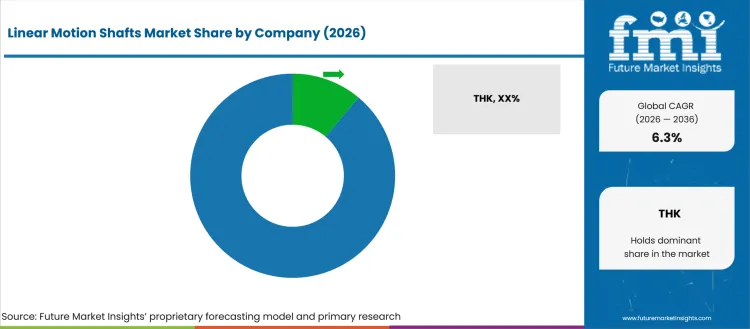
Competition in linear motion shafts is anticipated to center on motion-component portfolios and regional service reach. Account teams are likely to compare suppliers based on design response and ability to support repeat-order programs after initial approval. THK, Bosch Rexroth, NSK, and IKO are expected to receive review attention due to linear motion component depth and engineering support. Nippon Bearing, MISUMI, and Thomson Linear are projected to compete driven by application guidance, and replacement support. HIWIN, PBC Linear, and Schaeffler are estimated to support account demand led by linear guides and motion-system experience.
- THK, Bosch Rexroth, NSK, and IKO are expected to gain account attention based on motion-component depth and engineering support. Linear guide and actuator experience is likely to support shaft programs needing tolerance proof and repeat production discipline.
- Nippon Bearing, MISUMI, and Thomson Linear are anticipated to compete due to catalog support and replacement availability. Their role is projected to improve as machine builders and maintenance teams review part access before approval.
- HIWIN and PBC Linear are forecast to support demand depending on linear guideway and shafting expertise. Motion-component experience is expected to help accounts compare shaft materials and bearing compatibility.
- Schaeffler is estimated to gain review strength based on bearing and guidance-system support. Supplier access is likely to improve as machinery buyers need validated motion components and service continuity.
Competitive Benchmarking: Linear Motion Shafts Market
| Company | Portfolio Depth | Segment Match | Documentation Depth | Service Reach |
|---|---|---|---|---|
| THK | High | High | High | Global |
| Bosch Rexroth | High | High | High | Global |
| NSK | High | High | High | Global |
| IKO | High | High | High | Global |
| Nippon Bearing | Medium | High | High | Global |
| MISUMI | Medium | High | High | Global |
| Thomson Linear | Medium | Medium | High | Regional/Global |
| HIWIN | Medium | Medium | Medium | Regional/Global |
| PBC Linear | Medium | Medium | Medium | Regional |
| Schaeffler | High | Medium | High | Global |
Source: Future Market Insights competitive analysis, 2026.
Key Developments in the Linear Motion Shafts Market
- In March 2025, Bosch Rexroth launched its Linear Motion Technology Selector for online engineering support. Bosch Rexroth stated on March 31, 2025 the selector includes profiled rail systems, linear bushings, and screw drives, improving specification review for buyers comparing motion components and support paths.
- In April 2025, NSK started customer orders for MT-Frix low-friction ball screws for machine-tool applications. NSK stated on October 4, 2024 customer orders were scheduled to start in April 2025, supporting machine-tool builders managing friction and positioning accuracy across precision movement systems.
- In July 2025, THK introduced HDR linear guide series for heavy-duty industrial applications. THK stated on July 23, 2025 HDR series was available in 8 sizes and rail lengths up to 3,000 mm, supporting equipment builders needing higher rigidity and standardized planning flexibility.
Key Players in the Linear Motion Shafts Market
Motion component and equipment suppliers
- THK
- Bosch Rexroth
- NSK
- IKO
Precision engineering and accessory specialists
- Nippon Bearing
- MISUMI
- Thomson Linear
Distribution and application support partners
- HIWIN
- PBC Linear
- Schaeffler
Linear Motion Shafts Market - Report Scope
| Coverage field | Report scope |
|---|---|
| Market breakdown | Linear Motion Shafts Market breakdown by shaft type, diameter range, accuracy grade, application, sales channel, and region |
| Market Definition | Linear motion shafts are motion-control components used to support precise linear movement, reliable guided travel, installation flexibility, and uptime across automated equipment. |
| Regions Covered | North America, Latin America, Europe, East Asia, South Asia, Oceania, and Middle East and Africa |
| Countries Covered | United States, China, Germany, Japan, India, South Korea, Italy, and more than 25 countries |
| Key Companies Profiled | THK, Bosch Rexroth, NSK, IKO, Nippon Bearing, MISUMI, Thomson Linear, HIWIN, PBC Linear, and Schaeffler |
| Forecast Period | 2026 to 2036 |
| Approach | Hybrid bottom-up and top-down methodology using machine-tool activity, automation component demand, OEM design cycles, retrofit activity, distributor coverage, and country-level industrial equipment indicators |
Source: Future Market Insights analysis, 2026.
Linear Motion Shafts Market - Research Methodology
| Method | Approach |
|---|---|
| Primary Research | Primary interviews covered machine builders, automation OEMs, maintenance teams, component distributors, precision equipment manufacturers, and channel accounts. Discussions focused on shaft tolerance, bearing compatibility, approval barriers, service ownership, replacement behavior, and practical limits of changing suppliers. |
| Desk Research | Desk research reviewed official robot statistics, machine-tool order releases, company product pages, standards-body references, and association sources. |
| Market Sizing and Forecasting | Market sizing used a hybrid model across 2025 backcast, 2026 base value, 2036 forecast value, segment-share mix, country CAGRs, channel path, and parent demand linked to automation and motion systems. |
| Data Validation | Data validation compared segment shares, country CAGRs, company alignment, product portfolios, and official source signals to avoid unsupported claims and unrelated component leakage. |
Source: Future Market Insights analysis, 2026.
Linear Motion Shafts Market by Segments
Linear Motion Shafts Market segmented by Shaft Type:
- Hardened Steel Shafts
- Stainless Steel Shafts
- Chrome-plated Shafts
- Hollow Shafts
- Precision Ground Shafts
- Supported Shaft Assemblies
Linear Motion Shafts Market segmented by Diameter Range:
- Below 10 mm
- 10-25 mm
- 25-50 mm
- Above 50 mm
Linear Motion Shafts Market segmented by Accuracy Grade:
- Commercial Grade
- Precision Grade
- High Precision Grade
Linear Motion Shafts Market segmented by Application:
- Machine Tools
- Packaging Machinery
- Robotics
- Medical / Lab Equipment
- Printing / Textile Machinery
Linear Motion Shafts Market segmented by Sales Channel:
- Linear Motion Distributors
- Direct OEM
- E-commerce / Catalog
- MRO Replacement
Linear Motion Shafts Market by Region:
- North America
- United States
- Canada
- Latin America
- Brazil
- Mexico
- Argentina
- Europe
- Germany
- United Kingdom
- France
- Italy
- Spain
- East Asia
- China
- Japan
- South Korea
- South Asia
- India
- Thailand
- Indonesia
- Oceania
- Australia
- New Zealand
- Middle East and Africa
- GCC countries
- South Africa
- Türkiye
Research Sources and Bibliography
- Association for Advancing Automation. (2026, February 6). Robot orders grow 6.6% in 2025 as general industries drive automation adoption.
- Association for Advancing Automation. (2026, May 13). Robot orders hold steady in Q1 2026 as demand broadens across non-automotive industries.
- Bosch Rexroth. (2025, March 31). Linear Motion Technology: Quantum leap in online engineering.
- Federal Statistical Office of Germany. (2026, February 6). New orders in manufacturing in December 2025: +7.8% on previous month.
- International Federation of Robotics. (2025, September 25). Global robot demand in factories doubles over 10 years.
- International Federation of Robotics. (2026, April 8). Robot density surges in Europe, Asia, and Americas.
- National Bureau of Statistics of China. (2026, April 17). Industrial production operation in March 2026.
- National Bureau of Statistics of China. (2026, June 17). Industrial production operation in May 2026.
- NSK. (2024, October 4). NSK develops MT-Frix low-friction ball screws for machine tools.
- Press Information Bureau. (2026, February 12). Manufacturing sector driving India’s next growth phase.
- THK. (2025, July 23). THK Linear Guide HDR: Robust, versatile and now available in online store.
- UCIMU-SISTEMI PER PRODURRE. (2025, July 15). In second quarter machine-tool orders increased 22.0%.
- UCIMU-SISTEMI PER PRODURRE. (2026, April 28). In first quarter 2026 machine-tool orders on rise 3.1%.
This bibliography is provided for reader reference and is not exhaustive. The full report contains the complete reference list and detailed citations.
This Report Answers
- What value is forecast for the linear motion shafts market in 2026 and by 2036?
- What CAGR is forecast for the linear motion shafts market from 2026 to 2036?
- What shaft type, diameter range, accuracy grade, application, and sales channel segments define the disclosed share view?
- How do machine builders and automation OEMs evaluate linear motion shafts before supplier approval?
- How do country CAGRs differ across profiled markets?
- What companies compete through portfolio depth and segment match?
- How does FMI validate forecasts using hybrid bottom-up and top-down methodology?
- What factors should buyer teams address before account expansion or sourcing commitment?
- How do technical files and qualification records affect vendor selection?
- What supplier capabilities improve long-term account confidence?
Frequently Asked Questions
What is supporting demand in the linear motion shafts market?
Demand is likely to be supported by machine builders and automation OEMs needing shafts improving guided movement and reducing commissioning risk across repeat equipment programs. Accounts are expected to prefer suppliers combining shaft quality and dependable replacement support.
Who are the key companies in the linear motion shafts market?
Key companies are anticipated to include THK, Bosch Rexroth, NSK, IKO, Nippon Bearing, MISUMI, Thomson Linear, HIWIN, PBC Linear, and Schaeffler. Competition is likely to be based on motion-component depth and service reach.
What is a restraint in the linear motion shafts market?
A main restraint is qualification uncertainty created by finish quality records and service responsibility during trial approval. Buyer teams may delay switching suppliers if product proof and site acceptance documents do not support recurring equipment programs.
Why should executives track the linear motion shafts market?
Executives are expected to track the market as shaft selection affects operating continuity and supplier accountability. Factors such as commissioning delays and repeat replacement confidence shape account reviews.
What business problem does the linear motion shafts market address?
Market demand addresses a practical motion-control gap faced by machine builders needing installation flexibility and uptime across automated equipment. Linear shafts help equipment teams reduce motion instability and support repeatable production quality across approved assemblies.
What should account teams evaluate before selecting suppliers?
Account teams are likely to evaluate tolerance records and local service before supplier approval. Bearing compatibility and replacement support are expected to guide final supplier review.
What limits return on investment for purchasing teams?
Return on investment weakens if product proof or site acceptance is not secured before conversion. Installation delays and replacement failures reduce expected savings from supplier change.
How do suppliers build long-term account confidence?
Suppliers build account confidence by providing consistent shaft quality and application evidence specific to linear motion shafts. Technical files and responsive field support are expected to influence repeat-order trust.
Preview the report firsthand - request a free sample
Get SampleGet the brochure for pricing and purchase details.
Get PDFTable of Content
- Key Takeaways
- Market Size and CAGR
- Top Growth Driver
- Fastest Growing Segment
- Leading Region
- Key Companies
- Emerging Opportunities
- Executive Summary
- Global Market Outlook
- Demand-side Trends
- Supply-side Trends
- Technology Roadmap Analysis
- Analysis and Recommendations
- Analyst Perspective (What is happening? Why now? What should investors know?)
- Key Questions Answered
- How large is the market?
- What is the CAGR?
- What are key trends?
- Which region dominates?
- Who are the leaders?
- Market Overview
- Market Coverage / Taxonomy
- Market Definition / Scope / Limitations
- Research Methodology
- Chapter Orientation
- Analytical Lens and Working Hypotheses
- Market Structure, Signals, and Trend Drivers
- Benchmarking and Cross-market Comparability
- Market Sizing, Forecasting, and Opportunity Mapping
- Research Design and Evidence Framework
- Desk Research Programme (Secondary Evidence)
- Expert Input and Fieldwork (Primary Evidence)
- Tooling, Models, and Reference Databases
- Data Engineering and Model Build
- Quality Assurance and Audit Trail
- Market Background
- Market Dynamics (Drivers, Restraints, Opportunity, Trends)
- Scenario Forecast (Optimistic, Likely, Conservative)
- Impact Analysis
- AI Impact
- Sustainability Impact
- Regulatory Impact
- Technology Impact
- Consumer / Buyer Analysis
- Purchase Drivers
- Adoption Barriers
- Buyer Journey
- Opportunity Map Analysis
- Product Life Cycle Analysis
- Supply Chain Analysis
- Investment Feasibility Matrix
- Value Chain Analysis
- PESTLE and Porter's Analysis
- Regulatory Landscape
- Regional Parent Market Outlook
- Production and Consumption Statistics
- Import and Export Statistics
- Global Market Analysis and Forecast, 2021 to 2036
- Historical Market Size Value (USD Million) & Volume (Unit) Analysis, 2021 to 2025
- Current and Future Market Size Value (USD Million) & Volume (Unit) Projections, 2026 to 2036
- Y-o-Y Growth Trend Analysis
- Absolute $ Opportunity Analysis
- Global Market Pricing Analysis, 2021 to 2036
- Global Market Analysis and Forecast, By Shaft Type, 2021 to 2036
- Introduction / Key Findings
- Historical Market Size Value (USD Million) & Volume (Unit) Analysis By Shaft Type, 2021 to 2025
- Current and Future Market Size Value (USD Million) & Volume (Unit) Analysis and Forecast By Shaft Type, 2026 to 2036
- Hardened Steel Shafts
- Stainless Steel Shafts
- Chrome-plated Shafts
- Hollow Shafts
- Precision Ground Shafts
- Supported Shaft Assemblies
- Hardened Steel Shafts
- Y-o-Y Growth Trend Analysis By Shaft Type, 2021 to 2025
- Absolute $ Opportunity Analysis By Shaft Type, 2026 to 2036
- Global Market Analysis and Forecast, By Diameter Range, 2021 to 2036
- Introduction / Key Findings
- Historical Market Size Value (USD Million) & Volume (Unit) Analysis By Diameter Range, 2021 to 2025
- Current and Future Market Size Value (USD Million) & Volume (Unit) Analysis and Forecast By Diameter Range, 2026 to 2036
- 10-25 mm
- <10 mm
- 25-50 mm
- >50 mm
- 10-25 mm
- Y-o-Y Growth Trend Analysis By Diameter Range, 2021 to 2025
- Absolute $ Opportunity Analysis By Diameter Range, 2026 to 2036
- Global Market Analysis and Forecast, By Accuracy Grade, 2021 to 2036
- Introduction / Key Findings
- Historical Market Size Value (USD Million) & Volume (Unit) Analysis By Accuracy Grade, 2021 to 2025
- Current and Future Market Size Value (USD Million) & Volume (Unit) Analysis and Forecast By Accuracy Grade, 2026 to 2036
- Precision Grade
- Commercial Grade
- High Precision Grade
- Precision Grade
- Y-o-Y Growth Trend Analysis By Accuracy Grade, 2021 to 2025
- Absolute $ Opportunity Analysis By Accuracy Grade, 2026 to 2036
- Global Market Analysis and Forecast, By Application, 2021 to 2036
- Introduction / Key Findings
- Historical Market Size Value (USD Million) & Volume (Unit) Analysis By Application, 2021 to 2025
- Current and Future Market Size Value (USD Million) & Volume (Unit) Analysis and Forecast By Application, 2026 to 2036
- Machine Tools
- Packaging Machinery
- Robotics
- Medical / Lab Equipment
- Printing / Textile Machinery
- Machine Tools
- Y-o-Y Growth Trend Analysis By Application, 2021 to 2025
- Absolute $ Opportunity Analysis By Application, 2026 to 2036
- Global Market Analysis and Forecast, By Sales Channel, 2021 to 2036
- Introduction / Key Findings
- Historical Market Size Value (USD Million) & Volume (Unit) Analysis By Sales Channel, 2021 to 2025
- Current and Future Market Size Value (USD Million) & Volume (Unit) Analysis and Forecast By Sales Channel, 2026 to 2036
- Linear Motion Distributors
- Direct OEM
- E-commerce / Catalog
- MRO Replacement
- Linear Motion Distributors
- Y-o-Y Growth Trend Analysis By Sales Channel, 2021 to 2025
- Absolute $ Opportunity Analysis By Sales Channel, 2026 to 2036
- Global Market Analysis and Forecast, By Region, 2021 to 2036
- Introduction
- Historical Market Size Value (USD Million) & Volume (Unit) Analysis By Region, 2021 to 2025
- Current Market Size Value (USD Million) & Volume (Unit) Analysis and Forecast By Region, 2026 to 2036
- North America
- Latin America
- Europe
- East Asia
- South Asia
- Oceania
- Middle East and Africa
- Market Attractiveness Analysis By Region
- North America Market Analysis and Forecast, By Country, 2021 to 2036
- Historical Market Size Value (USD Million) & Volume (Unit) Trend Analysis By Market Taxonomy, 2021 to 2025
- Market Size Value (USD Million) & Volume (Unit) Forecast By Market Taxonomy, 2026 to 2036
- By Country
- United States
- Canada
- By Shaft Type
- By Diameter Range
- By Accuracy Grade
- By Application
- By Sales Channel
- By Country
- Market Attractiveness Analysis
- By Country
- By Shaft Type
- By Diameter Range
- By Accuracy Grade
- By Application
- By Sales Channel
- Key Takeaways
- Latin America Market Analysis and Forecast, By Country
- Historical Market Size Value (USD Million) & Volume (Unit) Trend Analysis By Market Taxonomy, 2021 to 2025
- Market Size Value (USD Million) & Volume (Unit) Forecast By Market Taxonomy, 2026 to 2036
- By Country
- Brazil
- Mexico
- Argentina
- By Shaft Type
- By Diameter Range
- By Accuracy Grade
- By Application
- By Sales Channel
- By Country
- Market Attractiveness Analysis
- By Country
- By Shaft Type
- By Diameter Range
- By Accuracy Grade
- By Application
- By Sales Channel
- Key Takeaways
- Europe Market Analysis and Forecast, By Country
- Historical Market Size Value (USD Million) & Volume (Unit) Trend Analysis By Market Taxonomy, 2021 to 2025
- Market Size Value (USD Million) & Volume (Unit) Forecast By Market Taxonomy, 2026 to 2036
- By Country
- Germany
- United Kingdom
- France
- Italy
- Spain
- By Shaft Type
- By Diameter Range
- By Accuracy Grade
- By Application
- By Sales Channel
- By Country
- Market Attractiveness Analysis
- By Country
- By Shaft Type
- By Diameter Range
- By Accuracy Grade
- By Application
- By Sales Channel
- Key Takeaways
- East Asia Market Analysis and Forecast, By Country
- Historical Market Size Value (USD Million) & Volume (Unit) Trend Analysis By Market Taxonomy, 2021 to 2025
- Market Size Value (USD Million) & Volume (Unit) Forecast By Market Taxonomy, 2026 to 2036
- By Country
- China
- Japan
- South Korea
- By Shaft Type
- By Diameter Range
- By Accuracy Grade
- By Application
- By Sales Channel
- By Country
- Market Attractiveness Analysis
- By Country
- By Shaft Type
- By Diameter Range
- By Accuracy Grade
- By Application
- By Sales Channel
- Key Takeaways
- South Asia Market Analysis and Forecast, By Country
- Historical Market Size Value (USD Million) & Volume (Unit) Trend Analysis By Market Taxonomy, 2021 to 2025
- Market Size Value (USD Million) & Volume (Unit) Forecast By Market Taxonomy, 2026 to 2036
- By Country
- India
- Thailand
- Indonesia
- By Shaft Type
- By Diameter Range
- By Accuracy Grade
- By Application
- By Sales Channel
- By Country
- Market Attractiveness Analysis
- By Country
- By Shaft Type
- By Diameter Range
- By Accuracy Grade
- By Application
- By Sales Channel
- Key Takeaways
- Oceania Market Analysis and Forecast, By Country
- Historical Market Size Value (USD Million) & Volume (Unit) Trend Analysis By Market Taxonomy, 2021 to 2025
- Market Size Value (USD Million) & Volume (Unit) Forecast By Market Taxonomy, 2026 to 2036
- By Country
- Australia
- New Zealand
- By Shaft Type
- By Diameter Range
- By Accuracy Grade
- By Application
- By Sales Channel
- By Country
- Market Attractiveness Analysis
- By Country
- By Shaft Type
- By Diameter Range
- By Accuracy Grade
- By Application
- By Sales Channel
- Key Takeaways
- Middle East and Africa Market Analysis and Forecast, By Country
- Historical Market Size Value (USD Million) & Volume (Unit) Trend Analysis By Market Taxonomy, 2021 to 2025
- Market Size Value (USD Million) & Volume (Unit) Forecast By Market Taxonomy, 2026 to 2036
- By Country
- GCC countries
- South Africa
- Türkiye
- By Shaft Type
- By Diameter Range
- By Accuracy Grade
- By Application
- By Sales Channel
- By Country
- Market Attractiveness Analysis
- By Country
- By Shaft Type
- By Diameter Range
- By Accuracy Grade
- By Application
- By Sales Channel
- Key Takeaways
- Key Countries Market Analysis
- India
- Pricing Analysis
- Market Share Analysis, 2025
- By Shaft Type
- By Diameter Range
- By Accuracy Grade
- By Application
- By Sales Channel
- China
- Pricing Analysis
- Market Share Analysis, 2025
- By Shaft Type
- By Diameter Range
- By Accuracy Grade
- By Application
- By Sales Channel
- South Korea
- Pricing Analysis
- Market Share Analysis, 2025
- By Shaft Type
- By Diameter Range
- By Accuracy Grade
- By Application
- By Sales Channel
- Italy
- Pricing Analysis
- Market Share Analysis, 2025
- By Shaft Type
- By Diameter Range
- By Accuracy Grade
- By Application
- By Sales Channel
- United States
- Pricing Analysis
- Market Share Analysis, 2025
- By Shaft Type
- By Diameter Range
- By Accuracy Grade
- By Application
- By Sales Channel
- Germany
- Pricing Analysis
- Market Share Analysis, 2025
- By Shaft Type
- By Diameter Range
- By Accuracy Grade
- By Application
- By Sales Channel
- Japan
- Pricing Analysis
- Market Share Analysis, 2025
- By Shaft Type
- By Diameter Range
- By Accuracy Grade
- By Application
- By Sales Channel
- India
- Market Structure Analysis
- Competition Dashboard
- Competition Benchmarking
- Market Share Analysis of Top Players
- By Regional
- By Shaft Type
- By Diameter Range
- By Accuracy Grade
- By Application
- By Sales Channel
- Emerging Startups
- Innovation Benchmarking
- Competition Analysis
- Competition Deep Dive
- THK
- Overview
- Product Portfolio
- Profitability by Market Segments (Product/Region/Sales Channel)
- Sales Footprint
- Strategy Overview
- Marketing Strategy
- Product Strategy
- Channel Strategy
- Bosch Rexroth
- NSK
- IKO
- Nippon Bearing
- MISUMI
- Thomson Linear
- HIWIN
- PBC Linear
- Schaeffler
- THK
- Case Studies
- Success Stories
- Recent Developments
- Competition Deep Dive
- Assumptions & Acronyms Used


