

- Industry Size (2025)
- USD 216.8 Mn
- Forecast (2035)
- USD 382.5 Mn
- CAGR (2025 to 2035)
- 5.8%
Methylcobalamin Market Forecast and Outlook 2025 to 2035
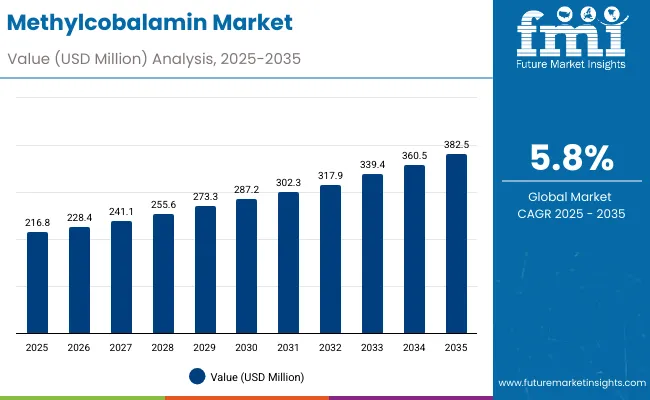
The methylcobalamin market is projected to reach USD 382.5 million by 2035, recording an absolute increase of USD 165.7 million over the forecast period. The market is valued at USD 216.8 million in 2025 and is set to rise at a CAGR of 5.8% during the assessment period. The overall market size is expected to grow by nearly 1.8 times during the same period, supported by increasing demand for bioactive vitamin B12 formulations and neurological health supplements worldwide, driving demand for pharmaceutical-grade methylcobalamin and increasing investments in dietary supplement applications and functional food fortification globally. However, supply chain constraints from active pharmaceutical ingredient manufacturing and regulatory compliance complexity may pose obstacles to market expansion.
Methylcobalamin represents the bioactive form of vitamin B12, demonstrating superior bioavailability and neurological benefits compared to synthetic cyanocobalamin alternatives. This naturally occurring coenzyme participates directly in cellular methylation reactions, supporting DNA synthesis, red blood cell formation, and myelin sheath maintenance. Unlike other B12 forms requiring metabolic conversion, methylcobalamin enters cells directly and contributes to neurotransmitter synthesis and homocysteine metabolism regulation.
Quick Stats for Methylcobalamin Market
- Methylcobalamin Market Value (2025): USD 216.8 million
- Methylcobalamin Market Forecast Value (2035): USD 382.5 million
- Methylcobalamin Market Forecast CAGR: 5.8%
- Leading Grade in Methylcobalamin Market: Pharmaceutical Grade
- Key Growth Regions in Methylcobalamin Market: Europe, North America, and South Asia & Pacific
- Top Players in Methylcobalamin Market: Northeast Pharmaceutical Group, Hebei Huarong Pharmaceutical, Yinghua Biotech, DishmanCarbogenAmcis, BASF
Methylcobalamin Market Key Takeaways
| Metric | Value |
|---|---|
| Market Value (2025) | USD 216.8 million |
| Market Forecast Value (2035) | USD 382.5 million |
| Forecast CAGR (2025 to 2035) | 5.8% |
Methylcobalamin Market Year-over-Year Forecast (2025-2035)
Manufacturing processes utilize advanced fermentation technologies and chemical synthesis methods to produce pharmaceutical-grade methylcobalamin meeting international quality standards. Fermentation approaches employ specialized bacterial strains under controlled conditions to generate natural methylcobalamin, while synthetic routes provide consistent supply availability for large-scale applications. Quality control systems ensure potency retention, stability maintenance, and contamination prevention throughout production and storage phases.
Pharmaceutical applications dominate methylcobalamin consumption through prescription formulations targeting neurological disorders, diabetic neuropathy, and vitamin B12 deficiency treatments. Injectable preparations provide rapid therapeutic intervention for severe deficiency cases and neurological complications. Oral pharmaceutical formulations offer convenient dosing options for maintenance therapy and preventive healthcare applications across diverse patient populations.
Between 2025 and 2030, the methylcobalamin market is projected to expand from USD 216.8 million to USD 287.2 million, resulting in a value increase of USD 70.4 million, which represents 42.5% of the total forecast growth for the decade. This phase of development will be shaped by rising demand for neurological health supplements and pharmaceutical applications, product innovation in bioavailable formulations and delivery systems, as well as expanding integration with functional food manufacturing and dietary supplement production. Companies are establishing competitive positions through investment in fermentation capabilities, advanced purification technologies, and strategic market expansion across pharmaceutical, nutraceutical, and food fortification applications.
From 2030 to 2035, the market is forecast to grow from USD 287.2 million to USD 382.5 million, adding another USD 95.3 million, which constitutes 57.5% of the overall ten-year expansion. This period is expected to be characterized by the expansion of specialized pharmaceutical applications, including advanced neurological treatments and next-generation therapeutic formulations tailored for specific health requirements, strategic collaborations between methylcobalamin producers and pharmaceutical companies, and an enhanced focus on high-purity standards and automated manufacturing protocols. The growing emphasis on personalized medicine and targeted nutritional therapies will drive demand for comprehensive methylcobalamin solutions across diverse therapeutic applications.
Why is the Methylcobalamin Market Growing?
The methylcobalamin market grows by enabling pharmaceutical manufacturers and supplement companies to optimize therapeutic formulations while accessing bioactive vitamin B12 without substantial in-house manufacturing infrastructure investment. Manufacturing companies and healthcare operators face mounting pressure to develop advanced neurological health products and specialized vitamin supplements while managing complex bioavailability requirements, with high-quality methylcobalamin typically providing 40-60% performance enhancement compared to conventional alternatives, making pharmaceutical-grade preparations essential for competitive market positioning.
The healthcare industry's need for bioactive vitamins and application-specific therapeutic capabilities creates demand for comprehensive methylcobalamin solutions that can provide superior efficacy, maintain consistent potency standards, and ensure reliable operation without compromising product safety or regulatory compliance.
Government initiatives promoting nutritional health and neurological disorder treatments drive adoption in pharmaceutical manufacturing, supplement production, and food fortification applications, where ingredient quality has a direct impact on therapeutic performance and health outcomes. However, supply complexity constraints during large-scale production projects and the expertise requirements for bioactive compound manufacturing may limit accessibility among smaller pharmaceutical companies and developing regions with limited technical infrastructure for advanced fermentation systems.
Segmental Analysis
The market is segmented by grade, form, application, sales channel, end user, and region. By grade, the market is divided into pharmaceutical grade, food grade, and feed grade. Based on form, the market is categorized into powder, liquid, and injectable. By application, the market includes dietary supplements, pharmaceuticals, fortified foods & beverages, and animal nutrition. By sales channel, the market encompasses B2B and B2C channels. By end user, the market is divided into adults, elderly, pregnant women, infants & children, and veterinary. Regionally, the market is divided into North America, Europe, East Asia, South Asia & Pacific, Latin America, and Middle East & Africa.
By Grade, the Pharmaceutical Grade Segment Accounts for a Dominant Market Share
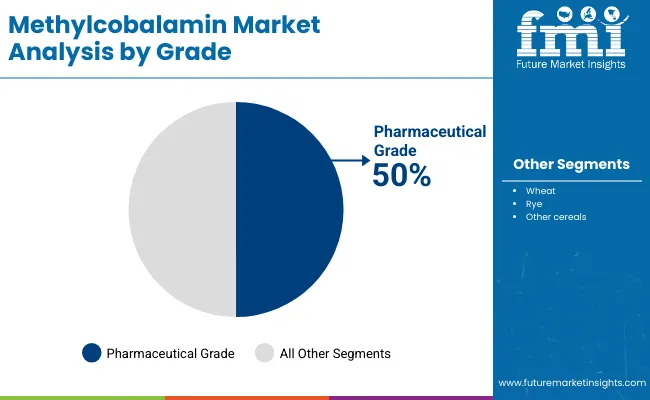
The pharmaceutical grade segment represents the dominant force in the methylcobalamin market, capturing approximately 50.0% of total market share in 2025. This established quality category encompasses solutions featuring advanced purification processes and specialized pharmaceutical applications, including high-performance therapeutic characteristics and enhanced bioavailability profiles that enable superior clinical benefits and treatment outcomes across all healthcare applications. The pharmaceutical grade segment's market leadership stems from its proven therapeutic capabilities, with formulations capable of addressing diverse medical requirements while maintaining consistent potency and processing effectiveness across all pharmaceutical environments.
The food grade segment maintains a substantial 45.0% market share, serving nutritional supplement applications that require safe consumption standards with consistent bioactivity for dietary supplement formulations and food fortification programs. The feed grade segment accounts for 5.0% market share through animal nutrition applications.
Key grade advantages driving the pharmaceutical grade segment include:
- Advanced purity standards with integrated quality control that enhances therapeutic effectiveness and ensures consistent clinical characteristics
- Established manufacturing processes allowing streamlined pharmaceutical workflows across different applications without extensive purification requirements
- Enhanced bioavailability capabilities enabling diverse dosage formats while maintaining compound integrity and therapeutic reliability
- Superior regulatory acceptance providing optimal therapeutic performance for various pharmaceutical applications
By Form, the Powder Segment Accounts for the Largest Market Share
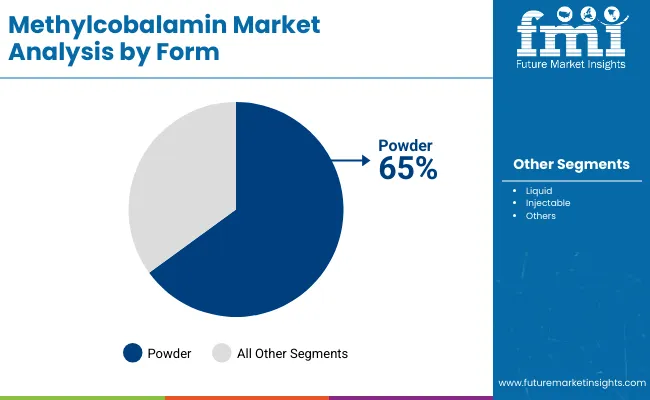
Powder applications dominate the methylcobalamin market with approximately 65.0% market share in 2025, reflecting the critical role of dry formulations in supporting specialized manufacturing processes and product development worldwide. The powder segment's market leadership is reinforced by increasing supplement manufacturing trends, processing convenience requirements, and rising needs for versatile formulation capabilities in production operations across developed and emerging markets.
The liquid segment represents the second-largest form category, capturing 20.0% market share through specialized applications requiring fluid formulations, beverage fortification, and direct consumption products. The injectable segment accounts for 15.0% market share, serving pharmaceutical applications requiring rapid therapeutic intervention and clinical treatment protocols.
Key market dynamics supporting form growth include:
- Powder expansion driven by manufacturing efficiency trends and processing convenience, requiring specialized dry formulation solutions in emerging supplement markets
- Pharmaceutical modernization trends require flexible, integrated delivery systems for competitive differentiation and therapeutic innovation development
- Integration of advanced processing technologies enabling enhanced formulation capabilities and automated production systems
- Growing emphasis on dosage precision driving demand for specialized, validated formulation solutions without traditional processing limitations
What are the Drivers, Restraints, and Key Trends of the Methylcobalamin Market?
The market is driven by three concrete demand factors tied to healthcare outcomes. First, neurological health awareness and aging population demographics create increasing demand for methylcobalamin supplements, with therapeutic benefit awareness growing 15-25% annually in major healthcare markets worldwide, requiring comprehensive pharmaceutical manufacturing infrastructure.
Second, government initiatives promoting nutritional health and vitamin deficiency prevention drive increased adoption of bioactive B12 compounds, with many countries implementing supplementation programs and regulatory frameworks for vitamin fortification advancement by 2030. Third, technological advancements in fermentation processes and purification systems enable more efficient and effective production methods that improve product quality while reducing manufacturing costs and processing complexity.
Market restraints include complex manufacturing requirements and validation costs for methylcobalamin production platforms that can challenge market participants in developing compliant manufacturing capabilities, particularly in regions where regulatory pathways for bioactive compounds remain evolving and uncertain. Technical complexity of fermentation systems and pharmaceutical grade requirements pose another challenge, as methylcobalamin demands sophisticated production methods and quality controls, potentially affecting production costs and operational efficiency. Supply chain constraints from limited manufacturing capacity across different regions create additional operational challenges for manufacturers, demanding ongoing investment in production infrastructure and quality assurance programs.
Key trends indicate accelerated adoption in European markets, particularly Germany and UK, where pharmaceutical innovation and health awareness drive comprehensive methylcobalamin adoption. Technology integration trends toward specialized fermentation systems with enhanced purity characteristics, advanced pharmaceutical applications, and integrated processing solutions enable effective manufacturing approaches that optimize production efficiency and minimize quality risks. However, the market thesis could face disruption if advances in alternative vitamin B12 forms or changes in therapeutic regulatory frameworks reduce reliance on traditional methylcobalamin applications.
Analysis of the Methylcobalamin Market by Key Country
| Countries | CAGR (%) |
|---|---|
| USA | 6.5 |
| UK | 6.1 |
| China | 5.9 |
| India | 5.8 |
| Germany | 5.1 |
| France | 5.0 |
| Brazil | 2.8 |
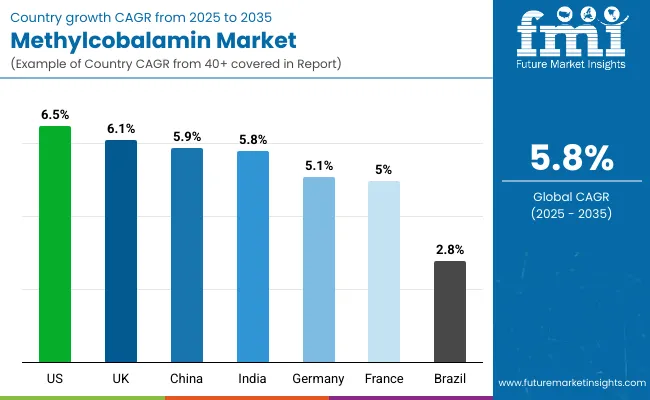
The global methylcobalamin market is expanding steadily, with USA leading at a 6.5% CAGR through 2035, driven by pharmaceutical innovation, health consciousness initiatives, and advanced supplement manufacturing platforms. UK follows at 6.1%, supported by pharmaceutical research and nutritional health development initiatives. China records 5.9%, reflecting established pharmaceutical manufacturing with growing integration in supplement applications. India advances at 5.8%, leveraging pharmaceutical capabilities and health awareness expansion. Germany post 5.1%, focusing on pharmaceutical research and therapeutic innovation, while Brazil grows at 2.8%, emphasizing traditional pharmaceutical applications.
USA Leads Global Market Expansion
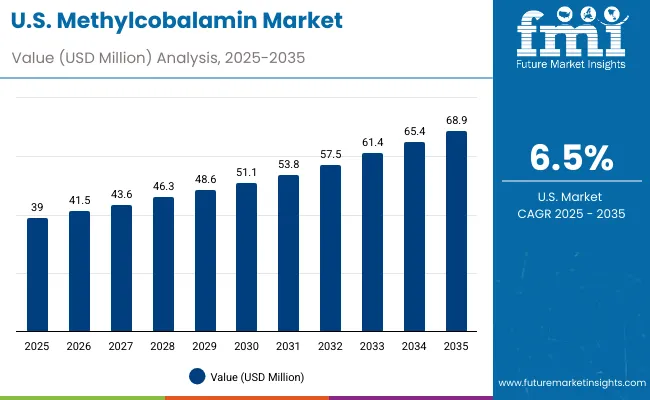
USA demonstrates the strongest growth potential in the methylcobalamin market with a CAGR of 6.5% through 2035. The country's leadership position stems from advanced pharmaceutical research capabilities, health consciousness trends, and comprehensive healthcare regulations driving the adoption of bioactive vitamin solutions. Growth is concentrated in major pharmaceutical and biotechnology centers, including California, Massachusetts, New Jersey, and North Carolina, where pharmaceutical companies and research institutions are implementing advanced methylcobalamin manufacturing systems for enhanced therapeutic capabilities and market performance.
Distribution channels through pharmaceutical networks and supplement retailers expand deployment across manufacturing projects and healthcare development initiatives. The country's FDA provides regulatory support for vitamin compound modernization, including comprehensive pharmaceutical development programs. Advanced nutraceutical industry infrastructure enables sophisticated product development for dietary supplements, functional foods, and specialized therapeutic formulations serving diverse consumer demographics.
UK Emerges as European Innovation Leader
UK demonstrates strong growth potential with a CAGR of 6.1% through 2035, driven by pharmaceutical excellence and advanced biotechnology research capabilities. Major pharmaceutical and research centers including London, Cambridge, Oxford, and Manchester showcase comprehensive methylcobalamin adoption across research projects and therapeutic development initiatives. The market demonstrates strong growth momentum linked to comprehensive pharmaceutical modernization and increasing focus on nutritional health solutions.
British companies are implementing advanced methylcobalamin processing systems and research platforms to enhance drug development performance while meeting growing demand in expanding pharmaceutical and nutraceutical manufacturing sectors. The country's health development initiatives create continued demand for bioactive vitamins, while increasing emphasis on therapeutic innovation drives adoption of advanced manufacturing systems.
China Shows Manufacturing Excellence
China's market expansion demonstrates strong growth potential with a CAGR of 5.9% through 2035, driven by pharmaceutical manufacturing expertise and established production capabilities. Major pharmaceutical centers in Beijing, Shanghai, Guangzhou, and Shenzhen implement comprehensive methylcobalamin manufacturing systems across production facilities and research institutions.
Chinese companies are adopting intelligent processing systems for quality improvement and production enhancement, particularly in regions with established pharmaceutical infrastructure and applications demanding comprehensive technology upgrades. Traditional pharmaceutical manufacturing provides established supply chain infrastructure, while modern facilities implement advanced fermentation and purification technologies for domestic and export markets. Government health initiatives support vitamin B12 supplementation programs, while pharmaceutical industry development creates continued demand for high-quality bioactive compounds.
India Demonstrates Growing Healthcare Focus
The India market shows strong growth potential with a CAGR of 5.8% through 2035, driven by healthcare awareness expansion and pharmaceutical industry development. Major pharmaceutical centers in Mumbai, Bangalore, Hyderabad, and Delhi implement comprehensive methylcobalamin solutions across manufacturing facilities and research institutions.
Indian companies are adopting advanced processing systems for quality improvement and therapeutic enhancement, particularly in regions with established pharmaceutical infrastructure and applications demanding comprehensive technology upgrades. FSSAI regulatory clarifications provide framework for methylcobalamin applications in dietary supplements and nutraceuticals, while traditional pharmaceutical expertise enables sophisticated manufacturing capabilities. Growing health consciousness and vitamin deficiency awareness drive adoption of bioactive B12 formulations across diverse consumer segments.
Germany Demonstrates Research Innovation
Germany demonstrates steady growth potential with a CAGR of 5.1% through 2035, driven by pharmaceutical research infrastructure and therapeutic innovation capabilities. German pharmaceutical centers in Bavaria, Baden-Württemberg, and North Rhine-Westphalia implement comprehensive methylcobalamin research programs across manufacturing facilities and research institutions. German companies benefit from established pharmaceutical industry with strong research partnerships, advanced quality standards, and regulatory frameworks supporting bioactive compound development. Technology deployment focuses on therapeutic applications and precision medicine initiatives that meet European pharmaceutical standards while addressing specific German healthcare market requirements.
France Shows Pharmaceutical Expertise
France's market expansion demonstrates steady growth potential with a CAGR of 5.0% through 2035, driven by pharmaceutical research excellence and therapeutic development capabilities. Major pharmaceutical regions including Île-de-France, Rhône-Alpes, and Provence-Alpes-Côte d'Azur implement comprehensive methylcobalamin research programs across pharmaceutical facilities and research institutions. French companies benefit from established pharmaceutical infrastructure with strong academic partnerships, advanced regulatory frameworks, and government support for therapeutic innovation development. Technology deployment emphasizes precision medicine applications and specialized therapeutic formulations serving European and international markets.
Brazil Shows Traditional Applications
Brazil's methylcobalamin market demonstrates established pharmaceutical landscape with a CAGR of 2.8% through 2035, characterized by traditional pharmaceutical applications and regional market development. The country's moderate growth reflects established market patterns focused on basic pharmaceutical uses rather than advanced therapeutic applications. Major pharmaceutical regions including São Paulo, Rio de Janeiro, and Minas Gerais maintain traditional manufacturing systems serving domestic markets through established distribution channels. Processing facilities focus on regional pharmaceutical applications while modern therapeutic development remains limited compared to developed markets.
Competitive Landscape
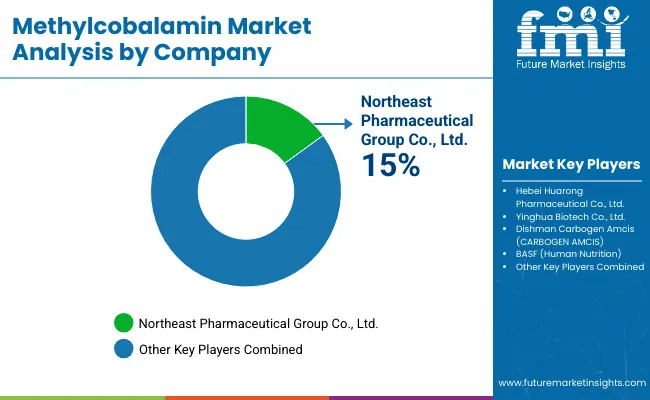
The methylcobalamin (mecobalamin) market is supplied by dozens of API and ingredient manufacturers, but bulk volumes are heavily concentrated in a small group of Chinese and European producers that specialise in vitamin B₁₂ and its active forms. Public data indicate that Hebei Huarong Pharmaceutical Co., Ltd. (CSPC Group) alone accounts for a very large share of global mecobalamin output, with strong positions also held by other Chinese vitamin B₁₂ houses and a handful of Indian and European API specialists.
Competition is driven far more by purity profile, regulatory status (DMFs, CEPs, Halal/Kosher, FAMI-QS) and consistency of supply than by pure price. Leading suppliers differentiate through validated fermentation and purification processes, multi-pharmacopeia compliance (USP, JP, EP), and the ability to service pharmaceutical, nutraceutical, and feed customers with technical documentation and audit-ready quality systems.
At the API and bulk ingredient level, companies such as Hebei Huarong Pharmaceutical, North China Pharmaceutical Huasheng, SupriyaLifescience, Mahima Life Sciences, and HealthTechBioActives (HTBA) act as core suppliers for finished-dosage manufacturers worldwide. These firms maintain scale advantages via long-running fermentation know-how, integrated vitamin B₁₂ portfolios (cyanocobalamin, hydroxocobalamin, adenosylcobalamin and mecobalamin), and deep experience in global regulatory filings.
Downstream, major nutrition and vitamin houses such as BASF Human Nutrition focus more on formulated premixes and branded dietary supplements rather than high-volume methylcobalamin API alone, using a mix of internal production and sourced APIs.
Regional and smaller manufacturers in India, China, and Europe compete by targeting specific use-cases (neuropathy formulations, high-strength nutraceutical tablets, functional foods) or by offering flexible MOQs and contract customisation. Growth in pharmaceutical neuropathy indications, vegan B₁₂ supplementation, and fortified functional foods continues to pull demand into North America, Europe, and parts of Asia, favouring suppliers that can guarantee long-term, compliant supply rather than just lowest-cost material.
Key Players in the Methylcobalamin Market
- Hebei Huarong Pharmaceutical Co., Ltd. (CSPC Group)
- North China Pharmaceutical Huasheng Co., Ltd.
- SupriyaLifescience Ltd.
- Mahima Life Sciences Pvt. Ltd.
- HealthTechBioActives (HTBA)
- BASF SE (Human Nutrition)
Scope of the Report
| Items | Values |
|---|---|
| Quantitative Units (2025) | USD 216.8 Million |
| Grade | Pharmaceutical Grade, Food Grade, Feed Grade |
| Form | Powder, Liquid, Injectable |
| Application | Dietary Supplements (Tablets, Capsules, Gummies, Powders), Pharmaceuticals (Injectable B12, Prescription Neurotonics, Combination Therapies), Fortified Foods & Beverages (Functional Beverages, Breakfast Cereals, Nutritional Bars), Animal Nutrition (Companion Animal Supplements, Livestock Feed Additives) |
| Sales Channel | B2B (Ingredient Supply to Manufacturers), B2C (Online Retail, Pharmacy Chains, Specialty Health Stores) |
| End User | Adults, Elderly, Pregnant Women, Infants & Children, Veterinary |
| Regions Covered | North America, Europe, East Asia, South Asia & Pacific, Latin America, Middle East & Africa |
| Countries Covered | China, India, Germany, France, UK, USA, Brazil, South Korea, Japan, and 40+ countries |
| Key Companies Profiled | Northeast Pharmaceutical Group Co., Ltd., Hebei Huarong Pharmaceutical Co., Ltd., Yinghua Biotech Co., Ltd., Dishman Carbogen Amcis (CARBOGEN AMCIS), BASF (Human Nutrition) |
| Additional Attributes | Dollar sales by grade and form categories, regional adoption trends across Europe, North America, and South Asia & Pacific, competitive landscape with methylcobalamin providers and pharmaceutical companies, manufacturing facility requirements and specifications, integration with pharmaceutical initiatives and supplement platforms. |
Methylcobalamin Market by Segments
By Grade:
- Pharmaceutical Grade
- Food Grade
- Feed Grade
By Form:
- Powder
- Liquid
- Injectable
By Application:
- Dietary Supplements
- Tablets
- Capsules
- Gummies
- Powders
- Pharmaceuticals
- Injectable B12
- Prescription Neurotonics
- Combination Therapies
- Fortified Foods & Beverages
- Functional Beverages
- Breakfast Cereals
- Nutritional Bars
- Animal Nutrition
- Companion Animal Supplements
- Livestock Feed Additives
By Sales Channel:
- B2B (Ingredient Supply to Manufacturers)
- B2C
- Online Retail
- Pharmacy Chains
- Specialty Health Stores
By End User:
- Adults
- Elderly
- Pregnant Women
- Infants & Children
- Veterinary
By Region:
- North America
- United States
- Canada
- Mexico
- Europe
- Germany
- United Kingdom
- France
- Italy
- Spain
- Nordic
- BENELUX
- Rest of Europe
- East Asia
- China
- Japan
- South Korea
- Rest of East Asia
- South Asia & Pacific
- India
- Australia & New Zealand
- ASEAN
- Rest of South Asia & Pacific
- Latin America
- Brazil
- Argentina
- Rest of Latin America
- Middle East & Africa
- Kingdom of Saudi Arabia
- Other GCC Countries
- Turkey
- South Africa
- Other African Union
- Rest of Middle East & Africa
Frequently Asked Questions
How big is the methylcobalamin market in 2025?
The global methylcobalamin market is estimated to be valued at USD 216.8 million in 2025.
What will be the size of the methylcobalamin market in 2035?
The market size for the methylcobalamin market is projected to reach USD 382.5 million by 2035.
How much will be the methylcobalamin market growth between 2025 and 2035?
The methylcobalamin market is expected to grow at a 5.8% CAGR between 2025 and 2035.
What are the key product types in the methylcobalamin market?
The key product types in the methylcobalamin market are pharmaceutical grade, food grade, and feed grade methylcobalamin.
Which application segment to contribute significant share in the methylcobalamin market in 2025?
In terms of application, the dietary supplements segment is expected to contribute a significant share in the methylcobalamin market in 2025.
Preview the report firsthand - request a free sample
Get SampleGet the brochure for pricing and purchase details.
Get PDFTable of Content
- Executive Summary
- Global Market Outlook
- Demand-side Trends
- Supply-side Trends
- Technology Roadmap Analysis
- Analysis and Recommendations
- Market Overview
- Market Coverage / Taxonomy
- Market Definition / Scope / Limitations
- Market Background
- Market Dynamics
- Drivers
- Restraints
- Opportunity
- Trends
- Scenario Forecast
- Demand in Optimistic Scenario
- Demand in Likely Scenario
- Demand in Conservative Scenario
- Opportunity Map Analysis
- Product Life Cycle Analysis
- Supply Chain Analysis
- Investment Feasibility Matrix
- Value Chain Analysis
- PESTLE and Porter’s Analysis
- Regulatory Landscape
- Regional Parent Market Outlook
- Production and Consumption Statistics
- Import and Export Statistics
- Market Dynamics
- Global Market Analysis 2020 to 2024 and Forecast, 2025 to 2035
- Historical Market Size Value (USD Million) Analysis, 2020 to 2024
- Current and Future Market Size Value (USD Million) Projections, 2025 to 2035
- Y-o-Y Growth Trend Analysis
- Absolute $ Opportunity Analysis
- Global Market Pricing Analysis 2020 to 2024 and Forecast 2025 to 2035
- Global Market Analysis 2020 to 2024 and Forecast 2025 to 2035, By Grade
- Introduction / Key Findings
- Historical Market Size Value (USD Million) Analysis By Grade , 2020 to 2024
- Current and Future Market Size Value (USD Million) Analysis and Forecast By Grade , 2025 to 2035
- Pharmaceutical Grade
- Food Grade
- Feed Grade
- Y-o-Y Growth Trend Analysis By Grade , 2020 to 2024
- Absolute $ Opportunity Analysis By Grade , 2025 to 2035
- Global Market Analysis 2020 to 2024 and Forecast 2025 to 2035, By Form
- Introduction / Key Findings
- Historical Market Size Value (USD Million) Analysis By Form, 2020 to 2024
- Current and Future Market Size Value (USD Million) Analysis and Forecast By Form, 2025 to 2035
- Powder
- Liquid
- Injectable
- Y-o-Y Growth Trend Analysis By Form, 2020 to 2024
- Absolute $ Opportunity Analysis By Form, 2025 to 2035
- Global Market Analysis 2020 to 2024 and Forecast 2025 to 2035, By Application
- Introduction / Key Findings
- Historical Market Size Value (USD Million) Analysis By Application, 2020 to 2024
- Current and Future Market Size Value (USD Million) Analysis and Forecast By Application, 2025 to 2035
- Dietary Supplements
- Tablets
- Capsules
- Gummies
- Powders
- Pharmaceuticals
- Injectable B12
- Prescription Neurotonics
- Combination Therapies
- Fortified Foods & Beverages
- Functional Beverages
- Breakfast Cereals
- Nutritional Bars
- Animal Nutrition
- Companion Animal Supplements
- Livestock Feed Additives
- Dietary Supplements
- Y-o-Y Growth Trend Analysis By Application, 2020 to 2024
- Absolute $ Opportunity Analysis By Application, 2025 to 2035
- Global Market Analysis 2020 to 2024 and Forecast 2025 to 2035, By Sales Channel
- Introduction / Key Findings
- Historical Market Size Value (USD Million) Analysis By Sales Channel, 2020 to 2024
- Current and Future Market Size Value (USD Million) Analysis and Forecast By Sales Channel, 2025 to 2035
- B2B (Ingredient Supply to Manufacturers)
- B2C
- Online Retail
- Pharmacy Chains
- Specialty Health Stores
- Y-o-Y Growth Trend Analysis By Sales Channel, 2020 to 2024
- Absolute $ Opportunity Analysis By Sales Channel, 2025 to 2035
- Global Market Analysis 2020 to 2024 and Forecast 2025 to 2035, By End User
- Introduction / Key Findings
- Historical Market Size Value (USD Million) Analysis By End User, 2020 to 2024
- Current and Future Market Size Value (USD Million) Analysis and Forecast By End User, 2025 to 2035
- Adults
- Elderly
- Pregnant Women
- Infants & Children
- Veterinary
- Y-o-Y Growth Trend Analysis By End User, 2020 to 2024
- Absolute $ Opportunity Analysis By End User, 2025 to 2035
- Global Market Analysis 2020 to 2024 and Forecast 2025 to 2035, By Region
- Introduction
- Historical Market Size Value (USD Million) Analysis By Region, 2020 to 2024
- Current Market Size Value (USD Million) Analysis and Forecast By Region, 2025 to 2035
- North America
- Latin America
- Western Europe
- Eastern Europe
- East Asia
- South Asia and Pacific
- Middle East & Africa
- Market Attractiveness Analysis By Region
- North America Market Analysis 2020 to 2024 and Forecast 2025 to 2035, By Country
- Historical Market Size Value (USD Million) Trend Analysis By Market Taxonomy, 2020 to 2024
- Market Size Value (USD Million) Forecast By Market Taxonomy, 2025 to 2035
- By Country
- USA
- Canada
- Mexico
- By Grade
- By Form
- By Application
- By Sales Channel
- By End User
- By Country
- Market Attractiveness Analysis
- By Country
- By Grade
- By Form
- By Application
- By Sales Channel
- By End User
- Key Takeaways
- Latin America Market Analysis 2020 to 2024 and Forecast 2025 to 2035, By Country
- Historical Market Size Value (USD Million) Trend Analysis By Market Taxonomy, 2020 to 2024
- Market Size Value (USD Million) Forecast By Market Taxonomy, 2025 to 2035
- By Country
- Brazil
- Argentina
- Chile
- Rest of Latin America
- By Grade
- By Form
- By Application
- By Sales Channel
- By End User
- By Country
- Market Attractiveness Analysis
- By Country
- By Grade
- By Form
- By Application
- By Sales Channel
- By End User
- Key Takeaways
- Western Europe Market Analysis 2020 to 2024 and Forecast 2025 to 2035, By Country
- Historical Market Size Value (USD Million) Trend Analysis By Market Taxonomy, 2020 to 2024
- Market Size Value (USD Million) Forecast By Market Taxonomy, 2025 to 2035
- By Country
- Germany
- UK
- Italy
- Spain
- France
- Nordic
- BENELUX
- Rest of Western Europe
- By Grade
- By Form
- By Application
- By Sales Channel
- By End User
- By Country
- Market Attractiveness Analysis
- By Country
- By Grade
- By Form
- By Application
- By Sales Channel
- By End User
- Key Takeaways
- Eastern Europe Market Analysis 2020 to 2024 and Forecast 2025 to 2035, By Country
- Historical Market Size Value (USD Million) Trend Analysis By Market Taxonomy, 2020 to 2024
- Market Size Value (USD Million) Forecast By Market Taxonomy, 2025 to 2035
- By Country
- Russia
- Poland
- Hungary
- Balkan & Baltic
- Rest of Eastern Europe
- By Grade
- By Form
- By Application
- By Sales Channel
- By End User
- By Country
- Market Attractiveness Analysis
- By Country
- By Grade
- By Form
- By Application
- By Sales Channel
- By End User
- Key Takeaways
- East Asia Market Analysis 2020 to 2024 and Forecast 2025 to 2035, By Country
- Historical Market Size Value (USD Million) Trend Analysis By Market Taxonomy, 2020 to 2024
- Market Size Value (USD Million) Forecast By Market Taxonomy, 2025 to 2035
- By Country
- China
- Japan
- South Korea
- By Grade
- By Form
- By Application
- By Sales Channel
- By End User
- By Country
- Market Attractiveness Analysis
- By Country
- By Grade
- By Form
- By Application
- By Sales Channel
- By End User
- Key Takeaways
- South Asia and Pacific Market Analysis 2020 to 2024 and Forecast 2025 to 2035, By Country
- Historical Market Size Value (USD Million) Trend Analysis By Market Taxonomy, 2020 to 2024
- Market Size Value (USD Million) Forecast By Market Taxonomy, 2025 to 2035
- By Country
- India
- ASEAN
- Australia & New Zealand
- Rest of South Asia and Pacific
- By Grade
- By Form
- By Application
- By Sales Channel
- By End User
- By Country
- Market Attractiveness Analysis
- By Country
- By Grade
- By Form
- By Application
- By Sales Channel
- By End User
- Key Takeaways
- Middle East & Africa Market Analysis 2020 to 2024 and Forecast 2025 to 2035, By Country
- Historical Market Size Value (USD Million) Trend Analysis By Market Taxonomy, 2020 to 2024
- Market Size Value (USD Million) Forecast By Market Taxonomy, 2025 to 2035
- By Country
- Kingdom of Saudi Arabia
- Other GCC Countries
- Turkiye
- South Africa
- Other African Union
- Rest of Middle East & Africa
- By Grade
- By Form
- By Application
- By Sales Channel
- By End User
- By Country
- Market Attractiveness Analysis
- By Country
- By Grade
- By Form
- By Application
- By Sales Channel
- By End User
- Key Takeaways
- Key Countries Market Analysis
- USA
- Pricing Analysis
- Market Share Analysis, 2024
- By Grade
- By Form
- By Application
- By Sales Channel
- By End User
- Canada
- Pricing Analysis
- Market Share Analysis, 2024
- By Grade
- By Form
- By Application
- By Sales Channel
- By End User
- Mexico
- Pricing Analysis
- Market Share Analysis, 2024
- By Grade
- By Form
- By Application
- By Sales Channel
- By End User
- Brazil
- Pricing Analysis
- Market Share Analysis, 2024
- By Grade
- By Form
- By Application
- By Sales Channel
- By End User
- Argentina
- Pricing Analysis
- Market Share Analysis, 2024
- By Grade
- By Form
- By Application
- By Sales Channel
- By End User
- Chile
- Pricing Analysis
- Market Share Analysis, 2024
- By Grade
- By Form
- By Application
- By Sales Channel
- By End User
- Germany
- Pricing Analysis
- Market Share Analysis, 2024
- By Grade
- By Form
- By Application
- By Sales Channel
- By End User
- UK
- Pricing Analysis
- Market Share Analysis, 2024
- By Grade
- By Form
- By Application
- By Sales Channel
- By End User
- Italy
- Pricing Analysis
- Market Share Analysis, 2024
- By Grade
- By Form
- By Application
- By Sales Channel
- By End User
- Spain
- Pricing Analysis
- Market Share Analysis, 2024
- By Grade
- By Form
- By Application
- By Sales Channel
- By End User
- France
- Pricing Analysis
- Market Share Analysis, 2024
- By Grade
- By Form
- By Application
- By Sales Channel
- By End User
- India
- Pricing Analysis
- Market Share Analysis, 2024
- By Grade
- By Form
- By Application
- By Sales Channel
- By End User
- ASEAN
- Pricing Analysis
- Market Share Analysis, 2024
- By Grade
- By Form
- By Application
- By Sales Channel
- By End User
- Australia & New Zealand
- Pricing Analysis
- Market Share Analysis, 2024
- By Grade
- By Form
- By Application
- By Sales Channel
- By End User
- China
- Pricing Analysis
- Market Share Analysis, 2024
- By Grade
- By Form
- By Application
- By Sales Channel
- By End User
- Japan
- Pricing Analysis
- Market Share Analysis, 2024
- By Grade
- By Form
- By Application
- By Sales Channel
- By End User
- South Korea
- Pricing Analysis
- Market Share Analysis, 2024
- By Grade
- By Form
- By Application
- By Sales Channel
- By End User
- Russia
- Pricing Analysis
- Market Share Analysis, 2024
- By Grade
- By Form
- By Application
- By Sales Channel
- By End User
- Poland
- Pricing Analysis
- Market Share Analysis, 2024
- By Grade
- By Form
- By Application
- By Sales Channel
- By End User
- Hungary
- Pricing Analysis
- Market Share Analysis, 2024
- By Grade
- By Form
- By Application
- By Sales Channel
- By End User
- Kingdom of Saudi Arabia
- Pricing Analysis
- Market Share Analysis, 2024
- By Grade
- By Form
- By Application
- By Sales Channel
- By End User
- Turkiye
- Pricing Analysis
- Market Share Analysis, 2024
- By Grade
- By Form
- By Application
- By Sales Channel
- By End User
- South Africa
- Pricing Analysis
- Market Share Analysis, 2024
- By Grade
- By Form
- By Application
- By Sales Channel
- By End User
- USA
- Market Structure Analysis
- Competition Dashboard
- Competition Benchmarking
- Market Share Analysis of Top Players
- By Regional
- By Grade
- By Form
- By Application
- By Sales Channel
- By End User
- Competition Analysis
- Competition Deep Dive
- Northeast Pharmaceutical Group Co., Ltd.
- Overview
- Product Portfolio
- Profitability by Market Segments (Product/Age /Sales Channel/Region)
- Sales Footprint
- Strategy Overview
- Marketing Strategy
- Product Strategy
- Channel Strategy
- Hebei Huarong Pharmaceutical Co., Ltd.
- Yinghua Biotech Co., Ltd.
- Dishman Carbogen Amcis (CARBOGEN AMCIS)
- BASF (Human Nutrition)
- Northeast Pharmaceutical Group Co., Ltd.
- Competition Deep Dive
- Assumptions & Acronyms Used
- Research Methodology


