

- Industry Size (2026)
- USD 98 Mn
- Forecast (2036)
- USD 232 Mn
- CAGR (2026 to 2036)
- 9.0%
Yeast-Derived Vitamin B12 Methylcobalamin Size, Market Forecast and Outlook By FMI
In 2025, the yeast-derived vitamin B12 methylcobalamin market surpassed a value of USD 90.0 million and is projected to reach USD 98.0 million in 2026 and USD 232.0 million by 2036, reflecting a CAGR of 9.0%, with momentum tied to clinical adoption of bioavailable vegan formats. Formulators prioritize active configurations to bypass conversion steps required by cyanocobalamin alternatives. According to FMI's estimates, procurement concentrates on natural fermentation substrates to resolve clinical gaps without animal precursors, directly boosting the quality of vegan supplements.
Demand for yeast-derived vitamin B12 methylcobalamin is rising as nutraceutical and functional food manufacturers prioritize fermentation-based, vegan-compatible micronutrients. Microbial production enables scalable supply and consistent purity for pharmaceutical and supplement applications. Expansion of plant-based diets, fortified foods, and biotechnology-driven fermentation processes continues to strengthen procurement demand for high-quality methylcobalamin ingredients globally.
Summary of Yeast-Derived Vitamin B12 Methylcobalamin Market
- Yeast-Derived Vitamin B12 Methylcobalamin Definition
- Commercial production comprises highly bioavailable, vegan-compliant active B12 ingredients utilized for premium nutritional fortification.
- Demand Drivers in the Market
- Escalating clinical diagnostic rates expose widespread physiological population deficiencies.
- Formulators pivot to active coenzyme forms to guarantee immediate cellular absorption.
- Consumer preference forces manufacturer elimination of animal-derived chemical precursors.
- Key Segments Analyzed in the FMI Report
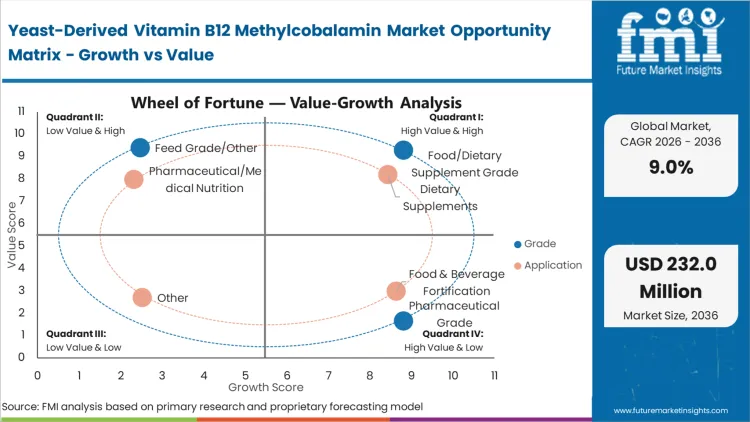
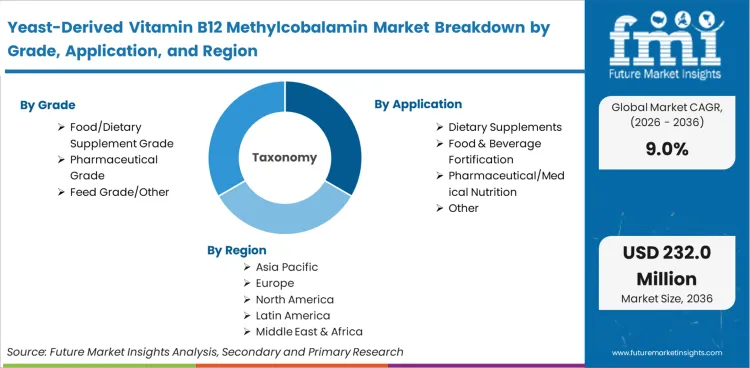
- Grade: Food/Dietary Supplement Grade, Pharmaceutical Grade, Feed Grade/Other.
- Application: Dietary Supplements, Food & Beverage Fortification, Pharmaceutical/Medical Nutrition, Other.
- Region: North America, Latin America, Europe, East Asia, South Asia, Oceania, Middle East & Africa.
- Analyst Opinion at FMI
- Nandini Roy Choudhury, Consultant for Food & Beverage at Future Market Insights, opines, “In the 2026 to 2036 outlook for Yeast-Derived Vitamin B12 Methylcobalamin, food manufacturers must prepare for a decisive shift toward naturally fermented micronutrients in fortification strategies. My assessment indicates that clean-label positioning and bioavailability-backed claims will increasingly influence procurement decisions across functional beverages, plant-based dairy alternatives, and fortified staples. As vegan and flexitarian populations expand, yeast-derived methylcobalamin will move from niche supplementation to mainstream nutritional enrichment. Brands that secure transparent sourcing partnerships and regulatory-compliant labeling will gain a premium edge in a highly credibility-driven food ecosystem.”
- Strategic Implications/Executive Takeaways
- Scale dedicated fermentation infrastructure to capture premium dietary supplement contracts.
- Secure clinical dossiers to validate bioavailability claims for pharmaceutical buyers.
- Establish localized warehousing to compress lead times for food fortification partners.
- Methodology
- Validated through first-hand corporate production and capacity data.
- Zero reliance on speculative third-party market research reports.
- Based on verifiable industrial benchmarks and verified sources.
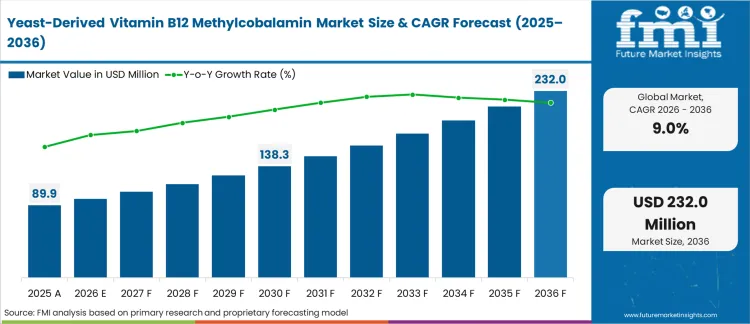
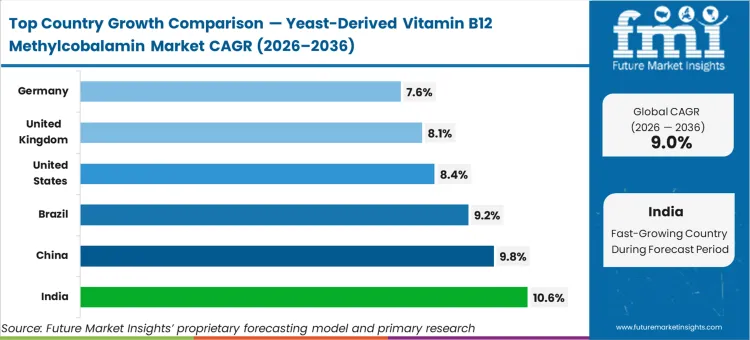
Across global corridors, growth concentrates where diagnostic expansion aligns with nutritional intervention. Country dispersion skews toward India (10.6% CAGR), China (9.8% CAGR), Brazil (9.2% CAGR), United States (8.4% CAGR), United Kingdom (8.1% CAGR), and Germany (7.6% CAGR). Rising testing frequencies compel regional healthcare infrastructures to secure scalable plant-based formulations.
Yeast-Derived Vitamin B12 Methylcobalamin Market Key Takeaways
| Metric | Details |
|---|---|
| Industry Size (2026) | USD 98 Million |
| Industry Value (2036) | USD 232 Million |
| CAGR (2026-2036) | 9.0% |
Yeast-Derived Vitamin B12 Methylcobalamin Market Definition
Yeast-derived vitamin B12 methylcobalamin refers to the active coenzyme form of vitamin B12 produced through controlled microbial fermentation using selected bacterial or yeast-based biological systems cultivated on nutrient substrates. The resulting compound is converted and purified into methylcobalamin, a bioactive form of vitamin B12 recognized for supporting neurological function, DNA synthesis, and red blood cell production. Commercial supply focuses on non-animal-sourced vitamin ingredients widely utilized in nutraceutical formulations, medical nutrition products, and specialized dietary supplements.
Yeast-Derived Vitamin B12 Methylcobalamin Market Inclusions
The scope includes methylcobalamin ingredients manufactured through microbial fermentation and subsequent conversion processes designed for nutritional or pharmaceutical use. Covered product formats include stabilized dry powders, crystalline extracts, liquid concentrates, and standardized vitamin premix ingredients incorporated into dietary supplements, fortified foods, clinical nutrition products, and pharmaceutical formulations. Revenue assessment captures bulk ingredient sales supplied to nutraceutical manufacturers, pharmaceutical producers, functional beverage developers, and dietary supplement formulators.
Yeast-Derived Vitamin B12 Methylcobalamin Market Exclusions
The analysis excludes finished consumer products containing vitamin B12 such as packaged beverages, energy drinks, nutrition bars, capsules, or ready-to-consume supplement products, as the focus remains on upstream ingredient production and supply. Vitamin B12 variants including cyanocobalamin and hydroxocobalamin that do not represent the methylcobalamin molecular structure fall outside the defined scope. Chemically synthesized vitamin compounds produced solely through petrochemical pathways without microbial fermentation are not considered within the market boundary.
Yeast-Derived Vitamin B12 Methylcobalamin Research Methodology
- Primary Research: Interviews with fermentation operators and procurement stakeholders support supply-side assumptions and buying criteria.
- Desk Research: Peer-reviewed clinical nutrition literature and publicly available health surveillance datasets inform regional deficiency estimates.
- Market-Sizing and Forecasting: Bottom-up modeling uses capacity proxies and utilization assumptions, aligned with regional supplement demand indicators.
- Data Validation and Update Cycle: Estimates are triangulated using trade statistics where classification permits, supplier disclosures, and periodic model refreshes.
Segmental Analysis
Yeast-Derived Vitamin B12 Methylcobalamin Analysis by Grade
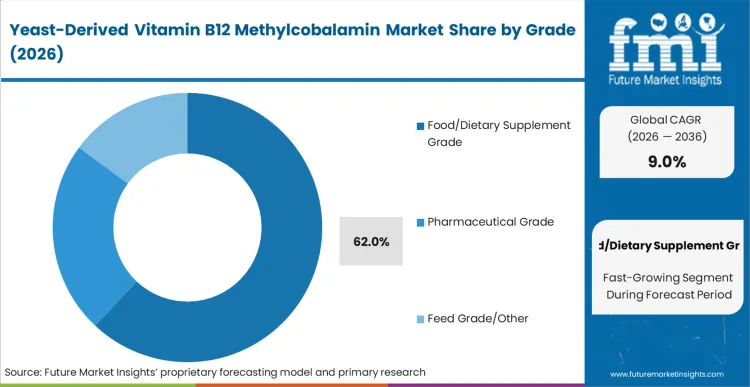
Food/Dietary Supplement Grade commands 62% of the sector in 2026. Formulators favor this specification to balance purity needs and scalable costs. Label scrutiny and brand standards are encouraging shifts toward fermentation-derived B12 inputs. Producers are improving downstream purification and quality controls to meet food safety specifications while managing processing costs and capex intensity.
- Procurement trigger: NHANES-based estimates indicate that approximately 3.6% of U.S. adults aged 19 and older have vitamin B12 deficiency (serum B12 <200 pg/mL), with deficiency rates reaching above 5% in select demographic subgroups [Zhou X et al., Am J Clin Nutr, 2023; NHANES 2007-2018]. In response to this documented shortfall, nutrition brands are increasingly reformulating with active coenzyme grades (methylcobalamin, adenosylcobalamin) to ensure potency is maintained and label claims are guaranteed through end of shelf life.
- Formulation shift: Liquid absorption properties dictate grade selection for novel delivery formats, increasing reliance on vitamin yeast extracts. Facilities standardize extraction protocols to satisfy precise solubility metrics.
- Regulatory signal: Health authorities scrutinize synthetic analogs in infant and specialized nutrition, pushing regulators to codify active methylcobalamin as a preferred active substrate. Manufacturers realign portfolios to ensure compliance with updated pharmacopeial monographs.
Yeast-Derived Vitamin B12 Methylcobalamin Analysis by Application
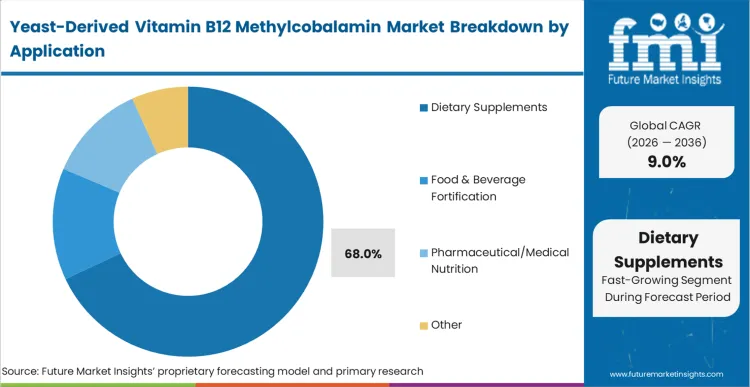
Dietary Supplements capture 68% of application demand in 2026. Brands require bioactive inputs to differentiate premium offerings in crowded retail spaces. Clinical review in September 2025 noted that vegan diets and metformin use represent significant risk factors for B12 shortfalls [5]. Pill fatigue accelerates adoption of alternative formats like gummies and sublingual patches. Consumer preference for immediate cognitive benefits reinforces necessity for active coenzymes across daily wellness and active aging lines.
- Buyer priority: Brands emphasize clean-label, non-animal vitamin sourcing. Procurement teams favor fermentation-based methylcobalamin for consistent quality and traceability. Demand rises across daily wellness, active aging, and plant-forward nutrition lines.
- Technology shift: Processing improvements protect active vitamin integrity during blending, tableting, and filling. Better stability reduces potency loss during storage and distribution. Manufacturers target tighter lot-to-lot uniformity and fewer formulation adjustments.
- Supply-side move: Ingredient producers scale fermentation, purification, and standardized premix capabilities. Suppliers offer customized B12 strengths and blended B-complex concentrates for contract manufacturers. Longer contract cycles support predictable lead times and inventory planning.
Yeast-Derived Vitamin B12 Methylcobalamin Drivers, Restraints, and Opportunities
Diagnostic infrastructure expansion propels fundamental ingredient demand. Pathology networks report massive testing surges, directly translating into physician-directed supplementation protocols. Medical practitioners increasingly specify active methylcobalamin to bypass metabolic bottlenecks observed in aging populations, creating a rigid procurement mandate for highly bioavailable vitamin B12 ingredient formats.
Production scaling barriers temporarily constrain rapid volume expansion. Specialized fermentation of active coenzymes requires precise bioreactor controls and complex downstream purification, creating elevated capital thresholds for new entrants.
- Formulation upgrade: Functional food and dairy-alternative brands prefer vegan-suitable, fermentation-derived B12 inputs that support clean-label positioning and consistent fortification across batches.
- Clinical integration: Medical nutrition and supplement formulators lean toward active B12 forms to align with practitioner-led protocols focused on neurological support and reliable utilization.
- Performance positioning: Sports and wellness brands use methylcobalamin to differentiate energy and cognition-oriented products, supporting premium claims within compliant labeling frameworks.
Regional Analysis
Based on the regional analysis, the Yeast-Derived Vitamin B12 Methylcobalamin market is segmented into North America, Latin America, Europe, East Asia, South Asia, Oceania and Middle East & Africa across 40+ countries. The full report also offers market attractiveness analysis based on regional trends.
.webp "Top Country Growth Comparison Yeast Derived Vitamin B12 Methylcobalamin Market Cagr (2026 2036)")
| Country | CAGR (2026 to 2036) |
|---|---|
| India | 10.6% |
| China | 9.8% |
| Brazil | 9.2% |
| United States | 8.4% |
| United Kingdom | 8.1% |
| Germany | 7.6% |
Source: Future Market Insights (FMI) analysis, based on proprietary forecasting model and primary research
Asia Pacific Yeast-Derived Vitamin B12 Methylcobalamin Analysis
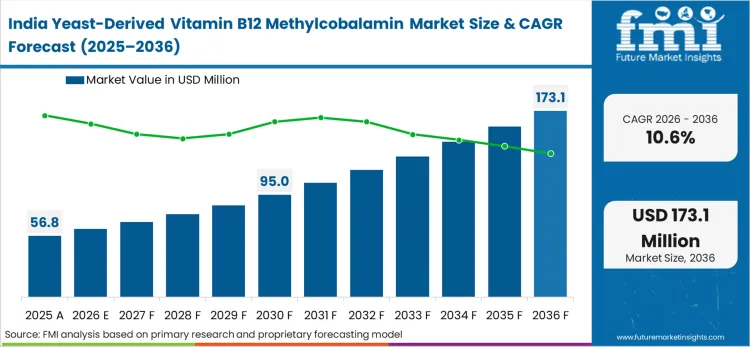
Asia Pacific exhibits rapid adoption driven by expanding middle-class demographics and escalating health awareness. Formulators pivot toward active Aemia treatment formats to serve aging populations with impaired absorption capabilities. According to FMI's estimates, regional mega-factories prioritize powder formats to execute stable transit across fragmented distribution networks.
- India: Demand for yeast-derived vitamin B12 methylcobalamin in India is anticipated to grow at 10.6% CAGR through 2036, supported by widespread vegetarianism before procurement cycles translate into higher fortification volumes.
- China: Sales of yeast-derived vitamin B12 methylcobalamin in China are projected to rise at 9.8% CAGR from 2026 to 2036 as geriatric population metrics compel preventative care, creating a clearer pathway from policy intent to purchase orders.
FMI’s report includes an extensive evaluation of Asia Pacific dynamics. Regional analysis covers Japan, South Korea, and Indonesia, highlighting targeted elder-care nutrition protocols. Buyers monitor Chinese export capacities, as localized bioreactor expansions dictate global spot pricing.
North America Yeast-Derived Vitamin B12 Methylcobalamin Analysis
North America relies on mature diagnostic networks identifying subclinical deficiencies across adult populations. As per FMI's projection, formulation teams secure high-grade methylcobalamin to satisfy rigorous clean-label consumer scrutiny. Integration of bio-active compounds into daily wellness routines sustains elevated baseline consumption across the region.
- United States: The United States yeast-derived vitamin B12 methylcobalamin sector is poised to expand at 8.4% CAGR during 2026 to 2036 because extensive clinical testing exposes hidden shortfalls, which lifts utilization rates and justifies technology refresh decisions. Pernicious anemia in the United States is reported at 151 per 100,000, and vitamin B12 therapy commonly uses injections, while very high-dose oral regimens are used in selected cases [3].
FMI’s report includes detailed coverage of North American procurement trends. The assessment features Canada, analyzing parallel clean-label supplement adoption. Formulators monitor united states vitamin b test volumes, as rising diagnostics pull forward retail inventory replenishment cycles.
Latin America Yeast-Derived Vitamin B12 Methylcobalamin Analysis
Latin America demonstrates steady uptake as macroeconomic stability allows for discretionary spending on preventative health products. Regional manufacturers upgrade formulation quality to compete with imported premium brands. FMI analysts opine that local pharmaceutical entities specify active formats to differentiate generic lines in crowded public tender markets.
- Brazil: Demand for yeast-derived vitamin B12 methylcobalamin in Brazil is expected to grow 9.2% CAGR from 2026 to 2036 as expanding domestic supplement manufacturing replaces imported finished goods, tightening the link between operational constraints and adoption-led investment. Buyers demand stable Australia vitamin premix styled powdered formulas adaptable for tropical climate storage.
FMI’s report includes granular insights into Latin American trade flows. The analysis incorporates Mexico and Argentina, focusing on domestic biological production capabilities. Suppliers track Brazilian import tariffs to optimize regional distribution warehousing.
Europe Yeast-Derived Vitamin B12 Methylcobalamin Analysis
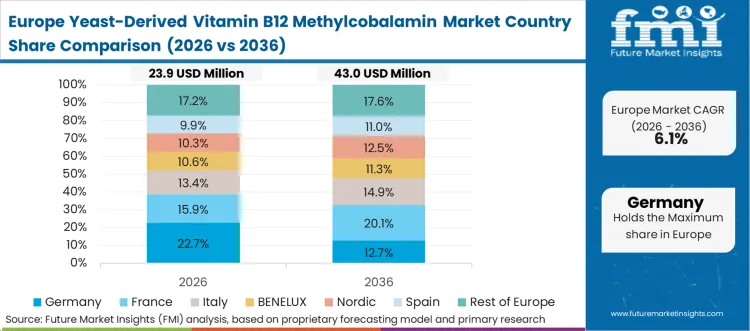
Europe acts as a stringent regulatory environment, mandating rigorous clinical backing for health claims. Formulators substitute synthetic ingredients with natural fermented alternatives to secure clean-label certifications. Regional production scales to ensure localized supply security against volatile intercontinental shipping routes.
- United Kingdom: In United Kingdom, the yeast-derived vitamin B12 methylcobalamin market is forecast to advance at 8.1% CAGR through 2036, with growth anchored in plant-based dietary shifts that convert into measurable budget allocation. Formulators utilize United kingdom yeast derivatives for vegan-certified retail lines to capture expanding ethically minded consumer segments.
- Germany: Sales of yeast-derived vitamin B12 methylcobalamin in Germany are anticipated to grow at 7.6% CAGR over the forecast period as strict clean-label standards exclude petrochemical synthetics, helping suppliers align positioning with local buying triggers. Nutrition companies specify fermented origins, adhering to exacting European Pharmacopoeia standards.
FMI’s report includes comprehensive tracking of European regulatory impacts. Coverage extends to France, Italy, and Spain, examining organic certification requirements. Purchasing managers evaluate Spanish manufacturing expansions to secure short-haul supply lines.
Competitive Aligners for Market Players
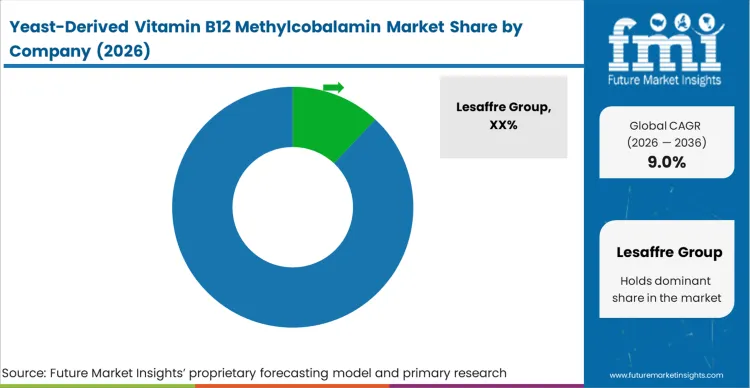
Production scale determines cost survivability for bulk ingredient manufacturers. Facilities operating massive bioreactors amortize capital expenditures across higher tonnage yields, lowering unit pricing to capture mass-market food fortification contracts. According to FMI's estimates, strategic financial backing enables required infrastructure upgrades to maintain capacity dominance.
Integration of proprietary fermentation strains creates distinct competitive moats. Companies engineering high-yield biological variants minimize raw material inputs and accelerate biological batch turnaround times. Partnerships focused on sustainable biosynthetic production methods directly lower long-term overhead costs.
Clinical validation separates premium suppliers from commodity traders. Ingredient producers investing in specific human efficacy trials command higher margins from specialized nutraceutical brands. Documented bioavailability studies allow retail partners to confidently print verified health claims on commercial packaging.
Key Players in Yeast-Derived Vitamin B12 Methylcobalamin Market
- Lesaffre Group
- Lallemand Inc.
- Angel Yeast Co., Ltd.
- Ohly GmbH
- Associated British Foods plc
Scope of the Report
| Metric | Value |
|---|---|
| Quantitative Units | USD 98 Million (2026) to USD 232 Million (2036), at a CAGR of 9.0% |
| Market Definition | Yeast-derived vitamin B12 methylcobalamin represents an active, coenzyme molecular structure synthesized via controlled microbial fermentation using specific biological strains on natural substrates. |
| Grade Segmentation | Food/Dietary Supplement Grade, Pharmaceutical Grade, Feed Grade/Other |
| Application Segmentation | Dietary Supplements, Food & Beverage Fortification, Pharmaceutical/Medical Nutrition, Other |
| Regions Covered | North America, Latin America, Europe, East Asia, South Asia, Oceania, Middle East and Africa |
| Countries Covered | United States, Canada, Mexico, Brazil, Argentina, Germany, France, United Kingdom, Italy, Spain, China, India, Japan, South Korea, Indonesia, Australia and 40 plus countries |
| Key Companies Profiled | Lesaffre Group, Lallemand Inc., Angel Yeast Co., Ltd., Ohly GmbH, Associated British Foods plc, HTBA |
| Forecast Period | 2026 to 2036 |
| Approach | Hybrid top down and bottom up market modeling validated through primary interviews with fermentation facility directors, supported by trade data benchmarking |
Yeast-Derived Vitamin B12 Methylcobalamin Analysis by Segments
Grade:
- Food/Dietary Supplement Grade
- Pharmaceutical Grade
- Feed Grade/Other
Application:
- Dietary Supplements
- Food & Beverage Fortification
- Pharmaceutical/Medical Nutrition
- Other
Region:
- Asia Pacific
- India
- China
- Japan
- South Korea
- Indonesia
- Australia & New Zealand
- ASEAN
- Rest of Asia Pacific
- Europe
- Germany
- Italy
- France
- United Kingdom
- Spain
- Benelux
- Nordics
- Central & Eastern Europe
- Rest of Europe
- North America
- United States
- Canada
- Mexico
- Latin America
- Brazil
- Argentina
- Chile
- Rest of Latin America
- Middle East & Africa
- Kingdom of Saudi Arabia
- United Arab Emirates
- South Africa
- Turkey
- Rest of Middle East & Africa
Bibliography
- [1] HTBA. (2025). Teresa Pellicer on MecobalActive cognitive performance benefits.
- [2] National Institutes of Health, Office of Dietary Supplements. (2025, July 2). Vitamin B12: Fact sheet for health professionals.
- [3] National Institutes of Health, Office of Dietary Supplements. (2025, July 2). Vitamin B12: Fact sheet for health professionals.
- [4] HTBA. (2025, February 4). HTBA strengthens its commitment to sustainability and innovation with a 25 million euros investment in its Beniel industrial center.
- [5] Patel, H., & McGuirk, R. (2025). Vitamin B12 deficiency: Common questions and answers. American Family Physician, 112 (3), 294-300.
This bibliography is provided for reader reference and is not exhaustive. The full report contains the complete reference list and detailed citations.
This Report Addresses
- Market intelligence to enable structured strategic decision making across mature and emerging fermentation economies
- Market size estimation and 10 year revenue forecasts from 2026 to 2036, supported by validated capacity and trade benchmarks
- Growth opportunity mapping across specific grade and application segments with emphasis on active coenzyme transitions
- Segment and regional revenue forecasts covering dietary supplements, food fortification, and medical nutrition applications
- Competition strategy assessment including integration models, cost survivability positioning, and clinical compliance capability benchmarking
- Product reformulation and clean-label compliance tracking including vegan and organic certified grades
- Regulatory impact analysis covering synthetic analog restrictions, pharmacopeial monographs, and export driven specification upgrades
- Market report delivery in PDF, Excel, PPT, and interactive dashboard formats for executive and operational use
Frequently Asked Questions
How large is the demand for Yeast-Derived Vitamin B12 Methylcobalamin in the global market in 2026?
Demand for Yeast-Derived Vitamin B12 Methylcobalamin in the global market is estimated to be valued at USD 98 Million in 2026.
What will be the market size of Yeast-Derived Vitamin B12 Methylcobalamin in the global market by 2036?
Market size for Yeast-Derived Vitamin B12 Methylcobalamin is projected to reach USD 232 Million by 2036.
What is the expected demand growth for Yeast-Derived Vitamin B12 Methylcobalamin in the global market between 2026 and 2036?
Demand for Yeast-Derived Vitamin B12 Methylcobalamin in the global market is expected to grow at a CAGR of 9.0% between 2026 and 2036.
Which Grade is poised to lead global sales by 2026?
Food/Dietary Supplement Grade is expected to be the dominant format, capturing 62% of global market share in 2026 due to mass-market clean-label formulation requirements.
How significant is the role of Dietary Supplements in driving Yeast-Derived Vitamin B12 Methylcobalamin adoption in 2026?
Dietary Supplements represents a critical segment, projected to hold a substantial 68% share of the total market in 2026 as consumer preference dictates active nutrient formats.
What is driving demand in India?
Widespread plant-based dietary habits and an expanding pharmaceutical sector drive reliance on exogenous fortified yeast formats.
What compliance standards or regulations are referenced for India?
European Pharmacopoeia standards dictate export quality requirements for regional manufacturers executing overseas shipments.
What is the India growth outlook in this report?
India is projected to grow at a CAGR of 10.6% during 2026 to 2036.
Why is North America described as a priority region in this report?
Extensive clinical testing infrastructure exposes hidden population shortfalls, driving rapid therapeutic intervention and retail inventory replenishment.
What type of demand dominates in North America?
Clinically validated replacement demand for active, highly bioavailable coenzyme formulations dominates regional consumption.
What is China growth outlook in this report?
China is projected to expand at a CAGR of 9.8% during 2026 to 2036.
Does the report cover Brazil in its regional analysis?
Brazil is included within Latin America under the regional scope of analysis.
What are the sources referred to for analyzing Brazil?
Import trade statistics and domestic pharmaceutical capacity additions are cited as primary reference sources.
What is the main demand theme linked to Brazil in its region coverage?
Latin American demand is associated with expanding domestic supplement manufacturing replacing imported finished goods.
Does the report cover United States in its regional analysis?
United States is included within North America under the regional coverage framework.
What is the main United States related demand theme in its region coverage?
Rigorous diagnostic protocols exposing subclinical insufficiencies drive targeted formulation upgrades across patient demographics.
Which product formats or configurations are strategically important for Asia Pacific supply chains?
Stable powder formats are prioritized to execute reliable transit across fragmented distribution networks, bypassing complex vegan vitamin d3 supplements supply hurdles.
What is Yeast-Derived Vitamin B12 Methylcobalamin and what is it mainly used for?
It is a highly bioavailable, vegan-compliant active B12 coenzyme used primarily in specialized dietary supplements and functional food fortification.
What does Yeast-Derived Vitamin B12 Methylcobalamin mean in this report?
Scope refers to the global bulk production and industrial consumption of active B12 ingredients synthesized via microbial fermentation.
What is included in the scope of this Yeast-Derived Vitamin B12 Methylcobalamin report?
Scope covers natural and synthetic methylcobalamin grades derived explicitly from fermentation, alongside related united kingdom vegan vitamin d3 supplements analysis metrics in bulk supply forms.
What is excluded from the scope of this report?
Inactive cyanocobalamin, petrochemical-derived analogs lacking microbial processing, and finished retail consumer goods like packaged Australia prenatal vitamin supplements are excluded.
What does market forecast mean on this page?
Market forecast represents a capacity and consumption-based projection built on defined adoption metrics utilizing homocysteine testing volume data for strategic planning.
How does FMI build and validate the Yeast-Derived Vitamin B12 Methylcobalamin forecast?
Forecast is developed using bottom-up bioreactor capacity models validated through trade export data, demand for yeast based spreads in EU metrics, and primary facility interviews.
What does zero reliance on speculative third party market research mean here?
Primary interviews and clinical vitamin B test prevalence datasets are utilized exclusively instead of unverified syndicated estimates.
Preview the report firsthand - request a free sample
Get SampleGet the brochure for pricing and purchase details.
Get PDFTable of Content
- Executive Summary
- Global Market Outlook
- Demand-side Trends
- Supply-side Trends
- Technology Roadmap Analysis
- Analysis and Recommendations
- Market Overview
- Market Coverage / Taxonomy
- Market Definition / Scope / Limitations
- Research Methodology
- Chapter Orientation
- Analytical Lens and Working Hypotheses
- Market Structure, Signals, and Trend Drivers
- Benchmarking and Cross-market Comparability
- Market Sizing, Forecasting, and Opportunity Mapping
- Research Design and Evidence Framework
- Desk Research Programme (Secondary Evidence)
- Company Annual and Sustainability Reports
- Peer-reviewed Journals and Academic Literature
- Corporate Websites, Product Literature, and Technical Notes
- Earnings Decks and Investor Briefings
- Statutory Filings and Regulatory Disclosures
- Technical White Papers and Standards Notes
- Trade Journals, Industry Magazines, and Analyst Briefs
- Conference Proceedings, Webinars, and Seminar Materials
- Government Statistics Portals and Public Data Releases
- Press Releases and Reputable Media Coverage
- Specialist Newsletters and Curated Briefings
- Sector Databases and Reference Repositories
- FMI Internal Proprietary Databases and Historical Market Datasets
- Subscription Datasets and Paid Sources
- Social Channels, Communities, and Digital Listening Inputs
- Additional Desk Sources
- Expert Input and Fieldwork (Primary Evidence)
- Primary Modes
- Qualitative Interviews and Expert Elicitation
- Quantitative Surveys and Structured Data Capture
- Blended Approach
- Why Primary Evidence is Used
- Field Techniques
- Interviews
- Surveys
- Focus Groups
- Observational and In-context Research
- Social and Community Interactions
- Stakeholder Universe Engaged
- C-suite Leaders
- Board Members
- Presidents and Vice Presidents
- R&D and Innovation Heads
- Technical Specialists
- Domain Subject-matter Experts
- Scientists
- Physicians and Other Healthcare Professionals
- Governance, Ethics, and Data Stewardship
- Research Ethics
- Data Integrity and Handling
- Primary Modes
- Tooling, Models, and Reference Databases
- Desk Research Programme (Secondary Evidence)
- Data Engineering and Model Build
- Data Acquisition and Ingestion
- Cleaning, Normalisation, and Verification
- Synthesis, Triangulation, and Analysis
- Quality Assurance and Audit Trail
- Market Background
- Market Dynamics
- Drivers
- Restraints
- Opportunity
- Trends
- Scenario Forecast
- Demand in Optimistic Scenario
- Demand in Likely Scenario
- Demand in Conservative Scenario
- Opportunity Map Analysis
- Product Life Cycle Analysis
- Supply Chain Analysis
- Investment Feasibility Matrix
- Value Chain Analysis
- PESTLE and Porter’s Analysis
- Regulatory Landscape
- Regional Parent Market Outlook
- Production and Consumption Statistics
- Import and Export Statistics
- Market Dynamics
- Global Market Analysis 2021 to 2025 and Forecast, 2026 to 2036
- Historical Market Size Value (USD Million) Analysis, 2021 to 2025
- Current and Future Market Size Value (USD Million) Projections, 2026 to 2036
- Y-o-Y Growth Trend Analysis
- Absolute $ Opportunity Analysis
- Global Market Pricing Analysis 2021 to 2025 and Forecast 2026 to 2036
- Global Market Analysis 2021 to 2025 and Forecast 2026 to 2036, By Grade
- Introduction / Key Findings
- Historical Market Size Value (USD Million) Analysis By Grade , 2021 to 2025
- Current and Future Market Size Value (USD Million) Analysis and Forecast By Grade , 2026 to 2036
- Food/Dietary Supplement Grade
- Pharmaceutical Grade
- Feed Grade/Other
- Food/Dietary Supplement Grade
- Y-o-Y Growth Trend Analysis By Grade , 2021 to 2025
- Absolute $ Opportunity Analysis By Grade , 2026 to 2036
- Global Market Analysis 2021 to 2025 and Forecast 2026 to 2036, By Application
- Introduction / Key Findings
- Historical Market Size Value (USD Million) Analysis By Application, 2021 to 2025
- Current and Future Market Size Value (USD Million) Analysis and Forecast By Application, 2026 to 2036
- Dietary Supplements
- Food & Beverage Fortification
- Pharmaceutical/Medical Nutrition
- Other
- Dietary Supplements
- Y-o-Y Growth Trend Analysis By Application, 2021 to 2025
- Absolute $ Opportunity Analysis By Application, 2026 to 2036
- Global Market Analysis 2021 to 2025 and Forecast 2026 to 2036, By Region
- Introduction
- Historical Market Size Value (USD Million) Analysis By Region, 2021 to 2025
- Current Market Size Value (USD Million) Analysis and Forecast By Region, 2026 to 2036
- North America
- Latin America
- Western Europe
- Eastern Europe
- East Asia
- South Asia and Pacific
- Middle East & Africa
- Market Attractiveness Analysis By Region
- North America Market Analysis 2021 to 2025 and Forecast 2026 to 2036, By Country
- Historical Market Size Value (USD Million) Trend Analysis By Market Taxonomy, 2021 to 2025
- Market Size Value (USD Million) Forecast By Market Taxonomy, 2026 to 2036
- By Country
- USA
- Canada
- Mexico
- By Grade
- By Application
- By Country
- Market Attractiveness Analysis
- By Country
- By Grade
- By Application
- Key Takeaways
- Latin America Market Analysis 2021 to 2025 and Forecast 2026 to 2036, By Country
- Historical Market Size Value (USD Million) Trend Analysis By Market Taxonomy, 2021 to 2025
- Market Size Value (USD Million) Forecast By Market Taxonomy, 2026 to 2036
- By Country
- Brazil
- Chile
- Rest of Latin America
- By Grade
- By Application
- By Country
- Market Attractiveness Analysis
- By Country
- By Grade
- By Application
- Key Takeaways
- Western Europe Market Analysis 2021 to 2025 and Forecast 2026 to 2036, By Country
- Historical Market Size Value (USD Million) Trend Analysis By Market Taxonomy, 2021 to 2025
- Market Size Value (USD Million) Forecast By Market Taxonomy, 2026 to 2036
- By Country
- Germany
- UK
- Italy
- Spain
- France
- Nordic
- BENELUX
- Rest of Western Europe
- By Grade
- By Application
- By Country
- Market Attractiveness Analysis
- By Country
- By Grade
- By Application
- Key Takeaways
- Eastern Europe Market Analysis 2021 to 2025 and Forecast 2026 to 2036, By Country
- Historical Market Size Value (USD Million) Trend Analysis By Market Taxonomy, 2021 to 2025
- Market Size Value (USD Million) Forecast By Market Taxonomy, 2026 to 2036
- By Country
- Russia
- Poland
- Hungary
- Balkan & Baltic
- Rest of Eastern Europe
- By Grade
- By Application
- By Country
- Market Attractiveness Analysis
- By Country
- By Grade
- By Application
- Key Takeaways
- East Asia Market Analysis 2021 to 2025 and Forecast 2026 to 2036, By Country
- Historical Market Size Value (USD Million) Trend Analysis By Market Taxonomy, 2021 to 2025
- Market Size Value (USD Million) Forecast By Market Taxonomy, 2026 to 2036
- By Country
- China
- Japan
- South Korea
- By Grade
- By Application
- By Country
- Market Attractiveness Analysis
- By Country
- By Grade
- By Application
- Key Takeaways
- South Asia and Pacific Market Analysis 2021 to 2025 and Forecast 2026 to 2036, By Country
- Historical Market Size Value (USD Million) Trend Analysis By Market Taxonomy, 2021 to 2025
- Market Size Value (USD Million) Forecast By Market Taxonomy, 2026 to 2036
- By Country
- India
- ASEAN
- Australia & New Zealand
- Rest of South Asia and Pacific
- By Grade
- By Application
- By Country
- Market Attractiveness Analysis
- By Country
- By Grade
- By Application
- Key Takeaways
- Middle East & Africa Market Analysis 2021 to 2025 and Forecast 2026 to 2036, By Country
- Historical Market Size Value (USD Million) Trend Analysis By Market Taxonomy, 2021 to 2025
- Market Size Value (USD Million) Forecast By Market Taxonomy, 2026 to 2036
- By Country
- Kingdom of Saudi Arabia
- Other GCC Countries
- Turkiye
- South Africa
- Other African Union
- Rest of Middle East & Africa
- By Grade
- By Application
- By Country
- Market Attractiveness Analysis
- By Country
- By Grade
- By Application
- Key Takeaways
- Key Countries Market Analysis
- USA
- Pricing Analysis
- Market Share Analysis, 2025
- By Grade
- By Application
- Canada
- Pricing Analysis
- Market Share Analysis, 2025
- By Grade
- By Application
- Mexico
- Pricing Analysis
- Market Share Analysis, 2025
- By Grade
- By Application
- Brazil
- Pricing Analysis
- Market Share Analysis, 2025
- By Grade
- By Application
- Chile
- Pricing Analysis
- Market Share Analysis, 2025
- By Grade
- By Application
- Germany
- Pricing Analysis
- Market Share Analysis, 2025
- By Grade
- By Application
- UK
- Pricing Analysis
- Market Share Analysis, 2025
- By Grade
- By Application
- Italy
- Pricing Analysis
- Market Share Analysis, 2025
- By Grade
- By Application
- Spain
- Pricing Analysis
- Market Share Analysis, 2025
- By Grade
- By Application
- France
- Pricing Analysis
- Market Share Analysis, 2025
- By Grade
- By Application
- India
- Pricing Analysis
- Market Share Analysis, 2025
- By Grade
- By Application
- ASEAN
- Pricing Analysis
- Market Share Analysis, 2025
- By Grade
- By Application
- Australia & New Zealand
- Pricing Analysis
- Market Share Analysis, 2025
- By Grade
- By Application
- China
- Pricing Analysis
- Market Share Analysis, 2025
- By Grade
- By Application
- Japan
- Pricing Analysis
- Market Share Analysis, 2025
- By Grade
- By Application
- South Korea
- Pricing Analysis
- Market Share Analysis, 2025
- By Grade
- By Application
- Russia
- Pricing Analysis
- Market Share Analysis, 2025
- By Grade
- By Application
- Poland
- Pricing Analysis
- Market Share Analysis, 2025
- By Grade
- By Application
- Hungary
- Pricing Analysis
- Market Share Analysis, 2025
- By Grade
- By Application
- Kingdom of Saudi Arabia
- Pricing Analysis
- Market Share Analysis, 2025
- By Grade
- By Application
- Turkiye
- Pricing Analysis
- Market Share Analysis, 2025
- By Grade
- By Application
- South Africa
- Pricing Analysis
- Market Share Analysis, 2025
- By Grade
- By Application
- USA
- Market Structure Analysis
- Competition Dashboard
- Competition Benchmarking
- Market Share Analysis of Top Players
- By Regional
- By Grade
- By Application
- Competition Analysis
- Competition Deep Dive
- Lesaffre Group
- Overview
- Product Portfolio
- Profitability by Market Segments (Product/Age /Sales Channel/Region)
- Sales Footprint
- Strategy Overview
- Marketing Strategy
- Product Strategy
- Channel Strategy
- Lallemand Inc.
- Angel Yeast Co., Ltd.
- Ohly GmbH
- Associated British Foods plc
- Lesaffre Group
- Competition Deep Dive
- Assumptions & Acronyms Used


