

- Industry Size (2026)
- USD 620 Mn
- Forecast (2036)
- USD 1113.6 Mn
- CAGR (2026 to 2036)
- 6.7%
Micronized Silicon Market Forecast and Outlook 2026 to 2036
The micronized silicon market is projected to reach USD 1113.6 million by 2036, growing at a CAGR of 6.7% from its 2026 valuation of USD 620 million. Dominant players defend their pricing power through advanced production techniques and the establishment of long-term contracts with key customers, which often involve exclusive agreements and pricing structures. Entry barriers are maintained by high capital requirements for manufacturing, specialized expertise in micronization processes, and the need for regulatory compliance in key markets. Smaller players face challenges in scaling production and meeting quality standards, creating a competitive gap.
Fragmentation persists due to the varied applications of micronized silicon across industries, with smaller companies targeting niche sectors or regional markets. However, as the demand for high-performance materials grows, the larger players are likely to increase their share through acquisitions or technological innovation, narrowing fragmentation over time and further solidifying their market control.
Quick Stats for the Micronized Silicon Market
- Micronized Silicon Market Value (2026E): USD 620 million
- Micronized Silicon Market Forecast Value (2036): USD 1113.6 million
- Micronized Silicon Market Global Forecast CAGR (2026-2036): 6.7%
- Micronized Silicon Market Leading Segment: 10-45 µm (46%)
- Key Growth Regions in Micronized Silicon Market: India
- Top Players in Micronized Silicon Market: Elkem ASA, Ferroglobe, Wacker Chemie, H.C. Starck Solutions, DOWA Electronics Materials, Mississippi Silicon, Xiamen Tungsten, Zhejiang Kaihua (Silicon Powders), Anyang Wanhua
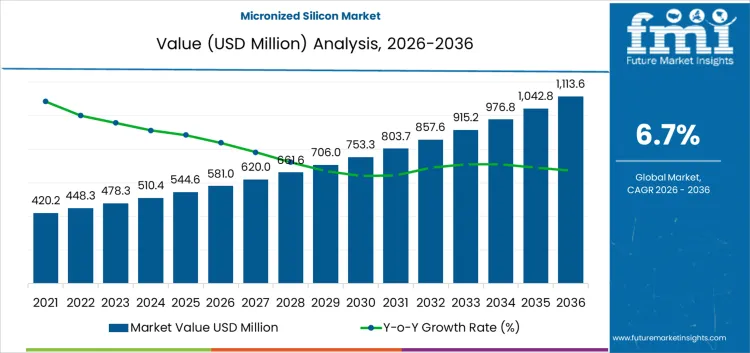
What is the 10-Year Growth Comparison for the Micronized Silicon Market through 2036?
The 10-year growth comparison of the micronized silicon market reflects consistent, gradual growth over the forecast period. From USD 620 million in 2026, the market will experience steady year-on-year increases, reaching USD 661.6 million in 2027 and USD 706 million in 2028. This early growth reflects the ongoing adoption of micronized silicon in various applications, particularly in high-performance battery production.
The growth will continue, with values rising from USD 753.3 million in 2029 to USD 803.7 million in 2030. By 2036, the market is expected to reach USD 1113.6 million, demonstrating strong growth in the latter half of the decade. This reflects the increasing demand for micronized silicon in energy storage and automotive sectors, as well as the continued expansion of green energy solutions and technological advancements in battery performance. The 10-year comparison shows a consistent upward trajectory, driven by the growing demand for high-efficiency materials in various industrial sectors.
Micronized Silicon Market Key Takeaways
| Metric | Value |
|---|---|
| Industry Sales Value (2026) | USD 620 million |
| Industry Forecast Value (2036) | USD 1113.6 million |
| Industry Forecast CAGR (2026-2036) | 6.7% |
What Is Driving the Micronized Silicon Market?
Historically, the micronized silicon market developed in response to performance demands in industries such as rubber, coatings, and electronics where fine particle morphology and high purity were critical. Conventional silicon powders were produced for metallurgical applications, where coarse particles sufficed for alloying and basic conductivity roles. As industrial processes became more sophisticated, particularly for adhesives, sealants, and high performance elastomers, demand grew for silicon powders with controlled particle size distribution, high surface area, and consistent reactivity.
Micronization techniques such as jet milling and controlled precipitation were adopted to produce silicon particles with sub 10 µm median diameters that enhanced dispersion in polymer matrices, improved mechanical strength, and reduced viscosity in formulations. Early adoption was concentrated in specialty rubber compounds for tire reinforcement and conductive additives in battery anodes where improved cycle life and capacity were important. These applications demonstrated how finely milled silicon could change composite behavior, although challenges in handling, purity control, and particle agglomeration were apparent. The historical phase established processing baselines, material specifications, and preliminary market demand from sectors that valued enhanced performance metrics over cost alone.
Future demand for micronized silicon is expected to be shaped by growth in energy storage, advanced coatings, and high end electronics where fine silicon powders deliver performance advantages. A key driver will be the expansion of lithium ion and next generation battery technologies, where micronized silicon is used as an anode additive to increase energy density and improve charge capacity. As electric vehicle and grid storage adoption expands, battery manufacturers are projected to increase procurement of high quality silicon powders engineered for stability and low impurity levels. Other growth factors will include increased use in conductive polymers, specialty ceramics, and compound semiconductors where controlled particle size enhances electrical and thermal properties.
Advances in micronization processes and quality control will help reduce production costs and improve consistency, enabling broader uptake beyond niche segments. Barriers include competition from alternative anode materials, stringent quality requirements in electronics, and the need for safe handling protocols due to high reactivity of fine silicon particles. Long term market expansion will depend on demonstrated performance improvements, cost effective production at scale, and alignment between material innovations and emerging end use requirements.
What are the Key Segments in the Micronized Silicon Market?
The Micronized Silicon market is segmented by purity grade and particle size. Purity grades include metallurgical grade, chemical or high purity grade, battery or advanced materials grade, and others, with metallurgical grade holding the largest market share at 44%. Particle size segments include 10-45 µm, below 10 µm, 45-150 µm, and others, with the 10-45 µm segment representing the largest share at 46%. The market is driven by the increasing demand for micronized silicon in various industries, including electronics, batteries, and advanced materials. The growing use of silicon in battery applications, particularly in lithium-ion batteries, is contributing to significant market growth. Key regions driving the market include North America, Europe, and Asia Pacific, where the electronics and battery industries are expanding rapidly.
What is Driving Growth in the Metallurgical Grade Purity Segment?
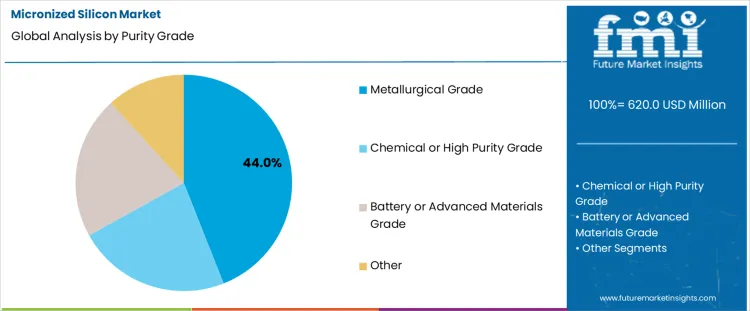
Metallurgical grade silicon leads the purity grade segment in the Micronized Silicon market, accounting for 44% of the market share. This growth is driven by its widespread use in the production of aluminum-silicon alloys, which are essential in the automotive and construction industries. Metallurgical grade silicon is typically used in lower-cost applications, where high purity is not required. It is also used in the manufacturing of various industrial products, including semiconductors, photovoltaic cells, and aluminum alloys. As industries seek to optimize cost-effectiveness without compromising material strength or functionality, the demand for metallurgical grade silicon is expected to continue to grow. Additionally, the demand for aluminum alloys in automotive manufacturing, driven by the push for lighter vehicles, is further fueling the demand for metallurgical grade silicon. This segment is especially strong in regions like North America, Europe, and Asia Pacific, where the automotive and construction sectors are prominent.
What is Driving the Demand for 10-45 µm Particle Size in Micronized Silicon?
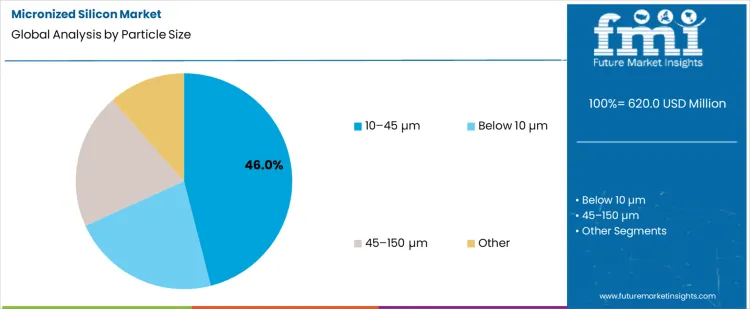
The 10-45 µm particle size segment holds the largest share in the Micronized Silicon market, representing 46% of the market share. This particle size range is preferred in a wide range of applications, including in the electronics industry, where it is used in the manufacturing of semiconductors and other electronic components. The 10-45 µm size range allows for improved material properties, such as enhanced conductivity and better surface area, which are essential for high-performance applications. Additionally, in battery manufacturing, this particle size is ideal for enhancing the electrochemical performance of lithium-ion batteries, which is driving the growth of the segment. The increasing use of micronized silicon in advanced materials and energy storage solutions, especially for electric vehicles and renewable energy applications, is expected to support the continued demand for the 10-45 µm particle size range. As the demand for energy-efficient and high-performance technologies grows, particularly in North America, Europe, and Asia Pacific, the 10-45 µm particle size segment will likely continue to lead the market.
What are the Key Dynamics in the Micronized Silicon Market?
The micronized silicon market is expanding due to the increasing demand for advanced materials in various applications, including electronics, energy storage, automotive, and construction. Micronized silicon, which refers to silicon particles that have been finely ground or processed to micron-sized dimensions, offers enhanced properties such as improved conductivity, higher surface area, and greater reactivity compared to traditional silicon. These characteristics make micronized silicon highly suitable for use in lithium-ion batteries, solar cells, semiconductors, and other high-tech materials.
The market is driven by the rising demand for energy storage systems, especially electric vehicles (EVs), and renewable energy sources, which require efficient and durable materials. Additionally, advancements in semiconductor technologies, along with the need for better performance in electronics and computing, are propelling the growth of the micronized silicon market. The increasing adoption of electric vehicles and the growing push for energy-efficient technologies are expected to further accelerate market demand.
What are the Key Drivers of Growth in the Micronized Silicon Market?
The key drivers of growth in the micronized silicon market include the increasing demand for efficient and high-performance materials in a wide range of industries. One of the primary drivers is the expanding electric vehicle (EV) market, as micronized silicon is used in the production of high-capacity batteries, which are crucial for EV performance. The rising need for energy storage solutions, such as large-scale batteries for renewable energy systems, also contributes to market growth. Additionally, advancements in solar technology are boosting the demand for micronized silicon in photovoltaic cells, as its enhanced properties improve the efficiency and performance of solar energy systems. The increasing reliance on electronics, semiconductors, and communication devices further drives the demand for micronized silicon, as it improves the performance and miniaturization of devices. Furthermore, micronized silicon's growing use in the construction industry, specifically in the production of advanced cement and concrete materials, is expanding its market applications.
What are the Key Restraints in the Micronized Silicon Market?
Despite its growth potential, the micronized silicon market faces several challenges. One of the primary restraints is the high cost of production, as the process of micronizing silicon requires advanced technology and equipment, leading to higher manufacturing costs compared to traditional silicon. This can make it difficult for certain industries, especially in emerging markets or cost-sensitive sectors, to adopt micronized silicon at scale. Additionally, the processing of silicon into micronized form can lead to a loss of material due to fragmentation or waste, further increasing costs. Another challenge is the need for specialized infrastructure to handle the micronized material, which can complicate supply chains and add to operational costs. Moreover, micronized silicon may face competition from alternative materials or technologies that offer similar benefits at a lower cost, such as graphene and other advanced conductive materials. Finally, the reliance on silicon mining and processing, which can have environmental impacts, could lead to increased scrutiny and regulatory pressures on production practices.
What are the Key Trends in the Micronized Silicon Market?
Several key trends are shaping the micronized silicon market. One major trend is the increasing focus on sustainability and energy efficiency, which is driving innovation in energy storage and renewable energy technologies. Micronized silicon plays a crucial role in improving the performance of lithium-ion batteries, which are essential for EVs and renewable energy storage. As the demand for EVs and clean energy solutions grows, so does the need for advanced materials like micronized silicon. Another trend is the development of new applications for micronized silicon, particularly in semiconductors and electronic devices, where its enhanced properties allow for improved performance and miniaturization of components. Additionally, there is a growing trend toward the integration of micronized silicon in construction materials, such as in the production of high-strength, durable concrete and cement. This shift is driven by the construction industry's focus on sustainability and the use of advanced materials to reduce the environmental footprint of building projects. Furthermore, ongoing research into improving the cost-effectiveness and scalability of micronized silicon production is expected to expand its applications across a broader range of industries, helping to drive continued growth in the market.
What is the Country-Wise Analysis of the Micronized Silicon Market?
The micronized silicon market is growing as demand for advanced materials in various industries, including electronics, automotive, and renewable energy, continues to rise. Micronized silicon, with its fine particle size and high surface area, is essential for improving the performance of batteries, semiconductors, and other high-tech applications. The market is being driven by technological advancements, the increasing demand for high-performance materials, and the need for energy-efficient solutions. Key countries such as India, China, Indonesia, Brazil, and the USA are driving the growth of the micronized silicon market, each influenced by local industrial activities, technological advancements, and the push for sustainability.
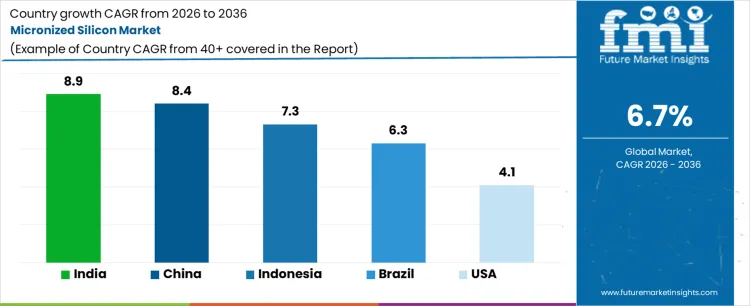
| Country | CAGR (%) |
|---|---|
| India | 8.9 |
| China | 8.4 |
| Indonesia | 7.3 |
| Brazil | 6.3 |
| USA | 4.1 |
What is Driving the Growth of the Micronized Silicon Market in India?
India’s micronized silicon market is growing at a CAGR of 8.9%, the highest among the countries analyzed. This growth is driven by the increasing demand for advanced materials in India’s rapidly expanding industries, particularly in electronics, renewable energy, and electric vehicle manufacturing. The growing adoption of lithium-ion batteries, which use micronized silicon to enhance performance, is a key factor contributing to the market’s growth. Additionally, India’s push towards manufacturing high-tech products and increasing infrastructure development is driving the demand for micronized silicon in construction materials and coatings. As India continues to invest in technology and infrastructure, the demand for micronized silicon is expected to rise significantly.
How is the Micronized Silicon Market Performing in China?
China’s micronized silicon market is growing at a CAGR of 8.4%. As one of the world’s largest producers and consumers of silicon, China’s demand for micronized silicon is driven by its booming electronics industry, growing demand for renewable energy technologies, and expansion of electric vehicle production. China is a major player in the global battery market, and the increasing adoption of micronized silicon in battery anodes is a significant factor driving the market. The country’s push for technological innovation, along with government initiatives aimed at reducing carbon emissions, is further boosting the demand for high-performance materials like micronized silicon. As China continues to expand its industrial and technological base, the market for micronized silicon is expected to grow steadily.
What Factors are Shaping the Micronized Silicon Market in Indonesia?
Indonesia’s micronized silicon market is growing at a CAGR of 7.3%. The growth in Indonesia is driven by the increasing demand for high-performance materials across various industries, including automotive, construction, and energy. The country’s focus on expanding its industrial base and improving manufacturing processes is contributing to the demand for micronized silicon, particularly in applications such as coatings, composites, and electronics. As Indonesia continues to develop its infrastructure and increase its production of electric vehicles, the need for materials that improve energy efficiency and performance, such as micronized silicon, is rising. Additionally, Indonesia’s growing interest in renewable energy solutions is further fueling the market for micronized silicon in solar and battery applications.
How is the Micronized Silicon Market Evolving in Brazil?
Brazil’s micronized silicon market is growing at a CAGR of 6.3%. The market in Brazil is driven by the expanding demand for high-performance materials in industries such as automotive, construction, and renewable energy. As Brazil seeks to modernize its infrastructure and expand its electric vehicle production, the need for micronized silicon in batteries and energy storage solutions is rising. Additionally, Brazil’s growing emphasis on sustainable development and energy efficiency is fueling the demand for advanced materials like micronized silicon. The construction and coatings industries are also major consumers of micronized silicon, contributing to the market’s growth. As Brazil continues to focus on innovation and sustainability, the demand for micronized silicon is expected to increase in the coming years.
What is Contributing to the Growth of the Micronized Silicon Market in the USA?
The micronized silicon market in the USA is growing at a CAGR of 4.1%, the lowest among the countries analyzed. Despite this slower growth, the market is still driven by significant demand from the electronics, automotive, and renewable energy sectors. The increasing use of micronized silicon in high-performance batteries, particularly in electric vehicles and energy storage systems, is a key factor contributing to the market’s growth. Additionally, the USA’s ongoing focus on technological advancements and the development of sustainable energy solutions is driving the adoption of micronized silicon in various applications, including solar panels and electric vehicle batteries. As the demand for energy-efficient solutions continues to rise, the market for micronized silicon in the USA is expected to grow at a moderate pace.
What is the Competitive Landscape for the Micronized Silicon Market?
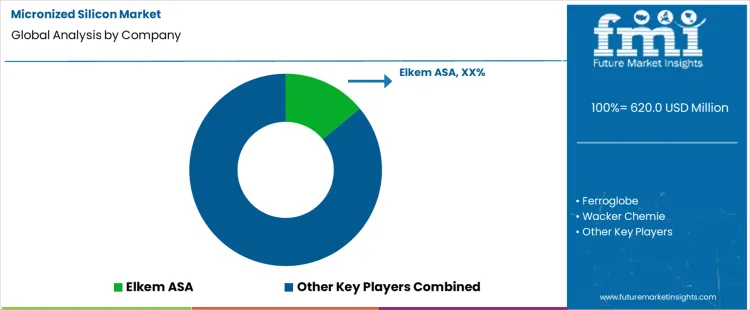
The micronized silicon market is growing steadily, driven by increasing demand for high-performance materials used in a variety of industries, including electronics, energy storage, and automotive. Elkem ASA leads the market, offering micronized silicon products that cater to various applications, including advanced battery technology and semiconductors. Elkem’s focus on high-quality, precise silicon powders ensures it remains a dominant player in the market. Ferroglobe is another key competitor, providing micronized silicon for use in energy storage, construction, and electronics. The company’s production capabilities and technological expertise allow it to cater to a wide range of industries with its high-performance silicon products. Wacker Chemie competes by offering micronized silicon that is used in a variety of applications, from silicones and electronics to energy storage, with a focus on high-purity materials.
H.C. Starck Solutions provides specialized micronized silicon powders, focusing on applications in semiconductor and electronic materials, where performance and precision are critical. DOWA Electronics Materials is also a significant player, offering micronized silicon solutions that meet the stringent requirements of the electronics and energy storage sectors. Other companies such as Mississippi Silicon, Xiamen Tungsten, Zhejiang Kaihua (Silicon Powders), and Anyang Wanhua contribute to the market by providing high-quality micronized silicon for a variety of industrial uses, from photovoltaic systems to advanced electronics.
In the competitive micronized silicon market, companies focus on product innovation, production scalability, and industry-specific solutions to maintain their market position. Elkem ASA continues to enhance its offerings by developing advanced silicon powders that meet the increasing performance demands of battery technologies and electronics. Ferroglobe is investing in capacity expansion and improving its product quality to strengthen its position in the global market. Wacker Chemie is focusing on creating high-purity micronized silicon products for a range of applications, ensuring they meet the evolving needs of energy storage and semiconductor markets.
H.C. Starck Solutions continues to refine its micronized silicon products to cater to specialized markets, emphasizing precision and performance. DOWA Electronics Materials focuses on improving its manufacturing processes to offer high-quality silicon powders for use in next-generation electronic devices. Other competitors, such as Mississippi Silicon and Xiamen Tungsten, are targeting niche applications and expanding their reach in emerging industries like renewable energy and electric vehicles. These strategies, combined with increasing demand for advanced materials, position these companies as strong players in the growing micronized silicon market.
Key Players of the Micronized Silicon Market
- Elkem ASA
- Ferroglobe
- Wacker Chemie
- H.C. Starck Solutions
- DOWA Electronics Materials
- Mississippi Silicon
- Xiamen Tungsten
- Zhejiang Kaihua (Silicon Powders)
- Anyang Wanhua
Scope of the Report
| Items | Values |
|---|---|
| Quantitative Units (2026) | USD Million |
| Purity Grade | Metallurgical Grade, Chemical or High Purity Grade, Battery or Advanced Materials Grade, Other |
| Particle Size | Below 10 µm, 10-45 µm, 45-150 µm, Other |
| End Use | Aluminum & Metallurgy Additives, Silicones & Silanes, Electronics & Thermal Interface, Energy Storage & Others |
| Sales Channel | Direct to Industrial Users, Distributors, Toll Processing or Private Label, Other |
| Companies | Elkem ASA, Ferroglobe, Wacker Chemie, H.C. Starck Solutions, DOWA Electronics Materials, Mississippi Silicon, Xiamen Tungsten, Zhejiang Kaihua (Silicon Powders), Anyang Wanhua |
| Regions Covered | North America, Latin America, Western Europe, Eastern Europe, South Asia and Pacific, East Asia, Middle East & Africa |
| Countries Covered | United States, Canada, Mexico, Brazil, Argentina, Germany, France, United Kingdom, Italy, Spain, Netherlands, China, India, Japan, South Korea, ANZ, GCC Countries, South Africa |
| Additional Attributes | Dollar by sales by purity grade, particle size, end use, and sales channel. Includes market trends towards advanced materials, cost-effectiveness, regulatory compliance, and the role of micronized silicon in modern industrial and energy applications. |
Micronized Silicon Market Segmentation
Purity Grade
- Metallurgical Grade
- Chemical or High Purity Grade
- Battery or Advanced Materials Grade
- Other
Particle Size
- Below 10 µm
- 10-45 µm
- 45-150 µm
- Other
End Use
- Aluminum & Metallurgy Additives
- Silicones & Silanes
- Electronics & Thermal Interface
- Energy Storage & Others
- Other
Sales Channel
- Direct to Industrial Users
- Distributors
- Toll Processing or Private Label
- Other
Region
- Asia Pacific
- China
- Japan
- India
- Australia & New Zealand
- ASEAN
- Rest of Asia Pacific
- Europe
- Germany
- United Kingdom
- France
- Italy
- Spain
- Nordic
- BENELUX
- Rest of Europe
- North America
- United States
- Canada
- Mexico
- Latin America
- Brazil
- Argentina
- Rest of Latin America
- Middle East & Africa
- Kingdom of Saudi Arabia
- Other GCC Countries
- South Africa
- Rest of Middle East & Africa
Bibliography
- Elkem ASA. (2023). Advancing Silicon Technologies: High-Performance Micronized Silicon Solutions for Energy Storage and Electronics Applications. Elkem ASA Publications.
- Ferroglobe. (2023). Micronized Silicon for Industrial Applications: From Metallurgy to Advanced Materials. Ferroglobe Market Insights.
- Wacker Chemie. (2023). High-Purity Micronized Silicon: Driving Innovation in Semiconductor and Energy Storage Applications. Wacker Chemie Research.
- H.C. Starck Solutions. (2023). Precision Micronized Silicon Powders: Meeting the Demands of Electronics and Energy Industries. H.C. Starck Solutions Annual Report.
- DOWA Electronics Materials. (2023). Micronized Silicon for Next-Generation Electronics and Energy Storage Solutions. DOWA Electronics Materials Innovations.
Frequently Asked Questions
How big is the micronized silicon market in 2026?
The global micronized silicon market is estimated to be valued at USD 620.0 million in 2026.
What will be the size of micronized silicon market in 2036?
The market size for the micronized silicon market is projected to reach USD 1,185.9 million by 2036.
How much will be the micronized silicon market growth between 2026 and 2036?
The micronized silicon market is expected to grow at a 6.7% CAGR between 2026 and 2036.
What are the key product types in the micronized silicon market?
The key product types in micronized silicon market are metallurgical grade, chemical or high purity grade, battery or advanced materials grade and other.
Which particle size segment to contribute significant share in the micronized silicon market in 2026?
In terms of particle size, 10–45 µm segment to command 46.0% share in the micronized silicon market in 2026.
Preview the report firsthand - request a free sample
Get SampleGet the brochure for pricing and purchase details.
Get PDFTable of Content
- Executive Summary
- Global Market Outlook
- Demand-side Trends
- Supply-side Trends
- Technology Roadmap Analysis
- Analysis and Recommendations
- Market Overview
- Market Coverage / Taxonomy
- Market Definition / Scope / Limitations
- Market Background
- Market Dynamics
- Drivers
- Restraints
- Opportunity
- Trends
- Scenario Forecast
- Demand in Optimistic Scenario
- Demand in Likely Scenario
- Demand in Conservative Scenario
- Opportunity Map Analysis
- Product Life Cycle Analysis
- Supply Chain Analysis
- Investment Feasibility Matrix
- Value Chain Analysis
- PESTLE and Porter’s Analysis
- Regulatory Landscape
- Regional Parent Market Outlook
- Production and Consumption Statistics
- Import and Export Statistics
- Market Dynamics
- Global Market Analysis 2021 to 2025 and Forecast, 2026 to 2036
- Historical Market Size Value (USD Million) Analysis, 2021 to 2025
- Current and Future Market Size Value (USD Million) Projections, 2026 to 2036
- Y-o-Y Growth Trend Analysis
- Absolute $ Opportunity Analysis
- Global Market Pricing Analysis 2021 to 2025 and Forecast 2026 to 2036
- Global Market Analysis 2021 to 2025 and Forecast 2026 to 2036, By Purity Grade
- Introduction / Key Findings
- Historical Market Size Value (USD Million) Analysis By Purity Grade , 2021 to 2025
- Current and Future Market Size Value (USD Million) Analysis and Forecast By Purity Grade , 2026 to 2036
- Metallurgical Grade
- Chemical or High Purity Grade
- Battery or Advanced Materials Grade
- Other
- Metallurgical Grade
- Y-o-Y Growth Trend Analysis By Purity Grade , 2021 to 2025
- Absolute $ Opportunity Analysis By Purity Grade , 2026 to 2036
- Global Market Analysis 2021 to 2025 and Forecast 2026 to 2036, By Particle Size
- Introduction / Key Findings
- Historical Market Size Value (USD Million) Analysis By Particle Size, 2021 to 2025
- Current and Future Market Size Value (USD Million) Analysis and Forecast By Particle Size, 2026 to 2036
- 10-45 µm
- Below 10 µm
- 45-150 µm
- Other
- 10-45 µm
- Y-o-Y Growth Trend Analysis By Particle Size, 2021 to 2025
- Absolute $ Opportunity Analysis By Particle Size, 2026 to 2036
- Global Market Analysis 2021 to 2025 and Forecast 2026 to 2036, By End Use
- Introduction / Key Findings
- Historical Market Size Value (USD Million) Analysis By End Use, 2021 to 2025
- Current and Future Market Size Value (USD Million) Analysis and Forecast By End Use, 2026 to 2036
- Aluminum & Metallurgy Additives
- Silicones & Silanes
- Electronics & Thermal Interface
- Energy Storage & Others
- Aluminum & Metallurgy Additives
- Y-o-Y Growth Trend Analysis By End Use, 2021 to 2025
- Absolute $ Opportunity Analysis By End Use, 2026 to 2036
- Global Market Analysis 2021 to 2025 and Forecast 2026 to 2036, By Sales Channel
- Introduction / Key Findings
- Historical Market Size Value (USD Million) Analysis By Sales Channel, 2021 to 2025
- Current and Future Market Size Value (USD Million) Analysis and Forecast By Sales Channel, 2026 to 2036
- Direct to Industrial Users
- Distributors
- Toll Processing or Private Label
- Other
- Direct to Industrial Users
- Y-o-Y Growth Trend Analysis By Sales Channel, 2021 to 2025
- Absolute $ Opportunity Analysis By Sales Channel, 2026 to 2036
- Global Market Analysis 2021 to 2025 and Forecast 2026 to 2036, By Region
- Introduction
- Historical Market Size Value (USD Million) Analysis By Region, 2021 to 2025
- Current Market Size Value (USD Million) Analysis and Forecast By Region, 2026 to 2036
- North America
- Latin America
- Western Europe
- Eastern Europe
- East Asia
- South Asia and Pacific
- Middle East & Africa
- Market Attractiveness Analysis By Region
- North America Market Analysis 2021 to 2025 and Forecast 2026 to 2036, By Country
- Historical Market Size Value (USD Million) Trend Analysis By Market Taxonomy, 2021 to 2025
- Market Size Value (USD Million) Forecast By Market Taxonomy, 2026 to 2036
- By Country
- USA
- Canada
- Mexico
- By Purity Grade
- By Particle Size
- By End Use
- By Sales Channel
- By Country
- Market Attractiveness Analysis
- By Country
- By Purity Grade
- By Particle Size
- By End Use
- By Sales Channel
- Key Takeaways
- Latin America Market Analysis 2021 to 2025 and Forecast 2026 to 2036, By Country
- Historical Market Size Value (USD Million) Trend Analysis By Market Taxonomy, 2021 to 2025
- Market Size Value (USD Million) Forecast By Market Taxonomy, 2026 to 2036
- By Country
- Brazil
- Chile
- Rest of Latin America
- By Purity Grade
- By Particle Size
- By End Use
- By Sales Channel
- By Country
- Market Attractiveness Analysis
- By Country
- By Purity Grade
- By Particle Size
- By End Use
- By Sales Channel
- Key Takeaways
- Western Europe Market Analysis 2021 to 2025 and Forecast 2026 to 2036, By Country
- Historical Market Size Value (USD Million) Trend Analysis By Market Taxonomy, 2021 to 2025
- Market Size Value (USD Million) Forecast By Market Taxonomy, 2026 to 2036
- By Country
- Germany
- UK
- Italy
- Spain
- France
- Nordic
- BENELUX
- Rest of Western Europe
- By Purity Grade
- By Particle Size
- By End Use
- By Sales Channel
- By Country
- Market Attractiveness Analysis
- By Country
- By Purity Grade
- By Particle Size
- By End Use
- By Sales Channel
- Key Takeaways
- Eastern Europe Market Analysis 2021 to 2025 and Forecast 2026 to 2036, By Country
- Historical Market Size Value (USD Million) Trend Analysis By Market Taxonomy, 2021 to 2025
- Market Size Value (USD Million) Forecast By Market Taxonomy, 2026 to 2036
- By Country
- Russia
- Poland
- Hungary
- Balkan & Baltic
- Rest of Eastern Europe
- By Purity Grade
- By Particle Size
- By End Use
- By Sales Channel
- By Country
- Market Attractiveness Analysis
- By Country
- By Purity Grade
- By Particle Size
- By End Use
- By Sales Channel
- Key Takeaways
- East Asia Market Analysis 2021 to 2025 and Forecast 2026 to 2036, By Country
- Historical Market Size Value (USD Million) Trend Analysis By Market Taxonomy, 2021 to 2025
- Market Size Value (USD Million) Forecast By Market Taxonomy, 2026 to 2036
- By Country
- China
- Japan
- South Korea
- By Purity Grade
- By Particle Size
- By End Use
- By Sales Channel
- By Country
- Market Attractiveness Analysis
- By Country
- By Purity Grade
- By Particle Size
- By End Use
- By Sales Channel
- Key Takeaways
- South Asia and Pacific Market Analysis 2021 to 2025 and Forecast 2026 to 2036, By Country
- Historical Market Size Value (USD Million) Trend Analysis By Market Taxonomy, 2021 to 2025
- Market Size Value (USD Million) Forecast By Market Taxonomy, 2026 to 2036
- By Country
- India
- ASEAN
- Australia & New Zealand
- Rest of South Asia and Pacific
- By Purity Grade
- By Particle Size
- By End Use
- By Sales Channel
- By Country
- Market Attractiveness Analysis
- By Country
- By Purity Grade
- By Particle Size
- By End Use
- By Sales Channel
- Key Takeaways
- Middle East & Africa Market Analysis 2021 to 2025 and Forecast 2026 to 2036, By Country
- Historical Market Size Value (USD Million) Trend Analysis By Market Taxonomy, 2021 to 2025
- Market Size Value (USD Million) Forecast By Market Taxonomy, 2026 to 2036
- By Country
- Kingdom of Saudi Arabia
- Other GCC Countries
- Turkiye
- South Africa
- Other African Union
- Rest of Middle East & Africa
- By Purity Grade
- By Particle Size
- By End Use
- By Sales Channel
- By Country
- Market Attractiveness Analysis
- By Country
- By Purity Grade
- By Particle Size
- By End Use
- By Sales Channel
- Key Takeaways
- Key Countries Market Analysis
- USA
- Pricing Analysis
- Market Share Analysis, 2025
- By Purity Grade
- By Particle Size
- By End Use
- By Sales Channel
- Canada
- Pricing Analysis
- Market Share Analysis, 2025
- By Purity Grade
- By Particle Size
- By End Use
- By Sales Channel
- Mexico
- Pricing Analysis
- Market Share Analysis, 2025
- By Purity Grade
- By Particle Size
- By End Use
- By Sales Channel
- Brazil
- Pricing Analysis
- Market Share Analysis, 2025
- By Purity Grade
- By Particle Size
- By End Use
- By Sales Channel
- Chile
- Pricing Analysis
- Market Share Analysis, 2025
- By Purity Grade
- By Particle Size
- By End Use
- By Sales Channel
- Germany
- Pricing Analysis
- Market Share Analysis, 2025
- By Purity Grade
- By Particle Size
- By End Use
- By Sales Channel
- UK
- Pricing Analysis
- Market Share Analysis, 2025
- By Purity Grade
- By Particle Size
- By End Use
- By Sales Channel
- Italy
- Pricing Analysis
- Market Share Analysis, 2025
- By Purity Grade
- By Particle Size
- By End Use
- By Sales Channel
- Spain
- Pricing Analysis
- Market Share Analysis, 2025
- By Purity Grade
- By Particle Size
- By End Use
- By Sales Channel
- France
- Pricing Analysis
- Market Share Analysis, 2025
- By Purity Grade
- By Particle Size
- By End Use
- By Sales Channel
- India
- Pricing Analysis
- Market Share Analysis, 2025
- By Purity Grade
- By Particle Size
- By End Use
- By Sales Channel
- ASEAN
- Pricing Analysis
- Market Share Analysis, 2025
- By Purity Grade
- By Particle Size
- By End Use
- By Sales Channel
- Australia & New Zealand
- Pricing Analysis
- Market Share Analysis, 2025
- By Purity Grade
- By Particle Size
- By End Use
- By Sales Channel
- China
- Pricing Analysis
- Market Share Analysis, 2025
- By Purity Grade
- By Particle Size
- By End Use
- By Sales Channel
- Japan
- Pricing Analysis
- Market Share Analysis, 2025
- By Purity Grade
- By Particle Size
- By End Use
- By Sales Channel
- South Korea
- Pricing Analysis
- Market Share Analysis, 2025
- By Purity Grade
- By Particle Size
- By End Use
- By Sales Channel
- Russia
- Pricing Analysis
- Market Share Analysis, 2025
- By Purity Grade
- By Particle Size
- By End Use
- By Sales Channel
- Poland
- Pricing Analysis
- Market Share Analysis, 2025
- By Purity Grade
- By Particle Size
- By End Use
- By Sales Channel
- Hungary
- Pricing Analysis
- Market Share Analysis, 2025
- By Purity Grade
- By Particle Size
- By End Use
- By Sales Channel
- Kingdom of Saudi Arabia
- Pricing Analysis
- Market Share Analysis, 2025
- By Purity Grade
- By Particle Size
- By End Use
- By Sales Channel
- Turkiye
- Pricing Analysis
- Market Share Analysis, 2025
- By Purity Grade
- By Particle Size
- By End Use
- By Sales Channel
- South Africa
- Pricing Analysis
- Market Share Analysis, 2025
- By Purity Grade
- By Particle Size
- By End Use
- By Sales Channel
- USA
- Market Structure Analysis
- Competition Dashboard
- Competition Benchmarking
- Market Share Analysis of Top Players
- By Regional
- By Purity Grade
- By Particle Size
- By End Use
- By Sales Channel
- Competition Analysis
- Competition Deep Dive
- Elkem ASA
- Overview
- Product Portfolio
- Profitability by Market Segments (Product/Age /Sales Channel/Region)
- Sales Footprint
- Strategy Overview
- Marketing Strategy
- Product Strategy
- Channel Strategy
- Ferroglobe
- Wacker Chemie
- H.C. Starck Solutions
- DOWA Electronics Materials
- Mississippi Silicon
- Xiamen Tungsten
- Zhejiang Kaihua (Silicon Powders)
- Anyang Wanhua
- Regional Micronizers
- Elkem ASA
- Competition Deep Dive
- Assumptions & Acronyms Used
- Research Methodology


