

- Market Size (2026)
- : USD 185.0 Mn
- Forecast (2036)
- USD 430.0 Mn
- CAGR (2026 to 2036)
- 8.8%
How big is the Modulated Aspiration Devices Market?
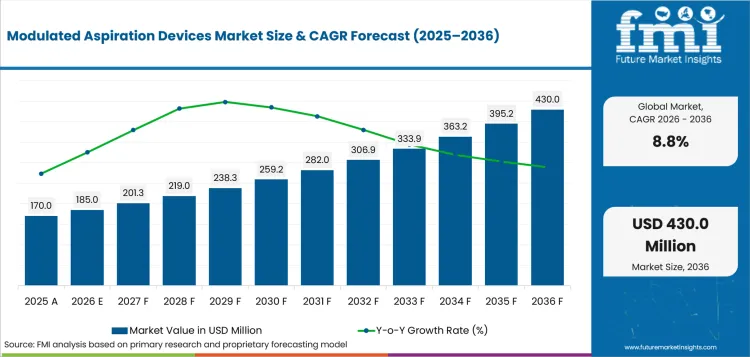
The Modulated Aspiration Devices Market is projected to grow from USD 185.0 million in 2026 to USD 430.0 million by 2036, at a CAGR of 8.8%.
Modulated Aspiration Devices Market value totaled USD 170.0 million in 2025 and is projected to reach USD 185.0 million in 2026. By 2036, the market is forecast to reach USD 430.0 million at a CAGR of 8.8%. Ischemic Stroke is projected to account for a 56.0% share by application in 2026. Pressure Modulation is expected to hold a 48.0% share by technology feature in 2026.
Modulated Aspiration Devices Market Overview: Size and Forecast
- 2025 Market Size: USD 170.0 million
- 2026 Market Size: USD 185.0 million
- 2036 Market Size: USD 430.0 million
- Forecast CAGR: 8.8% from 2026 to 2036
- Featured Application: Ischemic Stroke
- Ischemic Stroke Share in 2026: 56.0%
- Featured Technology Feature: Pressure Modulation
- Pressure Modulation Share in 2026: 48.0%
- Country CAGR Highlight: China
- China CAGR: 10.2% by 2036
Summary of the Modulated Aspiration Devices Market
- Demand and Growth Drivers
- Stroke centers need aspiration tools that shorten clot removal attempts and reduce delays in large-vessel occlusion procedures.
- Pulmonary embolism teams are evaluating vacuum control as large thrombus burden creates blood loss and clogging concerns.
- Peripheral vascular use expands the addressable pool as interventional radiology suites standardize catheter-based clot removal.
- Disposable catheter revenue grows with every procedure as consoles anchor repeat purchasing inside hospitals.
- Product and Segment View
- Ischemic Stroke is projected to account for a 56.0% share by application in 2026 as neurovascular pathways drive urgent aspiration use.
- With an estimated 48.0% share in 2026, Pressure Modulation is expected to retain a notable position in technology features through safer suction control.
- Aspiration Catheters are anticipated to hold 52.0% product share in 2026 as disposable device sets drive recurring revenue.
- Geography and Competitive Outlook
- The United States is projected to grow at a CAGR of 8.9% through 2036 as FDA-cleared systems support premium adoption.
- India is forecast to grow at a CAGR of 9.8% through 2036 as private tertiary hospitals widen stroke intervention capacity.
- Penumbra and Imperative Care shape the pressure-controlled aspiration field through product launches and FDA clearances.
- Medtronic, Stryker, Terumo Neuro, Boston Scientific, and Johnson & Johnson MedTech compete through catheter reach and access depth.
- Analyst Opinion
- Anurag Sharma, Principal Consultant at Future Market Insights for the healthcare domain, says, “I see modulated aspiration moving from a device feature into a purchasing criterion. Hospitals are not only buying suction power. They are buying control during the few minutes when a catheter tip is against clot and blood loss can rise quickly. Stroke centers want faster reperfusion with fewer passes. Interventional radiology teams want pulmonary and peripheral systems that can handle large thrombus without workflow disruption. Suppliers gain an edge when they can prove pressure behavior, catheter trackability, and service support across emergency cases. Clients should watch whether device claims are backed by clearance scope and real procedure evidence.”
Penumbra launched Lightning Flash 3.0 in January 2026 with enlarged tubing and automated backflush for large thrombus burden. Imperative Care received FDA clearance in January 2025 for the Zoom System with a large-bore 0.088-inch catheter for stroke aspiration use.
These signals show a clear buyer move toward systems that combine catheter reach with controlled suction behavior.
Why is the Modulated Aspiration Devices Market growing?
Stroke centers need aspiration tools that shorten clot removal attempts and reduce delays in large-vessel occlusion procedures. Pulmonary embolism teams are evaluating vacuum control as large thrombus burden creates blood loss and clogging concerns.
- Stroke centers need aspiration tools that shorten clot removal attempts and reduce delays in large-vessel occlusion procedures.
- Pulmonary embolism teams are evaluating vacuum control as large thrombus burden creates blood loss and clogging concerns.
- Peripheral vascular use expands the addressable pool as interventional radiology suites standardize catheter-based clot removal.
Stroke care is an important adoption anchor since time to reperfusion shapes treatment outcome and device choice. The USA Centers for Disease Control and Prevention reported in October 2024 that over 795,000 people in the United States have a stroke each year. This disease load supports investment in faster neurovascular workflows and catheter-based reperfusion capacity. Modulated aspiration fits this need by giving physicians stronger control at the clot interface. This pushes hospitals to compare aspiration behavior, not only catheter diameter, when they shortlist thrombectomy platforms. Pulmonary embolism and peripheral vascular use create a second commercial channel for pressure-controlled suction systems.
How is the Modulated Aspiration Devices Market segmented?
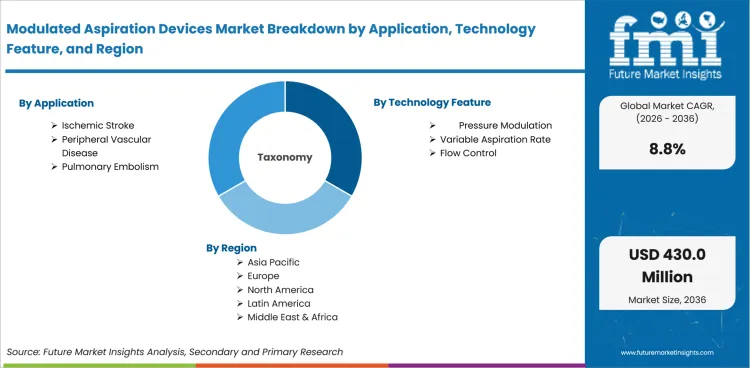
The Modulated Aspiration Devices Market is segmented by application, technology feature, product, end user, and region.
- Ischemic Stroke is projected to account for a 56.0% share by application in 2026 as neurovascular pathways drive urgent aspiration use.
- With an estimated 48.0% share in 2026, Pressure Modulation is expected to retain a notable position in technology features through safer suction control.
- Aspiration Catheters are anticipated to hold 52.0% product share in 2026 as disposable device sets drive recurring revenue.
How does Ischemic Stroke contribute to the application category?
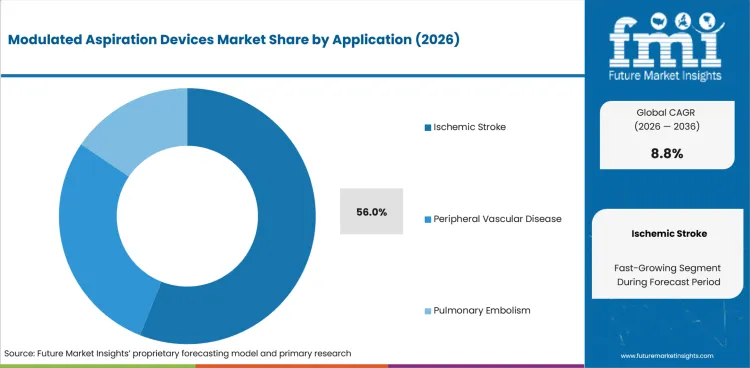
- Ischemic Stroke is projected to account for a 56.0% share in 2026 as large-vessel occlusion workflows favor aspiration systems with fast setup and controlled suction during clot engagement.
- Stroke buyers compare aspiration catheters against stroke catheters and stent retriever kits, since treatment teams often choose between first-pass aspiration and combined techniques.
What supports demand for Pressure Modulation?
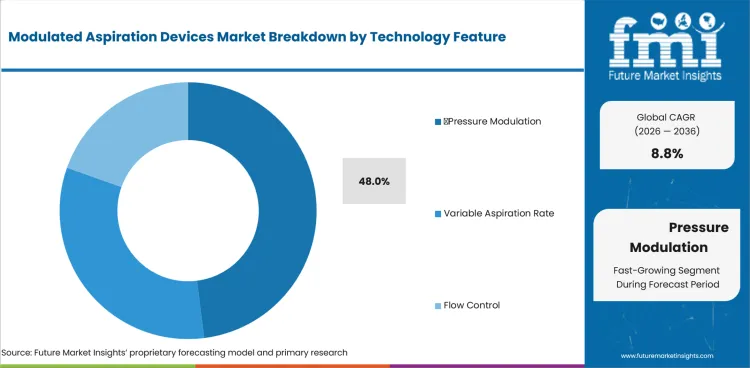
- Pressure Modulation is expected to represent a 48.0% share in 2026 as device selection shifts toward vacuum behavior that reduces blood loss risk during prolonged clot contact.
- Penumbra’s Lightning Flash 3.0 algorithm was designed for enhanced clot detection sensitivity and automated backflush, which shows how software now shapes aspiration performance.
How do buyers evaluate Aspiration Catheters within the product category?
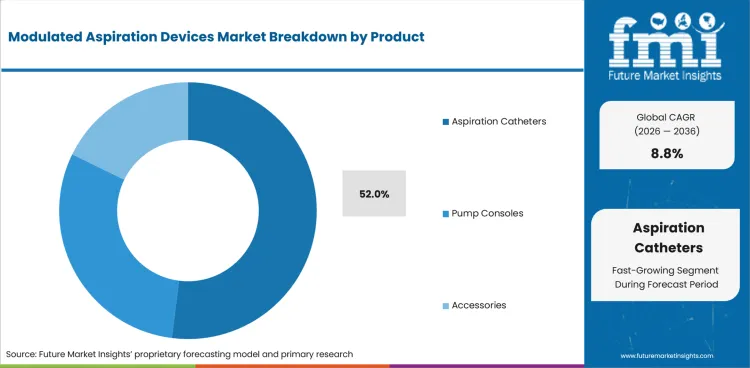
- Aspiration Catheters are anticipated to hold a 52.0% share in 2026 as each procedure requires sterile disposable access and clot-removal components.
- Catheter buyers assess inner diameter with trackability, so adjacent neurovascular guidewires and microcatheter compatibility influence final supplier choice.
What market factors influence demand for Hospitals?
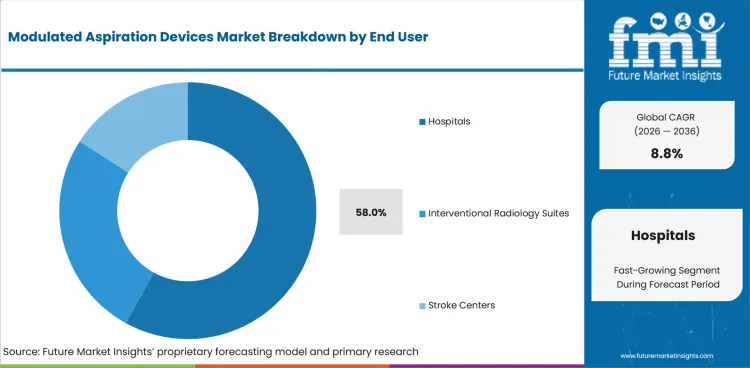
- Hospitals are projected to account for a 58.0% share in 2026 as acute stroke and vascular clot removal remain concentrated in tertiary care facilities.
- Hospital purchasing teams compare modulated aspiration against catheter-directed thrombolysis when bleeding risk, procedure time, and intensive-care capacity affect protocol design.
What drives and restrains the market?
The market reflects a balance between the identified demand driver, adoption constraints, and the supplier opportunity outlined below.
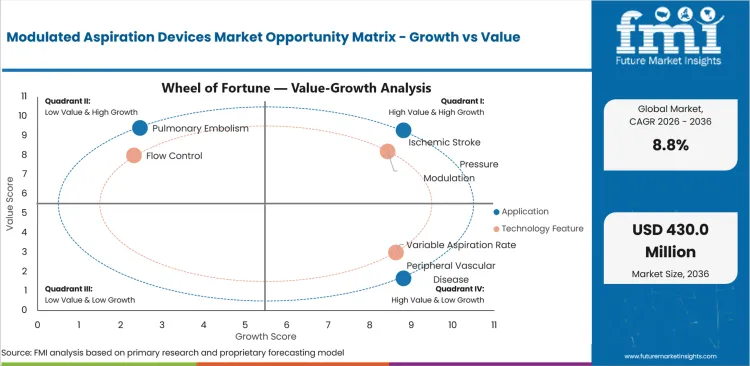
Driver: Large-vessel stroke workflows drive device use as physicians seek faster clot engagement and fewer aspiration interruptions; restraint: Training burden restrains adoption where intervention teams lack enough high-volume operators; opportunity: flow-control software creates an opportunity for suppliers to sell measurable procedure consistency.
- Driver: Large-vessel stroke workflows drive device use as physicians seek faster clot engagement and fewer aspiration interruptions.
- Restraint: Training burden restrains adoption where intervention teams lack enough high-volume operators.
- Opportunity: flow-control software creates an opportunity for suppliers to sell measurable procedure consistency.
Stroke Reperfusion Workflow: Stroke demand behaves around time-sensitive procedure flow, not routine device replacement. NHS England evidence has identified thrombectomy as suitable for at least 10% of stroke patients, but access has historically fallen below that target. This gap creates a direct reason for hospitals to invest in systems that shorten preparation and reduce repeat passes. Modulated aspiration supports this need by improving suction control when clot contact changes. Suppliers with training programs and clear labeling can convert workflow pressure into long-term hospital placement.
Vacuum Control Differentiation: Vacuum control is becoming a product separator as large-bore catheters reach more complex clot cases. Boston Scientific describes AngioJet as a pharmacomechanical peripheral thrombectomy device with active aspiration and lytic delivery. That shows how the broader thrombectomy field already competes around active clot-removal mechanics. Modulated aspiration narrows this contest toward suction timing and flow control. Buyers are therefore asking for evidence on pressure behavior and blood management during the procedure. Operator Training Bottleneck: Operator availability remains a real constraint because advanced aspiration devices need specialists comfortable with catheter navigation and emergency imaging workflows.
Which factors support expansion?
Commercial expansion is reinforced by the value, workflow, and recurring-demand factors below.
- Market value is rising as aspiration systems shift from passive suction toward controlled vacuum behavior in acute intervention rooms.
- Product pricing stays premium when suppliers combine catheter design with console control and single-use sterile tubing.
- Hospitals are paying for fewer procedural interruptions as clot clogging and blood loss concerns influence technology choice.
Which country markets are included in the CAGR comparison?
The selected CAGR comparison covers China (10.2%), India (9.8%), United States (8.9%), South Korea (8.4%), and United Kingdom (8.1%) through 2036.
.webp "Top Country Growth Comparison Modulated Aspiration Devices Market Cagr (2026 2036)")
| Country | CAGR |
|---|---|
| China | 10.2% |
| India | 9.8% |
| United States | 8.9% |
| South Korea | 8.4% |
| United Kingdom | 8.1% |
Source: Future Market Insights analysis based on the supplied country forecast table.
How do country-level CAGRs compare?
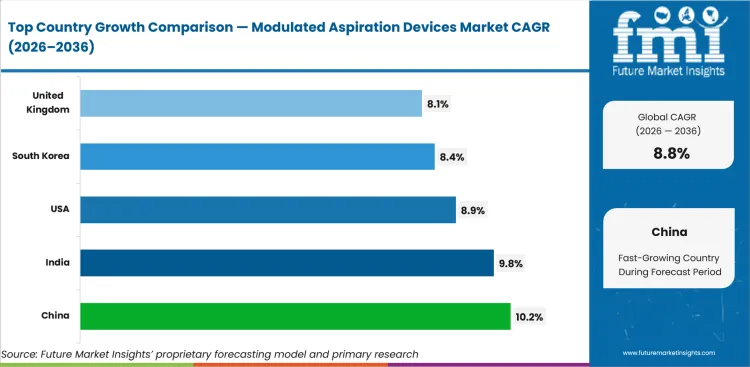
- China (CAGR: 10.2%): Large stroke burden supports high procedure growth potential.
- India (CAGR: 9.8%): Private tertiary hospitals support advanced thrombectomy uptake.
- United States (CAGR: 8.9%): CDC stroke data supports a large annual intervention pool.
- South Korea (CAGR: 8.4%): Organized stroke registries support clinical benchmarking.
- United Kingdom (CAGR: 8.1%): NHS thrombectomy access goals shape service expansion.
The global Modulated Aspiration Devices Market is forecast to record a CAGR of 8.8% from 2026 to 2036. The supplied study covers 8 named country forecasts across the report regions.
How is the Modulated Aspiration Devices Market developing in China?
China is projected to record a CAGR of 10.2% through 2036. The country outlook identifies this demand signal: Large stroke burden supports high procedure growth potential.
Country Market Snapshot
| Country | China |
|---|---|
| Forecast CAGR | 10.2% |
| Demand anchor | Large stroke burden supports high procedure growth potential. |
| Procurement route | Provincial hospital buying influences device access. |
| Channel signal | Advanced stroke centers shape thrombectomy procedure volume. |
| Application mix | Ischemic stroke dominates modulated aspiration demand. |
| Restraint | Domestic pricing pressure can challenge premium imports. |
| Proof point | China reported 81,865 mechanical thrombectomy procedures in 2023. |
| Primary demand signal | Large stroke burden supports high procedure growth potential. |
Market Outlook
China records a notable CAGR in this forecast because procedure scale is rising from a large stroke-care base. China Stroke Prevention and Control Report 2024 cited 81,865 mechanical thrombectomy procedures for ischemic stroke in 2023. That volume creates a strong platform for aspiration catheter and console demand. Modulated systems fit high-volume centers that need speed, suction control, and predictable accessory supply. China is forecast to grow at a CAGR of 10.2% through 2036 as stroke-center capacity expands and clinical protocols mature.
Key Growth Drivers
- High thrombectomy procedure volume supports recurring disposable demand.
- Advanced stroke centers create reference sites for pressure-controlled systems.
- Provincial purchasing growth opens channels beyond major coastal hospitals.
- Large stroke burden supports high procedure growth potential.
Key Restraints
- Price controls and tender pressure can compress premium-device margins.
- Regulatory approval and local clinical evidence can delay foreign product scale-up.
- Domestic pricing pressure can challenge premium imports.
Country Market FAQs
Why should executives monitor Modulated Aspiration Devices Market demand in China?
Executives should monitor China because local buyer readiness, large stroke burden supports high procedure growth potential, and service capacity can influence account timing and market-entry priorities.
What should suppliers localize for China?
Suppliers should localize proof points, pricing logic, partner coverage, and training support around provincial hospital buying influences device access and advanced stroke centers shape thrombectomy procedure volume.
What adoption risk needs attention in China?
Executive teams should watch adoption risk because price controls and tender pressure can compress premium-device margins can delay conversion from evaluation to commercial deployment.
How is the Modulated Aspiration Devices Market developing in India?
India is projected to record a CAGR of 9.8% through 2036. The country outlook identifies this demand signal: Private tertiary hospitals support advanced thrombectomy uptake.
Country Market Snapshot
| Country | India |
|---|---|
| Forecast CAGR | 9.8% |
| Demand anchor | Private tertiary hospitals support advanced thrombectomy uptake. |
| Procurement route | Hospital chains and specialists influence product choice. |
| Channel signal | Distributor coverage shapes availability outside metro centers. |
| Application mix | Stroke intervention drives early demand. |
| Restraint | Out-of-pocket exposure limits broad premium device use. |
| Proof point | The PRAAN registry enrolled 200 patients across 14 centers over 24 months. |
| Primary demand signal | Private tertiary hospitals support advanced thrombectomy uptake. |
Market Outlook
India demand is early but commercially important because private tertiary hospitals are expanding neurovascular services. The PRAAN registry enrolled 200 patients across 14 centers over 24 months and assessed mechanical thrombectomy in Indian AIS patients. This shows that local clinical evidence is starting to support broader procedure acceptance. Modulated aspiration devices can gain ground where hospitals market stroke capability and invest in specialist cath labs.
Key Growth Drivers
- Private hospital chains use advanced stroke care as a clinical differentiation point.
- Local registry evidence supports physician confidence in thrombectomy procedures.
- Metro neurointervention programs create early adoption hubs for aspiration systems.
- Private tertiary hospitals support advanced thrombectomy uptake.
Key Restraints
- High patient out-of-pocket cost limits broad use of premium disposables.
- Specialist availability remains uneven outside large metro hospitals.
- Distribution quality matters because emergency procedures cannot tolerate supply gaps.
Country Market FAQs
Why should executives monitor Modulated Aspiration Devices Market demand in India?
Executives should monitor India because local buyer readiness, private tertiary hospitals lead advanced thrombectomy uptake, and service capacity can influence account timing and market-entry priorities.
What should suppliers localize for India?
Suppliers should localize proof points, pricing logic, partner coverage, and training support around hospital chains and specialists influence product choice and distributor coverage shapes availability outside metro centers.
What adoption risk needs attention in India?
Executive teams should watch adoption risk because high patient out-of-pocket cost limits broad use of premium disposables can delay conversion from evaluation to commercial deployment.
How is the Modulated Aspiration Devices Market developing in the United States?
The United States is projected to record a CAGR of 8.9% through 2036. The country outlook identifies this demand signal: CDC stroke data supports a large annual intervention pool.
Country Market Snapshot
| Country | United States |
|---|---|
| Forecast CAGR | 8.9% |
| Demand anchor | CDC stroke data supports a large annual intervention pool. |
| Regulatory context | FDA 510(k) pathways shape product entry and labeling. |
| Buyer route | Comprehensive stroke centers influence premium platform selection. |
| Channel signal | Direct sales teams support neurovascular account training. |
| Application mix | Ischemic stroke and pulmonary embolism both influence demand. |
| Restraint | Hospital value committees challenge premium disposable pricing. |
| Primary demand signal | CDC stroke data supports a large annual intervention pool. |
Market Outlook
United States demand is shaped by fast product clearance cycles and high specialist center concentration. CDC data published in October 2024 shows over 795,000 annual stroke cases in the country. This scale supports continuing demand for faster clot-removal workflows. Premium modulated aspiration systems gain traction when hospitals can link device choice with shorter procedures and lower complication exposure. The United States is projected to record a CAGR of 8.9% through 2036 as FDA-cleared innovation supports upgrade cycles.
Key Growth Drivers
- FDA-cleared large-bore stroke and PE systems support faster technology turnover.
- Comprehensive stroke centers create clinical reference sites for aspiration workflow.
- Hospital committees favor systems with training and evidence-backed workflow claims.
- CDC stroke data supports a large annual intervention pool.
Key Restraints
Premium disposable sets face value analysis review before broad adoption.
Specialist staffing gaps can slow 24-hour thrombectomy availability outside major centers.
Hospital value committees challenge premium disposable pricing.
Country Market FAQs
Why should executives monitor Modulated Aspiration Devices Market demand in the United States?
Executives should monitor the United States because local buyer readiness, cdc stroke data supports a large annual intervention pool, and service capacity can influence account timing and market-entry priorities.
What should suppliers localize for the United States?
Suppliers should localize proof points, pricing logic, partner coverage, and training support around comprehensive stroke centers influence premium platform selection and direct sales teams support neurovascular account training.
What adoption risk needs attention in the United States?
Executive teams should watch adoption risk because premium disposable sets face value analysis review before broad adoption can delay conversion from evaluation to commercial deployment.
How is the Modulated Aspiration Devices Market developing in South Korea?
South Korea is projected to record a CAGR of 8.4% through 2036. The country outlook identifies this demand signal: Organized stroke registries support clinical benchmarking.
Country Market Snapshot
| Country | South Korea |
|---|---|
| Forecast CAGR | 8.4% |
| Demand anchor | Organized stroke registries support clinical benchmarking. |
| Procurement route | Large tertiary hospitals influence device choice. |
| Channel signal | Seoul-area academic centers shape adoption patterns. |
| Application mix | Acute ischemic stroke drives early demand. |
| Restraint | Hospital concentration can limit broad regional uptake. |
| Proof point | CRCS-K-NIH registry data describe national multicenter stroke patterns. |
| Primary demand signal | Organized stroke registries support clinical benchmarking. |
Market Outlook
South Korea demand is shaped by high specialist density and strong tertiary hospital influence. The 2024 CRCS-K-NIH registry report presents nationwide multicenter stroke data and describes a male-to-female ratio of 1.5 in the Korean stroke cohort. This evidence base supports device evaluation through outcomes and workflow measures. Modulated aspiration adoption is notable where high-volume centers compare catheter performance in real procedures. South Korea is expected to record a CAGR of 8.4% through 2036 as neurovascular programs upgrade within a compact healthcare system.
Key Growth Drivers
- Multicenter stroke registries support data-driven procedure improvement.
- High tertiary hospital concentration enables faster specialist feedback.
- Seoul-area centers influence national device preference through clinical experience.
- Organized stroke registries support clinical benchmarking.
Key Restraints
- Concentrated hospital buying can make new account access difficult.
- Reimbursement and tender review may limit premium system expansion.
- Hospital concentration can limit broad regional uptake.
Country Market FAQs
Why should executives monitor Modulated Aspiration Devices Market demand in South Korea?
Executives should monitor South Korea because local buyer readiness, organized stroke registries support clinical benchmarking, and service capacity can influence account timing and market-entry priorities.
What should suppliers localize for South Korea?
Suppliers should localize proof points, pricing logic, partner coverage, and training support around large tertiary hospitals influence device choice and seoul-area academic centers shape adoption patterns.
What adoption risk needs attention in South Korea?
Executive teams should watch adoption risk because concentrated hospital buying can make new account access difficult can delay conversion from evaluation to commercial deployment.
How is the Modulated Aspiration Devices Market developing in the United Kingdom?
The United Kingdom is projected to record a CAGR of 8.1% through 2036. The country outlook identifies this demand signal: NHS thrombectomy access goals shape service expansion.
Country Market Snapshot
| Country | United Kingdom |
|---|---|
| Forecast CAGR | 8.1% |
| Demand anchor | NHS thrombectomy access goals shape service expansion. |
| Procurement route | National Health Service buying favors evidence and service capacity. |
| Channel signal | Regional stroke networks influence referral and device use. |
| Application mix | Ischemic stroke dominates early demand. |
| Restraint | 24-hour access gaps limit procedure conversion. |
| Proof point | England reported thrombectomy access below the 10% target. |
| Primary demand signal | NHS thrombectomy access goals shape service expansion. |
Market Outlook
United Kingdom demand depends on service availability as much as device preference. NHS-linked evidence cited around 3.4% thrombectomy activity in early 2023 against a 10% patient suitability benchmark. This gap creates an addressable pool for procedure growth, but device sales follow workforce and network readiness. Modulated aspiration adoption improves when regional centers can prove reliable round-the-clock pathways. The United Kingdom is expected to grow at a CAGR of 8.1% through 2036 due to stroke network improvement and targeted access expansion.
Key Growth Drivers
- Stroke network reform creates room for higher thrombectomy procedure conversion.
- NHS purchasing favors devices with clear evidence and repeatable workflow fit.
- Regional service gaps create demand for tools that simplify emergency procedures.
- NHS thrombectomy access goals shape service expansion.
Key Restraints
- Staffing shortages can limit full use of advanced aspiration systems.
- Public procurement cycles slow switching from established catheter platforms.
- 24-hour access gaps limit procedure conversion.
Country Market FAQs
Why should executives monitor Modulated Aspiration Devices Market demand in the United Kingdom?
Executives should monitor the United Kingdom because local buyer readiness, NHS thrombectomy access goals shape service expansion, and service capacity can influence account timing and market-entry priorities.
What should suppliers localize for the United Kingdom?
Suppliers should localize proof points, pricing logic, partner coverage, and training support around national health service buying favors evidence and service capacity and regional stroke networks influence referral and device use.
What adoption risk needs attention in the United Kingdom?
Executive teams should watch adoption risk because staffing shortages can limit full use of advanced aspiration systems can delay conversion from evaluation to commercial deployment.
Which companies are discussed in the Modulated Aspiration Devices Market?
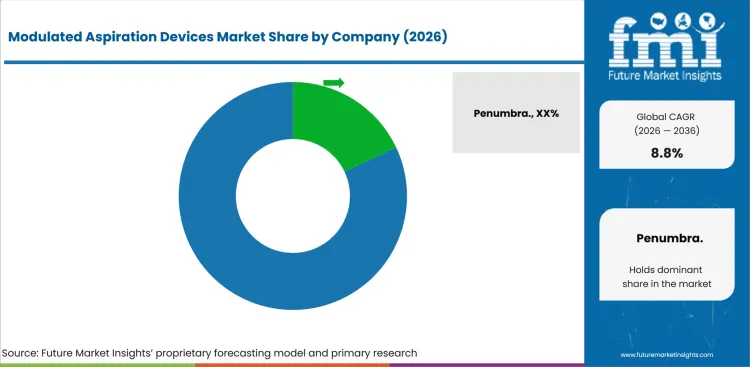
The preview discusses Penumbra, Imperative Care, Medtronic, Stryker, and Terumo Neuro among the companies active in this market.
The market is moderately concentrated because pressure-controlled aspiration requires catheter design, console integration, and regulatory evidence. Penumbra supports the most visible modulated aspiration niche through computer-assisted vacuum thrombectomy and Lightning platform upgrades. Imperative Care competes through large-bore aspiration systems across stroke and pulmonary embolism use.
Smaller specialists can win accounts with catheter handling advantages and strong physician training. Entry barriers include FDA clearance, thrombectomy evidence, sterile manufacturing, and hospital education needs. Penumbra has the clearest direct positioning in modulated aspiration through its CAVT platform.
How is competition structured?
Competition reflects differences in specialization, portfolio scope, geographic reach, evidence, and customer access.
Competition is organized around integrated aspiration platforms, catheter families, and vascular intervention reach.
- Integrated Aspiration Platform Leaders: Penumbra and Imperative Care hold the most direct relevance in pressure-controlled or large-bore aspiration systems. Penumbra brings CAVT and Lightning Flash technology for PE and venous thrombus.
- Diversified Vascular Device Companies: Medtronic, Stryker, Boston Scientific, and Johnson & Johnson MedTech compete through broad hospital relationships and adjacent thrombectomy portfolios. Medtronic offers neurovascular aspiration systems. Stryker has neurovascular catheters and acquired Inari for peripheral vascular clot removal.
- Catheter Specialists and Access Players: Terumo Neuro competes through SOFIA aspiration and access catheter families. The company’s SOFIA Flow 88 activity highlights physician control and EMEA commercial availability.
How do selected companies compare?
The selected companies differ in portfolio focus, geographic reach, evidence depth, and channel strength.
| Company | Competitive position |
|---|---|
| Penumbra | Penumbra’s wider neurovascular platform also supports cross-selling into neurointerventional device buyers. |
| Imperative Care | Imperative Care brings Zoom for stroke aspiration and Symphony for PE thrombectomy. |
| Medtronic | Medtronic’s Riptide aspiration system is designed to remove occlusive thrombus from cerebral vasculature during acute ischemic stroke. |
| Stryker | Stryker has neurovascular catheters and acquired Inari for peripheral vascular clot removal. |
| Terumo Neuro | Terumo Neuro launched SOFIA Flow 88 in EMEA in June 2025 and highlighted trackability, proximal stability, and physician control. |
What are the key developments in the Modulated Aspiration Devices Market?
- In January 2026, Penumbra launched Lightning Flash 3.0 with enlarged tubing and automated backflush. The launch strengthens its CAVT position in PE and venous thrombus.
- In March 2026, Penumbra published a Lightning Flash 3.0 case study noting improved clot detection sensitivity. This supports clinical communication around modulated aspiration behavior.
- In February 2025, FDA documentation confirmed clearance activity for Penumbra System RED 72. This reinforces Penumbra’s stroke aspiration catheter portfolio.
Selected Companies in the Modulated Aspiration Devices Market
Companies referenced in this preview
- Penumbra.
- Imperative Care.
- Medtronic.
- Stryker.
- Terumo Neuro.
- Boston Scientific.
- Johnson & Johnson MedTech.
- MicroVention.
Market Scope & Definition
| Market definition | Values |
|---|---|
| Functions covered | Pressure Modulation, Variable Aspiration Rate, Flow Control |
| Applications covered | Ischemic Stroke, Peripheral Vascular Disease, Pulmonary Embolism |
| End-use industries | Hospitals, Interventional Radiology Suites, Stroke Centers |
| Inclusions | Market scope covers aspiration catheters, pump consoles, sterile tubing, clot-management accessories, ischemic stroke use, peripheral vascular disease use, pulmonary embolism use, hospitals, interventional radiology suites, stroke centers, and selected global countries from 2026 to 2036. |
| Exclusions | Market scope excludes manual syringe aspiration, drug-only thrombolysis, stand-alone stent retrievers, ultrasound-only lysis systems, open surgical clot removal, diagnostic catheters, and general suction pumps outside thrombectomy use. |
Research Methodology
| Primary Research | Future Market Insights reviewed input from neurointerventional physicians, vascular specialists, hospital purchasing teams, and distributor representatives. The work focused on how buyers compare suction control, catheter reach, training burden, and disposable set economics. |
|---|---|
| Desk Research | Analysts reviewed FDA product clearances, clinical stroke references, company product pages, and public hospital workflow evidence. Regulatory evidence helped define which systems were direct aspiration devices and which products were adjacent. |
| Market Sizing and Forecasting | The model combined procedure-linked device use, average catheter set pricing, console placement assumptions, and country-level hospital access. Forecasts were adjusted for stroke-center density and pulmonary embolism response team maturity. |
| Data Validation | Forecasts were checked against aspiration thrombectomy portfolios and adjacent blood clot retrieval devices demand. The team cross-checked catheter intensity against ischemic stroke aspiration systems and broader thrombectomy use. |
What does the report cover?
The report covers application, technology feature, product, end user, and region across the 2026-2036 forecast period in 30+ countries.
| Periods | Base year 2025; estimated year 2026; forecast period 2026-2036 |
|---|---|
| Quantitative units | USD 185.0 million in 2026 to USD 430.0 million in 2036, at a CAGR of 8.8% |
| Segment axes | application, technology feature, product, end user, and region |
| Regions | North America, Europe, East Asia, South Asia, Middle East, and Rest of World |
| Countries | United States, United Kingdom, Germany, France, Japan, China, South Korea, India and 30+ |
| Companies | Penumbra, Imperative Care, Medtronic, Stryker, Terumo Neuro, Boston Scientific, Johnson & Johnson MedTech |
| Approach | Hybrid bottom-up and selected-down methodology using procedure demand, device pricing, country access, and company portfolio validation. |
Segmentation
Segmented by Application
- Ischemic Stroke.
- Peripheral Vascular Disease.
- Pulmonary Embolism.
Segmented by Technology Feature
- Pressure Modulation.
- Variable Aspiration Rate.
- Flow Control.
Segmented by Product
- Aspiration Catheters.
- Pump Consoles.
- Accessories.
Segmented by End User
- Hospitals.
- Interventional Radiology Suites.
- Stroke Centers.
By Region
- North America.
- United States.
- East Asia.
- China.
- Japan.
- South Korea.
Research Sources and Bibliography
- 1. Centers for Disease Control and Prevention. (2024, October 24). Stroke facts.
- 2. Getting It Right First Time. (2023, October). Mechanical thrombectomy delivery in England.
- 3. Penumbra, Inc. (2026, January 26). Penumbra launches Lightning Flash 3.0.
- 4. Penumbra, Inc. (2026, March 5). Case study: Next-generation Lightning Flash 3.0 efficiently clears right-sided PE and lower extremity venous thrombus.
- 5. USA Food and Drug Administration. (2025, February 13). Penumbra System Reperfusion Catheter RED 72 510(k) summary.
- 6. Imperative Care, Inc. (2025, January 27). Imperative Care secures FDA 510(k) clearance for the Zoom System.
- 7. USA Food and Drug Administration. (2025, May 28). Zoom 7X Catheter and Zoom Aspiration Tubing 510(k) notification.
- 8. Imperative Care, Inc. (2025, September 2). Imperative Care announces FDA clearance of Symphony Thrombectomy System.
- 9. Stryker Corporation. (2025, February 19). Stryker completes acquisition of Inari Medical.
- 10. Terumo Neuro. (2025, September 3). Terumo Neuro unveils new SOFIA Flow 88 neurovascular aspiration catheter.
- 11. Medtronic. (2025). Riptide aspiration system.
- 12. Boston Scientific. (2025). AngioJet thrombectomy systems.
- 13. China Stroke Prevention and Control Report Writing Group. (2024). China Stroke Prevention and Control Report 2024.
- 14. Kim, D. Y., et al. (2024). Insights from the CRCS-K-NIH registry. Journal of Korean Medical Science.
- 15. Yamasaki, B., et al. (2024). A simulation-based study in Hyogo Prefecture, Japan.
- 16. Gabet, A., et al. (2024). Epidemiology of stroke in France.
The bibliography is provided for reader reference and uses primary regulatory, official company, academic, or recognized health sources.
This Report Answers
- What is the projected value of the Modulated Aspiration Devices Market in 2026?
- What value is forecast for the Modulated Aspiration Devices Market by 2036?
- What CAGR is forecast for the Modulated Aspiration Devices Market from 2026 to 2036?
- What 2026 share is projected for Ischemic Stroke within the application category?
- What 2026 share is projected for Pressure Modulation within the technology feature category?
- Which demand factors support the Modulated Aspiration Devices Market outlook?
- Which restraints and opportunities affect adoption in the Modulated Aspiration Devices Market?
- How are country CAGR outlooks, including China at 10.2%, compared?
- Which companies and product developments are covered in the competitive analysis?
- What is included in the market scope, and how is the forecast validated?
Frequently Asked Questions
Why should executives track the Modulated Aspiration Devices Market?
Executives should track this market because it can affect capital allocation, supplier strategy, operating risk, and competitive positioning across applications.
What business problem does the Modulated Aspiration Devices Market address?
It helps executive teams judge where customer pain, supplier capability, compliance exposure, and implementation economics justify investment, procurement, or market-entry decisions.
What should procurement leaders evaluate before selecting suppliers?
Procurement leaders should assess evidence quality, integration fit, service coverage, compliance readiness, total cost of ownership, and supplier execution capability.
What can limit return on investment for buyers?
Return on investment can be limited by low utilization, integration delays, training gaps, unclear ownership, pricing pressure, or weak fit with existing workflows.
How can suppliers build executive confidence?
Suppliers can build confidence by proving implementation speed, risk reduction, support depth, reference use cases, and measurable outcomes for budget owners.
Preview the report firsthand - request a free sample
Get SampleGet the brochure for pricing and purchase details.
Get PDFTable of Content
- Key Takeaways
- Market Size and CAGR
- Top Growth Driver
- Fastest Growing Segment
- Leading Region
- Key Companies
- Emerging Opportunities
- Executive Summary
- Global Market Outlook
- Demand-side Trends
- Supply-side Trends
- Technology Roadmap Analysis
- Analysis and Recommendations
- Analyst Perspective (What is happening? Why now? What should investors know?)
- Key Questions Answered
- How large is the market?
- What is the CAGR?
- What are key trends?
- Which region dominates?
- Who are the leaders?
- Market Overview
- Market Coverage / Taxonomy
- Market Definition / Scope / Limitations
- Research Methodology
- Chapter Orientation
- Analytical Lens and Working Hypotheses
- Market Structure, Signals, and Trend Drivers
- Benchmarking and Cross-market Comparability
- Market Sizing, Forecasting, and Opportunity Mapping
- Research Design and Evidence Framework
- Desk Research Programme (Secondary Evidence)
- Expert Input and Fieldwork (Primary Evidence)
- Tooling, Models, and Reference Databases
- Data Engineering and Model Build
- Quality Assurance and Audit Trail
- Market Background
- Market Dynamics (Drivers, Restraints, Opportunity, Trends)
- Scenario Forecast (Optimistic, Likely, Conservative)
- Impact Analysis
- AI Impact
- Sustainability Impact
- Regulatory Impact
- Technology Impact
- Consumer / Buyer Analysis
- Purchase Drivers
- Adoption Barriers
- Buyer Journey
- Opportunity Map Analysis
- Product Life Cycle Analysis
- Supply Chain Analysis
- Investment Feasibility Matrix
- Value Chain Analysis
- PESTLE and Porter's Analysis
- Regulatory Landscape
- Regional Parent Market Outlook
- Production and Consumption Statistics
- Import and Export Statistics
- Global Market Analysis and Forecast, 2021 to 2036
- Historical Market Size Value (USD Million) Analysis, 2021 to 2025
- Current and Future Market Size Value (USD Million) Projections, 2026 to 2036
- Y-o-Y Growth Trend Analysis
- Absolute $ Opportunity Analysis
- Global Market Pricing Analysis, 2021 to 2036
- Global Market Analysis and Forecast, By Application, 2021 to 2036
- Introduction / Key Findings
- Historical Market Size Value (USD Million) Analysis By Application, 2021 to 2025
- Current and Future Market Size Value (USD Million) Analysis and Forecast By Application, 2026 to 2036
- Ischemic Stroke
- Peripheral Vascular Disease
- Pulmonary Embolism
- Ischemic Stroke
- Y-o-Y Growth Trend Analysis By Application, 2021 to 2025
- Absolute $ Opportunity Analysis By Application, 2026 to 2036
- Global Market Analysis and Forecast, By Technology Feature, 2021 to 2036
- Introduction / Key Findings
- Historical Market Size Value (USD Million) Analysis By Technology Feature, 2021 to 2025
- Current and Future Market Size Value (USD Million) Analysis and Forecast By Technology Feature, 2026 to 2036
- Pressure Modulation
- Variable Aspiration Rate
- Flow Control
- Pressure Modulation
- Y-o-Y Growth Trend Analysis By Technology Feature, 2021 to 2025
- Absolute $ Opportunity Analysis By Technology Feature, 2026 to 2036
- Global Market Analysis and Forecast, By Product, 2021 to 2036
- Introduction / Key Findings
- Historical Market Size Value (USD Million) Analysis By Product, 2021 to 2025
- Current and Future Market Size Value (USD Million) Analysis and Forecast By Product, 2026 to 2036
- Aspiration Catheters
- Pump Consoles
- Accessories
- Aspiration Catheters
- Y-o-Y Growth Trend Analysis By Product, 2021 to 2025
- Absolute $ Opportunity Analysis By Product, 2026 to 2036
- Global Market Analysis and Forecast, By End User, 2021 to 2036
- Introduction / Key Findings
- Historical Market Size Value (USD Million) Analysis By End User, 2021 to 2025
- Current and Future Market Size Value (USD Million) Analysis and Forecast By End User, 2026 to 2036
- Hospitals
- Interventional Radiology Suites
- Stroke Centers
- Hospitals
- Y-o-Y Growth Trend Analysis By End User, 2021 to 2025
- Absolute $ Opportunity Analysis By End User, 2026 to 2036
- Global Market Analysis and Forecast, By Region, 2021 to 2036
- Introduction
- Historical Market Size Value (USD Million) Analysis By Region, 2021 to 2025
- Current Market Size Value (USD Million) Analysis and Forecast By Region, 2026 to 2036
- North America
- Latin America
- Western Europe
- Eastern Europe
- East Asia
- South Asia and Pacific
- Middle East & Africa
- Market Attractiveness Analysis By Region
- North America Market Analysis and Forecast, By Country, 2021 to 2036
- Historical Market Size Value (USD Million) Trend Analysis By Market Taxonomy, 2021 to 2025
- Market Size Value (USD Million) Forecast By Market Taxonomy, 2026 to 2036
- By Country
- USA
- Canada
- Mexico
- By Application
- By Technology Feature
- By Product
- By End User
- By Country
- Market Attractiveness Analysis
- By Country
- By Application
- By Technology Feature
- By Product
- By End User
- Key Takeaways
- Latin America Market Analysis and Forecast, By Country
- Historical Market Size Value (USD Million) Trend Analysis By Market Taxonomy, 2021 to 2025
- Market Size Value (USD Million) Forecast By Market Taxonomy, 2026 to 2036
- By Country
- Brazil
- Chile
- Rest of Latin America
- By Application
- By Technology Feature
- By Product
- By End User
- By Country
- Market Attractiveness Analysis
- By Country
- By Application
- By Technology Feature
- By Product
- By End User
- Key Takeaways
- Western Europe Market Analysis and Forecast, By Country
- Historical Market Size Value (USD Million) Trend Analysis By Market Taxonomy, 2021 to 2025
- Market Size Value (USD Million) Forecast By Market Taxonomy, 2026 to 2036
- By Country
- Germany
- UK
- Italy
- Spain
- France
- Nordic
- BENELUX
- Rest of Western Europe
- By Application
- By Technology Feature
- By Product
- By End User
- By Country
- Market Attractiveness Analysis
- By Country
- By Application
- By Technology Feature
- By Product
- By End User
- Key Takeaways
- Eastern Europe Market Analysis and Forecast, By Country
- Historical Market Size Value (USD Million) Trend Analysis By Market Taxonomy, 2021 to 2025
- Market Size Value (USD Million) Forecast By Market Taxonomy, 2026 to 2036
- By Country
- Russia
- Poland
- Hungary
- Balkan & Baltic
- Rest of Eastern Europe
- By Application
- By Technology Feature
- By Product
- By End User
- By Country
- Market Attractiveness Analysis
- By Country
- By Application
- By Technology Feature
- By Product
- By End User
- Key Takeaways
- East Asia Market Analysis and Forecast, By Country
- Historical Market Size Value (USD Million) Trend Analysis By Market Taxonomy, 2021 to 2025
- Market Size Value (USD Million) Forecast By Market Taxonomy, 2026 to 2036
- By Country
- China
- Japan
- South Korea
- By Application
- By Technology Feature
- By Product
- By End User
- By Country
- Market Attractiveness Analysis
- By Country
- By Application
- By Technology Feature
- By Product
- By End User
- Key Takeaways
- South Asia and Pacific Market Analysis and Forecast, By Country
- Historical Market Size Value (USD Million) Trend Analysis By Market Taxonomy, 2021 to 2025
- Market Size Value (USD Million) Forecast By Market Taxonomy, 2026 to 2036
- By Country
- India
- ASEAN
- Australia & New Zealand
- Rest of South Asia and Pacific
- By Application
- By Technology Feature
- By Product
- By End User
- By Country
- Market Attractiveness Analysis
- By Country
- By Application
- By Technology Feature
- By Product
- By End User
- Key Takeaways
- Middle East & Africa Market Analysis and Forecast, By Country
- Historical Market Size Value (USD Million) Trend Analysis By Market Taxonomy, 2021 to 2025
- Market Size Value (USD Million) Forecast By Market Taxonomy, 2026 to 2036
- By Country
- Kingdom of Saudi Arabia
- Other GCC Countries
- Türkiye
- South Africa
- Other African Union
- Rest of Middle East & Africa
- By Application
- By Technology Feature
- By Product
- By End User
- By Country
- Market Attractiveness Analysis
- By Country
- By Application
- By Technology Feature
- By Product
- By End User
- Key Takeaways
- Key Countries Market Analysis
- USA
- Pricing Analysis
- Market Share Analysis, 2025
- By Application
- By Technology Feature
- By Product
- By End User
- Canada
- Pricing Analysis
- Market Share Analysis, 2025
- By Application
- By Technology Feature
- By Product
- By End User
- Mexico
- Pricing Analysis
- Market Share Analysis, 2025
- By Application
- By Technology Feature
- By Product
- By End User
- Brazil
- Pricing Analysis
- Market Share Analysis, 2025
- By Application
- By Technology Feature
- By Product
- By End User
- Chile
- Pricing Analysis
- Market Share Analysis, 2025
- By Application
- By Technology Feature
- By Product
- By End User
- Germany
- Pricing Analysis
- Market Share Analysis, 2025
- By Application
- By Technology Feature
- By Product
- By End User
- UK
- Pricing Analysis
- Market Share Analysis, 2025
- By Application
- By Technology Feature
- By Product
- By End User
- Italy
- Pricing Analysis
- Market Share Analysis, 2025
- By Application
- By Technology Feature
- By Product
- By End User
- Spain
- Pricing Analysis
- Market Share Analysis, 2025
- By Application
- By Technology Feature
- By Product
- By End User
- France
- Pricing Analysis
- Market Share Analysis, 2025
- By Application
- By Technology Feature
- By Product
- By End User
- India
- Pricing Analysis
- Market Share Analysis, 2025
- By Application
- By Technology Feature
- By Product
- By End User
- ASEAN
- Pricing Analysis
- Market Share Analysis, 2025
- By Application
- By Technology Feature
- By Product
- By End User
- Australia & New Zealand
- Pricing Analysis
- Market Share Analysis, 2025
- By Application
- By Technology Feature
- By Product
- By End User
- China
- Pricing Analysis
- Market Share Analysis, 2025
- By Application
- By Technology Feature
- By Product
- By End User
- Japan
- Pricing Analysis
- Market Share Analysis, 2025
- By Application
- By Technology Feature
- By Product
- By End User
- South Korea
- Pricing Analysis
- Market Share Analysis, 2025
- By Application
- By Technology Feature
- By Product
- By End User
- Russia
- Pricing Analysis
- Market Share Analysis, 2025
- By Application
- By Technology Feature
- By Product
- By End User
- Poland
- Pricing Analysis
- Market Share Analysis, 2025
- By Application
- By Technology Feature
- By Product
- By End User
- Hungary
- Pricing Analysis
- Market Share Analysis, 2025
- By Application
- By Technology Feature
- By Product
- By End User
- Kingdom of Saudi Arabia
- Pricing Analysis
- Market Share Analysis, 2025
- By Application
- By Technology Feature
- By Product
- By End User
- Türkiye
- Pricing Analysis
- Market Share Analysis, 2025
- By Application
- By Technology Feature
- By Product
- By End User
- South Africa
- Pricing Analysis
- Market Share Analysis, 2025
- By Application
- By Technology Feature
- By Product
- By End User
- USA
- Market Structure Analysis
- Competition Dashboard
- Competition Benchmarking
- Market Share Analysis of Top Players
- By Regional
- By Application
- By Technology Feature
- By Product
- By End User
- Emerging Startups
- Innovation Benchmarking
- Competition Analysis
- Competition Deep Dive
- Penumbra.
- Overview
- Product Portfolio
- Profitability by Market Segments (Product/Region/Sales Channel)
- Sales Footprint
- Strategy Overview
- Marketing Strategy
- Product Strategy
- Channel Strategy
- Imperative Care.
- Medtronic.
- Stryker.
- Terumo Neuro.
- Boston Scientific.
- Johnson & Johnson MedTech.
- Penumbra.
- Case Studies
- Success Stories
- Recent Developments
- Competition Deep Dive
- Assumptions & Acronyms Used


