

- Market Size (2026)
- USD 3560.7 Mn
- Forecast (2036)
- USD 6437.1 Mn
- CAGR (2026 to 2036)
- 6.1%
How big is the PAC coagulants market in 2026?
USD 3,560.7 million in 2026 and USD 6,437.1 million by 2036 at a 6.1% CAGR.
The PAC coagulants industry value is forecast to grow from USD 3,356.0 million in 2025 to USD 6,437.1 million by 2036 at 6.1% CAGR as municipal utilities and industrial plants use aluminum-based coagulants for turbidity control, phosphorus capture, and sludge management. Direct sales are expected to secure 64.0% share in 2026 because large treatment plants need assured supply, jar-test support, and delivery scheduling. Utilities are forecast to represent 61.0% share in 2026, led by recurring chemical use across drinking water and wastewater facilities.
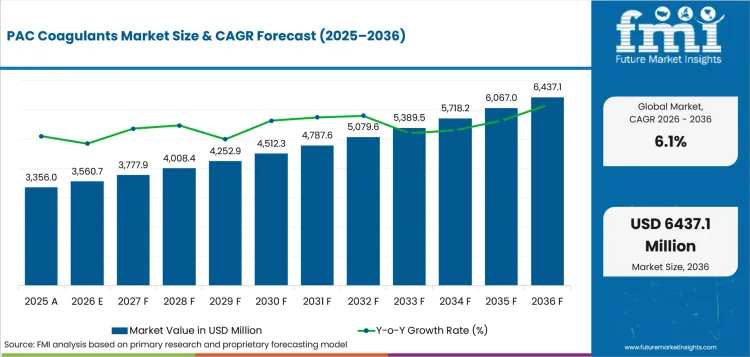
PAC Coagulants Market Overview: Size and Forecast
- 2025 Market Size: USD 3,356.0 million
- 2026 Market Size: USD 3,560.7 million
- 2036 Market Size: USD 6,437.1 million
- Forecast CAGR (2026-2036): 6.1%
- Leading Sales Channel: Direct
- Direct Sales Share (2026): 64.0%
- Leading End Use: Utilities
- Utilities Share (2026): 61.0%
- Fastest-growing Country: India
- India CAGR (2026-2036): 6.8%
Summary of the PAC Coagulants Market
- Demand and Growth Drivers
- Utilities are adopting PAC where raw-water quality shifts require faster floc formation during rainfall, runoff, and seasonal turbidity changes.
- Industrial plants are using PAC for suspended solids, color, and phosphorus control before discharge or reuse.
- Blended coagulants are gaining attention as plants seek fewer chemical feeds and simpler operator control.
- Product and Segment View
- Direct sales are projected to represent 64.0% share in 2026, supported by large contracts that require technical service and assured delivery.
- Utilities are expected to account for 61.0% share in 2026, led by daily use across drinking water and wastewater systems.
- Liquid PAC is forecast to secure 57.0% share in 2026, supported by tanker delivery, storage tanks, and metered dosing systems.
- Geography and Competitive Outlook
- India is projected to record 6.8% CAGR by 2036, backed by drinking water expansion and urban sewerage investment.
- China is expected to expand at 6.4% CAGR by 2036, supported by municipal wastewater and industrial park treatment demand.
- Kemira and USALCO compete through coagulant capacity, drinking-water references, and regional supply programs.
- Feralco, Solenis, Taki Chemical, and GACL focus on grade breadth, application support, and country-specific supply channels.
- Analyst Opinion
- Nikhil Kaitwade, Associate Vice President at FMI, observes, “PAC coagulants are now more than aluminum salts bought by the tonne. Utilities judge them by dose response, floc strength, sludge volume, and delivery reliability. Industrial users select PAC when discharge compliance punishes weak clarification. Suppliers that combine stable basicity, certified drinking water grades, and fast plant support should gain stronger tender retention.”
The PAC coagulants market is expected to witness steady growth through 2036, driven by recurring demand from public water utilities and industrial wastewater users seeking reliable clarification. Market expansion is further supported by water infrastructure funding and tighter wastewater performance expectations.
Quality and supply assurance are becoming central to PAC coagulant buying as water utilities review chemical performance before annual awards. The USA EPA stated in May 2024 that at least USD 630.0 billion would be needed over 20 years for clean water infrastructure, which supports treatment-plant upgrades and recurring chemical demand. UN-Water reported in 2024 that only 38.0% of industrial wastewater was treated among reporting countries, with only 27.0% safely treated. Ofwat approved GBP 104.0 billion of water-sector spending for 2025 to 2030, giving coagulant suppliers a stronger utility investment base across regulated wastewater and drinking water systems.
Which factors support expansion in the PAC coagulants market?
Water treatment chemical revenue and supply documentation support market value across utility and industrial channels.
- Market value is supported by PAC shipment revenue before distributors and service providers add technical service margins.
- Supplier pricing reflects aluminum input, basicity, storage stability, and delivery distance before jar-test results affect awards.
- Revenue improves as utilities convert from alum or ferric salts where lower dose and reduced sludge handling can be proven.
- Buyer confidence rises as product approvals, use limits, and batch consistency make treatment outcomes easier to compare.
Why is the PAC coagulants market growing?
Utilities and industrial plants are using PAC to stabilize clarification while meeting stricter water-quality and discharge expectations.
Growth outlook has become more structured as public infrastructure funding supports treatment plants and chemical dosing systems. In May 2026, EPA announced USD 7.2 billion in FY 2026 allotments for states, Tribes, and territories through Clean Water and Drinking Water State Revolving Fund programs. This funding supports treatment infrastructure, pumping systems, and process improvements where coagulants remain part of daily operating demand. PAC suppliers benefit when they prove dose efficiency, pH compatibility, lower sludge burden, and reliable liquid delivery across utility contracts.
How is the PAC coagulants market segmented?
The PAC coagulants industry is segmented by product type, application, basicity, end use, and sales channel.
- Liquid PAC is projected to secure 57.0% share in 2026, led by high-volume utility buyers using bulk tanks, transfer pumps, and metered dosing systems for continuous treatment.
- Municipal Drinking Water is expected to hold 38.0% share in 2026, supported by surface-water plants that need dependable turbidity removal before filtration and disinfection.
- Medium Basicity is anticipated to represent 46.0% share in 2026, since balanced charge strength and pH behavior suit common raw-water and wastewater conditions.
- Utilities are forecast to account for 61.0% share in 2026, reflected by public systems buying coagulants under recurring supply agreements and service-backed tenders.
- Direct sales are expected to represent 64.0% share in 2026, guided by large plants requiring assured volume, technical trials, and emergency delivery planning.
Why does Liquid PAC dominate the PAC coagulants market?
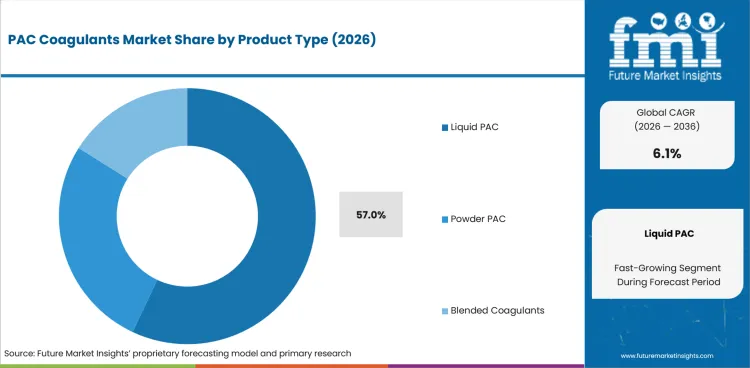
- Liquid PAC is projected to account for 57.0% share in 2026, influenced by tanker delivery, bulk tanks, and metering systems that fit daily treatment operations at large plants.
- Powder PAC gains use in export lanes and remote projects as lower water content reduces landed freight cost, although buyers must manage dissolving and dust-control steps.
Which application leads the PAC coagulants market?
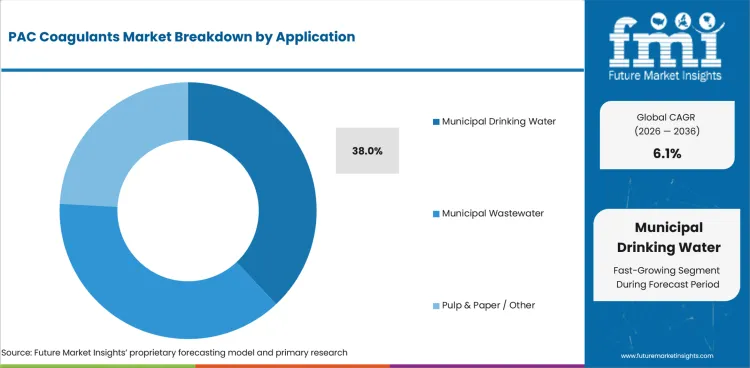
- Municipal Drinking Water is expected to hold 38.0% share in 2026, reflected by surface-water plants using PAC to remove turbidity before filtration and disinfection.
- Municipal Wastewater gains value as phosphorus capture and suspended-solids removal become practical retrofit routes for clarifiers and tertiary treatment lines.
Which basicity leads the PAC coagulants market?
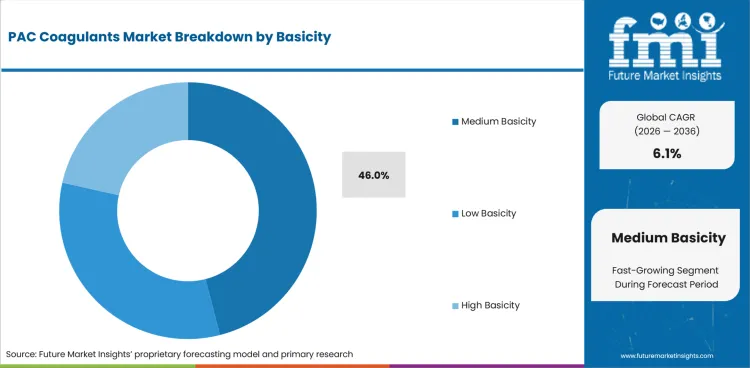
- Medium Basicity is anticipated to represent 46.0% share in 2026, supported by balanced charge density, pH impact, and cost across common plant conditions.
- High Basicity grades suit low-alkalinity water and sludge-reduction targets, although they require tighter storage and formulation control than standard grades.
Which end use leads the PAC coagulants market?
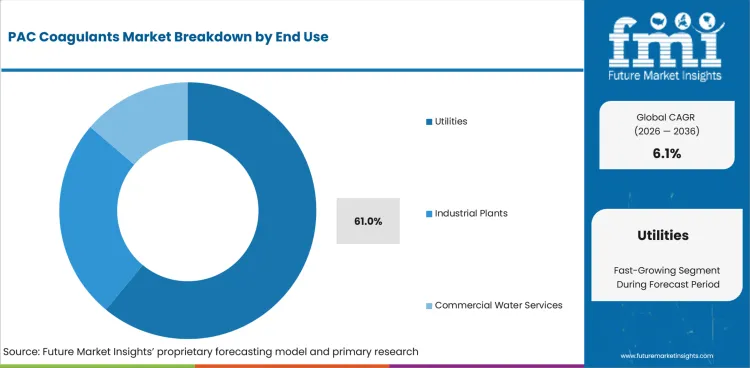
- Utilities are projected to account for 61.0% share in 2026, led by recurring chemical use across public drinking water and wastewater treatment facilities.
- Industrial Plants create added demand where effluent color, oil traces, suspended solids, or nutrient loads must be controlled before discharge or reuse.
Which sales channel leads the PAC coagulants market?
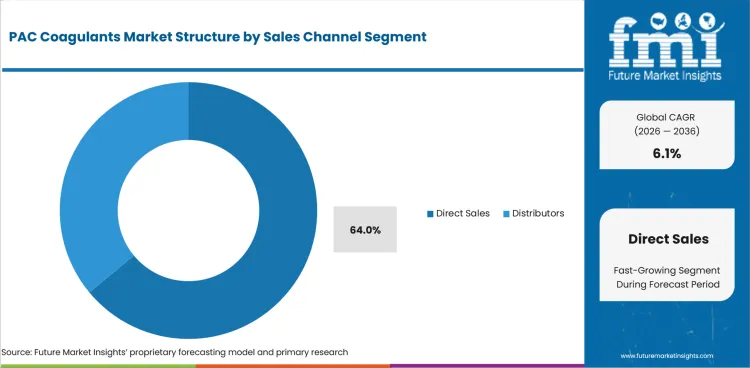
- Direct sales are expected to represent 64.0% share in 2026, shaped by large-volume contracts, certified product supply, and plant-specific technical support.
- Distributors remain important for smaller municipalities and private plants that buy PAC within wider chemical baskets and flexible delivery programs.
What are the drivers, restraints, and opportunities in the PAC coagulants market?
Public treatment upgrades and discharge compliance support growth while liquid logistics and input cost exposure limit supplier reach.
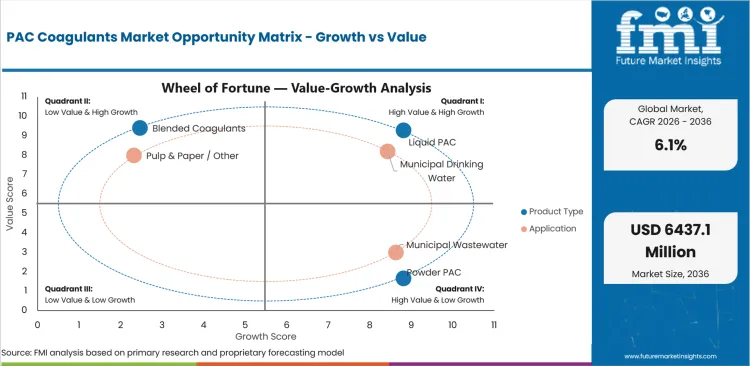
- Raw-water turbidity swings increase PAC use because treatment plants need faster floc formation during rainfall, runoff, and seasonal quality variation.
- High liquid freight cost limits long-distance PAC trade because water content raises transport expense and favors production near dense utility clusters.
- Blended coagulants create value when plants want fewer chemical feeds, simpler operator control, and more stable performance across changing water conditions.
PAC Coagulants Market Demand Outlook
Demand outlook is moving toward PAC grades that can prove stable dose response before utilities change annual supply contracts. SDG 6 Data reported in 2024 that only 56.0% of the world’s domestic wastewater was safely treated. That treatment gap keeps attention on clarification steps that remove solids before discharge, reuse, or advanced treatment. PAC demand benefits where plants need better floc formation without major equipment changes. Suppliers serving drinking water and wastewater buyers should prioritize certified grades, batch consistency, and plant-level trial support.
Industrial Water Treatment Purchase Behavior Analysis
Industrial buyers select PAC when untreated color, suspended solids, and phosphorus create discharge risk or reuse problems. USGS reported in February 2026 that USA primary aluminum production value was estimated at USD 2.6 billion in 2025, 35.0% higher than 2024, showing why aluminum-based coagulant suppliers watch raw material exposure alongside freight. Industrial purchasing is therefore not only a chemical price decision. Buyers compare delivered cost, concentration, insolubles, storage stability, and sludge impact before changing suppliers. Producers with local stock and documented formulation control can defend contracts when input costs change.
Plant Operator and Decision-driver Analysis
Operator decisions are shaped by jar-test results, dosing equipment fit, and sludge handling outcomes. The Council of the European Union stated in November 2024 that tertiary treatment for nitrogen and phosphorus removal will apply to urban wastewater treatment plants with a load of 150,000 population equivalents and above. PAC and ferric salts will continue competing in this setting through pH impact, floc strength, sludge volume, and chemical feed compatibility. The opportunity for PAC suppliers is strongest where a plant can improve compliance within existing clarifiers, filters, and dosing rooms rather than build an entirely new process line.
Which countries are growing fastest in the PAC coagulants market?
India 6.8% CAGR, China 6.4% CAGR, United States 5.8% CAGR, United Kingdom 5.7% CAGR, South Korea 5.6% CAGR, France 5.5% CAGR, Germany 5.4% CAGR, and Japan 4.8% CAGR through 2036.
.webp "Top Country Growth Comparison Pac Coagulants Market Cagr (2026 2036)")
| Country | CAGR |
|---|---|
| India | 6.8% |
| China | 6.4% |
| United States | 5.8% |
| United Kingdom | 5.7% |
| South Korea | 5.6% |
| France | 5.5% |
| Germany | 5.4% |
| Japan | 4.8% |
Source: Future Market Insights, 2026.
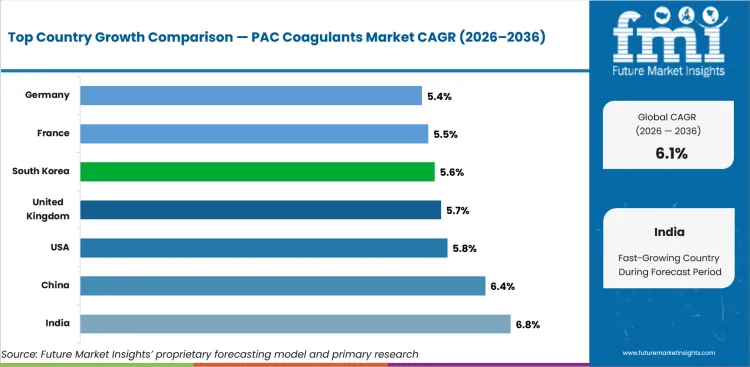
How do country-level CAGRs compare in the PAC coagulants market?
India leads country growth while Japan records the most cautious expansion outlook among profiled markets.
- India is projected to record 6.8% CAGR by 2036 as drinking water and sewerage projects widen chemical procurement.
- China is forecast to grow at 6.4% CAGR through 2036 with municipal wastewater and industrial park treatment supporting demand.
- The United States is expected to expand at 5.8% CAGR from 2026 to 2036 due to certified utility procurement and local supply depth.
- The United Kingdom is estimated to rise at 5.7% CAGR by 2036 as AMP8 investment supports wastewater treatment performance.
- South Korea is projected to grow at 5.6% CAGR through 2036 with high treatment coverage and industrial effluent control.
- France is forecast to advance at 5.5% CAGR over the forecast period as water-quality programs and reuse planning support treatment chemicals.
- Germany is expected to post 5.4% CAGR by 2036 as nutrient control and municipal tender discipline support recurring PAC usage.
- Japan is projected to rise at 4.8% CAGR through 2036 as mature utilities prioritize certified and reliable coagulant grades.
What is the PAC coagulants market outlook in the United States?
A 5.8% CAGR through 2036 reflects certified product demand, recurring utility contracts, and regional coagulant supply.
Country Market Snapshot Table
| Parameter | Value |
|---|---|
| Market Size in 2025 (Value) | USD 534.0 million |
| Market Size in 2026 (Value) | USD 565.0 million |
| Market Forecast in 2036 (Value) | USD 993.5 million |
| CAGR (2026 to 2036) | 5.8% |
| Years Considered | 2021 to 2036 |
| Base Year | 2025 |
| Forecast Period | 2026 to 2036 |
| Units Considered | Value (USD million) |
| Leading Sub-Region | Great Lakes and South Atlantic utility corridors |
United States PAC Coagulants Market Outlook
United States PAC coagulant demand is shaped by mature drinking water networks, wastewater compliance, and public utility procurement discipline. Treatment plants evaluate PAC through certified use limits, dose response, pH impact, and assured delivery.
Local production and supplier service carry strong weight in the country because liquid PAC freight can alter delivered cost. Suppliers with certified grades, emergency supply capacity, and plant-level support should gain stronger contract retention.
Key Growth Drivers
- Federal infrastructure finance improves upgrade visibility for drinking water and wastewater utilities. EPA announced USD 7.2 billion in FY 2026 SRF allotments for states, Tribes, and territories.
- High treatment coverage keeps recurring chemical demand active. SDG 6 Data reported 98.0% of domestic wastewater in the United States was safely treated in 2024.
- Public utilities prefer suppliers that can prove drinking water approval, maximum use limits, and emergency delivery reliability before awarding chemical contracts.
- Industrial users in food, paper, and process water need stable clarification before reuse, discharge, or downstream membrane treatment.
Key Restraints
- Liquid PAC freight weakens supplier reach outside local production zones, especially where utilities require regular tanker delivery and winter storage assurance.
- Public bid cycles can slow switching because operators usually require jar tests and several operating-season checks before replacing alum or ferric salts.
- Aluminum input exposure can affect PAC pricing. USGS reported in 2026 that the estimated average annual USA aluminum market price increased 39.0% from 2024.
What makes the United States unique
United States is unique due to certified utility procurement and strong regional supply needs for liquid aluminum coagulants.
Key Companies
- USALCO
- Ecolab Nalco Water
- Kemira
- Solenis
- Chemtrade Logistics
- Hawkins Inc.
- GEO Specialty Chemicals
Sales & Marketing Channels
- Direct utility contracts
- State and municipal procurement portals
- Industrial water service teams
- Regional chemical distributors
- Engineering contractor specifications
- Emergency supply agreements
Country Segment Breakdown Table
| Segment | Sub-Segments |
|---|---|
| By Product Type | Liquid PAC, Powder PAC, Blended Coagulants |
| By Application | Municipal Drinking Water, Municipal Wastewater, Industrial Wastewater, Pulp & Paper / Other |
| By Basicity | Low Basicity, Medium Basicity, High Basicity |
| By End Use | Utilities, Industrial Plants, Commercial Water Services |
| By Sales Channel | Direct, Distributors |
| Key Sub-Regions Covered, Utility and Industrial Treatment Corridors | Great Lakes, South Atlantic, Texas, California, Midwest, Northeast |
Frequently Asked Questions
How fast is United States PAC coagulants market growing?
Sector in the United States is anticipated to grow at 5.8% CAGR from 2026 to 2036 reflecting certified utility demand.
Who leads United States PAC coagulants market?
USALCO, Ecolab Nalco Water, Kemira, Solenis, and Chemtrade compete based on local supply and utility service.
What is driving adoption in United States PAC coagulants market?
Certified product procurement and recurring drinking water treatment demand are moving utilities toward reliable PAC grades.
What is the PAC coagulants market outlook in the United Kingdom?
A 5.7% CAGR through 2036 is supported by AMP8 investment, wastewater performance pressure, and framework buying.
Country Market Snapshot Table
| Parameter | Value |
|---|---|
| Market Size in 2025 (Value) | USD 170.3 million |
| Market Size in 2026 (Value) | USD 180.0 million |
| Market Forecast in 2036 (Value) | USD 313.3 million |
| CAGR (2026 to 2036) | 5.7% |
| Years Considered | 2021 to 2036 |
| Base Year | 2025 |
| Forecast Period | 2026 to 2036 |
| Units Considered | Value (USD million) |
| Leading Sub-Region | England and Wales regulated water-company networks |
United Kingdom PAC Coagulants Market Outlook
United Kingdom PAC coagulant demand is supported by regulated water-company investment and wastewater treatment obligations. PAC suppliers can gain contracts where chemical precipitation and clarification support permit compliance without full process replacement.
Framework access matters because procurement is concentrated across large regulated water companies. Local storage, site trials, and technical service should remain important differentiators for liquid PAC suppliers.
Key Growth Drivers
- Regulated investment creates visibility for wastewater treatment chemicals. Ofwat approved GBP 104.0 billion for the 2025 to 2030 price-review period.
- Environmental performance pressure keeps attention on clarification and discharge reliability. England’s Environment Agency recorded 2,469 sewerage pollution incidents in 2024.
- Water-company frameworks favor suppliers with local storage, dosing support, and evidence from utility trials.
- AMP8 delivery can support coagulant demand where phosphorus removal is added without full biological process replacement.
Key Restraints
- Mandatory investment competes with affordability pressure, which can delay non-critical chemical switching even when plant outcomes improve.
- Water-company procurement is concentrated, so suppliers outside framework agreements may struggle to access large treatment sites.
- Bill pressure can limit discretionary upgrades. The UK competition authority allowed an expected average bill increase of 2.2% for disputed water-company price controls in March 2026.
What makes the United Kingdom unique
United Kingdom is unique due to regulated five-year price reviews and concentrated water-company framework procurement.
Key Companies
- Kemira
- Feralco
- Solenis
- Veolia Water Technologies
- SUEZ
- Brenntag
- Univar Solutions
Sales & Marketing Channels
- Water company framework agreements
- AMP8 project contractor routes
- Distributor supply to smaller works
- Chemical dosing service packages
- Wastewater compliance consultants
- Emergency delivery contracts
Country Segment Breakdown Table
| Segment | Sub-Segments |
|---|---|
| By Product Type | Liquid PAC, Powder PAC, Blended Coagulants |
| By Application | Municipal Drinking Water, Municipal Wastewater, Industrial Wastewater, Pulp & Paper / Other |
| By Basicity | Low Basicity, Medium Basicity, High Basicity |
| By End Use | Utilities, Industrial Plants, Commercial Water Services |
| By Sales Channel | Direct, Distributors |
| Key Sub-Regions Covered, Regulated Water Networks | London, Midlands, North West, Yorkshire, Wales, Scotland |
Frequently Asked Questions
How fast is United Kingdom PAC coagulants market growing?
Industry in the United Kingdom is projected to increase at 5.7% CAGR from 2026 to 2036 through regulated water investment.
Who leads United Kingdom PAC coagulants market?
Kemira, Feralco, Solenis, Veolia Water Technologies, and SUEZ compete based on framework access and service support.
What is driving adoption in United Kingdom PAC coagulants market?
AMP8 investment and wastewater performance pressure are moving water companies toward dependable coagulant programs.
How is the PAC coagulants market performing in Germany?
A 5.4% CAGR through 2036 reflects nutrient control, mature treatment coverage, and municipal tender discipline.
Country Market Snapshot Table
| Parameter | Value |
|---|---|
| Market Size in 2025 (Value) | USD 232.4 million |
| Market Size in 2026 (Value) | USD 245.0 million |
| Market Forecast in 2036 (Value) | USD 414.3 million |
| CAGR (2026 to 2036) | 5.4% |
| Years Considered | 2021 to 2036 |
| Base Year | 2025 |
| Forecast Period | 2026 to 2036 |
| Units Considered | Value (USD million) |
| Leading Sub-Region | North Rhine-Westphalia and Bavaria municipal corridors |
Germany PAC Coagulants Market Outlook
Germany PAC coagulant demand is shaped by advanced wastewater infrastructure and strict municipal tender practices. Buyers compare PAC with ferric salts and alum through sludge output, phosphorus removal stability, and pH effect.
The market favors suppliers that provide documentation and reliable regional logistics. PAC demand is less about first-time use and more about optimized dosing, tighter compliance, and chemistry replacement.
Key Growth Drivers
- Wastewater treatment maturity creates recurring chemical demand. Germany’s federal environment ministry stated in February 2026 that around 97.0% of the population is connected to the public sewage system.
- Treatment plant density gives PAC suppliers a wide municipal base. The same ministry stated that wastewater is treated in around 9,000 treatment plants.
- Municipal utilities need coagulants that fit existing clarifiers and sludge handling rather than forcing major plant reconstruction.
- Industrial clusters in North Rhine-Westphalia and Bavaria require predictable effluent clarification for manufacturing discharge control.
Key Restraints
- Mature treatment coverage limits new plant-led volume expansion because most demand moves through optimization and contract replacement.
- Public tender rules can slow supplier switching even when lower dose or sludge reduction is demonstrated in plant trials.
- EU treatment rules increase documentation needs. Directive 2024/3019 requires certain treatment plants to add a fourth treatment stage by 2045 to reduce micropollutants.
What makes Germany unique
Germany is unique due to nutrient compliance and municipal tender discipline shaping supplier success.
Key Companies
- Feralco
- Kemira
- Solenis
- Kurita Europe
- Brenntag
- Donau Chemie
- Veolia Water Technologies
Sales & Marketing Channels
- Municipal tender portals
- Utility purchasing associations
- Industrial wastewater service contracts
- Engineering firm specifications
- Regional chemical distributors
- Plant trial programs
Country Segment Breakdown Table
| Segment | Sub-Segments |
|---|---|
| By Product Type | Liquid PAC, Powder PAC, Blended Coagulants |
| By Application | Municipal Drinking Water, Municipal Wastewater, Industrial Wastewater, Pulp & Paper / Other |
| By Basicity | Low Basicity, Medium Basicity, High Basicity |
| By End Use | Utilities, Industrial Plants, Commercial Water Services |
| By Sales Channel | Direct, Distributors |
| Key Sub-Regions Covered, Municipal and Industrial Treatment Areas | North Rhine-Westphalia, Bavaria, Baden-Württemberg, Hesse, Lower Saxony, Berlin-Brandenburg |
Frequently Asked Questions
How fast is Germany PAC coagulants market growing?
Demand in Germany is ready to rise at 5.4% CAGR from 2026 to 2036, guided by nutrient-control needs.
Who leads Germany PAC coagulants market?
Feralco, Kemira, Solenis, Kurita, and Brenntag compete based on municipal tenders and industrial service channels.
What is driving adoption in Germany PAC coagulants market?
Nutrient compliance, wastewater treatment maturity, and industrial effluent control are supporting steady PAC use.
What is driving PAC coagulants growth in France?
A 5.5% CAGR through 2036 is supported by water-quality management, reuse planning, and delegated water-service models.
Country Market Snapshot Table
| Parameter | Value |
|---|---|
| Market Size in 2025 (Value) | USD 194.3 million |
| Market Size in 2026 (Value) | USD 205.0 million |
| Market Forecast in 2036 (Value) | USD 350.8 million |
| CAGR (2026 to 2036) | 5.5% |
| Years Considered | 2021 to 2036 |
| Base Year | 2025 |
| Forecast Period | 2026 to 2036 |
| Units Considered | Value (USD million) |
| Leading Sub-Region | Paris Basin and Rhône-Alpes water service corridors |
France PAC Coagulants Market Outlook
France PAC coagulant demand is influenced by drinking water quality, wastewater performance, and large water-service operators. Supplier access is shaped by local authority contracts and delegated service models.
PAC suppliers gain value when they prove dose efficiency and compatibility with existing treatment assets. Water reuse planning and micropollutant attention also support stronger pretreatment discipline.
Key Growth Drivers
- Water-quality management gives PAC a role in drinking water and wastewater clarification. SDG 6 Data reported 87.0% of domestic wastewater in France was safely treated in 2024.
- France’s Water Plan objective to cut water abstraction by 10.0% by 2030 makes reuse-linked treatment performance more important for utilities and industries.
- Delegated service models allow large operators to standardize coagulant trials across multiple municipal systems.
- Industrial users in chemicals, paper, and food processing use PAC where color and suspended solids affect discharge outcomes.
Key Restraints
- Local authority budget cycles can slow adoption of new high-basicity grades when contracts prioritize continuity over chemistry replacement.
- Aluminum residual scrutiny can make buyers require stronger jar-test evidence and documentation before changing product specifications.
- The revised EU urban wastewater framework requires producer responsibility schemes to cover at least 80.0% of quaternary treatment costs, raising funding coordination pressure for advanced treatment programs.
What makes France unique
France is unique due to delegated water-service structures that connect chemical choice with operator accountability.
Key Companies
- Veolia
- SUEZ
- Feralco
- Kemira
- Solenis
- Brenntag
- SNF
Sales & Marketing Channels
- Public service delegation contracts
- Local authority procurement
- Utility operator supply chains
- Industrial water service contracts
- Regional chemical distribution
- Engineering consultant specifications
Country Segment Breakdown Table
| Segment | Sub-Segments |
|---|---|
| By Product Type | Liquid PAC, Powder PAC, Blended Coagulants |
| By Application | Municipal Drinking Water, Municipal Wastewater, Industrial Wastewater, Pulp & Paper / Other |
| By Basicity | Low Basicity, Medium Basicity, High Basicity |
| By End Use | Utilities, Industrial Plants, Commercial Water Services |
| By Sales Channel | Direct, Distributors |
| Key Sub-Regions Covered, Water Service Corridors | Île-de-France, Auvergne-Rhône-Alpes, Hauts-de-France, Nouvelle-Aquitaine, Grand Est, Provence-Alpes-Côte d’Azur |
Frequently Asked Questions
How fast is France PAC coagulants market growing?
Demand in France is ready to expand at 5.5% CAGR from 2026 to 2036 with treatment-quality programs.
Who leads France PAC coagulants market?
Veolia, SUEZ, Feralco, Kemira, and Solenis compete through water-service channels and coagulant portfolios.
What is driving adoption in France PAC coagulants market?
Water reuse planning, public service delegation, and industrial discharge control are supporting PAC demand.
What is the PAC coagulants market forecast for Japan?
A 4.8% CAGR through 2036 reflects mature treatment networks, certified product use, and supplier approval discipline.
Country Market Snapshot Table
| Parameter | Value |
|---|---|
| Market Size in 2025 (Value) | USD 131.7 million |
| Market Size in 2026 (Value) | USD 138.0 million |
| Market Forecast in 2036 (Value) | USD 220.5 million |
| CAGR (2026 to 2036) | 4.8% |
| Years Considered | 2021 to 2036 |
| Base Year | 2025 |
| Forecast Period | 2026 to 2036 |
| Units Considered | Value (USD million) |
| Leading Sub-Region | Tokyo-Osaka utility and industrial corridors |
Japan PAC Coagulants Market Outlook
Japan PAC coagulant demand is shaped by high treatment reliability and strict supplier approval cycles. Municipal utilities select PAC through product specifications, performance history, and trusted local service.
Commercial expansion is slower than in developing treatment markets because infrastructure is mature. Suppliers can still gain value through certified grades, reliable delivery, and industrial water treatment applications.
Key Growth Drivers
- High sanitation reliability keeps chemical demand stable. SDG 6 Data reported 99.0% of Japan’s domestic wastewater was safely treated in 2024.
- Japan’s Ministry of the Environment reported wastewater treatment system population coverage at 93.3% in 2025, supporting recurring use of certified coagulants.
- Municipal buyers favor suppliers with JIS-compatible product documentation and stable delivery.
- Industrial water users in electronics, chemicals, and paper require consistent clarification before reuse or discharge.
Key Restraints
- Mature networks limit new volume acceleration because procurement is tied mainly to replacement cycles and process optimization.
- Supplier approval cycles make entry difficult for unfamiliar overseas producers even when product chemistry fits plant needs.
- Japan’s environment report stated BOD and COD environmental standard achievement at 89.1% in 2025, keeping treatment quality expectations high for water operators.
What makes Japan unique
Japan is unique due to technical standards and supplier trust carrying more weight than aggressive pricing.
Key Companies
- Taki Chemical
- Kurita Water Industries
- Kemira
- Solenis
- Organo Corporation
- Mitsubishi Chemical Group
- Veolia Water Technologies Japan
Sales & Marketing Channels
- Municipal utility tenders
- Approved supplier lists
- Industrial water service teams
- Trading house distribution
- Plant engineering contractors
- Direct technical trials
Country Segment Breakdown Table
| Segment | Sub-Segments |
|---|---|
| By Product Type | Liquid PAC, Powder PAC, Blended Coagulants |
| By Application | Municipal Drinking Water, Municipal Wastewater, Industrial Wastewater, Pulp & Paper / Other |
| By Basicity | Low Basicity, Medium Basicity, High Basicity |
| By End Use | Utilities, Industrial Plants, Commercial Water Services |
| By Sales Channel | Direct, Distributors |
| Key Sub-Regions Covered, Utility and Industrial Treatment Areas | Tokyo, Osaka, Yokohama, Nagoya, Fukuoka, Sapporo |
Frequently Asked Questions
How fast is Japan PAC coagulants market growing?
Sector in Japan is projected at 4.8% CAGR from 2026 to 2036 as mature utilities maintain certified chemical demand.
Who leads Japan PAC coagulants market?
Taki Chemical, Kurita Water Industries, Kemira, Solenis, and Organo compete through certification and technical service.
What is driving adoption in Japan PAC coagulants market?
Certified chemical use, mature utility procurement, and industrial clarification needs are supporting PAC demand.
What is the PAC coagulants market outlook in China?
A 6.4% CAGR through 2036 reflects municipal wastewater upgrades, industrial park compliance, and local production scale.
Country Market Snapshot Table
| Parameter | Value |
|---|---|
| Market Size in 2025 (Value) | USD 648.5 million |
| Market Size in 2026 (Value) | USD 690.0 million |
| Market Forecast in 2036 (Value) | USD 1,283.1 million |
| CAGR (2026 to 2036) | 6.4% |
| Years Considered | 2021 to 2036 |
| Base Year | 2025 |
| Forecast Period | 2026 to 2036 |
| Units Considered | Value (USD million) |
| Leading Sub-Region | Yangtze River Delta and Bohai industrial corridors |
China PAC Coagulants Market Outlook
China PAC coagulant demand is influenced by large municipal wastewater programs, industrial park discharge control, and broad local chemical production. Liquid PAC and powder PAC both find demand across utilities, factories, and export-oriented distributors.
Price competition remains intense in standard grades, although buyers with tighter discharge requirements are moving toward better basicity control and lower insoluble content. Suppliers that combine scale with quality documentation should hold stronger positions.
Key Growth Drivers
- China’s 2024 climate-action report set a goal of establishing 100 green, low-carbon benchmark wastewater treatment plants by 2025, supporting coagulant optimization and sludge reduction.
- The same national report noted pollution and carbon-reduction pilots across 21 cities and 43 industrial parks, expanding chemical clarification needs in regulated manufacturing clusters.
- Local PAC production supports low-cost powder supply and export movement to South Asia, Southeast Asia, and the Middle East.
- Municipal and industrial tenders give suppliers a route to large volume where industrial parks need reliable plant-level performance.
Key Restraints
- Price competition is intense in standard powder PAC, which can compress margins when buyers focus on delivered cost rather than treatment outcome.
- Quality differentiation requires tighter control of insolubles, aluminum content, and basicity, making weak producers vulnerable in higher-specification tenders.
- Regional treatment gaps keep benchmarking pressure high. SDG 6 Data reported 65.0% safely treated domestic wastewater in Eastern and South-Eastern Asia in 2024.
What makes China unique
China is unique due to large domestic PAC production meeting municipal wastewater expansion and industrial park compliance demand.
Key Companies
- Henan Aierfuke Chemicals
- Gongyi Filter Industry
- Zibo Hailan Chemical
- Shandong Sanfeng Group
- Shandong Taihe Technologies
- Kemira China
- SNF China
Sales & Marketing Channels
- Municipal tenders
- Industrial park contracts
- Direct producer supply
- Regional chemical distributors
- Export traders
- Engineering procurement contractors
Country Segment Breakdown Table
| Segment | Sub-Segments |
|---|---|
| By Product Type | Liquid PAC, Powder PAC, Blended Coagulants |
| By Application | Municipal Drinking Water, Municipal Wastewater, Industrial Wastewater, Pulp & Paper / Other |
| By Basicity | Low Basicity, Medium Basicity, High Basicity |
| By End Use | Utilities, Industrial Plants, Commercial Water Services |
| By Sales Channel | Direct, Distributors |
| Key Sub-Regions Covered, Municipal and Industrial Corridors | Yangtze River Delta, Pearl River Delta, Bohai Rim, Chengdu-Chongqing, Central China, Shandong |
Frequently Asked Questions
How fast is China PAC coagulants market growing?
Industry in China is expected to rise at 6.4% CAGR from 2026 to 2036 through wastewater and industrial demand.
Who leads China PAC coagulants market?
Henan Aierfuke, Gongyi Filter Industry, Zibo Hailan, Shandong Sanfeng, and Kemira China compete through scale and grade range.
What is driving adoption in China PAC coagulants market?
Municipal wastewater upgrades, industrial park compliance, and local PAC production depth are supporting adoption.
How is the PAC coagulants market performing in South Korea?
A 5.6% CAGR through 2036 reflects high treatment coverage, industrial effluent control, and urban utility service quality.
Country Market Snapshot Table
| Parameter | Value |
|---|---|
| Market Size in 2025 (Value) | USD 119.3 million |
| Market Size in 2026 (Value) | USD 126.0 million |
| Market Forecast in 2036 (Value) | USD 217.5 million |
| CAGR (2026 to 2036) | 5.6% |
| Years Considered | 2021 to 2036 |
| Base Year | 2025 |
| Forecast Period | 2026 to 2036 |
| Units Considered | Value (USD million) |
| Leading Sub-Region | Seoul Capital Area and Ulsan-Busan industrial corridor |
South Korea PAC Coagulants Market Outlook
South Korea PAC coagulant demand is supported by dense urban utilities and industrial wastewater users in electronics, petrochemicals, and manufacturing. Chemical suppliers must meet high service expectations and consistent product specifications.
The market favors PAC grades that fit advanced treatment plants and industrial effluent systems. Supplier reliability is important because customers often require stable quality and quick technical response.
Key Growth Drivers
- High wastewater treatment coverage supports recurring coagulant demand. SDG 6 Data reported 99.0% of domestic wastewater in South Korea was safely treated in 2024.
- Ambient water quality expectations support chemical clarification needs. SDG 6 Data reported 94.0% of monitored water bodies had good ambient water quality in 2023.
- Electronics and petrochemical wastewater users need reliable clarification before advanced treatment and reuse steps.
- Dense urban utility networks favor technical suppliers with stable delivery and dosing-control support.
Key Restraints
- Mature public treatment coverage limits first-time PAC adoption because demand mainly comes from replacement contracts and process optimization.
- High service expectations can raise qualification barriers for suppliers that cannot provide plant-level trials and fast technical response.
- Water resource pressure keeps operating scrutiny high. SDG 6 Data placed South Korea’s water stress at 85.0% in 2022.
What makes South Korea unique
South Korea is unique due to advanced municipal systems and industrial effluent users requiring consistent product quality.
Key Companies
- Kemira Korea
- Kurita Korea
- Ecolab Korea
- OCI
- Samchun Chemical
- Daejung Chemicals
- Hansol Chemical
Sales & Marketing Channels
- Utility procurement programs
- Industrial water service teams
- Regional chemical distributors
- Electronics and petrochemical plant contracts
- Engineering contractor specifications
- Direct technical service
Country Segment Breakdown Table
| Segment | Sub-Segments |
|---|---|
| By Product Type | Liquid PAC, Powder PAC, Blended Coagulants |
| By Application | Municipal Drinking Water, Municipal Wastewater, Industrial Wastewater, Pulp & Paper / Other |
| By Basicity | Low Basicity, Medium Basicity, High Basicity |
| By End Use | Utilities, Industrial Plants, Commercial Water Services |
| By Sales Channel | Direct, Distributors |
| Key Sub-Regions Covered, Urban and Industrial Treatment Areas | Seoul Capital Area, Busan, Ulsan, Daegu, Daejeon, Gwangju |
Frequently Asked Questions
How fast is South Korea PAC coagulants market growing?
Demand in South Korea is projected to increase at 5.6% CAGR from 2026 to 2036 with industrial treatment needs.
Who leads South Korea PAC coagulants market?
Kemira Korea, Kurita Korea, Ecolab Korea, OCI, and Samchun Chemical compete through quality and service access.
What is driving adoption in South Korea PAC coagulants market?
Advanced municipal treatment, industrial effluent control, and strict water-quality expectations are supporting PAC use.
What is the PAC coagulants market outlook in India?
A 6.8% CAGR through 2036 reflects drinking water expansion, urban wastewater projects, and local aluminum chemical supply.
Country Market Snapshot Table
| Parameter | Value |
|---|---|
| Market Size in 2025 (Value) | USD 285.6 million |
| Market Size in 2026 (Value) | USD 305.0 million |
| Market Forecast in 2036 (Value) | USD 589.2 million |
| CAGR (2026 to 2036) | 6.8% |
| Years Considered | 2021 to 2036 |
| Base Year | 2025 |
| Forecast Period | 2026 to 2036 |
| Units Considered | Value (USD million) |
| Leading Sub-Region | Ganga basin and western industrial corridors |
India PAC Coagulants Market Outlook
India PAC coagulant demand is shaped by rural tap-water expansion, urban wastewater projects, and variable raw-water quality. PAC use is rising where utilities need stable clarification during monsoon-linked turbidity swings.
Local production and delivered price remain central to procurement. Suppliers with BIS-aligned grades, regional storage, and technical support should gain from drinking water and sewage treatment expansion.
Key Growth Drivers
- Rural tap-water expansion widens the chemical procurement base. Press Information Bureau reported 15.44 crore rural households with tap-water connections in February 2025.
- Urban sewerage investment supports new dosing points. AMRUT 2.0 national progress reporting listed 594 sewerage and septage projects worth INR 68,089.09 crore in 2026.
- State water boards need PAC for raw-water turbidity and monsoon variability across surface-water treatment plants.
- Industrial growth corridors use PAC for effluent clarification in textiles, paper, chemicals, and food processing.
Key Restraints
- Wastewater treatment gaps can slow uniform PAC adoption outside funded cities. SDG 6 Data reported only 29.0% of domestic wastewater in India was safely treated in 2024.
- Tender-led purchasing can prioritize delivered price over grade stability, limiting uptake of higher-basicity or specialty blended products.
- Long-distance liquid PAC freight can narrow supplier reach where local storage or nearby production is not available.
What makes India unique
India is unique due to drinking water expansion and urban sewerage projects meeting price-sensitive public procurement.
Key Companies
- Gujarat Alkalies and Chemicals Limited
- Aditya Birla Chemicals
- Grasim Industries
- Chemtex Speciality
- Rakshit Chemicals
- Yash Chemicals
- Veolia Water Technologies India
Sales & Marketing Channels
- State water board tenders
- Municipal corporation procurement
- Industrial water service contracts
- Regional chemical distributors
- EPC contractor supply routes
- Direct producer supply
Country Segment Breakdown Table
| Segment | Sub-Segments |
|---|---|
| By Product Type | Liquid PAC, Powder PAC, Blended Coagulants |
| By Application | Municipal Drinking Water, Municipal Wastewater, Industrial Wastewater, Pulp & Paper / Other |
| By Basicity | Low Basicity, Medium Basicity, High Basicity |
| By End Use | Utilities, Industrial Plants, Commercial Water Services |
| By Sales Channel | Direct, Distributors |
| Key Sub-Regions Covered, Public Water and Industrial Corridors | Ganga Basin, Maharashtra, Gujarat, Tamil Nadu, Karnataka, Delhi NCR |
Frequently Asked Questions
How fast is India PAC coagulants market growing?
Sales in India are expected to expand at 6.8% CAGR from 2026 to 2036 with public water projects.
Who leads India PAC coagulants market?
GACL, Aditya Birla Chemicals, Grasim Industries, Chemtex Speciality, and Veolia India compete through local supply channels.
What is driving adoption in India PAC coagulants market?
Rural tap-water expansion, sewerage projects, and monsoon-linked turbidity control are supporting PAC adoption.
Who are the leading companies in the PAC coagulants market?
Kemira, USALCO, Feralco, Solenis and Taki Chemical.
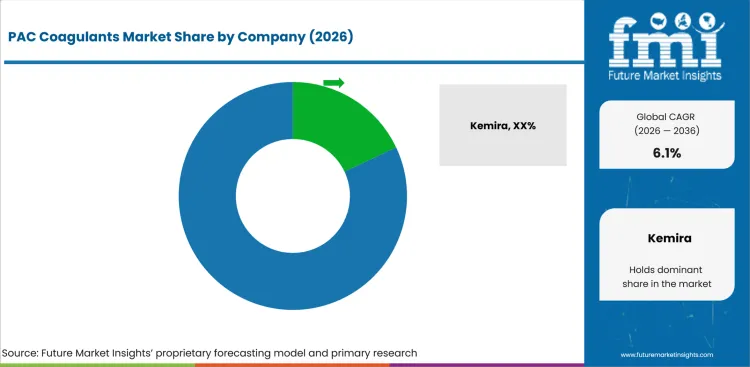
- Integrated coagulant producers hold an advantage through basicity control, drinking-water approvals, and plant-level technical service.
- Regional aluminum chemical suppliers gain positions where local freight and storage decide delivered PAC cost.
- Water service companies influence product selection through dosing programs, operations contracts, and performance guarantees.
- Distributor-led supply remains useful for small municipalities that need mixed chemical baskets and flexible delivery lots.
Coagulant producers compete by combining chemistry control with plant-level trust. Kemira and Feralco maintain strong European positions through inorganic coagulant portfolios and regional logistics. USALCO holds a strong United States position through aluminum-based water treatment chemicals. Taki Chemical has a relevant Japan position through liquid and powder PAC grades used in water treatment. Solenis and Ecolab Nalco Water compete through broader water treatment programs that influence chemical choice.
Manufacturing scale has become a competitive separator as utility buyers move beyond spot chemical buying. Kemira’s Norway and Tarragona investments show how coagulant supply is being localized around water treatment demand. USALCO’s California facility highlights the value of production close to liquid PAC consumption areas. Suppliers with local tanks and technical support can defend share even when spot prices weaken.
Smaller and regional producers can win through local stock, tender responsiveness, and price discipline. India and China offer room for domestic suppliers that meet product specifications and deliver reliably. Germany and Japan create harder conditions since certification, documentation, and supplier approval cycles can slow entry. Companies with stable basicity control and documented plant results should gain more durable listing decisions.
How do top PAC coagulants companies compare?
Kemira and USALCO score strongest on water treatment supply depth while Feralco leads European inorganic coagulant relevance.
| Company | Relevance to Market Title | Basicity Control Depth | Drinking Water Approval Coverage | Liquid Logistics Reach | Channel Reach | Geographic Footprint |
|---|---|---|---|---|---|---|
| Kemira | Very High | Very Strong | Strong | Very Strong | Very Strong | Global |
| USALCO | Very High | Very Strong | Strong | Very Strong | Strong | United States |
| Feralco | Very High | Very Strong | Strong | Strong | Strong | Europe |
| Solenis | High | Strong | Moderate | Strong | Very Strong | Global |
| Ecolab Nalco Water | High | Moderate | Strong | Strong | Very Strong | Global |
| Taki Chemical | High | Very Strong | Strong | Moderate | Strong | Japan |
| GACL | High | Moderate | Moderate | Moderate | Strong | India |
| Aditya Birla Chemicals | Moderate to High | Moderate | Moderate | Moderate | Strong | India and Asia |
| Kurita Water Industries | Moderate to High | Moderate | Moderate | Strong | Strong | Japan and Global |
| SUEZ | Moderate | Moderate | Moderate | Strong | Strong | Global Water Services |
Source: Future Market Insights competitive analysis, 2026.
Who are the key players in the PAC coagulants market?
Kemira, USALCO and Feralco are listed with Solenis and Taki Chemical among other suppliers.
Key global companies leading the PAC coagulants market include:
- Kemira
- USALCO
- Feralco
- Solenis
- Ecolab Nalco Water
- Taki Chemical
- Gujarat Alkalies and Chemicals Limited
- Aditya Birla Chemicals
- Kurita Water Industries
- SUEZ
Key Developments in PAC Coagulants Market
- In July 2025, Kemira announced an investment of close to EUR 20.0 million at its Tarragona site to add an aluminum chlorohydrate production line for drinking water treatment.
- In August 2024, USALCO announced construction of a new water treatment chemicals production facility near Los Angeles, California, serving municipal and commercial customers.
- In November 2025, Solenis completed the acquisition of NCH Corporation, strengthening its water and hygiene solutions platform.
Key Players in the PAC Coagulants Market
Integrated Coagulant Producers
- Kemira
- USALCO
- Feralco
- Solenis
Regional Aluminum Chemical Producers
- Gujarat Alkalies and Chemicals Limited
- Aditya Birla Chemicals
- Taki Chemical
- Chemtrade Logistics
Water Service and Specialty Treatment Firms
- Ecolab Nalco Water
- Kurita Water Industries
- Veolia
- SUEZ
PAC Coagulants Market - Report Scope
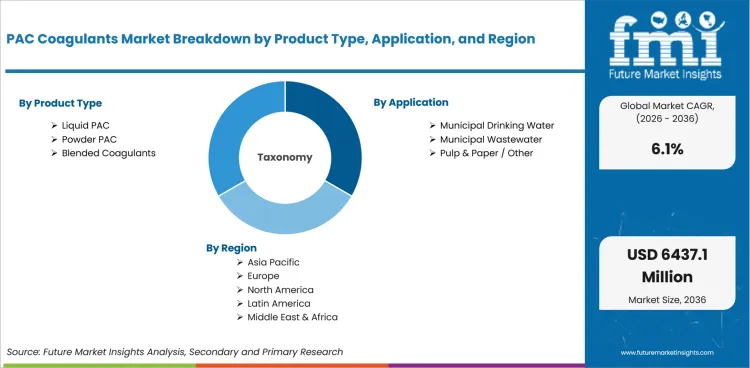
| Parameter | Details |
|---|---|
| Forecast period | 2026 to 2036 |
| Historical period | 2021 to 2025 |
| Quantitative unit | Revenue in USD million |
| By product type | Liquid PAC, powder PAC, blended coagulants |
| By application | Municipal drinking water, municipal wastewater, industrial wastewater, pulp & paper / other |
| By basicity | Low basicity, medium basicity, high basicity |
| By end use | Utilities, industrial plants, commercial water services |
| By sales channel | Direct, distributors |
| Regions covered | North America, Latin America, Europe, East Asia, South Asia and Pacific, Middle East and Africa |
| Countries covered | United States, United Kingdom, Germany, France, Japan, China, South Korea, India |
| Key companies profiled | Kemira, USALCO, Feralco, Solenis, Ecolab Nalco Water, Taki Chemical, GACL, Aditya Birla Chemicals, Kurita Water Industries, SUEZ |
| Approach | Hybrid bottom-up and top-down approach using PAC shipment value, utility demand, industrial wastewater use, and country-level treatment coverage |
PAC Coagulants Market - Scope & Definition
| Attribute | Detail |
|---|---|
| Market Definition | Aluminum-based inorganic polymer salts used to destabilize fine particles in water for clarification across drinking water, wastewater, industrial effluent, and process water applications. |
| Functions Covered | Charge neutralization, floc formation, turbidity removal, phosphorus precipitation, color reduction, and pretreatment before filtration or reuse systems. |
| Applications Covered | Liquid PAC, powder PAC, and blended coagulants used in municipal drinking water, municipal wastewater, industrial wastewater, and pulp and paper process water. |
| End-Use Industries | Utilities, industrial plants, commercial water services, paper producers, food processors, chemical manufacturers, and municipal wastewater operators. |
| Grades Covered | Low basicity, medium basicity, and high basicity PAC grades supplied in liquid, powder, and blended formats. |
| Inclusions | All commercially available PAC coagulants across product type, application, basicity, end use, and sales channel in the selected country and regional scope. |
| Exclusions | Aluminum sulfate, ferric chloride, ferric sulfate, sodium aluminate, standalone organic polymers, disinfectants, membranes, ion exchange resins, activated carbon, lab-scale reagents, and non-water-treatment aluminum salts. |
PAC Coagulants Market - Research Methodology
| Method | Description |
|---|---|
| Primary Research | FMI analyst interviews with municipal utility buyers, industrial water treatment managers, chemical distributors, and application specialists across selected markets. |
| Desk Research | Review of drinking water chemical standards, wastewater permitting, public water investment plans, supplier product data sheets, and official infrastructure datasets. |
| Market Sizing & Forecasting | Hybrid bottom-up and top-down approach using PAC shipment value, product form mix, utility demand, industrial wastewater use, and country-level treatment coverage. |
| Data Validation | Cross-verification using water treatment chemical demand, aluminum chemical use, official infrastructure spending, wastewater treatment indicators, and company portfolios. |
Source: Future Market Insights, 2026.
PAC Coagulants Market Breakdown by Product Type, Application, Basicity, End Use, Sales Channel, and Region
PAC Coagulants Market Segmented by Product Type
- Liquid PAC
- Powder PAC
- Blended Coagulants
PAC Coagulants Market Segmented by Application
- Municipal Drinking Water
- Municipal Wastewater
- Industrial Wastewater
- Pulp & Paper / Other
PAC Coagulants Market Segmented by Basicity
- Low Basicity
- Medium Basicity
- High Basicity
PAC Coagulants Market Segmented by End Use
- Utilities
- Industrial Plants
- Commercial Water Services
PAC Coagulants Market Segmented by Sales Channel
- Direct
- Distributors
PAC Coagulants Market by Region
- North America
- Latin America
- Europe
- East Asia
- South Asia and Pacific
- Middle East and Africa
Research Sources and Bibliography
- USA Environmental Protection Agency. (2024, May 14). New EPA survey highlights wastewater infrastructure needs to protect waterbodies.
- USA Environmental Protection Agency. (2026, May 20). Drinking Water State Revolving Fund.
- UN-Water. (2024, August 25). Progress on wastewater treatment: 2024 update.
- SDG 6 Data. (2026). Progress on wastewater treatment.
- Ofwat. (2024, December 19). Ofwat approves £104bn upgrade to accelerate delivery of cleaner rivers and seas and secure long-term drinking water supplies for customers.
- Ofwat. (2025, October). Water company performance report 2024-25.
- Environment Agency. (2025, October 23). Water and sewerage companies in England: Environmental performance report for 2024.
- Competition and Markets Authority. (2026, March 10). Final decision on disputed price controls for 5 water companies.
- SDG 6 Data. (2026). United States of America country profile.
- USA Geological Survey. (2026, February). Mineral commodity summaries 2026: Aluminum.
- Federal Ministry for the Environment, Nature Conservation, Nuclear Safety and Consumer Protection. (2026, February 11). General information on waste water treatment plants.
- Council of the European Union. (2024, November 5). Urban wastewater: Council adopts new rules for more efficient treatment.
- SDG 6 Data. (2026). France country profile.
- United Nations Department of Economic and Social Affairs. (2024). Plan eau 2023-2030 pour une gestion résiliente, sobre et concertée de la ressource en eau.
- European Commission Joint Research Centre. (2026). Updated estimation of the costs of quaternary wastewater treatment.
- SDG 6 Data. (2026). Japan country profile.
- Ministry of the Environment, Government of Japan. (2025). Annual report on the environment in Japan 2025.
- Ministry of Ecology and Environment of the People’s Republic of China. (2025, January 21). China’s policies and actions for addressing climate change: 2024 annual report.
- SDG 6 Data. (2026). Republic of Korea country profile.
- Press Information Bureau. (2025, February 1). Jal Jeevan Mission: Ensuring tap water for rural families.
- Ministry of Housing and Urban Affairs. (2026, June 22). AMRUT 2.0 national progress comparison report.
- SDG 6 Data. (2026). India country profile.
- Kemira. (2025, July 24). Kemira to invest in Tarragona site to expand drinking water treatment portfolio with new ACH production line.
- USALCO. (2024, August 19). USALCO announces construction of a new water treatment chemicals production facility in California.
- Solenis. (2025, November 3). Solenis completes acquisition of NCH Corporation.
- Kemira. (2024, September 18). Kemira invests in coagulant capacity in Norway to respond to increased market demand.
- Kemira. (2025, February 4). Kemira continues to expand in water in North America.
This bibliography is provided for reader reference and is not exhaustive. The full report contains the complete reference list and detailed citations.
This Report Answers
- Market size estimates for 2026 and forecasts through 2036 for the PAC coagulants market.
- Insights across more than 30 regional and country-level markets.
- Analysis of demand drivers, utility adoption patterns, treatment usage trends, and purchasing behavior.
- Evaluation of product type, application, basicity, end use, and sales channel dynamics.
- Assessment of drinking water approvals, wastewater requirements, and public procurement impacts on market development.
- Identification of growth opportunities across liquid PAC, powder PAC, blended coagulants, and utility contracts.
- Evaluation of supply chain dynamics, product consistency, and regional production structures.
- Country-level growth analysis covering the United States, United Kingdom, Germany, France, Japan, China, South Korea, and India.
- Assessment of the competitive landscape, including leading PAC coagulant producers and water treatment service companies.
- Analysis of plant-level decision drivers, jar-test expectations, and supplier qualification barriers.
- Regional outlooks across North America, Europe, East Asia, and South Asia and Pacific.
- Delivery of market data, forecasts, and supporting analysis in PDF and Excel formats.
Frequently Asked Questions
What is the growth prospect for PAC coagulants?
Demand for PAC coagulants is expected to rise at a considerable pace as utilities and industrial plants seek reliable clarification chemistry.
Which companies are expected to shape the PAC coagulants market?
Kemira, USALCO, Feralco, Solenis, Ecolab Nalco Water, Taki Chemical, GACL, and Aditya Birla Chemicals are expected to shape competition through coagulant portfolios and treatment service access.
Why are leading water treatment companies investing in PAC coagulants?
Leading water treatment companies are investing in PAC coagulants to serve municipal and industrial buyers requiring stable turbidity and phosphorus control.
Why are direct sales channels important in the PAC coagulants market?
Direct sales channels support large-volume utility contracts, jar-test service, emergency delivery planning, and technical documentation.
Which product formats are gaining attention in PAC coagulants?
Liquid PAC and blended coagulants are gaining attention as plants seek bulk dosing efficiency and simpler chemical feed management.
How do regulations influence PAC coagulant procurement?
Regulations influence procurement through drinking water approvals, discharge permits, nutrient limits, and product documentation requirements.
Why is basicity important for PAC coagulants?
Basicity is important because it affects charge strength, pH impact, floc formation, sludge volume, and product suitability for plant conditions.
What role do utilities play in PAC coagulants adoption?
Utilities create the largest recurring demand base by using PAC in drinking water clarification and wastewater treatment operations.
How do distributors support PAC coagulants in smaller markets?
Distributors support smaller municipalities and private plants by supplying mixed chemical baskets, flexible lots, and local delivery access.
Preview the report firsthand - request a free sample
Get SampleGet the brochure for pricing and purchase details.
Get PDFTable of Content
- Key Takeaways
- Market Size and CAGR
- Top Growth Driver
- Fastest Growing Segment
- Leading Region
- Key Companies
- Emerging Opportunities
- Executive Summary
- Global Market Outlook
- Demand-side Trends
- Supply-side Trends
- Technology Roadmap Analysis
- Analysis and Recommendations
- Analyst Perspective (What is happening? Why now? What should investors know?)
- Key Questions Answered
- How large is the market?
- What is the CAGR?
- What are key trends?
- Which region dominates?
- Who are the leaders?
- Market Overview
- Market Coverage / Taxonomy
- Market Definition / Scope / Limitations
- Research Methodology
- Chapter Orientation
- Analytical Lens and Working Hypotheses
- Market Structure, Signals, and Trend Drivers
- Benchmarking and Cross-market Comparability
- Market Sizing, Forecasting, and Opportunity Mapping
- Research Design and Evidence Framework
- Desk Research Programme (Secondary Evidence)
- Expert Input and Fieldwork (Primary Evidence)
- Tooling, Models, and Reference Databases
- Data Engineering and Model Build
- Quality Assurance and Audit Trail
- Market Background
- Market Dynamics (Drivers, Restraints, Opportunity, Trends)
- Scenario Forecast (Optimistic, Likely, Conservative)
- Impact Analysis
- AI Impact
- Sustainability Impact
- Regulatory Impact
- Technology Impact
- Consumer / Buyer Analysis
- Purchase Drivers
- Adoption Barriers
- Buyer Journey
- Opportunity Map Analysis
- Product Life Cycle Analysis
- Supply Chain Analysis
- Investment Feasibility Matrix
- Value Chain Analysis
- PESTLE and Porter's Analysis
- Regulatory Landscape
- Regional Parent Market Outlook
- Production and Consumption Statistics
- Import and Export Statistics
- Global Market Analysis and Forecast, 2021 to 2036
- Historical Market Size Value (USD Billion) & Volume (Unit) Analysis, 2021 to 2025
- Current and Future Market Size Value (USD Billion) & Volume (Unit) Projections, 2026 to 2036
- Y-o-Y Growth Trend Analysis
- Absolute $ Opportunity Analysis
- Global Market Pricing Analysis, 2021 to 2036
- Global Market Analysis and Forecast, By Product Type, 2021 to 2036
- Introduction / Key Findings
- Historical Market Size Value (USD Billion) & Volume (Unit) Analysis By Product Type, 2021 to 2025
- Current and Future Market Size Value (USD Billion) & Volume (Unit) Analysis and Forecast By Product Type, 2026 to 2036
- Liquid PAC
- Powder PAC
- Blended Coagulants
- Liquid PAC
- Y-o-Y Growth Trend Analysis By Product Type, 2021 to 2025
- Absolute $ Opportunity Analysis By Product Type, 2026 to 2036
- Global Market Analysis and Forecast, By Application, 2021 to 2036
- Introduction / Key Findings
- Historical Market Size Value (USD Billion) & Volume (Unit) Analysis By Application, 2021 to 2025
- Current and Future Market Size Value (USD Billion) & Volume (Unit) Analysis and Forecast By Application, 2026 to 2036
- Municipal Drinking Water
- Municipal Wastewater
- Industrial Wastewater
- Pulp & Paper
- Other
- Municipal Drinking Water
- Y-o-Y Growth Trend Analysis By Application, 2021 to 2025
- Absolute $ Opportunity Analysis By Application, 2026 to 2036
- Global Market Analysis and Forecast, By Basicity, 2021 to 2036
- Introduction / Key Findings
- Historical Market Size Value (USD Billion) & Volume (Unit) Analysis By Basicity, 2021 to 2025
- Current and Future Market Size Value (USD Billion) & Volume (Unit) Analysis and Forecast By Basicity, 2026 to 2036
- Medium Basicity
- Low Basicity
- High Basicity
- Medium Basicity
- Y-o-Y Growth Trend Analysis By Basicity, 2021 to 2025
- Absolute $ Opportunity Analysis By Basicity, 2026 to 2036
- Global Market Analysis and Forecast, By End Use, 2021 to 2036
- Introduction / Key Findings
- Historical Market Size Value (USD Billion) & Volume (Unit) Analysis By End Use, 2021 to 2025
- Current and Future Market Size Value (USD Billion) & Volume (Unit) Analysis and Forecast By End Use, 2026 to 2036
- Utilities
- Industrial Plants
- Commercial Water Services
- Utilities
- Y-o-Y Growth Trend Analysis By End Use, 2021 to 2025
- Absolute $ Opportunity Analysis By End Use, 2026 to 2036
- Global Market Analysis and Forecast, By Sales Channel, 2021 to 2036
- Introduction / Key Findings
- Historical Market Size Value (USD Billion) & Volume (Unit) Analysis By Sales Channel, 2021 to 2025
- Current and Future Market Size Value (USD Billion) & Volume (Unit) Analysis and Forecast By Sales Channel, 2026 to 2036
- Direct
- Distributors
- Direct
- Y-o-Y Growth Trend Analysis By Sales Channel, 2021 to 2025
- Absolute $ Opportunity Analysis By Sales Channel, 2026 to 2036
- Global Market Analysis and Forecast, By Region, 2021 to 2036
- Introduction
- Historical Market Size Value (USD Billion) & Volume (Unit) Analysis By Region, 2021 to 2025
- Current Market Size Value (USD Billion) & Volume (Unit) Analysis and Forecast By Region, 2026 to 2036
- North America
- Latin America
- Western Europe
- Eastern Europe
- East Asia
- South Asia and Pacific
- Middle East & Africa
- Market Attractiveness Analysis By Region
- North America Market Analysis and Forecast, By Country, 2021 to 2036
- Historical Market Size Value (USD Billion) & Volume (Unit) Trend Analysis By Market Taxonomy, 2021 to 2025
- Market Size Value (USD Billion) & Volume (Unit) Forecast By Market Taxonomy, 2026 to 2036
- By Country
- USA
- Canada
- Mexico
- By Product Type
- By Application
- By Basicity
- By End Use
- By Sales Channel
- By Country
- Market Attractiveness Analysis
- By Country
- By Product Type
- By Application
- By Basicity
- By End Use
- By Sales Channel
- Key Takeaways
- Latin America Market Analysis and Forecast, By Country
- Historical Market Size Value (USD Billion) & Volume (Unit) Trend Analysis By Market Taxonomy, 2021 to 2025
- Market Size Value (USD Billion) & Volume (Unit) Forecast By Market Taxonomy, 2026 to 2036
- By Country
- Brazil
- Chile
- Rest of Latin America
- By Product Type
- By Application
- By Basicity
- By End Use
- By Sales Channel
- By Country
- Market Attractiveness Analysis
- By Country
- By Product Type
- By Application
- By Basicity
- By End Use
- By Sales Channel
- Key Takeaways
- Western Europe Market Analysis and Forecast, By Country
- Historical Market Size Value (USD Billion) & Volume (Unit) Trend Analysis By Market Taxonomy, 2021 to 2025
- Market Size Value (USD Billion) & Volume (Unit) Forecast By Market Taxonomy, 2026 to 2036
- By Country
- Germany
- UK
- Italy
- Spain
- France
- Nordic
- BENELUX
- Rest of Western Europe
- By Product Type
- By Application
- By Basicity
- By End Use
- By Sales Channel
- By Country
- Market Attractiveness Analysis
- By Country
- By Product Type
- By Application
- By Basicity
- By End Use
- By Sales Channel
- Key Takeaways
- Eastern Europe Market Analysis and Forecast, By Country
- Historical Market Size Value (USD Billion) & Volume (Unit) Trend Analysis By Market Taxonomy, 2021 to 2025
- Market Size Value (USD Billion) & Volume (Unit) Forecast By Market Taxonomy, 2026 to 2036
- By Country
- Russia
- Poland
- Hungary
- Balkan & Baltic
- Rest of Eastern Europe
- By Product Type
- By Application
- By Basicity
- By End Use
- By Sales Channel
- By Country
- Market Attractiveness Analysis
- By Country
- By Product Type
- By Application
- By Basicity
- By End Use
- By Sales Channel
- Key Takeaways
- East Asia Market Analysis and Forecast, By Country
- Historical Market Size Value (USD Billion) & Volume (Unit) Trend Analysis By Market Taxonomy, 2021 to 2025
- Market Size Value (USD Billion) & Volume (Unit) Forecast By Market Taxonomy, 2026 to 2036
- By Country
- China
- Japan
- South Korea
- By Product Type
- By Application
- By Basicity
- By End Use
- By Sales Channel
- By Country
- Market Attractiveness Analysis
- By Country
- By Product Type
- By Application
- By Basicity
- By End Use
- By Sales Channel
- Key Takeaways
- South Asia and Pacific Market Analysis and Forecast, By Country
- Historical Market Size Value (USD Billion) & Volume (Unit) Trend Analysis By Market Taxonomy, 2021 to 2025
- Market Size Value (USD Billion) & Volume (Unit) Forecast By Market Taxonomy, 2026 to 2036
- By Country
- India
- ASEAN
- Australia & New Zealand
- Rest of South Asia and Pacific
- By Product Type
- By Application
- By Basicity
- By End Use
- By Sales Channel
- By Country
- Market Attractiveness Analysis
- By Country
- By Product Type
- By Application
- By Basicity
- By End Use
- By Sales Channel
- Key Takeaways
- Middle East & Africa Market Analysis and Forecast, By Country
- Historical Market Size Value (USD Billion) & Volume (Unit) Trend Analysis By Market Taxonomy, 2021 to 2025
- Market Size Value (USD Billion) & Volume (Unit) Forecast By Market Taxonomy, 2026 to 2036
- By Country
- Kingdom of Saudi Arabia
- Other GCC Countries
- Türkiye
- South Africa
- Other African Union
- Rest of Middle East & Africa
- By Product Type
- By Application
- By Basicity
- By End Use
- By Sales Channel
- By Country
- Market Attractiveness Analysis
- By Country
- By Product Type
- By Application
- By Basicity
- By End Use
- By Sales Channel
- Key Takeaways
- Key Countries Market Analysis
- USA
- Pricing Analysis
- Market Share Analysis, 2025
- By Product Type
- By Application
- By Basicity
- By End Use
- By Sales Channel
- Canada
- Pricing Analysis
- Market Share Analysis, 2025
- By Product Type
- By Application
- By Basicity
- By End Use
- By Sales Channel
- Mexico
- Pricing Analysis
- Market Share Analysis, 2025
- By Product Type
- By Application
- By Basicity
- By End Use
- By Sales Channel
- Brazil
- Pricing Analysis
- Market Share Analysis, 2025
- By Product Type
- By Application
- By Basicity
- By End Use
- By Sales Channel
- Chile
- Pricing Analysis
- Market Share Analysis, 2025
- By Product Type
- By Application
- By Basicity
- By End Use
- By Sales Channel
- Germany
- Pricing Analysis
- Market Share Analysis, 2025
- By Product Type
- By Application
- By Basicity
- By End Use
- By Sales Channel
- UK
- Pricing Analysis
- Market Share Analysis, 2025
- By Product Type
- By Application
- By Basicity
- By End Use
- By Sales Channel
- Italy
- Pricing Analysis
- Market Share Analysis, 2025
- By Product Type
- By Application
- By Basicity
- By End Use
- By Sales Channel
- Spain
- Pricing Analysis
- Market Share Analysis, 2025
- By Product Type
- By Application
- By Basicity
- By End Use
- By Sales Channel
- France
- Pricing Analysis
- Market Share Analysis, 2025
- By Product Type
- By Application
- By Basicity
- By End Use
- By Sales Channel
- India
- Pricing Analysis
- Market Share Analysis, 2025
- By Product Type
- By Application
- By Basicity
- By End Use
- By Sales Channel
- ASEAN
- Pricing Analysis
- Market Share Analysis, 2025
- By Product Type
- By Application
- By Basicity
- By End Use
- By Sales Channel
- Australia & New Zealand
- Pricing Analysis
- Market Share Analysis, 2025
- By Product Type
- By Application
- By Basicity
- By End Use
- By Sales Channel
- China
- Pricing Analysis
- Market Share Analysis, 2025
- By Product Type
- By Application
- By Basicity
- By End Use
- By Sales Channel
- Japan
- Pricing Analysis
- Market Share Analysis, 2025
- By Product Type
- By Application
- By Basicity
- By End Use
- By Sales Channel
- South Korea
- Pricing Analysis
- Market Share Analysis, 2025
- By Product Type
- By Application
- By Basicity
- By End Use
- By Sales Channel
- Russia
- Pricing Analysis
- Market Share Analysis, 2025
- By Product Type
- By Application
- By Basicity
- By End Use
- By Sales Channel
- Poland
- Pricing Analysis
- Market Share Analysis, 2025
- By Product Type
- By Application
- By Basicity
- By End Use
- By Sales Channel
- Hungary
- Pricing Analysis
- Market Share Analysis, 2025
- By Product Type
- By Application
- By Basicity
- By End Use
- By Sales Channel
- Kingdom of Saudi Arabia
- Pricing Analysis
- Market Share Analysis, 2025
- By Product Type
- By Application
- By Basicity
- By End Use
- By Sales Channel
- Türkiye
- Pricing Analysis
- Market Share Analysis, 2025
- By Product Type
- By Application
- By Basicity
- By End Use
- By Sales Channel
- South Africa
- Pricing Analysis
- Market Share Analysis, 2025
- By Product Type
- By Application
- By Basicity
- By End Use
- By Sales Channel
- USA
- Market Structure Analysis
- Competition Dashboard
- Competition Benchmarking
- Market Share Analysis of Top Players
- By Regional
- By Product Type
- By Application
- By Basicity
- By End Use
- By Sales Channel
- Emerging Startups
- Innovation Benchmarking
- Competition Analysis
- Competition Deep Dive
- Feralco
- Overview
- Product Portfolio
- Profitability by Market Segments (Product/Region/Sales Channel)
- Sales Footprint
- Strategy Overview
- Marketing Strategy
- Product Strategy
- Channel Strategy
- Kemira
- Solenis
- Kurita Europe
- Brenntag
- Donau Chemie
- Veolia Water Technologies
- Feralco
- Case Studies
- Success Stories
- Recent Developments
- Competition Deep Dive
- Assumptions & Acronyms Used


