

- Industry Size (2026)
- USD 55 Bn
- Forecast (2036)
- USD 97.6 Bn
- CAGR (2026 to 2036)
- 5.9%
Pre-engineered Buildings Market Forecast and Outlook 2026 to 2036
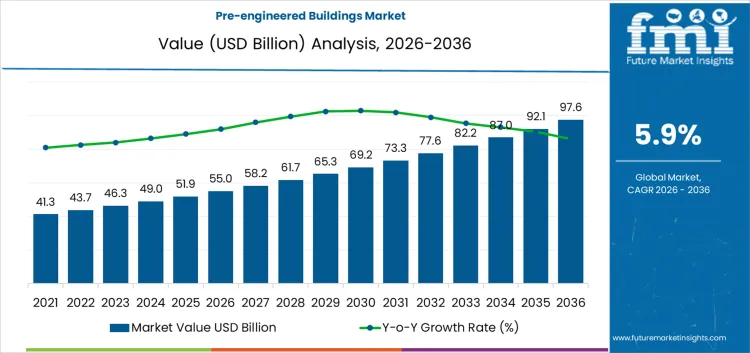
The pre-engineered buildings market increases from USD 55 billion in 2026 to USD 97.6 billion by 2036, representing a CAGR of 5.90%. Profitability is shaped primarily by control over steel sourcing, in house design libraries, and fabrication throughput rather than by contract count. Firms that own detailing software, standard connection systems, and high utilization plants retain stronger pricing authority and lower unit costs. By contrast, contractor’s dependent on third party fabrication face tighter spreads and higher exposure to steel price volatility. Value capture concentrates where suppliers control engineering approvals, shop drawings, and delivery schedules that are embedded into tender specifications.
Over the period, margin outcomes depend on the ability to manage bid discipline and project risk more than on geographic footprint alone. Turnkey providers that bundle foundations, erection, and certification preserve higher contribution margins than component suppliers competing on frame price. Working capital cycles, logistics coordination, and change order management materially affect realized returns. Public procurement and large industrial tenders compress headline pricing, yet firms with proprietary profiles and fast track approval records defend economics through specification control. The market expands steadily, though operating profit remains concentrated among producers with scale fabrication assets and standardized design platforms.
Quick Stats of the Pre-engineered Buildings Market
- Pre-engineered Buildings Market Value (2026): USD 55 billion
- Pre-engineered Buildings Forecast Value (2036): USD 97.6 billion
- Pre-engineered Buildings Forecast CAGR 2026 to 2036: 5.9%
- Leading Structure Type in Pre-engineered Buildings Market: Single-storey Buildings (47 % share)
- Leading End-Use Industry in Pre-engineered Buildings Market: Industrial & Manufacturing (51 % share)
- Key Growth Regions in Pre-engineered Buildings Market: India, China, Brazil, USA, UK
- Top Players in Pre-engineered Buildings Market: Nucor Corporation, BlueScope Steel, Tata Steel, Ceco Building Systems, Butler Manufacturing, Eagle Building Systems, Zamil Steel
What is the Growth Forecast for Pre-engineered Buildings Market through 2036?
Between 2026 and 2031, the pre-engineered buildings market is projected to expand from USD 55 billion along a path consistent with a 5.9% CAGR, shaped by shifts in construction timelines and capital efficiency expectations rather than by architectural fashion. Developers and industrial users increasingly prioritize speed of execution, cost predictability, and phased capacity expansion, all of which favor factory-fabricated structural systems. Warehouses, light manufacturing plants, logistics hubs, and commercial sheds account for much of the volume, with projects often justified by time-to-operation metrics rather than by pure construction cost. Growth in this phase is tied to industrialization, e-commerce logistics, and infrastructure-linked private investment. Purchasing decisions focus on delivery certainty, erection time, and standardization benefits rather than on bespoke structural complexity.
From 2031 to 2036, the market is expected to reach USD 97.6 billion, with expansion driven by wider acceptance of pre-engineered systems as mainstream building solutions rather than as purely industrial structures. More commercial, institutional, and mixed-use projects adopt these formats to manage cost risk and scheduling pressure. As urban and peri-urban development accelerates, the ability to replicate proven building templates across multiple sites becomes a strategic advantage. Value growth comes from higher project counts and larger average project sizes, not from price inflation. Competitive positioning depends on engineering depth, fabrication capacity, logistics coordination, and erection capability, as customers increasingly select partners based on execution reliability and lifecycle support rather than only on quoted steel tonnage.
Pre-engineered Buildings Market Key Takeaways
| Metric | Value |
|---|---|
| Market Value (2026) | USD 55 billion |
| Forecast Value (2036) | USD 97.6 billion |
| Forecast CAGR 2026 to 2036 | 5.9% |
How Are Pre-Engineered Buildings Transforming Construction Efficiency?
Pre-engineered buildings (PEBs) are increasingly adopted to reduce construction time, cost, and labor requirements in industrial, commercial, and institutional projects. Historically, building construction relied on conventional reinforced concrete and steel frameworks, which required extensive on-site work, longer timelines, and higher material waste. Modern PEBs use pre-fabricated steel components, modular panels, and standardized connections to enable rapid assembly, structural flexibility, and scalability.
Construction firms, industrial operators, and commercial developers prioritize structural integrity, design adaptability, and compliance with local building codes. Early adoption focused on warehouses and industrial plants, while current demand spans commercial complexes, educational institutions, and agricultural facilities, driven by urbanization, industrial expansion, and efficiency-focused construction practices. Material quality, design flexibility, and assembly efficiency influence supplier selection.
Rising infrastructure development, industrialization, and the need for rapid project completion are shaping market growth. Compared with traditional construction methods, pre-engineered buildings emphasize modular assembly, reduced material waste, and faster occupancy timelines. Cost structures depend on steel fabrication, component standardization, and logistics, concentrating margins among suppliers capable of delivering certified, high-performance PEB systems. Developers and industrial operators adopt these structures to reduce construction timelines, optimize resource use, and ensure structural safety. By 2036, pre-engineered buildings are expected to become standard in industrial, commercial, and institutional projects, supporting efficient construction, cost-effective scaling, and durable infrastructure solutions.
What Factors Are Shaping the Demand for Pre Engineered Buildings by Structural Configuration and End Use in 2026?
The pre-engineered buildings market in 2026 is segmented by structure type and by end use industry. By structural configuration, demand is divided into single storey buildings, multi storey buildings, modular prefabricated units, and steel frame extensions, each offering different spans, load paths, and construction sequences. By end use, demand is organized around industrial and manufacturing, commercial and retail, institutional and educational, and residential or recreational projects, which differ in schedule pressure, compliance requirements, and financing models. These segments reflect how developers and owners prioritize speed of delivery, cost predictability, and adaptability when choosing building systems for permanent or semi-permanent facilities.
Why Do Single Storey Buildings Represent the Largest Share of Pre Engineered Construction?
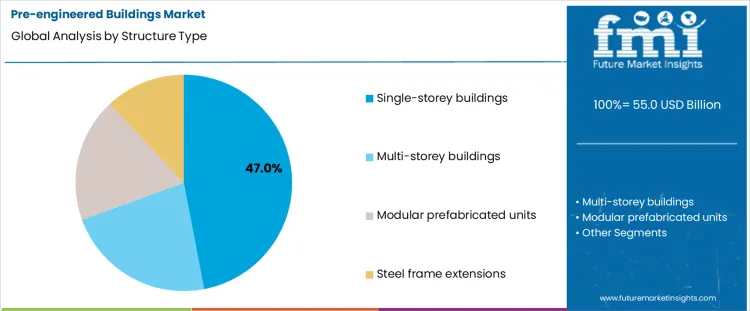
Single storey buildings account for about 47% of demand in 2026, reflecting their suitability for factories, warehouses, and logistics facilities that require large clear spans and efficient material flow. Many industrial processes depend on uninterrupted floor space rather than vertical stacking, which favors wide, low rise structures. Pre-engineered systems allow these buildings to be erected quickly with predictable costs and limited on site fabrication. Foundation and structural complexity remain lower than in multi-level designs, which reduces both engineering time and construction risk. Expansion is also simpler, since additional bays can often be added without major disruption. This alignment with industrial layout needs keeps single storey formats as the dominant configuration.
Multi storey, modular, and extension projects serve more specific development constraints. Multi storey pre-engineered buildings appear where land is limited or zoning requires vertical use, yet they involve more complex structural and fire design. Modular units focus on speed and repeatability, often for temporary or rapidly deployed facilities, but their scale is usually smaller. Steel frame extensions depend on existing buildings and therefore arise opportunistically rather than as standard projects. These categories are important, yet their addressable project pool is narrower. This keeps their combined volumes below that of single storey buildings, which match the most common industrial and logistics construction requirements.
Why Does Industrial and Manufacturing Dominate End Use Demand?
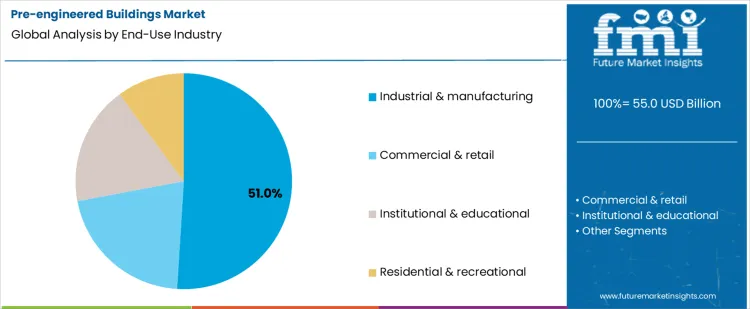
Industrial and manufacturing projects represent about 51% of demand in 2026 because these sectors value fast project delivery and predictable capital cost. Production facilities, workshops, and storage halls are often built to support capacity expansions or new contracts, which places emphasis on construction speed. Pre-engineered buildings meet these needs by standardizing components and reducing on site work. The resulting structures also allow flexible interior layouts and future expansion. In many regions, industrial zones and logistics parks further concentrate demand for such buildings. This consistent pipeline of capacity driven projects explains why industrial and manufacturing uses account for the largest share of overall pre-engineered building deployment.
Commercial, institutional, and residential or recreational projects follow different investment logics. Retail and commercial buildings place greater emphasis on façade design and tenant specific fit outs, which can reduce the appeal of standardized structures. Institutional projects face procurement rules and longer approval cycles. Residential and recreational uses often involve smaller scales or different construction methods. These segments adopt pre-engineered solutions where speed or budget constraints are critical, yet their total project volume remains lower. As a result, while diversified, the market remains anchored in industrial and manufacturing demand.
Why Are Project Time Risk and Capital Discipline Making Pre-engineered Buildings the Default Choice in Many New Builds through 2036?
Demand is being pulled by how investors manage schedule and cost exposure. In logistics, manufacturing, and warehousing, the value of a building often comes from how quickly it becomes operational rather than from architectural uniqueness. Pre-engineered systems offer predictable delivery times, fixed material quantities, and limited on site fabrication risk. Developers can lock designs early and align financing, equipment orders, and tenant commitments with more certainty. In markets where interest costs and contractor availability fluctuate, this predictability matters. Once organizations adopt standardized building templates across sites, procurement becomes repeatable, and volume follows expansion plans rather than one off construction decisions.
What Design Constraints, Approval Processes, and Perception Issues Are Limiting Their Use?
Limits come from both technical and institutional factors. Pre-engineered buildings work best within defined spans, heights, and load envelopes, which makes them less suitable for complex architectural or mixed use projects. Local approval authorities and consultants sometimes treat them as industrial boxes, applying additional scrutiny or restrictions. In some segments, there is still a perception that they are lower quality or less permanent, which affects acceptance for offices, public buildings, or premium facilities. Customization beyond the standard module set raises cost and erodes the economic advantage. These factors keep adoption concentrated in functional, cost driven projects rather than across all building categories.
How Are Standardization, Supply Chain Integration, and Portfolio Development Changing This Category?
The category is being reshaped by how large users build repeatedly. Logistics operators, retailers, and manufacturers increasingly develop portfolios of similar sites, which favors standardized structural systems and component libraries. Suppliers are integrating design, fabrication, and erection more tightly to shorten handoffs and reduce interface risk. Digital design tools allow earlier coordination with equipment layouts and racking systems, making buildings part of a broader operational template. Some owners also bundle long term maintenance and extension options into the original contract. Pre-engineered buildings are evolving from one off construction solutions into repeatable infrastructure products aligned with multi-site expansion strategies.
What is the Demand for Pre-Engineered Buildings by Country?
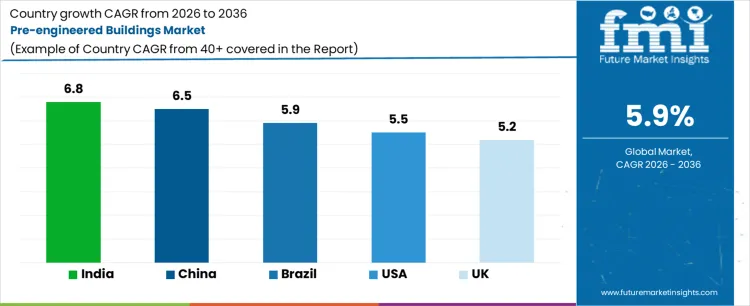
| Country | CAGR (%) |
|---|---|
| USA | 5.5% |
| UK | 5.2% |
| China | 6.5% |
| India | 6.8% |
| Brazil | 5.9% |
Demand for pre-engineered buildings is rising as construction and industrial sectors adopt modular, cost-effective, and rapid-deployment building solutions. India leads with a 6.8% CAGR, driven by growing industrialization, urban infrastructure development, and demand for warehouse and factory spaces. China follows at 6.5%, supported by large-scale commercial and industrial construction projects and adoption of standardized building components. Brazil records 5.9% growth, shaped by industrial expansion and logistics facility development. The USA grows at 5.5%, influenced by modernization of industrial and commercial structures. The UK shows 5.2% CAGR, reflecting steady adoption of pre-engineered solutions in warehouses, manufacturing facilities, and commercial buildings.
How is the United States experiencing growth in the pre-engineered buildings market?
United States is experiencing growth at a CAGR of 5.5%, driven by demand for cost-effective, rapid construction solutions in industrial, commercial, and warehousing sectors. Pre-engineered buildings (PEBs) are optimized for modular assembly, structural efficiency, and compliance with local building codes. Demand is concentrated in industrial hubs such as Houston, Chicago, and Dallas, where manufacturing, logistics, and storage facilities are expanding. Investments focus on material quality, structural integrity, and adherence to OSHA and local construction standards. Growth reflects increasing preference for faster construction timelines, reduced labor costs, and durable modular infrastructure.
- Industrial and commercial expansion drives adoption.
- PEBs optimize modular assembly and structural efficiency.
- Industrial hubs concentrate demand.
- Material quality and regulatory compliance guide investment.
How is the United Kingdom witnessing growth in the pre-engineered buildings market?
United Kingdom is witnessing growth at a CAGR of 5.2%, supported by industrial modernization, logistics expansion, and government initiatives for efficient construction. Pre-engineered buildings are optimized for rapid installation, structural durability, and compliance with UK building and safety codes. Demand is concentrated in London, Birmingham, and Manchester, where warehouses, industrial units, and commercial facilities are expanding. Investments prioritize modular design quality, material reliability, and adherence to local construction standards. Growth reflects adoption of time-efficient construction methods, cost reduction strategies, and scalable building solutions.
- Industrial modernization drives adoption.
- PEBs enhance installation speed and structural durability.
- Urban and industrial centers concentrate demand.
- Material reliability and compliance guide investment.
How is China experiencing growth in the pre-engineered buildings market?
China is experiencing growth at a CAGR of 6.5%, fueled by rapid urbanization, industrial expansion, and growth of e-commerce warehouses in Jiangsu, Guangdong, and Zhejiang. Pre-engineered buildings are optimized for large-scale industrial applications, modular assembly, and high structural efficiency. Demand is concentrated in industrial and logistics parks supporting manufacturing, e-commerce, and distribution. Investments focus on material quality, structural performance, and compliance with national construction codes. Growth reflects increasing industrial output, adoption of modular construction technologies, and a push for rapid deployment of large-scale facilities.
- Industrial and logistics expansion drives adoption.
- PEBs optimize modularity and structural efficiency.
- Industrial parks and manufacturing hubs concentrate demand.
- Material quality and regulatory compliance guide investment.
How is India witnessing growth in the pre-engineered buildings market?
India is witnessing growth at a CAGR of 6.8%, supported by infrastructure development, industrial park expansion, and demand for cost-effective commercial and warehouse buildings in Mumbai, Delhi, and Bengaluru. Pre-engineered buildings are optimized for quick assembly, durability, and adaptability to tropical climatic conditions. Demand is concentrated in industrial clusters, logistics hubs, and manufacturing zones. Investments prioritize structural integrity, material resilience, and adherence to national building standards. Growth reflects rising industrialization, expansion of warehousing and logistics infrastructure, and preference for fast, scalable construction solutions.
- Industrial parks and logistics hubs drive adoption.
- PEBs enhance assembly speed and structural resilience.
- Manufacturing clusters concentrate demand.
- Material durability and compliance guide investment.
How is Brazil experiencing growth in the pre-engineered buildings market?
Brazil is experiencing growth at a CAGR of 5.9%, fueled by industrial, commercial, and agricultural construction in São Paulo, Rio de Janeiro, and Paraná. Pre-engineered buildings are optimized for modular assembly, structural durability, and performance under tropical weather conditions. Demand is concentrated in industrial facilities, warehouses, and agricultural storage centers. Investments focus on material quality, structural performance, and compliance with Brazilian building regulations. Growth reflects increasing industrial activity, modernization of storage and manufacturing infrastructure, and adoption of cost-efficient construction methods.
- Industrial and commercial expansion drives adoption.
- PEBs optimize modular assembly and durability.
- Industrial and agricultural hubs concentrate demand.
- Material quality and regulatory compliance guide investment.
Who Competes in the Pre-Engineered Buildings Market and How Do Their Capabilities Differ?
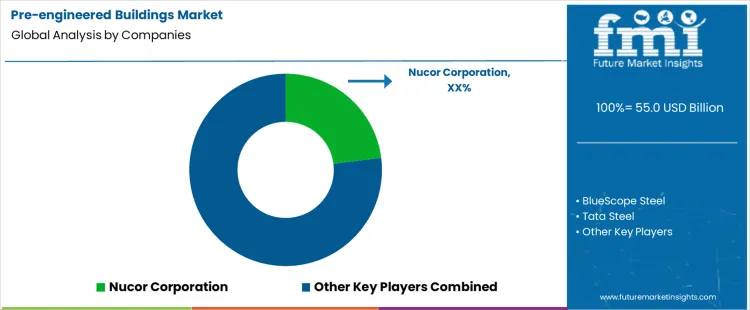
Competition in the pre-engineered buildings market is shaped by structural design expertise, material quality, and integration with construction and fabrication services. Nucor Corporation supplies steel components and structural systems tailored for pre-engineered buildings, with emphasis on high-strength steel and fabrication support across industrial and commercial projects. BlueScope Steel provides coated steel products and building solutions designed for durability, thermal performance, and resistance to environmental conditions. Tata Steel delivers steel framing and cladding systems with broad service networks in Asia and global supply chains. Ceco Building Systems offers turnkey pre-engineered building packages with engineering, fabrication, and onsite support to meet project specifications. Butler Manufacturing supplies integrated building systems with standardized components for rapid assembly and predictable performance.
Eagle Building Systems focuses on customizable pre-engineered structures with engineering services that align with regional codes and end-use requirements. Zamil Steel delivers steel building solutions with modular design, fabrication, and erection services, supported by global engineering competence. Other regional and specialty suppliers contribute localized manufacturing, engineering support, and installation services for pre-engineered buildings in industrial parks, warehouses, and infrastructure projects. Market differentiation arises from structural design optimization, build speed, cost efficiency, material performance, and ability to meet seismic, wind, and climatic standards. Suppliers that combine robust engineering services, responsive project support, and strong fabrication and delivery networks maintain competitive relevance across sectors where pre-engineered buildings are specified to reduce construction timelines, control costs, and provide durable structural solutions.
Key Players in the Pre-engineered Buildings Market
- Nucor Corporation
- BlueScope Steel
- Tata Steel
- Ceco Building Systems
- Butler Manufacturing
- Eagle Building Systems
- Zamil Steel
Scope of the Report
| Items | Values |
|---|---|
| Quantitative Units (2026) | USD billion |
| Structure Type | Single-storey Buildings, Multi-storey Buildings, Modular Prefabricated Units, Steel Frame Extensions |
| End-Use Industry | Industrial and Manufacturing, Commercial and Retail, Institutional and Educational, Residential and Recreational |
| Regions Covered | Asia Pacific, Europe, North America, Latin America, Middle East & Africa |
| Countries Covered | China, Japan, South Korea, India, Australia & New Zealand, ASEAN, Germany, United Kingdom, France, Italy, Spain, Nordic, BENELUX, United States, Canada, Mexico, Brazil, Chile, Saudi Arabia, Turkey, South Africa, and other regional markets |
| Key Companies Profiled | Nucor Corporation, BlueScope Steel, Tata Steel, Ceco Building Systems, Butler Manufacturing, Eagle Building Systems, Zamil Steel |
| Additional Attributes | Dollar sales by structure type and end-use industry, single-storey buildings forming the largest configuration segment due to suitability for factories, warehouses, and logistics facilities, industrial and manufacturing representing the largest end-use segment because of speed-driven capacity expansion projects, market economics shaped by steel sourcing control, in-house design libraries, fabrication throughput, and engineering approvals, value capture concentrated among vertically integrated and turnkey suppliers bundling design, fabrication, erection, and certification, strong influence of delivery certainty, erection speed, and standardization on buying decisions, growing use of standardized building templates across multi-site portfolios, and competitive positioning based on engineering depth, fabrication capacity, logistics coordination, and execution reliability rather than quoted steel tonnage alone. |
Pre-engineered Buildings Market Segmentation
By Structure Type:
- Single-storey buildings
- Multi-storey buildings
- Modular prefabricated units
- Steel frame extensions
By End-Use Industry:
- Industrial & manufacturing
- Commercial & retail
- Institutional & educational
- Residential & recreational
By Region
- Asia Pacific
- China
- Japan
- South Korea
- India
- Australia & New Zealand
- ASEAN
- Rest of Asia Pacific
- Europe
- Germany
- United Kingdom
- France
- Italy
- Spain
- Nordic
- BENELUX
- Rest of Europe
- North America
- United States
- Canada
- Mexico
- Latin America
- Brazil
- Chile
- Rest of Latin America
- Middle East & Africa
- Kingdom of Saudi Arabia
- Other GCC Countries
- Turkey
- South Africa
- Other African Union
- Rest of Middle East & Africa
Bibliography
- American Institute of Steel Construction (AISC). (2023). Steel construction manual (15th ed.). American Institute of Steel Construction.
- International Code Council (ICC). (2023). International building code (IBC 2023). International Code Council.
- National Institute of Standards and Technology (NIST). (2023). Building construction and safety standards. USA Department of Commerce, National Institute of Standards and Technology.
- World Steel Association. (2023). Steel’s role in modern construction and pre-engineered buildings. World Steel Association.
- USA Green Building Council (USGBC). (2023). LEED v4 for building design and construction. USA Green Building Council.
Frequently Asked Questions
How big is the pre-engineered buildings market in 2026?
The global pre-engineered buildings market is estimated to be valued at USD 55.0 billion in 2026.
What will be the size of pre-engineered buildings market in 2036?
The market size for the pre-engineered buildings market is projected to reach USD 97.6 billion by 2036.
How much will be the pre-engineered buildings market growth between 2026 and 2036?
The pre-engineered buildings market is expected to grow at a 5.9% CAGR between 2026 and 2036.
What are the key product types in the pre-engineered buildings market?
The key product types in pre-engineered buildings market are single-storey buildings, multi-storey buildings, modular prefabricated units and steel frame extensions.
Which end-use industry segment to contribute significant share in the pre-engineered buildings market in 2026?
In terms of end-use industry, industrial & manufacturing segment to command 51.0% share in the pre-engineered buildings market in 2026.
Preview the report firsthand - request a free sample
Get SampleGet the brochure for pricing and purchase details.
Get PDFTable of Content
- Executive Summary
- Global Market Outlook
- Demand-side Trends
- Supply-side Trends
- Technology Roadmap Analysis
- Analysis and Recommendations
- Market Overview
- Market Coverage / Taxonomy
- Market Definition / Scope / Limitations
- Market Background
- Market Dynamics
- Drivers
- Restraints
- Opportunity
- Trends
- Scenario Forecast
- Demand in Optimistic Scenario
- Demand in Likely Scenario
- Demand in Conservative Scenario
- Opportunity Map Analysis
- Product Life Cycle Analysis
- Supply Chain Analysis
- Investment Feasibility Matrix
- Value Chain Analysis
- PESTLE and Porter’s Analysis
- Regulatory Landscape
- Regional Parent Market Outlook
- Production and Consumption Statistics
- Import and Export Statistics
- Market Dynamics
- Global Market Analysis 2021 to 2025 and Forecast, 2026 to 2036
- Historical Market Size Value (USD Million) Analysis, 2021 to 2025
- Current and Future Market Size Value (USD Million) Projections, 2026 to 2036
- Y-o-Y Growth Trend Analysis
- Absolute $ Opportunity Analysis
- Global Market Pricing Analysis 2021 to 2025 and Forecast 2026 to 2036
- Global Market Analysis 2021 to 2025 and Forecast 2026 to 2036, By Structure Type
- Introduction / Key Findings
- Historical Market Size Value (USD Million) Analysis By Structure Type, 2021 to 2025
- Current and Future Market Size Value (USD Million) Analysis and Forecast By Structure Type, 2026 to 2036
- Single-storey buildings
- Multi-storey buildings
- Modular prefabricated units
- Steel frame extensions
- Single-storey buildings
- Y-o-Y Growth Trend Analysis By Structure Type, 2021 to 2025
- Absolute $ Opportunity Analysis By Structure Type, 2026 to 2036
- Global Market Analysis 2021 to 2025 and Forecast 2026 to 2036, By End-Use Industry
- Introduction / Key Findings
- Historical Market Size Value (USD Million) Analysis By End-Use Industry, 2021 to 2025
- Current and Future Market Size Value (USD Million) Analysis and Forecast By End-Use Industry, 2026 to 2036
- Industrial & manufacturing
- Commercial & retail
- Institutional & educational
- Residential & recreational
- Industrial & manufacturing
- Y-o-Y Growth Trend Analysis By End-Use Industry, 2021 to 2025
- Absolute $ Opportunity Analysis By End-Use Industry, 2026 to 2036
- Global Market Analysis 2021 to 2025 and Forecast 2026 to 2036, By Region
- Introduction
- Historical Market Size Value (USD Million) Analysis By Region, 2021 to 2025
- Current Market Size Value (USD Million) Analysis and Forecast By Region, 2026 to 2036
- North America
- Latin America
- Western Europe
- Eastern Europe
- East Asia
- South Asia and Pacific
- Middle East & Africa
- Market Attractiveness Analysis By Region
- North America Market Analysis 2021 to 2025 and Forecast 2026 to 2036, By Country
- Historical Market Size Value (USD Million) Trend Analysis By Market Taxonomy, 2021 to 2025
- Market Size Value (USD Million) Forecast By Market Taxonomy, 2026 to 2036
- By Country
- USA
- Canada
- Mexico
- By Structure Type
- By End-Use Industry
- By Country
- Market Attractiveness Analysis
- By Country
- By Structure Type
- By End-Use Industry
- Key Takeaways
- Latin America Market Analysis 2021 to 2025 and Forecast 2026 to 2036, By Country
- Historical Market Size Value (USD Million) Trend Analysis By Market Taxonomy, 2021 to 2025
- Market Size Value (USD Million) Forecast By Market Taxonomy, 2026 to 2036
- By Country
- Brazil
- Chile
- Rest of Latin America
- By Structure Type
- By End-Use Industry
- By Country
- Market Attractiveness Analysis
- By Country
- By Structure Type
- By End-Use Industry
- Key Takeaways
- Western Europe Market Analysis 2021 to 2025 and Forecast 2026 to 2036, By Country
- Historical Market Size Value (USD Million) Trend Analysis By Market Taxonomy, 2021 to 2025
- Market Size Value (USD Million) Forecast By Market Taxonomy, 2026 to 2036
- By Country
- Germany
- UK
- Italy
- Spain
- France
- Nordic
- BENELUX
- Rest of Western Europe
- By Structure Type
- By End-Use Industry
- By Country
- Market Attractiveness Analysis
- By Country
- By Structure Type
- By End-Use Industry
- Key Takeaways
- Eastern Europe Market Analysis 2021 to 2025 and Forecast 2026 to 2036, By Country
- Historical Market Size Value (USD Million) Trend Analysis By Market Taxonomy, 2021 to 2025
- Market Size Value (USD Million) Forecast By Market Taxonomy, 2026 to 2036
- By Country
- Russia
- Poland
- Hungary
- Balkan & Baltic
- Rest of Eastern Europe
- By Structure Type
- By End-Use Industry
- By Country
- Market Attractiveness Analysis
- By Country
- By Structure Type
- By End-Use Industry
- Key Takeaways
- East Asia Market Analysis 2021 to 2025 and Forecast 2026 to 2036, By Country
- Historical Market Size Value (USD Million) Trend Analysis By Market Taxonomy, 2021 to 2025
- Market Size Value (USD Million) Forecast By Market Taxonomy, 2026 to 2036
- By Country
- China
- Japan
- South Korea
- By Structure Type
- By End-Use Industry
- By Country
- Market Attractiveness Analysis
- By Country
- By Structure Type
- By End-Use Industry
- Key Takeaways
- South Asia and Pacific Market Analysis 2021 to 2025 and Forecast 2026 to 2036, By Country
- Historical Market Size Value (USD Million) Trend Analysis By Market Taxonomy, 2021 to 2025
- Market Size Value (USD Million) Forecast By Market Taxonomy, 2026 to 2036
- By Country
- India
- ASEAN
- Australia & New Zealand
- Rest of South Asia and Pacific
- By Structure Type
- By End-Use Industry
- By Country
- Market Attractiveness Analysis
- By Country
- By Structure Type
- By End-Use Industry
- Key Takeaways
- Middle East & Africa Market Analysis 2021 to 2025 and Forecast 2026 to 2036, By Country
- Historical Market Size Value (USD Million) Trend Analysis By Market Taxonomy, 2021 to 2025
- Market Size Value (USD Million) Forecast By Market Taxonomy, 2026 to 2036
- By Country
- Kingdom of Saudi Arabia
- Other GCC Countries
- Turkiye
- South Africa
- Other African Union
- Rest of Middle East & Africa
- By Structure Type
- By End-Use Industry
- By Country
- Market Attractiveness Analysis
- By Country
- By Structure Type
- By End-Use Industry
- Key Takeaways
- Key Countries Market Analysis
- USA
- Pricing Analysis
- Market Share Analysis, 2025
- By Structure Type
- By End-Use Industry
- Canada
- Pricing Analysis
- Market Share Analysis, 2025
- By Structure Type
- By End-Use Industry
- Mexico
- Pricing Analysis
- Market Share Analysis, 2025
- By Structure Type
- By End-Use Industry
- Brazil
- Pricing Analysis
- Market Share Analysis, 2025
- By Structure Type
- By End-Use Industry
- Chile
- Pricing Analysis
- Market Share Analysis, 2025
- By Structure Type
- By End-Use Industry
- Germany
- Pricing Analysis
- Market Share Analysis, 2025
- By Structure Type
- By End-Use Industry
- UK
- Pricing Analysis
- Market Share Analysis, 2025
- By Structure Type
- By End-Use Industry
- Italy
- Pricing Analysis
- Market Share Analysis, 2025
- By Structure Type
- By End-Use Industry
- Spain
- Pricing Analysis
- Market Share Analysis, 2025
- By Structure Type
- By End-Use Industry
- France
- Pricing Analysis
- Market Share Analysis, 2025
- By Structure Type
- By End-Use Industry
- India
- Pricing Analysis
- Market Share Analysis, 2025
- By Structure Type
- By End-Use Industry
- ASEAN
- Pricing Analysis
- Market Share Analysis, 2025
- By Structure Type
- By End-Use Industry
- Australia & New Zealand
- Pricing Analysis
- Market Share Analysis, 2025
- By Structure Type
- By End-Use Industry
- China
- Pricing Analysis
- Market Share Analysis, 2025
- By Structure Type
- By End-Use Industry
- Japan
- Pricing Analysis
- Market Share Analysis, 2025
- By Structure Type
- By End-Use Industry
- South Korea
- Pricing Analysis
- Market Share Analysis, 2025
- By Structure Type
- By End-Use Industry
- Russia
- Pricing Analysis
- Market Share Analysis, 2025
- By Structure Type
- By End-Use Industry
- Poland
- Pricing Analysis
- Market Share Analysis, 2025
- By Structure Type
- By End-Use Industry
- Hungary
- Pricing Analysis
- Market Share Analysis, 2025
- By Structure Type
- By End-Use Industry
- Kingdom of Saudi Arabia
- Pricing Analysis
- Market Share Analysis, 2025
- By Structure Type
- By End-Use Industry
- Turkiye
- Pricing Analysis
- Market Share Analysis, 2025
- By Structure Type
- By End-Use Industry
- South Africa
- Pricing Analysis
- Market Share Analysis, 2025
- By Structure Type
- By End-Use Industry
- USA
- Market Structure Analysis
- Competition Dashboard
- Competition Benchmarking
- Market Share Analysis of Top Players
- By Regional
- By Structure Type
- By End-Use Industry
- Competition Analysis
- Competition Deep Dive
- Nucor Corporation
- Overview
- Product Portfolio
- Profitability by Market Segments (Product/Age /Sales Channel/Region)
- Sales Footprint
- Strategy Overview
- Marketing Strategy
- Product Strategy
- Channel Strategy
- BlueScope Steel
- Tata Steel
- Ceco Building Systems
- Butler Manufacturing
- Eagle Building Systems
- Zamil Steel
- Nucor Corporation
- Competition Deep Dive
- Assumptions & Acronyms Used
- Research Methodology


