

- Industry Size (2026)
- USD 294.1 Mn
- Forecast (2036)
- USD 1016.2 Mn
- CAGR (2026 to 2036)
- 13.2%
Self-Healing Microcapsule Systems Market Forecast and Outlook 2026 to 2036
The self-healing microcapsule systems market is projected to grow from USD 294.1 million in 2026 to USD 1,016.2 million by 2036, at a CAGR of 13.2%, driven by the growing use of autonomous repair chemistries in performance-focused materials. Segment demand is led by protective coatings, which hold a 40% share, driven by corrosion resistance, surface continuity, and reduced maintenance cycles across automotive, infrastructure, and marine assets. Composites follow due to applications in aerospace and energy structures requiring micro-crack mitigation, while adhesives, sealants, electronics encapsulation, and concrete remain selective but high-value outlets. Polymerization-based microcapsules dominate healing mechanisms with a 36% share, favored for reliable structural recovery, alongside corrosion inhibitor and solvent release systems for surface protection. UF MF resin shells account for the largest shell material share at 30% due to formulation compatibility and cost efficiency. Competition is defined by chemistry depth and integration capability, with suppliers such as BASF, Evonik Industries, 3M, Dow, Henkel, and AkzoNobel shaping segment specific demand.
Quick Stats of the Self-Healing Microcapsule Systems Market
- Self-Healing Microcapsule Systems Market Value (2026): USD 294.1 million
- Self-Healing Microcapsule Systems Market Forecast Value (2036): USD 1,016.2 million
- Self-Healing Microcapsule Systems Market Global Forecast CAGR (2026-2036): 13.2%
- Self-Healing Microcapsule Systems Market Leading Segment: Target Application (Protective coatings) 40%
- Key Growth Regions in Self-Healing Microcapsule Systems Market: China
- Top Players in Self-Healing Microcapsule Systems Market: BASF, Evonik Industries, 3M, Dow, Henkel, AkzoNobel, Nouryon, Microtek Laboratories, Autonomic Materials, Solvay
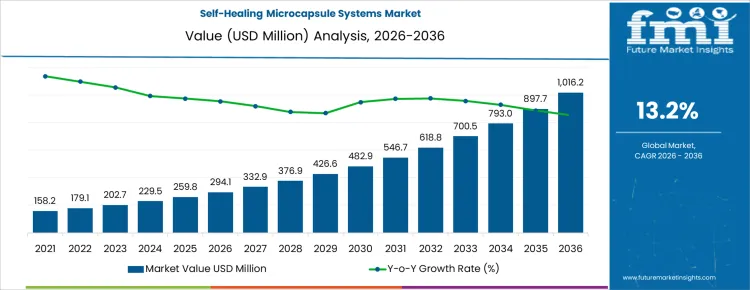
What is the Growth Forecast for the Self-Healing Microcapsule Systems Market through 2036?
The growth forecast for self-healing microcapsule systems is strong, with a projected CAGR of 13.2% from 2026 to 2036. The market will increase from USD 294.1 million in 2026 to USD 1,016.2 million by 2036. Over the years, the market will experience consistent growth, with the value rising to USD 332.8 million in 2027, USD 376.7 million in 2028, and USD 426.7 million in 2029. By 2030, the value will reach USD 483.7 million, continuing to grow steadily.
From 2031 to 2036, the market will see continued expansion, with values reaching USD 548.9 million in 2031, USD 623.8 million in 2032, and USD 709.9 million in 2033. In 2034, the market will grow to USD 808.6 million, followed by USD 898.3 million in 2035. By 2036, self-healing microcapsule systems are expected to reach USD 1,016.2 million, marking a significant increase over the forecast period.
Self-Healing Microcapsule Systems Market Key Takeaways
| Metric | Value |
|---|---|
| Industry Sales Value (2026) | USD 294.1 million |
| Industry Forecast Value (2036) | USD 1,016.2 million |
| Industry Forecast CAGR (2026-2036) | 13.2% |
What Is Driving the Demand for the Self-Healing Microcapsule Systems Market Globally?
The global demand for self-healing microcapsule systems is driven by the need to extend the lifetime and reliability of materials across coatings, composites, electronics, and construction sectors. Self-healing microcapsules are tiny containers embedded in a host material that release healing agents when damage such as cracks or abrasion occurs, enabling autonomous repair without manual intervention. In protective coatings for infrastructure, oil and gas, marine, and automotive applications, microcapsule systems help maintain corrosion resistance, gloss retention, and barrier properties, reducing maintenance costs and downtime.
In composite materials used in aerospace, wind energy, and high-performance sporting goods, these technologies enhance durability, reduce the risk of catastrophic failure, and improve safety by mitigating micro-damage before it propagates. The electronics industry is also adopting self-healing microcapsule technologies to protect against mechanical stress and environmental degradation in flexible displays, printed circuits, and encapsulated devices. Increasing adoption is supported by rising customer expectations for long-lasting performance, growing awareness of total cost of ownership over a product’s life cycle, and industry pressure to deliver sustainable solutions that reduce waste and resource use. As manufacturers focus on innovation and competitive differentiation, integrating self-healing capabilities into materials and products has become a high-value strategy for premium segments.
Future demand for self-healing microcapsule systems is expected to grow as formulation science and material integration technologies advance. New chemistries, including reversible polymers, phase-change systems, and multi-component healing agents, are improving repair efficiency, compatibility with diverse substrates, and the range of environmental triggers that activate healing. Expansion of lightweight and high-strength materials in sectors such as electric vehicles, renewable energy, and urban infrastructure will sustain interest in autonomous repair solutions that improve safety and reduce lifecycle costs. Regulatory emphasis on durability and sustainability, particularly in construction and transportation, will further encourage use of self-healing materials to meet stricter performance standards.
Growth in additive manufacturing and smart materials research will broaden potential applications, enabling microcapsule systems to be tailored for specific damage modes and service conditions. As digital design and simulation tools mature, engineers will more readily specify self-healing systems early in product development, accelerating adoption. The balance of improved performance, reduced maintenance burden, and alignment with environmental and economic priorities positions the self-healing microcapsule systems market for steady global expansion over the coming decade.
What are the Leading Segments in the Global Self-Healing Microcapsule Systems Market?
The global self-healing microcapsule systems market is segmented by target application and healing mechanism. Among target applications, protective coatings hold the largest share at 40%, followed by composites, adhesives & sealants, concrete/structural materials, and electronics encapsulation. Protective coatings are widely used in various industries to prevent wear and tear, and microcapsules play a crucial role in providing self-healing properties to these coatings. In terms of healing mechanism, polymerization-based microcapsules lead the market, capturing 36% of the share, followed by corrosion-inhibitor release capsules, solvent/plasticizer release capsules, and multi-capsule hybrid systems. The demand for self-healing systems in protective coatings and other applications is driven by the need for materials that can autonomously repair damage, reducing maintenance costs and extending the lifespan of products.
What Drives the Growth of Protective Coatings in the Self-Healing Microcapsule Systems Market?
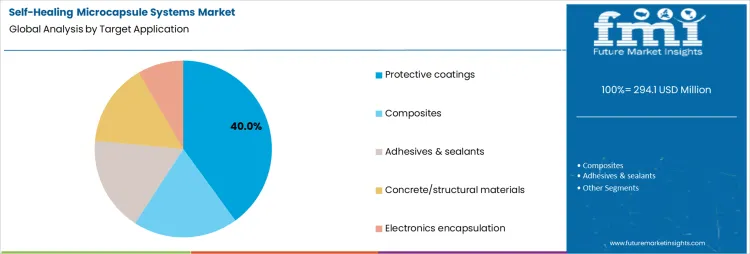
Protective coatings are the leading target application in the self-healing microcapsule systems market, accounting for 40% of the share. The demand for protective coatings with self-healing properties has grown significantly in industries such as automotive, construction, and aerospace, where coatings must withstand harsh environmental conditions and physical stress. Self-healing coatings containing microcapsules are designed to release healing agents when the coating is damaged, thereby repairing the affected area and restoring the coating's protective function. This technology enhances the durability and performance of coatings, reducing the need for frequent maintenance and reapplication.
As industries continue to focus on improving product longevity and reducing operational costs, self-healing coatings offer a sustainable solution by extending the service life of materials and minimizing downtime. Additionally, as industries face increasing regulatory pressure to reduce maintenance costs and improve environmental impact, the demand for self-healing coatings in various sectors, including marine, automotive, and infrastructure, is expected to continue to grow. The ability of these coatings to autonomously repair damage, such as scratches or cracks, further solidifies their position as a key segment in the market.
What is Driving the Demand for Polymerization-Based Microcapsules in the Self-Healing Microcapsule Systems Market?
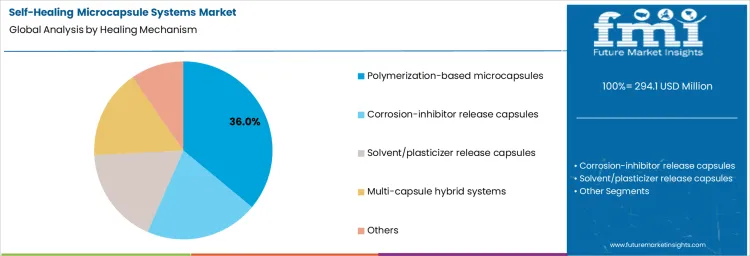
Polymerization-based microcapsules are the leading healing mechanism in the self-healing microcapsule systems market, holding 36% of the share. These microcapsules are designed to release healing agents that trigger polymerization, allowing the damaged material to self-repair. The ability to repair cracks, scratches, and other damage autonomously is highly valued in applications like protective coatings, composites, and adhesives. Polymerization-based microcapsules are particularly effective because they can initiate a chemical reaction that hardens and bonds the damaged area, restoring the material’s structural integrity. This mechanism is widely used in industries such as automotive and construction, where the performance and durability of materials are critical.
The growing demand for more sustainable and cost-effective solutions, as well as the need for enhanced material longevity, is driving the adoption of polymerization-based microcapsules. These microcapsules contribute to reducing maintenance costs, improving the overall lifespan of products, and minimizing the environmental impact associated with frequent repairs and replacements. As industries continue to innovate and seek self-healing technologies, polymerization-based microcapsules are expected to maintain their dominant position in the market.
What are the Key Dynamics of the Global Self-Healing Microcapsule Systems Market?
The global self-healing microcapsule systems market is growing as manufacturers integrate microencapsulation technologies that help materials autonomously repair damage such as cracks, scratches or fissures. These systems embed tiny capsules containing healing agents into coatings, polymers, composites and construction materials. When damage occurs, the capsules break and release restorative chemistry that extends service life and reduces maintenance. Growth reflects demand for durable, long-lasting products in automotive, aerospace, electronics, infrastructure and industrial sectors. Adoption aligns with priorities for performance improvement, lifecycle cost savings and enhanced reliability worldwide.
What are the Key Drivers for the Global Self-Healing Microcapsule Systems Market?
Increasing emphasis on durability and reduced maintenance costs drives interest in self-healing microcapsule systems. Industries that manage critical assets pursue technologies that lessen failure risk, cut repair downtime and lengthen intervals between maintenance cycles. Advances in microencapsulation and polymer science enable tailored healing chemistries that address specific damage modes. Growth in sectors such as transportation, construction and consumer electronics supports broader adoption as product designers aim to enhance quality and differentiate offerings. Environmental and sustainability goals also encourage materials that prolong service life and reduce waste from premature replacement.
What are the Restraints for the Global Self-Healing Microcapsule Systems Market?
One restraint is the technical complexity tied to developing and scaling microcapsule formulations that perform reliably under varied conditions and material systems. Ensuring uniform dispersion, compatibility with host matrices and predictable release of healing agents requires significant R&D. Some high-performance systems add cost relative to conventional materials, which may slow uptake in cost-sensitive applications. Industry standards and long-term performance data for new self-healing materials are still evolving, which can influence specification decisions by engineers and procurement teams. Integration with existing manufacturing processes may also require adaptation and testing.
What is the Key Trends in the Global Self-Healing Microcapsule Systems Market?
A key trend is the development of multifunctional microcapsule systems that pair self-healing with other benefits such as corrosion inhibition, UV resistance or thermal management. Material scientists are designing stimuli-responsive capsules that activate under specific triggers and deliver tailored responses. Collaboration between additive suppliers, OEMs and research institutions accelerates innovation and supports qualification for high-value sectors like aerospace and automotive. There is rising interest in bio-based and environmentally friendly encapsulation materials to align with sustainability initiatives. Industry adoption of digital materials characterization and predictive modelling helps optimise formulations for targeted performance outcomes.
What is the Country-Wise Analysis of the Self-Healing Microcapsule Systems Market?
The self-healing microcapsule systems market is projected to experience strong growth, driven by the increasing demand for advanced materials that offer enhanced durability and longevity. These systems release healing agents when a material is damaged, restoring its properties and extending its service life. The applications for self-healing microcapsules are broad, covering industries such as automotive, construction, textiles, and electronics. High-growth markets like China are leading the market due to rapid industrialization and increasing consumer demand for high-performance materials. Developed markets such as the USA, UK, and Germany are also experiencing strong growth, fueled by innovations in material science and the increasing focus on sustainability and product longevity.
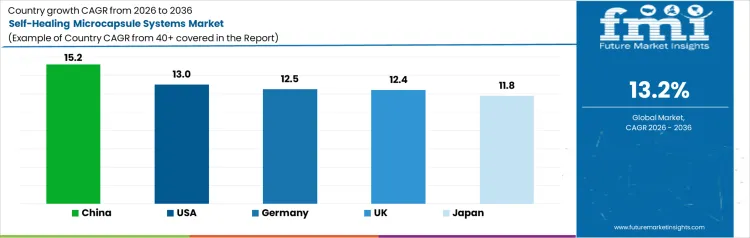
| Country | CAGR (2026-2036) |
|---|---|
| China | 15.2% |
| United States | 13% |
| United Kingdom | 12.4% |
| Germany | 12.5% |
| Japan | 11.8% |
What is the Growth Outlook for the Self-Healing Microcapsule Systems Market in China?
The self-healing microcapsule systems market in China is expected to grow at the highest rate, with a projected CAGR of 15.2%. China’s rapidly expanding industrial base and its growing consumer demand for high-performance, long-lasting products are driving this market growth. As the country continues to invest in advanced manufacturing technologies and materials, the adoption of self-healing systems is increasing across sectors such as automotive, construction, and electronics. Furthermore, China’s emphasis on improving the durability and sustainability of products, combined with rising environmental awareness, is accelerating the development and use of self-healing microcapsules. As innovation in materials science continues, China is expected to lead the global market for self-healing microcapsule systems.
What is the Market Outlook for the Self-Healing Microcapsule Systems Market in the United States?
The self-healing microcapsule systems market in the United States is projected to grow steadily, with a projected CAGR of 13%. The USA is a key player in material science innovation, particularly in sectors like automotive, aerospace, and electronics, where durability and product longevity are crucial. As industries seek ways to reduce maintenance costs and enhance product life cycles, the demand for self-healing materials is rising. The USA market is also driven by the increasing focus on sustainability and efficiency, as self-healing materials offer a way to extend the life of products and reduce waste. With technological advancements and increased adoption of these systems in high-performance applications, the USA market is poised for significant growth.
What is the Growth Forecast for the Self-Healing Microcapsule Systems Market in the United Kingdom?
The self-healing microcapsule systems market in the United Kingdom is expected to grow at a strong pace, with a projected CAGR of 12.4%. The UK is witnessing growing demand for advanced materials in sectors such as automotive, construction, and textiles, where self-healing properties can significantly enhance product longevity and reduce the need for repairs. As the UK continues to focus on innovation and sustainability, the adoption of self-healing microcapsule systems is increasing, especially in high-value industries. Furthermore, the UK government’s commitment to supporting green technologies and sustainable manufacturing is expected to drive market growth. As industries look for efficient, long-lasting solutions, the market for self-healing microcapsules in the UK is expected to continue to expand steadily.
What is the Market Outlook for the Self-Healing Microcapsule Systems Market in Germany?
The self-healing microcapsule systems market in Germany is projected to grow at a steady pace, with a projected CAGR of 12.5%. Germany, known for its leadership in automotive engineering, manufacturing, and materials science, is seeing increased adoption of self-healing systems across various sectors. The demand for high-performance materials that extend product life and reduce maintenance is rising, particularly in the automotive, construction, and electronics industries. Germany’s strong emphasis on sustainability and innovation in manufacturing is driving the market for self-healing microcapsules, as these materials help improve product durability and reduce waste. With continued advancements in material science and a focus on long-term sustainability, Germany’s market for self-healing microcapsule systems is expected to continue to grow steadily.
What are the Growth Prospects for the Self-Healing Microcapsule Systems Market in Japan?
The self-healing microcapsule systems market in Japan is expected to grow at a moderate pace, with a projected CAGR of 11.8%. Japan’s strong focus on technological innovation and material science is driving the demand for self-healing systems, particularly in sectors like automotive, electronics, and manufacturing. As Japanese industries strive to enhance product durability and performance while minimizing maintenance costs, the adoption of self-healing materials is on the rise. Japan’s commitment to sustainability and efficiency in manufacturing is also pushing the development of advanced self-healing technologies. While Japan’s market growth may be slower compared to other regions, the demand for high-performance, durable products will continue to support steady growth in the self-healing microcapsule systems market.
What is the Competitive Landscape for the Self-Healing Microcapsule Systems Market?
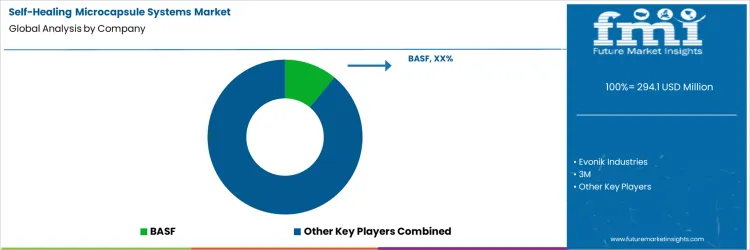
The self-healing microcapsule systems market is growing rapidly as industries seek innovative solutions to improve material longevity and performance across a variety of sectors, including automotive, construction, and coatings. BASF leads the market with its advanced self-healing microcapsule systems, offering solutions that can repair damages autonomously, enhancing the durability and functionality of materials. Their commitment to innovation and cutting-edge technology has positioned them as a key player. Evonik Industries, 3M, and Dow are significant competitors, each providing specialized self-healing microcapsule solutions for different applications. Evonik Industries focuses on creating high-performance microcapsules for a range of industries, while 3M and Dow offer effective systems that improve product longevity and material performance.
Henkel, AkzoNobel, Nouryon, Microtek Laboratories, Autonomic Materials, and Solvay further contribute to the competitive landscape by offering tailored self-healing microcapsule systems. Henkel and AkzoNobel provide advanced materials for industrial and consumer applications, while Nouryon focuses on developing sustainable and innovative self-healing technologies. Microtek Laboratories and Autonomic Materials specialize in self-healing microcapsules for the construction and automotive industries, offering solutions that enhance material resilience. Solvay also delivers effective microcapsule systems designed to improve material durability. These companies compete based on technological innovation, product performance, and their ability to offer self-healing solutions that meet the growing demand for more durable and sustainable materials.
Key Players of the Self-Healing Microcapsule Systems Market
- BASF
- Evonik Industries
- 3M
- Dow
- Henkel
- AkzoNobel
- Nouryon
- Microtek Laboratories
- Autonomic Materials
- Solvay
Scope of the Report
| Items | Values |
|---|---|
| Quantitative Units (2026) | USD Million |
| Healing Mechanism | Polymerization-Based Microcapsules, Corrosion-Inhibitor Release Capsules, Solvent/Plasticizer Release Capsules, Multi-Capsule Hybrid Systems |
| Capsule Shell Material | UF/MF Resin Shells, Polyurea/PU Shells, Gelatin/Biopolymer Shells, Silica/Inorganic Shells, Others |
| Target Application | Protective Coatings, Composites, Adhesives & Sealants, Concrete/Structural Materials, Electronics Encapsulation |
| End-Use Industry | Aerospace & Defense, Automotive, Marine/Offshore, Construction, Electronics |
| Companies | BASF, Evonik Industries, 3M, Dow, Henkel, AkzoNobel, Nouryon, Microtek Laboratories, Autonomic Materials, Solvay |
| Regions Covered | North America, Latin America, Western Europe, Eastern Europe, South Asia and Pacific, East Asia, Middle East & Africa |
| Countries Covered | United States, Canada, Mexico, Brazil, Argentina, Germany, France, United Kingdom, Italy, Spain, Netherlands, China, India, Japan, South Korea, ANZ, GCC Countries, South Africa |
| Additional Attributes | Dollar by sales by healing mechanism, capsule shell material, target application, end-use industry, and region. Includes market trends in self-healing microcapsule systems, focusing on polymerization-based microcapsules, corrosion inhibitors, solvent/plasticizer release capsules, and multi-capsule hybrid systems. Highlights the role of different shell materials like resin, polyurea, and silica in aerospace, automotive, marine, and construction applications. Focus on sustainability, performance, regulatory compliance, market share, and competitive positioning of key companies in the microencapsulation market. |
Self-Healing Microcapsule Systems Market Segmentation
Healing Mechanism
- Polymerization-based microcapsules
- Corrosion-inhibitor release capsules
- Solvent/plasticizer release capsules
- Multi-capsule hybrid systems
- Others
Capsule Shell Material
- UF/MF resin shells
- Polyurea/PU shells
- Gelatin/biopolymer shells
- Silica/inorganic shells
- Others
Target Application
- Protective coatings
- Composites
- Adhesives & sealants
- Concrete/structural materials
- Electronics encapsulation
End-Use Industry
- Aerospace & defense
- Automotive
- Marine/offshore
- Construction
- Electronics
Region
- Asia Pacific
- China
- Japan
- South Korea
- India
- Australia & New Zealand
- ASEAN
- Rest of Asia Pacific
- Europe
- Germany
- United Kingdom
- France
- Italy
- Spain
- Nordic
- BENELUX
- Rest of Europe
- North America
- United States
- Canada
- Mexico
- Latin America
- Brazil
- Chile
- Rest of Latin America
- Middle East & Africa
- Kingdom of Saudi Arabia
- Other GCC Countries
- Turkey
- South Africa
- Other African Union
- Rest of Middle East & Africa
Frequently Asked Questions
How big is the self-healing microcapsule systems market in 2026?
The global self-healing microcapsule systems market is estimated to be valued at USD 294.1 million in 2026.
What will be the size of self-healing microcapsule systems market in 2036?
The market size for the self-healing microcapsule systems market is projected to reach USD 1,016.2 million by 2036.
How much will be the self-healing microcapsule systems market growth between 2026 and 2036?
The self-healing microcapsule systems market is expected to grow at a 13.2% CAGR between 2026 and 2036.
What are the key product types in the self-healing microcapsule systems market?
The key product types in self-healing microcapsule systems market are polymerization-based microcapsules, corrosion-inhibitor release capsules, solvent/plasticizer release capsules, multi-capsule hybrid systems and others.
Which capsule shell material segment to contribute significant share in the self-healing microcapsule systems market in 2026?
In terms of capsule shell material, uf/mf resin shells segment to command 30.0% share in the self-healing microcapsule systems market in 2026.
Preview the report firsthand - request a free sample
Get SampleGet the brochure for pricing and purchase details.
Get PDFTable of Content
- Executive Summary
- Global Market Outlook
- Demand-side Trends
- Supply-side Trends
- Technology Roadmap Analysis
- Analysis and Recommendations
- Market Overview
- Market Coverage / Taxonomy
- Market Definition / Scope / Limitations
- Market Background
- Market Dynamics
- Drivers
- Restraints
- Opportunity
- Trends
- Scenario Forecast
- Demand in Optimistic Scenario
- Demand in Likely Scenario
- Demand in Conservative Scenario
- Opportunity Map Analysis
- Product Life Cycle Analysis
- Supply Chain Analysis
- Investment Feasibility Matrix
- Value Chain Analysis
- PESTLE and Porter’s Analysis
- Regulatory Landscape
- Regional Parent Market Outlook
- Production and Consumption Statistics
- Import and Export Statistics
- Market Dynamics
- Global Market Analysis 2021 to 2025 and Forecast, 2026 to 2036
- Historical Market Size Value (USD Million) Analysis, 2021 to 2025
- Current and Future Market Size Value (USD Million) Projections, 2026 to 2036
- Y-o-Y Growth Trend Analysis
- Absolute $ Opportunity Analysis
- Global Market Pricing Analysis 2021 to 2025 and Forecast 2026 to 2036
- Global Market Analysis 2021 to 2025 and Forecast 2026 to 2036, By Healing Mechanism
- Introduction / Key Findings
- Historical Market Size Value (USD Million) Analysis By Healing Mechanism , 2021 to 2025
- Current and Future Market Size Value (USD Million) Analysis and Forecast By Healing Mechanism , 2026 to 2036
- Polymerization-based microcapsules
- Corrosion-inhibitor release capsules
- Solvent/plasticizer release capsules
- Multi-capsule hybrid systems
- Others
- Y-o-Y Growth Trend Analysis By Healing Mechanism , 2021 to 2025
- Absolute $ Opportunity Analysis By Healing Mechanism , 2026 to 2036
- Global Market Analysis 2021 to 2025 and Forecast 2026 to 2036, By Capsule Shell Material
- Introduction / Key Findings
- Historical Market Size Value (USD Million) Analysis By Capsule Shell Material, 2021 to 2025
- Current and Future Market Size Value (USD Million) Analysis and Forecast By Capsule Shell Material, 2026 to 2036
- UF/MF resin shells
- Polyurea/PU shells
- Gelatin/biopolymer shells
- Silica/inorganic shells
- Others
- Y-o-Y Growth Trend Analysis By Capsule Shell Material, 2021 to 2025
- Absolute $ Opportunity Analysis By Capsule Shell Material, 2026 to 2036
- Global Market Analysis 2021 to 2025 and Forecast 2026 to 2036, By Target Application
- Introduction / Key Findings
- Historical Market Size Value (USD Million) Analysis By Target Application, 2021 to 2025
- Current and Future Market Size Value (USD Million) Analysis and Forecast By Target Application, 2026 to 2036
- Protective coatings
- Composites
- Adhesives & sealants
- Concrete/structural materials
- Electronics encapsulation
- Y-o-Y Growth Trend Analysis By Target Application, 2021 to 2025
- Absolute $ Opportunity Analysis By Target Application, 2026 to 2036
- Global Market Analysis 2021 to 2025 and Forecast 2026 to 2036, By End-Use Industry
- Introduction / Key Findings
- Historical Market Size Value (USD Million) Analysis By End-Use Industry, 2021 to 2025
- Current and Future Market Size Value (USD Million) Analysis and Forecast By End-Use Industry, 2026 to 2036
- Aerospace & defense
- Automotive
- Marine/offshore
- Construction
- Electronics
- Y-o-Y Growth Trend Analysis By End-Use Industry, 2021 to 2025
- Absolute $ Opportunity Analysis By End-Use Industry, 2026 to 2036
- Global Market Analysis 2021 to 2025 and Forecast 2026 to 2036, By Region
- Introduction
- Historical Market Size Value (USD Million) Analysis By Region, 2021 to 2025
- Current Market Size Value (USD Million) Analysis and Forecast By Region, 2026 to 2036
- North America
- Latin America
- Western Europe
- Eastern Europe
- East Asia
- South Asia and Pacific
- Middle East & Africa
- Market Attractiveness Analysis By Region
- North America Market Analysis 2021 to 2025 and Forecast 2026 to 2036, By Country
- Historical Market Size Value (USD Million) Trend Analysis By Market Taxonomy, 2021 to 2025
- Market Size Value (USD Million) Forecast By Market Taxonomy, 2026 to 2036
- By Country
- USA
- Canada
- Mexico
- By Healing Mechanism
- By Capsule Shell Material
- By Target Application
- By End-Use Industry
- By Country
- Market Attractiveness Analysis
- By Country
- By Healing Mechanism
- By Capsule Shell Material
- By Target Application
- By End-Use Industry
- Key Takeaways
- Latin America Market Analysis 2021 to 2025 and Forecast 2026 to 2036, By Country
- Historical Market Size Value (USD Million) Trend Analysis By Market Taxonomy, 2021 to 2025
- Market Size Value (USD Million) Forecast By Market Taxonomy, 2026 to 2036
- By Country
- Brazil
- Chile
- Rest of Latin America
- By Healing Mechanism
- By Capsule Shell Material
- By Target Application
- By End-Use Industry
- By Country
- Market Attractiveness Analysis
- By Country
- By Healing Mechanism
- By Capsule Shell Material
- By Target Application
- By End-Use Industry
- Key Takeaways
- Western Europe Market Analysis 2021 to 2025 and Forecast 2026 to 2036, By Country
- Historical Market Size Value (USD Million) Trend Analysis By Market Taxonomy, 2021 to 2025
- Market Size Value (USD Million) Forecast By Market Taxonomy, 2026 to 2036
- By Country
- Germany
- UK
- Italy
- Spain
- France
- Nordic
- BENELUX
- Rest of Western Europe
- By Healing Mechanism
- By Capsule Shell Material
- By Target Application
- By End-Use Industry
- By Country
- Market Attractiveness Analysis
- By Country
- By Healing Mechanism
- By Capsule Shell Material
- By Target Application
- By End-Use Industry
- Key Takeaways
- Eastern Europe Market Analysis 2021 to 2025 and Forecast 2026 to 2036, By Country
- Historical Market Size Value (USD Million) Trend Analysis By Market Taxonomy, 2021 to 2025
- Market Size Value (USD Million) Forecast By Market Taxonomy, 2026 to 2036
- By Country
- Russia
- Poland
- Hungary
- Balkan & Baltic
- Rest of Eastern Europe
- By Healing Mechanism
- By Capsule Shell Material
- By Target Application
- By End-Use Industry
- By Country
- Market Attractiveness Analysis
- By Country
- By Healing Mechanism
- By Capsule Shell Material
- By Target Application
- By End-Use Industry
- Key Takeaways
- East Asia Market Analysis 2021 to 2025 and Forecast 2026 to 2036, By Country
- Historical Market Size Value (USD Million) Trend Analysis By Market Taxonomy, 2021 to 2025
- Market Size Value (USD Million) Forecast By Market Taxonomy, 2026 to 2036
- By Country
- China
- Japan
- South Korea
- By Healing Mechanism
- By Capsule Shell Material
- By Target Application
- By End-Use Industry
- By Country
- Market Attractiveness Analysis
- By Country
- By Healing Mechanism
- By Capsule Shell Material
- By Target Application
- By End-Use Industry
- Key Takeaways
- South Asia and Pacific Market Analysis 2021 to 2025 and Forecast 2026 to 2036, By Country
- Historical Market Size Value (USD Million) Trend Analysis By Market Taxonomy, 2021 to 2025
- Market Size Value (USD Million) Forecast By Market Taxonomy, 2026 to 2036
- By Country
- India
- ASEAN
- Australia & New Zealand
- Rest of South Asia and Pacific
- By Healing Mechanism
- By Capsule Shell Material
- By Target Application
- By End-Use Industry
- By Country
- Market Attractiveness Analysis
- By Country
- By Healing Mechanism
- By Capsule Shell Material
- By Target Application
- By End-Use Industry
- Key Takeaways
- Middle East & Africa Market Analysis 2021 to 2025 and Forecast 2026 to 2036, By Country
- Historical Market Size Value (USD Million) Trend Analysis By Market Taxonomy, 2021 to 2025
- Market Size Value (USD Million) Forecast By Market Taxonomy, 2026 to 2036
- By Country
- Kingdom of Saudi Arabia
- Other GCC Countries
- Turkiye
- South Africa
- Other African Union
- Rest of Middle East & Africa
- By Healing Mechanism
- By Capsule Shell Material
- By Target Application
- By End-Use Industry
- By Country
- Market Attractiveness Analysis
- By Country
- By Healing Mechanism
- By Capsule Shell Material
- By Target Application
- By End-Use Industry
- Key Takeaways
- Key Countries Market Analysis
- USA
- Pricing Analysis
- Market Share Analysis, 2025
- By Healing Mechanism
- By Capsule Shell Material
- By Target Application
- By End-Use Industry
- Canada
- Pricing Analysis
- Market Share Analysis, 2025
- By Healing Mechanism
- By Capsule Shell Material
- By Target Application
- By End-Use Industry
- Mexico
- Pricing Analysis
- Market Share Analysis, 2025
- By Healing Mechanism
- By Capsule Shell Material
- By Target Application
- By End-Use Industry
- Brazil
- Pricing Analysis
- Market Share Analysis, 2025
- By Healing Mechanism
- By Capsule Shell Material
- By Target Application
- By End-Use Industry
- Chile
- Pricing Analysis
- Market Share Analysis, 2025
- By Healing Mechanism
- By Capsule Shell Material
- By Target Application
- By End-Use Industry
- Germany
- Pricing Analysis
- Market Share Analysis, 2025
- By Healing Mechanism
- By Capsule Shell Material
- By Target Application
- By End-Use Industry
- UK
- Pricing Analysis
- Market Share Analysis, 2025
- By Healing Mechanism
- By Capsule Shell Material
- By Target Application
- By End-Use Industry
- Italy
- Pricing Analysis
- Market Share Analysis, 2025
- By Healing Mechanism
- By Capsule Shell Material
- By Target Application
- By End-Use Industry
- Spain
- Pricing Analysis
- Market Share Analysis, 2025
- By Healing Mechanism
- By Capsule Shell Material
- By Target Application
- By End-Use Industry
- France
- Pricing Analysis
- Market Share Analysis, 2025
- By Healing Mechanism
- By Capsule Shell Material
- By Target Application
- By End-Use Industry
- India
- Pricing Analysis
- Market Share Analysis, 2025
- By Healing Mechanism
- By Capsule Shell Material
- By Target Application
- By End-Use Industry
- ASEAN
- Pricing Analysis
- Market Share Analysis, 2025
- By Healing Mechanism
- By Capsule Shell Material
- By Target Application
- By End-Use Industry
- Australia & New Zealand
- Pricing Analysis
- Market Share Analysis, 2025
- By Healing Mechanism
- By Capsule Shell Material
- By Target Application
- By End-Use Industry
- China
- Pricing Analysis
- Market Share Analysis, 2025
- By Healing Mechanism
- By Capsule Shell Material
- By Target Application
- By End-Use Industry
- Japan
- Pricing Analysis
- Market Share Analysis, 2025
- By Healing Mechanism
- By Capsule Shell Material
- By Target Application
- By End-Use Industry
- South Korea
- Pricing Analysis
- Market Share Analysis, 2025
- By Healing Mechanism
- By Capsule Shell Material
- By Target Application
- By End-Use Industry
- Russia
- Pricing Analysis
- Market Share Analysis, 2025
- By Healing Mechanism
- By Capsule Shell Material
- By Target Application
- By End-Use Industry
- Poland
- Pricing Analysis
- Market Share Analysis, 2025
- By Healing Mechanism
- By Capsule Shell Material
- By Target Application
- By End-Use Industry
- Hungary
- Pricing Analysis
- Market Share Analysis, 2025
- By Healing Mechanism
- By Capsule Shell Material
- By Target Application
- By End-Use Industry
- Kingdom of Saudi Arabia
- Pricing Analysis
- Market Share Analysis, 2025
- By Healing Mechanism
- By Capsule Shell Material
- By Target Application
- By End-Use Industry
- Turkiye
- Pricing Analysis
- Market Share Analysis, 2025
- By Healing Mechanism
- By Capsule Shell Material
- By Target Application
- By End-Use Industry
- South Africa
- Pricing Analysis
- Market Share Analysis, 2025
- By Healing Mechanism
- By Capsule Shell Material
- By Target Application
- By End-Use Industry
- USA
- Market Structure Analysis
- Competition Dashboard
- Competition Benchmarking
- Market Share Analysis of Top Players
- By Regional
- By Healing Mechanism
- By Capsule Shell Material
- By Target Application
- By End-Use Industry
- Competition Analysis
- Competition Deep Dive
- BASF
- Overview
- Product Portfolio
- Profitability by Market Segments (Product/Age /Sales Channel/Region)
- Sales Footprint
- Strategy Overview
- Marketing Strategy
- Product Strategy
- Channel Strategy
- Evonik Industries
- 3M
- Dow
- Henkel
- AkzoNobel
- Nouryon
- Microtek Laboratories
- Autonomic Materials
- Solvay
- BASF
- Competition Deep Dive
- Assumptions & Acronyms Used
- Research Methodology


