

- Market Size (2026)
- USD 38.5 Bn
- Forecast (2036)
- USD 63.9 Bn
- CAGR (2026 to 2036)
- 5.2%
Self-Priming Centrifugal Pump Market Size, Market Forecast and Outlook By FMI
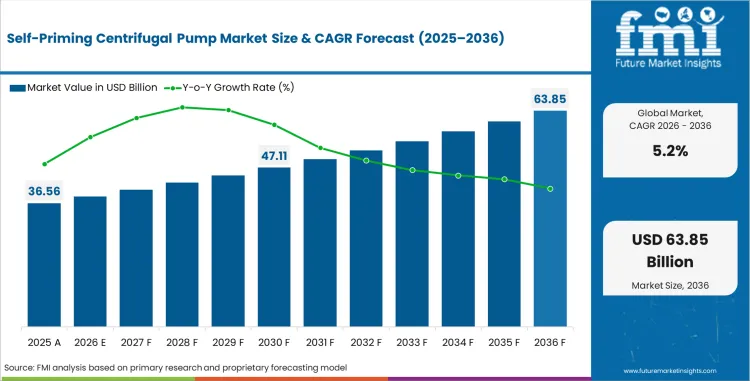
The self-priming centrifugal pump market was valued at USD 36.6 billion in 2025. The market is set to reach USD 38.5 billion by 2026-end and grow at a CAGR of 5.2% between 2026-2036 to reach USD 63.9 billion by 2036. Multistage Self Priming Pump will dominate with a 58.0% share, while Electric will lead with a 72.0% share.
Summary of the Self-Priming Centrifugal Pump Market
- Demand and Growth Drivers
- Agricultural irrigation expansion across South Asia, East Asia, and Latin America is sustaining demand for self priming centrifugal pumps in water transfer, flood irrigation, and pressurized sprinkler systems.
- Industrial process water handling requirements in manufacturing, chemical processing, and food production are creating stable procurement pipelines for medium to high horsepower self priming units.
- Construction sector dewatering requirements and municipal water management projects are expanding the addressable market beyond traditional agricultural and industrial applications.
- Product and Segment View
- Multistage self priming pumps account for 58.0% of the product segment, supported by demand for higher pressure and flow rate capability across agricultural irrigation and industrial process applications.
- By drive type, electric driven pumps hold 72.0% share, reflecting the availability of grid power in established agricultural and industrial installations and the lower operating cost compared to diesel alternatives.
- Agriculture leads the application segment at 42.0%, confirming the continued importance of irrigation and water transfer as the primary demand driver for self priming centrifugal pump procurement.
- Geography and Competitive Outlook
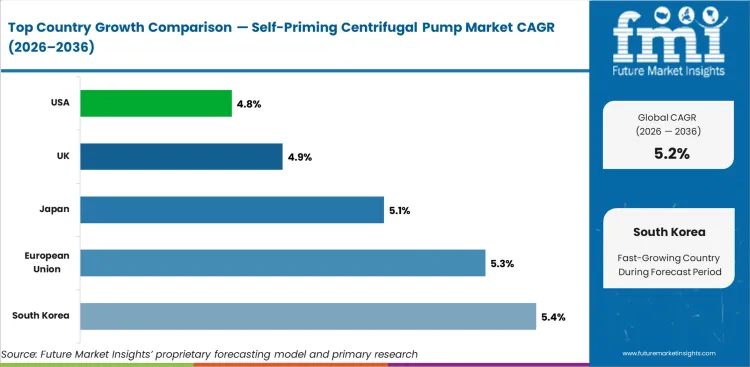
- South Korea is projected to grow at 5.4% through 2036, supported by growing investment in agricultural modernization and industrial water management infrastructure.
- European Union follows at 5.3%, reflecting the scale of irrigation infrastructure and industrial process water handling requirements.
- Companies that combine manufacturing scale, distribution reach, and application engineering support across agricultural, industrial, and construction sectors are positioned to gain traction during the forecast period.
- Analyst Opinion
- The self priming centrifugal pump market is transitioning from a replacement driven cycle toward specification driven procurement as agricultural and industrial users upgrade to higher efficiency systems. Energy cost pressures and water management regulations are creating demand for pumps with better hydraulic efficiency and variable speed drive compatibility. Companies that can deliver application specific solutions, particularly in agricultural irrigation and industrial dewatering, rather than generic catalog products are gaining procurement preference. The competitive landscape favors manufacturers with broad product ranges that can serve multiple head size and horsepower requirements from single distribution relationships.
- The Self-Priming Centrifugal Pump Market is moving from a supply driven model toward a demand responsive structure where end user requirements shape product development priorities.
- Adoption is increasing due to evolving application requirements and expanding end user awareness of performance advantages.
- Growth reflects the structural shift toward higher specification products and more integrated procurement approaches.
- Demand is further supported by regulatory developments and sustainability requirements that favor the adoption of purpose built solutions.
Key Takeaways, Market Size, and Forecast
- The Self-Priming Centrifugal Pump market was valued at USD 36.56 billion in 2025.
- By 2036, the Self-Priming Centrifugal Pump Market is expected to be worth USD 63.85 billion.
- From 2026 to 2036, the market is projected to expand at a CAGR of 5.2%.
- The market is projected to create an incremental opportunity of USD 25.39 billion between 2026 and 2036.
- In 2026, Multistage Self Priming Pump is expected to account for 58.0% of the Product, driven by the scale of irrigation infrastructure and water transfer requirements across agricultural operations globally.
- South Korea (5.4%) and European Union (5.3%) are two of the fastest growing markets in the world.
Self-Priming Centrifugal Pump Market Definition
The self priming centrifugal pump market covers pump systems designed to evacuate air from the suction line and begin pumping without external priming assistance. Products include multistage and single stage configurations in electric and diesel drive types across a range of head sizes and horsepower ratings for agricultural, industrial, and construction applications.
Self-Priming Centrifugal Pump Market Inclusions
Market scope encompasses all commercially traded products categorized by Product (Multistage Self Priming Pump, Single Stage Self Priming Pump); Drive (Electric, Diesel); Head Size (Between 30 to 50 m, Below 30 m, Between 50 to 100 m, Between 100 to 150 m, Above 150 m); Horsepower (Between 1 HP to 10 HP, Between 10 HP to 50 HP, Below 1 HP, Above 50 HP); Application (Agriculture, Industrial, Construction); Sales Channel (Direct Sales, Distributors). Revenue estimates cover the forecast period from 2026 to 2036.
Self-Priming Centrifugal Pump Market Exclusions
The scope does not include submersible pumps, positive displacement pumps, vacuum pumps, or centrifugal pumps that require external priming assistance. General purpose water pumps without self priming capability are excluded.
Self-Priming Centrifugal Pump Market Research Methodology
- Primary Research: FMI analysts conducted interviews with pump distributors, agricultural irrigation consultants, industrial plant engineers, and construction site managers across key markets to validate demand patterns, pricing structures, and procurement dynamics.
- Desk Research: Research combined data from agricultural machinery production statistics, industrial pump association databases, and water management infrastructure reports, with cross referencing against publicly available industry databases and regulatory filings.
- Market Sizing and Forecasting: Market sizing uses a hybrid bottom up and top down approach, aggregating demand across product, drive, head size, horsepower, application, sales channel with regional adoption curves.
- Data Validation: Data was validated quarterly against production statistics, trade data, and manufacturer disclosures to maintain forecast accuracy.
Why is the Self-Priming Centrifugal Pump Market Growing?
- Agricultural irrigation expansion across South Asia, East Asia, and Latin America is sustaining demand for self priming centrifugal pumps in water transfer and pressurized irrigation systems.
- Industrial process water handling and construction site dewatering requirements are creating diversified demand across medium to high horsepower self priming pump configurations.
- South Korea leads growth at 5.4%, supported by growing investment in agricultural modernization and industrial water management infrastructure.
The self priming centrifugal pump market is growing as agricultural modernization, industrial expansion, and construction activity sustain demand across multiple application sectors. Self priming capability eliminates the need for external vacuum priming or foot valves, making these pumps the preferred choice for applications where suction conditions are variable or where pumps must be installed above the fluid source level.
Multistage self priming pumps account for 58.0% of product demand, reflecting the requirement for higher pressure delivery in irrigation systems, industrial process water circuits, and construction dewatering operations. Electric drive dominates at 72.0% of drive type demand, supported by lower operating costs and availability of grid power in established installations. Diesel driven pumps serve mobile and remote applications where electrical supply is unavailable.
Agriculture accounts for 42.0% of application demand, confirming irrigation and water transfer as the primary market driver. The 30 to 50 meter head range leads at 31.0%, serving the most common irrigation and industrial transfer applications. The 1 HP to 10 HP range holds 38.0% of horsepower demand, reflecting the concentration of small to medium scale agricultural and light industrial applications. Growth in construction dewatering and municipal water management is diversifying the demand base beyond traditional agricultural end uses.
Market Segmentation Analysis
- Multistage Self Priming Pump accounts for 58.0% of the Product segment, supported by established procurement patterns and application requirements.
- Electric holds 72.0% of the Drive segment, reflecting concentrated demand in core use cases.
The Self-Priming Centrifugal Pump market is segmented by product, drive, head size, horsepower, application, sales channel. Demand patterns reflect the concentration of procurement in established application areas and the growing diversification of end use requirements.
Insights into the Product Segment
In 2026, Multistage Self Priming Pump is expected to hold 58.0% of the product segment. Single Stage Self Priming Pump represents an additional sub-segment with growing procurement activity. Demand patterns within this segment reflect the concentration of procurement in established use cases and the evolving requirements of end users across different regions and application contexts.
Insights into the Drive Segment
In 2026, Electric is expected to hold 72.0% of the drive segment. Diesel represents an additional sub-segment with growing procurement activity. Demand patterns within this segment reflect the concentration of procurement in established use cases and the evolving requirements of end users across different regions and application contexts.
Self-Priming Centrifugal Pump Market Drivers, Restraints, and Opportunities
- Gorman-Rupp holds an estimated 15.0% market share through its established self priming pump portfolio serving agricultural, industrial, and municipal water management applications.
- KSB, Dab Pumps, and Azcue Pumps compete on product range, energy efficiency, and regional distribution capabilities.
- Competitive dynamics are shaped by distribution network reach, application engineering support, and the ability to deliver across multiple head size and horsepower configurations.
The Self-Priming Centrifugal Pump market is shaped by the interaction of demand drivers, supply constraints, and emerging opportunities. Growth is supported by expanding application requirements and evolving end user specifications, while cost pressures and competitive dynamics influence adoption rates across different market segments.
Primary Demand Drivers
Agricultural irrigation expansion across South Asia, East Asia, and Latin America is sustaining demand for self priming centrifugal pumps in water transfer, flood irrigation, and pressurized sprinkler systems.
Cost and Supply Constraints
Industrial process water handling requirements in manufacturing, chemical processing, and food production are creating stable procurement pipelines for medium to high horsepower self priming units.
Emerging Opportunities
Construction sector dewatering requirements and municipal water management projects are expanding the addressable market beyond traditional agricultural and industrial applications.
Analysis of Self-Priming Centrifugal Pump Market By Key Countries
.webp "Top Country Growth Comparison Self Priming Centrifugal Pump Market Cagr (2026 2036)")
| Country | CAGR |
|---|---|
| South Korea | 5.4% |
| European Union | 5.3% |
| Japan | 5.1% |
| UK | 4.9% |
| USA | 4.8% |
- South Korea at 5.4%: supported by local market conditions and sector investment.
- European Union at 5.3%: supported by local market conditions and sector investment.
- Japan at 5.1%: supported by local market conditions and sector investment.
- UK at 4.9%: supported by local market conditions and sector investment.
The global self-priming centrifugal pump market is expected to grow at a rate of 5.2% per year from 2026 to 2036. The study covers more than 30 countries, and the main markets are listed below.
Demand Outlook for Self-Priming Centrifugal Pump Market in South Korea
South Korea is projected to expand at 5.4% through 2036. Industrial water management requirements in semiconductor manufacturing, chemical processing, and food production are creating structured procurement for self priming pump systems. Agricultural modernization programs support replacement of aging irrigation infrastructure.
- Semiconductor and electronics manufacturing require precision water handling systems.
- Agricultural modernization programs support irrigation infrastructure upgrading.
- Industrial wastewater management regulations drive procurement of compliant pump systems.
Future Outlook for Self-Priming Centrifugal Pump Market in the European Union
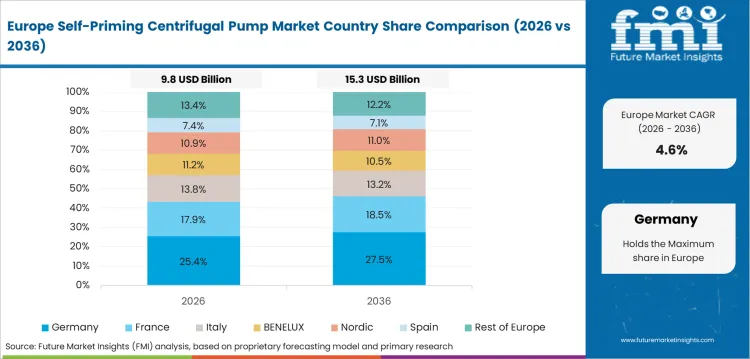
The European Union is projected to grow at 5.3% through 2036. EU water framework directive compliance and industrial wastewater management requirements are driving procurement of efficient pump systems. The emphasis on energy efficiency in pump selection reflects the EU Energy Efficiency Directive requirements for industrial equipment.
- EU Water Framework Directive compliance drives industrial water management investment.
- Energy Efficiency Directive requirements influence pump specification and selection.
- Agricultural irrigation modernization in Southern and Eastern Europe sustains procurement.
Opportunity Analysis of Self-Priming Centrifugal Pump Market in Japan
Japan is projected to grow at 5.1% through 2036. Industrial process water handling in automotive manufacturing, electronics production, and chemical processing sustains demand for reliable self priming pump systems. Replacement cycles for aging infrastructure in established industrial facilities create consistent procurement opportunities.
- Automotive and electronics manufacturing create stable process water handling demand.
- Aging infrastructure replacement cycles provide consistent procurement opportunities.
- Disaster preparedness programs sustain demand for portable dewatering pump systems.
In-depth Analysis of Self-Priming Centrifugal Pump Market in UK
The United Kingdom is projected to grow at 4.9% through 2036. Construction sector dewatering requirements and industrial water management needs are supporting pump procurement. Updated building regulations and commercial development activity create demand for reliable water transfer solutions.
- Construction sector growth drives dewatering pump procurement for site management.
- Industrial water management requirements sustain demand across manufacturing sectors.
- Updated building regulations create requirements for water handling systems.
Sales Analysis of Self-Priming Centrifugal Pump Market in the United States
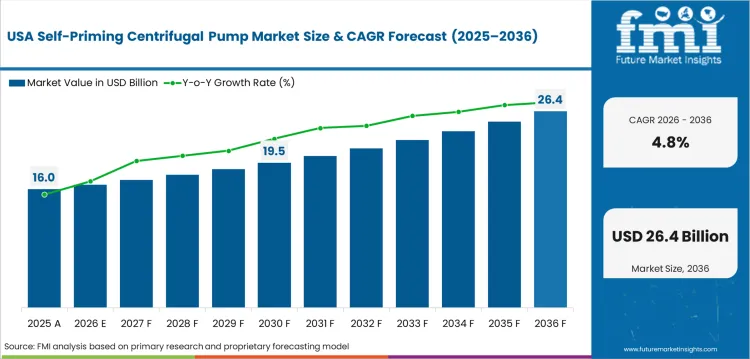
The United States is projected to grow at 4.8% through 2036. Agricultural irrigation in the central and western states, combined with construction site dewatering and industrial process water handling, sustains diversified demand. Energy cost pressures are driving replacement of older pumps with higher efficiency models.
- Central and western state agricultural irrigation sustains pump demand volume.
- Construction site dewatering requirements create procurement across all horsepower ranges.
- Energy cost pressures drive replacement of older pumps with higher efficiency models.
Competitive Landscape and Strategic Positioning
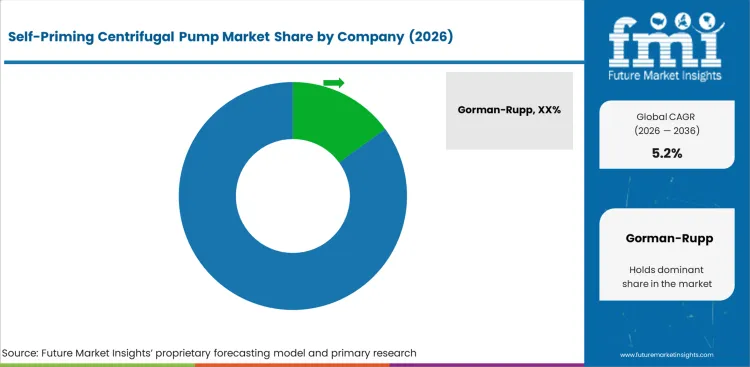
- Gorman-Rupp holds an estimated 15.0% market share through its established self priming pump portfolio serving agricultural, industrial, and municipal water management applications.
- KSB, Dab Pumps, and Azcue Pumps compete on product range, energy efficiency, and regional distribution capabilities.
- Competitive dynamics are shaped by distribution network reach, application engineering support, and the ability to deliver across multiple head size and horsepower configurations.
Gorman-Rupp holds an estimated 15.0% market share, supported by its comprehensive range of self priming centrifugal pumps for agriculture, construction, and industrial applications. The company's distribution network and application engineering capabilities provide competitive positioning.
KSB competes through its broad industrial pump portfolio and global manufacturing presence. Dab Pumps focuses on residential and light commercial applications. Azcue Pumps serves marine and industrial process applications. Schlumberger provides pumping solutions for upstream oil and gas operations.
The market structure reflects regional distribution patterns, with established manufacturers competing through dealer networks and direct sales channels. Energy efficiency specifications and total cost of ownership calculations are becoming more important in procurement decisions.
Key Companies in the Self-Priming Centrifugal Pump Market
Key global companies leading the self-priming centrifugal pump market include:
- Gorman-Rupp, KSB, Dab Pumps, Azcue Pumps S.A., Schlumberger hold established positions through product portfolios, manufacturing infrastructure, and customer relationships.
- Xylem Inc., Grundfos, Wilo SE are regional and specialized players focusing on technology differentiation.
- Ebara Corporation, Tsurumi Manufacturing represent emerging participants with growth potential.
Competitive Benchmarking: Self-Priming Centrifugal Pump Market
| Company | Product Range | Distribution Network | Application Engineering | Geographic Presence |
|---|---|---|---|---|
| Gorman-Rupp | High | Strong | Strong | N. America, Global |
| KSB | High | Strong | Strong | Global |
| Dab Pumps | Medium | Strong | Moderate | Europe, Global |
| Azcue Pumps S.A. | Medium | Moderate | Strong | Europe, Global |
| Schlumberger | Medium | Strong | Strong | Global |
Source: Future Market Insights competitive analysis, 2026.
Key Developments in Self-Priming Centrifugal Pump Market
- In 2025, Gorman-Rupp introduced a new line of high efficiency self priming pumps designed to meet updated energy efficiency standards for agricultural irrigation applications.
- In 2025, KSB expanded its self priming pump range with variable speed drive compatible models for industrial water management.
Key Players in the Self-Priming Centrifugal Pump Market
Major Global Players
- Gorman-Rupp
- KSB
- Dab Pumps
- Azcue Pumps S.A.
- Schlumberger
Emerging Players/Startups
- Xylem Inc.
- Grundfos
- Wilo SE
- Ebara Corporation
- Tsurumi Manufacturing
Report Scope and Coverage
| Parameter | Details |
|---|---|
| Quantitative Units | USD 38.46 Billion to USD 63.85 Billion, at a CAGR of 5.2% |
| Market Definition | The self priming centrifugal pump market covers pump systems designed to evacuate air from the suction line and begin pumping without external priming assistance. |
| Regions Covered | North America, Latin America, Europe, East Asia, South Asia and Pacific, Middle East and Africa |
| Countries Covered | South Korea, European Union, Japan, UK, USA, 30 plus countries |
| Key Companies Profiled | Gorman-Rupp, KSB, Dab Pumps, Azcue Pumps S.A., Schlumberger |
| Forecast Period | 2026 to 2036 |
| Approach | Hybrid bottom up and top down methodology starting with verified transaction data, projecting adoption velocity across segments and regions. |
Market Segmentation Analysis
Self-Priming Centrifugal Pump Market Segmented by Product:
-
- Multistage Self Priming Pump
- Horizontal Multistage Pumps
- Vertical Multistage Pumps
- Single Stage Self Priming Pump
- Centrifugal Single Stage Pumps
- Peripheral Single Stage Pumps
- Multistage Self Priming Pump
Self-Priming Centrifugal Pump Market Segmented by Drive:
-
- Electric
- AC Motor Driven
- DC Motor Driven
- Diesel
- Portable Diesel Pumps
- Heavy Duty Diesel Pumps
- Electric
Self-Priming Centrifugal Pump Market Segmented by Head Size:
-
- Between 30 to 50 m
- Below 30 m
- Between 50 to 100 m
- Between 100 to 150 m
- Above 150 m
Self-Priming Centrifugal Pump Market Segmented by Horsepower:
-
- Between 1 HP to 10 HP
- Between 10 HP to 50 HP
- Below 1 HP
- Above 50 HP
Self-Priming Centrifugal Pump Market Segmented by Application:
-
- Agriculture
- Irrigation Systems
- Water Transfer
- Industrial
- Process Water Handling
- Chemical Transfer
- Construction
- Dewatering
- Site Water Management
- Agriculture
Self-Priming Centrifugal Pump Market Segmented by Sales Channel:
-
- Direct Sales
- Manufacturer Contracts
- Bulk Industrial Supply
- Distributors
- Regional Dealers
- National Supply Networks
- Direct Sales
Self-Priming Centrifugal Pump Market by Region:
- North America
- USA
- Canada
- Mexico
- Latin America
- Brazil
- Chile
- Rest of Latin America
- Western Europe
- Germany
- UK
- Italy
- Spain
- France
- Nordic
- BENELUX
- Rest of Western Europe
- Eastern Europe
- Russia
- Poland
- Hungary
- Balkan & Baltic
- Rest of Eastern Europe
- East Asia
- China
- Japan
- South Korea
- South Asia and Pacific
- India
- ASEAN
- Australia & New Zealand
- Rest of South Asia and Pacific
- Middle East & Africa
- Kingdom of Saudi Arabia
- Other GCC Countries
- Turkiye
- South Africa
- Other African Union
- Rest of Middle East & Africa
Research Sources and Bibliography
- 1. Hydraulic Institute. (2025). Pump Standards and Technical Resources. HI.
- 2. Food and Agriculture Organization. (2025). FAO Global Irrigation and Water Management Report. FAO.
- 3. European Committee of Pump Manufacturers. (2024). Europump Industry Statistics. Europump.
- 4. International Electrotechnical Commission. (2024). IEC Standards for Rotating Electrical Machines. IEC.
- 5. World Bank. (2025). World Bank Water Supply and Sanitation Database. World Bank.
This bibliography is provided for reader reference. The full Future Market Insights report contains the complete reference list with publication dates, URLs, and supporting data for all cited works.
This Report Answers
- Estimating the size of the market and revenue from 2026 to 2036.
- Segmentation by product, drive, head size, horsepower, application, sales channel.
- Insights about more than 30 markets in the region.
- Analysis of technology and operational trends shaping the market.
- Assessment of the competitive landscape.
- Finding investment opportunities across key application areas.
- Supply chain and procurement pattern tracking.
- Delivery of data in PDF and Excel formats.
Frequently Asked Questions
How big is the self-priming centrifugal pump market in 2026?
The global self-priming centrifugal pump market is estimated to be valued at USD 38.5 billion in 2026.
What will be the size of self-priming centrifugal pump market in 2036?
The market size for the self-priming centrifugal pump market is projected to reach USD 63.9 billion by 2036.
How much will be the self-priming centrifugal pump market growth between 2026 and 2036?
The self-priming centrifugal pump market is expected to grow at a 5.2% CAGR between 2026 and 2036.
What are the key product types in the self-priming centrifugal pump market?
The key product types in self-priming centrifugal pump market are multistage self priming pump, horizontal multistage pumps, vertical multistage pumps, single stage self priming pump, centrifugal single stage pumps and peripheral single stage pumps.
Which drive segment is expected to contribute significant share in the self-priming centrifugal pump market in 2026?
In terms of drive, electric segment is expected to command 72.0% share in the self-priming centrifugal pump market in 2026.
Preview the report firsthand - request a free sample
Get SampleGet the brochure for pricing and purchase details.
Get PDFTable of Content
- Executive Summary
- Global Market Outlook
- Demand-side Trends
- Supply-side Trends
- Technology Roadmap Analysis
- Analysis and Recommendations
- Market Overview
- Market Coverage / Taxonomy
- Market Definition / Scope / Limitations
- Research Methodology
- Chapter Orientation
- Analytical Lens and Working Hypotheses
- Market Structure, Signals, and Trend Drivers
- Benchmarking and Cross-market Comparability
- Market Sizing, Forecasting, and Opportunity Mapping
- Research Design and Evidence Framework
- Desk Research Programme (Secondary Evidence)
- Company Annual and Sustainability Reports
- Peer-reviewed Journals and Academic Literature
- Corporate Websites, Product Literature, and Technical Notes
- Earnings Decks and Investor Briefings
- Statutory Filings and Regulatory Disclosures
- Technical White Papers and Standards Notes
- Trade Journals, Industry Magazines, and Analyst Briefs
- Conference Proceedings, Webinars, and Seminar Materials
- Government Statistics Portals and Public Data Releases
- Press Releases and Reputable Media Coverage
- Specialist Newsletters and Curated Briefings
- Sector Databases and Reference Repositories
- FMI Internal Proprietary Databases and Historical Market Datasets
- Subscription Datasets and Paid Sources
- Social Channels, Communities, and Digital Listening Inputs
- Additional Desk Sources
- Expert Input and Fieldwork (Primary Evidence)
- Primary Modes
- Qualitative Interviews and Expert Elicitation
- Quantitative Surveys and Structured Data Capture
- Blended Approach
- Why Primary Evidence is Used
- Field Techniques
- Interviews
- Surveys
- Focus Groups
- Observational and In-context Research
- Social and Community Interactions
- Stakeholder Universe Engaged
- C-suite Leaders
- Board Members
- Presidents and Vice Presidents
- R&D and Innovation Heads
- Technical Specialists
- Domain Subject-matter Experts
- Scientists
- Physicians and Other Healthcare Professionals
- Governance, Ethics, and Data Stewardship
- Research Ethics
- Data Integrity and Handling
- Primary Modes
- Tooling, Models, and Reference Databases
- Desk Research Programme (Secondary Evidence)
- Data Engineering and Model Build
- Data Acquisition and Ingestion
- Cleaning, Normalisation, and Verification
- Synthesis, Triangulation, and Analysis
- Quality Assurance and Audit Trail
- Market Background
- Market Dynamics
- Drivers
- Restraints
- Opportunity
- Trends
- Scenario Forecast
- Demand in Optimistic Scenario
- Demand in Likely Scenario
- Demand in Conservative Scenario
- Opportunity Map Analysis
- Product Life Cycle Analysis
- Supply Chain Analysis
- Investment Feasibility Matrix
- Value Chain Analysis
- PESTLE and Porter’s Analysis
- Regulatory Landscape
- Regional Parent Market Outlook
- Production and Consumption Statistics
- Import and Export Statistics
- Market Dynamics
- Global Market Analysis 2021 to 2025 and Forecast, 2026 to 2036
- Historical Market Size Value (USD Million) Analysis, 2021 to 2025
- Current and Future Market Size Value (USD Million) Projections, 2026 to 2036
- Y-o-Y Growth Trend Analysis
- Absolute $ Opportunity Analysis
- Global Market Pricing Analysis 2021 to 2025 and Forecast 2026 to 2036
- Global Market Analysis 2021 to 2025 and Forecast 2026 to 2036, By Product
- Introduction / Key Findings
- Historical Market Size Value (USD Million) Analysis By Product , 2021 to 2025
- Current and Future Market Size Value (USD Million) Analysis and Forecast By Product , 2026 to 2036
- Multistage Self Priming Pump
- Horizontal Multistage Pumps
- Vertical Multistage Pumps
- Single Stage Self Priming Pump
- Centrifugal Single Stage Pumps
- Peripheral Single Stage Pumps
- Multistage Self Priming Pump
- Y-o-Y Growth Trend Analysis By Product , 2021 to 2025
- Absolute $ Opportunity Analysis By Product , 2026 to 2036
- Global Market Analysis 2021 to 2025 and Forecast 2026 to 2036, By Drive
- Introduction / Key Findings
- Historical Market Size Value (USD Million) Analysis By Drive, 2021 to 2025
- Current and Future Market Size Value (USD Million) Analysis and Forecast By Drive, 2026 to 2036
- Electric
- AC Motor Driven
- DC Motor Driven
- Diesel
- Portable Diesel Pumps
- Heavy Duty Diesel Pumps
- Electric
- Y-o-Y Growth Trend Analysis By Drive, 2021 to 2025
- Absolute $ Opportunity Analysis By Drive, 2026 to 2036
- Global Market Analysis 2021 to 2025 and Forecast 2026 to 2036, By Head Size
- Introduction / Key Findings
- Historical Market Size Value (USD Million) Analysis By Head Size, 2021 to 2025
- Current and Future Market Size Value (USD Million) Analysis and Forecast By Head Size, 2026 to 2036
- Between 30 to 50 m
- Below 30 m
- Between 50 to 100 m
- Between 100 to 150 m
- Above 150 m
- Between 30 to 50 m
- Y-o-Y Growth Trend Analysis By Head Size, 2021 to 2025
- Absolute $ Opportunity Analysis By Head Size, 2026 to 2036
- Global Market Analysis 2021 to 2025 and Forecast 2026 to 2036, By Horsepower
- Introduction / Key Findings
- Historical Market Size Value (USD Million) Analysis By Horsepower, 2021 to 2025
- Current and Future Market Size Value (USD Million) Analysis and Forecast By Horsepower, 2026 to 2036
- Between 1 HP to 10 HP
- Between 10 HP to 50 HP
- Below 1 HP
- Above 50 HP
- Between 1 HP to 10 HP
- Y-o-Y Growth Trend Analysis By Horsepower, 2021 to 2025
- Absolute $ Opportunity Analysis By Horsepower, 2026 to 2036
- Global Market Analysis 2021 to 2025 and Forecast 2026 to 2036, By Application
- Introduction / Key Findings
- Historical Market Size Value (USD Million) Analysis By Application, 2021 to 2025
- Current and Future Market Size Value (USD Million) Analysis and Forecast By Application, 2026 to 2036
- Agriculture
- Irrigation Systems
- Water Transfer
- Industrial
- Process Water Handling
- Chemical Transfer
- Construction
- Dewatering
- Site Water Management
- Agriculture
- Y-o-Y Growth Trend Analysis By Application, 2021 to 2025
- Absolute $ Opportunity Analysis By Application, 2026 to 2036
- Global Market Analysis 2021 to 2025 and Forecast 2026 to 2036, By Sales Channel
- Introduction / Key Findings
- Historical Market Size Value (USD Million) Analysis By Sales Channel, 2021 to 2025
- Current and Future Market Size Value (USD Million) Analysis and Forecast By Sales Channel, 2026 to 2036
- Direct Sales
- Manufacturer Contracts
- Bulk Industrial Supply
- Distributors
- Regional Dealers
- National Supply Networks
- Direct Sales
- Y-o-Y Growth Trend Analysis By Sales Channel, 2021 to 2025
- Absolute $ Opportunity Analysis By Sales Channel, 2026 to 2036
- Global Market Analysis 2021 to 2025 and Forecast 2026 to 2036, By Region
- Introduction
- Historical Market Size Value (USD Million) Analysis By Region, 2021 to 2025
- Current Market Size Value (USD Million) Analysis and Forecast By Region, 2026 to 2036
- North America
- Latin America
- Western Europe
- Eastern Europe
- East Asia
- South Asia and Pacific
- Middle East & Africa
- Market Attractiveness Analysis By Region
- North America Market Analysis 2021 to 2025 and Forecast 2026 to 2036, By Country
- Historical Market Size Value (USD Million) Trend Analysis By Market Taxonomy, 2021 to 2025
- Market Size Value (USD Million) Forecast By Market Taxonomy, 2026 to 2036
- By Country
- USA
- Canada
- Mexico
- By Product
- By Drive
- By Head Size
- By Horsepower
- By Application
- By Sales Channel
- By Country
- Market Attractiveness Analysis
- By Country
- By Product
- By Drive
- By Head Size
- By Horsepower
- By Application
- By Sales Channel
- Key Takeaways
- Latin America Market Analysis 2021 to 2025 and Forecast 2026 to 2036, By Country
- Historical Market Size Value (USD Million) Trend Analysis By Market Taxonomy, 2021 to 2025
- Market Size Value (USD Million) Forecast By Market Taxonomy, 2026 to 2036
- By Country
- Brazil
- Chile
- Rest of Latin America
- By Product
- By Drive
- By Head Size
- By Horsepower
- By Application
- By Sales Channel
- By Country
- Market Attractiveness Analysis
- By Country
- By Product
- By Drive
- By Head Size
- By Horsepower
- By Application
- By Sales Channel
- Key Takeaways
- Western Europe Market Analysis 2021 to 2025 and Forecast 2026 to 2036, By Country
- Historical Market Size Value (USD Million) Trend Analysis By Market Taxonomy, 2021 to 2025
- Market Size Value (USD Million) Forecast By Market Taxonomy, 2026 to 2036
- By Country
- Germany
- UK
- Italy
- Spain
- France
- Nordic
- BENELUX
- Rest of Western Europe
- By Product
- By Drive
- By Head Size
- By Horsepower
- By Application
- By Sales Channel
- By Country
- Market Attractiveness Analysis
- By Country
- By Product
- By Drive
- By Head Size
- By Horsepower
- By Application
- By Sales Channel
- Key Takeaways
- Eastern Europe Market Analysis 2021 to 2025 and Forecast 2026 to 2036, By Country
- Historical Market Size Value (USD Million) Trend Analysis By Market Taxonomy, 2021 to 2025
- Market Size Value (USD Million) Forecast By Market Taxonomy, 2026 to 2036
- By Country
- Russia
- Poland
- Hungary
- Balkan & Baltic
- Rest of Eastern Europe
- By Product
- By Drive
- By Head Size
- By Horsepower
- By Application
- By Sales Channel
- By Country
- Market Attractiveness Analysis
- By Country
- By Product
- By Drive
- By Head Size
- By Horsepower
- By Application
- By Sales Channel
- Key Takeaways
- East Asia Market Analysis 2021 to 2025 and Forecast 2026 to 2036, By Country
- Historical Market Size Value (USD Million) Trend Analysis By Market Taxonomy, 2021 to 2025
- Market Size Value (USD Million) Forecast By Market Taxonomy, 2026 to 2036
- By Country
- China
- Japan
- South Korea
- By Product
- By Drive
- By Head Size
- By Horsepower
- By Application
- By Sales Channel
- By Country
- Market Attractiveness Analysis
- By Country
- By Product
- By Drive
- By Head Size
- By Horsepower
- By Application
- By Sales Channel
- Key Takeaways
- South Asia and Pacific Market Analysis 2021 to 2025 and Forecast 2026 to 2036, By Country
- Historical Market Size Value (USD Million) Trend Analysis By Market Taxonomy, 2021 to 2025
- Market Size Value (USD Million) Forecast By Market Taxonomy, 2026 to 2036
- By Country
- India
- ASEAN
- Australia & New Zealand
- Rest of South Asia and Pacific
- By Product
- By Drive
- By Head Size
- By Horsepower
- By Application
- By Sales Channel
- By Country
- Market Attractiveness Analysis
- By Country
- By Product
- By Drive
- By Head Size
- By Horsepower
- By Application
- By Sales Channel
- Key Takeaways
- Middle East & Africa Market Analysis 2021 to 2025 and Forecast 2026 to 2036, By Country
- Historical Market Size Value (USD Million) Trend Analysis By Market Taxonomy, 2021 to 2025
- Market Size Value (USD Million) Forecast By Market Taxonomy, 2026 to 2036
- By Country
- Kingdom of Saudi Arabia
- Other GCC Countries
- Turkiye
- South Africa
- Other African Union
- Rest of Middle East & Africa
- By Product
- By Drive
- By Head Size
- By Horsepower
- By Application
- By Sales Channel
- By Country
- Market Attractiveness Analysis
- By Country
- By Product
- By Drive
- By Head Size
- By Horsepower
- By Application
- By Sales Channel
- Key Takeaways
- Key Countries Market Analysis
- USA
- Pricing Analysis
- Market Share Analysis, 2025
- By Product
- By Drive
- By Head Size
- By Horsepower
- By Application
- By Sales Channel
- Canada
- Pricing Analysis
- Market Share Analysis, 2025
- By Product
- By Drive
- By Head Size
- By Horsepower
- By Application
- By Sales Channel
- Mexico
- Pricing Analysis
- Market Share Analysis, 2025
- By Product
- By Drive
- By Head Size
- By Horsepower
- By Application
- By Sales Channel
- Brazil
- Pricing Analysis
- Market Share Analysis, 2025
- By Product
- By Drive
- By Head Size
- By Horsepower
- By Application
- By Sales Channel
- Chile
- Pricing Analysis
- Market Share Analysis, 2025
- By Product
- By Drive
- By Head Size
- By Horsepower
- By Application
- By Sales Channel
- Germany
- Pricing Analysis
- Market Share Analysis, 2025
- By Product
- By Drive
- By Head Size
- By Horsepower
- By Application
- By Sales Channel
- UK
- Pricing Analysis
- Market Share Analysis, 2025
- By Product
- By Drive
- By Head Size
- By Horsepower
- By Application
- By Sales Channel
- Italy
- Pricing Analysis
- Market Share Analysis, 2025
- By Product
- By Drive
- By Head Size
- By Horsepower
- By Application
- By Sales Channel
- Spain
- Pricing Analysis
- Market Share Analysis, 2025
- By Product
- By Drive
- By Head Size
- By Horsepower
- By Application
- By Sales Channel
- France
- Pricing Analysis
- Market Share Analysis, 2025
- By Product
- By Drive
- By Head Size
- By Horsepower
- By Application
- By Sales Channel
- India
- Pricing Analysis
- Market Share Analysis, 2025
- By Product
- By Drive
- By Head Size
- By Horsepower
- By Application
- By Sales Channel
- ASEAN
- Pricing Analysis
- Market Share Analysis, 2025
- By Product
- By Drive
- By Head Size
- By Horsepower
- By Application
- By Sales Channel
- Australia & New Zealand
- Pricing Analysis
- Market Share Analysis, 2025
- By Product
- By Drive
- By Head Size
- By Horsepower
- By Application
- By Sales Channel
- China
- Pricing Analysis
- Market Share Analysis, 2025
- By Product
- By Drive
- By Head Size
- By Horsepower
- By Application
- By Sales Channel
- Japan
- Pricing Analysis
- Market Share Analysis, 2025
- By Product
- By Drive
- By Head Size
- By Horsepower
- By Application
- By Sales Channel
- South Korea
- Pricing Analysis
- Market Share Analysis, 2025
- By Product
- By Drive
- By Head Size
- By Horsepower
- By Application
- By Sales Channel
- Russia
- Pricing Analysis
- Market Share Analysis, 2025
- By Product
- By Drive
- By Head Size
- By Horsepower
- By Application
- By Sales Channel
- Poland
- Pricing Analysis
- Market Share Analysis, 2025
- By Product
- By Drive
- By Head Size
- By Horsepower
- By Application
- By Sales Channel
- Hungary
- Pricing Analysis
- Market Share Analysis, 2025
- By Product
- By Drive
- By Head Size
- By Horsepower
- By Application
- By Sales Channel
- Kingdom of Saudi Arabia
- Pricing Analysis
- Market Share Analysis, 2025
- By Product
- By Drive
- By Head Size
- By Horsepower
- By Application
- By Sales Channel
- Turkiye
- Pricing Analysis
- Market Share Analysis, 2025
- By Product
- By Drive
- By Head Size
- By Horsepower
- By Application
- By Sales Channel
- South Africa
- Pricing Analysis
- Market Share Analysis, 2025
- By Product
- By Drive
- By Head Size
- By Horsepower
- By Application
- By Sales Channel
- USA
- Market Structure Analysis
- Competition Dashboard
- Competition Benchmarking
- Market Share Analysis of Top Players
- By Regional
- By Product
- By Drive
- By Head Size
- By Horsepower
- By Application
- By Sales Channel
- Competition Analysis
- Competition Deep Dive
- Gorman-Rupp
- Overview
- Product Portfolio
- Profitability by Market Segments (Product/Age /Sales Channel/Region)
- Sales Footprint
- Strategy Overview
- Marketing Strategy
- Product Strategy
- Channel Strategy
- KSB
- Dab Pumps
- Azcue Pumps S.A.
- Schlumberger
- Other Companies
- Gorman-Rupp
- Competition Deep Dive
- Assumptions & Acronyms Used


