

- Industry Size (2026)
- USD 117 Mn
- Forecast (2036)
- USD 329.2 Mn
- CAGR (2026 to 2036)
- 10.9%
Specialized Recyclers for Complex Medical Polycarbonate Streams Market Forecast and Outlook 2026 to 2036
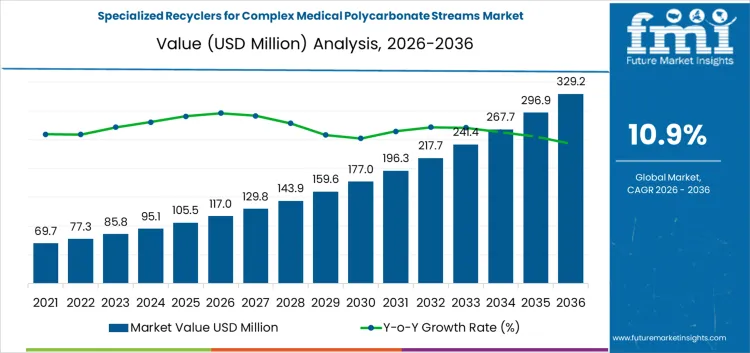
The specialized recyclers for complex medical polycarbonate streams market is valued at USD 117 million in 2026 and is projected to reach USD 329.2 million by 2036, reflecting a CAGR of 10.9%. Expansion is shaped by high capital requirements, as chemical recycling, solvent-based purification, supercritical fluid depolymerization, and advanced mechanical regranulation require specialized equipment and certification. Return timelines depend on securing long-term agreements with medical device manufacturers and ensuring consistent feedstock quality from post-consumer and post-industrial sources. Investment selectivity favors recyclers capable of handling multiple polymer streams while maintaining compliance with stringent medical standards. Margins concentrate with operators offering validated outputs rather than high throughput alone.
Between 2026 and 2036, value capture centers on aligning capacity growth with applications across medical device housings, diagnostic equipment, sterile packaging, and non-clinical polymer components. Regional adoption depends on infrastructure readiness, hospital density, and regulatory enforcement, with leading firms capturing the majority of value. Key players including Veolia, Covestro, Eastman, Celanese, Teijin, SABIC, and MBA Polymers leverage proprietary technologies, feedstock security, and regulatory alignment to maintain margin concentration. Operators focusing solely on volume without validated processes face slower payback and lower returns, whereas those integrating technical reliability, compliance, and multi-application capability secure stable, long-term revenue streams.
Quick Stats of the Specialized Recyclers for Complex Medical Polycarbonate Streams Market
- Specialized Recyclers for Complex Medical Polycarbonate Streams Market Value (2026): USD 117 million
- Specialized Recyclers for Complex Medical Polycarbonate Streams Market Forecast Value (2036): USD 329.2 million
- Specialized Recyclers for Complex Medical Polycarbonate Streams Market Forecast CAGR (2026 to 2036): 10.9%
- Specialized Recyclers for Complex Medical Polycarbonate Streams Market Leading Recycling Technology: Chemical recycling
- Specialized Recyclers for Complex Medical Polycarbonate Streams Market Key Growth Regions: India, China, USA, Brazil, UK
- Specialized Recyclers for Complex Medical Polycarbonate Streams Market Top Players: Veolia, Covestro, Eastman, Celanese, Teijin, SABIC, MBA Polymers
What is the Growth Forecast for Specialized Recyclers for Complex Medical Polycarbonate Streams Market through 2036?
Between 2026 and 2031, the specialized recyclers for complex medical polycarbonate streams market is projected to grow from USD 117 million to USD 214 million, generating an absolute increase of USD 97 million and accounting for approximately 46% of total decade growth. Early-stage growth is driven by the adoption of dedicated recycling processes for complex medical polycarbonate waste, rising regulatory pressure on medical waste circularity, and investment in advanced decontamination and regranulation technologies. Cost structures are influenced by sterilization, shredding, and quality validation processes. Value capture favors operators delivering high-purity, certified polycarbonate streams rather than focusing on processing volume alone.
From 2031 to 2036, the market is expected to expand from USD 214 million to USD 329.2 million, adding USD 115 million and representing roughly 54% of decade growth. Growth accelerates as specialized recycling becomes integral to medical device supply chains and regulatory-compliant material supply. Margins increasingly favor operators controlling feedstock sourcing, process consistency, and certification documentation. Competitive advantage shifts toward firms providing traceable, validated polycarbonate output, while late entrants optimize operational efficiency, standardization, and regulatory alignment to capture incremental market share.
Specialized Recyclers for Complex Medical Polycarbonate Streams Market Key Takeaways
| Metric | Value |
|---|---|
| Market Value (2026) | USD 117 million |
| Forecast Value (2036) | USD 329.2 million |
| Forecast CAGR (2026 to 2036) | 10.9% |
What Is Driving Demand for Specialized Recyclers of Complex Medical Polycarbonate Streams?
Specialized recyclers for complex medical polycarbonate streams are increasingly required to address the challenges of mixed-use medical devices, multi-layer components, and additive-laden polymers. Historically, such polycarbonate waste was largely incinerated due to contamination risk, inconsistent material properties, and sterilization complexity. Specialized recyclers now deploy controlled segregation, validated decontamination, and advanced extrusion techniques to produce high-purity regranulates suitable for non-critical medical applications. Hospitals, device manufacturers, and recyclers coordinate to ensure traceable handling, regulatory compliance, and mechanical property retention. Value capture emphasizes reliable material performance, regulatory audit readiness, and operational risk mitigation rather than processing volume alone. Early pilots informed process parameters, while current demand focuses on scalable, validated recycling pathways.
Future adoption is influenced by regulatory enforcement, hospital sustainability programs, and device manufacturer requirements rather than voluntary initiatives. Compared with early experimental efforts, modern specialized recycling emphasizes reproducible polymer properties, controlled additive management, and validated sterilization protocols. Cost sensitivity is driven by energy use, feedstock preparation, and yield efficiency, concentrating margins among operators with integrated quality management systems. Hospitals and manufacturers prioritize recyclers capable of consistent compliance documentation and material traceability. By 2036, specialized recyclers are expected to form a critical link in the medical plastics circular economy, supporting both regulatory alignment and operational efficiency for complex polycarbonate streams.
What Factors Are Shaping the Demand for Specialized Recyclers for Complex Medical Polycarbonate Streams in Terms of Recycling Technology and Application Focus?
The demand for specialized recyclers for complex medical polycarbonate (PC) streams is structured by recycling technology and application focus. Recycling technologies include chemical recycling, solvent based purification, supercritical fluid depolymerization, and advanced mechanical regranulation. Application focus covers medical device housings, diagnostic equipment components, sterile packaging structures, and non clinical polymer parts. Segment adoption is influenced by purity requirements, regulatory compliance, and retention of polymer performance. Adoption is driven by the need to safely recover PC from mixed streams while maintaining traceability and sterility. Operational reliability and quality assurance shape technology and application priorities rather than cost efficiency.
What Is Driving the Dominance of Chemical Recycling in Specialized Medical PC Stream Recyclers?
Chemical recycling accounts for approximately 50% of total technology adoption, making it the leading recycling route. Its prominence reflects the ability to depolymerize polycarbonate into monomers while removing contaminants, additives, and residual sterilization chemicals that mechanical or solvent methods cannot fully eliminate. Controlled reaction conditions ensure the recovered polymer retains mechanical strength, dimensional stability, and clarity suitable for critical healthcare applications. Chemical recycling also supports diverse feedstocks, including colored or composite medical PC streams, providing flexibility to recyclers handling complex post use material. Operators value reproducibility and regulatory alignment over throughput alone.
Demand for chemical recycling is further driven by compliance and functional requirements. High value applications, such as device housings and diagnostic components, require validated polymer properties, documented chain of custody, and adherence to ISO and FDA standards. Recyclers prioritize chemical recycling to deliver traceable, high purity output that meets sterilization resistance and structural demands. Process control allows consistent regranulate quality, reducing material variability and risk during downstream manufacturing. The segment leads because chemical recycling offers a robust, verifiable route for recovering medical grade polycarbonate from complex streams while satisfying both regulatory and performance expectations.
Why Do Medical Device Housings Represent the Largest Application Focus in Specialized Medical PC Recycling?
Medical device housings account for approximately 45% of total application demand, making them the largest end use segment. Their high volume, structural complexity, and regulatory scrutiny require recovered polycarbonate to maintain clarity, mechanical strength, and dimensional stability. Recycled PC is often reintegrated into housings for diagnostic, therapeutic, and procedural devices, where performance failure is not an option. Operators favor housings because their geometry and material requirements allow consistent quality control, enabling recyclers to validate both material properties and compliance before large scale deployment.
Demand for medical device housings is driven by regulatory oversight, material traceability, and operational reliability. Feedstock streams must be managed carefully to prevent contamination and ensure sterility. Recyclers apply chemical or solvent based processes to produce reproducible regranulate that meets ISO and FDA standards. High value components provide clear justification for investment in specialized recycling systems. The segment maintains leadership because housings combine significant material volume, critical performance demands, and strict compliance requirements, establishing them as the primary target for specialized medical PC recycling efforts.
How Are Specialized Recyclers Addressing Complex Medical Polycarbonate Streams?
Specialized recyclers for complex medical polycarbonate streams focus on recovering polymers from high-risk applications, including diagnostic devices, IV components, and single-use surgical instruments. Adoption is driven by the need to meet stringent regulatory standards for contamination control, sterilization tolerance, and polymer integrity. Operators prioritize validated processes, batch traceability, and compliance documentation to ensure material safety. Growth is concentrated in regions with clear regulatory enforcement and high hospital or laboratory density. Investment decisions emphasize process reliability and audit readiness rather than throughput or cost. Secure handling of complex feedstock is central to gaining trust from healthcare providers and device manufacturers.
Why Do Regulatory Compliance and Material Safety Standards Drive Demand for Specialized Recyclers?
Demand is influenced by national and regional healthcare regulations that mandate secure handling, sterilization, and validation of medical polycarbonate streams. Equipment manufacturers and hospitals prefer recyclers with documented process reproducibility, contaminant removal, and mechanical property retention. Certified recyclers reduce audit risk and facilitate adherence to local health authority requirements. Some regions provide incentives for integrating recycled polycarbonate into non-critical applications. The driver is regulatory certainty and operational risk mitigation rather than cost savings. Specialized recyclers capable of demonstrating consistent compliance gain preferential partnerships with healthcare networks and device producers, ensuring continued feedstock access and material utilization.
What Operational and Technical Challenges Limit Broader Adoption of Specialized Medical Polycarbonate Recycling?
Adoption is constrained by the complexity of medical waste segregation, variability in polymer feedstock, and stringent sterilization requirements. High capital costs for decontamination lines and quality monitoring systems restrict participation to experienced operators. Skilled technical personnel are necessary to maintain polymer integrity and regulatory documentation. Inconsistent regional regulations or unclear approval pathways further slow commercial deployment. Smaller hospitals or laboratories may struggle to provide consistent feedstock volumes. These factors limit adoption to well-funded operators with technical expertise, constraining widespread recycling of complex medical polycarbonate streams despite interest in sustainable material management.
How Are Process Design and Collaboration Influencing Specialized Medical Polycarbonate Recycling Practices?
Trends show a focus on advanced sterilization, solvent or thermal purification, and real-time quality monitoring to meet regulatory and material performance standards. Partnerships between recyclers, hospitals, and device manufacturers secure feedstock and ensure compliance documentation. Pilot-scale validation is increasingly used to demonstrate reproducibility before industrial deployment. Modular processing units allow scalable integration without compromising polymer quality. Digital traceability supports batch-level certification for audits. Emphasis is on operational reliability, safety, and regulatory alignment rather than throughput or cost. Collaborative models enable consistent recovery of high-quality polycarbonate from complex medical streams while maintaining compliance with healthcare regulations.
What is the Demand for Specialized Recyclers for Complex Medical Polycarbonate Streams by Country?
| Country | CAGR (%) |
|---|---|
| USA | 10.0% |
| UK | 9.5% |
| China | 11.5% |
| India | 12.8% |
| Brazil | 10.2% |
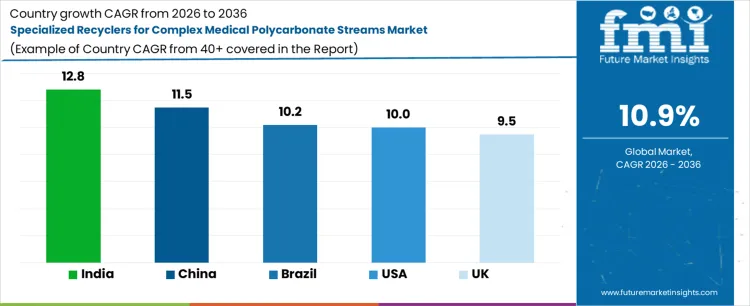
Demand for specialized recyclers handling complex medical polycarbonate streams is growing as healthcare facilities and device manufacturers seek high-purity recovery solutions for intricate single-use components. India leads at 12.8% CAGR, driven by rapid hospital network expansion, increasing use of multi-component polycarbonate devices, and investment in advanced recycling technologies. China follows at 11.5%, supported by large-scale production of diagnostic and therapeutic devices and regulatory-driven adoption of certified recycling streams. Brazil records 10.2% growth as private hospitals and clinics implement specialized collection and recycling partnerships. The USA grows at 10.0%, shaped by demand for FDA-compliant processes capable of handling complex polycarbonate waste. The UK shows 9.5% CAGR, reflecting steady adoption of specialized recyclers and incremental integration within existing medical waste management systems.
How Are Compliance and Safety Requirements Driving Specialized Medical Polycarbonate Recycling in the United States?
In the United States, the specialized recyclers for complex medical polycarbonate streams market is growing at a CAGR of 10%, supported by hospitals and medical device manufacturers prioritizing safe, regulatory-compliant recycling of high-value polycarbonate components. Operators deploy advanced cleaning, sterilization, and separation protocols to recover material suitable for reuse or industrial applications while maintaining biocompatibility standards. Demand is concentrated among certified recyclers servicing hospital networks and large device manufacturers. Investments focus on process validation, contamination control, and traceability rather than rapid capacity expansion. Growth reflects strategic engagement with specialized recycling pathways to meet regulatory and quality requirements.
- Hospitals and medical device manufacturers drive demand for specialized recycling.
- Advanced cleaning and sterilization ensure compliance and biocompatibility.
- Certified recyclers dominate the specialized recovery segment.
- Traceability supports regulatory adherence and quality assurance.
Why Is Regulatory Alignment Supporting Specialized Recycling in the United Kingdom?
In the United Kingdom, specialized recyclers for complex medical polycarbonate streams are expanding at a CAGR of 9.5%, driven by healthcare regulations and compliance frameworks for medical device waste. Recyclers focus on validated cleaning, sterilization, and material verification processes to recover high-quality polycarbonate suitable for reuse or secondary applications. Demand is concentrated among hospitals and certified recycling operators. Investments emphasize process standardization, traceability, and operational reliability rather than throughput expansion. Growth reflects cautious integration of specialized recycling services into hospital waste management and circular healthcare initiatives.
- Regulatory compliance drives adoption of specialized recycling platforms.
- Cleaning and sterilization processes ensure material safety.
- Certified operators lead early-stage adoption.
- Traceability supports regulatory and quality compliance.
How Is Export-Driven Medical Manufacturing Accelerating Specialized Recycling in China?
China is witnessing strong growth in specialized recyclers for complex medical polycarbonate streams, with a CAGR of 11.5%, fueled by export-oriented hospitals and device manufacturers seeking high-quality, compliant recycled feedstock. Recyclers deploy advanced separation, cleaning, and verification processes to recover polycarbonate suitable for critical and non-critical applications. Demand is concentrated in urban healthcare clusters and industrial regions supporting international medical device supply chains. Investments focus on traceability, process validation, and material quality. Growth is influenced by global regulatory requirements and environmental expectations alongside domestic policies.
- Export-oriented compliance requirements drive specialized recycling adoption.
- Advanced separation and cleaning ensure material quality.
- Urban healthcare clusters concentrate demand.
- Traceability supports international regulatory alignment.
Why Is Rising Device Consumption Driving Specialized Polycarbonate Recycling in India?
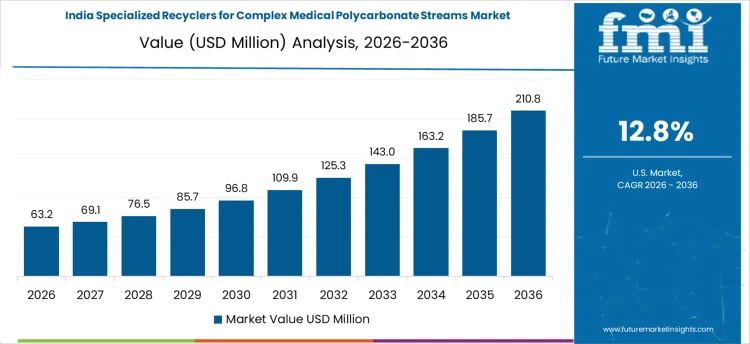
India shows the fastest growth in specialized recyclers for complex medical polycarbonate streams, expanding at a CAGR of 12.8%, driven by increasing hospital capacity and consumption of single-use medical devices. Recyclers are implementing advanced cleaning, sterilization, and verification processes to reclaim polycarbonate for industrial and non-critical healthcare applications. Demand is concentrated among organized recyclers and hospital networks engaged in compliance and sustainability initiatives. Investments prioritize process reliability, contamination control, and certification. Growth reflects both rising device volumes and the need to supply high-quality recycled material for domestic and export use.
- Growing single-use device volumes increase feedstock availability.
- Advanced cleaning and sterilization protocols ensure material compliance.
- Organized recyclers partner with hospital networks for adoption.
- Certification and traceability guide investment decisions.
How Is Hospital Waste Infrastructure Supporting Specialized Polycarbonate Recycling in Brazil?
Brazil is recording steady growth in specialized recyclers for complex medical polycarbonate streams at a CAGR of 10.2%, supported by improvements in hospital waste management and regulatory oversight. Recyclers are deploying advanced cleaning, sterilization, and material verification systems to recover high-quality polycarbonate suitable for reuse or secondary applications. Demand is concentrated in urban hospital networks and certified recycling operators. Investments emphasize process standardization, contamination control, and traceable documentation rather than rapid facility expansion. Growth reflects gradual integration of specialized recycling services into hospital waste management infrastructure.
- Hospital waste infrastructure improvements increase feedstock availability.
- Cleaning and sterilization processes ensure high-quality recovery.
- Urban hospital networks and certified recyclers lead adoption.
- Standardized processes support regulatory compliance and traceability.
Who Are the Competitors in Specialized Recycling of Complex Medical Polycarbonate Streams and How Do They Differ?
Competition in the specialized recycling market for complex medical polycarbonate streams reflects variation in process technology, material quality outcomes, and integration with clinical waste systems. Veolia participates through comprehensive recycling services that handle mixed medical polymer waste, combining sorting, decontamination, and reprocessing pathways tailored for polycarbonate-rich input from devices and components. Covestro AG emphasizes advanced purification and conditioning technologies designed to preserve polymer performance attributes needed for downstream applications. Eastman focuses on controlled regranulation and quality assurance to deliver recycled polycarbonate suitable for engineered uses.
Materials producers differentiate themselves through depth of polymer expertise and integration with supply chain requirements. Celanese deploys sorting and processing workflows that stabilize mixed feedstock, enabling higher purity outputs. Teijin addresses solvent-level cleaning and conditioning to maintain optical clarity and mechanical integrity. SABIC combines global polymer knowledge with partnerships that support recycling process development. MBA Polymers brings specialized expertise in mixed rigid plastic separation and decontamination, enhancing the consistency of recovered polycarbonate. Competitive differences emerge in how firms balance technology complexity with output quality, and in their ability to integrate clinical waste handling with robust quality assurance systems that align recycled material with regulatory and performance requirements for medical-adjacent applications.
Key Players in the Specialized Recyclers for Complex Medical Polycarbonate Streams Market
- Veolia
- Covestro
- Eastman
- Celanese
- Teijin
- SABIC
- MBA Polymers
Scope of the Report
| Items | Values |
|---|---|
| Quantitative Units (2026) | USD million |
| Recycling Technology | Chemical recycling, Solvent based purification, Supercritical fluid depolymerization, Advanced mechanical regranulation |
| Application Focus | Medical device housings, Diagnostic equipment components, Sterile packaging structures, Non-clinical polymer parts |
| Region | Asia Pacific, Europe, North America, Latin America, Middle East & Africa |
| Key Countries Covered | China, Japan, South Korea, India, Australia & New Zealand, Germany, United Kingdom, France, Italy, Spain, Nordic, BENELUX, United States, Canada, Mexico, Brazil, Chile, Kingdom of Saudi Arabia, Other GCC Countries, Turkey, South Africa, Other African Union |
| Key Companies Profiled | Veolia, Covestro, Eastman, Celanese, Teijin, SABIC, MBA Polymers |
| Additional Attributes | Dollar sales by recycling technology and application, feedstock traceability, regulatory compliance metrics, audit-ready documentation, operational efficiency, integration with hospital or device manufacturer waste streams, compliance with ISO/FDA standards, high-purity output validation |
Specialized Recyclers for Complex Medical Polycarbonate Streams Market Segmentation
Recycling Technology:
- Chemical recycling
- Solvent-based purification
- Supercritical fluid depolymerization
- Advanced mechanical regranulation
Application Focus:
- Medical device housings
- Diagnostic equipment components
- Sterile packaging structures
- Non-clinical polymer parts
Region
- Asia Pacific
- China
- Japan
- South Korea
- India
- Australia & New Zealand
- ASEAN
- Rest of Asia Pacific
- Europe
- Germany
- United Kingdom
- France
- Italy
- Spain
- Nordic
- BENELUX
- Rest of Europe
- North America
- United States
- Canada
- Mexico
- Latin America
- Brazil
- Chile
- Rest of Latin America
- Middle East & Africa
- Kingdom of Saudi Arabia
- Other GCC Countries
- Turkey
- South Africa
- Other African Union
- Rest of Middle East & Africa
Frequently Asked Questions
How big is the specialized recyclers for complex medical polycarbonate streams market in 2026?
The global specialized recyclers for complex medical polycarbonate streams market is estimated to be valued at USD 117.0 million in 2026.
What will be the size of specialized recyclers for complex medical polycarbonate streams market in 2036?
The market size for the specialized recyclers for complex medical polycarbonate streams market is projected to reach USD 329.2 million by 2036.
How much will be the specialized recyclers for complex medical polycarbonate streams market growth between 2026 and 2036?
The specialized recyclers for complex medical polycarbonate streams market is expected to grow at a 10.9% CAGR between 2026 and 2036.
What are the key recycling technology types in the specialized recyclers for complex medical polycarbonate streams market?
The key recycling technology types in specialized recyclers for complex medical polycarbonate streams market are solvent‑based purification, supercritical fluid depolymerization and advanced mechanical regranulation.
Which medical device housings segment to contribute significant share in the specialized recyclers for complex medical polycarbonate streams market in 2026?
In terms of medical device housings, application segment to command 45.0% share in the specialized recyclers for complex medical polycarbonate streams market in 2026.
Preview the report firsthand - request a free sample
Get SampleGet the brochure for pricing and purchase details.
Get PDFTable of Content
- Executive Summary
- Global Market Outlook
- Demand-side Trends
- Supply-side Trends
- Technology Roadmap Analysis
- Analysis and Recommendations
- Market Overview
- Market Coverage / Taxonomy
- Market Definition / Scope / Limitations
- Market Background
- Market Dynamics
- Drivers
- Restraints
- Opportunity
- Trends
- Scenario Forecast
- Demand in Optimistic Scenario
- Demand in Likely Scenario
- Demand in Conservative Scenario
- Opportunity Map Analysis
- Product Life Cycle Analysis
- Supply Chain Analysis
- Investment Feasibility Matrix
- Value Chain Analysis
- PESTLE and Porter’s Analysis
- Regulatory Landscape
- Regional Parent Market Outlook
- Production and Consumption Statistics
- Import and Export Statistics
- Market Dynamics
- Global Market Analysis 2021 to 2025 and Forecast, 2026 to 2036
- Historical Market Size Value (USD Million) Analysis, 2021 to 2025
- Current and Future Market Size Value (USD Million) Projections, 2026 to 2036
- Y-o-Y Growth Trend Analysis
- Absolute $ Opportunity Analysis
- Global Market Pricing Analysis 2021 to 2025 and Forecast 2026 to 2036
- Global Market Analysis 2021 to 2025 and Forecast 2026 to 2036, By Chemical recycling
- Introduction / Key Findings
- Historical Market Size Value (USD Million) Analysis By Chemical recycling , 2021 to 2025
- Current and Future Market Size Value (USD Million) Analysis and Forecast By Chemical recycling , 2026 to 2036
- Solvent‑based purification
- Supercritical fluid depolymerization
- Advanced mechanical regranulation
- Solvent‑based purification
- Y-o-Y Growth Trend Analysis By Chemical recycling , 2021 to 2025
- Absolute $ Opportunity Analysis By Chemical recycling , 2026 to 2036
- Global Market Analysis 2021 to 2025 and Forecast 2026 to 2036, By Medical device housings
- Introduction / Key Findings
- Historical Market Size Value (USD Million) Analysis By Medical device housings, 2021 to 2025
- Current and Future Market Size Value (USD Million) Analysis and Forecast By Medical device housings, 2026 to 2036
- Diagnostic equipment components
- Sterile packaging structures
- Non‑clinical polymer parts
- Diagnostic equipment components
- Y-o-Y Growth Trend Analysis By Medical device housings, 2021 to 2025
- Absolute $ Opportunity Analysis By Medical device housings, 2026 to 2036
- Global Market Analysis 2021 to 2025 and Forecast 2026 to 2036, By Region
- Introduction
- Historical Market Size Value (USD Million) Analysis By Region, 2021 to 2025
- Current Market Size Value (USD Million) Analysis and Forecast By Region, 2026 to 2036
- North America
- Latin America
- Western Europe
- Eastern Europe
- East Asia
- South Asia and Pacific
- Middle East & Africa
- Market Attractiveness Analysis By Region
- North America Market Analysis 2021 to 2025 and Forecast 2026 to 2036, By Country
- Historical Market Size Value (USD Million) Trend Analysis By Market Taxonomy, 2021 to 2025
- Market Size Value (USD Million) Forecast By Market Taxonomy, 2026 to 2036
- By Country
- USA
- Canada
- Mexico
- By Chemical recycling
- By Medical device housings
- By Country
- Market Attractiveness Analysis
- By Country
- By Chemical recycling
- By Medical device housings
- Key Takeaways
- Latin America Market Analysis 2021 to 2025 and Forecast 2026 to 2036, By Country
- Historical Market Size Value (USD Million) Trend Analysis By Market Taxonomy, 2021 to 2025
- Market Size Value (USD Million) Forecast By Market Taxonomy, 2026 to 2036
- By Country
- Brazil
- Chile
- Rest of Latin America
- By Chemical recycling
- By Medical device housings
- By Country
- Market Attractiveness Analysis
- By Country
- By Chemical recycling
- By Medical device housings
- Key Takeaways
- Western Europe Market Analysis 2021 to 2025 and Forecast 2026 to 2036, By Country
- Historical Market Size Value (USD Million) Trend Analysis By Market Taxonomy, 2021 to 2025
- Market Size Value (USD Million) Forecast By Market Taxonomy, 2026 to 2036
- By Country
- Germany
- UK
- Italy
- Spain
- France
- Nordic
- BENELUX
- Rest of Western Europe
- By Chemical recycling
- By Medical device housings
- By Country
- Market Attractiveness Analysis
- By Country
- By Chemical recycling
- By Medical device housings
- Key Takeaways
- Eastern Europe Market Analysis 2021 to 2025 and Forecast 2026 to 2036, By Country
- Historical Market Size Value (USD Million) Trend Analysis By Market Taxonomy, 2021 to 2025
- Market Size Value (USD Million) Forecast By Market Taxonomy, 2026 to 2036
- By Country
- Russia
- Poland
- Hungary
- Balkan & Baltic
- Rest of Eastern Europe
- By Chemical recycling
- By Medical device housings
- By Country
- Market Attractiveness Analysis
- By Country
- By Chemical recycling
- By Medical device housings
- Key Takeaways
- East Asia Market Analysis 2021 to 2025 and Forecast 2026 to 2036, By Country
- Historical Market Size Value (USD Million) Trend Analysis By Market Taxonomy, 2021 to 2025
- Market Size Value (USD Million) Forecast By Market Taxonomy, 2026 to 2036
- By Country
- China
- Japan
- South Korea
- By Chemical recycling
- By Medical device housings
- By Country
- Market Attractiveness Analysis
- By Country
- By Chemical recycling
- By Medical device housings
- Key Takeaways
- South Asia and Pacific Market Analysis 2021 to 2025 and Forecast 2026 to 2036, By Country
- Historical Market Size Value (USD Million) Trend Analysis By Market Taxonomy, 2021 to 2025
- Market Size Value (USD Million) Forecast By Market Taxonomy, 2026 to 2036
- By Country
- India
- ASEAN
- Australia & New Zealand
- Rest of South Asia and Pacific
- By Chemical recycling
- By Medical device housings
- By Country
- Market Attractiveness Analysis
- By Country
- By Chemical recycling
- By Medical device housings
- Key Takeaways
- Middle East & Africa Market Analysis 2021 to 2025 and Forecast 2026 to 2036, By Country
- Historical Market Size Value (USD Million) Trend Analysis By Market Taxonomy, 2021 to 2025
- Market Size Value (USD Million) Forecast By Market Taxonomy, 2026 to 2036
- By Country
- Kingdom of Saudi Arabia
- Other GCC Countries
- Turkiye
- South Africa
- Other African Union
- Rest of Middle East & Africa
- By Chemical recycling
- By Medical device housings
- By Country
- Market Attractiveness Analysis
- By Country
- By Chemical recycling
- By Medical device housings
- Key Takeaways
- Key Countries Market Analysis
- USA
- Pricing Analysis
- Market Share Analysis, 2025
- By Chemical recycling
- By Medical device housings
- Canada
- Pricing Analysis
- Market Share Analysis, 2025
- By Chemical recycling
- By Medical device housings
- Mexico
- Pricing Analysis
- Market Share Analysis, 2025
- By Chemical recycling
- By Medical device housings
- Brazil
- Pricing Analysis
- Market Share Analysis, 2025
- By Chemical recycling
- By Medical device housings
- Chile
- Pricing Analysis
- Market Share Analysis, 2025
- By Chemical recycling
- By Medical device housings
- Germany
- Pricing Analysis
- Market Share Analysis, 2025
- By Chemical recycling
- By Medical device housings
- UK
- Pricing Analysis
- Market Share Analysis, 2025
- By Chemical recycling
- By Medical device housings
- Italy
- Pricing Analysis
- Market Share Analysis, 2025
- By Chemical recycling
- By Medical device housings
- Spain
- Pricing Analysis
- Market Share Analysis, 2025
- By Chemical recycling
- By Medical device housings
- France
- Pricing Analysis
- Market Share Analysis, 2025
- By Chemical recycling
- By Medical device housings
- India
- Pricing Analysis
- Market Share Analysis, 2025
- By Chemical recycling
- By Medical device housings
- ASEAN
- Pricing Analysis
- Market Share Analysis, 2025
- By Chemical recycling
- By Medical device housings
- Australia & New Zealand
- Pricing Analysis
- Market Share Analysis, 2025
- By Chemical recycling
- By Medical device housings
- China
- Pricing Analysis
- Market Share Analysis, 2025
- By Chemical recycling
- By Medical device housings
- Japan
- Pricing Analysis
- Market Share Analysis, 2025
- By Chemical recycling
- By Medical device housings
- South Korea
- Pricing Analysis
- Market Share Analysis, 2025
- By Chemical recycling
- By Medical device housings
- Russia
- Pricing Analysis
- Market Share Analysis, 2025
- By Chemical recycling
- By Medical device housings
- Poland
- Pricing Analysis
- Market Share Analysis, 2025
- By Chemical recycling
- By Medical device housings
- Hungary
- Pricing Analysis
- Market Share Analysis, 2025
- By Chemical recycling
- By Medical device housings
- Kingdom of Saudi Arabia
- Pricing Analysis
- Market Share Analysis, 2025
- By Chemical recycling
- By Medical device housings
- Turkiye
- Pricing Analysis
- Market Share Analysis, 2025
- By Chemical recycling
- By Medical device housings
- South Africa
- Pricing Analysis
- Market Share Analysis, 2025
- By Chemical recycling
- By Medical device housings
- USA
- Market Structure Analysis
- Competition Dashboard
- Competition Benchmarking
- Market Share Analysis of Top Players
- By Regional
- By Chemical recycling
- By Medical device housings
- Competition Analysis
- Competition Deep Dive
- Covestro
- Overview
- Product Portfolio
- Profitability by Market Segments (Product/Age /Sales Channel/Region)
- Sales Footprint
- Strategy Overview
- Marketing Strategy
- Product Strategy
- Channel Strategy
- Eastman
- Celanese
- Teijin
- SABIC
- MBA Polymers
- Covestro
- Competition Deep Dive
- Assumptions & Acronyms Used
- Research Methodology


