

- Industry Size (2025)
- USD 916 Mn
- Forecast (2035)
- USD 1703.4 Mn
- CAGR (2025 to 2035)
- 7.0%
China Spinal Fusion Market Size, Market Forecast and Outlook By FMI
The China spinal fusion market was valued at USD 916.0 million in 2025 and is expected to reach USD 1,703.4 million by 2035. The market is anticipated to register a 7.0% CAGR during the forecast period. Spinal implants are likely to lead product type with a 58.0% share, while hospitals are projected to account for 82.0% of end-user demand in 2025.
Summary of the China Spinal Fusion Market
- Demand and Growth Drivers
- Minimally invasive spine surgery is expected to support spinal fusion device use across advanced hospital settings.
- Robotic navigation is likely to improve surgical precision and increase acceptance of complex fusion procedures.
- Degenerative spine conditions are anticipated to raise procedure volumes as China’s patient base ages.
- Product and Segment View
- Spinal implants are expected to lead the product type segment due to their role in stability and deformity correction.
- Hospitals are likely to remain the main end-user category because advanced infrastructure supports complex spine surgery.
- Posterolateral fusion is anticipated to retain strong use because it remains cost-effective and widely practiced.
- Geography and Competitive Outlook
- China is expected to remain a high-value spine surgery market due to hospital investment and procedural modernization.
- Tertiary hospitals are likely to drive adoption as robotics and image-guided systems enter surgical workflows.
- Companies with implant innovation, navigation support and surgeon training capacity are anticipated to gain preference.
- Analyst Opinion
- Anurag Sharma, Principal consultant for Healthcare at FMI, suggests, “The China spinal fusion market is expected to expand as hospitals adopt advanced implants and navigation-assisted surgery. Suppliers with strong clinical evidence, surgeon training support and localized hospital relationships are likely to gain advantage as spine surgery demand rises.”
- China Spinal Fusion Market Value Analysis
- The China spinal fusion market is moving from conventional fusion procedures toward technology-assisted spine surgery.
- Demand is likely to rise as hospitals adopt implants designed for minimally invasive and complex procedures.
- Adoption is expected to strengthen where robotic systems and image guidance improve procedural accuracy.
- Spending is anticipated to be supported by hospitals because complex spinal fusion procedures require advanced infrastructure.
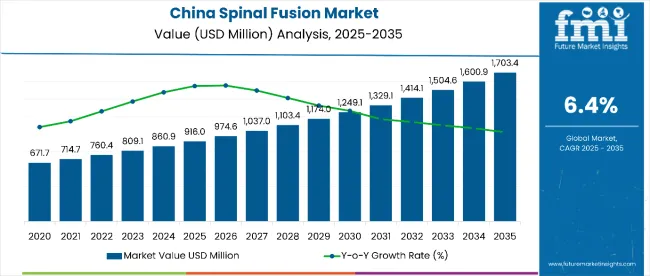
Key Takeaways, Market Size, and Forecast
| Metric | Value |
|---|---|
| Market Size (2025) | USD 916.0 Million |
| Market Size (2035) | USD 1,703.4 Million |
| CAGR (2025-2035) | 7.0% |
| Leading Product Type (2025) | Spinal Implants |
| Spinal Implants Share (2025) | 58.0% |
| Leading End-User (2025) | Hospitals |
| Hospitals Share (2025) | 82.0% |
| Fastest-Growing Country | China |
| China CAGR | 7.0% |
Robotics Reshape Surgical Protocols in China Spinal Fusion Market Landscape
AI and robotics are becoming central to surgical workflows in Chinas spinal fusion market. Operating rooms are undergoing structural redesigns to accommodate these advanced systems. Neurosurgical teams are increasingly reliant on multi-modal data inputs that combine intraoperative imaging, real-time feedback, and patient-specific anatomical modeling. Robotic systems are now routinely interfaced with AI-powered navigation tools to enhance the safety and precision of fusion procedures.
- Medtronic’s Mazor X Stealth Edition is being integrated into tertiary hospitals for real-time analytics and robotic control
- Stryker’s Mako suite is being used in orthopedic departments for lumbar fusion procedures
- AI-powered surgical rehearsal platforms are helping surgeons visualize outcomes before procedures
- Computer-assisted navigation is now standard in academic hospitals for multilevel fusions
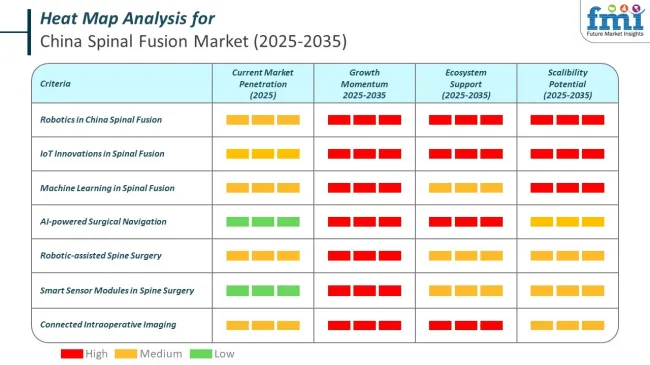
IoT Innovations Shaping China Spinal Fusion Market
In the China spinal fusion market, leading device manufacturers are incorporating Internet of Things (IoT) technologies to improve procedural safety, real-time data collection, and long-term patient outcomes. These applications are emerging across device tracking, implant lifecycle monitoring, post-operative care, and predictive maintenance of robotic systems. Global players are adapting IoT-enabled platforms specifically for the hospital environment, integrating them with existing electronic health record systems and regional hospital information systems.
- NuVasive, Inc. is enhancing its surgical ecosystem with connected intraoperative imaging systems that link navigation data, implant positioning, and real-time updates across operating teams.
- Zimmer Biomet Holdings, Inc. is deploying smart sensor modules within spinal fusion platforms that transmit post-operative mobility and healing data to centralized recovery management systems. These solutions are tailored for hospitals managing enhanced recovery protocols.
- Globus Medical, Inc. is advancing modular spine systems embedded with telemetry features, allowing surgeons to monitor implant performance and spinal load distribution remotely during critical recovery phases.
Emerging Role of Machine Learning in China Spinal Fusion Market in 2025
In China spinal fusion market, machine learning is playing an important role in hospitals and medical device companies. It helps doctors make smarter choices before and during surgery. Many companies are working with Chinese hospitals to test these tools.
- Medtronic is using machine learning in its robotic systems. The technology can study many past surgeries and suggest the best spot to place screws in the spine. This makes the surgery safer and faster for the patient.
- Stryker has robots that use machine learning to guide surgeons. The robots can learn from each surgery they do, which helps improve the next one. They also adjust to different patient body types, which is useful in hospitals with a high number of cases.
- Johnson & Johnson (Depuy Synthes) is creating smart tools that can predict how a patient might recover after surgery. It uses patient test results and history to help doctors plan the right treatment steps. This makes recovery faster and smoother.
Semi Annual Market Update
Comparative analysis of fluctuations in compound annual growth rate (CAGR) for the China spinal fusion market between 2025 and 2025 on a six months basis is shown below. By this examination, major variations in the performance of these markets are brought to light, and also trends of revenue generation are captured hence offering stakeholders useful ideas on how to carry on with the market’s growth path in any other given year. January through June covers the first part of the year called half1 (H1), while half2 (H2) represents July to December.
The below table presents the expected CAGR for the China spinal fusion market over several semi-annual periods spanning from 2025 to 2035. In the first half (H1) of the decade from 2025 to 2033, the business is predicted to surge at a CAGR of 7.1% followed by a slight decline in the growth rate which will grow at 6.8% in the second half (H2) of the same decade.
| Particular | Value CAGR |
|---|---|
| H1 (2024 to 2034) | 7.1% |
| H2 (2024 to 2034) | 6.8% |
| H1 (2025 to 2035) | 6.4% |
| H2 (2025 to 2035) | 5.9% |
Moving into the subsequent period, from H1 2025 to H2 2035, the CAGR is projected to decrease slightly to 6.4% in the first half and remain relatively moderate at 5.9% in the second half. In the first half (H1) the market witnessed a decrease of 70 BPS similar with the second half (H2), the market witnessed a decrease of 90 BPS.
Analyzing China Spinal Fusion Market by Top Investment Segments
A description of the leading segments in the industry is provided in this section. Spinal Implants hold 58% of the value share in 2025 by product category whereas, Hospitals by end user lead the market with a high share of 82% in the market in 2025.
Spinal Implants Drive Growth in the China Spinal Fusion Market with Technological Advancements and Innovation
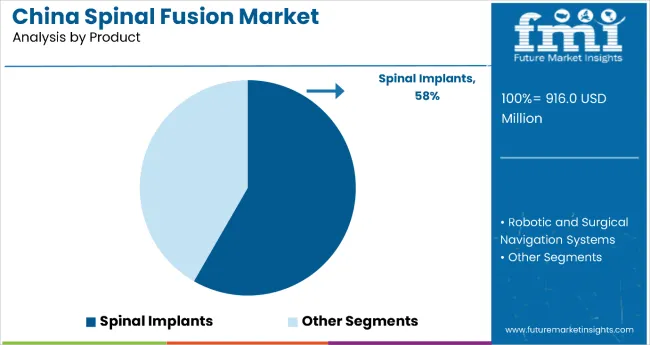
| Product | Spinal Implants |
|---|---|
| Value Share (2025) | 58% |
Spinal implants are at the forefront of the China spinal fusion market and will hold a 58% share in 2025 due to their critical role in achieving spinal stability, correcting deformities, and facilitating fusion. They are very important to minimally invasive procedures, which are increasing because of minimal recovery time and fewer complications.
The development of refined materials like titanium alloys and the incorporation of 3D printing have taken further advantage of the implant, which has made it an essential constituent for treating complex spinal conditions. The segment of spinal implants has thus taken a substantial part in market growth.
An exceptional innovation in the field of technology and research has spurred growth in China's spinal fusion market. Specifically, advancements respond directly to the rising demand for high-performance spinal fusion solutions. To this end, using 3D-printed implants has become very popular: they offer personalized care most conveniently and effectively of treating patients with complex spinal conditions.
Hospitals Lead the China Spinal Fusion Market with Advanced Infrastructure and Multidisciplinary Expertise
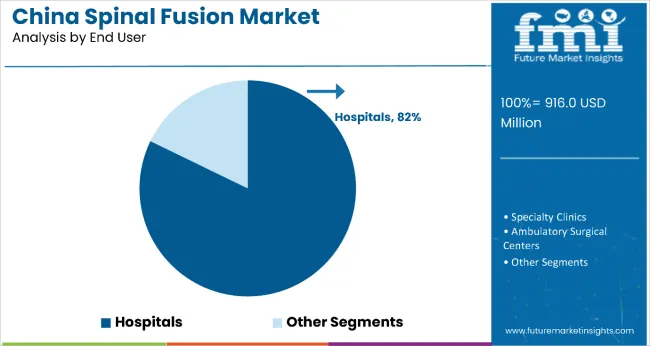
| End User | Hospital |
|---|---|
| Value Share (2025) | 82% |
Hospitals are leading the end-user segment in the China spinal fusion market and will hold 82% in 2025 due to their advanced infrastructure and access to cutting-edge technologies.
Hospitals, typically known for taking a holistic approach in surgical care and recovery for spinal fusion surgery, account for the highest share of spinal fusion procedures, by virtue of innovation solutions such as robotics and advanced navigation systems, to deal with higher procedural accuracy. The dominant position in this sector is further reinforced by the habitation of sharp professionals primed in selection; that is, spinal conditions are being met with a special degree of determination and market growth.
This is further supported by the concentration of hitherto existing and trained professionals and surgeons with specialist knowledge of spinal procedures, anesthetists, and rehabilitation specialists completing this multidisciplinary approach to patient care, with the hospitals being the primary facility for undertaking spinal fusion surgery. Further adoption of robotics in hospitals has redefined distinct surgical workflows, leading to increased acceptance of spinal fusion devices.
By Application, Posterolateral Fusion Segment Registers 55% Share
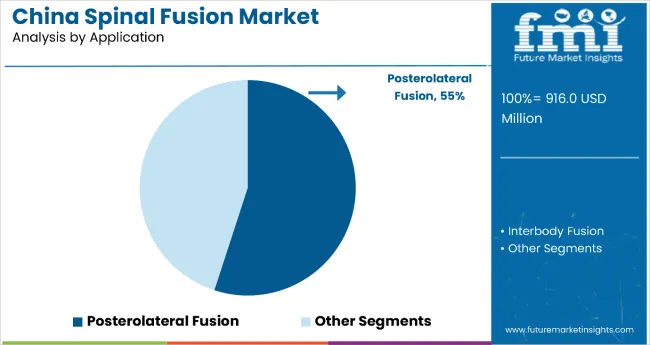
PLF is a well-established and relatively cost-effective procedure for treating degenerative spine conditions such as lumbar spinal stenosis and spondylolisthesis, which are increasingly common in China’s aging population.
Its lower cost compared to more advanced techniques like interbody fusion makes it more accessible in public hospitals and rural healthcare settings where budget constraints are a concern. PLF requires less specialized instrumentation and training,making it more widely practiced among orthopedic and spine surgeons across China.
The existing surgical infrastructure and surgeon familiarity with the technique further support its widespread adoption. Additionally, government-backed insurance schemes often cover PLF, enhancing its affordability and use among the general population.
Key Industry Highlights
Clinical Evaluation of Spinal Fusion Devices in China to Influence the Market Growth
The clinical evaluation guidelines for spinal fusion devices, announced by China's National Medical Products Administration (NMPA) in 2024, are an important driving factor for the market. The guideline offers a clearer way through regulation for manufacturers while providing a safer and more standardized approach toward the approval of spinal fusion devices.
With a focus on clinical data, material quality, and non-inferiority of the devices; the new set of regulations will push the companies to innovate in the development of spinal fusion devices. As a result, both local and international manufacturers are looking to invest in the Chinese market to expand the range and variety of spinal fusion technologies to become available.
Additionally, the emphasis on detailed mechanical testing (e.g., compression, shear, and torsion tests) ensures that only the highest-quality devices are introduced to the market, which can increase consumer confidence and demand.
These guidelines offer transparency and predictability to the approval processes, which acts as a further spur for manufacturers to enter the spinal fusion market. This will increase competition, boost technological advancements, improve access to high-quality, minimally invasive spinal fusion solutions to patients, and allow knowledge transfer among manufacturers.
The NMPA clinical evaluation guidelines are considered to drive the growth of the spinal fusion market by permitting innovation, enhancing the quality of devices, and attracting both local and global investments.
Establishing Training Systems to Enhance Endoscopic Spinal Fusion Surgery
A key opportunity for expanding the application of spinal fusion surgery in China lies in the development of structured training systems to improve the consistency and quality of endoscopic spinal surgeries. Standardized training systems are an attractive market proposition as they will remedy the existing incompetency and assure that surgeons are skilled enough to safely and effectively perform endoscopic spinal fusion surgery.
These training programs will not only channel the technical skills of surgeons but will also elevate the confidence of patients and increase the likelihood of them opting for endoscopic procedures, aware that trained hands are operating upon them.
Additionally, as the acceptance of minimally invasive spinal fusion surgeries is spreading, structured training systems would be paramount to unifying the techniques in various hospitals and private centers, fostering better clinical outcomes and enhancing acceptability. This would create competitive markets with a variety of treatment options, which will further propel the spinal fusion market.
In conclusion, the chance offers will further introduce a developmental course in training systems towards the general quality and consistency of endoscopic spinal fusion surgery, thereby providing growth opportunities through better surgical outcomes and thereby broadening the adoption of techniques that are indeed an advancement step forward.
Advances in Robotics and Artificial Intelligence are Increasing Surgical Procedures in China
In China, there is a burgeoning trend of integrating robotics and artificial intelligence in spinal fusion surgeries, requiring a great leap forward to evolve. The findings of the 2021 International Conference on Robotics and Automation (ICRA 2021) point out that robotics-based and AI-assisted procedures have gained significant attention and increasingly influence spinal surgery practice there.
The application of robotic surgery in spinal fusion is on the rise in China, with several studies showing the safety and effectiveness of the technique. Similar to joint replacement surgeries, robotic systems for spinal fusion have improved accuracy, optimal surgical precision, and reduced recovery times. Moreover, developing preoperative AI algorithms for planning and intraoperative navigation provides further improvement in the precision and results of these procedures.
Furthermore, the future of robot-assisted spinal fusion surgery in China will greatly depend on the deeper integration of medicine, engineering, and networks. Overcoming current technology limitations to optimize the AI system, enhance robotic precision, and improve system interoperability will be pivotal in enabling these innovations for effective and widespread dissemination across hospitals.
In conclusion, the trend of integrating robotics and AI into spinal fusion surgeries in China presents great potential for the future. Although immediate benefits from the clinical outcome are present, more research must be done to refine techniques and understand the limitations and thereby ensure a fuller clinical application of the newer techniques in the country.
Alternative Treatment Options for Spinal Cord Injuries in China Hampers China Spinal Fusion Market Growth
Spinal cord injuries (SCIs) pose a formidable challenge in medicine, with grievously low rates of cure and high rates of disability. Patients with increasing incidences of SCIs now cast their sights on future forms of therapy that are less dependent on invasive practices like spinal fusion. In China, Traditional Chinese Medicine (TCM) and stem cell treatment are two of the most notable alternatives, both showing potential for direct therapeutic application with some semblance of efficacy.
Traditional Chinese Medicine has long been practiced in the management of spinal cord injuries, where herbal medicines, acupuncture, and therapeutic exercises brought about advantageous changes in such cases and thereby improved the patients' lives. TCM aims to restore the body's balance, improve the function of nerves, and decrease inflammation.
Stem cell treatment is another promising option as this can allow the repair of damaged spinal tissue while promoting the regeneration of functional nerve cells. Though still under research and theoretical development, stem cell therapy has shown very good results in the pre-clinical and early clinical trials, one hoping for non-surgical intervention in the treatment of SCIs.
While these treatments constitute poor alternatives, they signify the quiet changes in treatment direction toward innovative methods versus antiquated methodologies to meet the unique challenges of spinal cord injuries as one moves away from surgical procedures like spinal fusion.
Market Concentration
Tier 1 includes companies cumulatively hold around 59.5% share of the total market revenue. These players often lead in innovation, introducing cutting-edge technologies like 3D-printed implants, robotics, and advanced navigation systems.
Their products are often differentiated by advanced features and higher performance. The companies that comprises tier I are Stryker Corporation, Inc., Medtronic Plc, Johnson & Johnson Services, Inc (Depuy Synthes) and Wenzel Spine, Inc.
Tier 2 includes companies cumulatively hold around 27.6% share of the total market revenue. The companies that comprises tier II are Centinel Spine, Inc., Spineart Geneva SA, K2M, Inc., MicroPort Scientific Corporation and others. Tier 2 players hold a smaller market share and are often regional or national companies. They cater to specific market segments or niche applications within the spinal fusion space.
Key Players of the China Spinal Fusion Industry
- Stryker Corporation, Inc.
- Medtronic Plc
- Johnson & Johnson Services, Inc (Depuy Synthes)
- Wenzel Spine, Inc.
- Centinel Spine, Inc.
- Spineart Geneva SA
- K2M, Inc.
- MicroPort Scientific Corporation
- Integra Lifesciences Holdings Corp
- Orthofix Holdings, Inc.
China Spinal Fusion Market Segmentation
By Product Type:
In terms of product type, the industry is segregated into spinal implants (interbody cages, pedicle screws and rods, spinal plates), robotic and surgical navigation systems
By Procedure:
In terms of procedure, the industry is segregated into posterolateral fusion and interbody fusion.
By End User:
In terms of end user, the industry is segregated into hospitals, specialty clinics and ambulatory surgical centers
Frequently Asked Questions
What is the anticipated growth of the China spinal fusion industry?
The China market is expected to increase at a CAGR of 7.0% between 2025 and 2035.
What is the expected market share of the spinal implant segment in 2025?
Spinal implant segment is expected to occupy a 58% market share in 2025.
What is the estimated value of a China spinal fusion industry by 2035?
The market for spinal fusion in the United States is expected to reach USD 1,794.4 million by 2035.
What is the historic CAGR for the spinal fusion industry in the China?
The United States is forecast to see a CAGR of 11.4% during the assessment period.
Who are the major players of the China spinal fusion industry?
The key players in the China spinal fusion industry include Stryker Corporation, Inc., Medtronic Plc, Johnson & Johnson Services, Inc (Depuy Synthes), Wenzel Spine, Inc., Centinel Spine, Inc., Spineart Geneva SA, K2M, Inc., MicroPort Scientific Corporation, Integra Lifesciences Holdings Corp, and Orthofix Holdings, Inc.
Preview the report firsthand - request a free sample
Get SampleGet the brochure for pricing and purchase details.
Get PDFTable of Content
- Executive Summary
- Industry Introduction, Including Taxonomy and Market Definition
- Market Trends and Success Factors, Including Macro-economic Factors, Market Dynamics, and Recent Industry Developments
- Market Demand Analysis 2020 to 2024 and Forecast 2025 to 2035, Including Historical Analysis and Future Projections
- Market Analysis 2020 to 2024 and Forecast 2025 to 2035
- Product
- Application
- End User
- Market Analysis 2020 to 2024 and Forecast 2025 to 2035, By Product
- Spinal Implants
- Interbody Cages
- Pedicle Screws and Rods
- Spinal Plates
- Robotic and Surgical Navigation Systems
- Spinal Implants
- Market Analysis 2020 to 2024 and Forecast 2025 to 2035, By Application
- Posterolateral Fusion
- Interbody Fusion
- Market Analysis 2020 to 2024 and Forecast 2025 to 2035, By End User
- Hospitals
- Specialty Clinics
- Ambulatory Surgical Centers
- Market Analysis 2020 to 2024 and Forecast 2025 to 2035, By Region
- Sales Forecast 2025 to 2035 by Product, Procedure, and End User for 30 Countries
- Competition Outlook, Including Market Structure Analysis, Company Share Analysis by Key Players, and Competition Dashboard
- Company Profile
- Stryker Corporation, Inc.
- Medtronic Plc
- Johnson & Johnson Services, Inc.
- Wenzel Spine, Inc.
- Centinel Spine, Inc.
- Spineart Geneva SA
- K2M, Inc.


