

- Market Size (2026)
- USD 7.4 Bn
- Forecast (2036)
- USD 15.8 Bn
- CAGR (2026 to 2036)
- 7.9%
How big is Superfood Powders Market in 2026?
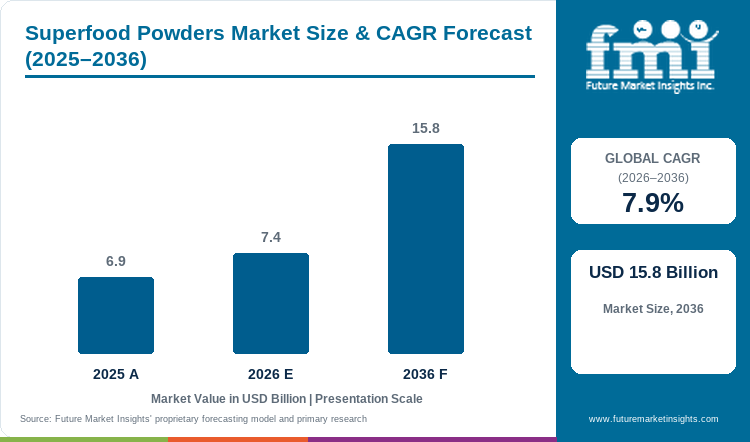
USD 7.4 billion in 2026 and USD 15.8 billion by 2036, expanding at 7.9% CAGR.
Sales of superfood powders are estimated to rise at 7.9% CAGR through 2036, increasing valuation from USD 6.9 billion in 2025 to USD 7.4 billion in 2026, and reaching USD 15.8 billion by 2036. Food and supplement manufacturers are using powder formats because concentrated botanicals enter existing dry-blending steps without liquid handling. The UK Food Standards Agency recognized powders as a common food-supplement format in June 2026. The guidance keeps labeling requirements and intended-use decisions close to formulation approval before repeat production begins.
National demand routes are producing different forecast paths because certification requirements and ingredient traditions vary between countries. The UK is projected to expand at 10.0% CAGR through 2036 while Japan is projected at 9.0%. Japan's agriculture ministry recorded a 24.6% rise in green tea exports during 2024 as demand increased for powdered tea including matcha. UK suppliers are managing tighter certification and labeling checks as organic powders move into mainstream retail and supplement channels.
Key Takeaways
- Food and supplement manufacturers are buying concentrated powders that shorten ingredient preparation while preserving a recognizable botanical identity.
- By nature, organic is estimated to hold 90.0% of revenue in 2026, supported by certification that makes sourcing claims easier to verify.
- Based on product type, matcha and green tea is projected to account for 30.0% in 2026, driven by familiar tea use in beverages and foods.
- In 2026, drink applications are expected to lead application demand with 44.0% share, supported by direct mixing into smoothies and ready-to-mix beverages.
- Supplier switching slows when certification records, contaminant controls and category-specific labels cannot move with the ingredient lot.
- Some of the key players in this market include Navitas Organics (Laird Superfood), Terrasoul Superfoods (Laird Superfood), Kuli Kuli Foods, 4Life Research, Nature Made (Pharmavite), and AdvoCare International.
Analyst Perspective
"Powder suppliers earn repeat orders by keeping ingredient identity and testing records consistent as crop sources change. Buyers are comparing flavor performance with certification evidence before moving a formulation into regular production."
- Nandini Roy Choudhury, Principal Consultant, Future Market Insights
How is the superfood powders market segmented?
The superfood powders market is segmented by Nature, Product Type, Application, and Region.
The superfood powders market is segmented by nature, product type, application, and region for the 2026 to 2036 assessment period. Nature separates organic and conventional products while product type covers matcha and green tea, berries, algae-based powders, moringa, ashwagandha, mushroom and camu blends, wheatgrass, and maca. Application distinguishes food, drink, and other commercial uses.
How does organic shape demand within the nature category?
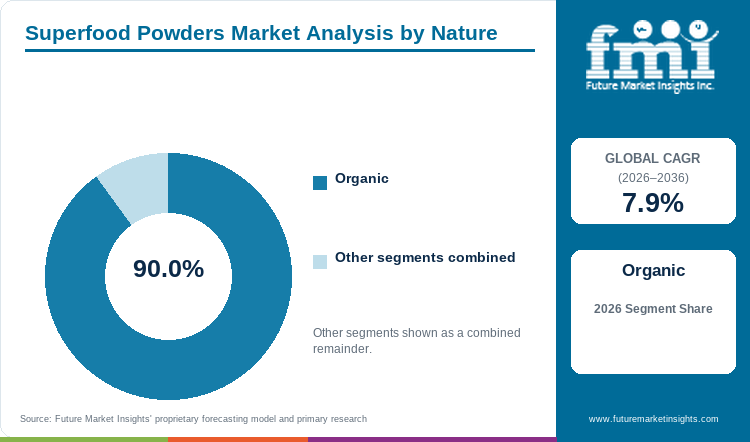
Organic certification gives retailers and supplement manufacturers a common control point for ingredients sourced from several countries. USDA data show 17,181 certified organic operations in 2025 while conventional grocery retailers remain the primary organic food outlets. Suppliers serving organic foods therefore need lot records that remain valid when crop origins or packing locations change. Certification increases documentation work but gives vendor-approval teams a consistent basis for checking production and handling claims.
- By nature, organic is estimated to hold 90.0% of revenue in 2026, reinforced by a standardized claim that buyers can verify before placement.
- Retailers continue to require traceable handling because an organic label depends on certified production and documented chain-of-custody controls.
Why does matcha and green tea influence product type selection?
Matcha enters beverages and foods without a separate extraction step at the point of use. Japan's agriculture ministry reported a 24.6% increase in green tea exports during 2024 as demand expanded for powdered tea including matcha. Buyers comparing matcha powder can evaluate origin and grade beside color and flavor performance. Origin and grade information gives buyers a clear specification route for cafe, bakery and packaged-beverage applications.
- Based on product type, matcha and green tea is projected to account for 30.0% in 2026, driven by familiar tea use and recognizable origin cues.
- Food developers test color, flavor and dispersibility before approving a matcha grade for repeated commercial batches.
What supports drink applications within the application category?
Drink applications require powders that disperse quickly and keep flavor acceptable at normal consumer serving levels. The UK Food Standards Agency treats powders as a normal supplement dosage form which supports measured drink-mix use without converting the ingredient into a liquid product. Brands entering functional beverages can use the same format in smoothies, shakes and sachets while controlling serving instructions. Poor solubility or strong botanical flavor can reduce repeat use even when the ingredient carries a familiar wellness position.
- By application, drink is forecast to represent 44.0% in 2026, supported by easy mixing into water, smoothies and protein beverages.
- Beverage formulators select powders that maintain dispersibility and sensory consistency after normal storage and repeated preparation.
What are the drivers, restraints and opportunities in the Superfood Powders Market?
Powder-format flexibility supports repeated use, compliance records slow supplier qualification and traceable processing can improve account conversion.
- Driver: Concentrated powders let formulators add recognizable botanicals to foods and drinks without installing liquid ingredient handling.
- Restraint: Organic, supplement and contaminant controls can extend qualification when a supplier lacks complete lot-level documentation.
- Opportunity: Vertically integrated processing can shorten sourcing and milling handoffs before powders move into packing and retail replenishment.
Powder convenience supports repeated formulation
Food developers are using powdered botanicals because dry ingredients enter existing blending lines without new liquid dosing equipment or chilled storage. The Food Standards Agency's June 2026 guidance lists powders among normal supplement formats and identifies botanicals as common supplement ingredients. Berry and other fruit powders enter measured recipes on the same dry-blending equipment while suppliers document intended use and serving instructions. Processors can compare powder performance within familiar mixing and packaging routines before approving a repeat commercial batch.
Qualification costs rise
Manufacturers producing protein supplements and botanical blends must document ingredient identity and finished-product specifications before a powder enters routine production. FDA's May 2026 warning letter to Flax & More cited failures in dietary-supplement specifications and manufacturing records under 21 CFR Part 111. Brands that cannot connect incoming botanical identity with finished-product testing face longer contract-manufacturer and retailer reviews. The requirement becomes more important when an approved ingredient changes source because the replacement lot must match identity and finished-product controls.
Integrated sourcing gives certified powder suppliers an opportunity
Retail accounts favor suppliers that coordinate ingredient receipt and milling because each handoff can separate lot identity from processing history. Laird described Terrasoul Superfoods as vertically integrated with in-house processing and packaging in Fort Worth in its April 2026 acquisition announcement. The integrated model gives the platform direct control over powder handling and replenishment for moisture-sensitive inputs such as freeze-dried fruits.
Which country CAGRs are profiled in the Superfood Powders Market?
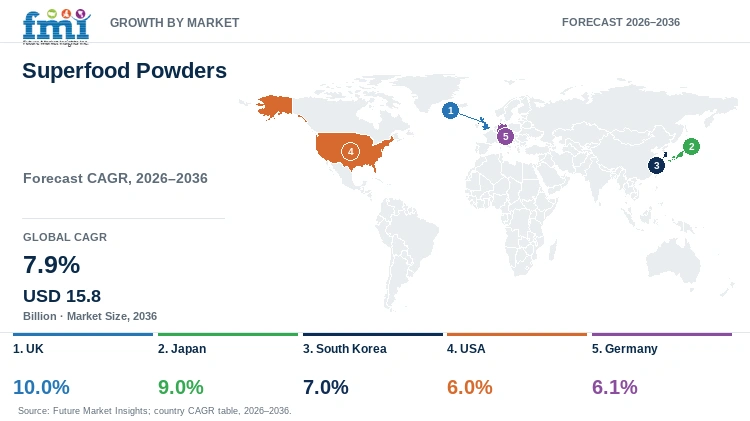
| Country | CAGR |
|---|---|
| UK | 10.0% |
| Japan | 9.0% |
| South Korea | 7.0% |
| USA | 6.0% |
| Germany | 6.1% |
How do country-level CAGRs compare in the Superfood Powders Market?
The UK and Japan form the upper forecast band while South Korea occupies the middle position. Germany is projected at 6.1% CAGR and the USA at 6.0%. Their distinct forecasts still produce different purchasing conditions as certification, ingredient heritage and supplement rules vary between national markets.
- UK organic retail growth increases certification continuity requirements for brands depending on imported botanicals.
- Japan combines matcha expertise with export demand that rewards origin and consistent powder grades.
- South Korea applies health-functional-food controls that make manufacturing records important during premium powder qualification.
- USA buyers compare organic certification with supplement controls before expanding powders into retail distribution.
- Germany combines substantial organic agriculture with EU food rules governing newer botanical ingredient classifications.
The full report provides country-level CAGR analysis across North America, Latin America, Western Europe, Eastern Europe, East Asia, South Asia and Pacific, and the Middle East and Africa.
Country-wise Analysis
- UK supermarkets are carrying more organic food while domestic organic farmland remains a small part of the agricultural base. Superfood powder demand in the UK is forecast to rise at 10.0% CAGR over the forecast period, supported by mainstream organic retail access and imported ingredient supply. Defra reported supermarket organic sales rose 7% in 2025 while organic farmland represented 3% of UK farmland. Brands selling moringa products and similar botanicals need certification records that follow each imported lot. Retail growth therefore favors suppliers that can replenish certified powders without changing the documentation package during seasonal ingredient changes and retailer reviews.
- Japanese food and beverage companies can source matcha from a domestic industry with long-running export testing and origin practices. Japan's superfood powders outlook is anticipated to advance at 9.0% CAGR over the assessment period, influenced by sustained demand for powdered tea and premium grades. MAFF recorded a 24.6% rise in green tea exports during 2024 and linked the increase to powdered tea including matcha. Japanese formulators using green tea extracts still separate supplement claims from conventional tea labeling because concentrated ingredients follow different review routes. Local matcha expertise gives domestic suppliers an advantage that unfamiliar imported botanicals cannot reproduce without added qualification work.
- South Korean supplement brands operate within a formal health-functional-food system that makes manufacturing documentation part of market access. Adoption of superfood powders in South Korea is estimated to expand at 7.0% CAGR through 2036, tied to product-quality controls and functional positioning. MFDS published national 2025 food and health-functional-food production statistics in May 2026 and recorded a 4.3% increase in total food-industry production. Brands using microalgae ingredients must separate ordinary food use from regulated functional claims before finalizing labels and product files. Suppliers that document ingredient identity and manufacturing controls can shorten technical review for premium powder products in national channels.
- USA retailers combine a mature organic channel with dietary-supplement manufacturing rules that place documentation beside shelf access. The USA is estimated to post 6.0% CAGR over the forecast period, reinforced by a large certified-organic supplier base and broad supplement distribution. USDA reported about 17,181 certified organic operations nationwide during 2025 which gives retailers a broad documented supplier base. FDA enforcement in May 2026 also showed that finished-product specifications remain a live compliance issue for supplement manufacturers. Suppliers selling spirulina powder therefore need identity and contaminant records that retailers can carry into vendor qualification during national store expansion and contract renewal.
- German organic retail familiarity gives certified powders a recognizable route into food and wellness applications. Superfood powder sales in Germany are forecast to expand at 6.1% CAGR by 2036, shaped by documented organic production and EU ingredient rules. Destatis reported that 11.1% of Germany's agricultural area was organically farmed in 2024. Botanical formulators comparing green tea extracts with whole powders still need to determine whether the final ingredient falls under ordinary food, supplement or novel-food requirements. Classification work can therefore slow supplier changes during new retail and supplement approvals even when consumer familiarity is already strong among established German food and supplement buyers.
Who are the notable companies in the Superfood Powders Market?
Navitas Organics (Laird Superfood), Terrasoul Superfoods (Laird Superfood), Kuli Kuli Foods, 4Life Research, Nature Made (Pharmavite), and AdvoCare International are active within the defined superfood powder supply boundary.
Competition includes acquired powder brands and botanical specialists beside direct-selling wellness companies and broad supplement brands.
Qualification depth differs by brand because organic certification, third-party testing and in-house processing are not equally documented. Retailers also check whether suppliers can reproduce color, flavor and contaminant results when botanical crop origins change. Entry becomes easier when a brand pairs a defined powder use case with current testing records and dependable replenishment evidence.
- Acquired powder platforms include Navitas Organics and Terrasoul Superfoods which now operate within the Laird Superfood portfolio.
- Botanical and direct-selling specialists include Kuli Kuli Foods and 4Life Research with drink-mix products using plant ingredients.
- Broad supplement brands include Nature Made under Pharmavite and AdvoCare International which place greens powders beside daily nutrition products.
Competitive Benchmarking: Superfood Powders Market
| Company | Single-ingredient powder breadth | Blended greens capability | Quality or certification evidence | Geographic Reach |
|---|---|---|---|---|
| Navitas Organics (Laird Superfood) | High | Medium | High | United States retail and e-commerce |
| Terrasoul Superfoods (Laird Superfood) | High | Medium | High | United States e-commerce, foodservice and retail |
| Kuli Kuli Foods | Medium | High | High | United States retail and e-commerce |
| 4Life Research | Low | Medium | Medium | United States and international direct-selling markets |
| Nature Made (Pharmavite) | Low | Medium | Medium | United States national retail and e-commerce |
| AdvoCare International | Low | Medium | Medium | United States direct and distributor channels |
Scoring basis: High breadth requires several documented powder families while Medium covers a narrower set and Low covers one principal powder route. High blend capability requires multiple current greens or beverage-mix formats while Medium reflects one documented blend family. High quality evidence requires product-specific certification or testing while Medium reflects narrower documented controls under a formal supplement quality system.
Key Developments in the Superfood Powders Market
- In April 2026, Terrasoul Superfoods became part of Laird Superfood after the company completed its acquisition and added the vertically integrated powder processor to its multi-brand platform.
- In April 2026, 4Life Research prelaunched Super Greens during its Global Convention in Salt Lake City as a daily-use plant-based beverage for its direct-selling network.
- In March 2026, Kuli Kuli Foods announced its largest product expansion for Expo West including two superfood drink mixes featuring moringa and other plant ingredients.
Key Players in the Superfood Powders Market
Multi-brand superfood platforms
- Navitas Organics (Laird Superfood)
- Terrasoul Superfoods (Laird Superfood)
Botanical and drink-mix specialists
- Kuli Kuli Foods
- 4Life Research
Broad supplement greens brands
- Nature Made (Pharmavite)
- AdvoCare International
Superfood Powders Market - Report Scope
| Coverage field | Report scope |
|---|---|
| Market breakdown | By nature, product type, application and region. |
| Quantitative Units | USD billion. |
| Market Definition | Commercial superfood powders sold as single-ingredient powders or qualifying blends for food, drink and supplement use are included. Ready-to-drink products, capsules and unrelated finished foods are excluded. |
| Regions Covered | North America, Latin America, Western Europe, Eastern Europe, East Asia, South Asia and Pacific, and Middle East and Africa. |
| Countries Covered | UK, Japan, South Korea, USA, Germany, and 20+ countries included in the full report. |
| Key Companies Profiled | Navitas Organics (Laird Superfood), Terrasoul Superfoods (Laird Superfood), Kuli Kuli Foods, 4Life Research, Nature Made (Pharmavite), and AdvoCare International. |
| Forecast Period | 2026 to 2036. |
| Approach | Primary and secondary research with market triangulation. |
Superfood Powders Market - Research Methodology
| Method | Approach |
|---|---|
| Primary Research | FMI analysts gathered input from manufacturers, service providers, technology developers, distributors, end users, procurement teams, and subject-matter experts. Interviews examined purchasing decisions, product or service evaluation, adoption barriers, approval requirements, pricing considerations, and expectations for technical or commercial support. Respondents were also asked what evidence is required before a trial, pilot, or initial order develops into regular purchasing. |
| Desk Research | Desk research covered government statistics, regulatory publications, trade data, industry associations, technical literature, standards, company filings, product information, and official corporate announcements. Sources were reviewed for relevance, publication date, geographic coverage, and consistency with the defined market scope. Claims relating to performance, applications, approvals, capacity, investment, and commercial activity were retained only when supported by credible public evidence. |
| Market Sizing and Forecasting | The market model combined the baseline value with historical performance, segment structure, pricing and volume indicators, adoption levels, company participation, and country-level demand conditions. Forecast assumptions considered economic activity, investment trends, regulatory developments, technology adoption, purchasing cycles, supply availability, and barriers to wider market use. Segment and regional estimates were reconciled before the final market total was calculated. |
| Data Validation | Estimates were checked against multiple independent indicators, including public data, company activity, trade patterns, industry developments, and findings from primary interviews. Validation also tested whether products, services, applications, and company revenues fell within the defined market boundaries. Adjacent categories, unsupported claims, overlapping revenues, and activities without direct market relevance were excluded to reduce double counting and maintain consistency across segments and countries. |
Superfood Powders Market by Segments
Superfood Powders Market segmented by Nature:
- Organic
- Conventional
Superfood Powders Market segmented by Product Type:
- Matcha and Green Tea
- Berries
- Algae-based (Spirulina, Chlorella)
- Moringa
- Ashwagandha
- Others (Mushroom, Camu)
- Wheatgrass
- Maca
Superfood Powders Market segmented by Application:
- Food
- Drink
- Others
Superfood Powders Market by Region:
- North America
- United States
- Canada
- Latin America
- Brazil
- Mexico
- Chile
- Rest of Latin America
- Western Europe
- Germany
- United Kingdom
- Italy
- Spain
- France
- Nordics
- Benelux
- Rest of Western Europe
- Eastern Europe
- Russia
- Poland
- Hungary
- Balkan and Baltic States
- Rest of Eastern Europe
- East Asia
- China
- Japan
- South Korea
- South Asia and Pacific
- India
- ASEAN
- Australia and New Zealand
- Rest of South Asia and Pacific
- Middle East and Africa
- Kingdom of Saudi Arabia
- Other GCC Countries
- Türkiye
- South Africa
- Other African Union Countries
- Rest of Middle East and Africa
Research Sources and Bibliography
- UK Government, Food Standards Agency. (2026, June 25). Food supplements guidance.
- Ministry of Agriculture, Forestry and Fisheries of Japan. (2025). Overview of agricultural exports: Green tea exports.
- U.S. Department of Agriculture, Economic Research Service. (2026, September 16). Organic agriculture.
- UK Government, Department for Environment, Food & Rural Affairs. (2026, July 29). Food statistics in your pocket.
- Ministry of Food and Drug Safety, Republic of Korea. (2026, May 29). 2025 food and health functional food production statistics.
- U.S. Food and Drug Administration. (2026, May 12). Flax & More Corporation - 722845 - 05/12/2026.
- German Federal Statistical Office (Destatis). (2026, February 17). Organic Farming in the EU 2024.
- Laird Superfood, Inc.. (2026, April 21). Laird Superfood Announces Acquisition of Terrasoul Superfoods and Additional $60 Million Convertible Preferred Equity Investment from Nexus Capital.
- 4Life Research USA, LLC. (2026). 4Life Product Launches 2026.
- Kuli Kuli Foods. (2026). Kuli Kuli Unveils Largest Product Launch in Company History, Turning Viral Wellness Trends into Climate-Smart Superfoods.
- Laird Superfood, Inc.. (2026, March 12). Laird Superfood Completes Acquisition of Navitas LLC.
- Laird Superfood, Inc.. (2026, August 13). Laird Superfood Reports Second Quarter 2026 Financial Results.
- Pharmavite. (2026, March 3). Nature Made® Continues Expansion of its Gut Health Offerings with the Launch of SuperGreens and Digestive Enzymes.
- AdvoCare International, LLC. (2026, January 8). AdvoCare Daily Greens Delivers All-in-One Nutrition.
- Laird Superfood, Inc.. (2026, May 14). Laird Superfood Reports First Quarter 2026 Financial Results.
- 4Life Research USA, LLC. (2026). 4Life Convention 2026: ONE Full Recap.
- Kuli Kuli Foods. (2026). Kuli Kuli Brings Two Exciting New Superfoods to Whole Foods Market Nationwide.
- Kuli Kuli Foods. (2026). Dr. Casey Means-Inspired Superfood Set Now in 3,000 Walmart Stores Nationwide.
This bibliography is provided for reader reference and is not exhaustive. The full report contains the complete reference list and detailed citations
This Report Answers
- How large is the superfood powders market in 2026 and what is forecast for 2036?
- Which operating conditions are supporting repeated commercial demand for concentrated powdered superfood formats in food and supplement production?
- Why does organic hold the largest verified 2026 share within the nature category of the superfood powders market?
- Why does matcha and green tea hold the largest current share within product type?
- Why do drink applications hold the largest verified 2026 share within the application category of the superfood powders market?
- How do the five profiled country growth rates differ during the complete 2026 to 2036 forecast period?
- Which compliance and quality controls can slow supplier qualification for food, beverage and dietary-supplement product routes?
- Which companies have current exact-market activity and documented 2026 actions in the defined superfood powders market?
- How are documented 2026 launches and acquisitions changing retail access and replenishment expectations for active powder brands?
Frequently Asked Questions
How large is the superfood powders market in 2026 and what value is projected for 2036?
The superfood powders market is valued at USD 7.4 billion in 2026 and is projected to reach USD 15.8 billion by 2036. Powder formats support food, drink and supplement formulations without requiring manufacturers to add liquid ingredient handling.
What CAGR is projected for the superfood powders market during the full 2026 to 2036 forecast period?
The superfood powders market is projected to grow at 7.9% CAGR between 2026 and 2036. Expansion is supported by repeated use of concentrated botanical ingredients in foods, beverages and dietary supplements.
Which nature segment holds the largest verified 2026 share within the superfood powders market by revenue?
The organic segment is expected to hold 90.0% of nature revenue in 2026, supported by certification that gives buyers a common verification route. Retailers still require traceable handling records when crop origins, processors or packing locations change during supply renewal.
Which product type holds the largest verified 2026 share within the superfood powders market by revenue?
The matcha and green tea segment is projected to account for 30.0% of product type revenue in 2026, driven by familiar beverage and food use. Buyers compare origin, grade and sensory performance before approving a powder for repeated production.
Which profiled countries record the highest forecast growth rates in the superfood powders market through 2036?
The UK is projected to grow at 10.0% CAGR while Japan follows at 9.0% through 2036. Their demand routes differ because UK organic retail relies on certified supply while Japan benefits from long-standing powdered-tea expertise.
Which companies are active in the superfood powders market with current powder products or documented 2026 actions?
Key companies operating in the superfood powders market include Navitas Organics, Terrasoul Superfoods, Kuli Kuli Foods, 4Life Research, Nature Made and AdvoCare International. These businesses compete on ingredient breadth, greens blends, quality evidence, processing control and retail access.
Preview the report firsthand - request a free sample
Get SampleGet the brochure for pricing and purchase details.
Get PDFTable of Content
- Key Takeaways
- Market Size and CAGR
- Top Growth Driver
- Fastest Growing Segment
- Leading Region
- Key Companies
- Emerging Opportunities
- Executive Summary
- Global Market Outlook
- Demand-side Trends
- Supply-side Trends
- Technology Roadmap Analysis
- Analysis and Recommendations
- Analyst Perspective (What is happening? Why now? What should investors know?)
- Key Questions Answered
- How large is the market?
- What is the CAGR?
- What are key trends?
- Which region dominates?
- Who are the leaders?
- Market Overview
- Market Coverage / Taxonomy
- Market Definition / Scope / Limitations
- Research Methodology
- Chapter Orientation
- Analytical Lens and Working Hypotheses
- Market Structure, Signals, and Trend Drivers
- Benchmarking and Cross-market Comparability
- Market Sizing, Forecasting, and Opportunity Mapping
- Research Design and Evidence Framework
- Desk Research Programme (Secondary Evidence)
- Expert Input and Fieldwork (Primary Evidence)
- Tooling, Models, and Reference Databases
- Data Engineering and Model Build
- Quality Assurance and Audit Trail
- Market Background
- Market Dynamics (Drivers, Restraints, Opportunity, Trends)
- Scenario Forecast (Optimistic, Likely, Conservative)
- Impact Analysis
- AI Impact
- Sustainability Impact
- Regulatory Impact
- Technology Impact
- Consumer / Buyer Analysis
- Purchase Drivers
- Adoption Barriers
- Buyer Journey
- Opportunity Map Analysis
- Product Life Cycle Analysis
- Supply Chain Analysis
- Investment Feasibility Matrix
- Value Chain Analysis
- PESTLE and Porter's Analysis
- Regulatory Landscape
- Regional Parent Market Outlook
- Production and Consumption Statistics
- Import and Export Statistics
- Global Market Analysis and Forecast, 2021 to 2036
- Historical Market Size Value (USD Billion) Analysis, 2021 to 2025
- Current and Future Market Size Value (USD Billion) Projections, 2026 to 2036
- Y-o-Y Growth Trend Analysis
- Absolute $ Opportunity Analysis
- Global Market Pricing Analysis, 2021 to 2036
- Global Market Analysis and Forecast, By Nature, 2021 to 2036
- Introduction / Key Findings
- Historical Market Size Value (USD Billion) Analysis By Nature, 2021 to 2025
- Current and Future Market Size Value (USD Billion) Analysis and Forecast By Nature, 2026 to 2036
- Organic
- Conventional
- Y-o-Y Growth Trend Analysis By Nature, 2021 to 2025
- Absolute $ Opportunity Analysis By Nature, 2026 to 2036
- Global Market Analysis and Forecast, By Product Type, 2021 to 2036
- Introduction / Key Findings
- Historical Market Size Value (USD Billion) Analysis By Product Type, 2021 to 2025
- Current and Future Market Size Value (USD Billion) Analysis and Forecast By Product Type, 2026 to 2036
- Matcha and Green Tea
- Berries
- Algae-based (Spirulina, Chlorella)
- Moringa
- Ashwagandha
- Others (Mushroom, Camu)
- Wheatgrass
- Maca
- Y-o-Y Growth Trend Analysis By Product Type, 2021 to 2025
- Absolute $ Opportunity Analysis By Product Type, 2026 to 2036
- Global Market Analysis and Forecast, By Application, 2021 to 2036
- Introduction / Key Findings
- Historical Market Size Value (USD Billion) Analysis By Application, 2021 to 2025
- Current and Future Market Size Value (USD Billion) Analysis and Forecast By Application, 2026 to 2036
- Food
- Drink
- Others
- Y-o-Y Growth Trend Analysis By Application, 2021 to 2025
- Absolute $ Opportunity Analysis By Application, 2026 to 2036
- Global Market Analysis and Forecast, By Region, 2021 to 2036
- Introduction
- Historical Market Size Value (USD Billion) Analysis By Region, 2021 to 2025
- Current Market Size Value (USD Billion) Analysis and Forecast By Region, 2026 to 2036
- North America
- Latin America
- Western Europe
- Eastern Europe
- East Asia
- South Asia and Pacific
- Middle East and Africa
- Market Attractiveness Analysis By Region
- North America Market Analysis and Forecast, By Country, 2021 to 2036
- Historical Market Size Value (USD Billion) Trend Analysis By Market Taxonomy, 2021 to 2025
- Market Size Value (USD Billion) Forecast By Market Taxonomy, 2026 to 2036
- By Country
- United States
- Canada
- By Nature
- By Product Type
- By Application
- By Country
- Market Attractiveness Analysis
- By Country
- By Nature
- By Product Type
- By Application
- Key Takeaways
- Latin America Market Analysis and Forecast, By Country
- Historical Market Size Value (USD Billion) Trend Analysis By Market Taxonomy, 2021 to 2025
- Market Size Value (USD Billion) Forecast By Market Taxonomy, 2026 to 2036
- By Country
- Brazil
- Mexico
- Chile
- Rest of Latin America
- By Nature
- By Product Type
- By Application
- By Country
- Market Attractiveness Analysis
- By Country
- By Nature
- By Product Type
- By Application
- Key Takeaways
- Western Europe Market Analysis and Forecast, By Country
- Historical Market Size Value (USD Billion) Trend Analysis By Market Taxonomy, 2021 to 2025
- Market Size Value (USD Billion) Forecast By Market Taxonomy, 2026 to 2036
- By Country
- Germany
- United Kingdom
- Italy
- Spain
- France
- Nordics
- Benelux
- Rest of Western Europe
- By Nature
- By Product Type
- By Application
- By Country
- Market Attractiveness Analysis
- By Country
- By Nature
- By Product Type
- By Application
- Key Takeaways
- Eastern Europe Market Analysis and Forecast, By Country
- Historical Market Size Value (USD Billion) Trend Analysis By Market Taxonomy, 2021 to 2025
- Market Size Value (USD Billion) Forecast By Market Taxonomy, 2026 to 2036
- By Country
- Russia
- Poland
- Hungary
- Balkan and Baltic States
- Rest of Eastern Europe
- By Nature
- By Product Type
- By Application
- By Country
- Market Attractiveness Analysis
- By Country
- By Nature
- By Product Type
- By Application
- Key Takeaways
- East Asia Market Analysis and Forecast, By Country
- Historical Market Size Value (USD Billion) Trend Analysis By Market Taxonomy, 2021 to 2025
- Market Size Value (USD Billion) Forecast By Market Taxonomy, 2026 to 2036
- By Country
- China
- Japan
- South Korea
- By Nature
- By Product Type
- By Application
- By Country
- Market Attractiveness Analysis
- By Country
- By Nature
- By Product Type
- By Application
- Key Takeaways
- South Asia and Pacific Market Analysis and Forecast, By Country
- Historical Market Size Value (USD Billion) Trend Analysis By Market Taxonomy, 2021 to 2025
- Market Size Value (USD Billion) Forecast By Market Taxonomy, 2026 to 2036
- By Country
- India
- ASEAN
- Australia and New Zealand
- Rest of South Asia and Pacific
- By Nature
- By Product Type
- By Application
- By Country
- Market Attractiveness Analysis
- By Country
- By Nature
- By Product Type
- By Application
- Key Takeaways
- Middle East and Africa Market Analysis and Forecast, By Country
- Historical Market Size Value (USD Billion) Trend Analysis By Market Taxonomy, 2021 to 2025
- Market Size Value (USD Billion) Forecast By Market Taxonomy, 2026 to 2036
- By Country
- Kingdom of Saudi Arabia
- Other GCC Countries
- Türkiye
- South Africa
- Other African Union Countries
- Rest of Middle East and Africa
- By Nature
- By Product Type
- By Application
- By Country
- Market Attractiveness Analysis
- By Country
- By Nature
- By Product Type
- By Application
- Key Takeaways
- Key Countries Market Analysis
- United States
- Pricing Analysis
- Market Share Analysis, 2025
- By Nature
- By Product Type
- By Application
- Canada
- Pricing Analysis
- Market Share Analysis, 2025
- By Nature
- By Product Type
- By Application
- Mexico
- Pricing Analysis
- Market Share Analysis, 2025
- By Nature
- By Product Type
- By Application
- Brazil
- Pricing Analysis
- Market Share Analysis, 2025
- By Nature
- By Product Type
- By Application
- Chile
- Pricing Analysis
- Market Share Analysis, 2025
- By Nature
- By Product Type
- By Application
- Germany
- Pricing Analysis
- Market Share Analysis, 2025
- By Nature
- By Product Type
- By Application
- United Kingdom
- Pricing Analysis
- Market Share Analysis, 2025
- By Nature
- By Product Type
- By Application
- Italy
- Pricing Analysis
- Market Share Analysis, 2025
- By Nature
- By Product Type
- By Application
- Spain
- Pricing Analysis
- Market Share Analysis, 2025
- By Nature
- By Product Type
- By Application
- France
- Pricing Analysis
- Market Share Analysis, 2025
- By Nature
- By Product Type
- By Application
- India
- Pricing Analysis
- Market Share Analysis, 2025
- By Nature
- By Product Type
- By Application
- ASEAN
- Pricing Analysis
- Market Share Analysis, 2025
- By Nature
- By Product Type
- By Application
- Australia and New Zealand
- Pricing Analysis
- Market Share Analysis, 2025
- By Nature
- By Product Type
- By Application
- China
- Pricing Analysis
- Market Share Analysis, 2025
- By Nature
- By Product Type
- By Application
- Japan
- Pricing Analysis
- Market Share Analysis, 2025
- By Nature
- By Product Type
- By Application
- South Korea
- Pricing Analysis
- Market Share Analysis, 2025
- By Nature
- By Product Type
- By Application
- Russia
- Pricing Analysis
- Market Share Analysis, 2025
- By Nature
- By Product Type
- By Application
- Poland
- Pricing Analysis
- Market Share Analysis, 2025
- By Nature
- By Product Type
- By Application
- Hungary
- Pricing Analysis
- Market Share Analysis, 2025
- By Nature
- By Product Type
- By Application
- Kingdom of Saudi Arabia
- Pricing Analysis
- Market Share Analysis, 2025
- By Nature
- By Product Type
- By Application
- Türkiye
- Pricing Analysis
- Market Share Analysis, 2025
- By Nature
- By Product Type
- By Application
- South Africa
- Pricing Analysis
- Market Share Analysis, 2025
- By Nature
- By Product Type
- By Application
- United States
- Market Structure Analysis
- Competition Dashboard
- Competition Benchmarking
- Market Share Analysis of Top Players
- By Regional
- By Nature
- By Product Type
- By Application
- Emerging Startups
- Innovation Benchmarking
- Competition Analysis
- Competition Deep Dive
- Navitas Organics (Laird Superfood)
- Overview
- Product Portfolio
- Profitability by Market Segments
- Sales Footprint
- Strategy Overview
- Marketing Strategy
- Product Strategy
- Channel Strategy
- Terrasoul Superfoods (Laird Superfood)
- Kuli Kuli Foods
- 4Life Research
- Nature Made (Pharmavite)
- AdvoCare International
- Navitas Organics (Laird Superfood)
- Case Studies
- Success Stories
- Recent Developments
- Competition Deep Dive
- Assumptions & Acronyms Used


