

- Market Size (2026)
- USD 7.78 Bn
- Forecast (2036)
- USD 19.56 Bn
- CAGR (2026 to 2036)
- 5.2%
Topical Antibiotic Pharmaceuticals Market Size, Market Forecast and Outlook By FMI
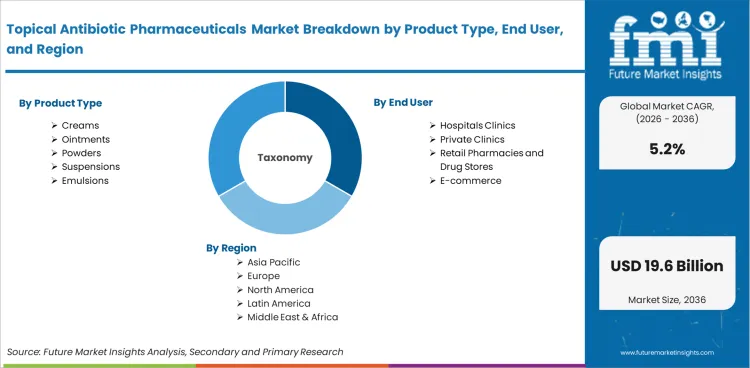
The topical antibiotic pharmaceuticals market was valued at USD 11.2 billion in 2025. The market is set to reach USD 11.8 billion by 2026-end and grow at a CAGR of 5.2% between 2026–2036 to reach USD 19.6 billion by 2036. Creams will dominate with a 29.3% share, while Hospitals Clinics will lead with a 30.9%% share.
Summary of the Topical Antibiotic Pharmaceuticals Market
- Demand and Growth Drivers
- Rising skin infection prevalence, growing wound care demand, and expanding access to dermatological treatment are creating sustained demand for topical antibiotic formulations across hospital and outpatient settings.
- Generic pharmaceutical market expansion is improving access to topical antibiotics in emerging markets where affordable treatment options are driving volume growth.
- E-commerce and direct to consumer pharmaceutical distribution are creating new access channels for OTC topical antibiotic products, expanding the addressable market beyond traditional pharmacy retail.
- Product and Segment View
- Creams are expected to account for 29.3% of the product type segment in 2026, reflecting their balanced drug delivery, patient compliance, and moisturizing properties for wound care and skin infection treatment.
- Hospitals and clinics are expected to represent 30.9% of the end user segment in 2026, driven by institutional procurement for wound care protocols, surgical site infection prevention, and dermatological treatment.
- E-commerce represents the fastest growing distribution channel as OTC topical antibiotic products become accessible through online pharmacy platforms.
- Geography and Competitive Outlook
- China is expected to lead growth at 7.0%, reflecting its expanding healthcare access, growing dermatological treatment adoption, and increasing pharmaceutical distribution coverage.
- India at 6.5% reflects growing healthcare infrastructure, expanding generic pharmaceutical access, and increasing awareness of topical infection treatment.
- Companies combining broad formulation portfolios, generic manufacturing capability, and multi-channel distribution are positioned to capture procurement.
- Analyst Opinion
- The topical antibiotic market is shaped by skin infection prevalence, wound care demand, and pharmaceutical access expansion that collectively create sustained consumption growth.
- Adoption reflects the clinical preference for topical antibiotic treatment of localized skin infections that avoids systemic antibiotic exposure and supports antimicrobial stewardship objectives.
- Growth at 5.2% CAGR reflects emerging market healthcare expansion, generic formulation accessibility, and growing e-commerce pharmaceutical distribution.
- Companies investing in enhanced formulation technology, generic portfolio expansion, and emerging market distribution are positioned to capture growing global demand.
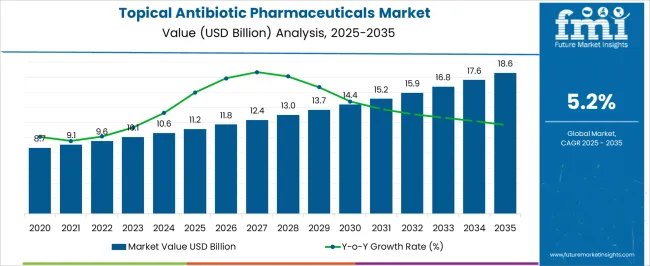
Key Takeaways, Market Size, and Forecast
- The topical antibiotic pharmaceuticals market was valued at USD1 1.2 billion in 2025.
- By 2036, the Topical Antibiotic Pharmaceuticals Market is expected to be worth USD 19.56 billion.
- From 2026 to 2036, the market is projected to expand at a CAGR of 5.2%.
- The market is projected to create an incremental opportunity of USD Billion 7.78 between 2026 and 2036.
- In 2026, creams is expected to account for 29.3% of the product type segment, driven by creams' balanced formulation that provides effective drug delivery, patient compliance, and moisturizing properties suitable for both acute wound care and chronic skin infection treatment.
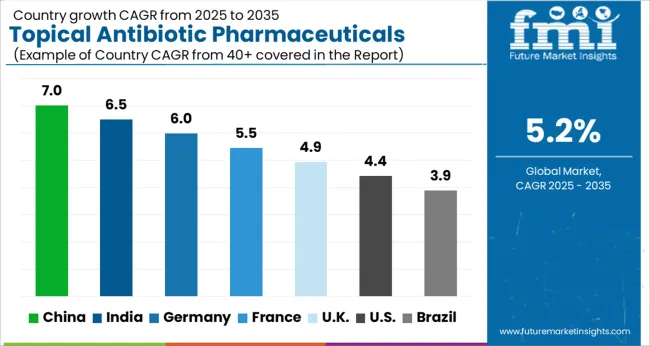
- China (7.0%) and India (6.5%) are two of the fastest growing markets in the world.
Topical Antibiotic Pharmaceuticals Market Definition
The topical antibiotic pharmaceuticals market covers prescription and over-the-counter antibiotic formulations applied directly to the skin for the treatment of bacterial infections, wound care, and skin condition management. Product forms include creams, ointments, powders, suspensions, and emulsions distributed through hospitals, clinics, retail pharmacies, and e-commerce channels.
Topical Antibiotic Pharmaceuticals Market Inclusions
Market scope includes all commercially traded topical antibiotic products categorized by product type (creams, ointments, powders, suspensions, emulsions) and end user (hospitals and clinics, private clinics, retail pharmacies and drug stores, e-commerce). Revenue coverage spans 2026 to 2036.
Topical Antibiotic Pharmaceuticals Market Exclusions
The scope does not include systemic oral or injectable antibiotics, topical antifungal products, topical antiseptics without antibiotic active ingredients, or wound dressing products without antibiotic components.
Topical Antibiotic Pharmaceuticals Market Research Methodology
- Primary Research: FMI analysts conducted interviews with manufacturers, technology specialists, and procurement professionals across key markets.
- Desk Research: Combined data from industry associations, regulatory bodies, and manufacturer disclosures.
- Market Sizing and Forecasting: Bottom up methodology aggregating segment and regional data with adoption velocity projections.
- Data Validation: Cross checked quarterly against production data, trade statistics, and manufacturer reporting.
Why is the Topical Antibiotic Pharmaceuticals Market Growing?
- Skin infection prevalence growth driven by diabetes, aging populations, and environmental exposure creates proportional demand for topical antibiotic treatments across healthcare settings.
- Generic pharmaceutical expansion in emerging markets improves access to affordable topical antibiotics, driving volume growth in China, India, and Southeast Asia.
- Antimicrobial stewardship programs favor topical over systemic antibiotic administration for localized infections, supporting market growth as healthcare systems implement stewardship protocols.
Demand for topical antibiotic pharmaceuticals is driven by the clinical requirement for localized bacterial infection treatment and wound care management. Skin infections represent one of the most common dermatological conditions, with prevalence linked to diabetes, immunosuppression, aging, and environmental exposure. Topical antibiotic application provides targeted treatment that achieves high local drug concentrations while minimizing systemic exposure and associated side effects.
The generic pharmaceutical segment represents the primary growth driver, with affordable topical antibiotic formulations expanding access in emerging markets where brand-name products may be cost-prohibitive. Generic manufacturers in India, Israel, and other countries provide cost-competitive formulations that enable healthcare systems to treat larger patient populations within budget constraints.
Distribution channel evolution is reshaping market access. E-commerce pharmaceutical platforms enable direct consumer access to OTC topical antibiotics without requiring pharmacy visits. This channel provides convenience for consumers and expands geographic reach for manufacturers, particularly in markets where physical pharmacy density limits treatment access.
Market Segmentation Analysis
- Creams represent 29.3% of the product type segment, reflecting balanced drug delivery and patient compliance properties suitable for wound care and skin infection treatment.
- Hospitals and clinics account for 30.9% of end user demand, driven by institutional wound care protocols and dermatological treatment programs.
- E-commerce is the fastest growing channel as OTC topical antibiotics become accessible through online pharmaceutical platforms.
The topical antibiotic market segments by product type and end user. By product type, the market covers creams, ointments, powders, suspensions, and emulsions. By end user, the market includes hospitals, private clinics, retail pharmacies, and e-commerce.
Insights into the Creams Product Type Segment
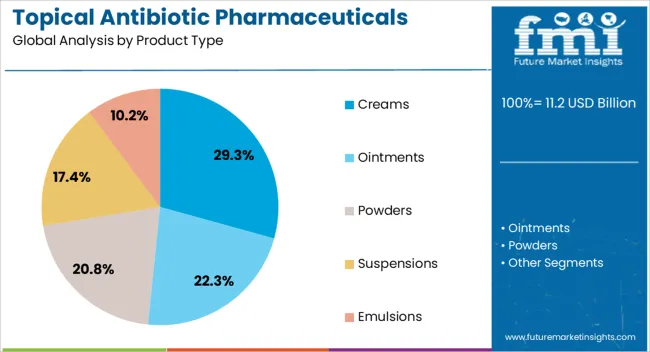
In 2026, creams are expected to account for 29.3% of the segment. Cream formulations provide a water-in-oil or oil-in-water base that combines effective drug delivery with moisturizing properties. This dual functionality supports patient compliance as the formulation provides comfort during application while delivering therapeutic antibiotic concentrations to infected tissue.
Insights into the Hospitals and Clinics End User Segment
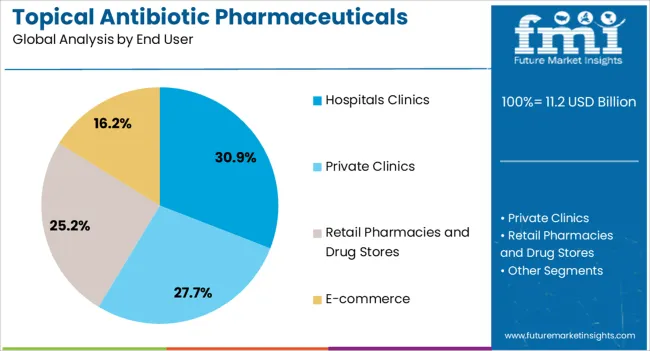
Hospitals and clinics are expected to represent 30.9% in 2026. Institutional procurement for wound care protocols, surgical site infection prevention, and inpatient dermatological treatment creates concentrated demand. Hospital formulary inclusion drives brand and generic selection decisions that determine product access across institutional healthcare settings.
Topical Antibiotic Pharmaceuticals Market Drivers, Restraints, and Opportunities
- Skin infection prevalence and wound care demand create sustained consumption of topical antibiotic formulations across healthcare settings.
- Antimicrobial resistance concerns and regulatory scrutiny of antibiotic use create compliance complexity and potential prescription restriction risks.
- Generic expansion and e-commerce distribution improve access and create volume growth in underserved markets.
The topical antibiotic market is expanding at 5.2% CAGR driven by infection prevalence, generic access, and distribution expansion. AMR concerns create regulatory complexity, while emerging market expansion provides volume growth.
Infection Prevalence Growth
Diabetes prevalence, aging populations, and chronic wound conditions create growing patient populations requiring topical antibiotic treatment for skin infections and wound management.
Antimicrobial Resistance Concerns
AMR awareness drives antimicrobial stewardship programs that favor topical over systemic antibiotic use for localized infections, supporting topical market growth while creating regulatory scrutiny of formulation practices.
Generic Market Expansion
Affordable generic topical antibiotics expand treatment access in emerging markets, driving volume growth as healthcare systems provide broader pharmaceutical coverage.
E-commerce Distribution Growth
Online pharmacy platforms expand consumer access to OTC topical antibiotic products, creating new distribution channels that supplement traditional retail pharmacy.
Analysis of Topical Antibiotic Pharmaceuticals Market By Key Countries
.webp "Top Country Growth Comparison Topical Antibiotic Pharmaceuticals Market Cagr (2026 2036)")
| Country | CAGR |
|---|---|
| China | 7.0% |
| India | 6.5% |
| Germany | 6.0% |
| France | 5.5% |
| UK | 4.9% |
| USA | 4.4% |
| Brazil | 3.9% |
- China leads at 7.0% CAGR through 2036.
- India leads at 6.5% CAGR through 2036.
- Germany leads at 6.0% CAGR through 2036.
- France leads at 5.5% CAGR through 2036.
The global topical antibiotic pharmaceuticals market is projected to grow at a CAGR of 5.2% from 2026 to 2036. The analysis covers more than 30 countries, with the leading markets detailed below.
Demand Outlook for Topical Antibiotic Pharmaceuticals Market in China
China is expected to lead growth at 7.0% through 2036, reflecting expanding healthcare access, growing dermatological treatment, and pharmaceutical distribution expansion.
- Healthcare access expansion drives treatment adoption.
- Dermatological service growth creates prescription demand.
- Pharmaceutical distribution expansion improves product availability.
Future Outlook for Topical Antibiotic Pharmaceuticals Market in India
India is expected to grow at 6.5% through 2036, supported by generic pharmaceutical leadership, expanding healthcare coverage, and growing infection treatment awareness.
- Generic pharmaceutical manufacturing drives affordable supply.
- Healthcare coverage expansion creates institutional demand.
- Infection treatment awareness increases patient utilization.
Opportunity Analysis of Topical Antibiotic Pharmaceuticals Market in Germany
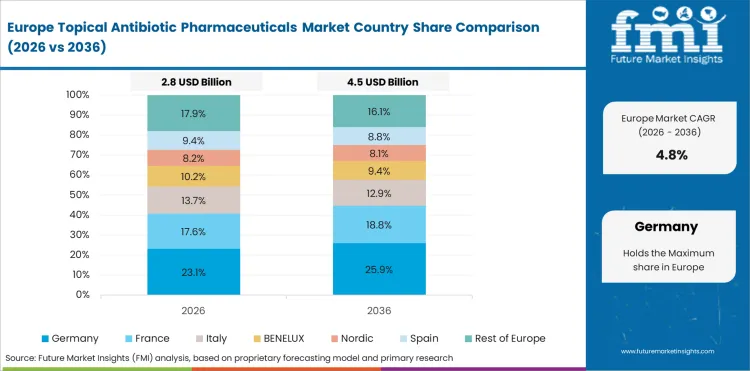
Germany is expected to grow at 6.0% through 2036, driven by advanced healthcare system, dermatological practice, and evidence-based wound care protocols.
- Advanced healthcare supports comprehensive dermatological care.
- Wound care protocols drive institutional antibiotic procurement.
- Evidence-based practice guides formulary selection decisions.
In-depth Analysis of Topical Antibiotic Pharmaceuticals Market in the United States
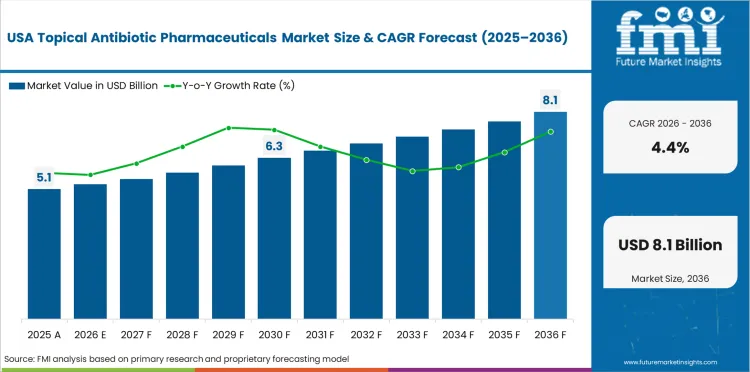
The USA is expected to grow at 4.4% through 2036, reflecting mature pharmaceutical market with OTC and prescription topical antibiotic demand.
- Mature market supports established topical antibiotic consumption.
- OTC segment drives retail and e-commerce distribution.
- Wound care market supports institutional procurement.
Sales Analysis of Topical Antibiotic Pharmaceuticals Market in the United Kingdom
The UK is expected to grow at 4.9% through 2036, supported by NHS prescribing protocols, antimicrobial stewardship programs, and community pharmacy access.
- NHS protocols drive institutional prescribing demand.
- Antimicrobial stewardship supports topical over systemic usage.
- Community pharmacy access enables patient treatment delivery.
Competitive Landscape and Strategic Positioning
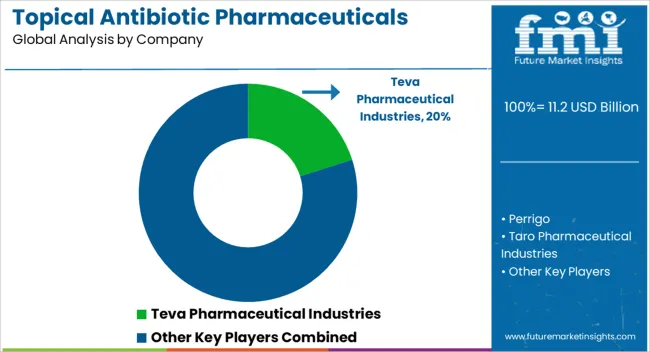
- Teva Pharmaceutical Industries leads the market with comprehensive product and service capabilities and established customer relationships.
- Multiple global and regional players compete on technology capability, certification credentials, and geographic reach.
- Emerging players are targeting specialized applications and next generation technology development.
Teva Pharmaceutical and Perrigo lead the global generic topical antibiotic market with broad formulation portfolios and established distribution across North American and European markets. Taro Pharmaceutical provides generic dermatological products.
Pfizer and GlaxoSmithKline maintain branded topical antibiotic positions while also participating in the generic segment. Both companies leverage global distribution networks and brand recognition.
Glenmark Pharmaceuticals serves emerging markets with cost competitive generic formulations. Fera and Watson provides North American generic pharmaceutical supply.
Key Companies in the Topical Antibiotic Pharmaceuticals Market
Key global companies leading the topical antibiotic pharmaceuticals market include:
- Teva Pharmaceutical Industries (Israel), Perrigo (Ireland), Taro Pharmaceutical Industries (Israel), Pfizer (USA), Glenmark Pharmaceuticals (India) hold strong positions through manufacturing scale, certification credentials, and established customer relationships.
- GlaxoSmithKline (UK), Fera and Watson Pharmaceuticals (USA) are expanding presence through regional focus and specialized product development.
Competitive Benchmarking: Topical Antibiotic Pharmaceuticals Market
| Company | Product Portfolio | Generic Capability | Distribution Network | Geographic Reach |
|---|---|---|---|---|
| Teva Pharmaceutical | High | High | Strong | Global |
| Perrigo | High | High | Strong | North America, Europe |
| Taro Pharmaceutical | High | High | Strong | North America, Global |
| Pfizer | High | High | Strong | Global |
| Glenmark Pharmaceuticals | High | High | Strong | Asia, Global |
| GlaxoSmithKline | High | High | Strong | Global |
| Fera and Watson | Medium | High | Moderate | North America |
Source: Future Market Insights competitive analysis, 2026.
Key Players in the Topical Antibiotic Pharmaceuticals Market
Major Global Players
- Teva Pharmaceutical Industries (Israel)
- Perrigo (Ireland)
- Taro Pharmaceutical Industries (Israel)
- Pfizer (USA)
- Glenmark Pharmaceuticals (India)
Emerging Players/Startups
- GlaxoSmithKline (UK)
- Fera and Watson Pharmaceuticals (USA)
Report Scope and Coverage
| Parameter | Details |
|---|---|
| Quantitative Units | USD Billion 11.78 to USD Billion 19.56, at a CAGR of 5.2% |
| Market Definition | The topical antibiotic pharmaceuticals market covers prescription and over-the-counter antibiotic formulations applied directly to the skin for the treatment of bacterial infections, wound care, and skin condition management. Product forms include creams, ointments, powders, suspensions, and emulsions distributed through hospitals, clinics, retail pharmacies, and e-commerce channels. |
| Regions Covered | North America, Latin America, Europe, East Asia, South Asia and Pacific, Middle East and Africa |
| Countries Covered | China, India, Germany, France, UK, USA, Brazil, and 30 plus countries |
| Key Companies Profiled | Teva Pharmaceutical Industries, Perrigo, Taro Pharmaceutical Industries, Pfizer, Glenmark Pharmaceuticals, GlaxoSmithKline, Fera and Watson Pharmaceuticals |
| Forecast Period | 2026 to 2036 |
| Approach | Hybrid bottom up and top down methodology starting with verified transaction data, projecting adoption velocity across segments and regions. |
Segmentation
Topical Antibiotic Pharmaceuticals Market Segmented by Product Type:
- Creams
- Ointments
- Powders
- Suspensions
- Emulsions
Topical Antibiotic Pharmaceuticals Market Segmented by End User:
- Hospitals Clinics
- Private Clinics
- Retail Pharmacies and Drug Stores
- E-commerce
Topical Antibiotic Pharmaceuticals Market by Region:
- North America
- USA
- Canada
- Mexico
- Latin America
- Brazil
- Chile
- Rest of Latin America
- Western Europe
- Germany
- UK
- Italy
- Spain
- France
- Nordic
- BENELUX
- Rest of Western Europe
- Eastern Europe
- Russia
- Poland
- Hungary
- Balkan & Baltic
- Rest of Eastern Europe
- East Asia
- China
- Japan
- South Korea
- South Asia and Pacific
- India
- ASEAN
- Australia & New Zealand
- Rest of South Asia and Pacific
- Middle East & Africa
- Kingdom of Saudi Arabia
- Other GCC Countries
- Turkiye
- South Africa
- Other African Union
- Rest of Middle East & Africa
Research Sources and Bibliography
- 1. World Health Organization. (2025). WHO Guidelines on Antimicrobial Stewardship: Topical Antibiotic Use. WHO.
- 2. USA Food and Drug Administration. (2024). FDA Guidance on Topical Antibiotic Drug Products: Chemistry and Safety. FDA.
- 3. European Medicines Agency. (2025). EMA Guidelines on Topical Antimicrobial Agents. EMA.
- 4. Centers for Disease Control and Prevention. (2024). CDC Antibiotic Resistance Threats Report. CDC.
- 5. International Wound Care Association. (2025). IWCA Best Practice Guidelines for Topical Antibiotic Use in Wound Care. IWCA.
This bibliography is provided for reader reference. The full Future Market Insights report contains the complete reference list.
This Report Answers
- Estimating the size of the market and projected revenue from 2026 to 2036.
- Segmentation by product type, end user, and region.
- Insights across more than 30 country markets.
- Analysis of formulation technology and generic pharmaceutical trends.
- Assessment of the competitive landscape and manufacturer positioning.
- Identification of investment opportunities in generic expansion, e-commerce distribution, and emerging market access.
- Tracking antimicrobial resistance developments and regulatory impacts.
- Delivery of data in PDF and Excel formats.
Frequently Asked Questions
What is the global market demand for Topical Antibiotic Pharmaceuticals in 2026?
In 2026, the global topical antibiotic pharmaceuticals market is expected to be worth USD Billion 11.78 billion.
How big will the Topical Antibiotic Pharmaceuticals Market be in 2036?
By 2036, the topical antibiotic pharmaceuticals market is expected to be worth USD Billion 19.56 billion.
How much is demand for Topical Antibiotic Pharmaceuticals expected to grow between 2026 and 2036?
Between 2026 and 2036, demand is expected to grow at a CAGR of 5.2%.
Which product type segment is expected to lead in 2026?
Creams is expected to account for 29.3% of the product type segment in 2026, driven by creams' balanced formulation that provides effective drug delivery, patient compliance, and moisturizing properties suitable for both acute wound care and chronic skin infection treatment.
What is causing demand to rise in China?
China is expected to grow at 7.0% CAGR through 2036. Healthcare access expansion drives treatment adoption.
What is causing demand to rise in India?
India is expected to grow at 6.5% CAGR through 2036. Generic pharmaceutical manufacturing drives affordable supply.
What does this report mean by 'Topical Antibiotic Pharmaceuticals Market definition'?
The topical antibiotic pharmaceuticals market covers prescription and over-the-counter antibiotic formulations applied directly to the skin for the treatment of bacterial infections, wound care, and skin condition management. Product forms include creams, ointments, powders, suspensions, and emulsions distributed through hospitals, clinics, retail pharmacies, and e-commerce channels.
How does FMI make the Topical Antibiotic Pharmaceuticals forecast and validate it?
Forecasting models use a hybrid bottom up and top down approach, starting with verified transaction data and validating against industry production statistics and manufacturer disclosures.
Preview the report firsthand - request a free sample
Get SampleGet the brochure for pricing and purchase details.
Get PDFTable of Content
- Executive Summary
- Global Market Outlook
- Demand-side Trends
- Supply-side Trends
- Technology Roadmap Analysis
- Analysis and Recommendations
- Market Overview
- Market Coverage / Taxonomy
- Market Definition / Scope / Limitations
- Research Methodology
- Chapter Orientation
- Analytical Lens and Working Hypotheses
- Market Structure, Signals, and Trend Drivers
- Company Annual and Sustainability Reports
- Peer-reviewed Journals and Academic Literature
- Corporate Websites, Product Literature, and Technical Notes
- Earnings Decks and Investor Briefings
- Statutory Filings and Regulatory Disclosures
- Technical White Papers and Standards Notes
- Trade Journals, Industry Magazines, and Analyst Briefs
- Conference Proceedings, Webinars, and Seminar Materials
- Government Statistics Portals and Public Data Releases
- Press Releases and Reputable Media Coverage
- Specialist Newsletters and Curated Briefings
- Sector Databases and Reference Repositories
- FMI Internal Proprietary Databases and Historical Market Datasets
- Subscription Datasets and Paid Sources
- Social Channels, Communities, and Digital Listening Inputs
- Additional Desk Sources
- Expert Input and Fieldwork (Primary Evidence)
- Primary Modes
- Qualitative Interviews and Expert Elicitation
- Quantitative Surveys and Structured Data Capture
- Blended Approach
- Why Primary Evidence is Used
- Field Techniques
- Interviews
- Surveys
- Focus Groups
- Observational and In-context Research
- Social and Community Interactions
- Stakeholder Universe Engaged
- C-suite Leaders
- Board Members
- Presidents and Vice Presidents
- R&D and Innovation Heads
- Technical Specialists
- Domain Subject-matter Experts
- Scientists
- Physicians and Other Healthcare Professionals
- Governance, Ethics, and Data Stewardship
- Research Ethics
- Data Integrity and Handling
- Primary Modes
- Tooling, Models, and Reference Databases
- Data Engineering and Model Build
- Data Acquisition and Ingestion
- Cleaning, Normalisation, and Verification
- Synthesis, Triangulation, and Analysis
- Quality Assurance and Audit Trail
- Market Background
- Market Dynamics
- Drivers
- Restraints
- Opportunity
- Trends
- Scenario Forecast
- Demand in Optimistic Scenario
- Demand in Likely Scenario
- Demand in Conservative Scenario
- Opportunity Map Analysis
- Product Life Cycle Analysis
- Supply Chain Analysis
- Investment Feasibility Matrix
- Value Chain Analysis
- PESTLE and Porter’s Analysis
- Regulatory Landscape
- Regional Parent Market Outlook
- Production and Consumption Statistics
- Import and Export Statistics
- Market Dynamics
- Global Market Analysis 2021 to 2025 and Forecast, 2026 to 2036
- Historical Market Size Value (USD Million) Analysis, 2021 to 2025
- Current and Future Market Size Value (USD Million) Projections, 2026 to 2036
- Y-o-Y Growth Trend Analysis
- Absolute $ Opportunity Analysis
- Global Market Pricing Analysis 2021 to 2025 and Forecast 2026 to 2036
- Global Market Analysis 2021 to 2025 and Forecast 2026 to 2036, By Product Type
- Introduction / Key Findings
- Historical Market Size Value (USD Million) Analysis By Product Type , 2021 to 2025
- Current and Future Market Size Value (USD Million) Analysis and Forecast By Product Type , 2026 to 2036
- Creams
- Ointments
- Powders
- Suspensions
- Emulsions
- Creams
- Y-o-Y Growth Trend Analysis By Product Type , 2021 to 2025
- Absolute $ Opportunity Analysis By Product Type , 2026 to 2036
- Global Market Analysis 2021 to 2025 and Forecast 2026 to 2036, By End User
- Introduction / Key Findings
- Historical Market Size Value (USD Million) Analysis By End User, 2021 to 2025
- Current and Future Market Size Value (USD Million) Analysis and Forecast By End User, 2026 to 2036
- Hospitals Clinics
- Private Clinics
- Retail Pharmacies and Drug Stores
- E-commerce
- Hospitals Clinics
- Y-o-Y Growth Trend Analysis By End User, 2021 to 2025
- Absolute $ Opportunity Analysis By End User, 2026 to 2036
- Global Market Analysis 2021 to 2025 and Forecast 2026 to 2036, By Region
- Introduction
- Historical Market Size Value (USD Million) Analysis By Region, 2021 to 2025
- Current Market Size Value (USD Million) Analysis and Forecast By Region, 2026 to 2036
- North America
- Latin America
- Western Europe
- Eastern Europe
- East Asia
- South Asia and Pacific
- Middle East & Africa
- Market Attractiveness Analysis By Region
- North America Market Analysis 2021 to 2025 and Forecast 2026 to 2036, By Country
- Historical Market Size Value (USD Million) Trend Analysis By Market Taxonomy, 2021 to 2025
- Market Size Value (USD Million) Forecast By Market Taxonomy, 2026 to 2036
- By Country
- USA
- Canada
- Mexico
- By Product Type
- By End User
- By Country
- Market Attractiveness Analysis
- By Country
- By Product Type
- By End User
- Key Takeaways
- Latin America Market Analysis 2021 to 2025 and Forecast 2026 to 2036, By Country
- Historical Market Size Value (USD Million) Trend Analysis By Market Taxonomy, 2021 to 2025
- Market Size Value (USD Million) Forecast By Market Taxonomy, 2026 to 2036
- By Country
- Brazil
- Chile
- Rest of Latin America
- By Product Type
- By End User
- By Country
- Market Attractiveness Analysis
- By Country
- By Product Type
- By End User
- Key Takeaways
- Western Europe Market Analysis 2021 to 2025 and Forecast 2026 to 2036, By Country
- Historical Market Size Value (USD Million) Trend Analysis By Market Taxonomy, 2021 to 2025
- Market Size Value (USD Million) Forecast By Market Taxonomy, 2026 to 2036
- By Country
- Germany
- UK
- Italy
- Spain
- France
- Nordic
- BENELUX
- Rest of Western Europe
- By Product Type
- By End User
- By Country
- Market Attractiveness Analysis
- By Country
- By Product Type
- By End User
- Key Takeaways
- Eastern Europe Market Analysis 2021 to 2025 and Forecast 2026 to 2036, By Country
- Historical Market Size Value (USD Million) Trend Analysis By Market Taxonomy, 2021 to 2025
- Market Size Value (USD Million) Forecast By Market Taxonomy, 2026 to 2036
- By Country
- Russia
- Poland
- Hungary
- Balkan & Baltic
- Rest of Eastern Europe
- By Product Type
- By End User
- By Country
- Market Attractiveness Analysis
- By Country
- By Product Type
- By End User
- Key Takeaways
- East Asia Market Analysis 2021 to 2025 and Forecast 2026 to 2036, By Country
- Historical Market Size Value (USD Million) Trend Analysis By Market Taxonomy, 2021 to 2025
- Market Size Value (USD Million) Forecast By Market Taxonomy, 2026 to 2036
- By Country
- China
- Japan
- South Korea
- By Product Type
- By End User
- By Country
- Market Attractiveness Analysis
- By Country
- By Product Type
- By End User
- Key Takeaways
- South Asia and Pacific Market Analysis 2021 to 2025 and Forecast 2026 to 2036, By Country
- Historical Market Size Value (USD Million) Trend Analysis By Market Taxonomy, 2021 to 2025
- Market Size Value (USD Million) Forecast By Market Taxonomy, 2026 to 2036
- By Country
- India
- ASEAN
- Australia & New Zealand
- Rest of South Asia and Pacific
- By Product Type
- By End User
- By Country
- Market Attractiveness Analysis
- By Country
- By Product Type
- By End User
- Key Takeaways
- Middle East & Africa Market Analysis 2021 to 2025 and Forecast 2026 to 2036, By Country
- Historical Market Size Value (USD Million) Trend Analysis By Market Taxonomy, 2021 to 2025
- Market Size Value (USD Million) Forecast By Market Taxonomy, 2026 to 2036
- By Country
- Kingdom of Saudi Arabia
- Other GCC Countries
- Turkiye
- South Africa
- Other African Union
- Rest of Middle East & Africa
- By Product Type
- By End User
- By Country
- Market Attractiveness Analysis
- By Country
- By Product Type
- By End User
- Key Takeaways
- Key Countries Market Analysis
- USA
- Pricing Analysis
- Market Share Analysis, 2025
- By Product Type
- By End User
- Canada
- Pricing Analysis
- Market Share Analysis, 2025
- By Product Type
- By End User
- Mexico
- Pricing Analysis
- Market Share Analysis, 2025
- By Product Type
- By End User
- Brazil
- Pricing Analysis
- Market Share Analysis, 2025
- By Product Type
- By End User
- Chile
- Pricing Analysis
- Market Share Analysis, 2025
- By Product Type
- By End User
- Germany
- Pricing Analysis
- Market Share Analysis, 2025
- By Product Type
- By End User
- UK
- Pricing Analysis
- Market Share Analysis, 2025
- By Product Type
- By End User
- Italy
- Pricing Analysis
- Market Share Analysis, 2025
- By Product Type
- By End User
- Spain
- Pricing Analysis
- Market Share Analysis, 2025
- By Product Type
- By End User
- France
- Pricing Analysis
- Market Share Analysis, 2025
- By Product Type
- By End User
- India
- Pricing Analysis
- Market Share Analysis, 2025
- By Product Type
- By End User
- ASEAN
- Pricing Analysis
- Market Share Analysis, 2025
- By Product Type
- By End User
- Australia & New Zealand
- Pricing Analysis
- Market Share Analysis, 2025
- By Product Type
- By End User
- China
- Pricing Analysis
- Market Share Analysis, 2025
- By Product Type
- By End User
- Japan
- Pricing Analysis
- Market Share Analysis, 2025
- By Product Type
- By End User
- South Korea
- Pricing Analysis
- Market Share Analysis, 2025
- By Product Type
- By End User
- Russia
- Pricing Analysis
- Market Share Analysis, 2025
- By Product Type
- By End User
- Poland
- Pricing Analysis
- Market Share Analysis, 2025
- By Product Type
- By End User
- Hungary
- Pricing Analysis
- Market Share Analysis, 2025
- By Product Type
- By End User
- Kingdom of Saudi Arabia
- Pricing Analysis
- Market Share Analysis, 2025
- By Product Type
- By End User
- Turkiye
- Pricing Analysis
- Market Share Analysis, 2025
- By Product Type
- By End User
- South Africa
- Pricing Analysis
- Market Share Analysis, 2025
- By Product Type
- By End User
- USA
- Market Structure Analysis
- Competition Dashboard
- Competition Benchmarking
- Market Share Analysis of Top Players
- By Regional
- By Product Type
- By End User
- Competition Analysis
- Competition Deep Dive
- Teva Pharmaceutical Industries
- Overview
- Product Portfolio
- Profitability by Market Segments (Product/Age /Sales Channel/Region)
- Sales Footprint
- Strategy Overview
- Marketing Strategy
- Product Strategy
- Channel Strategy
- Perrigo
- Taro Pharmaceutical Industries
- Pfizer
- Glenmark Pharmaceuticals
- GlaxoSmithKline
- Fera and Watson pharmaceuticals
- Teva Pharmaceutical Industries
- Competition Deep Dive
- Assumptions & Acronyms Used


