

- Industry Size (2026)
- USD 2.1 Bn
- Forecast (2036)
- USD 3.5 Bn
- CAGR (2026 to 2036)
- 5.3%
Turret Handler Market Forecast and Outlook 2026 to 2036
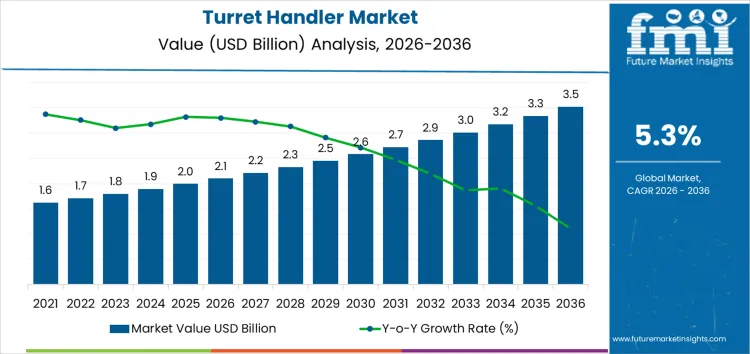
The turret handler market is projected to grow from USD 2.1 billion in 2026 to USD 3.5 billion by 2036, with a CAGR of 5.3%. This growth is largely driven by the increasing demand for high-density storage solutions in industries like e-commerce, retail, food & beverage, pharmaceuticals, and cold storage. Turret handlers are becoming integral in facilities with narrow aisles, as they enhance throughput, space utilization, and safety. The rising adoption of automation is also a key factor, with technologies like warehouse management systems (WMS), telematics, and real-time fleet monitoring playing a central role in improving operational efficiency. These technologies allow businesses to better track assets and improve productivity.
Quick Stats for Turret Handler Market
- Turret Handler Market Value (2026): USD 2.1 billion
- Turret Handler Market Forecast Value (2036): USD 3.5 billion
- Turret Handler Market Forecast CAGR: 5.3%
- Leading Package Type in Turret Handler Market: QFN or QFP (32% share)
- Key Growth Region in Turret Handler Market: Asia Pacific (led by China at 6.6% CAGR)
- Key Players in Turret Handler Market: Cohu, Advantest, Teradyne, Chroma ATE, ASMPT
A noticeable shift toward electric and hybrid turret handlers, which offer lower emissions and operating costs compared to traditional diesel models. Advances in ergonomics and safety systems, including collision detection and stability control, are making turret handlers more operator-friendly and reducing workplace accidents. The emergence of autonomous turret handling systems and retrofittable automation kits is also contributing to the market’s growth, allowing businesses to upgrade their facilities to fully automated operations with minimal infrastructure changes. As industries prioritize flexibility, speed, and safety in material handling, turret handlers are increasingly seen as essential tools for modernizing production and logistics environments.
Turret Handler Market Key Takeaways
| Metric | Value |
|---|---|
| Industry Value (2026) | USD 2.1 billion |
| Forecast Value (2036) | USD 3.5 billion |
| Forecast CAGR (2026-2036) | 5.3% |
How is the Global Turret Handler Market Evolving?
The global turret handler market is experiencing nuanced dynamics as the need for safe, efficient material handling in industrial environments remains strong. Turret handlers are specialized equipment used to move and position heavy loads like rolls of steel, coils, or other large materials especially in sectors like metals, manufacturing, and logistics. These machines are designed to improve operational productivity, reduce manual labor, and enhance workplace safety by handling bulky items with precision and stability. As industries focus on automation and efficient plant operations, turret handlers play a vital role in streamlining workflows and reducing cycle times.
Despite an overall demand for upgraded material handling solutions, the forecast value appearing lower than the current base may reflect shifts in adoption patterns, such as market saturation in certain industrial regions or transitions toward alternative handling technologies. The steady CAGR indicates continued investment in turret handler systems where heavy load manipulation remains necessary, especially in facilities upgrading older equipment or integrating connected, safety‑oriented handling solutions.
The sector is expected to maintain relevance as production environments modernize and emphasize ergonomic, compliant material handling. Challenges such as balancing capital expenditure with performance returns, integrating handlers with broader automation systems, and evolving safety standards may shape adoption rates. The focus on operational efficiency and industrial safety will continue to support demand for turret handlers in facilities that require reliable heavy‑load movement.
What Is the Segment-Wise Analysis for the Global Turret Handler Market?
The global turret handler market is segmented by package type and end user. QFN or QFP packages lead the market with a 32% share, driven by their widespread use in consumer electronics and automotive applications. BGA or FCBGA, SIP or MCM, and other package types follow, each offering unique advantages in terms of performance and miniaturization for specific applications. In terms of end users, OSATs dominate with a 28% share, as they require turret handlers for efficient and precise packaging solutions. IDMs, fabless companies, and test houses also represent significant shares, utilizing turret handlers for their packaging and testing needs.
How Do QFN or QFP Packages Lead the Global Turret Handler Market?

QFN or QFP packages hold a 32% share in the global turret handler market, driven by their widespread use in applications such as consumer electronics and automotive products. How do QFN or QFP packages impact the market? These packages are highly valued for their compact design and efficient performance, making them ideal for high-density applications where space and power consumption are critical. As demand for miniaturized, high-performance devices continues to grow across various industries, the need for precise and reliable packaging solutions, such as turret handlers, also rises. Turret handlers ensure that QFN or QFP packages are accurately and efficiently processed, enabling consistent quality in the manufacturing process.
How Do OSATs Contribute to the Global Turret Handler Market?

OSATs hold a 28% share in the global turret handler market due to their critical role in semiconductor packaging and assembly services. How do OSATs influence the market? OSATs depend on turret handlers to deliver high-precision packaging solutions for a variety of semiconductor packages, including QFN, QFP, and BGA. Turret handlers allow for the efficient and accurate handling of packages during the assembly process, ensuring the production of reliable and functional components. As the semiconductor industry continues to expand and the demand for more complex packages rises, OSATs increasingly rely on advanced handling solutions like turret handlers to meet high-quality standards and maintain production efficiency.
What Are the Key Dynamics for the Turret Handler Market?
Turret handlers specialized forklifts with rotating masts enable fast handling in narrow aisles and dense storage layouts, supporting higher throughput and space utilization. Growth in e commerce, retail distribution, and cold storage further drives demand as facilities seek flexible, high performance equipment that reduces labor costs and improves safety. Investments in smart intralogistics systems and integration with warehouse management systems (WMS) are accelerating deployment of turret handlers in modern supply chains.
What Are the Key Drivers for the Turret Handler Market?
The turret handler market is primarily driven by the need for high density storage and efficient pallet handling in warehouses with narrow aisles and limited space. Industries such as retail, food & beverage, pharmaceuticals, and cold storage increasingly prefer turret handlers because they allow forklifts to operate in very narrow aisles (VNA) without compromising load stability or operator visibility. The rise of e commerce and omni channel fulfillment models also increases demand for agile material handling solutions that boost throughput and inventory accuracy. Adoption is further supported by labor shortages, pushing companies to invest in automation to maintain productivity.
What Key Trends Are Shaping the Turret Handler Market?
Key trends include the push toward automation and connectivity such as integration with warehouse management systems (WMS), telematics, and real time fleet monitoring to improve productivity and asset utilization. There’s growing interest in electric and hybrid turret handlers that reduce emissions and operating costs compared to diesel models. Manufacturers are also offering ergonomic enhancements and advanced safety systems like collision detection and stability control to improve operator comfort and reduce incidents. Finally, the rise of autonomous turret handling solutions and retrofittable automation kits is enabling warehouses to scale toward fully automated operations without complete infrastructure rebuilds.
What is the Growth Outlook for the Turret Handler Market by Country?
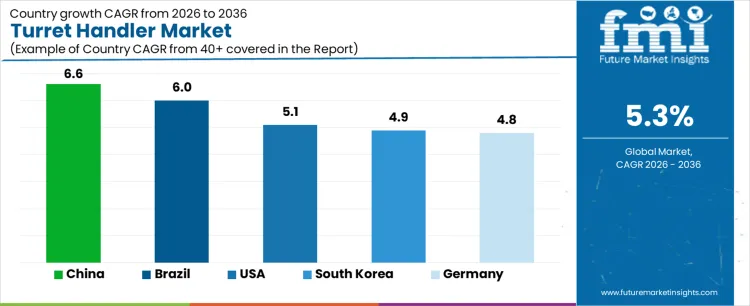
| Country | CAGR (%) |
|---|---|
| USA | 5.1% |
| South Korea | 4.9% |
| Germany | 4.8% |
| China | 6.6% |
| Brazil | 6% |
The turret handler market is steadily growing, with China leading at a 6.6% CAGR, driven by its large-scale manufacturing sector and the rising need for automation in production lines. Brazil follows with 6%, supported by the expansion of its industrial and automotive sectors. The USA’s market grows at 5.1%, backed by the adoption of automated handling systems in various industries, particularly in the automotive and material handling sectors. South Korea’s market grows at 4.9%, driven by its advanced semiconductor and electronics industries. Germany’s market grows at 4.8%, with strong demand from automotive and manufacturing sectors for efficient material handling solutions.
Why is China Leading in the Turret Handler Market?
China’s turret handler market is growing at 6.6%, driven by the country’s robust industrial growth and increasing automation in manufacturing. As the largest manufacturing hub globally, China faces rising demand for advanced material handling solutions like turret handlers to optimize production lines. These systems are crucial for industries such as automotive, electronics, and consumer goods, where fast and efficient material handling is essential. China’s initiatives to improve industrial efficiency and productivity through automation are propelling the adoption of turret handlers. With the country’s expanding manufacturing sector, especially in high-tech industries, the need for efficient and reliable material handling solutions is set to continue growing. As China modernizes its industrial base and moves toward advanced manufacturing techniques, the turret handler market will remain strong, supported by rising demand for automation and optimization.
What is Driving the Growth of the Turret Handler Market in Brazil?
Brazil’s turret handler market is growing at 6%, driven by the expansion of its industrial and automotive sectors. As Brazil’s manufacturing industry evolves, the need for efficient and cost-effective material handling solutions is rising. Turret handlers are particularly valuable in automotive and heavy manufacturing, where precise material management is essential for smooth production processes. As Brazil continues to industrialize and modernize, businesses are increasingly adopting automated systems like turret handlers to meet the demand for high-quality production while reducing costs. The government’s focus on improving infrastructure and boosting industrial output further fuels this growth. The global shift toward more sustainable and efficient manufacturing practices encourages the use of advanced automation technologies in Brazil’s growing industrial sectors, leading to increased demand for turret handlers.
How is the Turret Handler Market Expanding in the USA?
The USA’s turret handler market is growing at 5.1%, driven by the rising demand for automated material handling solutions in industries such as automotive, aerospace, and logistics. With industries focusing on improving production efficiency, turret handlers are increasingly being adopted to manage materials efficiently during manufacturing processes. These systems enhance speed and accuracy, reducing production time and costs. The USA’s emphasis on automation and advanced manufacturing techniques, particularly in high-precision sectors like aerospace and automotive, is boosting the market for turret handlers. As businesses look for ways to streamline operations and meet global production standards, the need for turret handlers continues to rise. With ongoing technological advancements and a growing focus on industrial efficiency, the USA’s market for turret handlers is expected to continue growing steadily.
What is Contributing to the Growth of the Turret Handler Market in South Korea?
South Korea’s turret handler market is growing at 4.9%, fueled by the country’s highly developed semiconductor, electronics, and automotive industries. South Korea’s industrial sectors are increasingly adopting automation technologies to streamline production and enhance product quality. Turret handlers, which offer precise and efficient material handling, are essential in high-tech manufacturing sectors, particularly for electronics and automotive production. As South Korea continues to lead in technology innovation and manufacturing efficiency, the demand for turret handlers grows. These systems help optimize production lines by improving material flow and minimizing production delays. With South Korea’s commitment to advancing its industrial capabilities and fostering innovation, the market for turret handlers is expected to expand steadily, supported by increased adoption of automation and manufacturing technologies.
What is Driving the Growth of the Turret Handler Market in Germany?
Germany’s turret handler market is growing at 4.8%, driven by the country’s strong industrial base, particularly in automotive, machinery, and manufacturing. As a global leader in high-quality industrial production, Germany has a high demand for automation technologies to ensure efficiency and precision in manufacturing processes. Turret handlers are crucial in these industries for managing materials during production, particularly in the automotive sector. With a focus on optimizing workflows and meeting strict regulatory standards, the demand for turret handlers is increasing. Germany’s emphasis on industrial innovation and commitment to maintaining high standards in manufacturing is driving the adoption of advanced material handling solutions. As industries continue to prioritize efficiency and automation, Germany’s market for turret handlers is expected to continue growing steadily.
What Are the Competitive Dynamics in the Turret Handler Market?
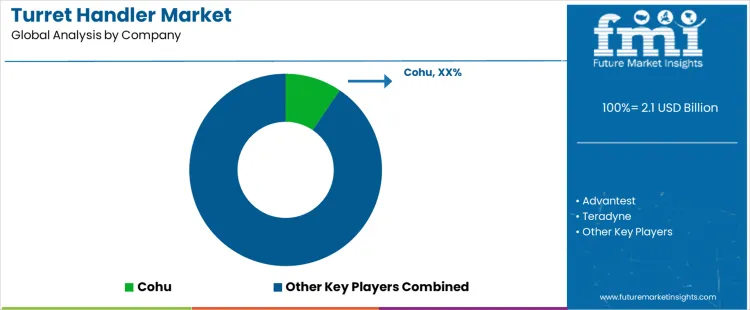
In the turret handler market Cohu, Advantest, Teradyne, Chroma ATE, ASMPT, Hon Precision, Microjet, Technoprobe, regional handler OEMs, and ATEC compete with product brochures that emphasize precision part handling, high speed exchange, and integration with test and assembly systems. Cohu materials present turret handlers engineered for reliable part transfer with clear specs on cycle rates, interface options, and footprint. Visual diagrams and configuration guides are used to help test engineers assess system fit. Advantest collateral highlights turret units designed to work seamlessly with complex ATE platforms. Performance summaries and connectivity notes support selection in high mix manufacturing.
Teradyne brochures focus on modular turret handlers with flexible tooling and quick changeovers, including technical tables showing throughput metrics and setup times. Chroma ATE product briefs emphasize adaptive handling solutions with concise application recommendations for semiconductor and electronic test flows. Technical summaries and interface diagrams assist integration planning. ASMPT materials present turret handler designs with precision motion control and scalability for back end assembly environments. Charts showing reliability and maintenance intervals are included to aid procurement decisions.
Hon Precision and Microjet literature describe compact and customizable handler solutions suited to space constrained lines, with product sheets outlining key specifications and common use cases. Technoprobe collateral highlights precision probe to handler interfaces, with clear guidance on synchronous operation and probing accuracy. Regional handler OEMs are featured with tailored solutions that offer localized support and rapid delivery, appealing to manufacturers seeking quick deployment. ATEC brochures present turret handler systems with focus on robust build quality and user friendly programming.
Key Players in Turret Handler Market
- Cohu
- Advantest
- Teradyne
- Chroma ATE
- ASMPT
- Hon Precision
- Microjet
- Technoprobe
- Regional handler OEMs
- ATEC
Scope of Report
| Items | Values |
|---|---|
| Quantitative Units (2026) | USD billion |
| Package Type | QFN or QFP, BGA or FCBGA, SIP/MCM, Other |
| Temperature Capability | Ambient, Hot, Cold, Tri-Temp |
| End User | OSATs, IDMs, Fabless or Test Houses, Other |
| Regions Covered | Asia Pacific, Europe, North America, Latin America, Middle East & Africa |
| Countries Covered | USA, China, Japan, South Korea, India, Australia & New Zealand, ASEAN, Germany, UK, France, Italy, Spain, Nordic, BENELUX, Brazil, Chile, Mexico, Saudi Arabia, Other GCC Countries, Turkey, South Africa, Other African Union |
| Key Companies Profiled | Cohu, Advantest, Teradyne, Chroma ATE, ASMPT, Hon Precision, Microjet, Technoprobe, Regional handler OEMs, ATEC |
| Additional Attributes | Dollar sales by package type, temperature capability, end user, and region; regional CAGR and growth outlook. |
Turret Handler Market by Key Segments
Package Type
- QFN or QFP
- BGA or FCBGA
- SIP/MCM
- Other
Temperature Capability
- Ambient
- Hot
- Cold
- Tri-Temp
End User
- OSATs
- IDMs
- Fabless or Test Houses
- Other
Region
- Asia Pacific
- China
- Japan
- South Korea
- India
- Australia & New Zealand
- ASEAN
- Rest of Asia Pacific
- Europe
- Germany
- United Kingdom
- France
- Italy
- Spain
- Nordic
- BENELUX
- Rest of Europe
- North America
- United States
- Canada
- Mexico
- Latin America
- Brazil
- Chile
- Rest of Latin America
- Middle East & Africa
- Kingdom of Saudi Arabia
- Other GCC Countries
- Turkey
- South Africa
- Other African Union
- Rest of Middle East & Africa
Frequently Asked Questions
How big is the turret handler market in 2026?
The global turret handler market is estimated to be valued at USD 2.1 billion in 2026.
What will be the size of turret handler market in 2036?
The market size for the turret handler market is projected to reach USD 3.5 billion by 2036.
How much will be the turret handler market growth between 2026 and 2036?
The turret handler market is expected to grow at a 5.3% CAGR between 2026 and 2036.
What are the key packaging types in the turret handler market?
The key packaging types in turret handler market are QFN or QFP, BGA or FCBGA, SIP or MCM, and other.
Which end user segment to contribute significant share in the turret handler market in 2026?
In terms of end user, OSATs segment to command 28% share in the turret handler market in 2026.
Preview the report firsthand - request a free sample
Get SampleGet the brochure for pricing and purchase details.
Get PDFTable of Content
- Executive Summary
- Global Market Outlook
- Demand-side Trends
- Supply-side Trends
- Technology Roadmap Analysis
- Analysis and Recommendations
- Market Overview
- Market Coverage / Taxonomy
- Market Definition / Scope / Limitations
- Market Background
- Market Dynamics
- Drivers
- Restraints
- Opportunity
- Trends
- Scenario Forecast
- Demand in Optimistic Scenario
- Demand in Likely Scenario
- Demand in Conservative Scenario
- Opportunity Map Analysis
- Product Life Cycle Analysis
- Supply Chain Analysis
- Investment Feasibility Matrix
- Value Chain Analysis
- PESTLE and Porter’s Analysis
- Regulatory Landscape
- Regional Parent Market Outlook
- Production and Consumption Statistics
- Import and Export Statistics
- Market Dynamics
- Global Market Analysis 2021 to 2025 and Forecast, 2026 to 2036
- Historical Market Size Value (USD Million) Analysis, 2021 to 2025
- Current and Future Market Size Value (USD Million) Projections, 2026 to 2036
- Y-o-Y Growth Trend Analysis
- Absolute $ Opportunity Analysis
- Global Market Pricing Analysis 2021 to 2025 and Forecast 2026 to 2036
- Global Market Analysis 2021 to 2025 and Forecast 2026 to 2036, By Package Type
- Introduction / Key Findings
- Historical Market Size Value (USD Million) Analysis By Package Type , 2021 to 2025
- Current and Future Market Size Value (USD Million) Analysis and Forecast By Package Type , 2026 to 2036
- QFN or QFP
- BGA or FCBGA
- SIP or MCM
- Other
- QFN or QFP
- Y-o-Y Growth Trend Analysis By Package Type , 2021 to 2025
- Absolute $ Opportunity Analysis By Package Type , 2026 to 2036
- Global Market Analysis 2021 to 2025 and Forecast 2026 to 2036, By Temperature Capability
- Introduction / Key Findings
- Historical Market Size Value (USD Million) Analysis By Temperature Capability, 2021 to 2025
- Current and Future Market Size Value (USD Million) Analysis and Forecast By Temperature Capability, 2026 to 2036
- Ambient
- Hot
- Cold
- Tri-Temp
- Ambient
- Y-o-Y Growth Trend Analysis By Temperature Capability, 2021 to 2025
- Absolute $ Opportunity Analysis By Temperature Capability, 2026 to 2036
- Global Market Analysis 2021 to 2025 and Forecast 2026 to 2036, By End User
- Introduction / Key Findings
- Historical Market Size Value (USD Million) Analysis By End User, 2021 to 2025
- Current and Future Market Size Value (USD Million) Analysis and Forecast By End User, 2026 to 2036
- OSATs
- IDMs
- Fabless or Test Houses
- Other
- OSATs
- Y-o-Y Growth Trend Analysis By End User, 2021 to 2025
- Absolute $ Opportunity Analysis By End User, 2026 to 2036
- Global Market Analysis 2021 to 2025 and Forecast 2026 to 2036, By Region
- Introduction
- Historical Market Size Value (USD Million) Analysis By Region, 2021 to 2025
- Current Market Size Value (USD Million) Analysis and Forecast By Region, 2026 to 2036
- North America
- Latin America
- Western Europe
- Eastern Europe
- East Asia
- South Asia and Pacific
- Middle East & Africa
- Market Attractiveness Analysis By Region
- North America Market Analysis 2021 to 2025 and Forecast 2026 to 2036, By Country
- Historical Market Size Value (USD Million) Trend Analysis By Market Taxonomy, 2021 to 2025
- Market Size Value (USD Million) Forecast By Market Taxonomy, 2026 to 2036
- By Country
- USA
- Canada
- Mexico
- By Package Type
- By Temperature Capability
- By End User
- By Country
- Market Attractiveness Analysis
- By Country
- By Package Type
- By Temperature Capability
- By End User
- Key Takeaways
- Latin America Market Analysis 2021 to 2025 and Forecast 2026 to 2036, By Country
- Historical Market Size Value (USD Million) Trend Analysis By Market Taxonomy, 2021 to 2025
- Market Size Value (USD Million) Forecast By Market Taxonomy, 2026 to 2036
- By Country
- Brazil
- Chile
- Rest of Latin America
- By Package Type
- By Temperature Capability
- By End User
- By Country
- Market Attractiveness Analysis
- By Country
- By Package Type
- By Temperature Capability
- By End User
- Key Takeaways
- Western Europe Market Analysis 2021 to 2025 and Forecast 2026 to 2036, By Country
- Historical Market Size Value (USD Million) Trend Analysis By Market Taxonomy, 2021 to 2025
- Market Size Value (USD Million) Forecast By Market Taxonomy, 2026 to 2036
- By Country
- Germany
- UK
- Italy
- Spain
- France
- Nordic
- BENELUX
- Rest of Western Europe
- By Package Type
- By Temperature Capability
- By End User
- By Country
- Market Attractiveness Analysis
- By Country
- By Package Type
- By Temperature Capability
- By End User
- Key Takeaways
- Eastern Europe Market Analysis 2021 to 2025 and Forecast 2026 to 2036, By Country
- Historical Market Size Value (USD Million) Trend Analysis By Market Taxonomy, 2021 to 2025
- Market Size Value (USD Million) Forecast By Market Taxonomy, 2026 to 2036
- By Country
- Russia
- Poland
- Hungary
- Balkan & Baltic
- Rest of Eastern Europe
- By Package Type
- By Temperature Capability
- By End User
- By Country
- Market Attractiveness Analysis
- By Country
- By Package Type
- By Temperature Capability
- By End User
- Key Takeaways
- East Asia Market Analysis 2021 to 2025 and Forecast 2026 to 2036, By Country
- Historical Market Size Value (USD Million) Trend Analysis By Market Taxonomy, 2021 to 2025
- Market Size Value (USD Million) Forecast By Market Taxonomy, 2026 to 2036
- By Country
- China
- Japan
- South Korea
- By Package Type
- By Temperature Capability
- By End User
- By Country
- Market Attractiveness Analysis
- By Country
- By Package Type
- By Temperature Capability
- By End User
- Key Takeaways
- South Asia and Pacific Market Analysis 2021 to 2025 and Forecast 2026 to 2036, By Country
- Historical Market Size Value (USD Million) Trend Analysis By Market Taxonomy, 2021 to 2025
- Market Size Value (USD Million) Forecast By Market Taxonomy, 2026 to 2036
- By Country
- India
- ASEAN
- Australia & New Zealand
- Rest of South Asia and Pacific
- By Package Type
- By Temperature Capability
- By End User
- By Country
- Market Attractiveness Analysis
- By Country
- By Package Type
- By Temperature Capability
- By End User
- Key Takeaways
- Middle East & Africa Market Analysis 2021 to 2025 and Forecast 2026 to 2036, By Country
- Historical Market Size Value (USD Million) Trend Analysis By Market Taxonomy, 2021 to 2025
- Market Size Value (USD Million) Forecast By Market Taxonomy, 2026 to 2036
- By Country
- Kingdom of Saudi Arabia
- Other GCC Countries
- Turkiye
- South Africa
- Other African Union
- Rest of Middle East & Africa
- By Package Type
- By Temperature Capability
- By End User
- By Country
- Market Attractiveness Analysis
- By Country
- By Package Type
- By Temperature Capability
- By End User
- Key Takeaways
- Key Countries Market Analysis
- USA
- Pricing Analysis
- Market Share Analysis, 2025
- By Package Type
- By Temperature Capability
- By End User
- Canada
- Pricing Analysis
- Market Share Analysis, 2025
- By Package Type
- By Temperature Capability
- By End User
- Mexico
- Pricing Analysis
- Market Share Analysis, 2025
- By Package Type
- By Temperature Capability
- By End User
- Brazil
- Pricing Analysis
- Market Share Analysis, 2025
- By Package Type
- By Temperature Capability
- By End User
- Chile
- Pricing Analysis
- Market Share Analysis, 2025
- By Package Type
- By Temperature Capability
- By End User
- Germany
- Pricing Analysis
- Market Share Analysis, 2025
- By Package Type
- By Temperature Capability
- By End User
- UK
- Pricing Analysis
- Market Share Analysis, 2025
- By Package Type
- By Temperature Capability
- By End User
- Italy
- Pricing Analysis
- Market Share Analysis, 2025
- By Package Type
- By Temperature Capability
- By End User
- Spain
- Pricing Analysis
- Market Share Analysis, 2025
- By Package Type
- By Temperature Capability
- By End User
- France
- Pricing Analysis
- Market Share Analysis, 2025
- By Package Type
- By Temperature Capability
- By End User
- India
- Pricing Analysis
- Market Share Analysis, 2025
- By Package Type
- By Temperature Capability
- By End User
- ASEAN
- Pricing Analysis
- Market Share Analysis, 2025
- By Package Type
- By Temperature Capability
- By End User
- Australia & New Zealand
- Pricing Analysis
- Market Share Analysis, 2025
- By Package Type
- By Temperature Capability
- By End User
- China
- Pricing Analysis
- Market Share Analysis, 2025
- By Package Type
- By Temperature Capability
- By End User
- Japan
- Pricing Analysis
- Market Share Analysis, 2025
- By Package Type
- By Temperature Capability
- By End User
- South Korea
- Pricing Analysis
- Market Share Analysis, 2025
- By Package Type
- By Temperature Capability
- By End User
- Russia
- Pricing Analysis
- Market Share Analysis, 2025
- By Package Type
- By Temperature Capability
- By End User
- Poland
- Pricing Analysis
- Market Share Analysis, 2025
- By Package Type
- By Temperature Capability
- By End User
- Hungary
- Pricing Analysis
- Market Share Analysis, 2025
- By Package Type
- By Temperature Capability
- By End User
- Kingdom of Saudi Arabia
- Pricing Analysis
- Market Share Analysis, 2025
- By Package Type
- By Temperature Capability
- By End User
- Turkiye
- Pricing Analysis
- Market Share Analysis, 2025
- By Package Type
- By Temperature Capability
- By End User
- South Africa
- Pricing Analysis
- Market Share Analysis, 2025
- By Package Type
- By Temperature Capability
- By End User
- USA
- Market Structure Analysis
- Competition Dashboard
- Competition Benchmarking
- Market Share Analysis of Top Players
- By Regional
- By Package Type
- By Temperature Capability
- By End User
- Competition Analysis
- Competition Deep Dive
- Cohu
- Overview
- Product Portfolio
- Profitability by Market Segments (Product/Age /Sales Channel/Region)
- Sales Footprint
- Strategy Overview
- Marketing Strategy
- Product Strategy
- Channel Strategy
- Advantest
- Teradyne
- Chroma ATE
- ASMPT
- Hon Precision
- Microjet
- Technoprobe
- Regional handler OEMs
- ATEC
- Cohu
- Competition Deep Dive
- Assumptions & Acronyms Used
- Research Methodology


