

- Industry Size (2026)
- USD 1.4 Bn
- Forecast (2036)
- USD 2.0 Bn
- CAGR (2026 to 2036)
- 3.6%
Wood Sanding Machine Market Forecast and Outlook 2026 to 2036
The wood sanding machine market is poised to garner around USD 1.4 billion in 2026 and is set to reach USD 2.0 billion by 2036, demonstrating a CAGR of 3.6%. The commercial importance of these machines lies in surface consistency and downstream finishing efficiency rather than in raw material removal rates. In furniture, flooring, panels, and joinery, sanding determines coating yield, defect rates, and rework intensity. Production lines therefore treat sanding as a quality control step embedded in process flow, not as a standalone operation. Regions with large furniture export industries and panel manufacturing bases account for a disproportionate share of installed capacity because surface appearance standards are contractually specified.
Investment behavior in this segment is shaped by line balancing and labor substitution rather than by capacity expansion alone. Many workshops upgrade sanding equipment to stabilize output quality, reduce manual finishing, and compress cycle times between machining and coating. Once a sanding format and grit sequence are tuned to a product family, equipment changes become infrequent due to setup, training, and process validation costs. Buyers focus on reliability, dust management, and changeover time more than on headline throughput. The market grows through incremental process optimization and automation of finishing stages, not through rapid expansion of woodworking capacity or short cycle equipment replacement.
Quick Stats for Wood Sanding Machine Market
- Wood Sanding Machine Market Value (2026): USD 1.4 billion
- Wood Sanding Machine Market Forecast Value (2036): USD 2.0 billion
- Wood Sanding Machine Market Forecast CAGR 2026 to 2036: 3.6%
- Leading Machine Type in Wood Sanding Machine Market: Belt sanders
- Leading End-Use Industry in Wood Sanding Machine Market: Furniture manufacturing
- Key Growth Regions in Wood Sanding Machine Market: Asia Pacific, Europe, North America
- Top Players in Wood Sanding Machine Market: Bosch, DeWalt (Stanley Black & Decker), Makita, Festool, Grizzly Industrial

What is the Growth Forecast for the Wood Sanding Machine Market through 2036?
The wood sanding machine market reflects the steady economics of furniture manufacturing, interior fit-out, and panel processing rather than rapid industrial technology cycles. In 2020, when the wood sanding machine market is around USD 1.2 billion, demand is largely driven by replacement of aging equipment and incremental capacity additions in furniture, flooring, and door manufacturing. As the wood sanding machine market moves to approximately USD 1.3 billion during 2022-2024 and reaches about USD 1.4 billion by 2026, investment is increasingly directed toward improving surface consistency, reducing rework, and supporting higher finish quality rather than expanding basic production capacity. At this stage, sanding machines are purchased mainly to stabilize quality and throughput, not to transform manufacturing models.
Subsequent growth of the wood sanding machine market is shaped primarily by gradual modernization and higher specification per production line rather than by a rise in the number of woodworking plants. By 2030, when the wood sanding machine market reaches approximately USD 1.6 billion, demand is increasingly supported by automated lines, wider use of engineered wood panels, and stricter finish quality requirements in furniture and interior products. As the wood sanding machine market approaches about USD 1.8 billion in 2033-2034 and reaches roughly USD 2.0 billion by 2036, value growth comes mainly from more advanced, wider, and more automated sanding systems replacing older equipment. Purchasing decisions remain focused on reliability, surface quality consistency, dust control, and ease of integration into existing production lines rather than on headline productivity alone.
Wood Sanding Machine Market Key Takeaways
| Metric | Value |
|---|---|
| Market Value (2026) | USD 1.4 billion |
| Forecast Value (2036) | USD 2.0 billion |
| Forecast CAGR 2026 to 2036 | 3.6% |
How Is the Wood Sanding Machine Market Enhancing Surface Finishing and Production Efficiency?
Wood sanding machines are increasingly used to achieve smooth, uniform finishes in furniture manufacturing, cabinetry, and flooring applications. Traditional manual sanding methods were labor-intensive, time-consuming, and prone to inconsistency, limiting production speed and surface quality. Modern sanding machines integrate automated feed systems, adjustable abrasive belts, and precision control mechanisms to ensure consistent material removal, reduced operator fatigue, and higher throughput. Furniture manufacturers, woodworking shops, and flooring producers prioritize machine reliability, sanding accuracy, and adaptability to various wood types and panel sizes. Early adoption focused on high-volume production facilities, while current demand spans custom furniture, modular interior panels, and industrial flooring, driven by quality standards, production efficiency, and cost management. Abrasive compatibility, feed speed control, and dust collection effectiveness influence supplier selection.
Improving finish quality while maintaining production throughput is shaping market growth. Compared with manual sanding, automated machines provide consistent results, minimize material waste, and reduce labor costs. Cost structures depend on motor performance, control systems, and abrasive durability, concentrating margins among suppliers capable of delivering robust, high-performance equipment. Manufacturers adopt wood sanding machines to enhance product aesthetics, streamline finishing processes, and improve operational efficiency. Moving forward, these machines are expected to become integral in woodworking operations, supporting precise surface finishing, reduced production bottlenecks, and consistent high-quality output across residential, commercial, and industrial applications.
How is the Wood Sanding Machine Market Structured?
The Wood Sanding Machine Market is driven by where value is created or destroyed in the finishing stage of wood products. In most woodworking operations, sanding does not add visible value, but it determines whether the value created in cutting, shaping, and assembly is preserved or rejected. By machine type, the Wood Sanding Machine Market includes belt sanders, orbital sanders, drum sanders, and disc sanders. By end-use, the Wood Sanding Machine Market serves furniture manufacturing, carpentry and woodworking shops, construction and renovation, and cabinet and interior fittings. These segments differ mainly in how much surface quality risk they carry and how costly rework or rejection becomes.
How Does Rework Cost, Not Material Removal Rate, Drive Machine Type Selection in the Wood Sanding Machine Market?
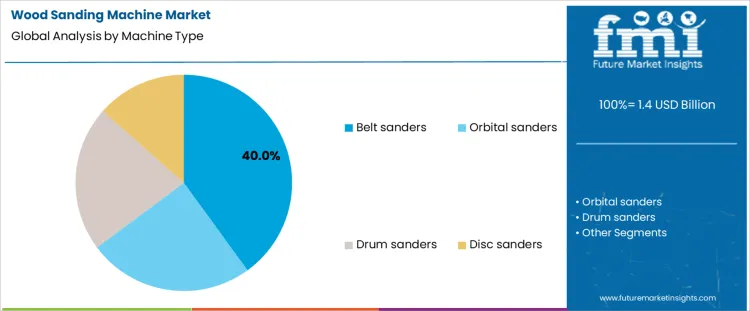
Belt sanders represent about 40% of demand in the Wood Sanding Machine Market because they sit at the highest-risk point in surface preparation workflows. In furniture and panel production, belt sanding is typically the last operation before finishing, coating, or lamination. Any inconsistency at this stage leads directly to visible defects, rework, or scrap. The decision to invest in belt sanding capacity is therefore driven less by speed and more by the cost of finishing-stage failure.
Drum sanders are used where thickness calibration and flatness control are more important than surface finish. Orbital sanders dominate in manual and semi-manual operations where local correction and touch-up work is required. Disc sanders serve edge preparation and shaping rather than surface uniformity. The structure of the Wood Sanding Machine Market is therefore not a progression from simple to advanced tools. It is a distribution of risk control tools, each placed where a specific type of quality failure would be most expensive.
Why Does Furniture Manufacturing Anchor Demand in the Wood Sanding Machine Market?

Furniture manufacturing represents about 45% of demand in the Wood Sanding Machine Market because furniture economics are highly sensitive to surface appearance and finishing yield. A small defect that would be acceptable in structural woodwork can render a visible furniture panel unsellable. This creates a strong incentive to control sanding quality tightly and to invest in stable, repeatable sanding processes.
Carpentry shops and construction sites perform sanding mainly for fit and finish, often under time pressure and with limited surface quality liability. Cabinet and interior fitting producers sit between these extremes, balancing appearance requirements with project schedules. Furniture manufacturers, by contrast, operate under product-level aesthetic acceptance standards, not just functional ones. This shifts sanding from a preparatory step into a value-protection operation, which explains why this segment absorbs the largest and most consistent share of equipment investment in the Wood Sanding Machine Market.
How Are the Key Dynamics Reshaping the Wood Sanding Machine Market?
The Wood Sanding Machine Market grows when surface quality becomes a business risk rather than a cosmetic detail. Rework, rejects, and inconsistent finishes quietly consume margins in furniture, panels, and joinery. Some shops treat sanding as an art and accept variability. Others restructure production so surface preparation becomes a controlled, repeatable step. The difference is not taste. It is tolerance for waste and schedule disruption. Where finish quality is audited and promised to customers, the Wood Sanding Machine Market becomes process infrastructure. Where it is judged by eye, the Wood Sanding Machine Market remains a collection of tools.
Why the Wood Sanding Machine Market Is Rework-Avoidance Driven?
Most buying decisions in the Wood Sanding Machine Market start after defects escape. Veneer telegraphs through coatings, edges burn, or swirl marks appear under light. Suddenly, handwork and patching are no longer acceptable. Wide-belt and profile sanding turn from convenience into insurance. When a line is balanced so sanding sets the finish window, downstream steps stabilize and scrap falls. That experience spreads inside groups and across plants. Demand in the Wood Sanding Machine Market therefore follows the cost of rework and warranty claims, not the age of existing machines or fashion in furniture styles.
Why the Wood Sanding Machine Market Is Hard to Standardize?
Sanding touches variability that upstream processes create. Different species, moisture levels, glues, and layups behave differently. This makes one-size setups rare and encourages local tuning. Many workshops rely on skilled operators to compensate, which reduces pressure to invest in more controlled equipment. Retrofitting also disturbs layouts and dust handling, so upgrades get postponed. Even when better machines exist, switching exposes production to learning curves and schedule risk. The Wood Sanding Machine Market therefore advances unevenly, expanding where variability is confronted systemically and stalling where it is absorbed by labor.
Why the Wood Sanding Machine Market Follows Production Architecture?
Plants organized around cells and defined process windows integrate sanding as a governed step with measured outputs. Plants organized around job-by-job flow treat sanding as a flexible craft station. That architectural choice decides whether machines are specified as platforms or bought as spot fixes. As larger groups replicate line templates across sites, the Wood Sanding Machine Market benefits from repeat selections and shared settings. Where shops remain bespoke, choices remain fragmented. The Wood Sanding Machine Market follows how factories are structured to manage variation, not how much wood they cut.
What is the Demand for Wood Sanding Machines by Country?
| Country | CAGR (%) |
|---|---|
| USA | 3.2% |
| UK | 3.0% |
| China | 4.0% |
| India | 4.2% |
| Brazil | 3.5% |
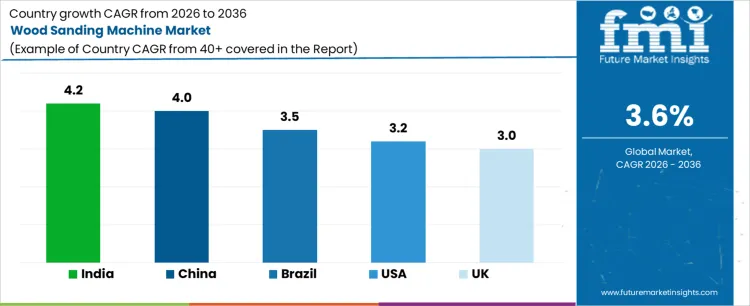
Demand for wood sanding machines is rising as furniture, woodworking, and construction sectors adopt automated and precision equipment to improve surface finishing, production efficiency, and product quality. India leads with a 4.2% CAGR, driven by growing furniture production, woodworking industries, and adoption of mechanized sanding systems. China follows at 4.0%, supported by large-scale furniture manufacturing and industrial wood processing. Brazil records 3.5% growth, shaped by adoption in residential and commercial woodworking. The USA grows at 3.2%, influenced by replacement demand and modern production upgrades. The UK shows 3.0% CAGR, reflecting steady adoption of sanding machines in industrial and artisanal woodworking applications.
How do production line configurations shape wood sanding machine demand in the United States?
Furniture and panel manufacturing line upgrades set the spending rhythm in United States woodworking plants, with wood sanding machine demand expanding at a 3.2% CAGR under current investment patterns. Order flow comes from cabinet, flooring, door, and engineered panel producers that balance throughput against surface finish standards. Equipment choice follows line speed targets, defect tolerance, and downstream coating requirements. Automation level influences whether wide belt, multi head, or integrated sanding systems are selected. Replacement cycles follow factory layout changes rather than machine wear alone. OEM line builders and system integrators influence specification decisions. Domestic suppliers compete on delivery lead times and service coverage. Import brands serve high precision finishing lines. Commercial success depends on inclusion inside line upgrade projects rather than standalone equipment sales to fragmented workshops.
Why do finish quality standards drive equipment investment in the United Kingdom?
Production planning in United Kingdom woodworking factories centers on finish consistency and rework reduction, with wood sanding machine purchases growing at a 3% CAGR. Cabinet makers, joinery plants, and panel processors invest in sanding stages that stabilize coating results and reduce downstream defects. Equipment selection focuses on calibration stability, dust control integration, and compatibility with spray and lamination lines. New factory construction plays a limited role compared with line optimization projects. System integrators and line designers shape early equipment choices. Import suppliers serve premium finishing applications. Local service coverage affects uptime planning. Spending decisions follow product mix shifts and customer specification changes. Commercial visibility depends on presence in production line redesign programs rather than direct selling to small workshops or maintenance driven replacements.
What manufacturing scale effects govern demand in China?
Large scale furniture and panel manufacturing expansion keeps China on a 4% growth path for wood sanding machine installations. Volume concentrates in export oriented furniture clusters, flooring plants, and engineered board facilities. Factory layout planning and throughput balancing drive equipment selection. Domestic manufacturers dominate standard sanding lines through pricing and production capacity. International suppliers retain roles in high precision finishing and automated lines. Line builders and factory designers influence specification setting. Order timing follows new plant buildouts and major line reconfigurations. Margin structure depends on mix between standard machines and integrated finishing systems. Commercial success depends on participation in large production line projects rather than selling individual machines into small workshops with limited automation.
Why does line modernization drive purchases in India?
Expansion of organized furniture, modular kitchen, and panel manufacturing keeps India on a 4.2% growth track for wood sanding machine demand. Most spending comes from plants shifting from manual finishing to semi-automated or automated lines. Equipment choice follows throughput targets, labor availability, and finish quality requirements. OEM line suppliers and turnkey plant builders shape early configuration decisions. Import machines serve high volume and export oriented plants. Domestic suppliers cover standard processing stages. Replacement demand remains secondary to capacity and layout upgrades. Investment timing follows factory expansion schedules. Commercial success depends on alignment with new line projects and plant modernization programs rather than transactional sales into fragmented small workshops.
How do production mix shifts influence demand in Brazil?
Changes in product mix across furniture, doors, and panel processing plants shape Brazil spending patterns, with wood sanding machine demand advancing at a 3.5% CAGR. Plants invest in sanding stages to improve surface quality and reduce finishing defects. New factory projects play a smaller role than line reconfiguration and quality improvement programs. Equipment selection depends on compatibility with existing presses, saw lines, and coating systems. Import machines serve higher precision finishing needs. Local suppliers compete on service response and installation support. Line integrators influence specification decisions. Spending follows production program changes rather than pure capacity additions. Commercial position depends on participation in line upgrade and product repositioning projects rather than isolated machine replacements.
How Are Manufacturers Competing in the Wood Sanding Machine Market Through Performance and Usability?

In the wood sanding machine market, suppliers differentiate based on power delivery, vibration control, and adaptability to varied wood types. Bosch designs sanders with balanced power and ergonomics tailored for both professional workshops and DIY users, emphasizing low vibration and dust extraction compatibility. DeWalt (Stanley Black & Decker) provides robust machines with durable housings and consistent sanding speed, supporting prolonged use in cabinetry and finish work. Makita offers models with brushless motors and efficient dust management, addressing demand for lower maintenance and quieter operation. Festool develops sanding systems engineered for precision surface finish, integration with track guides, and tailored abrasive systems. Grizzly Industrial supplies cost-effective, heavy-duty sanders suited to larger workpieces and high-throughput operations. These variations reflect distinct priorities across segments where finish quality and workflow integration matter.
Suppliers also distinguish through accessory ecosystems, service networks, and application support. Bosch expands usability with modular attachments and compatible extraction systems that maintain cleaner work environments. DeWalt emphasizes compatibility with its battery ecosystems, enabling cross-tool power sharing for cordless sanding applications. Makita’s focus on brushless designs improves energy efficiency and motor longevity, appealing to users with varied sanding tasks. Festool integrates precision controls with systematic workflows, aiding consistent results on complex surfaces. Grizzly Industrial targets value-conscious buyers with reliable core performance. Other niche producers supply machines optimized for specific tasks such as contour sanding or edge finishing. Competitive differences arise from ergonomics, dust control effectiveness, motor power characteristics, and ease of abrasive changeover. Manufacturers that combine reliable performance with support infrastructure and documented product life maintain relevance where surface quality and operational continuity are critical.
Key Players in the Wood Sanding Machine Market
- Bosch
- DeWalt (Stanley Black & Decker)
- Makita
- Festool
- Grizzly Industrial
Scope of the Report
| Items | Values |
|---|---|
| Quantitative Units (2026) | USD billion |
| Machine Type | Belt sanders, Orbital sanders, Drum sanders, Disc sanders |
| End-Use Industry | Furniture manufacturing, Carpentry and woodworking shops, Construction and renovation, Cabinet and interior fittings |
| Region | Asia Pacific, Europe, North America, Latin America, Middle East & Africa |
| Countries Covered | China, Japan, South Korea, India, Australia & New Zealand, ASEAN, Germany, United Kingdom, France, Italy, Spain, Nordic, BENELUX, United States, Canada, Mexico, Brazil, Chile, Saudi Arabia, Turkey, South Africa, and other regional markets |
| Key Companies Profiled | Bosch, DeWalt (Stanley Black & Decker), Makita, Festool, Grizzly Industrial |
| Additional Attributes | Dollar by sales by machine type and end-use; demand driven by finish quality requirements and rework avoidance; growth led by line modernization and automation in furniture and panel plants; purchasing shaped by reliability, dust control, surface consistency, and ease of integration rather than headline throughput. |
Wood Sanding Machine Market Segmentation
Machine Type:
- Belt sanders
- Orbital sanders
- Drum sanders
- Disc sanders
End-Use Industry:
- Furniture manufacturing
- Carpentry and woodworking shops
- Construction and renovation
- Cabinet and interior fittings
Region:
- Asia Pacific
- China
- Japan
- South Korea
- India
- Australia & New Zealand
- ASEAN
- Rest of Asia Pacific
- Europe
- Germany
- United Kingdom
- France
- Italy
- Spain
- Nordic
- BENELUX
- Rest of Europe
- North America
- United States
- Canada
- Mexico
- Latin America
- Brazil
- Chile
- Rest of Latin America
- Middle East & Africa
- Kingdom of Saudi Arabia
- Other GCC Countries
- Turkey
- South Africa
- Other African Union
- Rest of Middle East & Africa
Bibliography
- Health and Safety Executive. (2025, March 24). Construction dust: Cutting and sanding wood. UK Government.
- Safe Work Australia. (2024, September). Interpretation of workplace exposure standards for airborne contaminants (revised). Australian Government.
- Eurostat. (2025, February 13). Industrial production down by 1.1% in the euro area and by 0.8% in the EU. Euro indicators.
- U.S. Department of Agriculture, Foreign Agricultural Service. (2024, June 6). Wood and wood products update 2024 (India). GAIN Report No. IN2024-0026.
- Directorate General of Commercial Intelligence and Statistics, Ministry of Commerce & Industry, Government of India. (2025, June 26). Merchandise EXIM trade at a glance: Q1 FY 2024-25.
Frequently Asked Questions
How big is the wood sanding machine market in 2026?
The global wood sanding machine market is estimated to be valued at USD 1.4 billion in 2026.
What will be the size of wood sanding machine market in 2036?
The market size for the wood sanding machine market is projected to reach USD 2.0 billion by 2036.
How much will be the wood sanding machine market growth between 2026 and 2036?
The wood sanding machine market is expected to grow at a 3.6% CAGR between 2026 and 2036.
What are the key product types in the wood sanding machine market?
The key product types in wood sanding machine market are belt sanders , orbital sanders, drum sanders and disc sanders.
Which end‑use industry segment to contribute significant share in the wood sanding machine market in 2026?
In terms of end‑use industry, furniture manufacturing segment to command 45.0% share in the wood sanding machine market in 2026.
Preview the report firsthand - request a free sample
Get SampleGet the brochure for pricing and purchase details.
Get PDFTable of Content
- Executive Summary
- Global Market Outlook
- Demand-side Trends
- Supply-side Trends
- Technology Roadmap Analysis
- Analysis and Recommendations
- Market Overview
- Market Coverage / Taxonomy
- Market Definition / Scope / Limitations
- Market Background
- Market Dynamics
- Drivers
- Restraints
- Opportunity
- Trends
- Scenario Forecast
- Demand in Optimistic Scenario
- Demand in Likely Scenario
- Demand in Conservative Scenario
- Opportunity Map Analysis
- Product Life Cycle Analysis
- Supply Chain Analysis
- Investment Feasibility Matrix
- Value Chain Analysis
- PESTLE and Porter’s Analysis
- Regulatory Landscape
- Regional Parent Market Outlook
- Production and Consumption Statistics
- Import and Export Statistics
- Market Dynamics
- Global Market Analysis 2021 to 2025 and Forecast, 2026 to 2036
- Historical Market Size Value (USD Million) Analysis, 2021 to 2025
- Current and Future Market Size Value (USD Million) Projections, 2026 to 2036
- Y-o-Y Growth Trend Analysis
- Absolute $ Opportunity Analysis
- Global Market Pricing Analysis 2021 to 2025 and Forecast 2026 to 2036
- Global Market Analysis 2021 to 2025 and Forecast 2026 to 2036, By Machine Type
- Introduction / Key Findings
- Historical Market Size Value (USD Million) Analysis By Machine Type , 2021 to 2025
- Current and Future Market Size Value (USD Million) Analysis and Forecast By Machine Type , 2026 to 2036
- Belt sanders
- Orbital sanders
- Drum sanders
- Disc sanders
- Belt sanders
- Y-o-Y Growth Trend Analysis By Machine Type , 2021 to 2025
- Absolute $ Opportunity Analysis By Machine Type , 2026 to 2036
- Global Market Analysis 2021 to 2025 and Forecast 2026 to 2036, By End‑Use Industry
- Introduction / Key Findings
- Historical Market Size Value (USD Million) Analysis By End‑Use Industry, 2021 to 2025
- Current and Future Market Size Value (USD Million) Analysis and Forecast By End‑Use Industry, 2026 to 2036
- Furniture manufacturing
- Carpentry and woodworking shops
- Construction and renovation
- Cabinet and interior fittings
- Furniture manufacturing
- Y-o-Y Growth Trend Analysis By End‑Use Industry, 2021 to 2025
- Absolute $ Opportunity Analysis By End‑Use Industry, 2026 to 2036
- Global Market Analysis 2021 to 2025 and Forecast 2026 to 2036, By Region
- Introduction
- Historical Market Size Value (USD Million) Analysis By Region, 2021 to 2025
- Current Market Size Value (USD Million) Analysis and Forecast By Region, 2026 to 2036
- North America
- Latin America
- Western Europe
- Eastern Europe
- East Asia
- South Asia and Pacific
- Middle East & Africa
- Market Attractiveness Analysis By Region
- North America Market Analysis 2021 to 2025 and Forecast 2026 to 2036, By Country
- Historical Market Size Value (USD Million) Trend Analysis By Market Taxonomy, 2021 to 2025
- Market Size Value (USD Million) Forecast By Market Taxonomy, 2026 to 2036
- By Country
- USA
- Canada
- Mexico
- By Machine Type
- By End‑Use Industry
- By Country
- Market Attractiveness Analysis
- By Country
- By Machine Type
- By End‑Use Industry
- Key Takeaways
- Latin America Market Analysis 2021 to 2025 and Forecast 2026 to 2036, By Country
- Historical Market Size Value (USD Million) Trend Analysis By Market Taxonomy, 2021 to 2025
- Market Size Value (USD Million) Forecast By Market Taxonomy, 2026 to 2036
- By Country
- Brazil
- Chile
- Rest of Latin America
- By Machine Type
- By End‑Use Industry
- By Country
- Market Attractiveness Analysis
- By Country
- By Machine Type
- By End‑Use Industry
- Key Takeaways
- Western Europe Market Analysis 2021 to 2025 and Forecast 2026 to 2036, By Country
- Historical Market Size Value (USD Million) Trend Analysis By Market Taxonomy, 2021 to 2025
- Market Size Value (USD Million) Forecast By Market Taxonomy, 2026 to 2036
- By Country
- Germany
- UK
- Italy
- Spain
- France
- Nordic
- BENELUX
- Rest of Western Europe
- By Machine Type
- By End‑Use Industry
- By Country
- Market Attractiveness Analysis
- By Country
- By Machine Type
- By End‑Use Industry
- Key Takeaways
- Eastern Europe Market Analysis 2021 to 2025 and Forecast 2026 to 2036, By Country
- Historical Market Size Value (USD Million) Trend Analysis By Market Taxonomy, 2021 to 2025
- Market Size Value (USD Million) Forecast By Market Taxonomy, 2026 to 2036
- By Country
- Russia
- Poland
- Hungary
- Balkan & Baltic
- Rest of Eastern Europe
- By Machine Type
- By End‑Use Industry
- By Country
- Market Attractiveness Analysis
- By Country
- By Machine Type
- By End‑Use Industry
- Key Takeaways
- East Asia Market Analysis 2021 to 2025 and Forecast 2026 to 2036, By Country
- Historical Market Size Value (USD Million) Trend Analysis By Market Taxonomy, 2021 to 2025
- Market Size Value (USD Million) Forecast By Market Taxonomy, 2026 to 2036
- By Country
- China
- Japan
- South Korea
- By Machine Type
- By End‑Use Industry
- By Country
- Market Attractiveness Analysis
- By Country
- By Machine Type
- By End‑Use Industry
- Key Takeaways
- South Asia and Pacific Market Analysis 2021 to 2025 and Forecast 2026 to 2036, By Country
- Historical Market Size Value (USD Million) Trend Analysis By Market Taxonomy, 2021 to 2025
- Market Size Value (USD Million) Forecast By Market Taxonomy, 2026 to 2036
- By Country
- India
- ASEAN
- Australia & New Zealand
- Rest of South Asia and Pacific
- By Machine Type
- By End‑Use Industry
- By Country
- Market Attractiveness Analysis
- By Country
- By Machine Type
- By End‑Use Industry
- Key Takeaways
- Middle East & Africa Market Analysis 2021 to 2025 and Forecast 2026 to 2036, By Country
- Historical Market Size Value (USD Million) Trend Analysis By Market Taxonomy, 2021 to 2025
- Market Size Value (USD Million) Forecast By Market Taxonomy, 2026 to 2036
- By Country
- Kingdom of Saudi Arabia
- Other GCC Countries
- Turkiye
- South Africa
- Other African Union
- Rest of Middle East & Africa
- By Machine Type
- By End‑Use Industry
- By Country
- Market Attractiveness Analysis
- By Country
- By Machine Type
- By End‑Use Industry
- Key Takeaways
- Key Countries Market Analysis
- USA
- Pricing Analysis
- Market Share Analysis, 2025
- By Machine Type
- By End‑Use Industry
- Canada
- Pricing Analysis
- Market Share Analysis, 2025
- By Machine Type
- By End‑Use Industry
- Mexico
- Pricing Analysis
- Market Share Analysis, 2025
- By Machine Type
- By End‑Use Industry
- Brazil
- Pricing Analysis
- Market Share Analysis, 2025
- By Machine Type
- By End‑Use Industry
- Chile
- Pricing Analysis
- Market Share Analysis, 2025
- By Machine Type
- By End‑Use Industry
- Germany
- Pricing Analysis
- Market Share Analysis, 2025
- By Machine Type
- By End‑Use Industry
- UK
- Pricing Analysis
- Market Share Analysis, 2025
- By Machine Type
- By End‑Use Industry
- Italy
- Pricing Analysis
- Market Share Analysis, 2025
- By Machine Type
- By End‑Use Industry
- Spain
- Pricing Analysis
- Market Share Analysis, 2025
- By Machine Type
- By End‑Use Industry
- France
- Pricing Analysis
- Market Share Analysis, 2025
- By Machine Type
- By End‑Use Industry
- India
- Pricing Analysis
- Market Share Analysis, 2025
- By Machine Type
- By End‑Use Industry
- ASEAN
- Pricing Analysis
- Market Share Analysis, 2025
- By Machine Type
- By End‑Use Industry
- Australia & New Zealand
- Pricing Analysis
- Market Share Analysis, 2025
- By Machine Type
- By End‑Use Industry
- China
- Pricing Analysis
- Market Share Analysis, 2025
- By Machine Type
- By End‑Use Industry
- Japan
- Pricing Analysis
- Market Share Analysis, 2025
- By Machine Type
- By End‑Use Industry
- South Korea
- Pricing Analysis
- Market Share Analysis, 2025
- By Machine Type
- By End‑Use Industry
- Russia
- Pricing Analysis
- Market Share Analysis, 2025
- By Machine Type
- By End‑Use Industry
- Poland
- Pricing Analysis
- Market Share Analysis, 2025
- By Machine Type
- By End‑Use Industry
- Hungary
- Pricing Analysis
- Market Share Analysis, 2025
- By Machine Type
- By End‑Use Industry
- Kingdom of Saudi Arabia
- Pricing Analysis
- Market Share Analysis, 2025
- By Machine Type
- By End‑Use Industry
- Turkiye
- Pricing Analysis
- Market Share Analysis, 2025
- By Machine Type
- By End‑Use Industry
- South Africa
- Pricing Analysis
- Market Share Analysis, 2025
- By Machine Type
- By End‑Use Industry
- USA
- Market Structure Analysis
- Competition Dashboard
- Competition Benchmarking
- Market Share Analysis of Top Players
- By Regional
- By Machine Type
- By End‑Use Industry
- Competition Analysis
- Competition Deep Dive
- Bosch
- Overview
- Product Portfolio
- Profitability by Market Segments (Product/Age /Sales Channel/Region)
- Sales Footprint
- Strategy Overview
- Marketing Strategy
- Product Strategy
- Channel Strategy
- DeWalt (Stanley Black & Decker)
- Makita
- Festool
- Grizzly Industrial
- Bosch
- Competition Deep Dive
- Assumptions & Acronyms Used
- Research Methodology


