


Key Takeaways
- Organic milk and cream prices fluctuate 25-45% seasonally based on pasture availability and organic feed costs
- Certification overhead including USDA Organic, EU Organic, and NPOP compliance adds 12-18% to base manufacturing costs
- Premium organic inclusions like vanilla, cocoa, and specialty nuts create 30-50% ingredient cost premiums versus conventional equivalents
- Cold-chain logistics from processing through retail storage add 18-28% to total delivered cost structure
- Artisanal organic producers achieve 40-55% gross margins while large FMCG brands operate at 22-35% margins
Why Does Pricing Complexity Matter in Organic Ice Cream?
Price in organic ice cream reflects the translation of organic dairy volatility, premium ingredient cost cycles, certification overhead, supply chain constraints, and cold-chain logistics into wide ex-factory and retail price bands. Unlike conventional ice cream where commodity dairy pricing follows predictable Federal Milk Marketing Order mechanisms in the United States or intervention pricing in the European Union, organic dairy operates in smaller, fragmented markets with pronounced supply-demand imbalances.
Organic milk and cream pricing experiences seasonal swings tied to pasture availability, organic feed cost cycles, and herd size constraints that limit supply elasticity. Weather-dependent grass growth patterns create quarterly price volatility, while organic certification requirements prevent rapid conversion of conventional dairy farms to expand supply during shortage periods.
Cost drivers extend beyond base dairy to encompass premium organic ingredients including cane sugar, cocoa, vanilla, berries, nuts, and specialty inclusions commanding significant premiums over conventional alternatives. Organic vanilla prices demonstrate extreme volatility given limited global production concentrated in Madagascar, while organic cocoa sourcing requires navigating supply chains with certification verification at origin.
Organic nuts including almonds, pistachios, and cashews face agricultural yield variability and certification overhead that conventional nut supplies avoid. Organic stabilizers, emulsifiers, and sweeteners including agave, honey, and erythritol similarly command cost premiums while requiring dedicated supply chain management to maintain organic integrity throughout processing.
Ex-factory pricing reflects not just ingredient costs but processing overhead for organic compliance, dedicated production runs preventing cross-contamination with conventional products, and audit documentation requirements. Retailer margin structures accommodate premium positioning with organic ice cream occupying differentiated freezer sections commanding shelf-space fees and promotional support.
However, intense competition within organic frozen desserts constrains pricing power, with plant-based organic alternatives, certified-organic gelato formats, and artisanal premium products fragmenting category dollars. Certification costs including annual audits, traceability system maintenance, supplier verification, and documentation overhead establish cost floors below which smaller producers cannot operate profitably.
Working capital intensity increases substantially for organic ice cream manufacturers maintaining inventory buffers for seasonally available ingredients, managing longer payment terms with specialty organic suppliers, and financing cold-chain logistics infrastructure. Premiumization strategies positioning organic ice cream as indulgent, ethically sourced, and environmentally sustainable justify retail price points 40-80% above conventional equivalents, though mainstream organic offerings from large FMCG brands compress this premium to 25-35% through scale advantages.
The interplay between volatile organic feedstock costs, rigid certification requirements, premium ingredient sourcing constraints, and cold-chain logistics complexity creates pricing corridors where successful brands balance margin objectives against consumer price sensitivity in discretionary frozen dessert categories.
How Does Feedstock Volatility in Organic Dairy and Ingredients Impact Costs?
Organic milk and cream pricing demonstrates pronounced volatility driven by pasture-based feeding requirements, organic feed cost cycles, and seasonal lactation patterns. According to USDA organic dairy pricing reports, organic milk prices paid to farmers range from USD 38 to USD 52 per hundredweight depending on region and season, representing 60-90% premiums over conventional milk prices.
Pasture availability during growing seasons creates quarterly price fluctuations as grass-fed organic dairy production peaks during spring and summer months while declining substantially during winter when supplemental organic feed requirements increase. Organic feed costs including certified organic grain, hay, and silage track agricultural commodity markets while adding certification overhead, creating correlated volatility across the organic dairy supply chain.
Organic certification conversion periods requiring 36 months before conventional farms qualify as organic create supply inflexibility preventing rapid capacity expansion during tight market conditions. Herd size constraints for organic dairy operations, often smaller than conventional mega-dairies given pasture-access requirements under USDA organic regulations, limit economies of scale and concentrate production among specialty organic dairy cooperatives.
Organic Valley, Horizon Organic, and Straus Family Creamery represent major US organic dairy suppliers, while European organic dairy production concentrates in Germany, France, Denmark, and the Netherlands with established certification frameworks. Regional supply-demand imbalances occur frequently, with Northeast US organic dairy sometimes commanding 10-15% premiums over Midwest organic milk given processing capacity constraints and transportation economics.
Organic cane sugar pricing follows global sugar market dynamics while adding organic certification premiums typically ranging 35-65% over conventional sugar. Brazil, India, and Paraguay represent major organic cane sugar origins, with supply subject to agricultural yield variability, weather patterns affecting sugarcane cultivation, and certification capacity constraints limiting rapid production expansion.
Organic cocoa sourcing presents particular challenges given limited certified organic production concentrated in West Africa and Latin America, with organic certification requiring three-year conversion periods and ongoing compliance with pesticide-free cultivation practices. Organic cocoa premiums range from 40-80% over conventional cocoa, with Fair Trade and Rainforest Alliance certifications often layering additional premiums.
Organic berries including strawberries, blueberries, and raspberries demonstrate extreme seasonality with harvest windows creating supply concentration during summer months and requiring frozen inventory management for year-round ice cream production. Organic berry pricing premiums range from 50-120% over conventional equivalents, with California, Oregon, and Washington representing primary US organic berry production regions facing water availability constraints and labor cost pressures.
Organic vanilla commands extraordinary pricing given production concentration in Madagascar controlling 70-80% of global vanilla supply according to industry assessments, with cyclone damage, political instability, and hand-pollination labor requirements creating supply volatility. Organic vanilla prices have ranged from USD 400 to USD 600 per kilogram during tight supply periods, representing 200-400% premiums over synthetic vanillin alternatives that organic certification prohibits.
Organic nuts including almonds, pistachios, and cashews face agricultural yield cycles, water availability constraints particularly for California almond production, and certification overhead. Organic almond premiums typically range 40-70% over conventional pricing, while organic pistachios and cashews sourced internationally add freight costs and import certification verification requirements.
These premium ingredient cost cycles force organic ice cream manufacturers to implement sophisticated procurement strategies including forward contracting, inventory buffering during harvest seasons, and formulation flexibility to substitute ingredients based on seasonal availability and pricing.
Why Is Energy a Processing and Refrigeration Cost Floor?
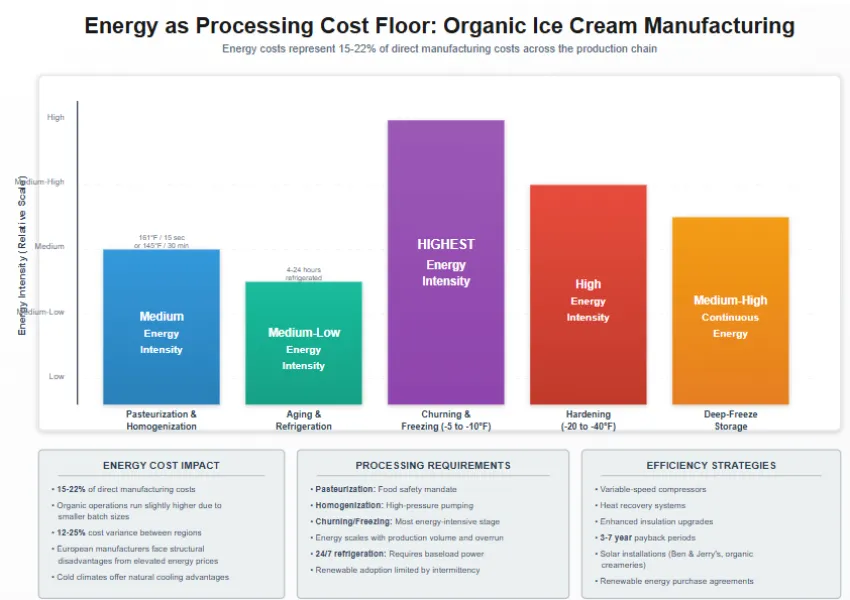
Energy intensity in organic ice cream manufacturing establishes significant cost floors spanning pasteurization, homogenization, aging, churning and freezing, and deep-freeze storage operations. Pasteurization requirements for organic dairy follow identical food safety standards as conventional products, requiring heating to 161 degrees Fahrenheit for 15 seconds in high-temperature short-time systems or 145 degrees Fahrenheit for 30 minutes in batch systems.
Homogenization processes breaking fat globules to prevent separation demand high-pressure pumping consuming substantial electricity. Aging organic ice cream mix at refrigerated temperatures for 4-24 hours before freezing requires continuous cooling capacity.
Churning and freezing operations represent the most energy-intensive processing stage, incorporating air while simultaneously freezing the mix to create smooth texture. Continuous freezers operating at negative 5 to negative 10 degrees Fahrenheit require substantial refrigeration compressor capacity, with energy consumption scaling to production volume and overrun percentage.
Hardening tunnels or blast freezers bringing finished ice cream from soft-serve consistency at negative 5 degrees Fahrenheit to deep-freeze storage temperatures of negative 20 to negative 40 degrees Fahrenheit demand additional refrigeration capacity. Deep-freeze warehouse storage maintaining product integrity before distribution consumes continuous energy for temperature maintenance.
According to disclosed operational data from dairy processing facilities, energy costs represent 15-22% of direct manufacturing costs for ice cream production, with organic operations potentially running slightly higher given smaller batch sizes preventing optimal energy efficiency. Regional energy-price disparities create 12-25% manufacturing cost differences between locations.
European manufacturers confronting elevated electricity and natural gas prices following energy market disruptions face structural disadvantages versus regions with lower industrial energy rates. Cold-climate locations offer natural cooling advantages reducing refrigeration loads, partially explaining organic ice cream production concentration in northern US states, Scandinavia, and New Zealand.
Renewable energy adoption by organic ice cream manufacturers aligns with brand positioning and potentially reduces energy cost volatility, with several producers including Ben & Jerry's and regional organic creameries investing in solar installations and renewable energy purchase agreements. However, upfront capital requirements and intermittency challenges limit renewable penetration for 24/7 refrigeration operations requiring reliable baseload power.
Energy efficiency investments in variable-speed compressors, heat recovery systems, and insulation upgrades offer payback periods of 3-7 years, though organic premium pricing provides margin cushion to absorb higher energy costs compared to conventional ice cream manufacturers operating on thinner margins.
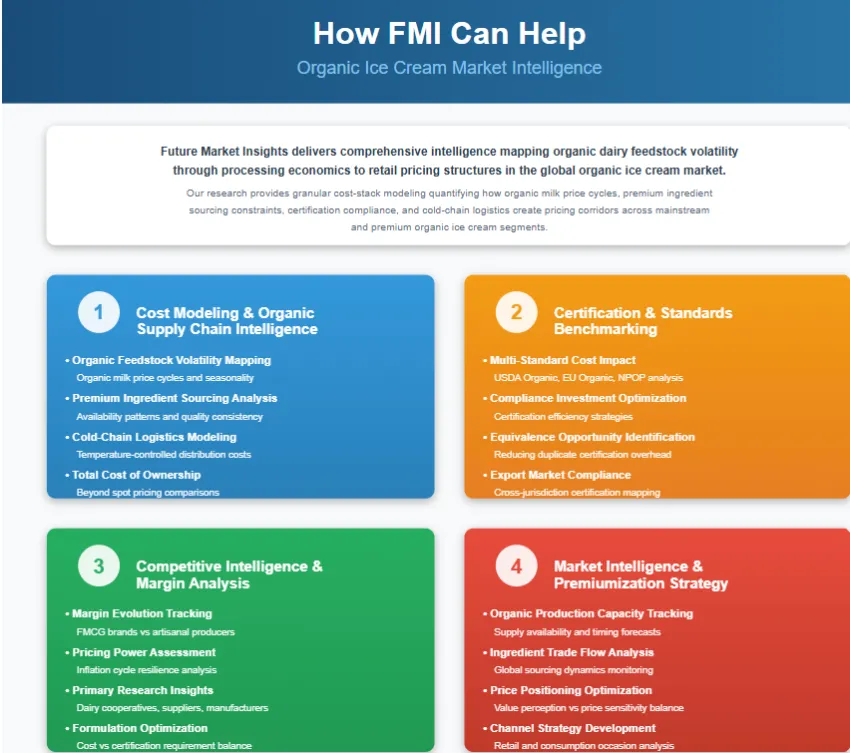
How Future Market Insights Can Help
Sources
- USDA National Agricultural Statistics Service organic dairy pricing reports and Federal Milk Marketing Order data for conventional dairy price benchmarking
- Annual reports and sustainability disclosures from Organic Valley, Horizon Organic, Danone, and Unilever (Ben & Jerry's) for operational insights and margin profiles
- Organic Trade Association industry surveys and organic dairy market assessments for certification cost structures and production trends
- UN Comtrade harmonized system codes for dairy products, ice cream, sugar, cocoa, and organic ingredients for trade flow analysis and FOB value benchmarks
- FAO dairy statistics and International Dairy Federation reports for global organic dairy production capacity and regional supply dynamics

