


Key Takeaways
- Board-grade inflation and resin volatility increase the cost of over-engineered packaging
- Testing enables data-backed down-gauging that reduces corrugate, plastic and cushioning use
- Performance verification lowers damage-related claims in retail and e-commerce channels
- Structural, vibration, drop and compression testing create safe reduction corridors for material cost
- Brands shift focus from material abundance to failure-mode management, driving testing demand
Why is inflation in corrugated board, plastics and fillers driving higher dependency on Packaging Testing Services?
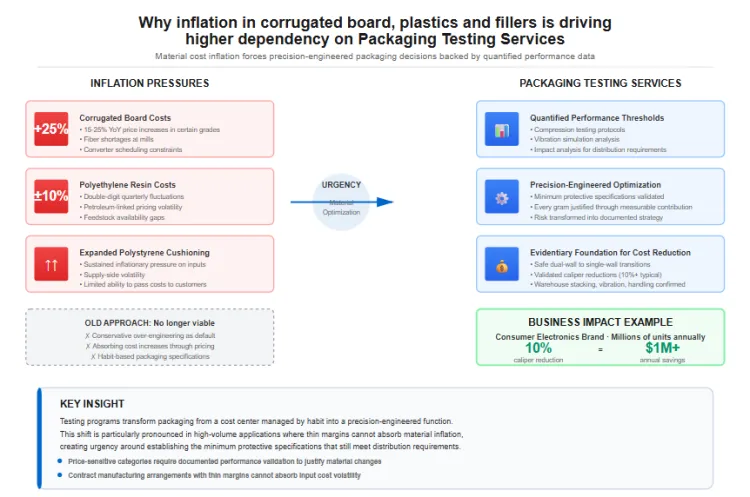
The economics of protective packaging have shifted dramatically as containerboard prices, polyethylene resin costs and expanded polystyrene cushioning inputs face sustained inflationary pressure. Brands historically defaulted to conservative material specifications, accepting over-engineering as a buffer against damage claims. That calculus no longer holds when corrugated board costs rise 15 to 25 percent year-over-year in certain grades, or when petroleum-linked resin pricing fluctuates by double digits within quarters.
Supply-side volatility compounds the issue. Mills face fiber shortages, converters experience scheduling constraints, and resin producers navigate feedstock availability gaps. This environment creates urgency around material optimization: brands cannot simply absorb higher input costs through price increases, particularly in price-sensitive consumer categories and contract manufacturing arrangements where margins are already thin.
Packaging Testing Services address this tension by establishing quantified performance thresholds. Rather than guessing at safe material reductions, brands deploy compression testing, vibration simulation and impact analysis to identify the minimum protective specifications that still meet distribution requirements. This approach transforms packaging from a cost center managed by habit into a precision-engineered function where every gram of material must justify its presence through measurable protective contribution.
The shift is particularly pronounced in high-volume applications. A consumer electronics brand shipping millions of units annually can translate a 10 percent reduction in corrugated caliper or a shift from dual-wall to single-wall board into seven-figure annual savings, provided testing validates that the thinner substrate withstands warehouse stacking loads, truck vibration and final-mile handling. Testing programs create the evidentiary foundation for these changes, turning material reduction from a risk into a documented, defensible strategy.
How do testing labs identify safe down-gauging thresholds for high-volume packaging formats?
Packaging engineers use standardized test protocols to map the relationship between material thickness, structural design and failure modes. ISTA 3A and ASTM D4169 procedures simulate the distribution environment through controlled sequences: packages endure vibration tables that replicate over-the-road transport, drop testers that mimic handling events, and compression platens that reproduce warehouse stacking conditions. Each test generates quantitative data on when and how packaging fails.
The process begins with baseline testing of existing specifications. A brand ships its current corrugated design through a full ISTA protocol, documenting any damage to contents, structural collapse points or closure failures. Engineers then introduce calibrated reductions: lighter fluting, thinner facings or reduced cushioning density. Each iteration undergoes identical testing sequences, creating a performance curve that shows how protective capability degrades as material is removed.
Critical thresholds emerge from this data. A package might tolerate a 15 percent reduction in board weight without any increase in product damage, but a 20 percent reduction could trigger edge crush failures during stacking tests. These inflection points define the safe reduction corridor, the range where material savings are achievable without compromising protective performance.
Advanced labs employ finite element analysis and predictive modeling to accelerate this discovery process. Digital twins of packaging structures undergo simulated stress scenarios, identifying weak points before physical prototypes are built. This computational approach reduces the number of test iterations required and allows engineers to evaluate dozens of material combinations quickly, comparing how different corrugate grades, plastic film gauges or foam densities perform under identical stress conditions.
The output is a validated specification sheet: documented proof that a lighter-weight design meets or exceeds distribution requirements. This evidence becomes essential when negotiating with procurement teams, convincing operations leaders wary of change, or defending material choices to quality assurance departments concerned about damage-rate increases.
Why do brands accept testing costs as a trade-off to avoid damage-related leakage in retail and e-commerce?
Damage economics dwarf testing expenses. A major retailer might charge back a supplier $50 to $150 per damaged unit that arrives at a distribution center, covering the cost of the unsaleable product, disposal logistics and administrative handling. For a brand shipping tens of thousands of units monthly, even a one percent increase in damage rates translates to six-figure quarterly losses that far exceed the cost of comprehensive testing programs.
E-commerce channels amplify this calculus. Online shoppers return damaged goods at higher rates than in-store purchasers, and each return triggers reverse logistics costs, customer service time and potential negative reviews that affect conversion rates. A cosmetics brand discovered through testing that its previous cushioning design failed under the repeated drops common in parcel carrier networks, resulting in a 3.2 percent damage rate. A $15,000 testing investment identified a lower-cost foam alternative that reduced damage to 0.7 percent, saving $180,000 annually in returns and chargebacks.
Third-party logistics providers impose performance penalties that make testing a defensive necessity. Fulfillment contracts often include damage-rate thresholds; exceeding those triggers per-unit surcharges or, in severe cases, contract termination. A food and beverage company faced 3PL penalties when its down-gauged corrugated design showed a 4 percent increase in warehouse damage. Post-testing modifications to corner reinforcement and flute orientation brought damage rates below baseline, satisfying the 3PL without returning to the heavier original specification.
Customer satisfaction metrics also drive testing adoption. Damaged deliveries generate poor online reviews, reduce repeat purchase rates and increase customer acquisition costs as brands must spend more to offset negative word-of-mouth. Testing validates that cost-reduced packaging still delivers products in pristine condition, protecting brand reputation while capturing material savings.
How does data-driven packaging optimization change sourcing choices for corrugate, plastics and cushioning materials?
Performance validation opens procurement options previously considered too risky. Brands traditionally specified premium-grade containerboard or virgin resin films to ensure protective margins, avoiding lighter alternatives due to uncertainty about their adequacy. Testing eliminates that uncertainty, allowing buyers to qualify lower-caliper materials with documented confidence.
A home goods manufacturer used compression and drop testing to validate that 32 ECT corrugated board could replace its existing 44 ECT specification for certain product lines. This shift reduced material costs by 18 percent while maintaining identical damage rates across six months of post-implementation monitoring. The testing data also provided leverage in supplier negotiations, as procurement teams could credibly threaten to switch to lighter grades if incumbent mills refused to sharpen pricing.
Hybrid structures emerge as testing reveals where different materials excel. A consumer electronics brand discovered through vibration analysis that combining thinner corrugated walls with strategically placed molded pulp reinforcements outperformed its previous all-corrugate design at lower total material cost. Testing identified the precise locations where pulp inserts prevented corner damage, allowing engineers to use less overall material by deploying each substrate only where it provided maximum protective value.
Sourcing geography also shifts. Testing validates that certain overseas substrate suppliers, previously dismissed due to unfamiliarity with their material properties, can meet performance requirements at lower price points. A pharmaceutical company qualified a Southeast Asian corrugate manufacturer after lab testing confirmed its lower-density board withstood the same distribution stresses as North American premium grades, enabling a 12 percent landed-cost reduction.
These sourcing changes cascade into supply chain resilience. Brands with tested, documented proof that multiple material options meet their requirements can pivot quickly when primary suppliers face capacity constraints or price spikes, avoiding the sole-source vulnerabilities that plagued many companies during recent supply disruptions.
How are Packaging Testing Services evolving for automated warehousing and robotics-ready environments?
Automated fulfillment systems impose packaging stresses that traditional testing protocols do not fully capture. Robotic grippers exert concentrated pressure on box surfaces, conveyor transfers introduce repetitive impacts at specific contact points, and high-speed sorting creates unique failure modes. Testing labs now offer specialized protocols that simulate these conditions.
Gripper-force testing evaluates whether down-gauged corrugate can withstand the clamping pressure of automated picking systems without collapsing or deforming. A beverage company discovered through this testing that its proposed lighter-weight design failed under robotic handling 8 percent of the time, triggering re-engineering before automation deployment rather than after costly production delays.
Conveyor abrasion testing replicates the surface wear that occurs when packages traverse miles of automated material handling equipment. Thin films or lightweight papers that perform well in traditional drop tests may fail when subjected to continuous sliding contact, developing tears or perforations that compromise contents. Testing identifies these vulnerabilities, guiding material selection toward substrates that balance weight reduction with abrasion resistance.
Contact-point fatigue analysis examines packaging performance under repeated stress at specific locations, such as where diverter arms contact boxes during high-speed sorting. This testing reveals whether lightweight designs maintain structural integrity through hundreds of touches, or whether concentrated stress causes progressive failure that manual handling would not expose.
These evolved testing capabilities help brands prepare packaging specifications before automation deployment, avoiding the costly redesigns that occur when lightweight materials prove inadequate in robotic environments only after fulfillment systems go live.
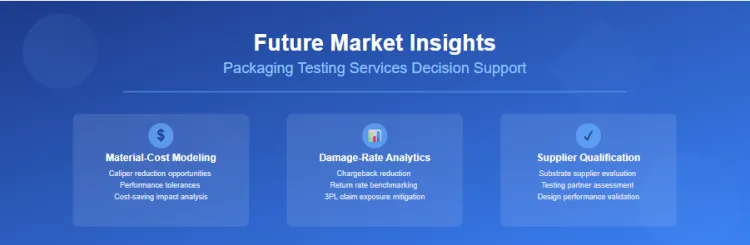
How can Future Market Insights support decision-making in Packaging Testing Services?
Sources
- Corrugated and resin industry price indices: Producer price data from industry associations and commodity tracking services provide evidence for board-grade and polymer cost inflation affecting packaging inputs across categories and geographies.
- ISTA and ASTM packaging performance standards: Published test methods define drop, vibration, compression and thermal testing protocols that establish protective performance benchmarks across distribution environments.
- E-commerce and retail vendor compliance manuals: Major retailers and online platforms publish chargeback rules, allowable damage rates and handling requirements that drive packaging specification decisions and testing investments.
- Packaging engineering and material-science literature: Academic and industry research documents relationships between caliper reduction, failure modes and protective performance under controlled testing conditions.
- Supply-chain and logistics media: Trade publications report on cost pressures, packaging optimization strategies and damage-rate economics affecting brands across consumer goods, industrial and pharmaceutical sectors.

