


Key Takeaways
- APAC controls most downstream capacity in flexible OLED and advanced electronics, but upstream flexible glass supply is still concentrated among a few global players.
- The real cost driver is not silica or melting but yield losses across ultra-thin glass production, handling and lamination.
- Midstream lamination, strengthening and adhesive stacks add a hidden and highly proprietary cost layer that strongly influences final prices.
- Device makers push prices down only through long term volume and design choices, not by switching base glass suppliers.
- APAC incentives and industrial clusters reduce logistics friction, but pricing power still sits upstream and midstream.
How is the flexible glass supply chain structured in APAC
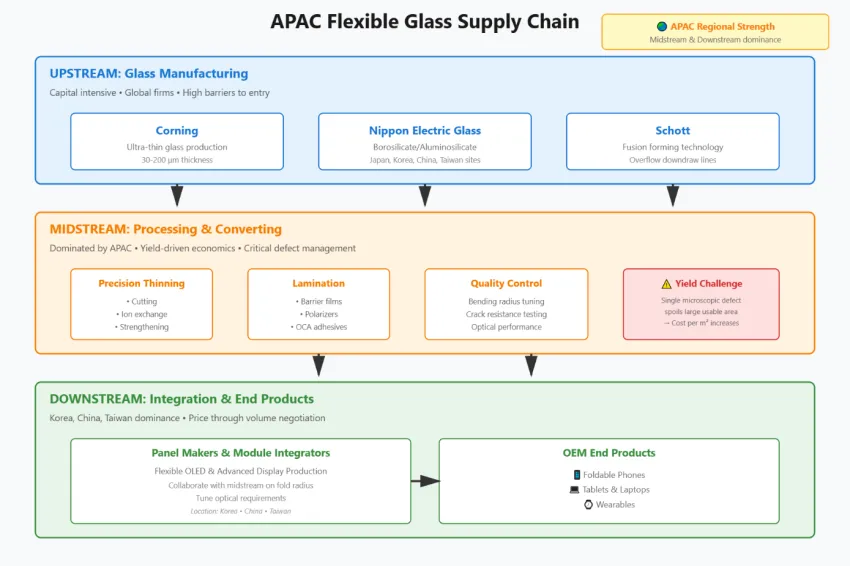
APAC dominates the midstream and downstream stages, but the top of the chain is controlled by a small set of global firms. Upstream, companies such as Corning, Nippon Electric Glass and Schott manufacture ultra thin borosilicate or aluminosilicate glass in thicknesses typically between 30 and 200 micrometers. The region hosts major display glass production sites because fusion forming and overflow downdraw lines already exist across Japan, Korea, China and Taiwan. The upstream tier is capital intensive and protected by knowhow, which reduces supplier turnover.
The midstream tier sits mostly inside APAC. Here the glass undergoes precision thinning, cutting, ion exchange strengthening, and lamination with barrier films, polarizers and optically clear adhesives. These stacks determine bending radius, crack resistance and optical quality. The economics are dominated by yield. A single microscopic defect on a thin sheet or roll can spoil large usable area, raising the actual cost per square meter far above the nominal list price.
Panel makers and module integrators in Korea, China and Taiwan use these laminated systems to build flexible OLED and advanced displays. They tune fold radius and optical requirements in collaboration with midstream converters. Downstream OEMs then incorporate these display modules into foldable phones, tablets, laptops and wearables. At this stage, flexible glass remains a specialty line item inside a larger bill of materials, so price sensitivity is applied through design adjustments and volume negotiation rather than material substitution.
How does this supply chain structure influence final pricing in APAC
Pricing is shaped by three forces. First is upstream concentration. Only a few companies can deliver qualified ultra thin glass at commercial scale, and switching suppliers demands new qualification cycles. This creates structural pricing power at the top. Second is the yield curve. Losses during forming, cutting, strengthening and lamination push the effective cost per usable area far higher than raw material inputs would suggest. The learning curve inside APAC fabs therefore directly influences when foldable devices become cheaper.
Third is midstream opacity. Lamination and bonding systems are proprietary and tailored program by program. These conversion steps add substantial value but are difficult for OEMs to benchmark or substitute. APAC clusters amplify this because converters, panel makers and glass manufacturers operate close to each other and refine processes jointly. Regional incentives, cheaper industrial land and stable supply of skilled technical labor further support cost competitiveness, but they do not erase the pricing power that comes from upstream scarcity and midstream complexity.
Sources
- Macrelli, G., et al. (2020). Ultra thin glass as a substrate for flexible photonics. Sensors and Actuators A: Physical.
- Plichta, A. (2003). Ultra thin flexible glass substrates. MRS Proceedings, 769.
- Garner, S., et al. (2019). Ultrathin glass substrates for thin, lightweight, flexible displays. Journal of the Society for Information Display.
- Nippon Electric Glass. (n.d.). Ultra thin glass product documentation and company site.
- Corning Incorporated. (n.d.). Willow Glass technical overview and display materials documentation.

