


Key Takeaways
- Battery packs dominate electric scooter cost structures, representing the largest single component expense, with lithium-ion technology creating significant leverage for brands with direct battery sourcing capabilities and long-term supplier relationships.
- Manufacturing economics favor high-volume producers and vertically integrated operations, with Chinese manufacturers like Yadea and NIU achieving substantial cost advantages over smaller-scale operations through economies of scale and supply chain control.
- Component sourcing creates distinct competitive tiers, with premium brands like Ola Electric and established players maintaining margins through proprietary battery management systems and integrated software, while budget manufacturers compete purely on hardware cost optimization.
- The real margin capture happens in three layers: battery technology and sourcing control at the component level, manufacturing scale and automation efficiency in production, and brand positioning that allows premium pricing for identical underlying hardware.
- Supply chain vulnerabilities exposed during recent disruptions have fundamentally altered cost structures, forcing manufacturers to balance efficiency against resilience through diversified sourcing and regional manufacturing strategies.
Why battery costs drive everything else in electric scooter economics?
The electric scooter cost structure is fundamentally anchored by battery technology and sourcing relationships. Unlike traditional vehicles where engine and transmission costs are spread across multiple suppliers, electric scooters concentrate their highest-value component in a single system that determines both performance and manufacturing economics.
Battery pack costs cascade through every other business decision. Manufacturers with direct relationships to major battery producers like CATL, LG Energy Solution, and Panasonic can negotiate volume discounts and technical specifications that smaller players cannot access. This creates a structural advantage that extends beyond simple procurement savings into product differentiation capabilities.
The battery management system represents another layer of competitive positioning. Brands that develop proprietary BMS technology can optimize charging speeds, extend battery life, and integrate predictive maintenance features that create switching costs for consumers. However, this requires substantial R&D investment that many manufacturers avoid by using generic battery solutions.
Lithium-ion chemistry variations add complexity to sourcing decisions. Lithium-iron-phosphate batteries offer cost advantages and safety benefits but sacrifice energy density. Nickel-manganese-cobalt formulations provide higher performance at premium costs. Manufacturers must balance these trade-offs against their target market positioning and cost structure constraints.
How manufacturing scale separates winners from commodity players?
Production volume creates the most visible competitive moats in electric scooter manufacturing. High-volume manufacturers benefit from dedicated supplier relationships, automated assembly lines, and the ability to absorb fixed costs across larger production runs. These advantages compound over time as successful brands reinvest savings into further automation and capacity expansion.
Chinese manufacturers dominate global production not just through labor cost advantages but through integrated supply chains and manufacturing ecosystems. Companies like Yadea operate vertically integrated facilities that control component quality, assembly timing, and inventory management in ways that contract manufacturers cannot match.
Manufacturing location decisions involve complex trade-offs between labor costs, regulatory compliance, and market access. Vietnam and India have emerged as attractive alternatives to traditional Chinese manufacturing, offering competitive labor costs while providing better access to Western markets and reduced geopolitical risk.
Automation represents a significant capital investment that creates long-term competitive advantages. Manufacturers that invest in robotic assembly, automated quality testing, and digital production monitoring achieve consistency and efficiency that manual assembly cannot replicate. However, these investments require substantial upfront capital and technical expertise that smaller players struggle to justify.
Where does component sourcing create hidden competitive advantages?
Beyond batteries, electric scooter manufacturers face complex sourcing decisions across motors, controllers, frames, and electronic components. Each category offers opportunities for cost optimization and performance differentiation, but also creates dependencies that can constrain flexibility and increase supply chain risk.
Motor sourcing particularly illustrates the strategic complexity of component decisions. Hub motors offer simplicity and cost advantages but limit performance customization. Mid-drive systems provide better efficiency and handling but require more complex integration and higher costs. Manufacturers must align motor choices with their brand positioning and target market expectations.
Electronic control units represent an often-overlooked competitive factor. Advanced controllers enable regenerative braking, multiple riding modes, and smartphone connectivity that consumers increasingly expect. However, sophisticated electronics increase both component costs and assembly complexity, requiring manufacturers to balance feature richness against cost targets.
Frame materials and manufacturing processes create another differentiation opportunity. Aluminum frames offer durability and lightweight performance but require specialized welding and finishing capabilities. Steel alternatives reduce costs but increase weight and limit premium positioning opportunities.
How established brands defend margins against Chinese disruption?
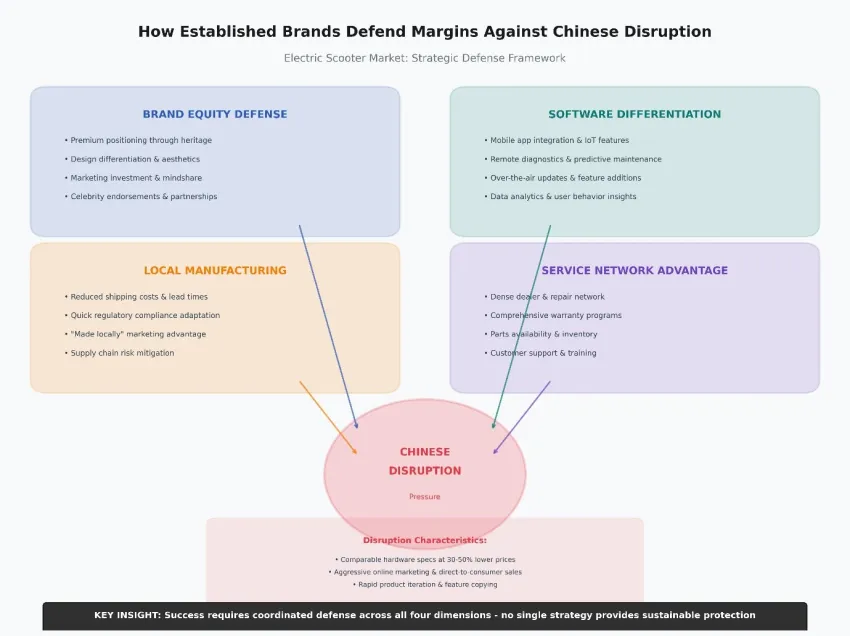
Premium manufacturers face increasing pressure from Chinese brands that offer comparable hardware specifications at significantly lower retail prices. This dynamic forces established players to defend their market positions through brand equity, distribution relationships, and service capabilities rather than pure product superiority.
Software and connectivity represent emerging differentiation strategies. Brands like Ather Energy and NIU integrate mobile applications, remote diagnostics, and over-the-air updates that create ongoing customer relationships beyond the initial hardware sale. These capabilities require ongoing investment but create switching costs that pure hardware manufacturers cannot replicate.
Local manufacturing and compliance represent defensive strategies for established brands. By maintaining production facilities in target markets, premium manufacturers can respond quickly to regulatory changes, reduce shipping costs, and market their products as locally produced alternatives to imported options.
Service network development creates another competitive advantage that Chinese manufacturers struggle to replicate quickly. Established brands invest in dealer networks, warranty programs, and parts availability that provide customer confidence and ongoing revenue opportunities.
How supply chain disruptions define the new economics of resilience?
Recent global supply chain disruptions have fundamentally altered electric scooter manufacturing economics. Manufacturers that previously optimized purely for cost efficiency now must balance resilience, flexibility, and risk management against traditional efficiency metrics.
Semiconductor shortages have particularly impacted electric scooter production, as modern models increasingly depend on sophisticated controllers, battery management systems, and connectivity modules. These disruptions have forced manufacturers to redesign products around component availability and develop relationships with multiple suppliers for critical components.
Shipping and logistics costs have become more volatile and significant components of total product costs. Manufacturers have responded by diversifying shipping routes, increasing buffer inventory, and in some cases relocating production closer to end markets to reduce transportation dependencies.
Raw material price volatility, particularly for lithium, cobalt, and rare earth elements, has created new cost management challenges. Forward contracting, alternative chemistry research, and recycling initiatives represent different strategies for managing input cost risk.
Sources
- USA Department of Energy (DOE). Battery Manufacturing and Supply Chain Challenges in Electric Vehicles.
- National Renewable Energy Laboratory (NREL). Economic and Environmental Impacts of Electric Scooters and Bikes: A Lifecycle Analysis.
- International Energy Agency (IEA). Global EV Outlook 2024: Trends in Electric Vehicle and Battery Manufacturing.
- USA Bureau of Labor Statistics. Producer Price Index by Industry: Electric Vehicle and Battery Manufacturing.
- Brookings Institution. Manufacturing and Supply Chain Strategies in Electric Mobility: Implications for Policy and Competition.
- World Economic Forum (WEF). The Global Battery Supply Chain: Risks and Opportunities for the Electric Mobility Industry.
- European Commission. Battery Production and Recycling: Impacts on the Electric Scooter and EV Market.

