


Key Takeaways
- Mobile payment cost structures are dominated by interchange fees and infrastructure maintenance rather than consumer-facing technology, with banks and card networks capturing the majority of transaction value while digital wallet providers operate on razor-thin margins.
- Digital wallet providers like Apple Pay and Google Pay function as pass-through payment facilitators rather than independent profit centers, relying on existing card networks and earning minimal direct revenue from transaction processing.
- The real margin capture happens in three distinct layers: interchange revenue flowing to issuing banks, assessment fees retained by card networks, and merchant service charges collected by acquiring banks and payment processors.
- Infrastructure costs including fraud prevention, data security, and system integration create significant fixed expenses that favor large-scale operators over smaller competitors.
- Traditional banks maintain structural advantages through interchange income and existing payment rails, while fintech disruptors face mounting infrastructure costs that erode their initial technology advantages.
- The hidden economics reveal that payment volume, not innovation, drives profitability in mobile payments, with successful providers focusing on transaction scale rather than premium pricing.
Why interchange fees still dominate mobile payment economics?
Despite the technological sophistication of mobile wallets, the fundamental cost structure of digital payments remains anchored in decades-old interchange fee models. When a customer taps their iPhone to pay for coffee, the underlying transaction flows through the same card network infrastructure that processes traditional plastic card payments.
Mobile payments are classified as card-present transactions, meaning they carry the same interchange rates as swipe or chip card payments rather than the higher fees associated with card-not-present online transactions. This classification benefits merchants by avoiding premium pricing, but it also means that mobile wallet providers cannot capture additional revenue from the payment processing itself.
Interchange fees typically represent a percentage of the transaction amount plus a fixed fee, compensating the issuing bank for risk and cost involved in handling the transaction. For a typical consumer purchase, interchange fees comprised the vast majority of total card processing fees, with the bulk flowing to issuing banks rather than the mobile payment platforms consumers interact with.
The economics become more complex when considering that interchange rates vary significantly based on card type, merchant category, and transaction characteristics. Premium rewards cards command higher interchange rates, which issuing banks use to fund cashback and loyalty programs, but mobile wallet providers see none of this premium.
For digital-first banks and fintech companies, interchange revenue represents a critical funding mechanism. Card spending generates interchange income that flows back to issuing institutions, forming the foundation of many fintech business models when split with partner banks through revenue-sharing agreements.
Where digital wallet providers actually make money?
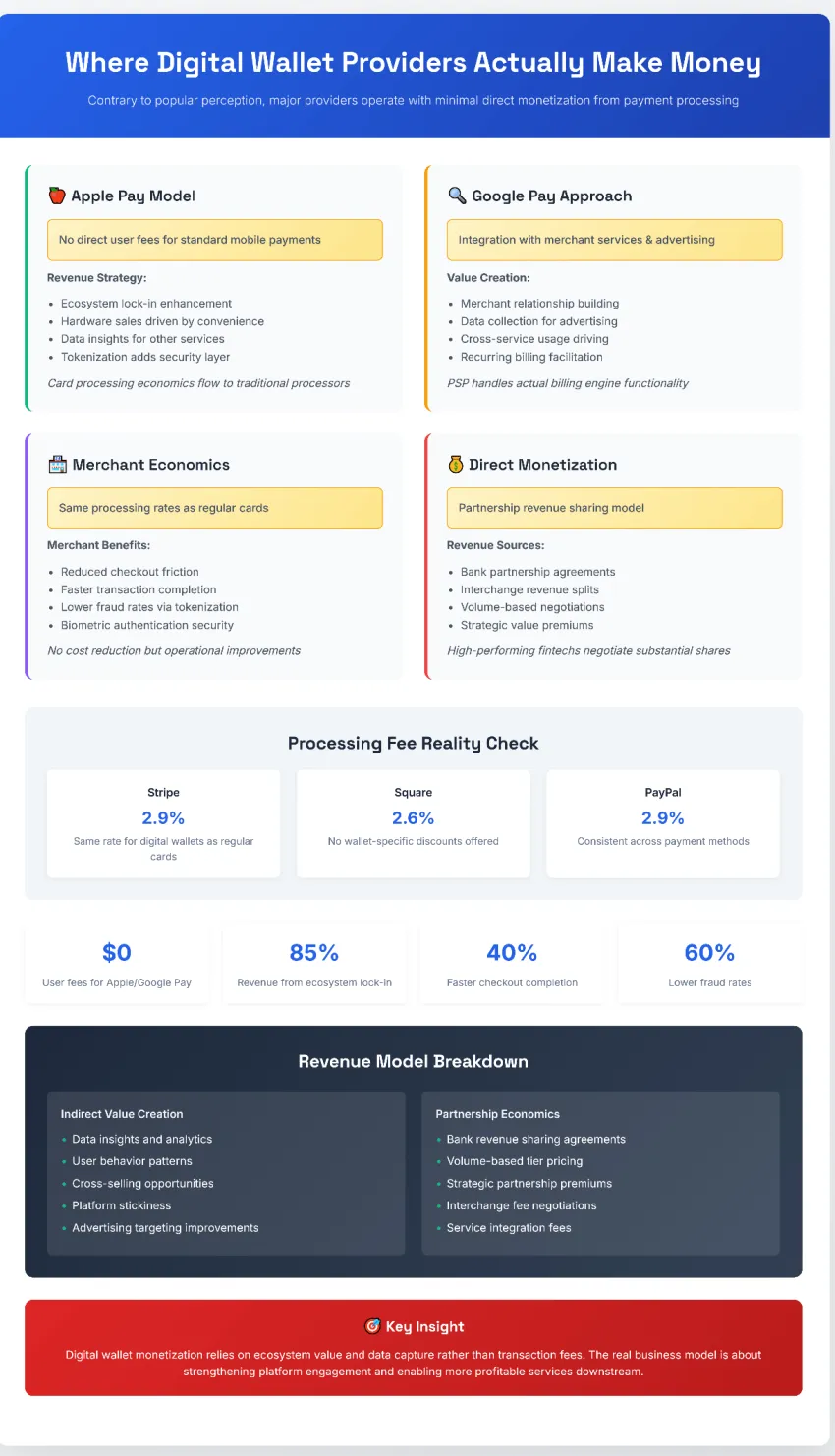
Contrary to popular perception, major digital wallet providers operate with minimal direct monetization from payment processing. Google Pay and Apple Pay do not charge users for making standard mobile payments, whether in stores or online. Their revenue models depend on indirect value creation rather than transaction fees.
Apple Pay transactions are essentially credit card transactions with an added layer of security, where card information is tokenized and encrypted by Apple, but the underlying economics flow to traditional payment processors. Apple's value capture comes from ecosystem lock-in, hardware sales driven by payment convenience, and data insights that enhance other services.
Google's approach differs slightly through integration with merchant services and advertising. Google Pay supports recurring billing through its online checkout system, with functionality typically facilitated by the Payment Service Provider used by the merchant rather than Google managing the billing engine directly. The platform's value lies in data collection, merchant relationships, and driving usage of other Google services.
For merchants, payment processors like Stripe and Square charge the same rates for digital wallets as they do for regular credit and debit cards, meaning mobile wallet adoption does not reduce their processing costs. The merchant benefits come from reduced checkout friction, faster transaction completion, and lower fraud rates due to tokenization and biometric authentication.
The most significant direct monetization occurs through partnership revenue sharing. For neobanks powered by licensed partner banks, bank partnership agreements determine the amount of interchange revenue received, which can vary by volume or follow a fixed split arrangement. High-performing fintech partners might negotiate substantial revenue shares, but this depends on transaction volume and strategic value to the partner bank.
How infrastructure costs create scale advantages?
The mobile payment industry requires substantial upfront technology investments that create natural barriers to entry and favor large-scale operators. Unlike simple software applications, payment systems must integrate with complex banking infrastructure, maintain round-the-clock uptime, and process transactions with millisecond response times.
Fraud prevention represents one of the largest ongoing infrastructure costs. Payment providers must invest in machine learning systems that analyze transaction patterns in real-time, maintain databases of known fraudulent activities, and implement multi-factor authentication systems. These systems require continuous updates and refinement as fraudsters develop new attack methods.
Data security infrastructure adds another significant cost layer. Payment Card Industry Data Security Standard requirements mandate specific hardware configurations, network segmentation, encryption protocols, and regular security audits. The cost of maintaining secure data centers, hiring certified security professionals, and implementing proper access controls scales with transaction volume but requires substantial minimum investments.
System integration costs multiply as providers expand their merchant and banking partnerships. Each new integration requires custom development work, extensive testing, ongoing maintenance, and dedicated support staff. Providers serving diverse merchant types must maintain different API configurations, webhook systems, and reporting formats for each partnership.
Customer support infrastructure represents an often-overlooked cost center. Payment issues require immediate resolution, forcing providers to maintain round-the-clock support teams with specialized knowledge of banking systems, card networks, and merchant account management. The cost per support interaction remains relatively fixed regardless of transaction size.
Why banks maintain structural cost advantages?
Traditional banks enjoy several structural cost advantages that mobile payment startups cannot easily replicate. Most importantly, banks already possess the necessary infrastructure, partnerships, and revenue streams to support payment services without requiring standalone profitability.
Banks earn interchange revenue directly as card issuers, capturing the largest share of payment processing fees without needing to split revenue with partners. This direct revenue stream subsidizes their payment technology investments and allows them to offer competitive merchant pricing while maintaining healthy margins.
Existing banking infrastructure provides another cost advantage. Banks already maintain the data centers, security systems, fraud monitoring capabilities, and customer support operations required for payment processing. Mobile payment providers must build these capabilities from scratch or purchase them from third-party vendors at higher per-transaction costs.
Banking relationships enable preferred access to card networks and wholesale pricing on payment processing services. Established banks negotiate volume discounts on network fees, settlement costs, and fraud prevention services that smaller providers cannot access. These wholesale advantages compound over time as transaction volumes grow.
What this means for mobile payment competitive positioning?
The cost structure analysis reveals that successful mobile payment providers must choose between scale-focused commodity strategies and value-added service differentiation. Pure payment processing offers limited margin potential due to interchange fee structures and infrastructure requirements.
Volume-based strategies require massive scale to achieve sustainable unit economics. Providers pursuing this approach must prioritize merchant acquisition, user adoption, and transaction frequency over premium pricing or specialized features. Success depends on achieving sufficient scale to negotiate favorable wholesale rates and spread fixed infrastructure costs across large transaction volumes.
Value-added service strategies attempt to capture margin through additional services layered on top of basic payment processing. These might include merchant financing, inventory management, customer analytics, or loyalty program management. Success requires developing specialized capabilities that justify premium pricing and create switching costs for customers.
Sources
- Fed Reserve Bank of Kansas City. Interchange Fees, Payment Card Networks, and the Economics of Mobile Payments.
- Federal Reserve Board. The Economics of Interchange Fees and Payment Card Markets.
- Bank for International Settlements. Retail Payments: Financial Stability Implications and Policy Considerations.
- European Central Bank. The Role of Interchange Fees in the European Card Payments Market.
- U.S. Government Accountability Office (GAO). Credit Cards: Rising Interchange Fees Have Increased Costs for Merchants.

