


Key Takeaways
- Magnetic sensors sit inside broader semiconductor supply chains, so they inherit the same mature-node bottlenecks that drove the 2020 to 2022 chip shortage, especially for automotive and industrial parts.
- Many sensor assemblies rely on permanent magnets. Rare earth magnet export restrictions and licensing delays from China have created a second point of fragility for components such as braking and leakage sensors in vehicles.
- Thin film magnetic stacks for AMR, GMR and TMR sensors depend on critical metals such as cobalt, nickel and iron alloys that feature in several "critical raw material" lists, which keeps long term cost and supply risk on the agenda.
- Governments are now backing domestic rare earth magnet capacity and semiconductor fabs, but most analysts expect any meaningful easing of structural risk to take most of this decade.
- For OEMs, the practical hedge is design and sourcing discipline: dual sourcing across fabs and regions, clear visibility into magnet and materials exposure, and a willingness to redesign around less constrained technologies where physics allows.
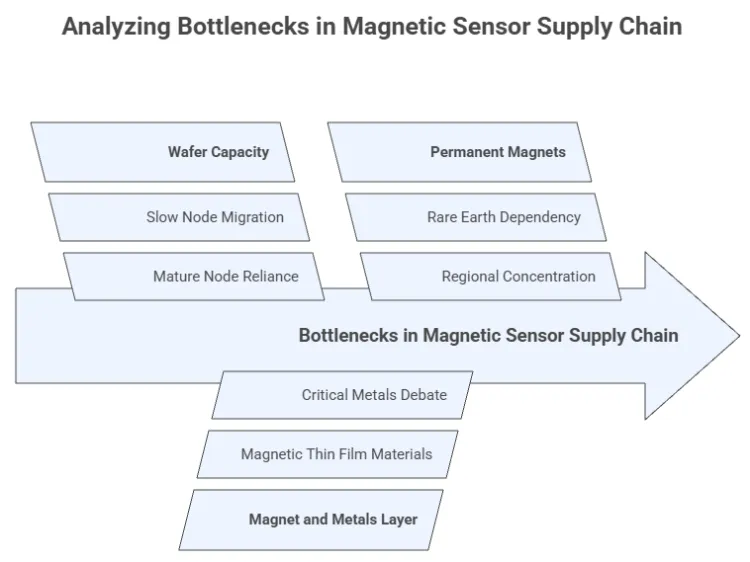
Where are the main bottlenecks in the magnetic sensor supply chain today?
Magnetic sensors are not a standalone industry; they are one branch of the wider analog and mixed signal semiconductor stack. A typical Hall or magnetoresistive sensor passes through design, wafer fabrication on mature CMOS or BiCMOS nodes, deposition of magnetic thin films, and then assembly and test in outsourced packaging houses. Reviews of magnetic sensor technology show that most devices are built as solid state ICs that integrate the sensing element and signal conditioning on a single chip, so they compete for the same fab and packaging capacity as other mature node analog parts.
The first bottleneck is therefore wafer capacity at older process nodes. The 2020 to 2022 chip crunch highlighted that many automotive and industrial chips still run on 200 millimetre lines and do not migrate quickly to newer nodes because of reliability and qualification requirements. Industry reports from the Semiconductor Industry Association describe how these mature nodes remained heavily loaded even when leading edge logic demand softened, which is exactly where many magnetic sensors sit.
The second bottleneck sits in the magnet and metals layer of the chain. The sensor die itself uses magnetic thin films based on alloys such as permalloy or cobalt based materials for AMR, GMR or TMR effects, often deposited by sputtering. Academic work on these films treats them as a subset of the broader soft magnetic and thin film materials domain that also feeds motors and actuators, which means they participate in the same critical metals debates around cobalt, nickel and other alloying elements.
Finally, many real world sensor modules depend on permanent magnets as the moving or reference element. Hall effect and magnetoresistive sensors are often combined with neodymium iron boron magnets in automotive and industrial assemblies. Policy and technical reports from Europe and international agencies consistently treat rare earths for these magnets as critical raw materials, given their concentration in a small number of mining and processing regions.
How did chip shortages and rare earth tensions change the risk profile?
The pandemic era chip shortage was the first clear warning. Automotive and industrial OEMs cut orders aggressively in early 2020, then returned to the market when demand rebounded, only to find that foundries had reallocated capacity to other segments. Analyses of the shortage note that semiconductors used in power management, control and sensing turned into the gating factor for vehicle production in 2021 and 2022, even though they use older technologies, not leading edge nodes.
Magnetic sensors were part of this story. They sit in safety relevant systems such as anti lock braking, steering, position sensing for throttle and pedals, and rotor position sensing in electric traction motors. Technical and application notes from industry and academic reviews document how these devices became ubiquitous in automotive and industrial motion control because they are robust and contactless, so any bottleneck in their supply quickly escalates into a vehicle level constraint.
The second shock came from magnets. In 2025, Chinese export controls on rare earth magnets and related elements led automotive trade associations in the United States, Europe and India to warn that production of critical components including motors, alternators and various sensors could halt within weeks if licensing delays continued. Reuters reporting shows how rare earth magnet exports are heavily concentrated in China, and how even temporary licensing frictions can leave automakers scrambling for supplies of brake and leakage sensors, windshield wiper motors and similar parts.
These two episodes changed the way OEMs think about magnetic sensors. What used to be a cheap, easily available commodity is now treated as part of a coupled system: wafer capacity at mature nodes, access to critical metals for thin films, and stable flows of rare earth magnets. Supply risk is no longer only about the fab; it is about the overlay between semiconductor and critical mineral geopolitics.
What are suppliers and OEMs doing to make magnetic sensor sourcing more resilient?
Response strategies are still evolving, but several themes are visible in policy documents and industry announcements. On the semiconductor side, sensor makers are qualifying multiple fabs and in some cases multiple process variants for key automotive families, so that production can move between regions if an individual plant is disrupted. The global push for new analog and power semiconductor capacity under the United States and European Chips Acts supports this by subsidising new mature node fabs, not only cutting edge logic.
On the materials and magnet side, two moves stand out. The first is geographic diversification of rare earth magnets. European and international roadmaps call for more domestic mining, separation and magnet making capacity, and recent policy decisions in India to fund large scale permanent magnet plants show how governments now treat magnet supply as strategic. The second is technical substitution. Automakers and researchers are exploring rare earth lean or rare earth free magnetic materials, as well as motor and sensor designs that rely less on high performance rare earth magnets, although most studies caution that scaling these alternatives will take many years.
Within sensor design, there is also a gradual shift toward more efficient architectures. Newer TMR based sensors, for example, offer higher sensitivity, which can allow smaller magnets or more relaxed mechanical tolerances for a given performance level. Academic work comparing sensor technologies points out that better sensitivity and noise performance can translate indirectly into lower materials use or simpler packaging, which supports cost and supply resilience even if per die complexity increases.
For OEMs, the practical playbook is therefore layered. First, map exactly where each magnetic sensor sits in the supply chain, from wafer foundry to magnet supplier. Second, design in at least one credible second source for each critical function, ideally on a different fab and magnet route. Third, engage in the policy debate around rare earths and semiconductors, because tax credits, long term offtake agreements and support for magnet recycling can all change the effective risk for long lived vehicle platforms.
How FMI Can Help
FMI can map the magnetic sensor value chain for specific OEMs and tiers, quantify exposure by technology and geography, and build scenarios that link semiconductor capacity, rare earth policies and end market demand. This includes benchmarking suppliers on process nodes, packaging locations and magnet sourcing, stress testing sourcing strategies under different policy and demand shocks, and identifying where design shifts, such as moving from rare earth intensive assemblies to alternative sensor concepts, would meaningfully reduce risk without eroding performance.
Sources
- Semiconductor Industry Association, State of the U.S. Semiconductor Industry reports.
- IRENA, Critical Materials for the Energy Transition: Rare Earth Elements.
- European Commission, Critical Raw Materials and related strategic technology studies.
- Jogschies L. et al., Recent Developments of Magnetoresistive Sensors for Industrial Applications, Sensors.
- Review articles on magnetic sensors and thin film magnetic materials in Sensors and related journals.

