


Key Takeaways
- Top wearables brands are no longer competing on "number of sensors" but on who can own the daily behaviour loop and turn that loop into a predictable stream of revenue, not one-off gadget sales.
- Platform players like Apple, Samsung and Google win by making the watch or ring a front-end to a larger ecosystem - payments, media, identity, cloud - where the real lifetime value sits.
- Specialist brands such as Garmin, Oura and Whoop win by going deep into narrower, high-value jobs: endurance training, recovery, sleep, stress and longevity, often backed by validation studies and quasi-clinical credibility.
- The brands that quietly fail usually don’t die because "people lost interest in wearables"; they die because they produce more data than decisions, mis-price hardware versus subscription, or ignore the limits of accuracy and regulation.
- For any OEM or investor looking at wearables now, the real strategic question is: which human problem am I willing to own every day, and does my economics (hardware, services, partnerships) match that choice?
What the platform giants are actually doing right
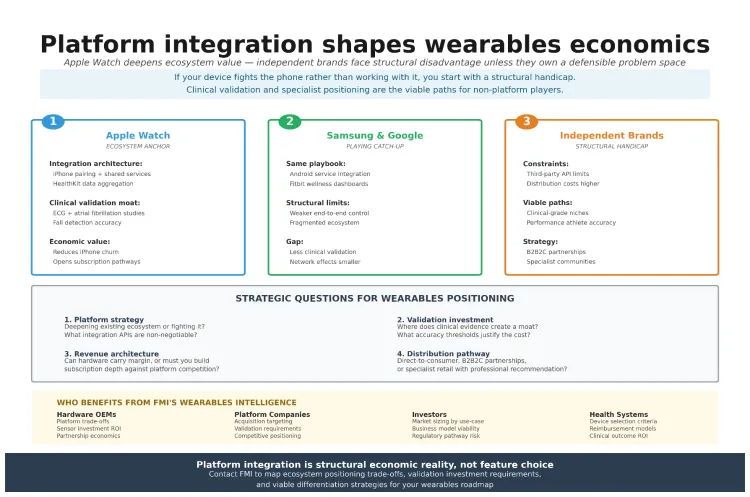
Apple, Samsung and Google did not win wearables purely by making good watches. They won because they understood that for most people, a watch or ring is a secondary device. The primary device is the phone and the cloud account behind it.
Apple
Apple Watch is effectively the wrist interface of the Apple stack. It deepens the value of the iPhone, AirPods, iCloud, Apple Pay, Apple Fitness+ and the Health app. The product design choices all reflect that:
- Fast, almost frictionless pairing with iPhone
- Shared services (notifications, calls, music control, Apple Pay, Wallet)
- Tight integration with HealthKit, which aggregates data from dozens of apps and devices
Apple’s health-specific features such as ECG, irregular rhythm notifications and fall detection sit on top of this base. Over the last years, those features have been repeatedly validated in clinical and real-world studies for detecting atrial fibrillation and capturing ECG parameters with useful accuracy. That evidence is not marketing fluff; it is a deliberate moat.
Economically, Apple Watch does three things for Apple:
it adds hardware revenue, it reduces churn from the iPhone ecosystem, and it opens doors for subscription services (Fitness+, iCloud tiers, future health services).
Samsung and Google
Samsung and Google are playing the same game on the Android side, though from weaker starting positions. Galaxy Watch and Pixel Watch lean heavily on:
- Integration with Android phones and services (Assistant, Maps, Wallet, notifications)
- Fitbit-style health dashboards and coaching for mainstream users
- Bundles with phones and earphones to raise average revenue per user
Neither has the same end-to-end integration as Apple, but both understand the core point: if you control the OS and cloud, the wearable is part of your lock-in strategy.
For a new brand, that is the first hard truth: if your device fights the phone rather than working with it, you are starting with a structural handicap.
What the specialist performance brands are doing right
Not everyone can own an OS. The more interesting strategies are from specialists who pick a vertical and go deep.
Garmin
Garmin is unapologetically built around endurance sports, outdoor use and aviation/marine niches. Its watches and bike computers optimise for:
- Battery life measured in days or weeks, not hours
- Accurate GNSS, maps, navigation and environmental data
- Training load, VO₂ max, endurance and recovery metrics tuned for people who plan their training in blocks, not steps
Independent validations show that Garmin’s VO₂ max estimates are reasonably accurate for moderately trained athletes, with caveats for very highly trained users. That is exactly Garmin’s positioning: good enough to steer everyday training, and often close to lab tests, while being rugged, weather-proof and integrated with an ecosystem of sensors.
Garmin’s real strength is not software sophistication in isolation, but a very tight match between metrics, form factor and user identity. A Fēnix or Forerunner owner isn’t just "a smartwatch user"; they are "a runner, triathlete, hiker, pilot." That identity makes the device sticky even if an Apple Watch looks sleeker.
Other sports brands
Polar, Coros and a few smaller players follow similar patterns with different emphases (price, ultra-endurance, specific sports). They compete more on depth and credibility within sport than on apps and payments.
What the sleep, recovery and longevity brands are doing right
A second cluster of specialists focuses on sleep, stress and recovery: Oura, Whoop, Withings and a growing set of ring-based or strap-based systems.
Oura
Oura has treated the ring as a discreet, everyday sensor for sleep, recovery and stress:
- Form factor that many people find more acceptable than a watch at night
- Aggregated scores such as sleep, readiness and daytime stress
- Long battery life and low on-body friction
Multiple independent studies and validation efforts have examined Oura’s sleep staging, readiness indices and physiological signals. The picture is nuanced: sleep-stage classification is not perfect, but for many metrics (total sleep, heart rate during sleep, patterns over time) the ring performs comparably to more intrusive setups in free-living conditions.
Strategically, Oura is now positioning itself less as "a fancy sleep tracker" and more as a proactive health platform: readiness for the next day, links to mental functioning and productivity, and growing partnerships with researchers and employers. The recent funding trajectory and emphasis on AI-driven health insights underline that shift.
Whoop
Whoop went even further in decoupling hardware from business model. Its choices:
- Strap form factor that can be worn under clothing and during high-intensity training
- Core focus on strain, recovery and sleep, not generic step counting
- A membership model where the subscription is the product and the hardware is a delivery mechanism
The message is clear: Whoop is meant for people willing to change their training and recovery behaviour, not for casual step tracking. It monetises continuous analysis and coaching rather than device sales alone.
This is economically risky - it demands genuinely differentiated, high-frequency insight - but it creates a very different relationship with the user: you are paying for an ongoing conversation about your body, not a gadget you bought two years ago.
Sources
- Shahid S. et al. (2025). Diagnostic accuracy of Apple Watch electrocardiogram for atrial fibrillation detection - systematic review of Apple Watch ECG performance.
- Khan S. et al. (2025). The Oura Ring versus medical-grade sleep studies - comparison of Oura with polysomnography and actigraphy.
- Engel F.A. et al. (2025). Validity of VO₂ max estimates from Garmin Forerunner smartwatches - assessment of Garmin VO₂ max algorithms in athletes.
- WHOOP (2025). Membership model and product positioning - official membership documentation and analysis of device-as-a-service strategy.

