


Key Takeaways
- Ring pull caps are metal crown style closures with an integrated pull ring that enables opener free opening on bottles.
- The supply chain is defined by coil quality, coatings, forming precision, liner consistency, and tight defect tolerance at bottling lines.
- Value concentrates in quality assurance, food contact compliance, and line performance rather than in basic metal conversion.
- Coating and liner chemistry is becoming a strategic constraint as food contact rules tighten in major markets.
- Alternatives win mainly by lowering system cost, improving resealability, or aligning better with recycling and reuse models.
- Ring pull caps still win when brands want glass bottle cues plus convenient opening without adding a plastic closure.
- The biggest risk is not one alternative, it is substitution across multiple packaging formats at once.
What does the ring pull cap supply chain look like from metal to the filling line?
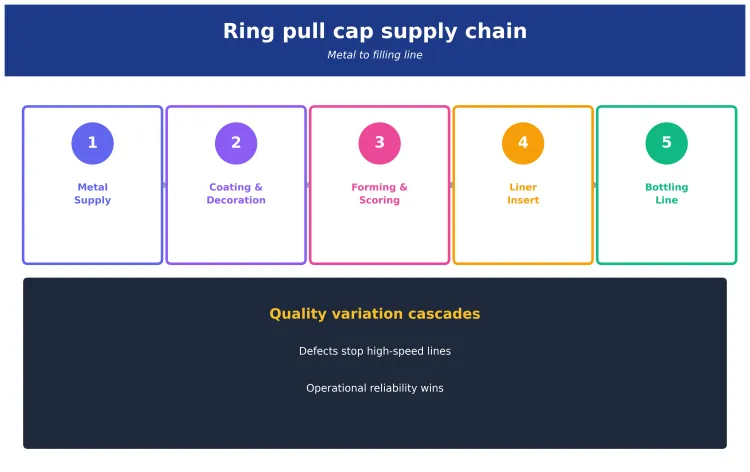
Ring pull caps are small, but the supply chain behind them is not. It starts with metal, most commonly steel tinplate or similar coated steel, sometimes aluminum depending on design and regional practice. The first economic truth is that closure makers are buying consistency more than they are buying metal. Variations in thickness, temper, surface cleanliness, and coating adhesion show up later as split skirts, weak crimps, panel defects, or unpredictable opening force. In this category, quality risk is expensive because the closure touches product integrity, carbonation retention, and shelf stability, and because a failure can stop a high speed bottling line.
From coil to finished cap, the conversion steps are broadly standard. Metal sheet is coated and decorated, then fed into high speed presses that stamp and form the crown shell. The ring pull feature adds a second layer of precision: scoring geometry, tab strength, and tear path control must be consistent enough to open reliably but not so weak that it compromises seal or tampers too easily. After forming, a liner is inserted and cured. The liner is a quiet hero. It is what actually seals against the bottle finish, it must resist flavor scalping, withstand pasteurization or hot fill where relevant, and maintain seal under internal pressure. Finally, closures are packed, shipped, and managed like a critical component in the bottler bill of materials, with lot traceability and defect limits that often feel closer to medical device discipline than commodity packaging.
The bottling line is where the supply chain either earns its premium or gets fired. Application requires consistent crown dimensions, skirt elasticity, and liner compression. The closure must work with capping heads, bottle finish variation, and throughput targets. In practice, this pushes the industry toward tight quality systems, process control, and vendor qualification. It also makes dual sourcing harder than it looks, because seemingly similar caps can behave differently at speed. That is why the ring pull cap market often rewards operational reliability more than clever marketing.
Which material and regulatory constraints can reshape the supply chain economics?
Two forces are increasingly shaping ring pull caps: food contact chemistry and packaging waste policy. Even though the closure is metal, its coatings and liners are chemistry heavy. Coatings are used to prevent corrosion, protect taste, and ensure clean processing performance. Liners and sealing compounds must maintain organoleptic neutrality and pressure performance. When regulators tighten restrictions on certain substances used in resins and coatings, the impact flows directly into closure qualification, testing cost, and redesign timelines. For closure suppliers, the constraint is not only compliance, it is avoiding performance regression during substitution. Any change that alters opening force, seal integrity, or flavor neutrality risks customer rejection.
Packaging waste policy changes the value of design choices. Rules that reward recyclability, minimize unnecessary packaging, or push reuse can indirectly affect closures by changing the container mix. If a market shifts toward refillable glass with standardized finishes, crown and ring pull formats can benefit if they remain compatible with wash and reuse systems. If the market shifts toward cans or cartons to reduce breakage and logistics emissions, bottle closures lose volume regardless of how good they are. Regulation also creates labeling and documentation demands that favor suppliers with mature traceability and compliance operations, because customers want paper trails that survive audits.
A practical way to think about this is to treat coatings and liners as the main redesign frontier. Metal forming is well understood and stable. The competitive turbulence comes when chemistry and compliance move faster than production assets do. Suppliers that can reformulate safely, validate quickly, and prove no sensory or performance tradeoffs tend to gain share during regulatory transitions. Suppliers that cannot do this get stuck competing on price in mature segments, which is a brutal place to be because unit values are low and volume is vulnerable to substitution.
What alternatives threaten ring pull caps, and where do ring pull caps still win?
Ring pull caps face two types of threats: closure alternatives on bottles and container format substitution. On bottles, the direct competitors are aluminum screw caps, twist off crowns, swing tops, and cork style systems depending on category. Screw caps win when resealability matters, when consumers expect easy open and close behavior, and when brands want lightweighting and fewer components in the opening experience. Twist off crowns can reduce the perceived novelty of ring pull while keeping similar cap line hardware. Swing tops and cork systems can win on premium cues and ritual, but usually at higher system cost and lower line speed.
Container format substitution is the bigger, quieter threat. Ready to drink beverages have been shifting into aluminum cans, especially where portability, chill speed, and on the go convenience dominate. Cans also avoid the need for a separate opening tool and can deliver strong barrier performance. Cartons and pouches can win in non carbonated segments by lowering distribution weight and improving pack efficiency. PET bottles with attached cap requirements in some regions push design attention toward plastic closures rather than metal crowns, even if glass remains exempt. When these shifts happen, ring pull caps do not lose because they are bad. They lose because the container format changes the game.
Ring pull caps still win in a specific sweet spot: glass bottles that want a traditional crown look and tamper evidence, but also want opener free access. That is common in beer, flavored malt beverages, and some premium soft drinks where brand equity is tied to glass, but consumption occasions are casual. Ring pull also fits accessibility narratives since it reduces reliance on tools. It can be a brand differentiator without changing the bottle itself too radically. The challenge is that differentiation must be worth the added complexity and the risk of consumer perception issues if opening force feels inconsistent.
The strategy implication is simple: ring pull caps are not fighting one enemy. They are fighting a swarm. Winning depends on staying excellent at line performance and compliance while owning a clear brand and user benefit that alternatives cannot cheaply copy.
How FMI can Help

FMI can help you turn ring pull caps into a supply chain and substitution story that is decision grade, not descriptive. This starts with mapping the value chain from metal feedstock and coatings through conversion, lining, printing, distribution, and bottler qualification, then identifying where margins concentrate and where failures propagate. FMI can profile the constraint points that drive switching cost, such as liner chemistry qualification, food contact compliance testing, and bottling line compatibility. On the demand side, FMI can segment substitution threats into bottle closure swaps and packaging format migration, then size which end uses are most exposed to cans, cartons, or screw caps based on category and consumption occasion. FMI can also track policy signals that change economics, including packaging waste rules and food contact restrictions, and translate them into timing and investment implications for closure makers and brand owners. The output is a market narrative tied to real operational choke points and realistic alternative pathways, so strategy discussions stay grounded in what can actually change and how fast.
Bibliography
- Deshwal, G K. 2019. Review on metal packaging materials forms food applications safety and recyclability. Journal of Food Science and Technology. Open access via PubMed Central.
- European Union. 2025. Regulation EU 2025/40 on packaging and packaging waste. Official Journal of the European Union. EUR Lex.
- European Union. 2019. Directive EU 2019/904 on the reduction of the impact of certain plastic products on the environment. EUR Lex.
- European Commission. 2024. Commission adopts ban of Bisphenol A in food contact materials. Directorate General for Health and Food Safety.
- European Food Safety Authority. 2023. Bisphenol A in food is a health risk. EFSA news release.
- Ramirez, V and coauthors. 2023. Risk assessment of food contact materials. EFSA Journal.
- Gress, A and coauthors. 2024. Packaging material use efficiency of commercial PET and glass beverage packaging systems. Beverages, MDPI.
- Food Safety and Standards Authority of India. 2018. Food Safety and Standards Packaging Regulations. Compendium edition 2022.
- US Patent Office. 2011. Easy pull crown bottle cap. Patent US8061544B2.
- German Patent Office. 1977. Crown cork closure with pull ring. Patent DE2718914A1.

