


Key Takeaways
- Oral disease burden in BRICS is high and preventive coverage is uneven, which means the biggest white space is still simple, fluoride based prevention rather than exotic devices.
- Three structural gaps show up consistently when you overlay disease data, behaviour and access: low adult and rural preventive coverage, weak interdental hygiene and mouthwash usage, and underdeveloped professional prevention for lower income groups.
- Toothbrushing frequency and fluoride toothpaste use are still below optimal levels in large parts of India, Brazil, South Africa and rural China, while caries and periodontal disease remain widespread.
- Access to dentists and preventive dental services is highly unequal: Brazil and South Africa have significant workforce and income related gaps, and China shows clear urban rural disparities. This pushes households to self manage with basic products or postpone treatment.
How does disease burden and behaviour frame white space in BRICS oral care
The underlying problem in BRICS oral care is a persistent mismatch between disease prevalence and preventive behaviour. Across these markets, untreated dental caries and periodontal disease remain widespread, especially as individuals move from adolescence into adulthood. Although patterns vary by country, the structural picture is consistent: high need for prevention but incomplete adoption of basic hygiene behaviours.
Brushing frequency illustrates this gap. In India, for example, only a minority achieve twice-daily brushing, while similar behavioural shortfalls appear in rural China where fluoride toothpaste usage is extremely low. These behavioural gaps are reinforced by limited and unequal access to professional care. Income, education, and location shape who receives preventive treatment and who delays care until symptoms become severe.
When these factors are overlaid, the white space becomes clear. The region needs solutions that lift large populations from low-frequency, low-quality hygiene to stable, everyday prevention-within the constraints of affordability and access. This is a scale challenge, not a premium innovation challenge.
Where is the product and usage white space in BRICS oral care
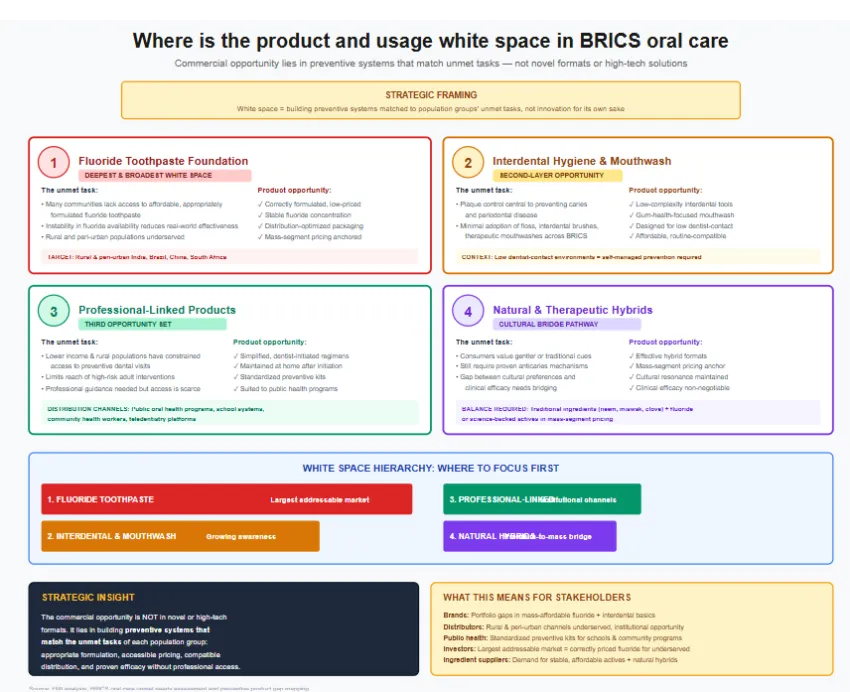
The commercial opportunity is not in novel or high-tech formats, but in building preventive systems that match the unmet tasks of each population group.
The first and largest gap lies in fluoride toothpaste. Many communities still lack access to affordable, appropriately formulated products, and instability in fluoride availability reduces real-world effectiveness. Correctly formulated, low-priced options aimed at rural and peri-urban India, Brazil, China and South Africa represent the deepest and broadest white space.
Interdental hygiene and mouthwash represent the second layer. Although plaque control is central to preventing caries and periodontal disease, adoption of floss, brushes and therapeutic mouthwashes is minimal in most BRICS markets. There is room for low-complexity, affordable interdental tools and gum-health-focused mouthwashes designed for low dentist-contact environments.
Professional-linked products form the third opportunity set. Lower income and rural populations have constrained access to preventive dental visits, limiting the reach of high-risk adult interventions. There is white space in simplified, dentist-initiated regimens that can be maintained at home, as well as standardised preventive kits suited to public oral health and school programs.
Finally, natural and therapeutic hybrid products create a pathway for consumers who value gentler or traditional cues but still require proven anticaries mechanisms. Effective hybrid formats priced for mass segments can bridge the gap between cultural preferences and clinical efficacy.
How do income and access constraints reshape the white space
The scalability of any white space in BRICS is defined by structural constraints: limited dental workforce capacity, sharp urban-rural divides in service access, and low behavioural baselines. With Africa representing a very small share of the global oral health workforce, and Brazil and South Africa showing clear inequalities in preventive dental use, solutions heavily dependent on professional channels will inherently remain narrow.
Rural populations in Brazil and China face utilisation gaps even after adjusting for income and education. This reality limits dentist-driven adoption curves and positions over-the-counter, behaviour-shifting products as the main growth lever.
Behavioural inertia adds another barrier. In countries where a significant share of consumers still brush once per day or less, moving them to consistent preventive routines is a prerequisite for commercial uptake of more advanced categories. Selling premium products into low-frequency-habit markets is structurally misaligned.
Across BRICS, the most scalable opportunity is affordable prevention that fits the reality of limited access, tight budgets and low baseline behaviours. Premiumisation has a role, but only after foundational habits are established.
What does this imply for innovation and strategy in BRICS oral care
If demand is viewed through the lens of affordability, access, and behavioural maturity, the strategic landscape changes significantly.
In Brazil and South Africa, the opportunity lies in strengthening adult preventive regimes for cohorts that currently seek care late. This points to integrated product-plus-professional pathways rather than standalone retail products.
In India, rural China, and lower income areas of Russia and South Africa, the immediate job is to normalise twice-daily brushing using effective fluoride formulations and pack sizes aligned to household economics. Whitening, cosmetic or premium functional claims become secondary until the habit foundation is secure.
Interdental and gum-health products can grow meaningfully in urban middle-income segments, but only when they operate at price points below premium tiers and when accompanied by simple guidance or dentist endorsement.
The overarching strategic constraint is clear: BRICS oral care cannot leapfrog to Western-style gadget penetration when preventive baselines remain low. Sustainable growth must follow the logic of sequence: first baseline prevention, then mid-tier upgrades, and only then selective premium expansion.
Sources
- World Health Organization. (2022). Global oral health status report. Geneva: WHO. Wiley Online Library; World Health Organization.
- FDI World Dental Federation. (2015). The challenge of oral disease: Oral health atlas (2nd ed.). Geneva: FDI. fdiworlddental.org; NCD Alliance.
- Jain, N., et al. (2024). WHO global oral health status report: Action on oral health for global health. Oral Diseases. Wiley Online Library.
- Cordeiro, D., et al. (2024). Utilization of dental services by rural riverside populations in Brazil. Rural and Remote Health. rrh.org.au.
- Bof de Andrade, F., et al. (2025). Socioeconomic inequalities in preventive dental service use among older adults in Brazil: An Oaxaca-Blinder decomposition. BMC Oral Health. SpringerLink.
- Qi, X., et al. (2021). Urban-rural disparities in dental services utilization among adults in China. BMC Oral Health. PMC.
- Sebastian, S. T., et al. (2015). Total and free fluoride concentration in various Brazilian toothpastes. Journal of Applied Oral Science. PMC.
- World Health Organization. (2019). Proposal for inclusion of fluoride toothpaste in the WHO model list of essential medicines. WHO Expert Committee on Selection and Use of Essential Medicines. World Health Organization.
- Gupta, R. D., et al. (2024). Toothbrushing frequency among children and adolescents and its impact on oral health. Journal of Public Health Dentistry.

