


Key Takeaways
- By 2025, the centre of gravity in terahertz moves from fundamental sources and detectors towards integrated, application-specific systems for non-destructive testing, biosensing and fast spectroscopy, anchored in metamaterials, graphene and on-chip platforms.
- The most active innovation zones are: high-throughput THz imaging architectures, room-temperature detectors, tunable modulators and polarisation control, and intelligent reconstruction using machine learning and on-chip signal processing.
- Recent roadmaps and reviews converge on a similar view: terahertz will matter first where no other modality can do the same job, such as non-destructive inspection of plastics, composites, packaged food, pharmaceuticals and high-voltage components, rather than generic medical body scanning.
- Patent activity between roughly 2020 and 2025 concentrates on packaging and modularisation of THz devices, metamaterial-based sensors, and compact modulators that can fit into future 6G-style front ends, not just stand-alone lab spectrometers.
- For strategy teams, the red pill is that long-term advantage is less about owning a single exotic source and more about combining "good enough" hardware with robust application know-how, data pipelines and regulatory-grade validation in a few high-value niches.
What actually changed in terahertz imaging and spectroscopy?
A decade ago, terahertz was still framed mainly as a future technology for airport security and generic medical imaging. The 2023 terahertz science and technology roadmap marks a pivot. It argues that advances in sources, detectors and time-domain spectroscopy have moved the bottleneck from basic generation towards system integration, throughput and application-specific performance, and it emphasises industrial inspection, cultural heritage and material characterisation alongside communications.
Recent reviews on terahertz spectroscopy and sensing underline how rapidly sources and detectors have matured. A 2025 survey of terahertz spectroscopy in food analysis highlights compact time-domain systems that can discriminate moisture content, structure and contaminants in real products rather than idealised samples. Parallel work on high-throughput terahertz imaging describes prototype systems that scan larger areas or volumes at useful speeds, using detector arrays, fast scanning schemes and efficient reconstruction algorithms.
On the application side, three clusters stand out in 2025. First, non-destructive testing of civil infrastructure and composites, where sub-terahertz and terahertz waves penetrate dielectrics such as concrete and glass-fibre-reinforced plastics and reveal defects that are difficult for ultrasound or x-ray to capture in certain geometries. Second, industrial and food quality screening, where THz signatures of water activity, structure and inclusions enable real-time detection of foreign bodies or spoilage in packaged foods and agricultural products. Third, pharmaceutical analysis and process monitoring, building on earlier pulsed-spectroscopy work but now aligned with continuous manufacturing and regulatory demands for non-destructive in-line measurement.
Where are the most defensible hardware innovation zones?
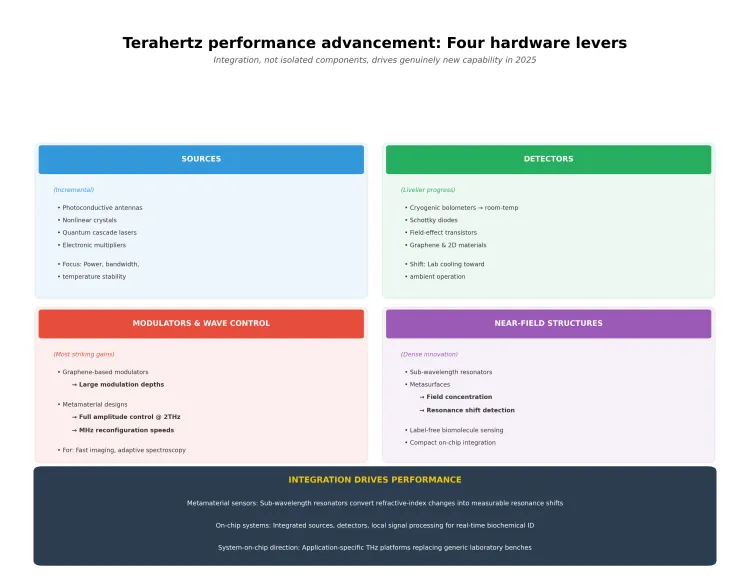
System-level capability still rests on four hardware levers: sources, detectors, modulators and polarisation control, and near-field structures that shape or localise fields. The 2023 roadmap and subsequent reviews converge on the idea that genuinely new performance in 2025 comes from combinations of these elements rather than isolated component tweaks.
Sources remain a mix of photoconductive antennas, nonlinear crystals, quantum cascade lasers and electronic multipliers. Innovation here is largely incremental, targeting higher output power, broader bandwidth and better temperature stability. Detector work is livelier. Surveys of terahertz sensors between 2022 and 2025 trace a progression from cryogenic bolometers towards room-temperature detectors based on Schottky diodes, field-effect transistors and novel materials such as graphene and other two-dimensional systems.
Modulators and wave control are where some of the most striking 2023-2025 results appear. Graphene-based terahertz modulators have demonstrated large modulation depths by coupling atomically thin graphene to resonant structures. One widely cited study reports a highly efficient graphene terahertz modulator with tunable amplitude enabled by engineered plasmonic interactions. A later metamaterial design goes further, achieving essentially full amplitude and intensity modulation around 2 terahertz with megahertz-scale reconfiguration speeds using a carefully engineered structure with back-side excitation and tailored gaps. These levels of performance are directly relevant for fast imaging, adaptive spectroscopy and future wireless front ends.
Metamaterial-based sensors form another dense innovation cluster. Recent reviews from 2024-2025 synthesise dozens of designs where sub-wavelength resonators or metasurfaces concentrate fields and convert tiny refractive-index changes into measurable shifts in resonance, enabling label-free detection of biomolecules, chemicals and thin films with high sensitivity. These structures are particularly important for compact, on-chip systems because they shrink interaction volumes and relax demands on sources and detectors.
Finally, system architects are pushing intelligence closer to the sensor. Work on on-chip terahertz sensing platforms couples integrated sources and detectors with local signal processing to perform real-time biochemical identification on a chip, reducing the burden on external measurement hardware. That direction points toward application-specific THz system-on-chip designs rather than generic laboratory benches.
What do recent patents tell us about where value will accrue?
Patent landscapes from roughly 2020 to 2025 show a shift from basic terahertz sources toward packaging, modularisation and system building blocks. Earlier foundational patents covered terahertz imaging systems for concealed-weapon detection and integrated terahertz imagers for security and spectroscopy. More recent grants focus on making terahertz elements manufacturable and easy to integrate.
A 2024 patent for a terahertz device and production method, for example, describes a packaging structure in which a terahertz element that converts between THz waves and electrical energy is encapsulated in resin with a conductive frame that also functions as a reflective surface. This enables modularisation of THz elements so they can be inserted into compact systems with standardised interfaces. Similar families address array configurations, antenna integration and thermal management, all designed to embed THz functionality into larger instruments or communication modules rather than treating it as stand-alone lab hardware.
In parallel, patent activity has accelerated in sub-terahertz and terahertz front ends for 6G-style communications, where optical devices, frequency multipliers and phased arrays generate and steer narrow beams at hundreds of gigahertz. Even when these filings are framed as communications rather than imaging, many of the underlying components especially modulators and arrays are directly relevant to high-speed imaging and time-resolved spectroscopy.
Taken together, the pattern is clear. Defensible IP is moving into three areas: manufacturable, packaged THz elements; metamaterial and graphene-based structures that deliver high modulation or sensing performance; and architectures that combine THz hardware with localised signal processing, often on chip. Commodity-style sources and detectors are unlikely to carry strategic advantage on their own.
Sources
- Huang, Y., et al. (2023). From terahertz imaging to terahertz wireless communications. Journal of Communications and Information Networks.
- Jiang, W., et al. (2024). Machine learning based non-destructive terahertz inspection for shelled seed quality. Sensors.
- Kim, M., et al. (2023). Highly efficient graphene terahertz modulator with tunable amplitude. Scientific Reports.
- Leitenstorfer, A., et al. (2023). The 2023 terahertz science and technology roadmap. Journal of Physics D: Applied Physics.
- Li, X., et al. (2023). High throughput terahertz imaging: Progress and challenges. Light: Science and Applications.
- Nie, H., et al. (2023). Application of terahertz nondestructive testing technology in industrial production. ACS Omega.
- Wang, Y., et al. (2025). Recent advances in metasurfaces: From THz biosensing to other applications. Advanced Materials Technologies.
- Xia, R., et al. (2023). Achieving 100 percent amplitude modulation depth in a graphene based tuneable capacitance metamaterial. arXiv preprint.
- Yu, P., et al. (2025). Recent developments and applications of terahertz spectroscopy in food analysis. Biosensors.
- Zhou, Z., et al. (2025). Recent progress in terahertz sensors based on graphene metamaterials. Nanomaterials.
- USA Patent No. 11,894,494. (2024). Terahertz device and production method. United States Patent and Trademark Office.

