


Key Takeaways
- Microalgae ingredients are constrained by production cost rather than biological potential
- Cultivation system choice determines energy and capex intensity
- Harvesting and drying dominate unit economics
- Regulatory approval gates limit addressable applications
- Integrated production models outperform standalone biomass production
Microalgae ingredients promise sustainable alternatives to conventional nutrients, pigments, and bioactive compounds. Species including Spirulina, Chlorella, Haematococcus, and Schizochytrium deliver proteins, omega-3 fatty acids, astaxanthin, and beta-carotene with minimal land footprint. Yet despite decades of research and hundreds of strains with documented nutritional properties, fewer than a dozen species reach commercial production volumes exceeding 1,000 metric tons annually. This concentration reflects fundamental constraints in cultivation engineering, downstream processing economics, and regulatory pathway navigation rather than biological limitations.
Commercial viability in microalgae ingredients separates at the intersection of capital efficiency, energy intensity, and process yield. Countries that dominate production share infrastructure advantages, regulatory frameworks that accelerate approvals, and climates or energy costs that reduce operating expenses. The gap between laboratory potential and commercial reality widens at each processing stage, where losses compound and costs accumulate. Understanding these technical and economic barriers explains why microalgae ingredient production remains concentrated in specific geographies and integrated production models rather than distributed across diverse producers.
How do cultivation systems shape microalgae ingredient economics?
Cultivation system selection determines capital intensity, contamination risk, productivity per unit area, and operating cost structure. Open raceway ponds represent the lowest capital investment pathway, typically requiring USD 50,000 to USD 150,000 per hectare for construction. These shallow channels use paddle wheels to circulate algae suspensions and rely on natural sunlight for photosynthesis. Productivity ranges from 10 to 25 grams per square meter per day for robust strains such as Spirulina in optimal climates. However, open systems face contamination from competing microorganisms, depend on specific climatic conditions, and achieve lower biomass concentrations, typically 0.3 to 0.8 grams per liter.
Closed photobioreactors offer contamination control and higher volumetric productivity but multiply capital costs by factors of 5 to 20. Tubular systems, flat panels, and vertical column configurations maintain axenic cultures and enable production of high-value compounds requiring pure biomass. Photobioreactor systems achieve biomass concentrations of 2 to 8 grams per liter and productivity of 20 to 50 grams per square meter per day. Yet this performance requires active temperature control, CO2 injection systems, and cleaning protocols that increase energy consumption and operational complexity. The capital payback period for photobioreactors often extends beyond 7 years even for premium ingredients.
Energy intensity diverges sharply between systems. Open ponds consume 0.5 to 1.5 kilowatt-hours per kilogram of dry biomass for circulation and harvesting, while photobioreactors require 3 to 15 kilowatt-hours per kilogram when including temperature management and cleaning. This difference makes electricity pricing a primary determinant of system viability. Countries with low industrial electricity costs below USD 0.06 per kilowatt-hour gain significant advantages for closed system production.
Why do harvesting and downstream processing define cost competitiveness?
Harvesting and dewatering account for 20 to 40 percent of total production costs and present the primary technical bottleneck in scaling microalgae production. Algae suspensions exit cultivation at 0.3 to 8 grams per liter solid content depending on system type. Reaching the 15 to 25 percent solid content required for spray drying or the 90+ percent content for direct use demands multiple concentration stages, each introducing losses and consuming energy.
Primary concentration through flocculation, sedimentation, or dissolved air flotation reduces volumes by factors of 10 to 50 but achieves only 2 to 6 percent solids. This step determines downstream efficiency. Poor flocculation leads to extended settling times, increased chemical costs, and biomass losses of 5 to 15 percent. Secondary dewatering using centrifugation or membrane filtration reaches 15 to 25 percent solids but requires significant electrical input. Disc stack centrifuges consume 0.3 to 0.8 kilowatt-hours per kilogram of dry biomass recovered and represent major capital investments, with industrial units costing USD 200,000 to USD 800,000.
Drying dominates energy consumption in the final processing stages. Spray drying microalgae to below 5 percent moisture content requires 3 to 6 kilowatt-hours per kilogram of water evaporated. For biomass entering at 20 percent solids, this translates to 12 to 24 kilowatt-hours per kilogram of final dry product. Alternative drying methods including drum drying, refractance window drying, or freeze drying offer quality benefits for specific applications but rarely improve energy efficiency at commercial scale.
Extraction adds another cost layer for ingredient applications requiring specific compounds rather than whole biomass. Astaxanthin extraction from Haematococcus requires cell disruption, solvent extraction, and purification steps that may cost USD 200 to USD 500 per kilogram of finished ingredient. Omega-3 oil extraction from Schizochytrium involves similar complexity. These processing costs explain why microalgae ingredients often target applications where premium pricing justifies USD 20 to USD 200+ per kilogram pricing rather than commodity food or feed uses at USD 2 to USD 8 per kilogram.
Which countries lead commercially viable microalgae ingredient production and why?
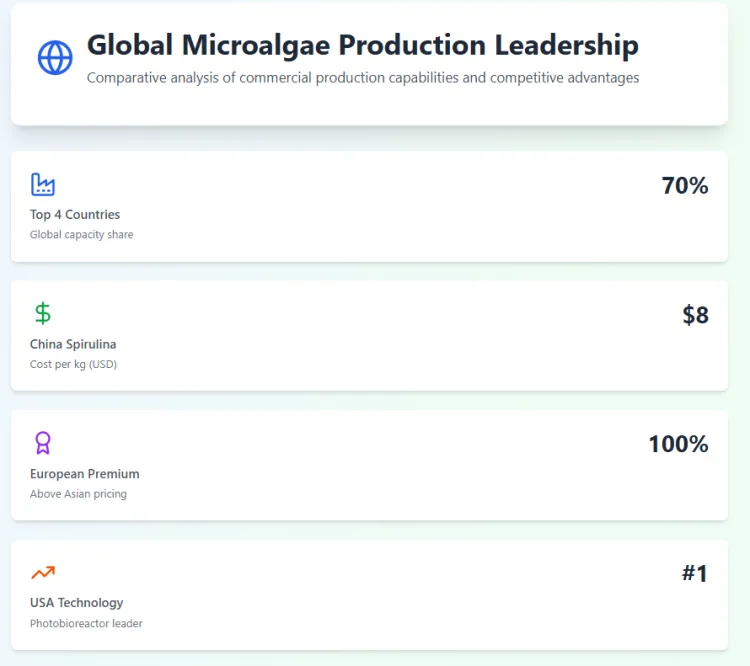
The United States, China, India, and Taiwan dominate global microalgae ingredient output, collectively representing over 70 percent of commercial production capacity. Their leadership stems from distinct advantage combinations rather than any single factor.
The United States hosts the largest number of photobioreactor facilities and leads in high-value ingredient production including astaxanthin, omega-3 oils, and beta-carotene. Regulatory pathways through FDA Generally Recognized as Safe determinations and novel food consultations provide clear approval routes. Access to low-cost natural gas in some regions supports competitive energy costs, while venture capital and corporate investment funding enables capital-intensive technology deployment. Major producers including Cellana, Qualitas Health, and Corbion operate integrated facilities that combine cultivation with downstream processing and direct customer relationships.
China operates the largest open pond capacity globally, with Spirulina and Chlorella facilities in Inner Mongolia, Yunnan, and Hainan provinces. Production costs benefit from lower labor expenses, established supply chains for cultivation inputs, and government support for biotechnology development. Chinese producers achieve Spirulina costs below USD 8 per kilogram at scale, compared to USD 12 to USD 18 per kilogram in Western facilities. However, quality perception challenges and regulatory acceptance issues in premium export applications limit addressable opportunities.
India maintains significant Spirulina production capacity in Tamil Nadu and other southern states, benefiting from year-round growing conditions and low labor costs. Indian facilities focus on domestic nutrition applications and export to developing regions rather than premium ingredient segments. Regulatory frameworks for food and nutraceutical applications provide adequate clarity for established species but less certainty for novel strains.
European production concentrates in Germany, France, Spain, and the Netherlands, emphasizing controlled cultivation, traceability, and regulatory compliance for food and cosmetic applications. Higher energy and labor costs limit commodity production but enable premium positioning. European producers often maintain smaller scale but achieve price premiums of 30 to 100 percent over Asian production for equivalent specifications through quality assurance and sustainability certification.
How does regulatory acceptance shape end use adoption of microalgae ingredients?
Regulatory approval requirements create distinct pathways and timelines that fundamentally influence which microalgae ingredients reach commercial adoption and in which applications. These approval processes determine addressable volume, allowable claims, and required investment before revenue generation.
Food applications present the most stringent requirements. In the United States, new microalgae ingredients require FDA GRAS notification or food additive petitions unless they qualify under existing regulations. GRAS determinations demand extensive safety data including toxicology studies, allergenicity assessment, and manufacturing process validation. This process typically requires 18 to 36 months and costs USD 200,000 to USD 800,000 per ingredient. European novel food approvals under EFSA evaluation demand similar evidence and timelines. Only approximately 12 microalgae species hold approved food status across major regulatory jurisdictions, creating strong first-mover advantages for established ingredients.
Dietary supplement and nutraceutical applications offer faster entry in many jurisdictions but limit claim potential. In the United States, supplements avoid premarket approval but face restrictions on disease treatment claims. European food supplement regulations vary by member state, creating regulatory fragmentation. These pathways enable companies to generate revenue during food approval processes but at lower price points and volumes.
Animal feed applications generally require less safety evidence for established species but face different economic thresholds. Feed ingredient pricing typically ranges from USD 2 to USD 15 per kilogram depending on nutritional value and target species. This pricing requires production costs well below most current microalgae facilities, limiting feed opportunities to high-value aquaculture applications or co-product strategies where feed-grade material offsets primary product costs.
Cosmetic and personal care applications provide alternative revenue channels with intermediate regulatory requirements. Ingredient approvals focus on safety and preservation rather than efficacy, typically requiring 6 to 18 months. However, cosmetic pricing varies widely based on positioning, and biomass quality requirements often match or exceed food standards.
Why do integrated production and application focused models outperform biomass first strategies?
Integrated models that connect cultivation, processing, and end-use applications consistently demonstrate superior commercial sustainability compared to approaches that produce generic biomass seeking buyers. This pattern reflects the economic realities of microalgae production and the importance of value capture at multiple stages.
Vertically integrated facilities that combine cultivation with extraction and formulation capture margin at each processing step rather than selling intermediate biomass at commodity pricing. Companies including DSM (acquired beta-carotene producer), Evonik (omega-3 producer), and Corbion (lactic acid and algae ingredients) operate this model. Integration enables process optimization across stages, reduces transportation and storage costs, and maintains quality control. More importantly, direct relationships with end customers provide volume commitments that justify capital investment and enable long-term production planning.
Application-focused strategies that develop production capabilities targeting specific end uses achieve higher success rates than generic production facilities. Designing cultivation and processing specifically for astaxanthin production, omega-3 oils, or protein concentrates enables optimization impossible in multi-product facilities. Purpose-built processes achieve higher target compound yields and lower production costs through equipment selection, solvent choice, and workflow design aligned with single objectives.
Offtake agreements and strategic partnerships stabilize revenue and reduce commercialization risk. Contracts with food manufacturers, supplement brands, or aquaculture companies provide demand certainty that enables financing and operational planning. These relationships often include co-development work where customers fund process optimization in exchange for supply commitments. The alternative approach of building production capacity and then seeking buyers exposes producers to pricing pressure and volume uncertainty.
Co-location with CO2 sources or energy infrastructure creates additional integration advantages. Facilities sited near power plants, ethanol plants, or industrial CO2 sources reduce carbon input costs by 40 to 70 percent. Similarly, operations adjacent to waste heat sources or renewable energy installations improve energy economics. These location decisions often determine viability for energy-intensive photobioreactor operations.
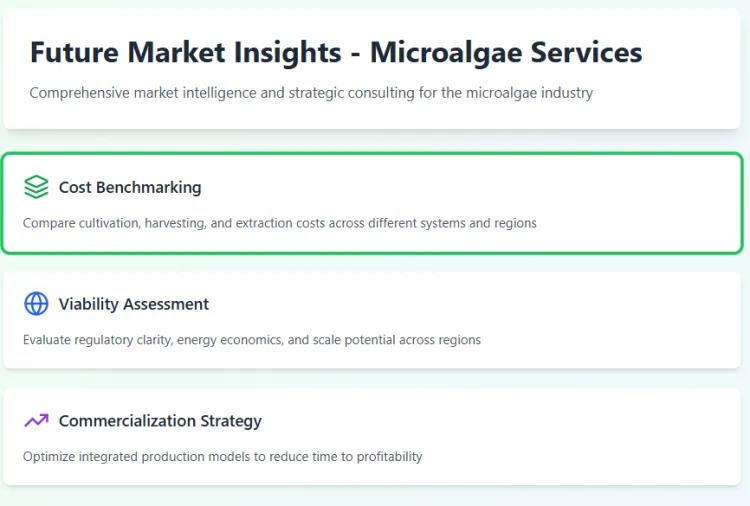
How Future Market Insights Can Help?
Sources
- Corbion. Technical documentation on algae cultivation systems and fermentation processes. Available through corporate technical resources and regulatory filing databases.
- Cyanotech Corporation. Spirulina and astaxanthin production specifications and cultivation methodology. Hawaii-based producer technical literature.
- DSM Nutritional Products. Beta-carotene from Dunaliella production process and regulatory status documentation. Historical technical reports prior to acquisition.

