


Key Takeaways
- Germany’s automotive and rail OEMs demand anti chip, abrasion and chemical resistant coatings for lifetime performance
- Low VOC and emissions regulations drive preference for high performance polyurea formulations that cure rapidly and bond reliably
- Robotic spray application and quality control protocols enable thin, consistent films that meet tight tolerances
- Industrial process equipment requiring chemical resistance and fast turnaround benefits from polyurea cure speed and durability
- Supplier qualification and OEM approval cycles create high switching costs and pricing resilience for certified formulators
Which German applications drive the highest specification demand for polyurea coatings?
German automotive manufacturers deploy polyurea coatings primarily for underbody protection and anti chip applications where mechanical impact resistance and long term environmental durability are critical. These coatings must withstand stone impact at highway speeds, resist road salt corrosion, and maintain adhesion across thermal cycling from negative twenty to positive eighty degrees Celsius over vehicle lifetimes exceeding fifteen years. Premium sedan and SUV platforms from German OEMs specify polyurea systems that deliver superior abrasion resistance compared with conventional epoxy or polyurethane alternatives, with measured improvement in gravel impact tests exceeding forty percent.
Rail applications represent another demanding segment where polyurea coatings protect both interior surfaces and exterior panels. High speed rail operators require coatings that resist repeated cleaning with harsh detergents, maintain color stability under UV exposure, and provide fire resistance ratings that meet stringent European rail safety standards. Interior wall and floor systems benefit from polyurea formulations that cure rapidly, allowing quick turnaround during maintenance windows and minimizing service disruption.
Chemical process equipment in pharmaceutical, food processing and specialty chemical manufacturing relies on polyurea linings for tanks, pipes and containment systems. These applications demand resistance to aggressive chemicals, thermal shock tolerance, and seamless application that eliminates potential leak paths. Industrial flooring in logistics facilities, manufacturing plants and food preparation areas increasingly specifies polyurea systems that combine rapid cure times with exceptional abrasion resistance, enabling facilities to return to service within hours rather than days.
How do low VOC and emissions rules in Germany shape formulation and procurement of polyurea coatings?
German regulations impose strict volatile organic compound limits on industrial coatings, with application facilities subject to continuous emissions monitoring and reporting obligations. The Technical Instructions on Air Quality Control mandate VOC content below specific thresholds depending on coating category, with enforcement mechanisms that include production stoppages for non compliant operations. These requirements effectively eliminate solvent based coating systems from most automotive and industrial applications, creating strong demand for low emission alternatives.
Polyurea formulations meet these regulatory demands through chemistry that requires minimal or zero volatile solvents while maintaining application properties. Two component polyurea systems cure through an exothermic reaction between isocyanate and amine components, achieving full cross linking within seconds to minutes without releasing significant VOC emissions. This rapid cure mechanism allows parts to proceed immediately to subsequent manufacturing steps, improving throughput while satisfying environmental compliance requirements.
Procurement specifications from German OEMs now routinely require suppliers to document VOC content, provide emissions data from production trials, and demonstrate compliance with both current and anticipated future regulatory thresholds. This forward looking approach means coating suppliers must invest in formulation development that anticipates regulatory tightening, even when current products meet existing standards. The result is continuous pressure toward ever lower emission chemistries, with polyurea systems well positioned to meet these evolving demands.
Why does robotic application capability confer a competitive advantage for German polyurea suppliers?
German automotive production relies heavily on automated spray application systems that demand coatings with narrow process windows and predictable behavior. Robotic cells apply polyurea coatings with precisely controlled spray patterns, application rates, and cure profiles that human operators cannot match consistently. These systems monitor mix ratios in real time, adjust spray parameters based on component geometry, and integrate inline thickness measurement to ensure every part meets specification.
Polyurea chemistry supports this automation through fast gel times and rapid strength development that accommodate high production rates. Modern formulations gel within three to seven seconds after mixing, allowing robots to apply uniform films without sagging or running even on vertical and inverted surfaces. This enables thin film application in the range of three hundred to six hundred microns that meets protection requirements while minimizing material usage and component weight.
Quality control integration represents another advantage of robotic polyurea application. Automated systems capture process data for every component, creating traceability that satisfies OEM quality management requirements and supports warranty claims analysis. Inline inspection systems verify film thickness, detect pinholes or thin spots, and trigger automatic rework before components leave the coating station. This closed loop control reduces scrap, improves first pass yield, and generates documentation that proves compliance with customer specifications.
How do OEM qualification and long term performance testing create pricing power for certified polyurea formulators?
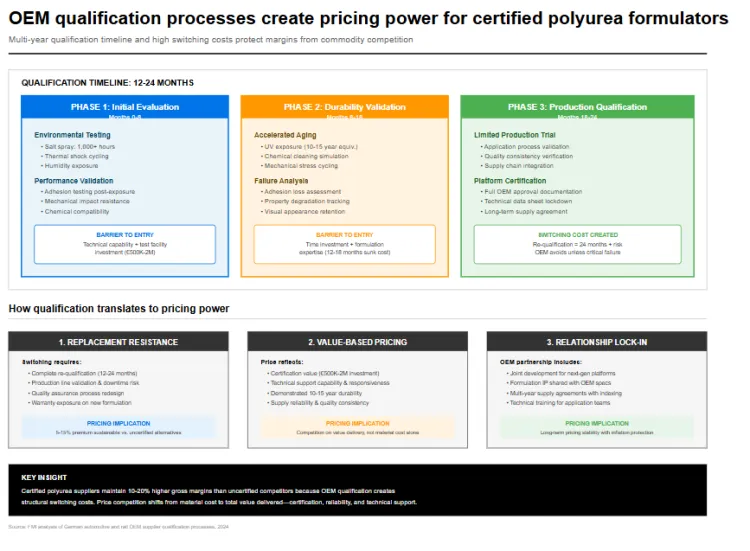
German automotive and rail OEMs maintain rigorous supplier qualification processes that typically require twelve to twenty four months from initial evaluation to production approval. Candidate coatings must pass adhesion testing after environmental exposure including salt spray cycles exceeding one thousand hours, thermal shock testing across temperature ranges, and mechanical impact tests that simulate years of service conditions. Only formulations that meet or exceed performance benchmarks across all test protocols advance to limited production trials.
Long term durability validation extends qualification timelines further, with accelerated aging protocols designed to predict performance after ten to fifteen years of service. These tests subject coated samples to UV exposure equivalent to multiple years of outdoor weathering, chemical exposure simulating cleaning and maintenance operations, and mechanical stress cycling that replicates vibration and flexing during vehicle operation. Formulations that show premature failure, adhesion loss, or significant property degradation are rejected regardless of initial performance.
The investment required to achieve OEM qualification creates significant switching costs that protect certified suppliers from price based competition. Once a coating system earns approval for a specific platform or application, changing suppliers requires repeating the entire qualification process, including durability testing and production validation. OEMs resist these changes unless performance issues emerge or significant cost savings justify the disruption and risk. This dynamic allows qualified polyurea suppliers to maintain pricing that reflects their certification value, technical support capability, and demonstrated reliability rather than competing solely on material cost.
How does Germany’s engineering ecosystem influence downstream supply chain choices and innovation in polyurea chemistry?
The close collaboration between German vehicle manufacturers, chemical companies and automation equipment suppliers accelerates specification development and formulation optimization. OEMs work directly with coating formulators during early platform design, identifying protection requirements and application constraints that shape product development priorities. This early engagement allows suppliers to tailor polyurea systems to specific applications rather than offering generic formulations, creating differentiated products with demonstrated performance advantages.
Equipment manufacturers contribute expertise in application technology, helping coating suppliers understand how formulation properties influence robot programming, spray pattern stability, and process control. This three way collaboration between end users, chemical suppliers and equipment providers generates feedback loops that drive rapid innovation in cure speed, adhesion mechanisms, and application latitude. German chemical companies leverage this ecosystem to develop proprietary formulations that combine performance attributes difficult for competitors to replicate without similar collaborative relationships.
Research institutions and technical universities strengthen this ecosystem by conducting fundamental research on polyurea chemistry, evaluating new raw materials, and validating performance through independent testing. Industry consortiums fund collaborative research that benefits multiple participants while maintaining competitive differentiation through proprietary application of shared knowledge. This combination of commercial collaboration and academic research creates an innovation environment that continuously raises performance expectations and extends polyurea applications into new domains.
How Can Future Market Insights help?
Sources
-
European VOC and emissions regulations
- EUR-Lex: Directive 2004/42/EC on limitation of emissions of volatile organic compounds
- European Coatings: VOC emissions from coatings seeking uniform regulation
- Eurofins: Legal requirements on VOC emissions for construction and coating products
-
Robotic spray application technology
- Graco: Paint automation and robotic paint systems for automated coating applications
- KEYENCE: Robot painting coating and dispensing methods in factory automation
- Augmentus: How painting robots are revolutionizing industrial coating processes
-
Polyurea coating technical specifications
- IXS Coatings: Automotive OEM polyurea protection and robotic applications
- Sherwin-Williams: Genesis Polyurea coating system technical specifications
- Marvel Coatings: Polyurea coatings for industrial and automotive applications
-
Automotive engineering and coatings research
- Journal of Coatings Technology and Research: American Coatings Association peer reviewed publication
- Surface and Coatings Technology: Elsevier international archival journal on surface engineering
- SpringerLink: Coating technologies for automotive engine applications research

