


Key Takeaways
- Most global acetone output is produced as a co product of phenol via the cumene process
- Phenol demand and operating rates directly determine acetone supply availability
- Dedicated acetone capacity is limited, restricting independent supply response
- Inventory build up and export flows act as balancing mechanisms during phenol downturns
- Capacity rationalisation decisions are driven by phenol margins, not acetone pricing
How is global acetone production structurally linked to phenol capacity?
The cumene process dominates global phenol production, accounting for approximately 95 percent of installed capacity worldwide. This process oxidises cumene to cumene hydroperoxide, which then decomposes to produce phenol and acetone in a fixed stoichiometric ratio of roughly 0.6 tonnes of acetone per tonne of phenol. This chemical constraint means acetone output cannot be adjusted independently of phenol production. When phenol plants operate, acetone emerges automatically as a co product. When phenol demand weakens and operating rates decline, acetone supply contracts proportionally regardless of acetone pricing or demand conditions.
Integrated petrochemical complexes treat acetone as a secondary output stream. Investment decisions, capacity expansions and operating rate adjustments respond to phenol margins, polycarbonate resin demand and downstream phenol derivative economics. Acetone pricing influences product realisation but does not determine whether plants run. A producer facing strong phenol margins will operate at high rates even if acetone prices are depressed, flooding solvent channels with unwanted supply. Conversely, weak phenol economics force production cuts that tighten acetone availability even when solvent demand remains robust.
This structural linkage creates supply dynamics fundamentally different from chemicals with dedicated production capacity. Acetone availability reflects phenol cycle timing rather than acetone consumption patterns. Producers cannot increase acetone output to capture high solvent prices without simultaneously producing more phenol. This inelastic supply response generates price volatility during periods when phenol and acetone demand cycles diverge, particularly when solvent demand strengthens while polycarbonate and epoxy resin consumption remains soft.
Why does phenol demand dictate acetone production levels across regions?
Polycarbonates represent the largest phenol end use globally, consuming approximately 30 to 35 percent of phenol production for bisphenol A synthesis. Automotive glazing, electronics housings and construction materials drive polycarbonate demand, creating cyclical patterns tied to industrial production and consumer spending. When automotive manufacturing slows or electronics production contracts, phenol demand weakens. Integrated producers reduce cumene plant operating rates in response, cutting acetone output even if solvent applications show steady or growing consumption.
Epoxy resins constitute another major phenol derivative, accounting for 15 to 20 percent of phenol consumption. Wind turbine blade manufacturing, aerospace composites and protective coatings link epoxy demand to infrastructure investment and construction activity. Geographic variation in these demand drivers creates regional differences in phenol operating rates. Asia Pacific phenol capacity runs at different utilisation than European or North American assets due to distinct downstream demand patterns, shaping regional acetone availability accordingly.
Phenolic resins, alkylphenols and caprolactam represent additional phenol outlets with independent demand cycles. When multiple phenol derivatives strengthen simultaneously, producers operate plants at high rates, maximising acetone co product output. During periods when several phenol end uses weaken together, production cuts amplify acetone supply tightness. This demand aggregation across phenol derivatives creates acetone supply volatility that correlates poorly with direct acetone consumption in solvents, paints or chemical intermediates.
How do regional phenol capacity distributions shape acetone availability?
Asia Pacific hosts approximately 55 to 60 percent of global phenol capacity, concentrated in China, Taiwan, South Korea and Japan. Large integrated complexes produce phenol for captive polycarbonate production, with acetone either consumed internally or sold into merchant channels. Chinese producers with downstream integration absorb acetone in methyl methacrylate synthesis or solvent applications, reducing merchant supply. When internal consumption patterns shift, export availability changes dramatically, affecting regional acetone balances in Southeast Asia and beyond.
North American phenol capacity represents 15 to 20 percent of global production, primarily serving polycarbonate and epoxy resin producers. Gulf Coast complexes benefit from propylene feedstock advantages, supporting cumene economics and phenol competitiveness. Acetone co product flows into merchant solvent channels or chemical derivative production. Operating rate decisions respond to North American phenol margins rather than global acetone pricing, creating supply disconnects when regional phenol economics diverge from broader acetone fundamentals.
European phenol capacity faces structural pressure from energy costs and downstream demand migration. Plant closures and capacity rationalisations reduce European acetone supply, increasing import dependence. Producers maintaining operations focus on phenol rather than acetone economics when evaluating plant viability. This creates situations where European acetone buyers face supply tightness while global phenol operating rates suggest adequate production capacity exists, but in regions where acetone cannot economically reach European consumers.
Why is standalone acetone production capacity structurally constrained?
Alternative acetone production routes exist but represent minimal global capacity. Direct propylene oxidation to acetone avoids phenol co production but requires dedicated investment and competes economically only in narrow circumstances. Isopropanol dehydrogenation provides another pathway but serves niche applications rather than bulk solvent supply. These alternative routes collectively account for less than 5 percent of global acetone production, insufficient to balance supply when phenol operating rates fluctuate significantly.
New acetone capacity investments almost universally connect to phenol projects. Petrochemical producers evaluate phenol demand growth, polycarbonate expansion plans and integrated complex economics when sanctioning cumene plant construction. Standalone acetone capacity expansions face unfavourable economics because cumene process acetone production costs benefit from phenol revenue sharing. A dedicated acetone plant must recover full capital and operating costs from acetone sales alone, while co product acetone economics allocate substantial value to phenol, making incremental acetone appear nearly cost free at the margin.
This investment pattern perpetuates structural linkage between phenol capacity and acetone supply. Even when acetone demand growth exceeds phenol derivative consumption, new supply capacity arrives only when phenol project economics justify investment. During periods of strong acetone pricing but weak phenol margins, no supply response occurs despite apparent price signals. Conversely, phenol driven capacity additions during polycarbonate booms flood acetone channels with unwanted supply, depressing prices regardless of underlying solvent demand strength.
How do operating rate adjustments and export flows stabilise acetone supply during demand swings?
Inventory management provides the primary buffer when phenol and acetone demand cycles diverge. Producers facing weak acetone realisation during high phenol operating periods accumulate inventory in storage tanks and terminals. Storage capacity limits constrain this buffering mechanism, typically accommodating several weeks of production before forcing operating rate cuts or export redirection. Asian producers particularly use inventory build up to smooth supply volatility, though storage economics deteriorate when phenol margins justify continued production despite acetone oversupply.
Export flows redirect acetone surpluses across regions when local consumption cannot absorb co product output. Chinese acetone exports to Southeast Asia, India and Africa rise during periods of high domestic phenol production coupled with soft internal acetone consumption. North American producers increase exports to Latin America and Europe when Gulf Coast phenol plants operate at high rates. These trade flows stabilise regional balances but introduce freight costs and logistics complexity that widen delivered price differentials between surplus and deficit regions.
Downstream solvent demand flexibility provides limited balancing. Acetone competes with other solvents in formulations where substitution is technically feasible. Paint manufacturers, adhesive producers and chemical intermediate synthesis can adjust acetone usage in response to pricing, absorbing surpluses when cheap or reducing consumption when tight supply drives prices higher. This demand elasticity dampens price volatility but cannot fully compensate for large supply swings driven by phenol cycle amplitude, particularly during periods of rapid phenol operating rate changes.
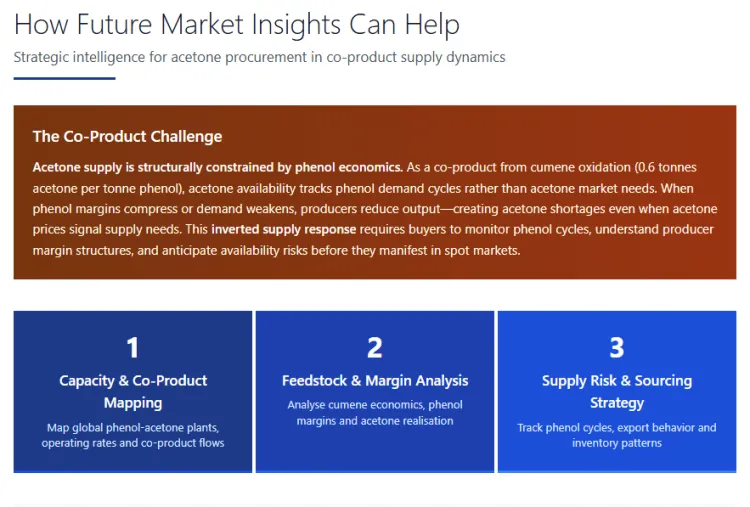
How Future Market Insights Can Help
Sources
- Mitsui Chemicals, Inc. (2024). Integrated phenol and polycarbonate operations: Capacity utilisation and product flows. Mitsui Chemicals, Inc.
- American Chemistry Council. (2024). Phenol and acetone production statistics: Regional capacity and operating rates. American Chemistry Council.

