


Key Takeaways
- GCC facilities management grew up as a labour-arbitrage and task-based industry, not as a single strategic service line, so contracts, budgets and vendors are still sliced by asset type and service category.
- Public spending and Vision programmes have created very large, complex assets, but only a subset of those is tied into long-horizon PPP or campus-wide FM contracts; the rest sits in municipal, ministerial or quasi-government silos that each procure their own vendors.
- In-house teams, short contract tenures and conservative risk appetites mean many asset owners deliberately keep multiple vendors in play to preserve bargaining power rather than consolidating under one integrated provider.
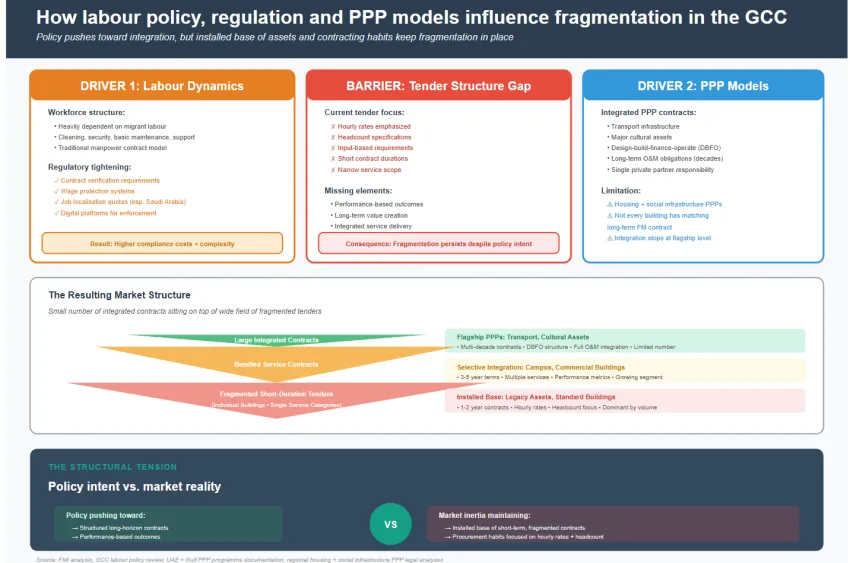
- Labour regulation, localisation and wage reforms across Saudi Arabia and the wider GCC are raising the true cost of manpower-heavy soft services, but procurement still often evaluates bids on headcount and unit rates rather than outcomes and lifecycle cost.
How did GCC facilities management grow up as a fragmented, labour-first business?
The modern GCC facilities base was built at speed. Airports, malls, government complexes, industrial zones and new-town housing were often delivered in project waves rather than as part of a slow, incremental urban evolution. Construction contracts came first; FM contracts followed as an afterthought. In that environment, developers and public entities treated cleaning, security, landscaping, waste, HVAC and specialist maintenance as separate line items to be contracted to whichever local firm could mobilise people fastest.
This created a landscape where hundreds of small and mid-sized companies offer one or two services at building or campus level, while a smaller group of regional providers bundle hard and soft services for flagship assets. International evidence from large FM portfolios shows that outsourcing and contract consolidation are the main levers for cost reduction and resilience, yet JLL’s global survey still finds most organisations running multi-vendor models and only gradually centralising their supply chains. That pattern is visible in the GCC, but with an extra layer of fragmentation because each major city has its own ecosystem of local contractors and public agencies.
Why has integrated facility management adoption lagged behind the Vision narrative?
Vision 2030 in Saudi Arabia and equivalent long-term plans in the UAE and other GCC states emphasise smart cities, sustainability and digital twins. Those themes naturally point towards integrated FM: one data spine, one command centre, one accountable operator. Yet on the ground, several frictions slow adoption.
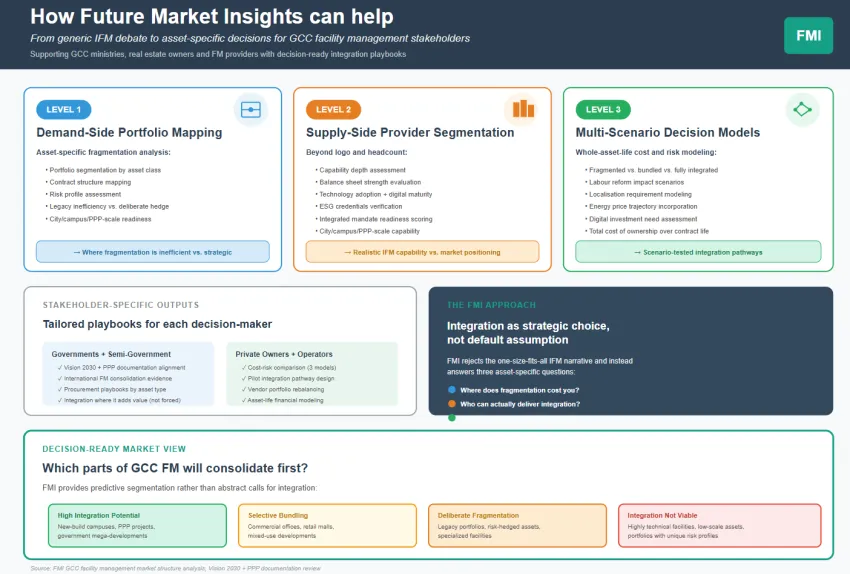
First, not all assets are created equal. A new international airport or metro system can justify a fully integrated operations and maintenance contract with strong performance indicators. A mid-sized municipal building or a secondary school often cannot attract the same level of provider interest or political attention, so default procurement models persist. Second, clients and providers are still experimenting with risk transfer. Integrated contracts concentrate operational risk in one counterparty, which demands stronger balance sheets, better governance and more sophisticated contract management from both sides. In many organisations, those capabilities are still being built.
Third, technology adoption is uneven. JLL’s recent global survey highlights that FM leaders are under pressure to use digital tools for cost control and experience, but budgets and skills lag behind ambition. That tension is sharper in the GCC, where some portfolios are state-of-the-art while others rely on manual processes. Integrated FM needs reliable data across assets and systems; fragmentation persists where that data is missing or siloed.
Sources
- JLL. 2025. Global State of Facilities Management Report 2025.
- Middle East Facility Management Association. 2024. GCC Facilities Management Market Analysis.
- PwC Middle East and Saudi Facility Management Association. 2025. Unlocking value: Growth opportunities in Saudi Arabia’s facility management sector.
- Ministry of Finance, United Arab Emirates. 2023. Public-Private Partnership Manual.
- World Bank. 2023. Benchmarking infrastructure public-private partnerships: Country profile, United Arab Emirates.
- King & Spalding. 2017. Delivering infrastructure projects under a public-private partnership in the Gulf.

