


Key Takeaways
- Gen Alpha usage patterns increasingly define how child safety rules are written and enforced, as regulators observe device exposure beginning before age two and continuous connectivity reshaping childhood development.
- Parental control tools are shifting from optional utilities to embedded compliance layers, with regulations mandating default safety features rather than opt in protections.
- Platforms integrate controls by default to meet regulatory expectations, transforming what were third party applications into core operating system and app store functions.
- Buyer economics change as controls move from discretionary purchase to bundled requirement, reducing standalone pricing power while expanding distribution through device manufacturers and education channels.
- Partnerships shift from consumer apps to operating systems, platforms and device makers, as shared regulatory accountability drives ecosystem integration over standalone tool competition.
Why are regulators using Gen Alpha behaviour as the reference point for child safety rules?
Gen Alpha, defined as children born from 2010 onward, represents the first generation experiencing digital platform exposure from infancy. Regulatory authorities worldwide now observe toddlers interacting with tablets before developing full verbal communication, primary school children maintaining persistent social media presence and pre teens navigating recommendation algorithms designed for adult engagement patterns. This early age platform immersion provides regulators with empirical evidence that previous child safety frameworks, built on assumptions of teenage first exposure, no longer reflect reality.
The United Kingdom Age Appropriate Design Code, implemented in 2020 and serving as a template for subsequent international regulation, explicitly references observed Gen Alpha behaviour in its development. Regulators documented children under age five interacting with YouTube recommendation systems, six to eight year olds creating accounts on platforms with nominal 13 year minimum ages and nine to eleven year olds exposed to algorithmic content curation designed to maximize engagement time. These usage patterns, captured through academic research and platform transparency reports, demonstrate that theoretical risk models underestimate actual exposure intensity.
Always on connectivity fundamentally distinguishes Gen Alpha from previous cohorts. Millennials and Gen Z experienced digital adoption during adolescence or childhood, maintaining offline social structures and non digital leisure activities. Gen Alpha children possess smartphones, tablets and connected devices from early childhood, with device access integrated into educational systems, family communication and entertainment consumption. This persistent connectivity creates regulatory urgency absent from earlier policy debates, as authorities recognize that delayed intervention allows platform design patterns to become normalized before protective frameworks exist.
Real usage data collection by child protection organizations, academic researchers and platform safety teams reveals behaviour patterns that inform regulatory design. Evidence shows Gen Alpha children spending three to five hours daily on connected devices by age eight, engaging with platforms across gaming, social media, video streaming and educational applications. Regulators respond to this empirical evidence by mandating default protections rather than relying on parental awareness and active tool deployment, recognizing that usage intensity exceeds most parent understanding or monitoring capacity.
Platform accountability pressure increases as regulators observe Gen Alpha exposure to harmful content, predatory contact and algorithmic manipulation at ages where cognitive development limits self protection capability. Documented cases of young children accessing age inappropriate content through recommendation algorithms, encountering online predators through gaming platforms and developing compulsive usage patterns through engagement optimization systems provide regulatory justification for mandatory control integration rather than voluntary parent activation.
How do child safety and data protection regulations force compliance logic into parental control tools?
Age appropriate design mandates require platforms to implement default safety settings calibrated to user age, fundamentally changing how parental control tools function. The UK Age Appropriate Design Code, California Age Appropriate Design Code Act and European Digital Services Act all mandate that platforms must provide highest privacy settings by default for child users, disable geolocation services unless essential, restrict data collection to minimum necessary for service provision and eliminate nudge techniques encouraging extended engagement. These requirements transform parental controls from optional restriction layers into mandatory compliance infrastructure embedded within platform architecture.
Default safety settings shift the control logic from parent activation to parent override. Traditional parental control tools required parents to discover, purchase, install and configure restrictions. Compliance driven design mandates that platforms implement protections automatically based on declared or inferred user age, placing the burden on platforms to demonstrate age verification accuracy rather than on parents to implement safeguards. This reversal fundamentally changes tool positioning from consumer product to platform obligation.
Data minimization requirements force parental control tools to adopt privacy preserving architectures. Regulations prohibit platforms from collecting, retaining or monetizing child user data beyond immediate service needs. Parental control tools must therefore operate with minimal data collection, using on device processing rather than cloud analytics and providing parents with transparency regarding what information platforms access about their children. This compliance requirement limits the behavioral analytics and detailed reporting that characterized earlier generation monitoring tools.
Consent workflows mandate that platforms obtain verifiable parental consent before collecting data from children under regulatory age thresholds, typically 13 to 16 depending on jurisdiction. Parental control tools must integrate age verification mechanisms, consent documentation and ongoing permission management into their core functionality. These compliance features add development complexity and operational cost that standalone consumer tools historically avoided, driving consolidation toward platform integrated solutions that can absorb regulatory overhead through scale.
Auditability requirements compel platforms to document and demonstrate compliance with child safety obligations. Regulators increasingly demand that platforms provide evidence of age appropriate design implementation, default safety setting effectiveness and parental control functionality. This documentation burden creates preference for standardized, platform embedded controls that can be centrally audited rather than fragmented third party tools with varying compliance capabilities. Tool vendors lacking resources to maintain regulatory documentation find themselves excluded from platform partnerships and institutional buyers.
Why do parental control tools shift from optional apps to mandatory platform infrastructure?

Operating system integration represents the most significant structural change in parental control tool deployment. Apple, Google and Microsoft have progressively embedded screen time controls, content filtering, app restrictions and location tracking into iOS, Android and Windows core functionality. This integration allows device manufacturers to claim compliance with child safety regulations at the operating system level, reducing liability exposure and regulatory friction. Standalone parental control apps must now compete with free, pre installed OS level controls that parents access without additional software installation.
App store gatekeeping creates compliance leverage that favors platform integrated controls. Apple App Store and Google Play Store enforce developer guidelines requiring age rating accuracy, data protection compliance and parental control compatibility. Platforms can more effectively enforce these requirements on third party applications when their own parental control infrastructure serves as the reference implementation. App store review processes increasingly require developers to demonstrate compatibility with native platform controls, creating ecosystem pressure toward standardization around platform defined control frameworks.
Device manufacturers embed parental controls to differentiate family focused product lines and address regulatory expectations at point of sale. Amazon Fire tablets, Samsung Galaxy devices and educational Chromebooks ship with pre configured parental controls marketed as child safety features. This bundling shifts buyer perception from parental controls as aftermarket add ons to expected baseline functionality, reducing willingness to pay for standalone tools while expanding distribution through device purchase decisions.
Regulatory enforcement actions increasingly target platforms rather than parents, creating incentive for platforms to demonstrate built in protection rather than rely on user activation of third party tools. When regulators fine platforms for child safety violations or data protection failures, platform operators respond by strengthening native controls and prominently displaying these features to demonstrate compliance effort. Third party tool vendors struggle to maintain relevance when platform operators prioritize their own compliance infrastructure.
Education sector adoption accelerates platform control integration as schools deploy devices requiring centralized management and regulatory compliance documentation. Chromebooks, iPads and Windows laptops distributed through school programs include managed parental controls that satisfy both educational technology requirements and child safety regulations. This institutional adoption path bypasses consumer purchase decisions entirely, establishing platform integrated controls as the default model for Gen Alpha device access.
How does regulation driven design change buyer economics for parental control tools?
Bundling with devices eliminates standalone pricing power that consumer parental control tools historically commanded. When operating systems include screen time limits, content filters and location tracking without additional cost, parents demonstrate limited willingness to purchase separate subscriptions for incremental features. Consumer parental control vendors that previously charged 50 to 100 dollars annually now face competitive pressure from free platform alternatives, forcing repositioning toward specialized capabilities like advanced social media monitoring or cross platform synchronization.
Enterprise and education licensing replaces consumer subscriptions as the primary revenue model for sophisticated parental control capabilities. School districts, daycare facilities and educational technology administrators purchase centralized management platforms that control thousands of devices simultaneously while maintaining regulatory compliance documentation. These institutional buyers pay based on seat count rather than household subscription, creating larger deal sizes but reducing total addressable buyer population. Tool vendors shift sales focus from consumer advertising to enterprise procurement processes and compliance certification.
Reduced standalone pricing power drives vendor consolidation and acquisition activity. Established security companies like Norton, McAfee and Kaspersky have acquired consumer parental control brands to bundle controls with antivirus and VPN subscriptions, spreading development costs across larger customer bases. Platform operators like Google have enhanced Family Link capabilities to match third party feature sets, eliminating differentiation that justified standalone pricing. Smaller vendors lacking enterprise sales capabilities or platform partnerships face margin compression and customer acquisition cost challenges.
Volume driven partnerships with telecom operators and internet service providers create new distribution channels compensating for reduced direct consumer sales. AT&T, Verizon, Comcast and BT offer parental control tools as value added services bundled with broadband or mobile plans, providing vendors with guaranteed customer access in exchange for revenue sharing arrangements. These partnerships prioritize distribution reach over per user pricing, fundamentally changing business model economics from high margin direct sales to volume based platform fees.
Freemium conversion models replace paid only offerings as vendors adapt to platform integrated free alternatives. Tools like Bark, Qustodio and Net Nanny now offer basic monitoring features without charge while reserving advanced capabilities like real time alerts, social media scanning and multiple device management for premium tiers. This freemium approach acknowledges that parents will not pay for capabilities their devices already include, but may upgrade for comprehensive monitoring that platform controls do not provide.
How do platform partnerships and ecosystem positioning change under compliance first control models?
Collaboration between tool vendors and OS providers shifts from competitive tension to regulatory necessity. Apple, Google and Microsoft increasingly partner with specialized parental control vendors to enhance native platform capabilities while maintaining compliance control. These partnerships involve API access, certification programs and co marketing arrangements where platform operators promote third party tools that extend rather than replace native controls. Vendors accepting subordinate ecosystem positioning gain platform endorsement and API access, while those pursuing competitive alternatives face technical limitations and reduced discoverability.
Telecom operator integration expands as mobile carriers face regulatory pressure to provide child safety tools for subscribers. AT&T Digital Secure, Verizon Smart Family and T Mobile FamilyMode represent branded parental control offerings sourced from specialized vendors but delivered through carrier billing and network level filtering. These partnerships allow operators to claim compliance with child online safety obligations while providing tool vendors with massive distribution reach. Network level controls offer capabilities like DNS filtering and usage throttling that app based tools cannot replicate, creating complementary value rather than direct substitution.
Education platform ecosystems emerge as critical partnership channels as schools become primary device provisioning entities for Gen Alpha children. Google Workspace for Education, Apple School Manager and Microsoft Intune for Education include parental control integration points that specialized vendors target with compatible solutions. Achieving education platform certification requires compliance documentation, data protection validation and technical integration that creates barrier to entry for smaller vendors while consolidating distribution through established education technology channels.
Cross platform synchronization partnerships address the reality that Gen Alpha children use multiple devices across home, school and mobile contexts. Parental control tools that operate only on iOS or only through web browsers provide insufficient coverage for regulatory compliance and parent needs. Vendors forming partnerships across operating systems, browsers and network providers offer unified management that justifies premium pricing despite platform integrated free alternatives. These ecosystem spanning partnerships require technical complexity and business development resources that drive further vendor consolidation.
Shared regulatory accountability creates cooperative dynamics between competing vendors, platforms and service providers. When regulators impose child safety obligations on entire digital ecosystems rather than individual companies, platforms, telecom operators and tool vendors recognize shared interest in demonstrating effective protection. Industry associations like the Family Online Safety Institute and participation in regulatory sandbox programs foster collaboration on standards, age verification methods and interoperability frameworks that benefit all ecosystem participants facing common compliance requirements.
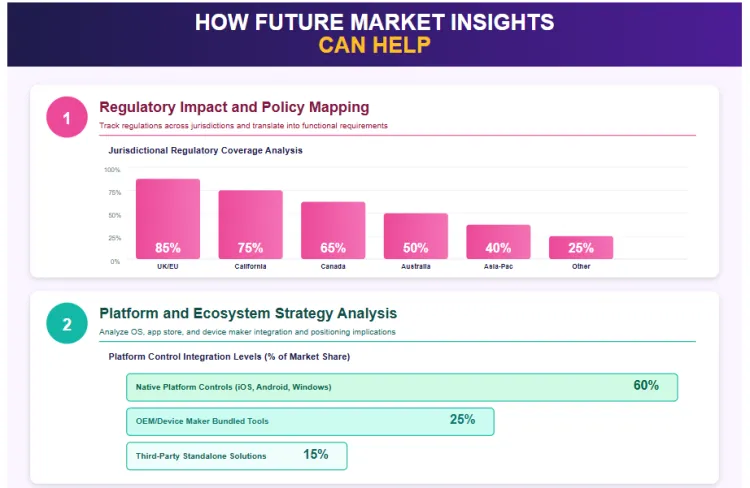
How Future Market Insights Can Help
SOURCES
- Government child safety and data protection authorities
- Used for age appropriate design codes, enforcement actions and compliance expectations from regulators including the UK Information Commissioner Office, California Privacy Protection Agency and European Data Protection Board.
- Platform transparency and compliance reports
- Used to assess how operating systems and digital platforms implement default safety controls, including reports from Apple, Google, Meta and Microsoft on child safety measures and regulatory compliance.
- Academic and policy research on child digital behaviour
- Used to link Gen Alpha usage patterns with regulatory focus areas, drawing on studies documenting early age device exposure, platform engagement intensity and developmental impact research.
- Digital rights and child protection organisations
- Used for evidence on risk exposure, policy advocacy and regulatory rationale from organisations including Common Sense Media, Internet Watch Foundation and National Center for Missing and Exploited Children.
- Reputable technology and policy media
- Used for reporting on regulatory changes, platform responses and enforcement trends from sources covering digital policy, child safety regulation and technology governance developments.

