

- Industry Size (2026)
- USD 104.58 Mn
- Forecast (2036)
- USD 170.35 Mn
- CAGR (2026 to 2036)
- 5.0%
2-Acetylthiophene Market Size, Market Forecast and Outlook By FMI
Summary of the 2-Acetylthiophene Market
- Demand and Growth Drivers
- Shifting consumer preferences toward health-conscious and sustainable alternatives are likely to support demand for 2-acetylthiophene products as retail and food service channels expand product assortments.
- Clean-label and plant-based trends are expected to sustain demand growth across developed and emerging markets during the forecast period.
- Distribution channel diversification, including online retail and specialty stores, is likely to expand consumer access and drive volume growth.
- Product and Segment View
- Industrial Grade 2 Acetylthiophene is likely to remain a leading product segment with 48.9% share, supported by demand from mainstream consumer categories.
- Pharmaceutical Intermediates is likely to lead the application segment with 41.6% share, reflecting consumer preference for accessibility and convenience.
- Emerging product categories and niche applications are expected to gain share incrementally as formulation technology and distribution access improve.
- Geography and Competitive Outlook
- South Korea is likely to remain a key market owing to high consumer spending and early adoption of new product formats.
- Japan is likely to sustain demand on account of growing retail penetration and evolving consumer preferences.
- Companies that can combine product innovation with scalable distribution are likely to gain traction during the forecast period.
- Analyst Opinion
- The 2-Acetylthiophene market is evolving from a niche product space into a mainstream consumer category with clear commercial trajectories.
- Adoption is being shaped by consumer health awareness and willingness to pay for quality differentiation.
- The market is also benefiting from expanding product variety and improved ingredient sourcing.
- Demand is further supported by the need for products that balance taste, nutrition, sustainability, and accessibility across both retail and food service channels.
Key Takeaways
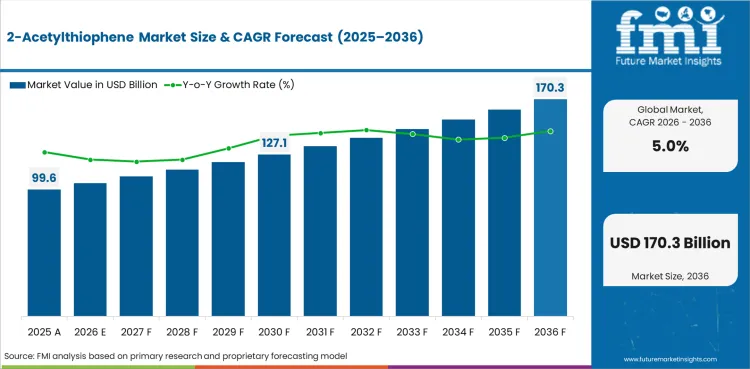
- The 2-Acetylthiophene market was valued at USD 99.60 billion in 2025.
- By 2036, the 2-Acetylthiophene Market is expected to be worth USD 170.35 billion.
- From 2026 to 2036, the market is projected to expand at a CAGR of 5.0%.
- The market is projected to create an incremental opportunity of USD 65.77 billion between 2026 and 2036.
- In 2026, Industrial Grade 2 Acetylthiophene is expected to account for 48.9% of the product segment, driven by demand for core application requirements.
- South Korea (4.9%) and Japan (4.8%) are two of the fastest growing markets in the world.
2-Acetylthiophene Market Definition
The 2-acetylthiophene market encompasses consumer products, ingredients, and formulations that address the core requirements of product applications across application, and related end-use categories. The market covers products segmented by product, application, end use, distribution channel, purity level, pricing tier, spanning the forecast period from 2026 to 2036.
2-Acetylthiophene Market Inclusions
Market scope encompasses all commercially relevant 2-acetylthiophene products categorized by Product, Application, End Use, Distribution Channel, Purity Level, Pricing Tier. The revenue scope covers the period from 2026 to 2036 across North America, Latin America, Europe, East Asia, South Asia and Pacific, and Middle East and Africa.
2-Acetylthiophene Market Exclusions
The scope does not include unprocessed raw ingredients sold in bulk commodity channels, non-branded products without commercial distribution, or products marketed under categories outside the defined scope.
2-Acetylthiophene Market Research Methodology
- Primary Research: FMI analysts talked to product developers, retail buyers, and distribution partners in important markets.
- Desk Research: used data from trade magazines, industry groups, and reports from manufacturers.
- Market sizing and forecasting: Adding up from the bottom up across product, application, end use, distribution channel, purity level, pricing tier categories, and regional adoption curves.
- Data validation: checked against retail tracking data and manufacturer disclosures every three months.
Why is the 2-Acetylthiophene Market Growing?
- Consumer preference shifts toward health-conscious, plant-based, and sustainable products are creating structured demand across retail and food service channels.
- South Korea leads growth with 4.9%, reflecting strong consumer spending and early adoption of new product formats.
- Product innovation in formulation, packaging, and distribution is expanding the addressable market beyond traditional consumer segments.
The 2-acetylthiophene market is expanding at a steady pace, supported by structural demand factors that are unlikely to reverse during the forecast period. Consumer awareness of ingredient sourcing, nutritional content, and environmental impact continues to reshape purchasing decisions across both premium and mainstream retail channels.
Industrial Grade 2 Acetylthiophene accounts for the largest share of the product segment at 48.9%. This reflects consumer preference patterns and the product format's versatility across multiple use occasions and preparation methods.
Retail modernization and digital commerce expansion are structural growth factors. As distribution infrastructure improves across developing markets and online penetration increases in developed markets, the addressable consumer base for these products expands.
Market Segmentation Analysis
- The 2-acetylthiophene market is segmented across 6 primary dimensions: Product, Application, End Use, Distribution Channel, Purity Level, Pricing Tier.
- Industrial Grade 2 Acetylthiophene holds 48.9% of the product segment, reflecting its position as the primary consumer category.
- Pharmaceutical Intermediates leads the application segment with 41.6% share, reflecting consumer channel preferences.
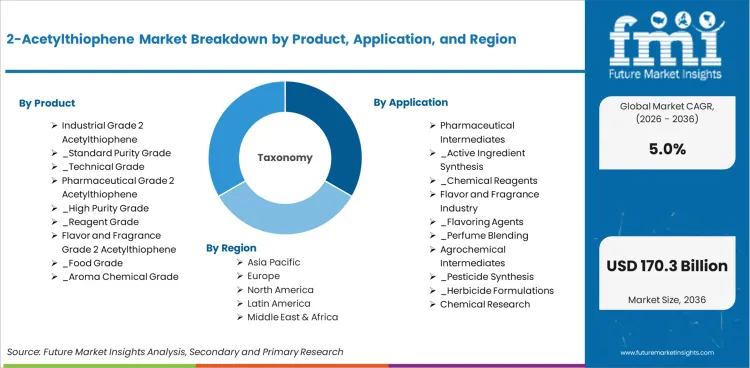
The market for 2-acetylthiophene is organized across product, end-use, and channel dimensions. Segmentation by product includes Industrial Grade 2 Acetylthiophene, Standard Purity Grade, Technical Grade, Pharmaceutical Grade 2 Acetylthiophene, High Purity Grade, Reagent Grade, Flavor and Fragrance Grade 2 Acetylthiophene, Food Grade, Aroma Chemical Grade. By application, the market includes Pharmaceutical Intermediates, Active Ingredient Synthesis, Chemical Reagents, Flavor and Fragrance Industry, Flavoring Agents, Perfume Blending, Agrochemical Intermediates, Pesticide Synthesis, Herbicide Formulations, Chemical Research, Laboratory Synthesis, Specialty Chemical Development.
Insights into the Industrial Grade 2 Acetylthiophene Product Segment
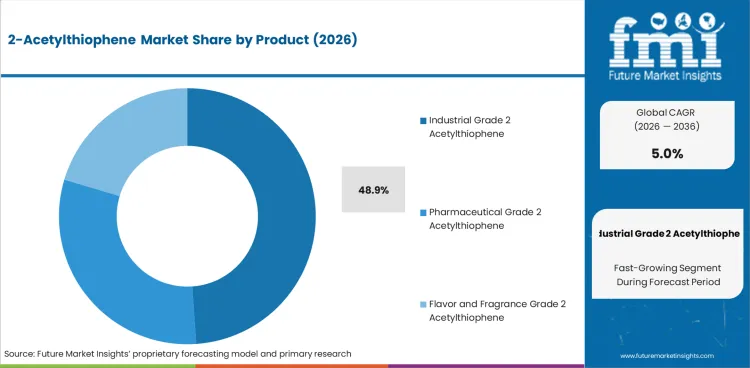
In 2026, Industrial Grade 2 Acetylthiophene is expected to account for 48.9% of the product segment. This product format benefits from consumer familiarity, versatile application properties, and strong positioning across both retail and food service distribution channels.
Consumer preferences continue to evolve, and newer formulation approaches are expected to improve taste, texture, and nutritional profiles within this segment. The expansion of retail availability in emerging markets is likely to sustain volume growth.
Insights into the Pharmaceutical Intermediates Application Segment
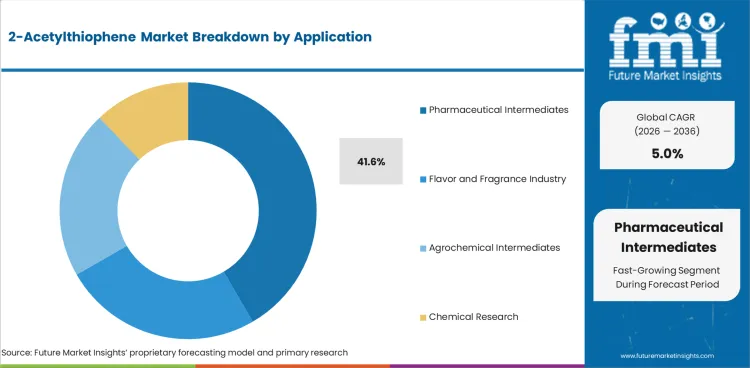
Pharmaceutical Intermediates accounts for 41.6% of the application segment. This channel benefits from broad consumer traffic, competitive pricing dynamics, and the ability to offer product variety that supports trial and repeat purchase behavior.
2-Acetylthiophene Market Drivers, Restraints, and Opportunities
- People are becoming more aware of their health and are more interested in products that are better for the environment. This is creating structured demand for products that are clearly different from standard ones.
- The price premium compared to regular options makes it hard for price-sensitive consumers to buy it, which means that growth is mostly happening in health-conscious and high-end retail channels.
- During the forecast period, the growth of retail distribution and product awareness in emerging markets is expected to speed up adoption.
There are both demand-side growth factors and supply-side constraints that affect the 2-acetylthiophene market. Consumer preferences keep changing for the better, but the costs of ingredients and problems with distribution slow down the rate of adoption in some price-sensitive groups.
Consumer Health Awareness and Product Innovation
Demand shows that consumers are changing what they look for when they buy things. They are now more interested in health, sustainability, and ingredient transparency. As more people learn about a product, the market for unique products grows.
Price Premium and Distribution Gaps
The price difference between premium products and regular ones makes adoption less likely. People's willingness to pay depends a lot on where they live, how much money they make, and how much they know about the product.
Emerging Market Retail Expansion
Growth is due to the growth of retail infrastructure in Asia, Latin America, and the Middle East. As modern trade and e-commerce become more common, more people in these areas are expected to start using them.
Analysis of 2-Acetylthiophene Market By Key Countries
.webp "Top Country Growth Comparison 2 Acetylthiophene Market Cagr (2026 2036)")
| Country | CAGR |
|---|---|
| UK | 4.5% |
| EU | 4.6% |
| Japan | 4.8% |
| South Korea | 4.9% |
| USA | 4.7% |
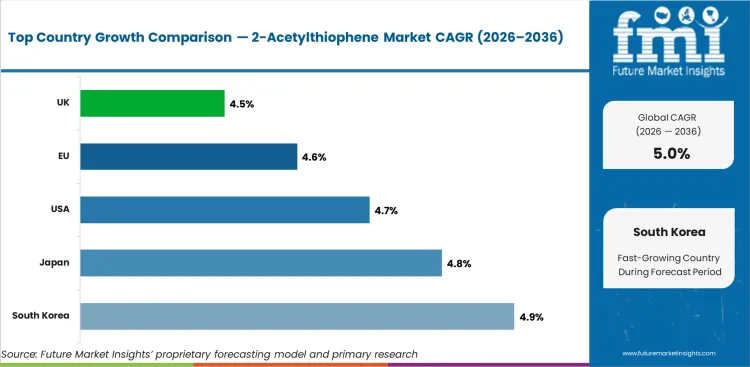
- South Korea is in first place with a 4.9% CAGR, reflecting high consumer spending and early product adoption.
- Japan at 4.8% shows strong demand because of evolving consumer preferences and retail expansion.
- USA (4.7%) and EU (4.6%) sustain growth through product innovation and distribution development.
- UK at 4.5% shows that consumer market development is creating new demand opportunities.
The global 2-acetylthiophene market is expected to grow at a rate of 5.0% per year from 2026 to 2036. The study covers more than 30 countries, and the main markets are listed below.
Demand Outlook for 2-Acetylthiophene Market in the United Kingdom
The UK will grow by 4.5% through 2036. This is supported by consumer spending trends, retail infrastructure development, and increasing product awareness.
- Consumer preference evolution supports demand through retail and food service channels.
- Product variety expansion accelerates consumer trial and repeat purchase.
- Brand investment supports development of next-generation product formats.
Future Outlook for 2-Acetylthiophene Market in the European Union
The European Union will grow by 4.6% through 2036. This is supported by consumer spending trends, retail infrastructure development, and increasing product awareness.
- Consumer preference evolution supports demand through retail and food service channels.
- Product variety expansion accelerates consumer trial and repeat purchase.
- Brand investment supports development of next-generation product formats.
Opportunity Analysis of 2-Acetylthiophene Market in Japan
Japan will grow by 4.8% through 2036. This is supported by consumer spending trends, retail infrastructure development, and increasing product awareness.
- Consumer preference evolution supports demand through retail and food service channels.
- Product variety expansion accelerates consumer trial and repeat purchase.
- Brand investment supports development of next-generation product formats.
In-depth Analysis of 2-Acetylthiophene Market in South Korea
South Korea will grow by 4.9% through 2036. This is supported by consumer spending trends, retail infrastructure development, and increasing product awareness.
- Consumer preference evolution supports demand through retail and food service channels.
- Product variety expansion accelerates consumer trial and repeat purchase.
- Brand investment supports development of next-generation product formats.
Sales Analysis of 2-Acetylthiophene Market in USA
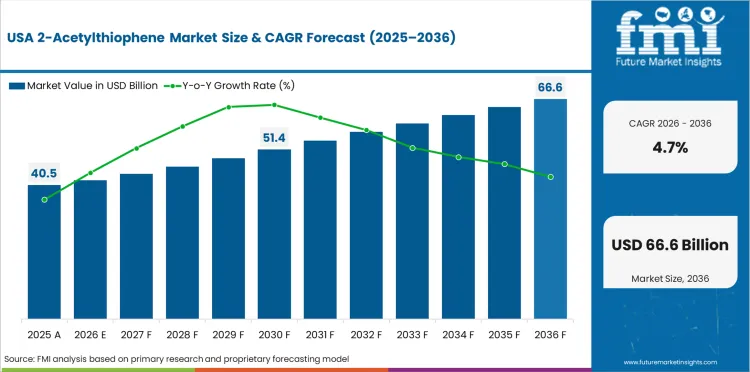
The USA will grow by 4.7% through 2036. This is supported by consumer spending trends, retail infrastructure development, and increasing product awareness.
- Consumer preference evolution supports demand through retail and food service channels.
- Product variety expansion accelerates consumer trial and repeat purchase.
- Brand investment supports development of next-generation product formats.
Competitive Landscape and Strategic Positioning
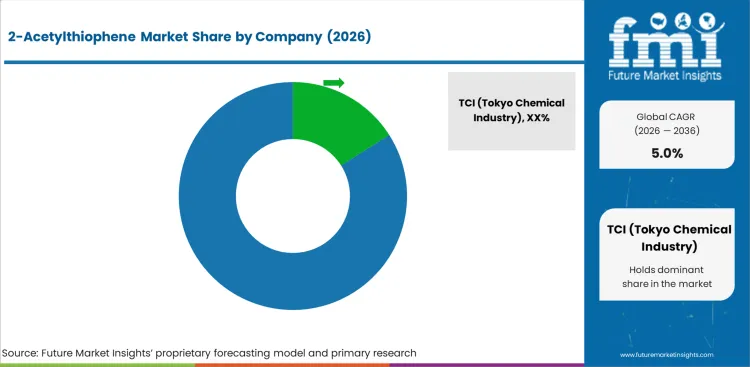
- TCI (Tokyo Chemical Industry) is the market leader because they have a well-known brand, a wide range of distribution, and the ability to come up with new products.
- TCI (Tokyo Chemical Industry), Acorn PharmaTech Product, and Aaron Chemicals LLC all sell a wide range of products that meet the needs of different types of customers and retail channels.
- New companies are focusing on specialized uses and small market segments where premium positioning and ingredient differentiation give them an edge over their competitors.
Companies lead the market because they have strong brands, a lot of distribution, and the ability to develop new products. There are a lot of different companies in the market, and they all compete on product quality, brand positioning, and distribution reach.
Costs of building a brand, requirements for getting products to customers, and the difficulty of developing new formulations are all barriers to entry. Product innovation, expanding distribution, and making things more sustainable are all strategic priorities.
Key Companies in the 2-Acetylthiophene Market
Key global companies leading the 2-acetylthiophene market include:
- Companies like TCI (Tokyo Chemical Industry), Acorn PharmaTech Product, and Aaron Chemicals LLC all have strong brand portfolios, distribution networks, and product development skills in important markets.
- Acros Organics, Ark Pharm Inc., and Hefei Hirisun Pharmatech Co. Ltd has built up regional strength by carefully positioning their products and forming partnerships for local distribution.
- Achemo Scientific Limited, Arvee Labs, A.B. Enterprises, Alpha Chemical, and other new companies have become well-known for their innovative products and smart marketing strategies.
Competitive Benchmarking: 2-Acetylthiophene Market
| Company | Product Range | Brand Strength | Distribution Access | Geographic Footprint |
|---|---|---|---|---|
| TCI (Tokyo Chemical Industry) | High | Strong | Strong | Global |
| Acorn PharmaTech Product | High | Strong | Strong | Global |
| Aaron Chemicals LLC | Medium | Medium | Moderate | Regional |
| Acros Organics | Medium | Medium | Moderate | Regional |
| Ark Pharm Inc. | Medium | Medium | Moderate | Regional |
| Hefei Hirisun Pharmatech Co. Ltd | Medium | Medium | Low | Emerging |
| Achemo Scientific Limited | Medium | Medium | Low | Emerging |
| Arvee Labs | Medium | Medium | Low | Emerging |
| A.B. Enterprises | Medium | Medium | Low | Emerging |
Source: Future Market Insights competitive analysis, 2026.
Key Developments in 2-Acetylthiophene Market
- In 2025, Tokyo Chemical Industry (TCI) expanded its portfolio of specialty organic reagents and heterocyclic compounds, strengthening its product offering for pharmaceutical, agrochemical, and research applications.
- In 2025, Aaron Chemicals LLC entered a distribution partnership to expand product availability across emerging markets.
Key Players in the 2-Acetylthiophene Market
Major Global Players
- TCI (Tokyo Chemical Industry)
- Acorn PharmaTech Product
- Aaron Chemicals LLC
- Acros Organics
- Ark Pharm Inc.
- Hefei Hirisun Pharmatech Co. Ltd
Emerging Players/Startups
- Achemo Scientific Limited
- Arvee Labs
- A.B. Enterprises
- Alpha Chemical
- Other Companies
Report Scope and Coverage
| Metric | Value |
|---|---|
| Quantitative Units | USD 104.58 billion to USD 170.35 billion, at a CAGR of 5.0% |
| Market Definition | The 2-acetylthiophene market encompasses consumer products and ingredients across product, application, end use, distribution channel, purity level, pricing tier categories. |
| Regions Covered | North America, Latin America, Europe, East Asia, South Asia and Pacific, Middle East and Africa |
| Countries Covered | UK, EU, Japan, South Korea, USA, 30 plus countries |
| Key Companies Profiled | TCI (Tokyo Chemical Industry), Acorn PharmaTech Product, Aaron Chemicals LLC, Acros Organics, Ark Pharm Inc., Hefei Hirisun Pharmatech Co. Ltd, Achemo Scientific Limited, Arvee Labs, A.B. Enterprises, Alpha Chemical, Other Companies |
| Forecast Period | 2026 to 2036 |
| Approach | Hybrid bottom-up and top-down methodology starting with verified transaction data, projecting adoption velocity across segments and regions. |
Segmentation
2-Acetylthiophene Market Market Segmented by Product:
- Industrial Grade 2 Acetylthiophene
- Standard Purity Grade
- Technical Grade
- Pharmaceutical Grade 2 Acetylthiophene
- High Purity Grade
- Reagent Grade
- Flavor and Fragrance Grade 2 Acetylthiophene
- Food Grade
- Aroma Chemical Grade
2-Acetylthiophene Market Market Segmented by Application:
- Pharmaceutical Intermediates
- Active Ingredient Synthesis
- Chemical Reagents
- Flavor and Fragrance Industry
- Flavoring Agents
- Perfume Blending
- Agrochemical Intermediates
- Pesticide Synthesis
- Herbicide Formulations
- Chemical Research
- Laboratory Synthesis
- Specialty Chemical Development
2-Acetylthiophene Market Market Segmented by End Use:
- Pharmaceutical Industry
- Drug Manufacturers
- Contract Manufacturing Organizations
- Food and Beverage Industry
- Flavor Manufacturers
- Processed Food Companies
- Agrochemical Industry
- Crop Protection Manufacturers
- Chemical Producers
- Research Institutes
- Academic Laboratories
- Industrial Research Centers
2-Acetylthiophene Market Market Segmented by Distribution Channel:
- Direct Sales
- Bulk Chemical Supply
- Manufacturer Contracts
- Distributors
- Chemical Distributors
- Regional Suppliers
- Online Sales
- Digital B2B Platforms
- E Commerce Channels
2-Acetylthiophene Market Market Segmented by Purity Level:
- High Purity
- Above 99 Percent Purity
- Standard Purity
- 95 to 99 Percent Purity
2-Acetylthiophene Market Market Segmented by Pricing Tier:
- Premium Grade
- Pharmaceutical and High Purity Grade
- Mid Range Grade
- Industrial Standard Grade
- Entry Level Grade
- Bulk Technical Grade
2-Acetylthiophene Market Market by Region:
- North America
- USA
- Canada
- Mexico
- Latin America
- Brazil
- Chile
- Rest of Latin America
- Western Europe
- Germany
- UK
- Italy
- Spain
- France
- Nordic
- BENELUX
- Rest of Western Europe
- Eastern Europe
- Russia
- Poland
- Hungary
- Balkan & Baltic
- Rest of Eastern Europe
- East Asia
- China
- Japan
- South Korea
- South Asia and Pacific
- India
- ASEAN
- Australia & New Zealand
- Rest of South Asia and Pacific
- Middle East & Africa
- Kingdom of Saudi Arabia
- Other GCC Countries
- Turkiye
- South Africa
- Other African Union
- Rest of Middle East & Africa
Research Sources and Bibliography
- European Chemicals Agency. (2025). Substance Information: 2-Acetylthiophene. ECHA
- PubChem. (2025). 2-Acetylthiophene (CID: 6920). National Center for Biotechnology Information, U.S. National Library of Medicine.
- U.S. Environmental Protection Agency. (2025). CompTox Chemicals Dashboard. EPA
- Organisation for Economic Co-operation and Development. (2025). OECD eChemPortal – Global Portal to Information on Chemical Substances. OECD.
- European Commission. (2025). REACH Regulation on the Registration, Evaluation, Authorisation and Restriction of Chemicals. European Commission.
This bibliography is provided for reader reference. The full Future Market Insights report contains the complete reference list with publication dates, URLs, and supporting data for all cited works.
This Report Answers
- Estimating the size of the market and revenue from 2026 to 2036.
- Segmentation by product, application, end use, distribution channel, purity level, pricing tier.
- Insights about more than 30 markets in the region.
- Analysis of consumer trends, product innovation, and distribution dynamics.
- Assessment of the competitive landscape.
- Finding investment opportunities across product segments and geographic markets.
- Keeping track of the supply chain.
- Delivery of data in PDF and Excel formats.
Frequently Asked Questions
What is the global market demand for 2-Acetylthiophene in 2026?
In 2026, the global market for 2-acetylthiophene is expected to be worth USD 104.58 billion.
How big will the market for 2-Acetylthiophene be in 2036?
By 2036, the market for 2-acetylthiophene is expected to be worth USD 170.35 billion.
How much do you think demand for 2-Acetylthiophene will grow between 2026 and 2036?
Between 2026 and 2036, the demand for 2-acetylthiophene is expected to grow at a CAGR of 5.0%.
Which Product segment is likely to be the best seller in the world by 2026?
Industrial Grade 2 Acetylthiophene is expected to account for 48.9% of the market in 2026, reflecting its strong consumer preference and broad distribution.
What is causing demand to rise in South Korea?
South Korea will grow at a rate of 4.9% per year through 2036, supported by high consumer spending and early adoption of new product formats.
What is causing demand to rise in Japan?
Japan will grow at a rate of 4.8% per year through 2036, supported by evolving consumer preferences and retail infrastructure development.
What does this report mean by "2-Acetylthiophene Market definition"?
The 2-acetylthiophene market includes consumer products and ingredients categorized by product, application, end use, distribution channel, purity level, pricing tier.
How does FMI make the 2-Acetylthiophene forecast and check it?
Forecasting models use a hybrid bottom-up and top-down approach, starting with verified transaction data and checking it against retail tracking data and manufacturer disclosures.
Preview the report firsthand - request a free sample
Get SampleGet the brochure for pricing and purchase details.
Get PDFTable of Content
- Executive Summary
- Global Market Outlook
- Demand-side Trends
- Supply-side Trends
- Technology Roadmap Analysis
- Analysis and Recommendations
- Market Overview
- Market Coverage / Taxonomy
- Market Definition / Scope / Limitations
- Research Methodology
- Chapter Orientation
- Analytical Lens and Working Hypotheses
- Market Structure, Signals, and Trend Drivers
- Benchmarking and Cross-market Comparability
- Market Sizing, Forecasting, and Opportunity Mapping
- Research Design and Evidence Framework
- Desk Research Programme (Secondary Evidence)
- Company Annual and Sustainability Reports
- Peer-reviewed Journals and Academic Literature
- Corporate Websites, Product Literature, and Technical Notes
- Earnings Decks and Investor Briefings
- Statutory Filings and Regulatory Disclosures
- Technical White Papers and Standards Notes
- Trade Journals, Industry Magazines, and Analyst Briefs
- Conference Proceedings, Webinars, and Seminar Materials
- Government Statistics Portals and Public Data Releases
- Press Releases and Reputable Media Coverage
- Specialist Newsletters and Curated Briefings
- Sector Databases and Reference Repositories
- FMI Internal Proprietary Databases and Historical Market Datasets
- Subscription Datasets and Paid Sources
- Social Channels, Communities, and Digital Listening Inputs
- Additional Desk Sources
- Expert Input and Fieldwork (Primary Evidence)
- Primary Modes
- Qualitative Interviews and Expert Elicitation
- Quantitative Surveys and Structured Data Capture
- Blended Approach
- Why Primary Evidence is Used
- Field Techniques
- Interviews
- Surveys
- Focus Groups
- Observational and In-context Research
- Social and Community Interactions
- Stakeholder Universe Engaged
- C-suite Leaders
- Board Members
- Presidents and Vice Presidents
- R&D and Innovation Heads
- Technical Specialists
- Domain Subject-matter Experts
- Scientists
- Physicians and Other Healthcare Professionals
- Governance, Ethics, and Data Stewardship
- Research Ethics
- Data Integrity and Handling
- Primary Modes
- Tooling, Models, and Reference Databases
- Desk Research Programme (Secondary Evidence)
- Data Engineering and Model Build
- Data Acquisition and Ingestion
- Cleaning, Normalisation, and Verification
- Synthesis, Triangulation, and Analysis
- Quality Assurance and Audit Trail
- Market Background
- Market Dynamics
- Drivers
- Restraints
- Opportunity
- Trends
- Scenario Forecast
- Demand in Optimistic Scenario
- Demand in Likely Scenario
- Demand in Conservative Scenario
- Opportunity Map Analysis
- Product Life Cycle Analysis
- Supply Chain Analysis
- Investment Feasibility Matrix
- Value Chain Analysis
- PESTLE and Porter’s Analysis
- Regulatory Landscape
- Regional Parent Market Outlook
- Production and Consumption Statistics
- Import and Export Statistics
- Market Dynamics
- Global Market Analysis 2021 to 2025 and Forecast, 2026 to 2036
- Historical Market Size Value (USD Million) Analysis, 2021 to 2025
- Current and Future Market Size Value (USD Million) Projections, 2026 to 2036
- Y-o-Y Growth Trend Analysis
- Absolute $ Opportunity Analysis
- Global Market Pricing Analysis 2021 to 2025 and Forecast 2026 to 2036
- Global Market Analysis 2021 to 2025 and Forecast 2026 to 2036, By Product
- Introduction / Key Findings
- Historical Market Size Value (USD Million) Analysis By Product , 2021 to 2025
- Current and Future Market Size Value (USD Million) Analysis and Forecast By Product , 2026 to 2036
- Industrial Grade 2 Acetylthiophene
- Standard Purity Grade
- Technical Grade
- Pharmaceutical Grade 2 Acetylthiophene
- High Purity Grade
- Reagent Grade
- Flavor and Fragrance Grade 2 Acetylthiophene
- Food Grade
- Aroma Chemical Grade
- Industrial Grade 2 Acetylthiophene
- Y-o-Y Growth Trend Analysis By Product , 2021 to 2025
- Absolute $ Opportunity Analysis By Product , 2026 to 2036
- Global Market Analysis 2021 to 2025 and Forecast 2026 to 2036, By Application
- Introduction / Key Findings
- Historical Market Size Value (USD Million) Analysis By Application, 2021 to 2025
- Current and Future Market Size Value (USD Million) Analysis and Forecast By Application, 2026 to 2036
- Pharmaceutical Intermediates
- Active Ingredient Synthesis
- Chemical Reagents
- Flavor and Fragrance Industry
- Flavoring Agents
- Perfume Blending
- Agrochemical Intermediates
- Pesticide Synthesis
- Herbicide Formulations
- Chemical Research
- Laboratory Synthesis
- Specialty Chemical Development
- Pharmaceutical Intermediates
- Y-o-Y Growth Trend Analysis By Application, 2021 to 2025
- Absolute $ Opportunity Analysis By Application, 2026 to 2036
- Global Market Analysis 2021 to 2025 and Forecast 2026 to 2036, By End Use
- Introduction / Key Findings
- Historical Market Size Value (USD Million) Analysis By End Use, 2021 to 2025
- Current and Future Market Size Value (USD Million) Analysis and Forecast By End Use, 2026 to 2036
- Pharmaceutical Industry
- Drug Manufacturers
- Contract Manufacturing Organizations
- Food and Beverage Industry
- Flavor Manufacturers
- Processed Food Companies
- Agrochemical Industry
- Crop Protection Manufacturers
- Chemical Producers
- Research Institutes
- Academic Laboratories
- Industrial Research Centers
- Pharmaceutical Industry
- Y-o-Y Growth Trend Analysis By End Use, 2021 to 2025
- Absolute $ Opportunity Analysis By End Use, 2026 to 2036
- Global Market Analysis 2021 to 2025 and Forecast 2026 to 2036, By Distribution Channel
- Introduction / Key Findings
- Historical Market Size Value (USD Million) Analysis By Distribution Channel, 2021 to 2025
- Current and Future Market Size Value (USD Million) Analysis and Forecast By Distribution Channel, 2026 to 2036
- Direct Sales
- Bulk Chemical Supply
- Manufacturer Contracts
- Distributors
- Chemical Distributors
- Regional Suppliers
- Online Sales
- Digital B2B Platforms
- E Commerce Channels
- Direct Sales
- Y-o-Y Growth Trend Analysis By Distribution Channel, 2021 to 2025
- Absolute $ Opportunity Analysis By Distribution Channel, 2026 to 2036
- Global Market Analysis 2021 to 2025 and Forecast 2026 to 2036, By Purity Level
- Introduction / Key Findings
- Historical Market Size Value (USD Million) Analysis By Purity Level, 2021 to 2025
- Current and Future Market Size Value (USD Million) Analysis and Forecast By Purity Level, 2026 to 2036
- High Purity
- Above 99 Percent Purity
- Standard Purity
- 95 to 99 Percent Purity
- High Purity
- Y-o-Y Growth Trend Analysis By Purity Level, 2021 to 2025
- Absolute $ Opportunity Analysis By Purity Level, 2026 to 2036
- Global Market Analysis 2021 to 2025 and Forecast 2026 to 2036, By Pricing Tier
- Introduction / Key Findings
- Historical Market Size Value (USD Million) Analysis By Pricing Tier, 2021 to 2025
- Current and Future Market Size Value (USD Million) Analysis and Forecast By Pricing Tier, 2026 to 2036
- Premium Grade
- Pharmaceutical and High Purity Grade
- Mid Range Grade
- Industrial Standard Grade
- Entry Level Grade
- Bulk Technical Grade
- Premium Grade
- Y-o-Y Growth Trend Analysis By Pricing Tier, 2021 to 2025
- Absolute $ Opportunity Analysis By Pricing Tier, 2026 to 2036
- Global Market Analysis 2021 to 2025 and Forecast 2026 to 2036, By Region
- Introduction
- Historical Market Size Value (USD Million) Analysis By Region, 2021 to 2025
- Current Market Size Value (USD Million) Analysis and Forecast By Region, 2026 to 2036
- North America
- Latin America
- Western Europe
- Eastern Europe
- East Asia
- South Asia and Pacific
- Middle East & Africa
- Market Attractiveness Analysis By Region
- North America Market Analysis 2021 to 2025 and Forecast 2026 to 2036, By Country
- Historical Market Size Value (USD Million) Trend Analysis By Market Taxonomy, 2021 to 2025
- Market Size Value (USD Million) Forecast By Market Taxonomy, 2026 to 2036
- By Country
- USA
- Canada
- Mexico
- By Product
- By Application
- By End Use
- By Distribution Channel
- By Purity Level
- By Pricing Tier
- By Country
- Market Attractiveness Analysis
- By Country
- By Product
- By Application
- By End Use
- By Distribution Channel
- By Purity Level
- By Pricing Tier
- Key Takeaways
- Latin America Market Analysis 2021 to 2025 and Forecast 2026 to 2036, By Country
- Historical Market Size Value (USD Million) Trend Analysis By Market Taxonomy, 2021 to 2025
- Market Size Value (USD Million) Forecast By Market Taxonomy, 2026 to 2036
- By Country
- Brazil
- Chile
- Rest of Latin America
- By Product
- By Application
- By End Use
- By Distribution Channel
- By Purity Level
- By Pricing Tier
- By Country
- Market Attractiveness Analysis
- By Country
- By Product
- By Application
- By End Use
- By Distribution Channel
- By Purity Level
- By Pricing Tier
- Key Takeaways
- Western Europe Market Analysis 2021 to 2025 and Forecast 2026 to 2036, By Country
- Historical Market Size Value (USD Million) Trend Analysis By Market Taxonomy, 2021 to 2025
- Market Size Value (USD Million) Forecast By Market Taxonomy, 2026 to 2036
- By Country
- Germany
- UK
- Italy
- Spain
- France
- Nordic
- BENELUX
- Rest of Western Europe
- By Product
- By Application
- By End Use
- By Distribution Channel
- By Purity Level
- By Pricing Tier
- By Country
- Market Attractiveness Analysis
- By Country
- By Product
- By Application
- By End Use
- By Distribution Channel
- By Purity Level
- By Pricing Tier
- Key Takeaways
- Eastern Europe Market Analysis 2021 to 2025 and Forecast 2026 to 2036, By Country
- Historical Market Size Value (USD Million) Trend Analysis By Market Taxonomy, 2021 to 2025
- Market Size Value (USD Million) Forecast By Market Taxonomy, 2026 to 2036
- By Country
- Russia
- Poland
- Hungary
- Balkan & Baltic
- Rest of Eastern Europe
- By Product
- By Application
- By End Use
- By Distribution Channel
- By Purity Level
- By Pricing Tier
- By Country
- Market Attractiveness Analysis
- By Country
- By Product
- By Application
- By End Use
- By Distribution Channel
- By Purity Level
- By Pricing Tier
- Key Takeaways
- East Asia Market Analysis 2021 to 2025 and Forecast 2026 to 2036, By Country
- Historical Market Size Value (USD Million) Trend Analysis By Market Taxonomy, 2021 to 2025
- Market Size Value (USD Million) Forecast By Market Taxonomy, 2026 to 2036
- By Country
- China
- Japan
- South Korea
- By Product
- By Application
- By End Use
- By Distribution Channel
- By Purity Level
- By Pricing Tier
- By Country
- Market Attractiveness Analysis
- By Country
- By Product
- By Application
- By End Use
- By Distribution Channel
- By Purity Level
- By Pricing Tier
- Key Takeaways
- South Asia and Pacific Market Analysis 2021 to 2025 and Forecast 2026 to 2036, By Country
- Historical Market Size Value (USD Million) Trend Analysis By Market Taxonomy, 2021 to 2025
- Market Size Value (USD Million) Forecast By Market Taxonomy, 2026 to 2036
- By Country
- India
- ASEAN
- Australia & New Zealand
- Rest of South Asia and Pacific
- By Product
- By Application
- By End Use
- By Distribution Channel
- By Purity Level
- By Pricing Tier
- By Country
- Market Attractiveness Analysis
- By Country
- By Product
- By Application
- By End Use
- By Distribution Channel
- By Purity Level
- By Pricing Tier
- Key Takeaways
- Middle East & Africa Market Analysis 2021 to 2025 and Forecast 2026 to 2036, By Country
- Historical Market Size Value (USD Million) Trend Analysis By Market Taxonomy, 2021 to 2025
- Market Size Value (USD Million) Forecast By Market Taxonomy, 2026 to 2036
- By Country
- Kingdom of Saudi Arabia
- Other GCC Countries
- Turkiye
- South Africa
- Other African Union
- Rest of Middle East & Africa
- By Product
- By Application
- By End Use
- By Distribution Channel
- By Purity Level
- By Pricing Tier
- By Country
- Market Attractiveness Analysis
- By Country
- By Product
- By Application
- By End Use
- By Distribution Channel
- By Purity Level
- By Pricing Tier
- Key Takeaways
- Key Countries Market Analysis
- USA
- Pricing Analysis
- Market Share Analysis, 2025
- By Product
- By Application
- By End Use
- By Distribution Channel
- By Purity Level
- By Pricing Tier
- Canada
- Pricing Analysis
- Market Share Analysis, 2025
- By Product
- By Application
- By End Use
- By Distribution Channel
- By Purity Level
- By Pricing Tier
- Mexico
- Pricing Analysis
- Market Share Analysis, 2025
- By Product
- By Application
- By End Use
- By Distribution Channel
- By Purity Level
- By Pricing Tier
- Brazil
- Pricing Analysis
- Market Share Analysis, 2025
- By Product
- By Application
- By End Use
- By Distribution Channel
- By Purity Level
- By Pricing Tier
- Chile
- Pricing Analysis
- Market Share Analysis, 2025
- By Product
- By Application
- By End Use
- By Distribution Channel
- By Purity Level
- By Pricing Tier
- Germany
- Pricing Analysis
- Market Share Analysis, 2025
- By Product
- By Application
- By End Use
- By Distribution Channel
- By Purity Level
- By Pricing Tier
- UK
- Pricing Analysis
- Market Share Analysis, 2025
- By Product
- By Application
- By End Use
- By Distribution Channel
- By Purity Level
- By Pricing Tier
- Italy
- Pricing Analysis
- Market Share Analysis, 2025
- By Product
- By Application
- By End Use
- By Distribution Channel
- By Purity Level
- By Pricing Tier
- Spain
- Pricing Analysis
- Market Share Analysis, 2025
- By Product
- By Application
- By End Use
- By Distribution Channel
- By Purity Level
- By Pricing Tier
- France
- Pricing Analysis
- Market Share Analysis, 2025
- By Product
- By Application
- By End Use
- By Distribution Channel
- By Purity Level
- By Pricing Tier
- India
- Pricing Analysis
- Market Share Analysis, 2025
- By Product
- By Application
- By End Use
- By Distribution Channel
- By Purity Level
- By Pricing Tier
- ASEAN
- Pricing Analysis
- Market Share Analysis, 2025
- By Product
- By Application
- By End Use
- By Distribution Channel
- By Purity Level
- By Pricing Tier
- Australia & New Zealand
- Pricing Analysis
- Market Share Analysis, 2025
- By Product
- By Application
- By End Use
- By Distribution Channel
- By Purity Level
- By Pricing Tier
- China
- Pricing Analysis
- Market Share Analysis, 2025
- By Product
- By Application
- By End Use
- By Distribution Channel
- By Purity Level
- By Pricing Tier
- Japan
- Pricing Analysis
- Market Share Analysis, 2025
- By Product
- By Application
- By End Use
- By Distribution Channel
- By Purity Level
- By Pricing Tier
- South Korea
- Pricing Analysis
- Market Share Analysis, 2025
- By Product
- By Application
- By End Use
- By Distribution Channel
- By Purity Level
- By Pricing Tier
- Russia
- Pricing Analysis
- Market Share Analysis, 2025
- By Product
- By Application
- By End Use
- By Distribution Channel
- By Purity Level
- By Pricing Tier
- Poland
- Pricing Analysis
- Market Share Analysis, 2025
- By Product
- By Application
- By End Use
- By Distribution Channel
- By Purity Level
- By Pricing Tier
- Hungary
- Pricing Analysis
- Market Share Analysis, 2025
- By Product
- By Application
- By End Use
- By Distribution Channel
- By Purity Level
- By Pricing Tier
- Kingdom of Saudi Arabia
- Pricing Analysis
- Market Share Analysis, 2025
- By Product
- By Application
- By End Use
- By Distribution Channel
- By Purity Level
- By Pricing Tier
- Turkiye
- Pricing Analysis
- Market Share Analysis, 2025
- By Product
- By Application
- By End Use
- By Distribution Channel
- By Purity Level
- By Pricing Tier
- South Africa
- Pricing Analysis
- Market Share Analysis, 2025
- By Product
- By Application
- By End Use
- By Distribution Channel
- By Purity Level
- By Pricing Tier
- USA
- Market Structure Analysis
- Competition Dashboard
- Competition Benchmarking
- Market Share Analysis of Top Players
- By Regional
- By Product
- By Application
- By End Use
- By Distribution Channel
- By Purity Level
- By Pricing Tier
- Competition Analysis
- Competition Deep Dive
- TCI (Tokyo Chemical Industry)
- Overview
- Product Portfolio
- Profitability by Market Segments (Product/Age /Sales Channel/Region)
- Sales Footprint
- Strategy Overview
- Marketing Strategy
- Product Strategy
- Channel Strategy
- Acorn PharmaTech Product
- Aaron Chemicals LLC
- Acros Organics
- Ark Pharm Inc.
- Hefei Hirisun Pharmatech Co. Ltd
- Achemo Scientific Limited
- Arvee Labs
- A.B. Enterprises
- Alpha Chemical
- Other Companies
- TCI (Tokyo Chemical Industry)
- Competition Deep Dive
- Assumptions & Acronyms Used


