

- Industry Size (2026)
- USD 0.68 Bn
- Forecast (2036)
- USD 1.07 Bn
- CAGR (2026 to 2036)
- 4.60%
2-Methylfuran Market Size, Market Forecast and Outlook By FMI
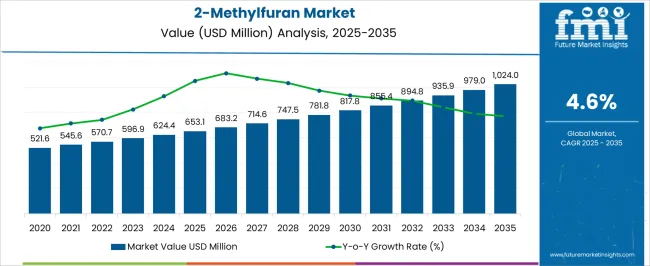
In 2025, the 2-methylfuran market was valued at USD 0.65 billion. Based on Future Market Insights' analysis, demand is estimated to grow to USD 0.68 billion in 2026 and USD 1.07 billion by 2036. FMI projects a CAGR of 4.60% during the forecast period.
The market is set to add approximately USD 0.39 billion in absolute terms between 2026 and 2036. Pharmaceutical intermediate demand for furan-based heterocyclic building blocks and growing interest in lignocellulosic bio-fuel additives are sustaining 2-methylfuran market expansion. The compound serves as a versatile C5 building block in Diels-Alder and cross-coupling reactions central to heterocyclic drug molecule construction. Bio-refinery research programs exploring 2-methylfuran as a gasoline blend component with higher energy density than ethanol provide a potential long-term demand diversification pathway.
Summary of 2-Methylfuran Market
- 2-Methylfuran Market Definition
- 2-Methylfuran is a five-membered heterocyclic compound derived from furfural, used as a pharmaceutical synthesis intermediate, an agricultural chemical building block, a specialty solvent in chemical processing, and a candidate bio-based fuel additive produced from lignocellulosic biomass conversion.
- Demand Drivers in the Market
- Pharmaceutical synthesis demand for furan-based heterocyclic intermediates sustains baseline consumption, with 2-methylfuran serving as a building block for constructing fused-ring pharmacophores found in antifungal, anti-inflammatory, and oncology drug candidates.
- Agrochemical active ingredient synthesis programs utilizing Diels-Alder cycloaddition chemistry with 2-methylfuran generate secondary demand for constructing cyclohexene-based pesticide scaffolds.
- Bio-refinery research programs at academic and government laboratories are evaluating 2-methylfuran as a lignocellulosic-derived fuel additive with 22.5 MJ/L energy density, creating a potential high-volume demand channel if automotive fuel blending mandates incorporate furan-based components.
- Key Segments Analyzed in the FMI Report
- Pharmaceuticals application: 57.8% share in 2026, reflecting its structural position as the primary category across established procurement channels.
- China: 6.20% compound growth through 2036, indicating concentrated demand acceleration.
- Analyst Opinion at FMI
- The 2-methylfuran market occupies a dual-identity position as both a niche pharmaceutical building block and a potential bio-fuel candidate. FMI analysts observe that pharmaceuticals command 57.8% application share because heterocyclic drug molecule synthesis generates the highest-value consumption channel at reagent and intermediate-grade pricing. The bio-fuel pathway remains pre-commercial, with pilot-scale production economics not yet competitive with ethanol or MTBE at current petroleum pricing. China leads at 6.2% CAGR because domestic furfural production from agricultural residues (corn cobs, sugarcane bagasse) provides a cost-advantaged feedstock base for 2-methylfuran manufacturing.
- Strategic Implications / Executive Takeaways
- Fine chemical producers should maintain pharmaceutical-grade 2-methylfuran production capability while monitoring bio-fuel policy developments that could trigger a volume-tier demand shift requiring dedicated bulk production infrastructure.
- Pharmaceutical process chemistry teams should evaluate 2-methylfuran-based Diels-Alder routes as alternatives to palladium-catalyzed coupling strategies for constructing cyclohexene intermediates, potentially reducing precious metal catalyst costs in multi-step API synthesis.
- Bio-refinery developers should benchmark 2-methylfuran production economics against cellulosic ethanol at current lignocellulosic feedstock pricing before committing capital to dedicated furan fuel additive production facilities.
2-Methylfuran Market Key Takeaways
| Metric | Details |
|---|---|
| Industry Size (2026) | USD 0.68 Billion |
| Industry Value (2036) | USD 1.07 Billion |
| CAGR (2026 to 2036) | 4.60% |
Source: Future Market Insights, 2026
As per FMI, country-level growth rates through 2036 are projected as follows: China at 6.20%, India at 5.80%, Germany at 5.30%, France at 4.80%, UK at 4.40%, USA at 3.90%, Brazil at 3.50%. China records the fastest expansion, while mature markets sustain steady growth driven by institutional research investment and regulatory framework development.
2-Methylfuran Market Definition
2-Methylfuran represents a biomass-derivable heterocyclic compound positioned at the intersection of pharmaceutical chemistry, agrochemical synthesis, and renewable fuel research. Produced via catalytic hydrogenation of furfural obtained from lignocellulosic biomass, the compound serves as a C5 building block for heterocyclic drug intermediates, a diene partner in Diels-Alder cycloaddition chemistry, and a candidate bio-fuel additive with energy density characteristics superior to ethanol. As per FMI, the market is primarily driven by pharmaceutical synthesis demand, with agricultural and bio-fuel applications providing supplementary growth channels.
2-Methylfuran Market Inclusions
Market scope covers 2-methylfuran in all commercial purity grades supplied for pharmaceutical intermediate synthesis, agrochemical production, specialty chemical solvent applications, and bio-fuel research across global markets.
2-Methylfuran Market Exclusions
Furfural (the primary precursor), furfuryl alcohol, tetrahydrofuran (THF), and downstream finished pharmaceutical and agrochemical products are excluded from scope.
2-Methylfuran Market Research Methodology
- Primary Research: Analysts conducted structured interviews with procurement managers, product engineers, and distribution channel operators to map purchase decision triggers and specification requirements across key verticals.
- Desk Research: Data collection aggregated regulatory filings, industry standards documentation, patent registries, trade body publications, and company annual reports across all target geographies.
- Market-Sizing and Forecasting: Baseline values derive from a bottom-up aggregation of product shipment volumes and average selling prices, validated against publicly disclosed revenue figures from leading suppliers.
- Data Validation and Update Cycle: Projections are cross-referenced against quarterly earnings data, import-export trade statistics, and industry association production reports to maintain forecast integrity.
Why is the 2-Methylfuran Market Growing?
The 2-Methylfuran market is gaining traction globally, supported by its expanding role in multiple industrial applications and its potential as a bio-based chemical with sustainable value. Increasing demand for renewable chemical intermediates is shaping the future outlook of the market, as industries transition toward greener alternatives. Advances in biomass conversion technologies have improved the production efficiency of 2-Methylfuran, allowing its wider adoption in pharmaceuticals, agrochemicals, and specialty chemical manufacturing.
The compound’s strong solvency properties and reactivity make it suitable for high-value chemical synthesis, further strengthening its utility in industrial processes. Heightened investment in bio-based fuels and chemical research is also influencing growth, as 2-Methylfuran is being explored for its potential in energy-efficient applications.
Regulatory focus on reducing carbon emissions and the global push for sustainable chemical solutions are encouraging producers to scale output and explore new commercial uses As downstream industries diversify their reliance on eco-friendly intermediates, the 2-Methylfuran market is positioned to achieve stable and long-term expansion across both established and emerging economies.
Segmental Analysis
The 2-methylfuran market is segmented by applications, and geographic regions. By applications, 2-methylfuran market is divided into Pharmaceuticals, Agricultural, and Chemical Industry. Regionally, the 2-methylfuran industry is classified into North America, Latin America, Western Europe, Eastern Europe, Balkan & Baltic Countries, Russia & Belarus, Central Asia, East Asia, South Asia & Pacific, and the Middle East & Africa.
Insights into the Pharmaceuticals Application Segment
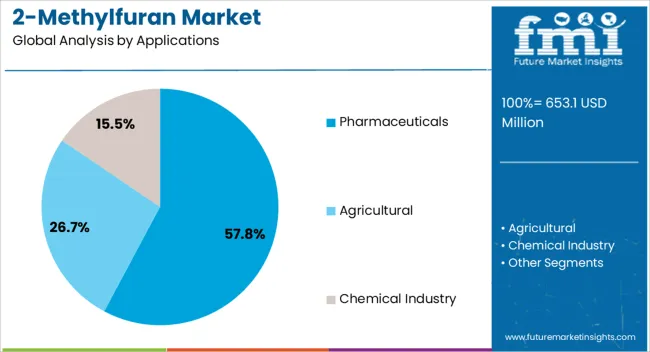
The pharmaceuticals segment is projected to hold 57.8% of the 2-Methylfuran market revenue share in 2026, making it the leading application area. Its prominence is being driven by the compound’s effectiveness as a versatile intermediate in the synthesis of active pharmaceutical ingredients, where precise chemical properties are critical for drug formulation. The segment is benefiting from the rising demand for new therapeutic solutions and the expansion of global pharmaceutical manufacturing capacity.
The solubility, stability, and reactivity of 2-Methylfuran enable the production of specialized compounds that support innovation in both generic and novel drug development pipelines. Regulatory emphasis on sustainable production methods is further influencing pharmaceutical companies to adopt bio-based intermediates such as 2-Methylfuran, ensuring compliance with international standards.
Growing healthcare investments in emerging markets, combined with the rise of chronic disease treatments, are also contributing to the segment’s leadership The ability of 2-Methylfuran to align with industry requirements for efficiency, cost-effectiveness, and environmental responsibility positions pharmaceuticals as the dominant driver of market growth in the forecast period.
Market Overview
Global 2-Methylfuran Market Overview
The global pharmaceuticals market is expected to increase at a CAGR of over 4-5% during forecast period. 2-Methylfuran is expected to gain traction in the near future as it is primarily used in pharmaceuticals industry. It is a light yellowish green volatile organic compound with an ethereal odor and is also known as sylvan.
2-Methylfuran changes its shading to black or yellow when exposed to sunlight. It is highly flammable and hence is stored in a ventilated, cool dry place far from heat & fire.
2-Methylfuran is widely used in manufacturing of drugs like atropine, sodium acetate, furadantine, anisodamine and thiamine furan. In pharmaceuticals industry, synthesis of vitamin B1 is done using 2-Methylfuran. It is less dense than water but its vapors are heavier when contrastedwith air.
2-Methylfuran also finds application as a tool for screening of lung cancer and production of anti-malarial drug like chloroquine. It is also used to produce methyl furfural, aliphatic compounds and sulfur and nitrogen heterocycles.
Moreover, 2-Methylfuran is also used for making pesticides, flavors or fragrances and has narcotic effect. Hence, the global 2-Methylfuran market is expected to grow at a moderate CAGR during the forecast period.
Global 2-Methylfuran Market Dynamics
2-Methyl furan is soluble in alcohol and ether and has the potential to be used as an alternative fuel. This factor is expected to drive the demand for 2-Methylfuran in chemical industry.
The growing pharmaceutical industry is also anticipated to be the major driving factor for the growth of global 2-Methylfuran market. Moreover, increasing demand for pesticides coupled with growing agricultural sector is expected to set an opportunity for the growth of 2-Methyl furan market.
One of the major factor restricting the growth of the global 2-Methylfuran market is its high flammability and lower flash point. This makes the transportation of 2-Methylfuran difficult, which in turn is expected to restrain the growth of 2-methylfuran market in the near future.
Moreover, environmental regulation are imposed for limited usage of 2-Methylfuran because of its toxic effects and thus expected to challenge the overall growth of the market. Additionally, the key players are responding to the challenges and are expanding their global presence in order to sustain their share in the global 2-Methylfuran market.
Global 2-Methylfuran Market: Region wise Outlook
North America is expected to be the most dominant region in global 2-Methylfuran market. Asia Pacific is anticipated to be the most promising revenue generating region for 2-Methylfuran and is expected to grow at significant rate.
Due to availability of labor and low cost of raw material, China is projected to be one of the highest revenue generating country in Asia Pacific region in 2-Methylfuran market. Middle East & Africa and Latin America are also expected to show positive growth in the near future.
Global 2-Methylfuran Market: Key Players
Some of the major key players identified in the global 2-Methylfuran market are as follows:
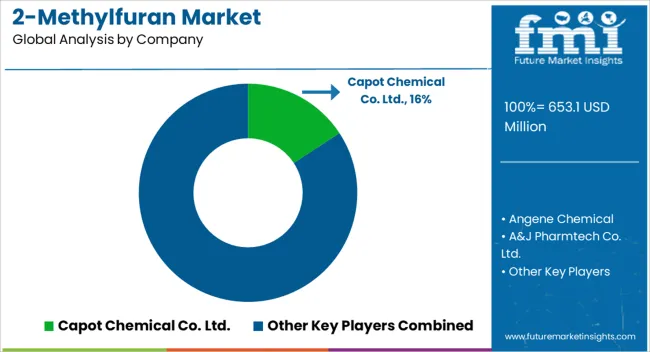
- Capot Chemical Co. Ltd.
- Angene Chemical
- A&J Pharmtech Co. Ltd.
- Sigma-Aldrich
- Finetech Industry Ltd.
- ChemExper Inc.
- MP Biomedicals, LLC.
- Amadis Chemical Co. Ltd.
- AN PharmaTech Co. Ltd.
- Tractus Company Ltd.
- Haihang Industry Co. Ltd.
The research report presents a comprehensive assessment of the market and contains thoughtful insights, facts, historical data, and statistically supported and industry-validated market data.
It also contains projections using a suitable set of assumptions and methodologies. The research report provides analysis and information according to market segments such as geography, technology and applications.
The report covers exhaustive analysis on
- Market Segments
- Market Dynamics
- Market Size
- Supply & Demand
- Current Trends/Issues/Challenges
- Competition & Companies involved
- Technology
- Value Chain
Regional analysis includes
- North America (USA, Canada)
- Latin America (Mexico. Brazil)
- Western Europe (Germany, Italy, France, UK, Spain, Nordic countries, Belgium, Netherlands, Luxembourg)
- Eastern Europe (Poland, Russia)
- Asia Pacific (China, India, ASEAN, Australia & New Zealand)
- Japan
- Middle East and Africa (GCC, S. Africa, N. Africa)
The report is a compilation of first-hand information, qualitative and quantitative assessment by industry analysts, inputs from industry experts and industry participants across the value chain.
The report provides in-depth analysis of parent market trends, macro-economic indicators and governing factors along with market attractiveness as per segments. The report also maps the qualitative impact of various market factors on market segments and geographies.
Analysis of 2-Methylfuran Market By Key Countries
.webp "Top Country Growth Comparison 2 Methylfuran Market Cagr (2026 2036)")
| Country | CAGR |
|---|---|
| China | 6.2% |
| India | 5.8% |
| Germany | 5.3% |
| France | 4.8% |
| UK | 4.4% |
| USA | 3.9% |
| Brazil | 3.5% |
Country-wise Analysis
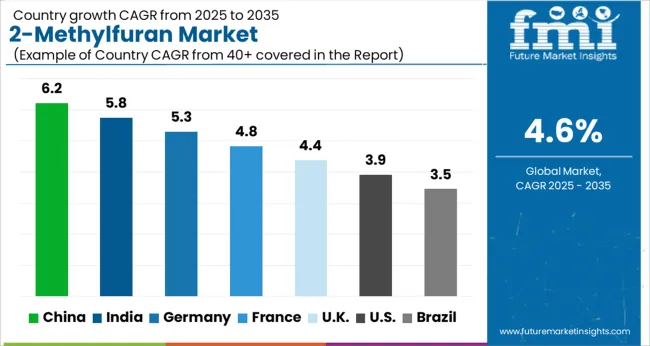
The 2-Methylfuran Market is expected to register a CAGR of 4.6% during the forecast period, exhibiting varied country level momentum. China leads with the highest CAGR of 6.2%, followed by India at 5.8%. Developed markets such as Germany, France, and the UK continue to expand steadily, while the USA is likely to grow at consistent rates. Brazil posts the lowest CAGR at 3.5%, yet still underscores a broadly positive trajectory for the global 2-Methylfuran Market. In 2024, Germany held a dominant revenue in the Western Europe market and is expected to grow with a CAGR of 5.3%. The USA 2-Methylfuran Market is estimated to be valued at USD 240.2 million in 2026 and is anticipated to reach a valuation of USD 352.4 million by 2036. Sales are projected to rise at a CAGR of 3.9% over the forecast period between 2026 and 2036. While Japan and South Korea markets are estimated to be valued at USD 34.8 million and USD 20.3 million respectively in 2026.
Key Players in the 2-Methylfuran Market
- Capot Chemical Co. Ltd.
- Angene Chemical
- A&J Pharmtech Co. Ltd.
- Sigma-Aldrich
- Finetech Industry Ltd.
- ChemExper Inc.
- MP Biomedicals, LLC.
- Amadis Chemical Co. Ltd.
- AN PharmaTech Co. Ltd.
- Tractus Company Ltd.
- Haihang Industry Co. Ltd.
Scope of the Report
| Metric | Value |
|---|---|
| Quantitative Units | USD 0.68 Bn to USD 1.07 Bn, at a CAGR of 4.60% |
| Market Definition | 2-Methylfuran is a five-membered heterocyclic compound derived from furfural, used as a pharmaceutical synthesis intermediate, an agricultural chemical building block, a specialty solvent in chemical processing, and a candidate bio-based fuel additive produced from lignocellulosic biomass conversion. |
| Application Segmentation | Pharmaceuticals, Agricultural, Chemical Industry |
| Regions Covered | North America, Latin America, Europe, East Asia, South Asia, Oceania, Middle East & Africa |
| Countries Covered | China, India, Germany, France, UK, USA, Brazil, and 40 plus countries |
| Key Companies Profiled | Capot Chemical Co. Ltd., Angene Chemical, A&J Pharmtech Co. Ltd., Sigma-Aldrich, Finetech Industry Ltd., ChemExper Inc., MP Biomedicals LLC, Amadis Chemical Co. Ltd., AN PharmaTech Co. Ltd., Tractus Company Ltd., Haihang Industry Co. Ltd. |
| Forecast Period | 2026 to 2036 |
| Approach | Hybrid bottom-up and top-down modeling validated against primary research inputs and publicly available industry data. |
2-Methylfuran Market by Segments
Applications:
- Pharmaceuticals
- Agricultural
- Chemical Industry
Region:
- North America
- USA
- Canada
- Mexico
- Latin America
- Brazil
- Chile
- Rest of Latin America
- Western Europe
- Germany
- UK
- Italy
- Spain
- France
- Nordic
- BENELUX
- Rest of Western Europe
- Eastern Europe
- Russia
- Poland
- Hungary
- Balkan & Baltic
- Rest of Eastern Europe
- East Asia
- China
- Japan
- South Korea
- South Asia and Pacific
- India
- ASEAN
- Australia & New Zealand
- Rest of South Asia and Pacific
- Middle East & Africa
- Kingdom of Saudi Arabia
- Other GCC Countries
- Turkiye
- South Africa
- Other African Union
- Rest of Middle East & Africa
Bibliography
- European Chemicals Agency. (2024). REACH Registration Dossier: 2-Methylfuran. ECHA.
- USA Department of Energy. (2024). Bioenergy Technologies Office: Furan-Based Fuel Additives Research Programme. DOE.
- Merck KGaA. (2024). Sigma-Aldrich Catalog: Furan Derivatives and Heterocyclic Building Blocks. Merck.
- Food and Agriculture Organization. (2024). Furfural Production from Agricultural Residues: Global Statistics. FAO.
- Royal Society of Chemistry. (2024). Green Chemistry Journal: Lignocellulosic Biomass Conversion Pathways. RSC.
This bibliography is provided for reader reference. The full FMI report contains the complete reference list with primary research documentation.
Frequently Asked Questions
How large is the demand for 2-Methylfuran in the global market in 2026?
Demand for 2-Methylfuran in the global market is estimated to be valued at USD 0.68 billion in 2026.
What will be the market size of 2-Methylfuran by 2036?
Market size for 2-Methylfuran is projected to reach USD 1.07 billion by 2036.
What is the expected demand growth between 2026 and 2036?
Demand is expected to grow at a CAGR of 4.60% between 2026 and 2036.
Which Application is poised to lead by 2026?
Pharmaceuticals accounts for 57.8% in 2026, reflecting its established position across primary channels.
How significant is Pharmaceuticals in driving adoption?
Pharmaceuticals represents 57.8% of segment share in 2026.
What country records the fastest growth?
China is projected to grow at a CAGR of 6.20% during 2026 to 2036.
What is the projected growth for India?
India is projected to expand at a CAGR of 5.80% during 2026 to 2036.
What is included in the scope of this report?
Market scope covers 2-methylfuran in all commercial purity grades supplied for pharmaceutical intermediate synthesis, agrochemical production, specialty chemical solvent applications, and bio-fuel research across global markets.
Preview the report firsthand - request a free sample
Get SampleGet the brochure for pricing and purchase details.
Get PDFTable of Content
- Executive Summary
- Global Market Outlook
- Demand-side Trends
- Supply-side Trends
- Technology Roadmap Analysis
- Analysis and Recommendations
- Market Overview
- Market Coverage / Taxonomy
- Market Definition / Scope / Limitations
- Research Methodology
- Chapter Orientation
- Analytical Lens and Working Hypotheses
- Market Structure, Signals, and Trend Drivers
- Benchmarking and Cross-market Comparability
- Market Sizing, Forecasting, and Opportunity Mapping
- Research Design and Evidence Framework
- Desk Research Programme (Secondary Evidence)
- Company Annual and Sustainability Reports
- Peer-reviewed Journals and Academic Literature
- Corporate Websites, Product Literature, and Technical Notes
- Earnings Decks and Investor Briefings
- Statutory Filings and Regulatory Disclosures
- Technical White Papers and Standards Notes
- Trade Journals, Industry Magazines, and Analyst Briefs
- Conference Proceedings, Webinars, and Seminar Materials
- Government Statistics Portals and Public Data Releases
- Press Releases and Reputable Media Coverage
- Specialist Newsletters and Curated Briefings
- Sector Databases and Reference Repositories
- FMI Internal Proprietary Databases and Historical Market Datasets
- Subscription Datasets and Paid Sources
- Social Channels, Communities, and Digital Listening Inputs
- Additional Desk Sources
- Expert Input and Fieldwork (Primary Evidence)
- Primary Modes
- Qualitative Interviews and Expert Elicitation
- Quantitative Surveys and Structured Data Capture
- Blended Approach
- Why Primary Evidence is Used
- Field Techniques
- Interviews
- Surveys
- Focus Groups
- Observational and In-context Research
- Social and Community Interactions
- Stakeholder Universe Engaged
- C-suite Leaders
- Board Members
- Presidents and Vice Presidents
- R&D and Innovation Heads
- Technical Specialists
- Domain Subject-matter Experts
- Scientists
- Physicians and Other Healthcare Professionals
- Governance, Ethics, and Data Stewardship
- Research Ethics
- Data Integrity and Handling
- Primary Modes
- Tooling, Models, and Reference Databases
- Desk Research Programme (Secondary Evidence)
- Data Engineering and Model Build
- Data Acquisition and Ingestion
- Cleaning, Normalisation, and Verification
- Synthesis, Triangulation, and Analysis
- Quality Assurance and Audit Trail
- Market Background
- Market Dynamics
- Drivers
- Restraints
- Opportunity
- Trends
- Scenario Forecast
- Demand in Optimistic Scenario
- Demand in Likely Scenario
- Demand in Conservative Scenario
- Opportunity Map Analysis
- Product Life Cycle Analysis
- Supply Chain Analysis
- Investment Feasibility Matrix
- Value Chain Analysis
- PESTLE and Porter’s Analysis
- Regulatory Landscape
- Regional Parent Market Outlook
- Production and Consumption Statistics
- Import and Export Statistics
- Market Dynamics
- Global Market Analysis 2021 to 2025 and Forecast, 2026 to 2036
- Historical Market Size Value (USD Million) Analysis, 2021 to 2025
- Current and Future Market Size Value (USD Million) Projections, 2026 to 2036
- Y-o-Y Growth Trend Analysis
- Absolute $ Opportunity Analysis
- Global Market Pricing Analysis 2021 to 2025 and Forecast 2026 to 2036
- Global Market Analysis 2021 to 2025 and Forecast 2026 to 2036, By Applications
- Introduction / Key Findings
- Historical Market Size Value (USD Million) Analysis By Applications , 2021 to 2025
- Current and Future Market Size Value (USD Million) Analysis and Forecast By Applications , 2026 to 2036
- Pharmaceuticals
- Agricultural
- Chemical Industry
- Pharmaceuticals
- Y-o-Y Growth Trend Analysis By Applications , 2021 to 2025
- Absolute $ Opportunity Analysis By Applications , 2026 to 2036
- Global Market Analysis 2021 to 2025 and Forecast 2026 to 2036, By Region
- Introduction
- Historical Market Size Value (USD Million) Analysis By Region, 2021 to 2025
- Current Market Size Value (USD Million) Analysis and Forecast By Region, 2026 to 2036
- North America
- Latin America
- Western Europe
- Eastern Europe
- East Asia
- South Asia and Pacific
- Middle East & Africa
- Market Attractiveness Analysis By Region
- North America Market Analysis 2021 to 2025 and Forecast 2026 to 2036, By Country
- Historical Market Size Value (USD Million) Trend Analysis By Market Taxonomy, 2021 to 2025
- Market Size Value (USD Million) Forecast By Market Taxonomy, 2026 to 2036
- By Country
- USA
- Canada
- Mexico
- By Applications
- By Country
- Market Attractiveness Analysis
- By Country
- By Applications
- Key Takeaways
- Latin America Market Analysis 2021 to 2025 and Forecast 2026 to 2036, By Country
- Historical Market Size Value (USD Million) Trend Analysis By Market Taxonomy, 2021 to 2025
- Market Size Value (USD Million) Forecast By Market Taxonomy, 2026 to 2036
- By Country
- Brazil
- Chile
- Rest of Latin America
- By Applications
- By Country
- Market Attractiveness Analysis
- By Country
- By Applications
- Key Takeaways
- Western Europe Market Analysis 2021 to 2025 and Forecast 2026 to 2036, By Country
- Historical Market Size Value (USD Million) Trend Analysis By Market Taxonomy, 2021 to 2025
- Market Size Value (USD Million) Forecast By Market Taxonomy, 2026 to 2036
- By Country
- Germany
- UK
- Italy
- Spain
- France
- Nordic
- BENELUX
- Rest of Western Europe
- By Applications
- By Country
- Market Attractiveness Analysis
- By Country
- By Applications
- Key Takeaways
- Eastern Europe Market Analysis 2021 to 2025 and Forecast 2026 to 2036, By Country
- Historical Market Size Value (USD Million) Trend Analysis By Market Taxonomy, 2021 to 2025
- Market Size Value (USD Million) Forecast By Market Taxonomy, 2026 to 2036
- By Country
- Russia
- Poland
- Hungary
- Balkan & Baltic
- Rest of Eastern Europe
- By Applications
- By Country
- Market Attractiveness Analysis
- By Country
- By Applications
- Key Takeaways
- East Asia Market Analysis 2021 to 2025 and Forecast 2026 to 2036, By Country
- Historical Market Size Value (USD Million) Trend Analysis By Market Taxonomy, 2021 to 2025
- Market Size Value (USD Million) Forecast By Market Taxonomy, 2026 to 2036
- By Country
- China
- Japan
- South Korea
- By Applications
- By Country
- Market Attractiveness Analysis
- By Country
- By Applications
- Key Takeaways
- South Asia and Pacific Market Analysis 2021 to 2025 and Forecast 2026 to 2036, By Country
- Historical Market Size Value (USD Million) Trend Analysis By Market Taxonomy, 2021 to 2025
- Market Size Value (USD Million) Forecast By Market Taxonomy, 2026 to 2036
- By Country
- India
- ASEAN
- Australia & New Zealand
- Rest of South Asia and Pacific
- By Applications
- By Country
- Market Attractiveness Analysis
- By Country
- By Applications
- Key Takeaways
- Middle East & Africa Market Analysis 2021 to 2025 and Forecast 2026 to 2036, By Country
- Historical Market Size Value (USD Million) Trend Analysis By Market Taxonomy, 2021 to 2025
- Market Size Value (USD Million) Forecast By Market Taxonomy, 2026 to 2036
- By Country
- Kingdom of Saudi Arabia
- Other GCC Countries
- Turkiye
- South Africa
- Other African Union
- Rest of Middle East & Africa
- By Applications
- By Country
- Market Attractiveness Analysis
- By Country
- By Applications
- Key Takeaways
- Key Countries Market Analysis
- USA
- Pricing Analysis
- Market Share Analysis, 2025
- By Applications
- Canada
- Pricing Analysis
- Market Share Analysis, 2025
- By Applications
- Mexico
- Pricing Analysis
- Market Share Analysis, 2025
- By Applications
- Brazil
- Pricing Analysis
- Market Share Analysis, 2025
- By Applications
- Chile
- Pricing Analysis
- Market Share Analysis, 2025
- By Applications
- Germany
- Pricing Analysis
- Market Share Analysis, 2025
- By Applications
- UK
- Pricing Analysis
- Market Share Analysis, 2025
- By Applications
- Italy
- Pricing Analysis
- Market Share Analysis, 2025
- By Applications
- Spain
- Pricing Analysis
- Market Share Analysis, 2025
- By Applications
- France
- Pricing Analysis
- Market Share Analysis, 2025
- By Applications
- India
- Pricing Analysis
- Market Share Analysis, 2025
- By Applications
- ASEAN
- Pricing Analysis
- Market Share Analysis, 2025
- By Applications
- Australia & New Zealand
- Pricing Analysis
- Market Share Analysis, 2025
- By Applications
- China
- Pricing Analysis
- Market Share Analysis, 2025
- By Applications
- Japan
- Pricing Analysis
- Market Share Analysis, 2025
- By Applications
- South Korea
- Pricing Analysis
- Market Share Analysis, 2025
- By Applications
- Russia
- Pricing Analysis
- Market Share Analysis, 2025
- By Applications
- Poland
- Pricing Analysis
- Market Share Analysis, 2025
- By Applications
- Hungary
- Pricing Analysis
- Market Share Analysis, 2025
- By Applications
- Kingdom of Saudi Arabia
- Pricing Analysis
- Market Share Analysis, 2025
- By Applications
- Turkiye
- Pricing Analysis
- Market Share Analysis, 2025
- By Applications
- South Africa
- Pricing Analysis
- Market Share Analysis, 2025
- By Applications
- USA
- Market Structure Analysis
- Competition Dashboard
- Competition Benchmarking
- Market Share Analysis of Top Players
- By Regional
- By Applications
- Competition Analysis
- Competition Deep Dive
- Capot Chemical Co. Ltd.
- Overview
- Product Portfolio
- Profitability by Market Segments (Product/Age /Sales Channel/Region)
- Sales Footprint
- Strategy Overview
- Marketing Strategy
- Product Strategy
- Channel Strategy
- Angene Chemical
- A&J Pharmtech Co. Ltd.
- Sigma-Aldrich
- Finetech Industry Ltd.
- ChemExper Inc.
- MP Biomedicals, LLC.
- Amadis Chemical Co. Ltd.
- AN PharmaTech Co. Ltd.
- Tractus Company Ltd.
- Haihang Industry Co. Ltd.
- Capot Chemical Co. Ltd.
- Competition Deep Dive
- Assumptions & Acronyms Used


