

- Market Size (2026)
- USD 3.7 Bn
- Forecast (2036)
- USD 15.2 Bn
- CAGR (2026 to 2036)
- 15.1%
Wearable Blood Pressure Monitor Market Size, Market Forecast and Outlook By FMI
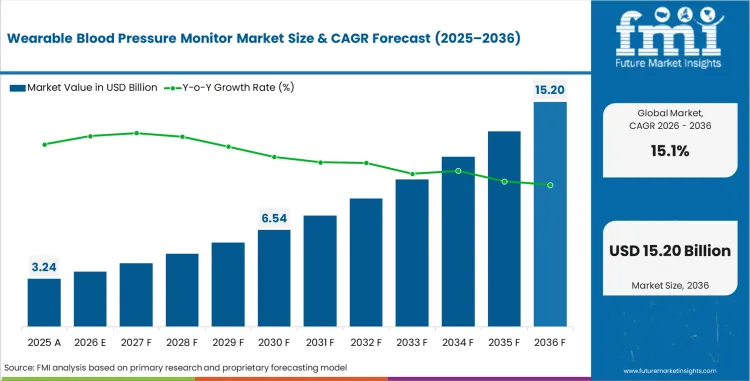
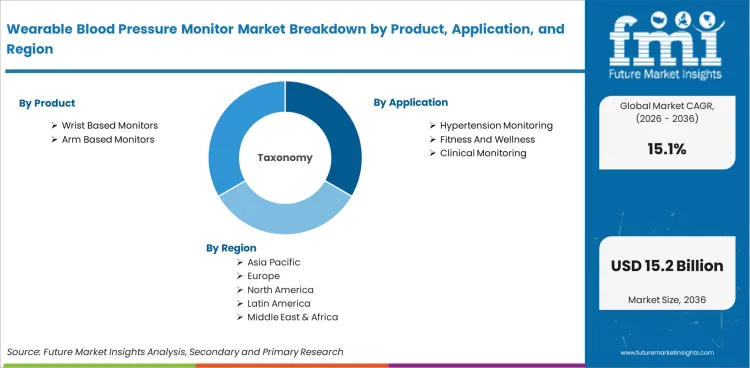
The wearable blood pressure monitor market was valued at USD 3.2 billion in 2025. The market is set to reach USD 3.7 billion by 2026-end and grow at a CAGR of 15.1% between 2026-2036 to reach USD 15.2 billion by 2036. Wrist Based Monitors will dominate with a 55.0% share, while Hypertension Monitoring will lead with a 60.0% share.
Summary of the Wearable Blood Pressure Monitor Market
- Demand and Growth Drivers
- Rising global hypertension prevalence and chronic disease management priorities are driving adoption of wearable blood pressure monitors for continuous, non clinical health tracking.
- Integration of blood pressure sensing into consumer smartwatches and fitness trackers is transforming blood pressure monitoring from a clinical task to a daily wellness metric.
- Telehealth and remote patient monitoring program expansion is creating institutional procurement channels for clinical grade wearable blood pressure devices.
- Product and Segment View
- Wrist based monitors are estimated to account for 55.0% of the product segment in 2026, reflecting consumer adoption of compact, portable devices including smartwatch integrated blood pressure sensors.
- The hypertension monitoring segment will account for 60.0% of the application segment, which is the core clinical use case that will drive the adoption of devices among chronic disease patients and preventive health consumers.
- Bluetooth enabled devices will account for 65.0% of the connectivity segment, driven by mobile app integration for real time data synchronization and health tracking.
- Geography and Competitive Outlook
- China is projected to lead global growth at 20.39% CAGR, supported by large scale hypertension prevalence, government digital health infrastructure investment, and domestic consumer electronics manufacturing capability.
- North America and Europe represent established markets where telehealth reimbursement, regulatory clearance pathways, and consumer health technology adoption drive premium device procurement.
- Companies combining medical device regulatory clearance with consumer electronics design, mobile app ecosystems, and clinically validated measurement accuracy are positioned to capture share across both clinical and consumer segments.
- Analyst Opinion
- Sabyasachi Ghosh, Principal Consultant at FMI says, 'The wearable blood pressure monitor market represents the convergence of medical device precision with consumer electronics accessibility. The growth trajectory reflects a fundamental shift in how blood pressure monitoring is positioned, moving from periodic clinical measurement to continuous personal health tracking. The competitive landscape is being reshaped by consumer technology companies entering the medical device space, while traditional medical device manufacturers are adapting their products for consumer form factors. Success requires navigating both FDA and CE regulatory pathways and consumer electronics distribution channels simultaneously.'
- As the management of hypertension is shifting from episodic clinical visits to continuous personal monitoring, the market for wearable blood pressure monitors is rapidly expanding.
- Consumer tech companies have baked blood pressure sensing into smartwatch platforms, which will accelerate adoption and make tracking blood pressure daily as normal as tracking heart rate and activity.
- Demand is also supported by the expansion of telehealth programs that create institutional procurement for remote patient monitoring devices capable of transmitting clinical grade blood pressure data.
Key Takeaways, Market Size, and Forecast
- The wearable blood pressure monitor market was valued at USD 3.24 billion in 2025.
- By 2036, the Wearable Blood Pressure Monitor Market is expected to be worth USD 15.20 billion.
- From 2026 to 2036, the market is projected to expand at a CAGR of 15.1%.
- The market is projected to create an incremental opportunity of USD 11.47 billion between 2026 and 2036.
- In 2026, Oscillometric Technology is expected to account for 70% of the Technology segment, driven by established clinical accuracy, regulatory clearance across major markets, and integration into wrist based and smartwatch form factors.
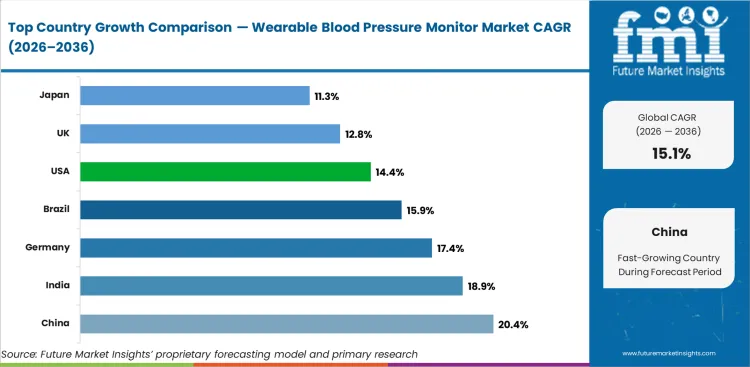
- China (20.39%) and India (18.88%) are two of the fastest growing markets in the world.
Wearable Blood Pressure Monitor Market Definition
The wearable blood pressure monitor market includes wrist based monitors, arm based wearable monitors, and patch based continuous monitoring devices designed for personal health tracking, home healthcare, clinical monitoring, and fitness and wellness applications. Product scope covers digital wrist monitors, smartwatch integrated sensors, upper arm wearable cuffs, continuous monitoring patches, and associated connectivity and display technologies.
Wearable Blood Pressure Monitor Market Inclusions
Market scope encompasses all commercially traded wearable blood pressure monitors categorized by product (wrist based monitors, arm based monitors), application (hypertension monitoring, fitness and wellness, clinical monitoring), end use (home healthcare, hospitals and clinics, fitness centers), distribution channel (online retail, offline retail), technology (oscillometric technology, tonometric technology, optical technology), and connectivity (Bluetooth enabled devices, Wi-Fi enabled devices, standalone devices). The range of revenue sizes is from 2026 to 2036.
Wearable Blood Pressure Monitor Market Exclusions
The scope does not include traditional tabletop sphygmomanometers, non wearable stationary blood pressure monitors designed exclusively for clinical environments, or implantable blood pressure sensing devices.
Wearable Blood Pressure Monitor Market Research Methodology
- Primary Research: FMI analysts conducted interviews with medical device product managers, consumer health technology executives, telehealth platform operators, and healthcare system procurement directors across key markets.
- Desk Research: Combined data from medical device registration databases, consumer electronics sales tracking platforms, telehealth adoption statistics, and clinical validation study databases.
- Market Sizing and Forecasting: Bottom up aggregation of device sales across product categories, application segments, and distribution channels with regional adoption curves incorporating regulatory clearance timelines.
- Data Validation: Cross checked quarterly against medical device trade data, consumer electronics sales tracking, and manufacturer shipment disclosures.
Why is the Wearable Blood Pressure Monitor Market Growing?
- The more than 1.2 billion adults with global hypertension represent a massive addressable population for wearable blood pressure monitoring devices in clinical, home health care and preventive wellness applications.
- The embedding of blood pressure sensing into smartwatch platforms by consumer technology companies is helping to catalyze mainstream use by putting blood pressure into a daily wellness metric with other biometric tracking already available.
- China leads the growth at 20.39% CAGR reflecting the combination of large scale prevalence of hypertension, government investment in digital health infrastructure and domestic manufacturing strength in consumer health electronics.
The wearable blood pressure monitor market is growing rapidly due to the convergence of growing prevalence of hypertension, adoption of consumer health technology, and investments by healthcare system in remote patient monitoring. Hypertension is the most prevalent modifiable risk factor for cardiovascular disease accounting for 1.28 billion adults worldwide. Current methods of blood pressure measurement are based on episodic clinical measurements which yield point in time values that may not be representative of the true ambulatory blood pressure profile of the patient. Wearable devices overcome this limitation by providing continuous or frequent blood pressure tracking in non clinical settings.
A transformative adoption catalyst is the integration of blood pressure sensing into consumer smartwatch platforms. Embedding blood pressure monitoring with heart rate, activity tracking, and sleep monitoring in a device already worn daily greatly reduces the behavioral barrier to regular blood pressure measurement. This convergence of form factors is leading to adoption by preventive health consumers who may not be hypertensive but want comprehensive biometric tracking as part of proactive health management.
As healthcare systems increase their investment in telehealth and remote patient monitoring, clinical grade wearable blood pressure devices are finding institutional procurement channels. Wearable device procurement in hospitals and clinics that can transmit validated blood pressure data to clinical information systems is being driven by chronic disease management programs, post discharge monitoring protocols and value based care models that incentivize continuous monitoring. This institutional demand channel supplements consumer retail adoption and allows for premium pricing of clinically validated devices.
Market Segmentation Analysis
- Wrist based monitors are 55.0% of the product segment due to compact form factor preference and smartwatch integration that allows for daily blood pressure monitoring.
- The core clinical use case is hypertension monitoring, which accounts for 60.0% of application segment across chronic disease management, home healthcare and preventive screening.
- 60.0% of distribution is online retail, similar to consumer electronics purchasing models, and direct to consumer health device brands.
The wearable blood pressure monitor market is segmented on the basis of product, application, end use, distribution channel, technology and connectivity. Product types are wrist based monitors, arm based monitors. Application segments include hypertension monitoring, fitness and wellness and clinical monitoring.
Insights into the Hypertension Monitoring Application Segment
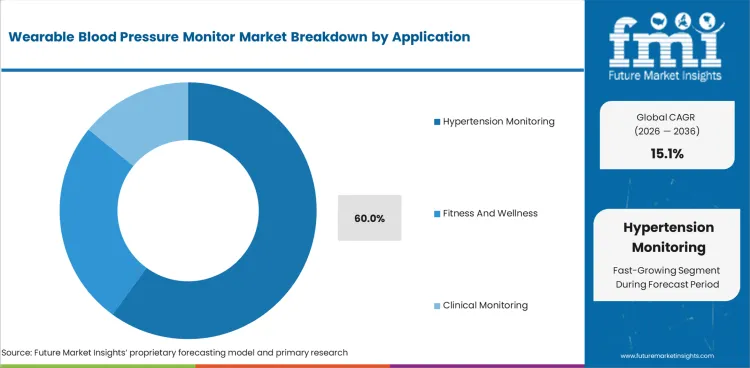
The application segment is expected to hold a share of 60.0% in the hypertension monitoring market by 2026. The biggest driver of demand is chronic disease management, with home monitoring devices that enable hypertensive patients to track their blood pressure between clinical visits. Increasingly, remote patient monitoring programs are listing wearable blood pressure devices as standard equipment for patients enrolled in the programs, creating institutional procurement channels with recurring device replacement cycles.
Preventive health care is a growing sub segment in hypertension monitoring. Even people without high blood pressure are turning to wearable blood pressure monitors to catch any problems early and keep tabs on their health, especially if they’re in a group that’s more likely to have heart problems. This preventive adoption is supported by the integration of consumer health platforms to monitor blood pressure trends and provide alerts in case of abnormalities.
Insights into the Oscillometric Technology Segment
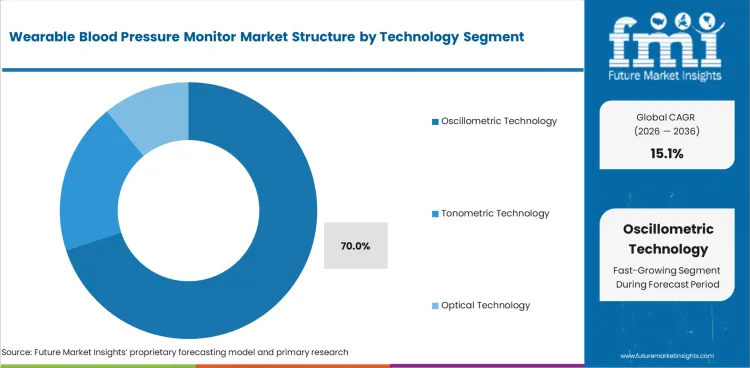
In 2026, the oscillometric technology segment is expected to hold 70.0% of the technology segment. Oscillometric measurement is the most validated and regulatory cleared technology for wearable blood pressure devices. It detects blood pressure by detecting arterial pulse oscillations. Automatic inflation and digital sensor based designs enable compact device form factors suitable for wrist and arm wearable configurations.
Within the technology segment, photoplethysmography-based optical technology is expected to have the highest growth potential. PPG based blood pressure estimation using light sensors allows for integration into smartwatch form factors without the need for inflatable cuffs, dramatically expanding the addressable consumer market. However clinical validation and regulatory clearance for PPG based blood pressure measurement is underway with accuracy standards being set during the forecast period.
Wearable Blood Pressure Monitor Market Drivers, Restraints, and Opportunities
- Wearable blood pressure monitoring devices are in constant demand across clinical and consumer segments, due to the increasing prevalence of hypertension and investments in managing chronic diseases.
- Clinical accuracy validation and regulatory clearance timelines are a bottleneck for market entry of novel sensing technologies, particularly cuffless optical measurement approaches.
- Institutional demand for validated wearable blood pressure devices that can transmit clinical data is being driven by the growth of telehealth and remote patient monitoring programs.
The wearable blood pressure monitor market is being driven by chronic disease burden, consumer health technology adoption, and the digital transformation of healthcare systems. Growth is indicative of the structural shift from episodic clinical blood pressure measurements to continuous personal monitoring enabled by wearable device technology.
Hypertension Prevalence and Chronic Disease Management
The prevalence of hypertension globally is over 1.2 billion adults, which is a major driver of demand. Also, the chronic disease management programs are increasingly recommending wearable monitoring as the standard care protocol. Home healthcare and remote patient monitoring create recurring cycles of device procurement tied to the enrolled patient populations.
Regulatory Clearance and Clinical Validation Barriers
The regulatory clearance timelines for medical device classification of wearable blood pressure monitors is a growth restraint. Novel technologies, such as cuffless optical measurement, are subject to lengthy validation cycles to prove that they are clinically as accurate as established oscillometric methods. Uncertain regulatory environment delays market entry, limits consumer adoption of emerging device categories.
Telehealth and Remote Patient Monitoring Expansion
The healthcare system’s investment in telehealth platforms with wearable blood pressure monitoring as a core remote patient monitoring capability drives adoption. Value based care models, post discharge monitoring protocols and chronic disease management programs create institutional demand channels with clear procurement specifications.
Consumer Health Technology Convergence
Consumer smartwatch and fitness tracker platforms integrating blood pressure sensing are supporting demand. This convergence positions daily blood pressure monitoring as a mainstream biometric like heart rate and activity tracking and expands the addressable market from hypertensive patients to preventive health consumers.
Analysis of Wearable Blood Pressure Monitor Market By Key Countries
.webp "Top Country Growth Comparison Wearable Blood Pressure Monitor Market Cagr (2026 2036)")
| Country | CAGR |
|---|---|
| China | 20.39% |
| India | 18.88% |
| Germany | 17.37% |
| Brazil | 15.86% |
| USA | 14.35% |
| UK | 12.84% |
| Japan | 11.33% |
- China leads with a 20.39% CAGR, driven by massive hypertension prevalence, government digital health investment, and domestic consumer electronics manufacturing strength.
- India at 18.88% reflects growing health awareness, expanding telehealth infrastructure, and rising demand for affordable home healthcare monitoring devices.
- Germany (17.37%) represents the European medical device hub where regulatory frameworks and healthcare reimbursement support validated wearable monitoring adoption.
- Brazil (15.86%) and the USA (14.35%) sustain growth through healthcare system remote monitoring investment and consumer health technology adoption.
The global wearable blood pressure monitor market is projected to grow at a CAGR of 15.1% from 2026 to 2036. The analysis covers more than 30 countries, with key markets detailed below.
Sales Analysis of Wearable Blood Pressure Monitor Market in China
China is expected to grow at 20.39% till 2036. With a burden of hypertension estimated at 245 million adults, combined with national digital health infrastructure programs and a strong domestic consumer electronics manufacturing ecosystem, China is poised for rapid, large-scale adoption of wearable blood pressure monitors.
- National Chronic Disease Prevention programs and Healthy China 2030 targets are conducive to the application of digital health monitoring devices and wearable blood pressure monitors are designated in community health management protocols.
- Local consumer electronics companies such as Xiaomi, Huawei and health device brands that focus on specific functions have cost advantages to produce cheap wrist based monitors for mass market sales.
- Government investment in telemedicine infrastructure connecting urban hospitals with rural health centers is generating institutional demand for remote monitoring blood pressure devices.
Demand Outlook for Wearable Blood Pressure Monitor Market in India
India is projected to grow at 18.88% till 2036. The fast adoption of wearable blood pressure monitoring devices is being driven by the increasing prevalence of hypertension, growing penetration of telemedicine, and increasing consumer health awareness in India, with the devices being used mainly by urban and semi-urban population.
- Telemedicine infrastructure as part of chronic disease management protocols for remote blood pressure monitoring is being built under the Ayushman Bharat Digital Mission and the National Digital Health Ecosystem.
- E commerce platforms are breaking the barriers of traditional retail for specialised health devices by enabling distribution of affordable wrist based monitors across tier 1 to tier 3 cities.
- Rising private healthcare investment and health insurance expansion are increasing consumer health monitoring awareness and willingness to invest in personal health tracking technology.
Opportunity Analysis of Wearable Blood Pressure Monitor Market in Germany
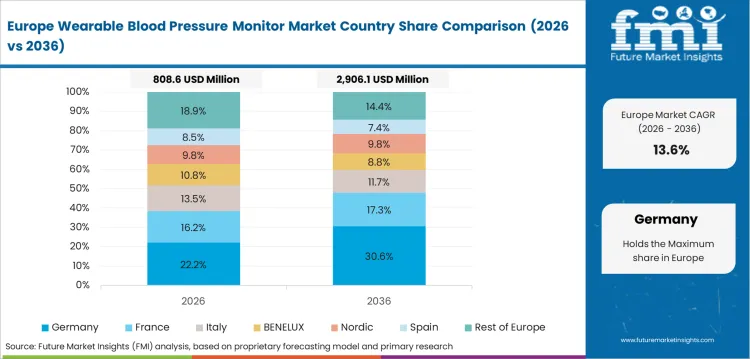
Germany’s predicted growth rate is 17.37% until 2036. Germany’s structured healthcare reimbursement system, compliance framework with EU Medical Device Regulation and high consumer receptiveness to health technology are creating a premium market for validated wearable blood pressure devices.
- The reimbursement of home blood pressure monitoring devices by the German statutory health insurance creates a funded procurement pathway for clinically validated and prescribed wearable monitors for hypertensive patients.
- EU MDR compliance requirements assure that marketed devices are clinically accurate, thus creating competitive barriers for imports that have not been validated and supporting premium pricing for CE marked devices.
- Germany's strong digital health adoption, supported by the Digital Healthcare Act that enables the prescription of digital health applications, creates an ecosystem that is supportive of connected wearable monitoring devices.
In-depth Analysis of Wearable Blood Pressure Monitor Market in Brazil
Brazil is forecast to grow 15.86% by 2036. The growth of the wearable blood pressure monitor market is driven by the increasing prevalence of cardiovascular diseases in Brazil, expanding public health surveillance programs, and increasing uptake of consumer electronics.
- Brazil’s Unified Health System is piloting remote monitoring for patients with chronic diseases, creating public sector purchasing of connected blood pressure monitors.
- Growing smartphone usage and the acceptance of mobile health apps are encouraging consumers to accept Bluetooth-based wearable monitors with real-time health monitoring.
- E-commerce distribution through Mercado Libre and health specialty channels is increasing access to wearable monitors across price tiers in urban and suburban markets.
Future Outlook for Wearable Blood Pressure Monitor Market in the United States
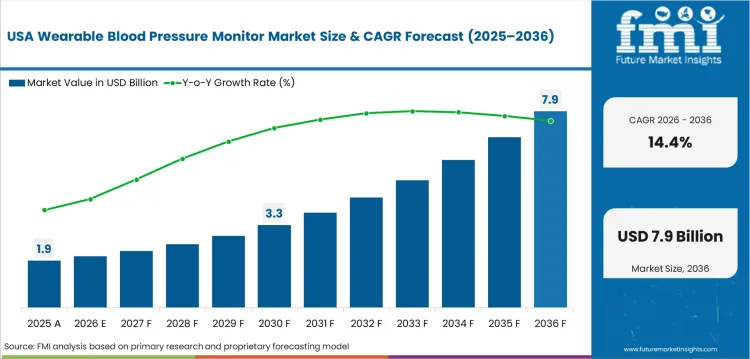
The USA is expected to grow by 14.35% by 2036. The USA is the biggest premium market for wearable blood pressure monitors due to the high adoption of consumer health technology, the expansion of telehealth reimbursements, and the FDA regulatory pathways that support market entry for validated wearable devices.
- CMS expansion of reimbursement codes for remote patient monitoring is enabling funded institutional purchasing for FDA cleared wearable blood pressure monitors used in chronic disease management programs.
- Achieving regulatory clearance will pave the way for blood pressure sensing integration on an installed base of Apple Watch, Fitbit and Samsung Galaxy Watch platforms receptive to adoption.
- Value based care models that incentivize continuous monitoring and preventive health management are driving health system investment in wearable blood pressure monitoring programs for enrolled patient populations.
In-depth Analysis of Wearable Blood Pressure Monitor Market in the United Kingdom
The UK is projected to grow at 12.84% through 2036. NHS digital health transformation programs, NICE approval pathways for validated monitoring devices, and a health conscious consumer base support wearable blood pressure monitor adoption in the UK market.
- NHS Long Term Plan targets for chronic disease management and digital health transformation are creating procurement pathways for validated wearable monitoring devices in primary care and community health settings.
- NICE medtech innovation briefings for wearable blood pressure monitors provide evidence based adoption guidance that supports clinical commissioning and procurement decisions.
- UK consumers demonstrate high receptiveness to connected health devices, with strong smartwatch adoption creating a platform base for integrated blood pressure monitoring features.
Competitive Landscape and Strategic Positioning
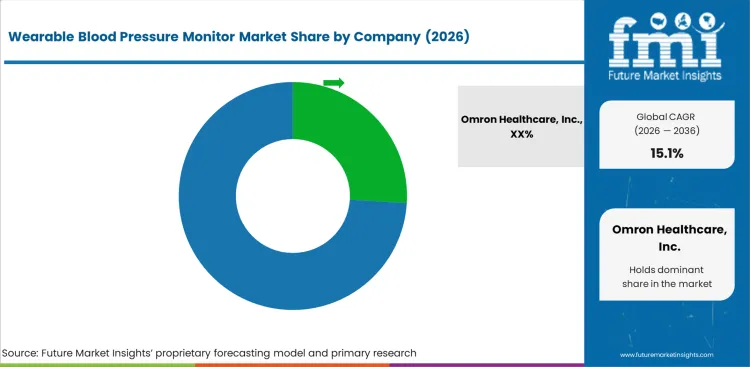
- Omron Healthcare, Inc. holds the global leadership position in blood pressure monitoring through decades of clinical validation, established healthcare channel relationships, and a broad portfolio spanning traditional and wearable device categories.
- Samsung, Apple, and Fitbit (Google) are transforming competitive dynamics by integrating blood pressure sensing into consumer smartwatch platforms with massive installed user bases.
- Biobeat Technologies Ltd. and emerging medical technology companies compete through clinical grade continuous monitoring devices targeting telehealth and institutional procurement channels.
Omron Healthcare, Inc. is the established global leader in blood pressure monitoring, with clinically validated oscillometric technology, FDA and CE cleared device portfolios, and deep relationships with healthcare systems and pharmacy retail channels. Omron's wearable product line extends its traditional monitoring expertise into wrist based form factors designed for home healthcare and personal monitoring applications.
Samsung Electronics and Apple Inc. represent the most significant competitive disruption in the wearable blood pressure monitor market. Samsung's Galaxy Watch series has received regulatory clearance for blood pressure monitoring in South Korea and is pursuing clearance in additional markets. Apple's investment in health sensor technology for Apple Watch positions it as a potential market transforming entrant pending regulatory clearance. Fitbit (Google) competes through its established health and fitness wearable platform with blood pressure monitoring as a forthcoming feature.
Biobeat Technologies Ltd. specializes in clinical grade continuous blood pressure monitoring using cuffless wrist sensor technology, targeting telehealth and hospital remote patient monitoring applications. Competitive barriers include medical device regulatory clearance timelines, clinical validation requirements, consumer brand recognition, and the network effects of established smartwatch ecosystems that create platform switching costs.
Key Companies in the Wearable Blood Pressure Monitor Market
Key global companies leading the wearable blood pressure monitor market include:
- Omron Healthcare, Inc. (Japan) maintains global leadership through clinically validated technology, FDA and CE cleared devices, and established healthcare channel relationships spanning professional and consumer segments.
- Samsung Electronics (South Korea), Apple Inc. (USA), and Fitbit Inc. (Google, USA) are reshaping competition through consumer smartwatch platform integration, leveraging massive installed user bases and digital health ecosystem capabilities.
- Biobeat Technologies Ltd. (Israel) and emerging medical technology companies compete through clinical grade continuous monitoring solutions targeting institutional telehealth and remote patient monitoring procurement.
Competitive Benchmarking: Wearable Blood Pressure Monitor Market
| Company | Clinical Validation | Consumer Platform | Regulatory Clearance | Distribution Reach |
|---|---|---|---|---|
| Omron Healthcare | Strong | Medium | FDA, CE | Global |
| Fitbit (Google) | Medium | Strong | Pending | Global |
| Samsung Electronics | Medium | Strong | Korea, Pending | Global |
| Apple Inc. | Medium | Strong | Pending | Global |
| Biobeat Technologies | Strong | Low | CE, FDA | Selective |
Source: Future Market Insights competitive analysis, 2026.
Key Developments in Wearable Blood Pressure Monitor Market
- In 2025, Samsung continued to expand availability and regulatory compliance of its Galaxy Watch blood pressure monitoring feature across additional markets, building on existing EU approvals while advancing clinical validation and software enhancements.
- In 2025, Omron Healthcare strengthened its wearable blood pressure monitoring portfolio with updates to its HeartGuide platform and remote patient monitoring integrations, supporting telehealth programs and continuous hypertension management solutions.
Key Players in the Wearable Blood Pressure Monitor Market
Major Global Players
- Omron Healthcare, Inc.
- Fitbit Inc. (Google)
- Samsung Electronics Co., Ltd.
- Apple Inc.
- Biobeat Technologies Ltd.
Emerging Players/Startups
- Withings
- Aktiia
- Valencell
- Blumio
- Leman Micro Devices
- BiOptimizers
Report Scope and Coverage
| Parameter | Details |
|---|---|
| Quantitative Units | USD 3.72 billion to USD 15.20 billion, at a CAGR of 15.1% |
| Market Definition | The wearable blood pressure monitor market encompasses wrist based, arm based, and patch based blood pressure monitoring devices for personal, clinical, and fitness applications. |
| Regions Covered | North America, Latin America, Europe, East Asia, South Asia and Pacific, Middle East and Africa |
| Countries Covered | USA, UK, France, Germany, Italy, South Korea, Japan, China, India, Brazil, 30 plus countries |
| Key Companies Profiled | Omron Healthcare, Inc., Fitbit Inc. (Google), Samsung Electronics Co., Ltd., Apple Inc., Biobeat Technologies Ltd. |
| Forecast Period | 2026 to 2036 |
| Approach | Hybrid bottom up and top down methodology starting with verified medical device sales and consumer electronics tracking data, projecting adoption across product categories, applications, and regions. |
Market Segmentation Analysis
Wearable Blood Pressure Monitor Market Segmented by Product:
- Wrist Based Monitors
- Digital Wrist Monitors
- Automatic Inflation Devices
- Compact Portable Devices
- Smart Wearables
- Fitness Tracker Integrated
- Smartwatch Integrated
- Digital Wrist Monitors
- Arm Based Monitors
- Upper Arm Wearables
- Cuff Based Wearables
- Flexible Band Devices
- Patch Based Monitors
- Continuous Monitoring Patches
- Disposable Patches
- Upper Arm Wearables
Wearable Blood Pressure Monitor Market Segmented by Application:
- Hypertension Monitoring
- Chronic Disease Management
- Home Monitoring
- Remote Patient Monitoring
- Preventive Healthcare
- Routine Health Check
- Early Detection
- Chronic Disease Management
- Fitness And Wellness
- Daily Health Tracking
- Lifestyle Monitoring
- Stress Tracking
- Sports Monitoring
- Athletic Performance
- Recovery Tracking
- Daily Health Tracking
- Clinical Monitoring
- Hospital Use
- Inpatient Monitoring
- Outpatient Monitoring
- Ambulatory Monitoring
- Twenty Four Hour Monitoring
- Continuous Monitoring
- Hospital Use
Wearable Blood Pressure Monitor Market Segmented by End Use:
- Home Healthcare
- Individual Users
- Elderly Users
- Chronic Patients
- Caregivers
- Family Monitoring
- Remote Care Providers
- Individual Users
- Hospitals And Clinics
- Hospitals
- General Hospitals
- Specialty Hospitals
- Clinics
- Primary Care Clinics
- Specialty Clinics
- Hospitals
- Fitness Centers
- Gyms
- Health Clubs
- Personal Training Centers
- Sports Facilities
- Professional Sports Teams
- Training Academies
- Gyms
Wearable Blood Pressure Monitor Market Segmented by Distribution Channel:
- Online Retail
- E Commerce Platforms
- Marketplace Platforms
- Brand Owned Websites
- Direct To Consumer
- Subscription Models
- Device Bundling Offers
- E Commerce Platforms
- Offline Retail
- Pharmacies
- Chain Pharmacies
- Independent Pharmacies
- Medical Device Stores
- Specialty Stores
- Hospital Stores
- Electronics Retailers
- Consumer Electronics Stores
- Multi Brand Retailers
- Pharmacies
Wearable Blood Pressure Monitor Market Segmented by Technology:
- Oscillometric Technology
- Automatic Measurement
- Digital Sensors
- Algorithm Based Readings
- Continuous Monitoring
- Wearable Sensors
- Real Time Tracking
- Automatic Measurement
- Tonometric Technology
- Arterial Pressure Sensing
- Pulse Wave Analysis
- Non Invasive Sensors
- Arterial Pressure Sensing
- Optical Technology
- Photoplethysmography
- Light Based Sensors
- Smartwatch Integration
- Photoplethysmography
Wearable Blood Pressure Monitor Market Segmented by Connectivity:
- Bluetooth Enabled Devices
- Mobile App Integration
- Real Time Data Sync
- Health Tracking Apps
- Device Pairing
- Smartphone Connectivity
- Wearable Ecosystems
- Mobile App Integration
- Wi Fi Enabled Devices
- Cloud Connectivity
- Remote Monitoring
- Data Storage
- Cloud Connectivity
- Standalone Devices
- Offline Monitoring
- Manual Data Recording
- Basic Display Devices
- Offline Monitoring
Wearable Blood Pressure Monitor Market by Region:
- North America
- USA
- Canada
- Mexico
- Latin America
- Brazil
- Chile
- Rest of Latin America
- Western Europe
- Germany
- UK
- Italy
- Spain
- France
- Nordic
- BENELUX
- Rest of Western Europe
- Eastern Europe
- Russia
- Poland
- Hungary
- Balkan & Baltic
- Rest of Eastern Europe
- East Asia
- China
- Japan
- South Korea
- South Asia and Pacific
- India
- ASEAN
- Australia & New Zealand
- Rest of South Asia and Pacific
- Middle East & Africa
- Kingdom of Saudi Arabia
- Other GCC Countries
- Turkiye
- South Africa
- Other African Union
- Rest of Middle East & Africa
Research Sources and Bibliography
- 1. World Health Organization. (2025). WHO Global Report on Hypertension: Burden and Prevention. WHO.
- 2. USA Food and Drug Administration. (2025). FDA Guidance on Wearable Blood Pressure Monitoring Devices. FDA.
- 3. European Commission. (2024). EU Medical Device Regulation: Digital Health Device Requirements. EC.
- 4. American Heart Association. (2025). AHA Scientific Statement on Home Blood Pressure Monitoring. AHA.
- 5. International Society of Hypertension. (2025). ISH Guidelines for Blood Pressure Monitoring Device Validation. ISH.
This bibliography is provided for reader reference.
This Report Answers
- Estimating the size of the market and revenue projections from 2026 to 2036.
- Segmentation by product, application, end use, distribution channel, technology, and connectivity.
- Insights about more than 30 markets across all regions.
- Technology analysis covering oscillometric, tonometric, and optical sensing approaches.
- Assessment of the competitive landscape including medical device and consumer technology players.
- Identifying investment opportunities in home healthcare, telehealth, and consumer wellness segments.
- Regulatory clearance and clinical validation pathway analysis across key markets.
- Delivery of data in PDF and Excel formats.
Frequently Asked Questions
How big is the wearable blood pressure monitor market in 2026?
The global wearable blood pressure monitor market is estimated to be valued at USD 3.72 billion in 2026.
What will be the size of wearable blood pressure monitor market in 2036?
The market size for the wearable blood pressure monitor market is projected to reach USD 15.20 billion by 2036.
How much will be the wearable blood pressure monitor market growth between 2026 and 2036?
The wearable blood pressure monitor market is expected to grow at a 15.1% CAGR between 2026 and 2036.
What are the key product types in the wearable blood pressure monitor market?
The key product types in wearable blood pressure monitor market are wrist based monitors and arm based monitors.
Which application segment is expected to contribute significant share in the wearable blood pressure monitor market in 2026?
In terms of application, hypertension monitoring segment is expected to command 60.0% share in the wearable blood pressure monitor market in 2026.
Preview the report firsthand - request a free sample
Get SampleGet the brochure for pricing and purchase details.
Get PDFTable of Content
- Executive Summary
- Global Market Outlook
- Demand-side Trends
- Supply-side Trends
- Technology Roadmap Analysis
- Analysis and Recommendations
- Market Overview
- Market Coverage / Taxonomy
- Market Definition / Scope / Limitations
- Research Methodology
- Chapter Orientation
- Analytical Lens and Working Hypotheses
- Market Structure, Signals, and Trend Drivers
- Benchmarking and Cross-market Comparability
- Market Sizing, Forecasting, and Opportunity Mapping
- Research Design and Evidence Framework
- Desk Research Programme (Secondary Evidence)
- Company Annual and Sustainability Reports
- Peer-reviewed Journals and Academic Literature
- Corporate Websites, Product Literature, and Technical Notes
- Earnings Decks and Investor Briefings
- Statutory Filings and Regulatory Disclosures
- Technical White Papers and Standards Notes
- Trade Journals, Industry Magazines, and Analyst Briefs
- Conference Proceedings, Webinars, and Seminar Materials
- Government Statistics Portals and Public Data Releases
- Press Releases and Reputable Media Coverage
- Specialist Newsletters and Curated Briefings
- Sector Databases and Reference Repositories
- FMI Internal Proprietary Databases and Historical Market Datasets
- Subscription Datasets and Paid Sources
- Social Channels, Communities, and Digital Listening Inputs
- Additional Desk Sources
- Expert Input and Fieldwork (Primary Evidence)
- Primary Modes
- Qualitative Interviews and Expert Elicitation
- Quantitative Surveys and Structured Data Capture
- Blended Approach
- Why Primary Evidence is Used
- Field Techniques
- Interviews
- Surveys
- Focus Groups
- Observational and In-context Research
- Social and Community Interactions
- Stakeholder Universe Engaged
- C-suite Leaders
- Board Members
- Presidents and Vice Presidents
- R&D and Innovation Heads
- Technical Specialists
- Domain Subject-matter Experts
- Scientists
- Physicians and Other Healthcare Professionals
- Governance, Ethics, and Data Stewardship
- Research Ethics
- Data Integrity and Handling
- Primary Modes
- Tooling, Models, and Reference Databases
- Desk Research Programme (Secondary Evidence)
- Data Engineering and Model Build
- Data Acquisition and Ingestion
- Cleaning, Normalisation, and Verification
- Synthesis, Triangulation, and Analysis
- Quality Assurance and Audit Trail
- Market Background
- Market Dynamics
- Drivers
- Restraints
- Opportunity
- Trends
- Scenario Forecast
- Demand in Optimistic Scenario
- Demand in Likely Scenario
- Demand in Conservative Scenario
- Opportunity Map Analysis
- Product Life Cycle Analysis
- Supply Chain Analysis
- Investment Feasibility Matrix
- Value Chain Analysis
- PESTLE and Porter’s Analysis
- Regulatory Landscape
- Regional Parent Market Outlook
- Production and Consumption Statistics
- Import and Export Statistics
- Market Dynamics
- Global Market Analysis 2021 to 2025 and Forecast, 2026 to 2036
- Historical Market Size Value (USD Million) Analysis, 2021 to 2025
- Current and Future Market Size Value (USD Million) Projections, 2026 to 2036
- Y-o-Y Growth Trend Analysis
- Absolute $ Opportunity Analysis
- Global Market Pricing Analysis 2021 to 2025 and Forecast 2026 to 2036
- Global Market Analysis 2021 to 2025 and Forecast 2026 to 2036, By Product
- Introduction / Key Findings
- Historical Market Size Value (USD Million) Analysis By Product , 2021 to 2025
- Current and Future Market Size Value (USD Million) Analysis and Forecast By Product , 2026 to 2036
- Wrist Based Monitors
- Digital Wrist Monitors
- Automatic Inflation Devices
- Compact Portable Devices
- Smart Wearables
- Fitness Tracker Integrated
- Smartwatch Integrated
- Arm Based Monitors
- Upper Arm Wearables
- Cuff Based Wearables
- Flexible Band Devices
- Patch Based Monitors
- Continuous Monitoring Patches
- Wrist Based Monitors
- Y-o-Y Growth Trend Analysis By Product , 2021 to 2025
- Absolute $ Opportunity Analysis By Product , 2026 to 2036
- Global Market Analysis 2021 to 2025 and Forecast 2026 to 2036, By Application
- Introduction / Key Findings
- Historical Market Size Value (USD Million) Analysis By Application, 2021 to 2025
- Current and Future Market Size Value (USD Million) Analysis and Forecast By Application, 2026 to 2036
- Hypertension Monitoring
- Chronic Disease Management
- Home Monitoring
- Remote Patient Monitoring
- Preventive Healthcare
- Routine Health Check
- Early Detection
- Fitness And Wellness
- Daily Health Tracking
- Lifestyle Monitoring
- Stress Tracking
- Sports Monitoring
- Athletic Performance
- Clinical Monitoring
- Hospital Use
- Inpatient Monitoring
- Outpatient Monitoring
- Ambulatory Monitoring
- Twenty Four Hour Monitoring
- Hypertension Monitoring
- Y-o-Y Growth Trend Analysis By Application, 2021 to 2025
- Absolute $ Opportunity Analysis By Application, 2026 to 2036
- Global Market Analysis 2021 to 2025 and Forecast 2026 to 2036, By End Use
- Introduction / Key Findings
- Historical Market Size Value (USD Million) Analysis By End Use, 2021 to 2025
- Current and Future Market Size Value (USD Million) Analysis and Forecast By End Use, 2026 to 2036
- Home Healthcare
- Individual Users
- Elderly Users
- Chronic Patients
- Caregivers
- Family Monitoring
- Remote Care Providers
- Hospitals And Clinics
- Hospitals
- General Hospitals
- Specialty Hospitals
- Clinics
- Primary Care Clinics
- Fitness Centers
- Gyms
- Health Clubs
- Personal Training Centers
- Sports Facilities
- Professional Sports Teams
- Home Healthcare
- Y-o-Y Growth Trend Analysis By End Use, 2021 to 2025
- Absolute $ Opportunity Analysis By End Use, 2026 to 2036
- Global Market Analysis 2021 to 2025 and Forecast 2026 to 2036, By Distribution Channel
- Introduction / Key Findings
- Historical Market Size Value (USD Million) Analysis By Distribution Channel, 2021 to 2025
- Current and Future Market Size Value (USD Million) Analysis and Forecast By Distribution Channel, 2026 to 2036
- Online Retail
- E Commerce Platforms
- Marketplace Platforms
- Brand Owned Websites
- Direct To Consumer
- Subscription Models
- Device Bundling Offers
- Offline Retail
- Pharmacies
- Chain Pharmacies
- Independent Pharmacies
- Medical Device Stores
- Specialty Stores
- Online Retail
- Y-o-Y Growth Trend Analysis By Distribution Channel, 2021 to 2025
- Absolute $ Opportunity Analysis By Distribution Channel, 2026 to 2036
- Global Market Analysis 2021 to 2025 and Forecast 2026 to 2036, By Technology
- Introduction / Key Findings
- Historical Market Size Value (USD Million) Analysis By Technology, 2021 to 2025
- Current and Future Market Size Value (USD Million) Analysis and Forecast By Technology, 2026 to 2036
- Oscillometric Technology
- Automatic Measurement
- Digital Sensors
- Algorithm Based Readings
- Continuous Monitoring
- Wearable Sensors
- Real Time Tracking
- Tonometric Technology
- Arterial Pressure Sensing
- Pulse Wave Analysis
- Non Invasive Sensors
- Optical Technology
- Photoplethysmography
- Light Based Sensors
- Smartwatch Integration
- Oscillometric Technology
- Y-o-Y Growth Trend Analysis By Technology, 2021 to 2025
- Absolute $ Opportunity Analysis By Technology, 2026 to 2036
- Global Market Analysis 2021 to 2025 and Forecast 2026 to 2036, By Connectivity
- Introduction / Key Findings
- Historical Market Size Value (USD Million) Analysis By Connectivity, 2021 to 2025
- Current and Future Market Size Value (USD Million) Analysis and Forecast By Connectivity, 2026 to 2036
- Bluetooth Enabled Devices
- Mobile App Integration
- Real Time Data Sync
- Health Tracking Apps
- Device Pairing
- Smartphone Connectivity
- Wearable Ecosystems
- Wi Fi Enabled Devices
- Cloud Connectivity
- Remote Monitoring
- Data Storage
- Standalone Devices
- Offline Monitoring
- Manual Data Recording
- Basic Display Devices
- Bluetooth Enabled Devices
- Y-o-Y Growth Trend Analysis By Connectivity, 2021 to 2025
- Absolute $ Opportunity Analysis By Connectivity, 2026 to 2036
- Global Market Analysis 2021 to 2025 and Forecast 2026 to 2036, By Region
- Introduction
- Historical Market Size Value (USD Million) Analysis By Region, 2021 to 2025
- Current Market Size Value (USD Million) Analysis and Forecast By Region, 2026 to 2036
- North America
- Latin America
- Western Europe
- Eastern Europe
- East Asia
- South Asia and Pacific
- Middle East & Africa
- Market Attractiveness Analysis By Region
- North America Market Analysis 2021 to 2025 and Forecast 2026 to 2036, By Country
- Historical Market Size Value (USD Million) Trend Analysis By Market Taxonomy, 2021 to 2025
- Market Size Value (USD Million) Forecast By Market Taxonomy, 2026 to 2036
- By Country
- USA
- Canada
- Mexico
- By Product
- By Application
- By End Use
- By Distribution Channel
- By Technology
- By Connectivity
- By Country
- Market Attractiveness Analysis
- By Country
- By Product
- By Application
- By End Use
- By Distribution Channel
- By Technology
- By Connectivity
- Key Takeaways
- Latin America Market Analysis 2021 to 2025 and Forecast 2026 to 2036, By Country
- Historical Market Size Value (USD Million) Trend Analysis By Market Taxonomy, 2021 to 2025
- Market Size Value (USD Million) Forecast By Market Taxonomy, 2026 to 2036
- By Country
- Brazil
- Chile
- Rest of Latin America
- By Product
- By Application
- By End Use
- By Distribution Channel
- By Technology
- By Connectivity
- By Country
- Market Attractiveness Analysis
- By Country
- By Product
- By Application
- By End Use
- By Distribution Channel
- By Technology
- By Connectivity
- Key Takeaways
- Western Europe Market Analysis 2021 to 2025 and Forecast 2026 to 2036, By Country
- Historical Market Size Value (USD Million) Trend Analysis By Market Taxonomy, 2021 to 2025
- Market Size Value (USD Million) Forecast By Market Taxonomy, 2026 to 2036
- By Country
- Germany
- UK
- Italy
- Spain
- France
- Nordic
- BENELUX
- Rest of Western Europe
- By Product
- By Application
- By End Use
- By Distribution Channel
- By Technology
- By Connectivity
- By Country
- Market Attractiveness Analysis
- By Country
- By Product
- By Application
- By End Use
- By Distribution Channel
- By Technology
- By Connectivity
- Key Takeaways
- Eastern Europe Market Analysis 2021 to 2025 and Forecast 2026 to 2036, By Country
- Historical Market Size Value (USD Million) Trend Analysis By Market Taxonomy, 2021 to 2025
- Market Size Value (USD Million) Forecast By Market Taxonomy, 2026 to 2036
- By Country
- Russia
- Poland
- Hungary
- Balkan & Baltic
- Rest of Eastern Europe
- By Product
- By Application
- By End Use
- By Distribution Channel
- By Technology
- By Connectivity
- By Country
- Market Attractiveness Analysis
- By Country
- By Product
- By Application
- By End Use
- By Distribution Channel
- By Technology
- By Connectivity
- Key Takeaways
- East Asia Market Analysis 2021 to 2025 and Forecast 2026 to 2036, By Country
- Historical Market Size Value (USD Million) Trend Analysis By Market Taxonomy, 2021 to 2025
- Market Size Value (USD Million) Forecast By Market Taxonomy, 2026 to 2036
- By Country
- China
- Japan
- South Korea
- By Product
- By Application
- By End Use
- By Distribution Channel
- By Technology
- By Connectivity
- By Country
- Market Attractiveness Analysis
- By Country
- By Product
- By Application
- By End Use
- By Distribution Channel
- By Technology
- By Connectivity
- Key Takeaways
- South Asia and Pacific Market Analysis 2021 to 2025 and Forecast 2026 to 2036, By Country
- Historical Market Size Value (USD Million) Trend Analysis By Market Taxonomy, 2021 to 2025
- Market Size Value (USD Million) Forecast By Market Taxonomy, 2026 to 2036
- By Country
- India
- ASEAN
- Australia & New Zealand
- Rest of South Asia and Pacific
- By Product
- By Application
- By End Use
- By Distribution Channel
- By Technology
- By Connectivity
- By Country
- Market Attractiveness Analysis
- By Country
- By Product
- By Application
- By End Use
- By Distribution Channel
- By Technology
- By Connectivity
- Key Takeaways
- Middle East & Africa Market Analysis 2021 to 2025 and Forecast 2026 to 2036, By Country
- Historical Market Size Value (USD Million) Trend Analysis By Market Taxonomy, 2021 to 2025
- Market Size Value (USD Million) Forecast By Market Taxonomy, 2026 to 2036
- By Country
- Kingdom of Saudi Arabia
- Other GCC Countries
- Turkiye
- South Africa
- Other African Union
- Rest of Middle East & Africa
- By Product
- By Application
- By End Use
- By Distribution Channel
- By Technology
- By Connectivity
- By Country
- Market Attractiveness Analysis
- By Country
- By Product
- By Application
- By End Use
- By Distribution Channel
- By Technology
- By Connectivity
- Key Takeaways
- Key Countries Market Analysis
- USA
- Pricing Analysis
- Market Share Analysis, 2025
- By Product
- By Application
- By End Use
- By Distribution Channel
- By Technology
- By Connectivity
- Canada
- Pricing Analysis
- Market Share Analysis, 2025
- By Product
- By Application
- By End Use
- By Distribution Channel
- By Technology
- By Connectivity
- Mexico
- Pricing Analysis
- Market Share Analysis, 2025
- By Product
- By Application
- By End Use
- By Distribution Channel
- By Technology
- By Connectivity
- Brazil
- Pricing Analysis
- Market Share Analysis, 2025
- By Product
- By Application
- By End Use
- By Distribution Channel
- By Technology
- By Connectivity
- Chile
- Pricing Analysis
- Market Share Analysis, 2025
- By Product
- By Application
- By End Use
- By Distribution Channel
- By Technology
- By Connectivity
- Germany
- Pricing Analysis
- Market Share Analysis, 2025
- By Product
- By Application
- By End Use
- By Distribution Channel
- By Technology
- By Connectivity
- UK
- Pricing Analysis
- Market Share Analysis, 2025
- By Product
- By Application
- By End Use
- By Distribution Channel
- By Technology
- By Connectivity
- Italy
- Pricing Analysis
- Market Share Analysis, 2025
- By Product
- By Application
- By End Use
- By Distribution Channel
- By Technology
- By Connectivity
- Spain
- Pricing Analysis
- Market Share Analysis, 2025
- By Product
- By Application
- By End Use
- By Distribution Channel
- By Technology
- By Connectivity
- France
- Pricing Analysis
- Market Share Analysis, 2025
- By Product
- By Application
- By End Use
- By Distribution Channel
- By Technology
- By Connectivity
- India
- Pricing Analysis
- Market Share Analysis, 2025
- By Product
- By Application
- By End Use
- By Distribution Channel
- By Technology
- By Connectivity
- ASEAN
- Pricing Analysis
- Market Share Analysis, 2025
- By Product
- By Application
- By End Use
- By Distribution Channel
- By Technology
- By Connectivity
- Australia & New Zealand
- Pricing Analysis
- Market Share Analysis, 2025
- By Product
- By Application
- By End Use
- By Distribution Channel
- By Technology
- By Connectivity
- China
- Pricing Analysis
- Market Share Analysis, 2025
- By Product
- By Application
- By End Use
- By Distribution Channel
- By Technology
- By Connectivity
- Japan
- Pricing Analysis
- Market Share Analysis, 2025
- By Product
- By Application
- By End Use
- By Distribution Channel
- By Technology
- By Connectivity
- South Korea
- Pricing Analysis
- Market Share Analysis, 2025
- By Product
- By Application
- By End Use
- By Distribution Channel
- By Technology
- By Connectivity
- Russia
- Pricing Analysis
- Market Share Analysis, 2025
- By Product
- By Application
- By End Use
- By Distribution Channel
- By Technology
- By Connectivity
- Poland
- Pricing Analysis
- Market Share Analysis, 2025
- By Product
- By Application
- By End Use
- By Distribution Channel
- By Technology
- By Connectivity
- Hungary
- Pricing Analysis
- Market Share Analysis, 2025
- By Product
- By Application
- By End Use
- By Distribution Channel
- By Technology
- By Connectivity
- Kingdom of Saudi Arabia
- Pricing Analysis
- Market Share Analysis, 2025
- By Product
- By Application
- By End Use
- By Distribution Channel
- By Technology
- By Connectivity
- Turkiye
- Pricing Analysis
- Market Share Analysis, 2025
- By Product
- By Application
- By End Use
- By Distribution Channel
- By Technology
- By Connectivity
- South Africa
- Pricing Analysis
- Market Share Analysis, 2025
- By Product
- By Application
- By End Use
- By Distribution Channel
- By Technology
- By Connectivity
- USA
- Market Structure Analysis
- Competition Dashboard
- Competition Benchmarking
- Market Share Analysis of Top Players
- By Regional
- By Product
- By Application
- By End Use
- By Distribution Channel
- By Technology
- By Connectivity
- Competition Analysis
- Competition Deep Dive
- Omron Healthcare, Inc.
- Overview
- Product Portfolio
- Profitability by Market Segments (Product/Age /Sales Channel/Region)
- Sales Footprint
- Strategy Overview
- Marketing Strategy
- Product Strategy
- Channel Strategy
- Fitbit Inc. (Google)
- Samsung Electronics Co., Ltd.
- Apple Inc.
- Biobeat Technologies Ltd.
- Other Companies (combined)
- Omron Healthcare, Inc.
- Competition Deep Dive
- Assumptions & Acronyms Used


