


Ablation Devices Market : Global Industry Analysis 2016 - 2025 and Opportunity Assessment 2026 - 2036
The Ablation Devices Market is segmented by Product type (Advanced Ablation Catheters, MRI Guided Neurosurgical Ablation, Standard Ablation Catheters, Bipolar Energy Ablation Devices, Cryotherapy Ablation Devices, Hydrothermal Ablation, Microwave Endometrial Ablation Devices, Thermal Balloon Ablation Devices), Technology (Radiofrequency, Microwave Ablation, Laser Ablation, Ultrasound Ablation, Cryoablation Devices, Hydrothermal/Hydromechanical Ablators, Accessories among others), Application (Cancer Treatment, Cardiovascular Disease Treatment, Ophthalmological Treatment, Pain Management, Urological Treatment, Orthopedic Treatment, Cosmetic/ Aesthetic Surgery, Gynecological Treatment, Others), and Region. Forecast for 2026 to 2036.
Historical Data Covered: 2016 - 2025 | Base Year: 2025 | Estimated Year: 2026 | Forecast Period: 2026 - 2036
Ablation Devices Market Size, Market Forecast and Outlook by FMI
Summary of the Ablation Devices Market
- Demand and Growth Drivers
- Growth is driven by the prevalence of chronic diseases, the preference for minimally invasive procedures, and the diversification of ablation technology, which keeps demand for procurement steady across the main application segments.
- Radiofrequency ablation technology has become the gold standard for both cardiac and oncological applications. It is still in high demand from both institutional and commercial buyers.
- Pulsed field ablation and robotic-assisted systems are paving the way for next-generation product development investments. These technologies are also opening up new markets that were not possible before.
- Product and Segment View
- Product type: Advanced Ablation Catheters is expected to lead, accounting for 69.4% of the product type segment in 2026.
- Technology: Radiofrequency is expected to lead, accounting for 41.4% of the technology segment in 2026.
- The ablation devices market is expanding as core application sectors increase procurement volumes and new use cases emerge from technology development. Advanced Ablation Catheters holds the largest share at 69.4% of the product type segment, reflecting established market preference for proven product configurations that deliver reliable performance. Demand growth tracks with end-use industry investment cycles and capacity expansion programmes.
- Geography and Competitive Outlook
- China is in the lead with a 13.2% CAGR, thanks to the growth of industrial infrastructure and rising domestic demand in key application areas.
- The UK comes next with 8.7%, thanks to established industries and advances in technology.
- Medtronic plc is a leader in the market because it has a wide range of products, well-established distribution networks, and a strong technical support system.
- Analyst Opinion
- Nandini Roy Choudhury, Principal Consultant at FMI says, “Companies that can navigate the evolving ablation devices landscape — the ablation devices market is defined by competition among established manufacturers and specialty suppliers — are likely to strengthen their position over the forecast period.”
The Radiofrequency category makes up 41.4% of the technology segment and gets the most business from regular customers. This application dominance is due to structural demand connected to how businesses work, not choices about what to buy. This keeps revenue stable through economic cycles.
Ablation Devices Market Definition
The ablation devices market encompasses medical instruments and consumables that use thermal, electrical, or mechanical energy to destroy or modify tissue for treatment of cancer, cardiovascular disease, pain, and other clinical applications in hospital, ambulatory surgical centre, and clinic settings.
Ablation Devices Market Inclusions
Market scope includes all commercially traded products segmented by product type, technology, application, functional, end user. Revenue sizing spans the 2026 to 2036 forecast period.
Ablation Devices Market Exclusions
The scope excludes related but distinct product categories and components manufactured exclusively for captive internal consumption.
Ablation Devices Market Research Methodology
- Primary Research: FMI analysts talked to procurement managers, technical engineers, and industry experts in North America, Europe, and Asia-Pacific.
- Desk Research: Collecting data included looking at industry statistics, company financial disclosures, regulatory records, and trade publication analysis.
- Market Sizing and Forecasting: We get baseline values by adding up transaction volumes from the bottom up and using end-use sector growth rates to predict demand through 2036.
- Data validation and update cycle: Every three months, projections are checked against data from the industry, manufacturer disclosures, and distributor records.
Why is the Ablation Devices Market Growing?
- Growth is driven by the prevalence of chronic diseases, the preference for minimally invasive procedures, and the diversification of ablation technology, which keeps demand for procurement steady across the main application segments.
- Radiofrequency ablation technology has become the gold standard for both cardiac and oncological applications. It is still in high demand from both institutional and commercial buyers.
- Pulsed field ablation and robotic-assisted systems are paving the way for next-generation product development investments. These technologies are also opening up new markets that were not possible before.
The ablation devices market is expanding as core application sectors increase procurement volumes and new use cases emerge from technology development. Advanced Ablation Catheters holds the largest share at 69.4% of the product type segment, reflecting established market preference for proven product configurations that deliver reliable performance. Demand growth tracks with end-use industry investment cycles and capacity expansion programmes.
The Radiofrequency category makes up 41.4% of the technology segment and gets the most business from regular customers. This application dominance is due to structural demand connected to how businesses work, not choices about what to buy. This keeps revenue stable through economic cycles.
The way demand is spread out across different areas shows how mature an industry is and how investments are made in different sectors. China is the fastest-growing country, with a compound annual growth rate (CAGR) of 13.2%. This is due to the growth of industrial capacity and infrastructure. Developed markets keep base revenue steady by providing steady demand for replacements and upgrades. Emerging markets, on the other hand, speed up growth by providing new installations and capacity expansion.
Market Segmentation Analysis
- Advanced Ablation Catheters will have a 69.4% share of the product type segment in 2026. This is because there is already a lot of demand for them in primary application sectors and they have a good track record of performance.
- Radiofrequency makes up 41.4% of the technology market. This is because core end-use industries and institutional buyers keep buying it.
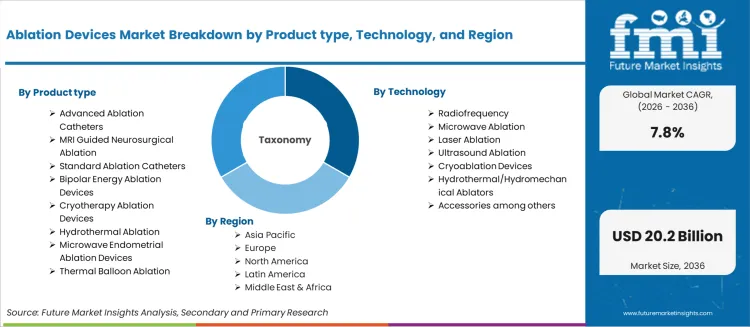
The ablation devices market is segmented by product type, technology, application, functional, end user, and geographic regions. By product type, the market is segmented as Advanced Ablation Catheters, MRI Guided Neurosurgical Ablation, Standard Ablation Catheters, Bipolar Energy Ablation Devices, Cryotherapy Ablation Devices, Hydrothermal Ablation, Microwave Endometrial Ablation Devices, Thermal Balloon Ablation Devices. By technology, the market is classified by Radiofrequency, Microwave Ablation, Laser Ablation, Ultrasound Ablation, Cryoablation Devices, Hydrothermal/Hydromechanical Ablators, Accessories among Others.
Insights into the Advanced Ablation Catheters Segment
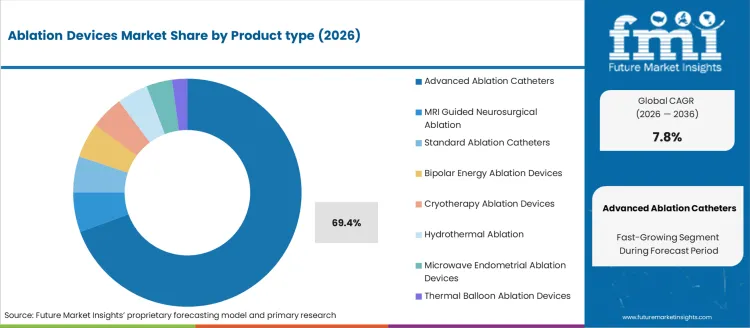
In 2026, Advanced Ablation Catheters is expected to have the largest share of the product type segment, with 69.4%. This leadership position is based on proven performance, a wide range of applications, and competitive economics that keep procurement preference. The growth trajectory is in line with the overall market expansion, as demand from the main application sectors keeps rising along with industry investment and capacity growth.
Insights into the Radiofrequency Segment
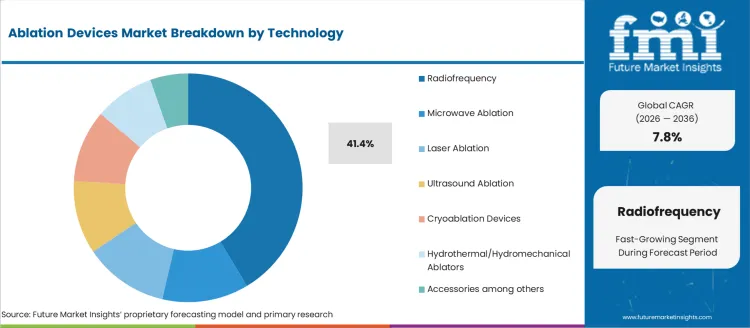
Radiofrequency is expected to capture 41.4% of the technology segment in 2026. This segment generates the largest procurement volumes from established industrial and institutional buyers who maintain standardized procurement specifications. Demand growth tracks with end-use industry investment and capacity expansion programmes.
Ablation Devices Market Drivers, Restraints, and Opportunities
- Core application sector investment creates steady demand growth underpinned by structural industry trends rather than discretionary spending.
- Input cost volatility and supply chain constraints create margin management challenges for manufacturers operating on competitive pricing.
- Technology advancement and product innovation are creating premium product tier opportunities that improve manufacturer margins and differentiate market positions.
The market for ablation devices is growing because the main application areas are getting bigger and new technologies are opening up new possibilities. Businesses are putting money into making more products, coming up with new ones, and growing their markets. Even though there are problems like changing costs, competition, and complicated rules, there are growth opportunities coming from new technologies, the need for sustainability, and expanding into new areas.
Primary Sector Investment and Demand Growth
Investment growth in key application areas affects demand. Each major end-use industry is increasing its capacity, updating its facilities, and raising its standards in ways that lead to more purchases. The Radiofrequency application alone makes up 41.4% of demand, which means that most of the money comes from meeting the needs of the industry..
Cost Structure and Margin Dynamics
Changes in the prices of raw materials and problems in the supply chain cause margins to change. Companies that have long-term procurement contracts or integrated supply chains have more stable cost structures. Optimizing the mix of products toward higher specifications raises average selling prices.
Innovation and Market Expansion Opportunities
Growth is a result of using better materials, designs, and performance standards. Companies that put money into research and development make unique products that cost more. Customer demand for better performance and compliance with sustainability rules is pushing companies to come up with new ideas.
Analysis of Ablation Devices Market By Key Countries
.webp "Top Country Growth Comparison Ablation Devices Market Cagr (2026 2036)")
| Country | CAGR |
|---|---|
| China | 13.2% |
| UK | 8.7% |
| Japan | 8.4% |
| South Korea | 8.3% |
| Germany | 6.2% |
| USA | 4.2% |
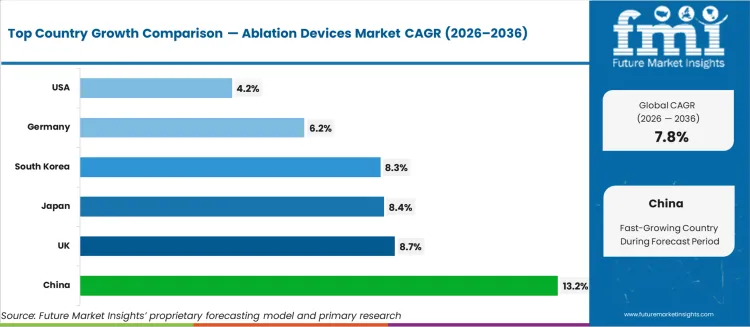
- China is in the lead with a 13.2% CAGR, thanks to the growth of industrial infrastructure and rising domestic demand in key application areas.
- The UK comes next with 8.7%, thanks to established industries and advances in technology.
- Japan's 8.4% shows that there is a lot of demand for manufacturing and that procurement standards are set by the government.
- USA at 4.2% CAGR represents steady growth from established industrial operations and infrastructure maintenance.
The ablation devices market is projected to grow globally at a CAGR of 7.8% from 2026 to 2036. The analysis spans over 30 countries, with the leading markets detailed below.
Demand Outlook of Ablation Devices Market in the United States
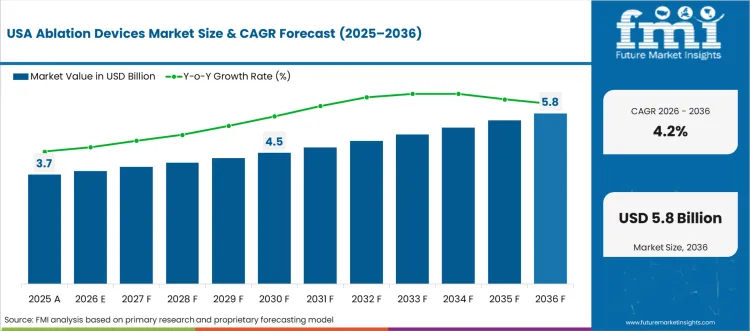
The United States is projected to grow at a CAGR of 4.2% through 2036, shaped by established industrial infrastructure, ongoing capacity investment, and growing procurement from primary application sectors.
- Industrial investment drives procurement volumes in primary application sectors.
- Regulatory and specification requirements sustain demand from compliance-driven buyers.
- Technology adoption supports premium product demand growth.
Future Outlook of Ablation Devices Market in the United Kingdom
The United Kingdom is projected to grow at a CAGR of 8.7% through 2036, shaped by established industrial infrastructure, ongoing capacity investment, and growing procurement from primary application sectors.
- Industrial investment drives procurement volumes in primary application sectors.
- Regulatory and specification requirements sustain demand from compliance-driven buyers.
- Technology adoption supports premium product demand growth.
Opportunity Analysis of Ablation Devices Market in Germany
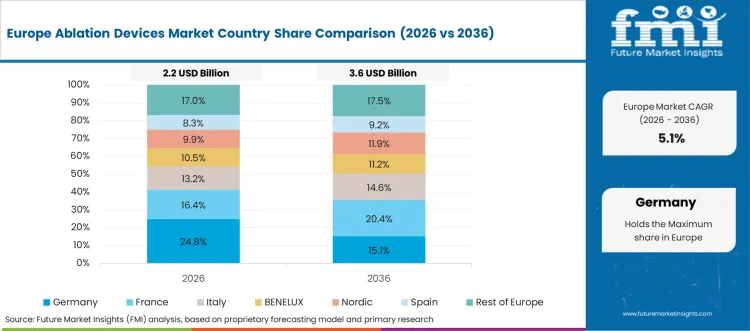
Germany is projected to grow at a CAGR of 6.2% through 2036, shaped by established industrial infrastructure, ongoing capacity investment, and growing procurement from primary application sectors.
- Industrial investment drives the amount of goods purchased in the main application sectors.
- Regulatory and specification requirements keep compliance-driven buyers interested.
- The growth of demand for premium products is helped by the use of technology.
In-depth Analysis of Ablation Devices Market in Japan
Japan is projected to grow at a CAGR of 8.4% through 2036, shaped by established industrial infrastructure, ongoing capacity investment, and growing procurement from primary application sectors.
- Industrial investment drives the amount of goods purchased in the main application sectors.
- Regulatory and specification requirements keep compliance-driven buyers interested.
- The growth of demand for premium products is helped by the use of technology.
Sales Analysis of Ablation Devices Market in China
China is projected to grow at a CAGR of 13.2% through 2036, shaped by established industrial infrastructure, ongoing capacity investment, and growing procurement from primary application sectors.
- Investment in industry drives the amount of goods bought in the main application sectors.
- Regulatory and specification requirements keep compliance-driven buyers interested.
- The growth of demand for premium products is helped by the use of technology.
In-depth Analysis of Ablation Devices Market in India
India is projected to grow at a CAGR of 5.0% through 2036, shaped by established industrial infrastructure, ongoing capacity investment, and growing procurement from primary application sectors.
- In primary application sectors, industrial investment drives up the amount of goods purchased.
- Regulatory and specification requirements keep compliance-driven buyers interested.
- The growth of demand for premium products is helped by the use of technology.
Competitive Landscape and Strategic Positioning
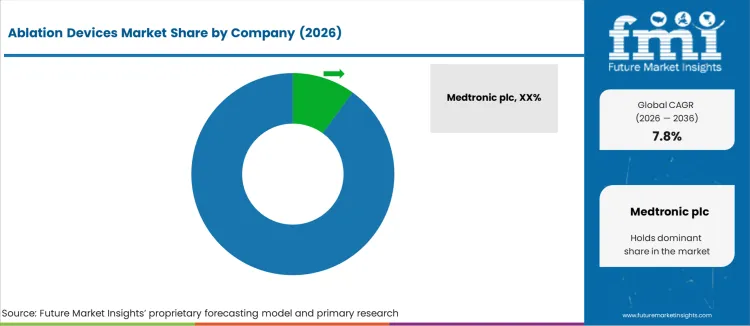
- Medtronic plc is a leader in the market because it has a wide range of products, well-established distribution networks, and a strong technical support system.
- Competitive differentiation centres on product performance, technical service capability, and distribution network breadth across primary application geographies.
- Regional manufacturers are gaining share in price-sensitive segments while established players maintain technology and specification leadership.
The ablation devices market is defined by competition among established manufacturers and specialty suppliers. Medtronic plc maintains market leadership through comprehensive product portfolios and established distribution infrastructure serving primary application markets.
Abbott Laboratories competes on product specialization and regional expertise. Ethicon Inc. (Johnson and Johnson) serves application-specific requirements through targeted product development.
Emerging companies and regional manufacturers expand market presence through competitive pricing, localized service, and niche application focus, creating a multi-tier competitive structure.
Key Companies in the Ablation Devices Market
Key global companies leading the ablation devices market include:
- Medtronic plc, Abbott Laboratories, Ethicon Inc. (Johnson and Johnson), Boston Scientific Corporation were identified as some of the star players in the ablation devices market (global), given their strong product portfolios, established distribution networks, and technical support capabilities.
- AngioDynamics Inc., Biotronik SE & Co. KG. have established strong regional positions by specializing in application-specific solutions, serving customers that prioritize technical performance and local service support.
- Japan Lifeline Co., CathRx Ltd., AtriCure, Inc., and others have set themselves apart from other startups and small and medium-sized businesses by establishing strong positions in specialized niche areas. This shows that they have the potential to become market leaders.
Competitive Benchmarking: Ablation Devices Market
| Company | Product Range | Technical Capability | Market Access | Innovation |
|---|---|---|---|---|
| Medtronic plc | High | Strong | Strong | High |
| Abbott Laboratories | High | Strong | Strong | High |
| Ethicon Inc. (Johnson and Johnson) | High | Strong | Medium | Medium |
| Boston Scientific Corporation | Medium | Medium | Medium | Medium |
| AngioDynamics Inc. | Medium | Medium | Medium | Medium |
| Biotronik SE & Co. KG. | Medium | Medium | Medium | Medium |
Source: Future Market Insights competitive analysis, 2026.
Key Developments in Ablation Devices Market
- In 2025, Medtronic plc continued strong commercial expansion and manufacturing capacity ramp-up for its pulsed field ablation (PFA) systems, including PulseSelect and Affera with Sphere-9 catheter, driven by high demand and positive clinical data for atrial fibrillation treatment.
- In 2025, Abbott Laboratories advanced its pulsed field ablation portfolio with CE Mark for the Volt PFA System (March 2025) and launched the TactiFlex Sensor Enabled ablation catheter in additional markets, targeting improved safety and efficiency in atrial fibrillation procedures.
Key Players in the Ablation Devices Market:
Major Global Players:
- Medtronic plc
- Abbott Laboratories
- Ethicon Inc. (Johnson and Johnson)
- Boston Scientific Corporation
- AngioDynamics Inc.
- Biotronik SE & Co. KG.
Emerging Players/Startups
- Japan Lifeline Co.
- CathRx Ltd.
- AtriCure, Inc.
- Hologic, Inc.
Report Scope and Coverage
| Metric | Value |
|---|---|
| Quantitative Units | USD 9.5 billion to USD 20.2 billion, at a CAGR of 7.8% |
| Market Definition | The ablation devices market encompasses medical instruments and consumables that use thermal, electrical, or mechanical energy to destroy or modify tissue for treatment of cancer, cardiovascular disease, pain, and other clinical applications in hospital, ambulatory surgical centre, and clinic settings. |
| Regions Covered | North America, Latin America, Europe, East Asia, South Asia and Pacific, Middle East and Africa |
| Countries Covered | India, China, USA, UK, Germany, Japan, and 30+ countries |
| Key Companies Profiled | Medtronic, Abbott Laboratories, Johnson and Johnson, Boston Scientific, AngioDynamics |
| Forecast Period | 2026 to 2036 |
| Approach | Hybrid bottom-up and top-down methodology starting with verified transaction data, projecting adoption velocity across segments and regions. |
Segmentation:
- Product Type
- Advanced Ablation Catheters
- MRI Guided Neurosurgical Ablation
- Standard Ablation Catheters
- Bipolar Energy Ablation Devices
- Cryotherapy Ablation Devices
- Hydrothermal Ablation
- Microwave Endometrial Ablation Devices
- Thermal Balloon Ablation Devices
- Technology
- Radiofrequency
- Microwave Ablation
- Laser Ablation
- Ultrasound Ablation
- Cryoablation Devices
- Hydrothermal/Hydromechanical Ablators
- Accessories among Others
- Application
- Cancer Treatment
- Cardiovascular Disease Treatment
- Ophthalmological Treatment
- Pain Management
- Urological Treatment
- Orthopedic Treatment
- Cosmetic/Aesthetic Surgery
- Gynecological Treatment
- Others
- Functional
- Robotic
- Conventional
- End User
- Hospitals
- Ambulatory Surgical Centres
- Clinics
Ablation Devices Market by Segments
Ablation Devices Market Segmented by Product type:
- Advanced Ablation Catheters
- MRI Guided Neurosurgical Ablation
- Standard Ablation Catheters
- Bipolar Energy Ablation Devices
- Cryotherapy Ablation Devices
- Hydrothermal Ablation
- Microwave Endometrial Ablation Devices
- Thermal Balloon Ablation Devices
Ablation Devices Market Segmented by Technology:
- Radiofrequency
- Microwave Ablation
- Laser Ablation
- Ultrasound Ablation
- Cryoablation Devices
- Hydrothermal/Hydromechanical Ablators
- Accessories among others
Ablation Devices Market Segmented by Application:
- Cancer Treatment
- Cardiovascular Disease Treatment
- Ophthalmological Treatment
- Pain Management
- Urological Treatment
- Orthopedic Treatment
- Cosmetic/ Aesthetic Surgery
- Gynecological Treatment
- Others
Ablation Devices Market Segmented by Functional:
- Robotic
- Conventional
Ablation Devices Market Segmented by End User:
- Hospitals
- Ambulatory Surgical Centres
- Clinics
Ablation Devices Market by Region:
- North America
- USA
- Canada
- Mexico
- Latin America
- Brazil
- Chile
- Rest of Latin America
- Western Europe
- Germany
- UK
- Italy
- Spain
- France
- Nordic
- BENELUX
- Rest of Western Europe
- Eastern Europe
- Russia
- Poland
- Hungary
- Balkan & Baltic
- Rest of Eastern Europe
- East Asia
- China
- Japan
- South Korea
- South Asia and Pacific
- India
- ASEAN
- Australia & New Zealand
- Rest of South Asia and Pacific
- Middle East & Africa
- Kingdom of Saudi Arabia
- Other GCC Countries
- Turkiye
- South Africa
- Other African Union
- Rest of Middle East & Africa
Research Sources and Bibliography
- 1. World Health Organization. (2025). Global Cancer Observatory. WHO/IARC.
- 2. USA Food and Drug Administration. (2025). Medical Device Database. FDA.
- 3. European Society of Cardiology. (2024). AF Management Guidelines. ESC.
- 4. American Heart Association. (2025). Heart Disease Statistics. AHA.
- 5. NCCN. (2025). Clinical Practice Guidelines. NCCN.
- 6. Society of Interventional Radiology. (2024). Tumour Ablation Guidelines. SIR.
This bibliography is provided for reader reference. The full FMI report contains the complete reference list with primary research documentation.
This Report Answers
- Market sizing and revenue forecasting for ablation devices market products from 2026 to 2036.
- Segmentation analysis across product type, technology, application, functional, end user, and region.
- Regional and country-level insights covering over 30 markets.
- Competitive landscape assessment.
- Technology and innovation analysis.
- Data delivery in PDF and Excel formats.
Frequently Asked Questions
What is driving demand in China?
China registers a 6.8% CAGR through 2036, propelled by pharmaceutical R&D investment and healthcare laboratory infrastructure expansion, including growing biotech cluster development, hospital network expansion, and government-backed life science research funding programmes.
What does the benchtop centrifuges market definition mean in this report?
The market encompasses compact laboratory centrifugation instruments for sample separation by density in clinical, pharmaceutical, and research applications, including microcentrifuges, refrigerated benchtop centrifuges, and multi-rotor configurations used across cell biology, molecular biology, and diagnostic workflows.
How does FMI build and validate the benchtop centrifuges forecast?
Forecasting models use verified unit placement data, cross-validated against pharmaceutical R&D spending and hospital laboratory statistics, alongside primary research with laboratory equipment distributors and reviewed instrument manufacturer shipment disclosures.
How large is the demand for Ablation Devices in the global market in 2026?
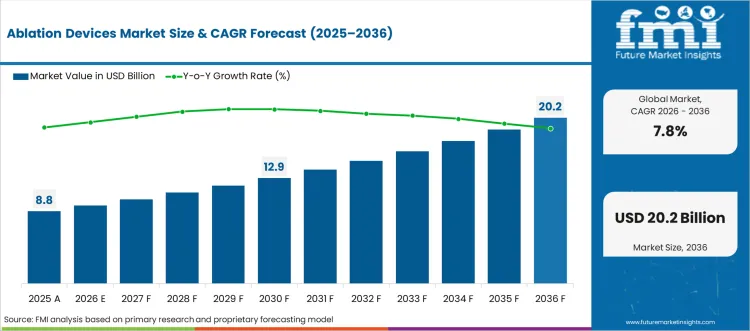
Demand for ablation devices in the global market is estimated to be valued at USD 9.53 billion in 2026, supported by rising procedure volumes across cardiac electrophysiology, oncology tumour ablation, and pain management, along with expanding minimally invasive treatment adoption in mature healthcare markets.
What will be the market size of Ablation Devices by 2036?
Market size for ablation devices is projected to reach USD 20.20 billion by 2036, driven by the continued shift toward minimally invasive therapies, rising incidence of atrial fibrillation and solid tumours, and ongoing innovation in catheter-based and energy-based ablation technologies.
What is the expected demand growth for Ablation Devices between 2026 and 2036?
The market is expected to grow at a CAGR of 7.8% between 2026 and 2036, reflecting growing global procedure volumes, adoption of advanced energy modalities, and expanded clinical indications across cardiac, oncology, and chronic pain applications.
Which Product Type is poised to lead global sales by 2026?
Advanced Ablation Catheters account for 69.4% in 2026, reflecting their central role in cardiac electrophysiology procedures, particularly for atrial fibrillation treatment, and the growing clinical preference for contact force-sensing and irrigated catheter designs.
Which Technology holds the largest share of the market?
Radiofrequency represents 41.4% of the market in 2026, supported by its long-established clinical track record, broad applicability across cardiac and tumour ablation indications, and the wide installed base of RF generators in electrophysiology labs worldwide.
Table of Content
- Executive Summary
- Global Market Outlook
- Demand-side Trends
- Supply-side Trends
- Technology Roadmap Analysis
- Analysis and Recommendations
- Market Overview
- Market Coverage / Taxonomy
- Market Definition / Scope / Limitations
- Research Methodology
- Chapter Orientation
- Analytical Lens and Working Hypotheses
- Market Structure, Signals, and Trend Drivers
- Benchmarking and Cross-market Comparability
- Market Sizing, Forecasting, and Opportunity Mapping
- Research Design and Evidence Framework
- Desk Research Programme (Secondary Evidence)
- Company Annual and Sustainability Reports
- Peer-reviewed Journals and Academic Literature
- Corporate Websites, Product Literature, and Technical Notes
- Earnings Decks and Investor Briefings
- Statutory Filings and Regulatory Disclosures
- Technical White Papers and Standards Notes
- Trade Journals, Industry Magazines, and Analyst Briefs
- Conference Proceedings, Webinars, and Seminar Materials
- Government Statistics Portals and Public Data Releases
- Press Releases and Reputable Media Coverage
- Specialist Newsletters and Curated Briefings
- Sector Databases and Reference Repositories
- FMI Internal Proprietary Databases and Historical Market Datasets
- Subscription Datasets and Paid Sources
- Social Channels, Communities, and Digital Listening Inputs
- Additional Desk Sources
- Expert Input and Fieldwork (Primary Evidence)
- Primary Modes
- Qualitative Interviews and Expert Elicitation
- Quantitative Surveys and Structured Data Capture
- Blended Approach
- Why Primary Evidence is Used
- Field Techniques
- Interviews
- Surveys
- Focus Groups
- Observational and In-context Research
- Social and Community Interactions
- Stakeholder Universe Engaged
- C-suite Leaders
- Board Members
- Presidents and Vice Presidents
- R&D and Innovation Heads
- Technical Specialists
- Domain Subject-matter Experts
- Scientists
- Physicians and Other Healthcare Professionals
- Governance, Ethics, and Data Stewardship
- Research Ethics
- Data Integrity and Handling
- Primary Modes
- Tooling, Models, and Reference Databases
- Desk Research Programme (Secondary Evidence)
- Data Engineering and Model Build
- Data Acquisition and Ingestion
- Cleaning, Normalisation, and Verification
- Synthesis, Triangulation, and Analysis
- Quality Assurance and Audit Trail
- Market Background
- Market Dynamics
- Drivers
- Restraints
- Opportunity
- Trends
- Scenario Forecast
- Demand in Optimistic Scenario
- Demand in Likely Scenario
- Demand in Conservative Scenario
- Opportunity Map Analysis
- Product Life Cycle Analysis
- Supply Chain Analysis
- Investment Feasibility Matrix
- Value Chain Analysis
- PESTLE and Porter’s Analysis
- Regulatory Landscape
- Regional Parent Market Outlook
- Production and Consumption Statistics
- Import and Export Statistics
- Market Dynamics
- Global Market Analysis 2021 to 2025 and Forecast, 2026 to 2036
- Historical Market Size Value (USD Million) Analysis, 2021 to 2025
- Current and Future Market Size Value (USD Million) Projections, 2026 to 2036
- Y-o-Y Growth Trend Analysis
- Absolute $ Opportunity Analysis
- Global Market Pricing Analysis 2021 to 2025 and Forecast 2026 to 2036
- Global Market Analysis 2021 to 2025 and Forecast 2026 to 2036, By Product type
- Introduction / Key Findings
- Historical Market Size Value (USD Million) Analysis By Product type , 2021 to 2025
- Current and Future Market Size Value (USD Million) Analysis and Forecast By Product type , 2026 to 2036
- Advanced Ablation Catheters
- MRI Guided Neurosurgical Ablation
- Standard Ablation Catheters
- Bipolar Energy Ablation Devices
- Cryotherapy Ablation Devices
- Hydrothermal Ablation
- Microwave Endometrial Ablation Devices
- Thermal Balloon Ablation Devices
- Advanced Ablation Catheters
- Y-o-Y Growth Trend Analysis By Product type , 2021 to 2025
- Absolute $ Opportunity Analysis By Product type , 2026 to 2036
- Global Market Analysis 2021 to 2025 and Forecast 2026 to 2036, By Technology
- Introduction / Key Findings
- Historical Market Size Value (USD Million) Analysis By Technology, 2021 to 2025
- Current and Future Market Size Value (USD Million) Analysis and Forecast By Technology, 2026 to 2036
- Radiofrequency
- Microwave Ablation
- Laser Ablation
- Ultrasound Ablation
- Cryoablation Devices
- Hydrothermal/Hydromechanical Ablators
- Accessories among others
- Radiofrequency
- Y-o-Y Growth Trend Analysis By Technology, 2021 to 2025
- Absolute $ Opportunity Analysis By Technology, 2026 to 2036
- Global Market Analysis 2021 to 2025 and Forecast 2026 to 2036, By Application
- Introduction / Key Findings
- Historical Market Size Value (USD Million) Analysis By Application, 2021 to 2025
- Current and Future Market Size Value (USD Million) Analysis and Forecast By Application, 2026 to 2036
- Cancer Treatment
- Cardiovascular Disease Treatment
- Ophthalmological Treatment
- Pain Management
- Urological Treatment
- Orthopedic Treatment
- Cosmetic/ Aesthetic Surgery
- Gynecological Treatment
- Others
- Cancer Treatment
- Y-o-Y Growth Trend Analysis By Application, 2021 to 2025
- Absolute $ Opportunity Analysis By Application, 2026 to 2036
- Global Market Analysis 2021 to 2025 and Forecast 2026 to 2036, By Functional
- Introduction / Key Findings
- Historical Market Size Value (USD Million) Analysis By Functional, 2021 to 2025
- Current and Future Market Size Value (USD Million) Analysis and Forecast By Functional, 2026 to 2036
- Robotic
- Conventional
- Robotic
- Y-o-Y Growth Trend Analysis By Functional, 2021 to 2025
- Absolute $ Opportunity Analysis By Functional, 2026 to 2036
- Global Market Analysis 2021 to 2025 and Forecast 2026 to 2036, By End User
- Introduction / Key Findings
- Historical Market Size Value (USD Million) Analysis By End User, 2021 to 2025
- Current and Future Market Size Value (USD Million) Analysis and Forecast By End User, 2026 to 2036
- Hospitals
- Ambulatory Surgical Centres
- Clinics
- Hospitals
- Y-o-Y Growth Trend Analysis By End User, 2021 to 2025
- Absolute $ Opportunity Analysis By End User, 2026 to 2036
- Global Market Analysis 2021 to 2025 and Forecast 2026 to 2036, By Region
- Introduction
- Historical Market Size Value (USD Million) Analysis By Region, 2021 to 2025
- Current Market Size Value (USD Million) Analysis and Forecast By Region, 2026 to 2036
- North America
- Latin America
- Western Europe
- Eastern Europe
- East Asia
- South Asia and Pacific
- Middle East & Africa
- Market Attractiveness Analysis By Region
- North America Market Analysis 2021 to 2025 and Forecast 2026 to 2036, By Country
- Historical Market Size Value (USD Million) Trend Analysis By Market Taxonomy, 2021 to 2025
- Market Size Value (USD Million) Forecast By Market Taxonomy, 2026 to 2036
- By Country
- USA
- Canada
- Mexico
- By Product type
- By Technology
- By Application
- By Functional
- By End User
- By Country
- Market Attractiveness Analysis
- By Country
- By Product type
- By Technology
- By Application
- By Functional
- By End User
- Key Takeaways
- Latin America Market Analysis 2021 to 2025 and Forecast 2026 to 2036, By Country
- Historical Market Size Value (USD Million) Trend Analysis By Market Taxonomy, 2021 to 2025
- Market Size Value (USD Million) Forecast By Market Taxonomy, 2026 to 2036
- By Country
- Brazil
- Chile
- Rest of Latin America
- By Product type
- By Technology
- By Application
- By Functional
- By End User
- By Country
- Market Attractiveness Analysis
- By Country
- By Product type
- By Technology
- By Application
- By Functional
- By End User
- Key Takeaways
- Western Europe Market Analysis 2021 to 2025 and Forecast 2026 to 2036, By Country
- Historical Market Size Value (USD Million) Trend Analysis By Market Taxonomy, 2021 to 2025
- Market Size Value (USD Million) Forecast By Market Taxonomy, 2026 to 2036
- By Country
- Germany
- UK
- Italy
- Spain
- France
- Nordic
- BENELUX
- Rest of Western Europe
- By Product type
- By Technology
- By Application
- By Functional
- By End User
- By Country
- Market Attractiveness Analysis
- By Country
- By Product type
- By Technology
- By Application
- By Functional
- By End User
- Key Takeaways
- Eastern Europe Market Analysis 2021 to 2025 and Forecast 2026 to 2036, By Country
- Historical Market Size Value (USD Million) Trend Analysis By Market Taxonomy, 2021 to 2025
- Market Size Value (USD Million) Forecast By Market Taxonomy, 2026 to 2036
- By Country
- Russia
- Poland
- Hungary
- Balkan & Baltic
- Rest of Eastern Europe
- By Product type
- By Technology
- By Application
- By Functional
- By End User
- By Country
- Market Attractiveness Analysis
- By Country
- By Product type
- By Technology
- By Application
- By Functional
- By End User
- Key Takeaways
- East Asia Market Analysis 2021 to 2025 and Forecast 2026 to 2036, By Country
- Historical Market Size Value (USD Million) Trend Analysis By Market Taxonomy, 2021 to 2025
- Market Size Value (USD Million) Forecast By Market Taxonomy, 2026 to 2036
- By Country
- China
- Japan
- South Korea
- By Product type
- By Technology
- By Application
- By Functional
- By End User
- By Country
- Market Attractiveness Analysis
- By Country
- By Product type
- By Technology
- By Application
- By Functional
- By End User
- Key Takeaways
- South Asia and Pacific Market Analysis 2021 to 2025 and Forecast 2026 to 2036, By Country
- Historical Market Size Value (USD Million) Trend Analysis By Market Taxonomy, 2021 to 2025
- Market Size Value (USD Million) Forecast By Market Taxonomy, 2026 to 2036
- By Country
- India
- ASEAN
- Australia & New Zealand
- Rest of South Asia and Pacific
- By Product type
- By Technology
- By Application
- By Functional
- By End User
- By Country
- Market Attractiveness Analysis
- By Country
- By Product type
- By Technology
- By Application
- By Functional
- By End User
- Key Takeaways
- Middle East & Africa Market Analysis 2021 to 2025 and Forecast 2026 to 2036, By Country
- Historical Market Size Value (USD Million) Trend Analysis By Market Taxonomy, 2021 to 2025
- Market Size Value (USD Million) Forecast By Market Taxonomy, 2026 to 2036
- By Country
- Kingdom of Saudi Arabia
- Other GCC Countries
- Turkiye
- South Africa
- Other African Union
- Rest of Middle East & Africa
- By Product type
- By Technology
- By Application
- By Functional
- By End User
- By Country
- Market Attractiveness Analysis
- By Country
- By Product type
- By Technology
- By Application
- By Functional
- By End User
- Key Takeaways
- Key Countries Market Analysis
- USA
- Pricing Analysis
- Market Share Analysis, 2025
- By Product type
- By Technology
- By Application
- By Functional
- By End User
- Canada
- Pricing Analysis
- Market Share Analysis, 2025
- By Product type
- By Technology
- By Application
- By Functional
- By End User
- Mexico
- Pricing Analysis
- Market Share Analysis, 2025
- By Product type
- By Technology
- By Application
- By Functional
- By End User
- Brazil
- Pricing Analysis
- Market Share Analysis, 2025
- By Product type
- By Technology
- By Application
- By Functional
- By End User
- Chile
- Pricing Analysis
- Market Share Analysis, 2025
- By Product type
- By Technology
- By Application
- By Functional
- By End User
- Germany
- Pricing Analysis
- Market Share Analysis, 2025
- By Product type
- By Technology
- By Application
- By Functional
- By End User
- UK
- Pricing Analysis
- Market Share Analysis, 2025
- By Product type
- By Technology
- By Application
- By Functional
- By End User
- Italy
- Pricing Analysis
- Market Share Analysis, 2025
- By Product type
- By Technology
- By Application
- By Functional
- By End User
- Spain
- Pricing Analysis
- Market Share Analysis, 2025
- By Product type
- By Technology
- By Application
- By Functional
- By End User
- France
- Pricing Analysis
- Market Share Analysis, 2025
- By Product type
- By Technology
- By Application
- By Functional
- By End User
- India
- Pricing Analysis
- Market Share Analysis, 2025
- By Product type
- By Technology
- By Application
- By Functional
- By End User
- ASEAN
- Pricing Analysis
- Market Share Analysis, 2025
- By Product type
- By Technology
- By Application
- By Functional
- By End User
- Australia & New Zealand
- Pricing Analysis
- Market Share Analysis, 2025
- By Product type
- By Technology
- By Application
- By Functional
- By End User
- China
- Pricing Analysis
- Market Share Analysis, 2025
- By Product type
- By Technology
- By Application
- By Functional
- By End User
- Japan
- Pricing Analysis
- Market Share Analysis, 2025
- By Product type
- By Technology
- By Application
- By Functional
- By End User
- South Korea
- Pricing Analysis
- Market Share Analysis, 2025
- By Product type
- By Technology
- By Application
- By Functional
- By End User
- Russia
- Pricing Analysis
- Market Share Analysis, 2025
- By Product type
- By Technology
- By Application
- By Functional
- By End User
- Poland
- Pricing Analysis
- Market Share Analysis, 2025
- By Product type
- By Technology
- By Application
- By Functional
- By End User
- Hungary
- Pricing Analysis
- Market Share Analysis, 2025
- By Product type
- By Technology
- By Application
- By Functional
- By End User
- Kingdom of Saudi Arabia
- Pricing Analysis
- Market Share Analysis, 2025
- By Product type
- By Technology
- By Application
- By Functional
- By End User
- Turkiye
- Pricing Analysis
- Market Share Analysis, 2025
- By Product type
- By Technology
- By Application
- By Functional
- By End User
- South Africa
- Pricing Analysis
- Market Share Analysis, 2025
- By Product type
- By Technology
- By Application
- By Functional
- By End User
- USA
- Market Structure Analysis
- Competition Dashboard
- Competition Benchmarking
- Market Share Analysis of Top Players
- By Regional
- By Product type
- By Technology
- By Application
- By Functional
- By End User
- Competition Analysis
- Competition Deep Dive
- Medtronic plc
- Overview
- Product Portfolio
- Profitability by Market Segments (Product/Age /Sales Channel/Region)
- Sales Footprint
- Strategy Overview
- Marketing Strategy
- Product Strategy
- Channel Strategy
- Abbott Laboratories
- Ethicon Inc. Johnson and Johnson
- Boston Scientific Corporation
- AngioDynamics Inc.
- Biotronik SE & Co. KG.
- Japan Lifeline Co.
- CathRx Ltd.
- AtriCure, Inc.
- Hologic, Inc.
- Others
- Medtronic plc
- Competition Deep Dive
- Assumptions & Acronyms Used
List of Tables
- Table 1: Global Market Value (USD Million) Forecast by Region, 2021 to 2036
- Table 2: Global Market Value (USD Million) Forecast by Product type , 2021 to 2036
- Table 3: Global Market Value (USD Million) Forecast by Technology, 2021 to 2036
- Table 4: Global Market Value (USD Million) Forecast by Application, 2021 to 2036
- Table 5: Global Market Value (USD Million) Forecast by Functional, 2021 to 2036
- Table 6: Global Market Value (USD Million) Forecast by End User, 2021 to 2036
- Table 7: North America Market Value (USD Million) Forecast by Country, 2021 to 2036
- Table 8: North America Market Value (USD Million) Forecast by Product type , 2021 to 2036
- Table 9: North America Market Value (USD Million) Forecast by Technology, 2021 to 2036
- Table 10: North America Market Value (USD Million) Forecast by Application, 2021 to 2036
- Table 11: North America Market Value (USD Million) Forecast by Functional, 2021 to 2036
- Table 12: North America Market Value (USD Million) Forecast by End User, 2021 to 2036
- Table 13: Latin America Market Value (USD Million) Forecast by Country, 2021 to 2036
- Table 14: Latin America Market Value (USD Million) Forecast by Product type , 2021 to 2036
- Table 15: Latin America Market Value (USD Million) Forecast by Technology, 2021 to 2036
- Table 16: Latin America Market Value (USD Million) Forecast by Application, 2021 to 2036
- Table 17: Latin America Market Value (USD Million) Forecast by Functional, 2021 to 2036
- Table 18: Latin America Market Value (USD Million) Forecast by End User, 2021 to 2036
- Table 19: Western Europe Market Value (USD Million) Forecast by Country, 2021 to 2036
- Table 20: Western Europe Market Value (USD Million) Forecast by Product type , 2021 to 2036
- Table 21: Western Europe Market Value (USD Million) Forecast by Technology, 2021 to 2036
- Table 22: Western Europe Market Value (USD Million) Forecast by Application, 2021 to 2036
- Table 23: Western Europe Market Value (USD Million) Forecast by Functional, 2021 to 2036
- Table 24: Western Europe Market Value (USD Million) Forecast by End User, 2021 to 2036
- Table 25: Eastern Europe Market Value (USD Million) Forecast by Country, 2021 to 2036
- Table 26: Eastern Europe Market Value (USD Million) Forecast by Product type , 2021 to 2036
- Table 27: Eastern Europe Market Value (USD Million) Forecast by Technology, 2021 to 2036
- Table 28: Eastern Europe Market Value (USD Million) Forecast by Application, 2021 to 2036
- Table 29: Eastern Europe Market Value (USD Million) Forecast by Functional, 2021 to 2036
- Table 30: Eastern Europe Market Value (USD Million) Forecast by End User, 2021 to 2036
- Table 31: East Asia Market Value (USD Million) Forecast by Country, 2021 to 2036
- Table 32: East Asia Market Value (USD Million) Forecast by Product type , 2021 to 2036
- Table 33: East Asia Market Value (USD Million) Forecast by Technology, 2021 to 2036
- Table 34: East Asia Market Value (USD Million) Forecast by Application, 2021 to 2036
- Table 35: East Asia Market Value (USD Million) Forecast by Functional, 2021 to 2036
- Table 36: East Asia Market Value (USD Million) Forecast by End User, 2021 to 2036
- Table 37: South Asia and Pacific Market Value (USD Million) Forecast by Country, 2021 to 2036
- Table 38: South Asia and Pacific Market Value (USD Million) Forecast by Product type , 2021 to 2036
- Table 39: South Asia and Pacific Market Value (USD Million) Forecast by Technology, 2021 to 2036
- Table 40: South Asia and Pacific Market Value (USD Million) Forecast by Application, 2021 to 2036
- Table 41: South Asia and Pacific Market Value (USD Million) Forecast by Functional, 2021 to 2036
- Table 42: South Asia and Pacific Market Value (USD Million) Forecast by End User, 2021 to 2036
- Table 43: Middle East & Africa Market Value (USD Million) Forecast by Country, 2021 to 2036
- Table 44: Middle East & Africa Market Value (USD Million) Forecast by Product type , 2021 to 2036
- Table 45: Middle East & Africa Market Value (USD Million) Forecast by Technology, 2021 to 2036
- Table 46: Middle East & Africa Market Value (USD Million) Forecast by Application, 2021 to 2036
- Table 47: Middle East & Africa Market Value (USD Million) Forecast by Functional, 2021 to 2036
- Table 48: Middle East & Africa Market Value (USD Million) Forecast by End User, 2021 to 2036
List of Figures
- Figure 1: Global Market Pricing Analysis
- Figure 2: Global Market Value (USD Million) Forecast 2021-2036
- Figure 3: Global Market Value Share and BPS Analysis by Product type , 2026 and 2036
- Figure 4: Global Market Y-o-Y Growth Comparison by Product type , 2026-2036
- Figure 5: Global Market Attractiveness Analysis by Product type
- Figure 6: Global Market Value Share and BPS Analysis by Technology, 2026 and 2036
- Figure 7: Global Market Y-o-Y Growth Comparison by Technology, 2026-2036
- Figure 8: Global Market Attractiveness Analysis by Technology
- Figure 9: Global Market Value Share and BPS Analysis by Application, 2026 and 2036
- Figure 10: Global Market Y-o-Y Growth Comparison by Application, 2026-2036
- Figure 11: Global Market Attractiveness Analysis by Application
- Figure 12: Global Market Value Share and BPS Analysis by Functional, 2026 and 2036
- Figure 13: Global Market Y-o-Y Growth Comparison by Functional, 2026-2036
- Figure 14: Global Market Attractiveness Analysis by Functional
- Figure 15: Global Market Value Share and BPS Analysis by End User, 2026 and 2036
- Figure 16: Global Market Y-o-Y Growth Comparison by End User, 2026-2036
- Figure 17: Global Market Attractiveness Analysis by End User
- Figure 18: Global Market Value (USD Million) Share and BPS Analysis by Region, 2026 and 2036
- Figure 19: Global Market Y-o-Y Growth Comparison by Region, 2026-2036
- Figure 20: Global Market Attractiveness Analysis by Region
- Figure 21: North America Market Incremental Dollar Opportunity, 2026-2036
- Figure 22: Latin America Market Incremental Dollar Opportunity, 2026-2036
- Figure 23: Western Europe Market Incremental Dollar Opportunity, 2026-2036
- Figure 24: Eastern Europe Market Incremental Dollar Opportunity, 2026-2036
- Figure 25: East Asia Market Incremental Dollar Opportunity, 2026-2036
- Figure 26: South Asia and Pacific Market Incremental Dollar Opportunity, 2026-2036
- Figure 27: Middle East & Africa Market Incremental Dollar Opportunity, 2026-2036
- Figure 28: North America Market Value Share and BPS Analysis by Country, 2026 and 2036
- Figure 29: North America Market Value Share and BPS Analysis by Product type , 2026 and 2036
- Figure 30: North America Market Y-o-Y Growth Comparison by Product type , 2026-2036
- Figure 31: North America Market Attractiveness Analysis by Product type
- Figure 32: North America Market Value Share and BPS Analysis by Technology, 2026 and 2036
- Figure 33: North America Market Y-o-Y Growth Comparison by Technology, 2026-2036
- Figure 34: North America Market Attractiveness Analysis by Technology
- Figure 35: North America Market Value Share and BPS Analysis by Application, 2026 and 2036
- Figure 36: North America Market Y-o-Y Growth Comparison by Application, 2026-2036
- Figure 37: North America Market Attractiveness Analysis by Application
- Figure 38: North America Market Value Share and BPS Analysis by Functional, 2026 and 2036
- Figure 39: North America Market Y-o-Y Growth Comparison by Functional, 2026-2036
- Figure 40: North America Market Attractiveness Analysis by Functional
- Figure 41: North America Market Value Share and BPS Analysis by End User, 2026 and 2036
- Figure 42: North America Market Y-o-Y Growth Comparison by End User, 2026-2036
- Figure 43: North America Market Attractiveness Analysis by End User
- Figure 44: Latin America Market Value Share and BPS Analysis by Country, 2026 and 2036
- Figure 45: Latin America Market Value Share and BPS Analysis by Product type , 2026 and 2036
- Figure 46: Latin America Market Y-o-Y Growth Comparison by Product type , 2026-2036
- Figure 47: Latin America Market Attractiveness Analysis by Product type
- Figure 48: Latin America Market Value Share and BPS Analysis by Technology, 2026 and 2036
- Figure 49: Latin America Market Y-o-Y Growth Comparison by Technology, 2026-2036
- Figure 50: Latin America Market Attractiveness Analysis by Technology
- Figure 51: Latin America Market Value Share and BPS Analysis by Application, 2026 and 2036
- Figure 52: Latin America Market Y-o-Y Growth Comparison by Application, 2026-2036
- Figure 53: Latin America Market Attractiveness Analysis by Application
- Figure 54: Latin America Market Value Share and BPS Analysis by Functional, 2026 and 2036
- Figure 55: Latin America Market Y-o-Y Growth Comparison by Functional, 2026-2036
- Figure 56: Latin America Market Attractiveness Analysis by Functional
- Figure 57: Latin America Market Value Share and BPS Analysis by End User, 2026 and 2036
- Figure 58: Latin America Market Y-o-Y Growth Comparison by End User, 2026-2036
- Figure 59: Latin America Market Attractiveness Analysis by End User
- Figure 60: Western Europe Market Value Share and BPS Analysis by Country, 2026 and 2036
- Figure 61: Western Europe Market Value Share and BPS Analysis by Product type , 2026 and 2036
- Figure 62: Western Europe Market Y-o-Y Growth Comparison by Product type , 2026-2036
- Figure 63: Western Europe Market Attractiveness Analysis by Product type
- Figure 64: Western Europe Market Value Share and BPS Analysis by Technology, 2026 and 2036
- Figure 65: Western Europe Market Y-o-Y Growth Comparison by Technology, 2026-2036
- Figure 66: Western Europe Market Attractiveness Analysis by Technology
- Figure 67: Western Europe Market Value Share and BPS Analysis by Application, 2026 and 2036
- Figure 68: Western Europe Market Y-o-Y Growth Comparison by Application, 2026-2036
- Figure 69: Western Europe Market Attractiveness Analysis by Application
- Figure 70: Western Europe Market Value Share and BPS Analysis by Functional, 2026 and 2036
- Figure 71: Western Europe Market Y-o-Y Growth Comparison by Functional, 2026-2036
- Figure 72: Western Europe Market Attractiveness Analysis by Functional
- Figure 73: Western Europe Market Value Share and BPS Analysis by End User, 2026 and 2036
- Figure 74: Western Europe Market Y-o-Y Growth Comparison by End User, 2026-2036
- Figure 75: Western Europe Market Attractiveness Analysis by End User
- Figure 76: Eastern Europe Market Value Share and BPS Analysis by Country, 2026 and 2036
- Figure 77: Eastern Europe Market Value Share and BPS Analysis by Product type , 2026 and 2036
- Figure 78: Eastern Europe Market Y-o-Y Growth Comparison by Product type , 2026-2036
- Figure 79: Eastern Europe Market Attractiveness Analysis by Product type
- Figure 80: Eastern Europe Market Value Share and BPS Analysis by Technology, 2026 and 2036
- Figure 81: Eastern Europe Market Y-o-Y Growth Comparison by Technology, 2026-2036
- Figure 82: Eastern Europe Market Attractiveness Analysis by Technology
- Figure 83: Eastern Europe Market Value Share and BPS Analysis by Application, 2026 and 2036
- Figure 84: Eastern Europe Market Y-o-Y Growth Comparison by Application, 2026-2036
- Figure 85: Eastern Europe Market Attractiveness Analysis by Application
- Figure 86: Eastern Europe Market Value Share and BPS Analysis by Functional, 2026 and 2036
- Figure 87: Eastern Europe Market Y-o-Y Growth Comparison by Functional, 2026-2036
- Figure 88: Eastern Europe Market Attractiveness Analysis by Functional
- Figure 89: Eastern Europe Market Value Share and BPS Analysis by End User, 2026 and 2036
- Figure 90: Eastern Europe Market Y-o-Y Growth Comparison by End User, 2026-2036
- Figure 91: Eastern Europe Market Attractiveness Analysis by End User
- Figure 92: East Asia Market Value Share and BPS Analysis by Country, 2026 and 2036
- Figure 93: East Asia Market Value Share and BPS Analysis by Product type , 2026 and 2036
- Figure 94: East Asia Market Y-o-Y Growth Comparison by Product type , 2026-2036
- Figure 95: East Asia Market Attractiveness Analysis by Product type
- Figure 96: East Asia Market Value Share and BPS Analysis by Technology, 2026 and 2036
- Figure 97: East Asia Market Y-o-Y Growth Comparison by Technology, 2026-2036
- Figure 98: East Asia Market Attractiveness Analysis by Technology
- Figure 99: East Asia Market Value Share and BPS Analysis by Application, 2026 and 2036
- Figure 100: East Asia Market Y-o-Y Growth Comparison by Application, 2026-2036
- Figure 101: East Asia Market Attractiveness Analysis by Application
- Figure 102: East Asia Market Value Share and BPS Analysis by Functional, 2026 and 2036
- Figure 103: East Asia Market Y-o-Y Growth Comparison by Functional, 2026-2036
- Figure 104: East Asia Market Attractiveness Analysis by Functional
- Figure 105: East Asia Market Value Share and BPS Analysis by End User, 2026 and 2036
- Figure 106: East Asia Market Y-o-Y Growth Comparison by End User, 2026-2036
- Figure 107: East Asia Market Attractiveness Analysis by End User
- Figure 108: South Asia and Pacific Market Value Share and BPS Analysis by Country, 2026 and 2036
- Figure 109: South Asia and Pacific Market Value Share and BPS Analysis by Product type , 2026 and 2036
- Figure 110: South Asia and Pacific Market Y-o-Y Growth Comparison by Product type , 2026-2036
- Figure 111: South Asia and Pacific Market Attractiveness Analysis by Product type
- Figure 112: South Asia and Pacific Market Value Share and BPS Analysis by Technology, 2026 and 2036
- Figure 113: South Asia and Pacific Market Y-o-Y Growth Comparison by Technology, 2026-2036
- Figure 114: South Asia and Pacific Market Attractiveness Analysis by Technology
- Figure 115: South Asia and Pacific Market Value Share and BPS Analysis by Application, 2026 and 2036
- Figure 116: South Asia and Pacific Market Y-o-Y Growth Comparison by Application, 2026-2036
- Figure 117: South Asia and Pacific Market Attractiveness Analysis by Application
- Figure 118: South Asia and Pacific Market Value Share and BPS Analysis by Functional, 2026 and 2036
- Figure 119: South Asia and Pacific Market Y-o-Y Growth Comparison by Functional, 2026-2036
- Figure 120: South Asia and Pacific Market Attractiveness Analysis by Functional
- Figure 121: South Asia and Pacific Market Value Share and BPS Analysis by End User, 2026 and 2036
- Figure 122: South Asia and Pacific Market Y-o-Y Growth Comparison by End User, 2026-2036
- Figure 123: South Asia and Pacific Market Attractiveness Analysis by End User
- Figure 124: Middle East & Africa Market Value Share and BPS Analysis by Country, 2026 and 2036
- Figure 125: Middle East & Africa Market Value Share and BPS Analysis by Product type , 2026 and 2036
- Figure 126: Middle East & Africa Market Y-o-Y Growth Comparison by Product type , 2026-2036
- Figure 127: Middle East & Africa Market Attractiveness Analysis by Product type
- Figure 128: Middle East & Africa Market Value Share and BPS Analysis by Technology, 2026 and 2036
- Figure 129: Middle East & Africa Market Y-o-Y Growth Comparison by Technology, 2026-2036
- Figure 130: Middle East & Africa Market Attractiveness Analysis by Technology
- Figure 131: Middle East & Africa Market Value Share and BPS Analysis by Application, 2026 and 2036
- Figure 132: Middle East & Africa Market Y-o-Y Growth Comparison by Application, 2026-2036
- Figure 133: Middle East & Africa Market Attractiveness Analysis by Application
- Figure 134: Middle East & Africa Market Value Share and BPS Analysis by Functional, 2026 and 2036
- Figure 135: Middle East & Africa Market Y-o-Y Growth Comparison by Functional, 2026-2036
- Figure 136: Middle East & Africa Market Attractiveness Analysis by Functional
- Figure 137: Middle East & Africa Market Value Share and BPS Analysis by End User, 2026 and 2036
- Figure 138: Middle East & Africa Market Y-o-Y Growth Comparison by End User, 2026-2036
- Figure 139: Middle East & Africa Market Attractiveness Analysis by End User
- Figure 140: Global Market - Tier Structure Analysis
- Figure 141: Global Market - Company Share Analysis


