

- Industry Size (2026)
- USD 2192.0 Mn
- Forecast (2036)
- USD 7055.1 Mn
- CAGR (2026 to 2036)
- 12.4%
Aquablation Therapy Market Forecast and Outlook 2026 to 2036
The aquablation therapy market is likely to be valued at USD 2,192.0 million in 2026, and is projected to reach USD 7,055.1 million by 2036, expanding at a CAGR of 12.4% during the forecast period. Growth reflects rising procedural adoption for benign prostatic hyperplasia management where consistency, precision, and functional outcome preservation influence treatment choice. Aquablation combines real-time imaging with robotically controlled waterjet ablation, enabling tissue removal without thermal damage and reducing variability associated with surgeon-dependent resection techniques. Hospitals and specialty urology centers increasingly evaluate this modality for patients with moderate to severe symptoms who require effective obstruction relief while minimizing risks related to sexual function and continence.
Demand momentum is reinforced by procedural efficiency requirements and care pathway optimization across inpatient and outpatient urology settings. Adoption decisions are shaped by capital deployment capacity, procedure volume thresholds, and availability of trained surgical teams rather than broad expansion of urology infrastructure. Integration with existing imaging platforms and standardized planning software supports reproducible outcomes across prostate sizes. Continued accumulation of comparative clinical evidence and reimbursement alignment further supports utilization, positioning aquablation as a structured alternative within minimally invasive BPH treatment pathways rather than a replacement for all established modalities.
Quick Stats for Aquablation Therapy Market
- Aquablation Therapy Market Value (2026): USD 2,192.0 million
- Aquablation Therapy Market Forecast Value (2036): USD 7,055.1 million
- Aquablation Therapy Market Forecast CAGR 2026 to 2036: 12.4%
- Leading System Component by Demand Share: Aquablation consoles
- Fastest-Growing Countries: India, Brazil, China, USA, Germany
- Top Players in Global Demand: PROCEPT BioRobotics, Medtronic, Olympus, Boston Scientific, Karl Storz
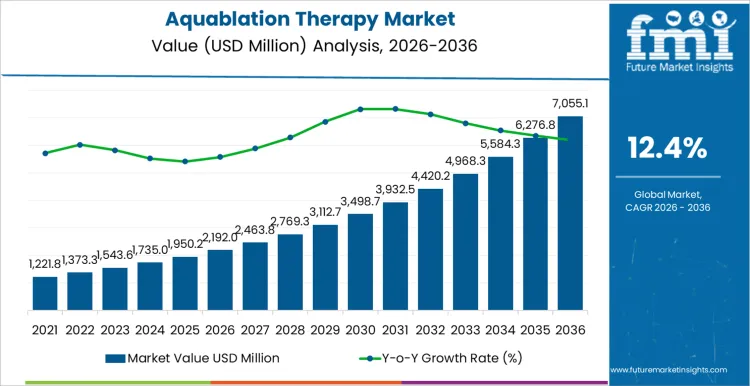
Aquablation Therapy Market Key Takeaways
| Metric | Value |
|---|---|
| Market Value (2026) | USD 2,192.0 million |
| Market Forecast Value (2036) | USD 7,055.1 million |
| Forecast CAGR 2026 to 2036 | 12.4% |
Why is the Demand for Automated Cage Handling Systems Growing?
Demand for automated cage handling systems is increasing as pharmaceutical companies, contract research organizations, and academic institutions expand laboratory animal research while facing intensifying biosafety, labor, and reproducibility requirements. Predictable operative times, shorter catheterization duration via ready to use intermittent catheters, and reduced retreatment variability support scheduling efficiency and bed utilization objectives. Automated cage handling systems reduce direct human interaction with soiled cages, standardize material flow between clean and dirty zones, and maintain consistent throughput across high-density research facilities. Vivarium managers and facility engineers prioritize automation to stabilize daily operations, protect staff health, and sustain uninterrupted research schedules under rising study volumes.
Growth is reinforced by regulatory oversight and scientific expectations surrounding animal welfare, study reproducibility, and environmental control. Automated systems enable predictable cage change intervals, controlled transfer conditions, and software-supported traceability that supports compliance with institutional animal care guidelines and audit requirements. Integration with cage washers, individually ventilated cage racks, and facility management software allows synchronized workflows that reduce cross-room traffic and environmental variability. As research protocols become more complex and facility layouts more compartmentalized, automation supports operational consistency across multi-room and high-barrier vivariums. These drivers are sustaining demand growth as facilities prioritize long-term efficiency, biosafety assurance, and compliance discipline rather than reliance on labor-intensive manual handling practices.
How Is the Aquablation Therapy Industry Segmented by System Components, Therapeutic Application, and End User?
Demand for aquablation therapy is shaped by preference for minimally invasive prostate procedures, emphasis on functional outcome preservation, and predictable procedural reproducibility. Adoption reflects rising incidence of benign prostatic enlargement, limitations of conventional resection techniques, and growing acceptance of image-guided robotic therapies. Healthcare providers evaluate procedural efficiency, learning curve, and perioperative safety. Utilization patterns vary across hospital and outpatient settings based on infrastructure readiness, procedural volumes, and reimbursement alignment, shaping segmentation across systems, applications, and care settings.
Why Do Aquablation Consoles Hold the Largest Share?
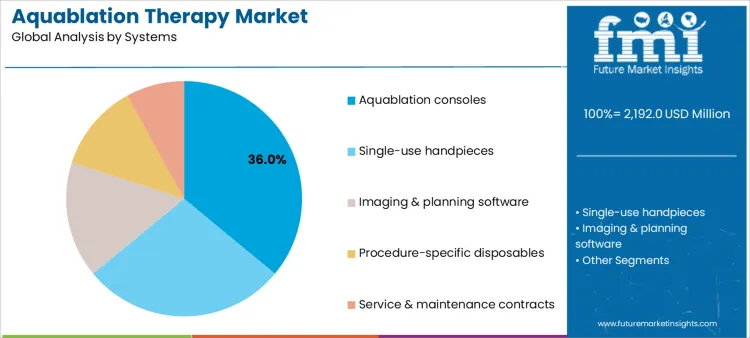
Aquablation consoles hold 36.0%, reflecting their role as the core capital equipment enabling robotic waterjet ablation and real-time imaging integration. These systems provide controlled tissue resection with consistent depth and precision, supporting standardized procedural execution. Single-use handpieces account for 28.0%, driven by procedure-linked consumption and infection control requirements. Imaging and planning software at 16.0% supports anatomical mapping and treatment planning accuracy. Procedure-specific disposables at 12.0% address sterile field requirements and workflow efficiency. Service and maintenance contracts at 8.0% ensure uptime, calibration, and long-term system performance. Component segmentation highlights emphasis on durable platforms supported by recurring consumables.
Key Points
- Consoles anchor procedural capability and standardization.
- Single-use components drive recurring utilization.
- Software supports planning accuracy and consistency.
How Do Therapeutic Applications Shape Aquablation Therapy Utilization?
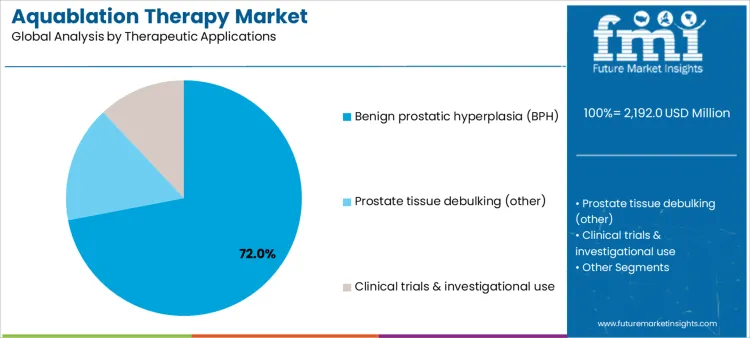
Benign prostatic hyperplasia accounts for 72.0%, reflecting primary clinical adoption for symptomatic prostate enlargement management. Aquablation is selected for its ability to remove tissue while preserving sexual and urinary function. Other prostate tissue debulking applications represent 16.0%, covering selected non-standard prostate interventions. Clinical trials and investigational use at 12.0% support evidence generation, technique refinement, and indication expansion. Application-based segmentation demonstrates concentration where clinical evidence, patient demand, and guideline inclusion support routine use, while investigational settings drive controlled adoption.
Key Points
- BPH treatment drives routine procedural demand.
- Non-standard debulking supports selective clinical use.
- Trials contribute to evidence development and refinement.
Which Care Settings Drive Aquablation Therapy Adoption?
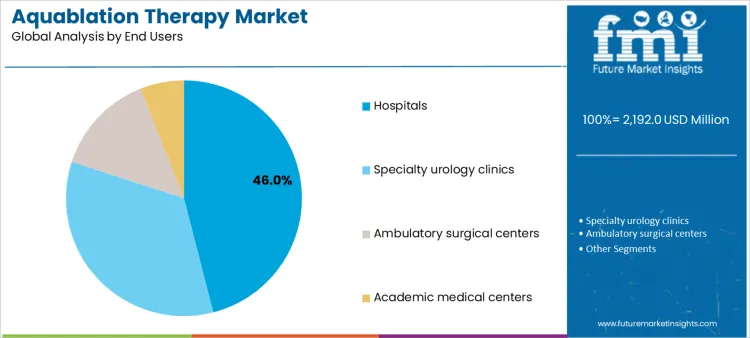
Hospitals account for 46.0%, reflecting availability of capital infrastructure, anesthesia support, and inpatient management capability. Specialty urology clinics at 34.0% apply aquablation within focused procedural practices emphasizing patient throughput and functional outcomes. Ambulatory surgical centers represent 14.0%, supporting same-day discharge models and selected patient profiles. Academic medical centers at 6.0% contribute through training, research, and protocol development. End-user segmentation shows adoption where procedural expertise, patient volume, and infrastructure alignment support effective aquablation delivery.
Key Points
- Hospitals lead due to infrastructure and case complexity.
- Specialty clinics emphasize focused urology care.
- ASCs support outpatient procedural pathways.
What are the Key Dynamics in the Aquablation Therapy Market?
Demand for aquablation therapy reflects procedural needs for precise, minimally invasive treatment of benign prostatic hyperplasia using image-guided tissue resection. Adoption concentrates in urology departments, surgical centers, and hospitals offering advanced endoscopic care. Global scope aligns with aging male populations and preference for symptom relief with reduced sexual side effects. Usage centers on robotic waterjet ablation systems combining real-time imaging and automated resection planning.
How do procedural precision requirements and functional outcome expectations shape adoption?
Benign prostatic hyperplasia treatment selection increasingly emphasizes symptom improvement while preserving continence and sexual function. Demand increases where traditional resection methods carry variability linked to operator technique. Aquablation uses high-velocity saline jets guided by real-time ultrasound to remove tissue with consistent depth and contour. Automated planning reduces dependence on surgeon manual resection skill, supporting reproducible outcomes across prostate sizes. Shorter learning curves attract centers expanding minimally invasive offerings. Reduced thermal injury supports favorable ejaculatory preservation compared with energy-based modalities. Operating room efficiency benefits from predictable procedure times. Adoption reflects clinical focus on standardized tissue removal with functional outcome preservation and procedural consistency.
How do capital investment, procedural integration, and evidence requirements influence market scalability?
Aquablation systems require dedicated capital equipment, disposables, and imaging integration, increasing upfront cost. Demand sensitivity rises where procedure volume is insufficient to justify investment. Operating room workflow adjustments and staff training affect implementation timelines. Patient selection remains focused on specific prostate anatomies, limiting universal applicability. Long-term comparative data versus established therapies influences payer coverage and guideline positioning. Consumable pricing affects per-case economics. Service support and system uptime expectations add procurement scrutiny. Scalability remains constrained by capital intensity, integration demands, and requirement for sustained clinical evidence supporting broad adoption across care settings.
How Is Demand for Aquablation Therapy Evolving Globally?
Demand for aquablation therapy is expanding globally as urology practices adopt image-guided, robot-assisted approaches for benign prostatic hyperplasia management. Consistent tissue resection, reduced thermal injury, and predictable outcomes support clinical acceptance. Training availability, capital equipment deployment, and reimbursement clarity shape adoption pace. Preference for minimally invasive procedures with shorter recovery periods strengthens utilization. Growth rates in India at 14.9%, Brazil at 14.4%, China at 14.0%, the USA at 10.8%, and Germany at 10.7% indicate sustained expansion driven by procedural modernization, patient throughput optimization, and technology diffusion rather than prostate disease incidence growth.
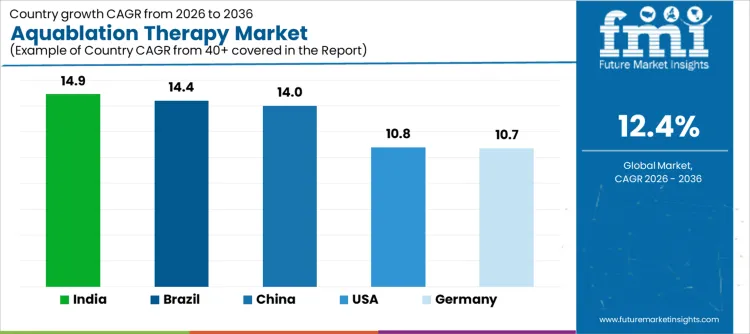
| Country | CAGR (%) |
|---|---|
| India | 14.9% |
| Brazil | 14.4% |
| China | 14.0% |
| USA | 10.8% |
| Germany | 10.7% |
What Is Driving Rapid Expansion of Aquablation Therapy Demand in India?
Aquablation therapy demand in India is growing at a CAGR of 14.9%, supported by rising adoption of advanced urology procedures in private hospitals. High patient volumes for benign prostatic hyperplasia increase interest in predictable, minimally invasive options. Robotic system installations expand across metropolitan tertiary centers. Shorter catheterization with foley catheter and recovery periods improve bed utilization efficiency. Urologist training programs improve procedural confidence and outcomes consistency. Growth reflects private sector technology investment, patient preference for minimally invasive care, and workflow efficiency priorities rather than expansion of public urology infrastructure.
- Expansion of private tertiary urology centers
- High benign prostatic hyperplasia case volumes
- Robotic system installations in metros
- Growing clinician training participation
Why Is Brazil Experiencing Strong Uptake of Aquablation Therapy?
Aquablation therapy demand in Brazil is expanding at a CAGR of 14.4%, driven by modernization of urology departments and procedural differentiation. Private hospitals introduce aquablation to address moderate to severe benign prostatic hyperplasia cases. Reduced learning curve compared to laser alternatives supports adoption. Patient demand for faster recovery influences procedure selection. Distributor-led training and service support facilitate deployment. Growth reflects competitive positioning among private providers and procedural efficiency goals rather than nationwide reimbursement expansion.
- Modernization of private urology departments
- Demand for faster postoperative recovery
- Lower learning curve versus alternatives
- Strong distributor-led clinical support
How Is China Sustaining Momentum in Aquablation Therapy Adoption?
Aquablation therapy demand in China is growing at a CAGR of 14.0%, aligned with large hospital systems adopting advanced urology technologies. High benign prostatic hyperplasia prevalence in aging populations increases procedural volumes. Tertiary hospitals integrate aquablation within minimally invasive surgery programs. Domestic policy support for advanced medical devices improves access. Centralized procurement enables multi-site deployment. Growth reflects scale-driven adoption, institutional investment, and standardized training rather than early-stage pilot use.
- Aging population increasing BPH procedures
- Integration into minimally invasive surgery programs
- Policy support for advanced device adoption
- Centralized hospital procurement models
What Factors Are Supporting Aquablation Therapy Demand in United States?
Aquablation therapy demand in the United States is expanding at a CAGR of 10.8%, supported by guideline inclusion and reimbursement coverage. Urology practices value consistent resection outcomes and reduced sexual side effects. Broad availability of robotic infrastructure supports deployment. Clinical evidence reinforces safety and efficacy perceptions. Replacement and system expansion across multisite groups sustain demand. Growth reflects evidence-based adoption, workflow optimization, and patient outcome priorities rather than expansion of procedural indications.
- Guideline recognition and reimbursement support
- Emphasis on functional outcome preservation
- Established robotic infrastructure availability
- Multisite urology group adoption
Why Is Germany Showing Steady Expansion in Aquablation Therapy?
Aquablation therapy demand in Germany is growing at a CAGR of 10.7%, shaped by structured adoption of minimally invasive urology technologies. Certified centers evaluate aquablation based on clinical outcomes and cost-effectiveness. Statutory insurance coverage supports appropriate utilization. Emphasis on training and protocol adherence guides deployment. Procurement discipline moderates rapid diffusion. Growth remains steady, reflecting evidence-based integration and health system governance rather than aggressive procedural expansion.
- Certified center-based technology evaluation
- Statutory insurance coverage for indications
- Strong emphasis on training and protocols
- Disciplined procurement decision processes
What is the competitive landscape for the aquablation therapy market globally?
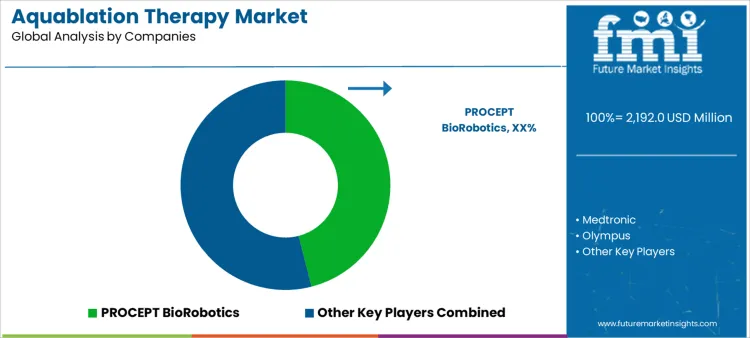
Demand for aquablation therapy is driven by benign prostatic hyperplasia prevalence, procedural efficiency goals, and interest in consistent surgical outcomes. Urologists evaluate resection precision, preservation of sexual function, learning curve length, operative time, and bleeding management. Buyer assessment includes capital equipment footprint, disposables economics, imaging guidance reliability, and compatibility with operating room workflows. Procurement behavior reflects hospital value analysis, training availability, service coverage, and reimbursement clarity. Trend in the aquablation therapy market shows increasing adoption among centers seeking reproducible outcomes independent of surgeon technique variability.
PROCEPT BioRobotics leads competitive positioning through a dedicated aquablation platform combining real-time imaging with robotically controlled waterjet resection. Medtronic competes by leveraging broad urology portfolios and relationships supporting alternative minimally invasive prostate therapies. Olympus supports demand with endoscopic visualization systems integrated into transurethral procedures across urology suites. Boston Scientific maintains relevance through established minimally invasive urology technologies and global hospital access. Karl Storz participates by supplying visualization and instrumentation enabling procedural adoption within modern operating rooms. Competitive differentiation centers on clinical outcome consistency, procedural standardization, training infrastructure, and lifecycle support strength.
Key Players in the Aquablation Therapy Market
- PROCEPT BioRobotics
- Medtronic
- Olympus
- Boston Scientific
- Karl Storz
- Others
Scope of the Report
| Items | Values |
|---|---|
| Quantitative Units | USD million |
| Systems | Aquablation consoles; Single-use handpieces; Imaging & planning software; Procedure-specific disposables; Service & maintenance contracts |
| Therapeutic Applications | Benign prostatic hyperplasia (BPH); Prostate tissue debulking (other); Clinical trials & investigational use |
| End Users | Hospitals; Specialty urology clinics; Ambulatory surgical centers; Academic medical centers |
| Regions Covered | Asia Pacific, Europe, North America, Latin America, Middle East & Africa |
| Countries Covered | India, Brazil, China, USA, Germany, and 40+ countries |
| Key Companies Profiled | PROCEPT BioRobotics; Medtronic; Olympus; Boston Scientific; Karl Storz; Others |
| Additional Attributes | Dollar sales by system component, therapeutic application, and end user; procedural precision and tissue resection consistency enabled by robotically controlled waterjet technology; integration of real-time imaging and planning software into urology workflows; single-use disposables driving recurring revenue streams; clinical adoption influenced by BPH treatment outcomes, procedure time, and learning curve; procurement dynamics shaped by hospital capital budgets, urology center specialization, and long-term service agreements. |
Aquablation Therapy Market by Segment
Systems:
- Aquablation consoles
- Single-use handpieces
- Imaging & planning software
- Procedure-specific disposables
- Service & maintenance contracts
Therapeutic Applications:
- Benign prostatic hyperplasia (BPH)
- Prostate tissue debulking (other)
- Clinical trials & investigational use
End Users:
- Hospitals
- Specialty urology clinics
- Ambulatory surgical centers
- Academic medical centers
Region:
- Asia Pacific
- China
- Japan
- South Korea
- India
- Australia & New Zealand
- ASEAN
- Rest of Asia Pacific
- Europe
- Germany
- United Kingdom
- France
- Italy
- Spain
- Nordic
- BENELUX
- Rest of Europe
- North America
- United States
- Canada
- Mexico
- Latin America
- Brazil
- Chile
- Rest of Latin America
- Middle East & Africa
- Kingdom of Saudi Arabia
- Other GCC Countries
- Turkey
- South Africa
- Other African Union
- Rest of Middle East & Africa
Bibliography
- European Association of Urology. (2023). EAU guidelines on the management of non-neurogenic male lower urinary tract symptoms, including benign prostatic obstruction. EAU Guidelines Office.
- International Organization for Standardization. (2023). ISO 14971: Medical devices—Application of risk management to medical devices. ISO.
- World Health Organization. (2023). WHO medical devices technical series: Evaluation of innovative minimally invasive surgical technologies. World Health Organization.
- European Commission. (2024). Regulation (EU) 2017/745 on medical devices (consolidated version, including amendments applicable to surgical and robotic devices). European Union.
- U.S. Food and Drug Administration. (2023). Computer-assisted surgical systems: Guidance for industry and Food and Drug Administration staff. U.S. Department of Health and Human Services.
- National Institute of Diabetes and Digestive and Kidney Diseases. (2023). Benign prostatic hyperplasia (BPH): Clinical management and treatment approaches. National Institutes of Health.
Frequently Asked Questions
How big is the aquablation therapy market in 2026?
The global aquablation therapy market is estimated to be valued at USD 2,192.0 million in 2026.
What will be the size of aquablation therapy market in 2036?
The market size for the aquablation therapy market is projected to reach USD 7,055.1 million by 2036.
How much will be the aquablation therapy market growth between 2026 and 2036?
The aquablation therapy market is expected to grow at a 12.4% CAGR between 2026 and 2036.
What are the key product types in the aquablation therapy market?
The key product types in aquablation therapy market are aquablation consoles, single-use handpieces, imaging & planning software, procedure-specific disposables and service & maintenance contracts.
Which therapeutic applications segment to contribute significant share in the aquablation therapy market in 2026?
In terms of therapeutic applications, benign prostatic hyperplasia (bph) segment to command 72.0% share in the aquablation therapy market in 2026.
Preview the report firsthand - request a free sample
Get SampleGet the brochure for pricing and purchase details.
Get PDFTable of Content
- Executive Summary
- Global Market Outlook
- Demand-side Trends
- Supply-side Trends
- Technology Roadmap Analysis
- Analysis and Recommendations
- Market Overview
- Market Coverage / Taxonomy
- Market Definition / Scope / Limitations
- Market Background
- Market Dynamics
- Drivers
- Restraints
- Opportunity
- Trends
- Scenario Forecast
- Demand in Optimistic Scenario
- Demand in Likely Scenario
- Demand in Conservative Scenario
- Opportunity Map Analysis
- Product Life Cycle Analysis
- Supply Chain Analysis
- Investment Feasibility Matrix
- Value Chain Analysis
- PESTLE and Porter’s Analysis
- Regulatory Landscape
- Regional Parent Market Outlook
- Production and Consumption Statistics
- Import and Export Statistics
- Market Dynamics
- Global Market Analysis 2021 to 2025 and Forecast, 2026 to 2036
- Historical Market Size Value (USD Million) Analysis, 2021 to 2025
- Current and Future Market Size Value (USD Million) Projections, 2026 to 2036
- Y-o-Y Growth Trend Analysis
- Absolute $ Opportunity Analysis
- Global Market Pricing Analysis 2021 to 2025 and Forecast 2026 to 2036
- Global Market Analysis 2021 to 2025 and Forecast 2026 to 2036, By Systems
- Introduction / Key Findings
- Historical Market Size Value (USD Million) Analysis By Systems , 2021 to 2025
- Current and Future Market Size Value (USD Million) Analysis and Forecast By Systems , 2026 to 2036
- Aquablation consoles
- Single-use handpieces
- Imaging & planning software
- Procedure-specific disposables
- Service & maintenance contracts
- Aquablation consoles
- Y-o-Y Growth Trend Analysis By Systems , 2021 to 2025
- Absolute $ Opportunity Analysis By Systems , 2026 to 2036
- Global Market Analysis 2021 to 2025 and Forecast 2026 to 2036, By Therapeutic Applications
- Introduction / Key Findings
- Historical Market Size Value (USD Million) Analysis By Therapeutic Applications, 2021 to 2025
- Current and Future Market Size Value (USD Million) Analysis and Forecast By Therapeutic Applications, 2026 to 2036
- Benign prostatic hyperplasia (BPH)
- Prostate tissue debulking (other)
- Clinical trials & investigational use
- Benign prostatic hyperplasia (BPH)
- Y-o-Y Growth Trend Analysis By Therapeutic Applications, 2021 to 2025
- Absolute $ Opportunity Analysis By Therapeutic Applications, 2026 to 2036
- Global Market Analysis 2021 to 2025 and Forecast 2026 to 2036, By End Users
- Introduction / Key Findings
- Historical Market Size Value (USD Million) Analysis By End Users, 2021 to 2025
- Current and Future Market Size Value (USD Million) Analysis and Forecast By End Users, 2026 to 2036
- Hospitals
- Specialty urology clinics
- Ambulatory surgical centers
- Academic medical centers
- Hospitals
- Y-o-Y Growth Trend Analysis By End Users, 2021 to 2025
- Absolute $ Opportunity Analysis By End Users, 2026 to 2036
- Global Market Analysis 2021 to 2025 and Forecast 2026 to 2036, By Region
- Introduction
- Historical Market Size Value (USD Million) Analysis By Region, 2021 to 2025
- Current Market Size Value (USD Million) Analysis and Forecast By Region, 2026 to 2036
- North America
- Latin America
- Western Europe
- Eastern Europe
- East Asia
- South Asia and Pacific
- Middle East & Africa
- Market Attractiveness Analysis By Region
- North America Market Analysis 2021 to 2025 and Forecast 2026 to 2036, By Country
- Historical Market Size Value (USD Million) Trend Analysis By Market Taxonomy, 2021 to 2025
- Market Size Value (USD Million) Forecast By Market Taxonomy, 2026 to 2036
- By Country
- USA
- Canada
- Mexico
- By Systems
- By Therapeutic Applications
- By End Users
- By Country
- Market Attractiveness Analysis
- By Country
- By Systems
- By Therapeutic Applications
- By End Users
- Key Takeaways
- Latin America Market Analysis 2021 to 2025 and Forecast 2026 to 2036, By Country
- Historical Market Size Value (USD Million) Trend Analysis By Market Taxonomy, 2021 to 2025
- Market Size Value (USD Million) Forecast By Market Taxonomy, 2026 to 2036
- By Country
- Brazil
- Chile
- Rest of Latin America
- By Systems
- By Therapeutic Applications
- By End Users
- By Country
- Market Attractiveness Analysis
- By Country
- By Systems
- By Therapeutic Applications
- By End Users
- Key Takeaways
- Western Europe Market Analysis 2021 to 2025 and Forecast 2026 to 2036, By Country
- Historical Market Size Value (USD Million) Trend Analysis By Market Taxonomy, 2021 to 2025
- Market Size Value (USD Million) Forecast By Market Taxonomy, 2026 to 2036
- By Country
- Germany
- UK
- Italy
- Spain
- France
- Nordic
- BENELUX
- Rest of Western Europe
- By Systems
- By Therapeutic Applications
- By End Users
- By Country
- Market Attractiveness Analysis
- By Country
- By Systems
- By Therapeutic Applications
- By End Users
- Key Takeaways
- Eastern Europe Market Analysis 2021 to 2025 and Forecast 2026 to 2036, By Country
- Historical Market Size Value (USD Million) Trend Analysis By Market Taxonomy, 2021 to 2025
- Market Size Value (USD Million) Forecast By Market Taxonomy, 2026 to 2036
- By Country
- Russia
- Poland
- Hungary
- Balkan & Baltic
- Rest of Eastern Europe
- By Systems
- By Therapeutic Applications
- By End Users
- By Country
- Market Attractiveness Analysis
- By Country
- By Systems
- By Therapeutic Applications
- By End Users
- Key Takeaways
- East Asia Market Analysis 2021 to 2025 and Forecast 2026 to 2036, By Country
- Historical Market Size Value (USD Million) Trend Analysis By Market Taxonomy, 2021 to 2025
- Market Size Value (USD Million) Forecast By Market Taxonomy, 2026 to 2036
- By Country
- China
- Japan
- South Korea
- By Systems
- By Therapeutic Applications
- By End Users
- By Country
- Market Attractiveness Analysis
- By Country
- By Systems
- By Therapeutic Applications
- By End Users
- Key Takeaways
- South Asia and Pacific Market Analysis 2021 to 2025 and Forecast 2026 to 2036, By Country
- Historical Market Size Value (USD Million) Trend Analysis By Market Taxonomy, 2021 to 2025
- Market Size Value (USD Million) Forecast By Market Taxonomy, 2026 to 2036
- By Country
- India
- ASEAN
- Australia & New Zealand
- Rest of South Asia and Pacific
- By Systems
- By Therapeutic Applications
- By End Users
- By Country
- Market Attractiveness Analysis
- By Country
- By Systems
- By Therapeutic Applications
- By End Users
- Key Takeaways
- Middle East & Africa Market Analysis 2021 to 2025 and Forecast 2026 to 2036, By Country
- Historical Market Size Value (USD Million) Trend Analysis By Market Taxonomy, 2021 to 2025
- Market Size Value (USD Million) Forecast By Market Taxonomy, 2026 to 2036
- By Country
- Kingdom of Saudi Arabia
- Other GCC Countries
- Turkiye
- South Africa
- Other African Union
- Rest of Middle East & Africa
- By Systems
- By Therapeutic Applications
- By End Users
- By Country
- Market Attractiveness Analysis
- By Country
- By Systems
- By Therapeutic Applications
- By End Users
- Key Takeaways
- Key Countries Market Analysis
- USA
- Pricing Analysis
- Market Share Analysis, 2025
- By Systems
- By Therapeutic Applications
- By End Users
- Canada
- Pricing Analysis
- Market Share Analysis, 2025
- By Systems
- By Therapeutic Applications
- By End Users
- Mexico
- Pricing Analysis
- Market Share Analysis, 2025
- By Systems
- By Therapeutic Applications
- By End Users
- Brazil
- Pricing Analysis
- Market Share Analysis, 2025
- By Systems
- By Therapeutic Applications
- By End Users
- Chile
- Pricing Analysis
- Market Share Analysis, 2025
- By Systems
- By Therapeutic Applications
- By End Users
- Germany
- Pricing Analysis
- Market Share Analysis, 2025
- By Systems
- By Therapeutic Applications
- By End Users
- UK
- Pricing Analysis
- Market Share Analysis, 2025
- By Systems
- By Therapeutic Applications
- By End Users
- Italy
- Pricing Analysis
- Market Share Analysis, 2025
- By Systems
- By Therapeutic Applications
- By End Users
- Spain
- Pricing Analysis
- Market Share Analysis, 2025
- By Systems
- By Therapeutic Applications
- By End Users
- France
- Pricing Analysis
- Market Share Analysis, 2025
- By Systems
- By Therapeutic Applications
- By End Users
- India
- Pricing Analysis
- Market Share Analysis, 2025
- By Systems
- By Therapeutic Applications
- By End Users
- ASEAN
- Pricing Analysis
- Market Share Analysis, 2025
- By Systems
- By Therapeutic Applications
- By End Users
- Australia & New Zealand
- Pricing Analysis
- Market Share Analysis, 2025
- By Systems
- By Therapeutic Applications
- By End Users
- China
- Pricing Analysis
- Market Share Analysis, 2025
- By Systems
- By Therapeutic Applications
- By End Users
- Japan
- Pricing Analysis
- Market Share Analysis, 2025
- By Systems
- By Therapeutic Applications
- By End Users
- South Korea
- Pricing Analysis
- Market Share Analysis, 2025
- By Systems
- By Therapeutic Applications
- By End Users
- Russia
- Pricing Analysis
- Market Share Analysis, 2025
- By Systems
- By Therapeutic Applications
- By End Users
- Poland
- Pricing Analysis
- Market Share Analysis, 2025
- By Systems
- By Therapeutic Applications
- By End Users
- Hungary
- Pricing Analysis
- Market Share Analysis, 2025
- By Systems
- By Therapeutic Applications
- By End Users
- Kingdom of Saudi Arabia
- Pricing Analysis
- Market Share Analysis, 2025
- By Systems
- By Therapeutic Applications
- By End Users
- Turkiye
- Pricing Analysis
- Market Share Analysis, 2025
- By Systems
- By Therapeutic Applications
- By End Users
- South Africa
- Pricing Analysis
- Market Share Analysis, 2025
- By Systems
- By Therapeutic Applications
- By End Users
- USA
- Market Structure Analysis
- Competition Dashboard
- Competition Benchmarking
- Market Share Analysis of Top Players
- By Regional
- By Systems
- By Therapeutic Applications
- By End Users
- Competition Analysis
- Competition Deep Dive
- PROCEPT BioRobotics
- Overview
- Product Portfolio
- Profitability by Market Segments (Product/Age /Sales Channel/Region)
- Sales Footprint
- Strategy Overview
- Marketing Strategy
- Product Strategy
- Channel Strategy
- Medtronic
- Olympus
- Boston Scientific
- Karl Storz
- Others
- PROCEPT BioRobotics
- Competition Deep Dive
- Assumptions & Acronyms Used
- Research Methodology


