

- Industry Size (2026)
- USD 566.8 Mn
- Forecast (2036)
- USD 1341.8 Mn
- CAGR (2026 to 2036)
- 9%
Water Vapor Ablation Market Forecast and Outlook 2026 to 2036
The water vapor ablation market is expected to grow from USD 566.8 million in 2026 to USD 1,341.8 million by 2036, reflecting a compound annual growth rate (CAGR) of 9%. Water vapor ablation is an innovative medical technique used primarily for the treatment of various cardiac conditions, such as atrial fibrillation, by using water vapor to ablate tissue. The market is driven by the increasing prevalence of atrial fibrillation and other related cardiovascular diseases, as well as the growing demand for minimally invasive procedures that offer faster recovery times and fewer complications.
The adoption of water vapor ablation technologies is also supported by the increasing preference for advanced and precise medical procedures, especially in the field of electrophysiology. The advancement of catheter-based technologies and improvements in the safety and efficacy of water vapor ablation will continue to drive market growth, particularly as healthcare systems prioritize more effective treatment options for heart-related conditions.
Quick Stats for Water Vapor Ablation Market
- Water Vapor Ablation Market Value (2026): USD 566.8 million
- Water Vapor Ablation Market Forecast Value (2036): USD 1,341.8 million
- Water Vapor Ablation Market Global Forecast CAGR (2026-2036): 9%
- Top Application by Share in Water Vapor Ablation Market: Benign Prostatic Hyperplasia (BPH) (55%)
- Key Growth Regions in Water Vapor Ablation Market: India, China, Brazil, USA, UK
- Top Players in Water Vapor Ablation Market: Francis Medical, Inc., Mara Water Vapor Ablation System, CooperSurgical, Inc., Medtronic Plc, Johnson & Johnson, Others
What is the Growth Forecast for the Water Vapor Ablation Market through 2036?
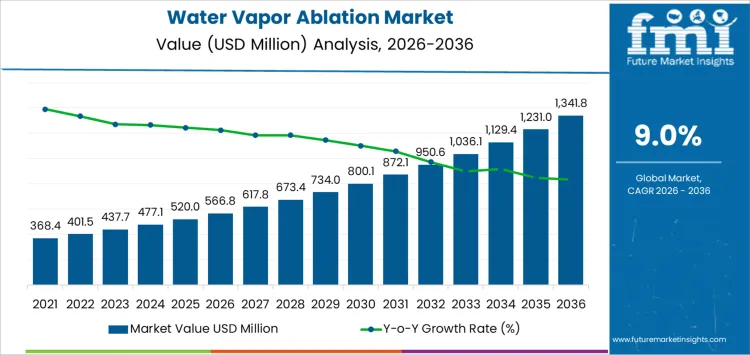
The acceleration and deceleration pattern for the water vapor ablation market shows steady growth with notable acceleration in the mid-forecast period. Starting at USD 566.8 million in 2026, the market grows to USD 617.8 million in 2027 and USD 673.4 million in 2028, reflecting early-stage adoption as hospitals and clinics begin integrating water vapor ablation technologies into their treatment options.
From 2028 to 2030, the market experiences a more pronounced acceleration, reaching USD 734 million in 2029 and USD 800.1 million in 2030. This acceleration is driven by expanding clinical evidence supporting the effectiveness of water vapor ablation in treating atrial fibrillation and the increasing demand for minimally invasive procedures. From 2030 to 2035, the market continues its upward trajectory, reaching USD 872.1 million in 2031, USD 950.6 million in 2032, and USD 1,036.1 million in 2033.
By 2035, the market is projected to reach USD 1,129.4 million, and by 2036, it is expected to reach USD 1,341.8 million. The acceleration and deceleration pattern reveals that while the market sees steady growth throughout the period, it experiences a noticeable acceleration in the middle years due to increasing awareness and acceptance of water vapor ablation procedures. The growth pattern suggests that the technology will continue to gain momentum, driven by positive clinical outcomes, improved procedure efficiency, and growing demand for minimally invasive treatment options.
Water Vapor Ablation Market Key Takeaways
| Metric | Value |
|---|---|
| Industry Sales Value (2026) | USD 566.8 million |
| Industry Forecast Value (2036) | USD 1,341.8 million |
| Industry Forecast CAGR (2026-2036) | 9% |
What Is Driving the Demand for the Water Vapor Ablation Market Globally?
The global demand for water vapor ablation technologies is driven by increasing adoption of minimally invasive surgical procedures and growing focus on improved clinical outcomes. Water vapor ablation uses steam or heated water vapor to target and remove soft tissue with controlled thermal energy, and it has been applied in areas such as treatment of benign prostatic hyperplasia (BPH), endometrial ablation, and certain soft tissue therapies. Clinicians and healthcare facilities are seeking alternatives to traditional surgical methods that involve cutting or excision because water vapor ablation can reduce bleeding, lower infection risk, and shorten recovery times. Rising prevalence of conditions like BPH, heavy menstrual bleeding, and other benign soft tissue disorders has contributed to procedure volumes where ablation is an option. Advances in device design, imaging guidance, and procedural workflows have made water vapor ablation more accessible and reliable, which supports uptake in urology, gynecology, and related clinical specialties. Hospital systems and outpatient surgical centres adopting minimally invasive interventions that enhance throughput and patient comfort further reinforce demand.
Future demand for water vapor ablation technologies is expected to grow as evidence of clinical benefit, long term outcomes, and cost effectiveness accumulates. Expansion of applications beyond current indications may drive additional adoption, especially if research demonstrates efficacy in other soft tissue conditions. Improvements in real time monitoring, device precision, and integration with imaging could broaden procedural utility and clinician confidence. Demand will also be influenced by demographic trends such as ageing populations in many regions, which correlate with higher incidence of conditions treatable by ablation. Reimbursement policies and healthcare funding models that recognise value of minimally invasive procedures may further encourage use. Continued training and education for clinicians on best practices and outcomes will shape how widely water vapor ablation is integrated into standard care pathways. As healthcare systems prioritise approaches that reduce hospital stays and postoperative complications while maintaining efficacy, water vapor ablation technologies are likely to see steady growth worldwide.
What Are the Key Segments in Water Vapor Ablation Market?
The water vapor ablation market is segmented by device type and application. Single-use ablation probes lead the device type segment with 42% of the market share, offering a convenient, one-time use solution for water vapor ablation procedures. Benign prostatic hyperplasia (BPH) dominates the application segment with 55%, reflecting the high demand for minimally invasive treatments for prostate enlargement. The market is expanding as water vapor ablation techniques gain popularity for their precision, minimal side effects, and effectiveness in treating a range of conditions.
Which Device Type Drives Water Vapor Ablation Market Demand Globally?
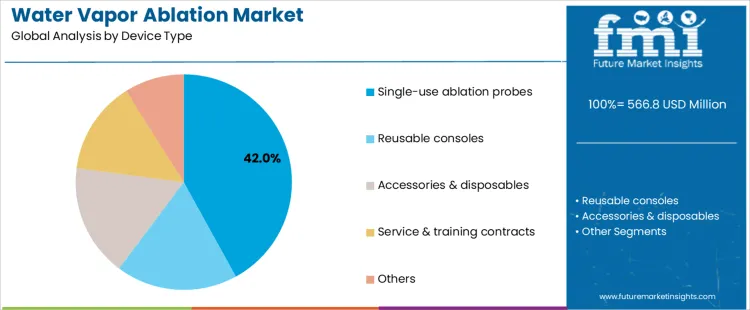
Single-use ablation probes account for 42% of the market share. These devices are designed for single-use procedures, ensuring high standards of hygiene, precision, and safety during water vapor ablation treatments. Single-use probes are preferred for their convenience and ability to minimize cross-contamination risks, especially in high-demand clinical environments. The rising preference for minimally invasive treatments in various medical specialties, including urology and gynecology, drives the demand for single-use devices. These probes are particularly effective for procedures targeting soft tissues, such as the prostate or uterine lining, providing high patient safety and optimal treatment outcomes. As medical facilities seek cost-effective, efficient, and sterile options for ablation procedures, the adoption of single-use ablation probes continues to grow, positioning them as the dominant device type in the market.
Which Application Drives Water Vapor Ablation Market Demand Globally?
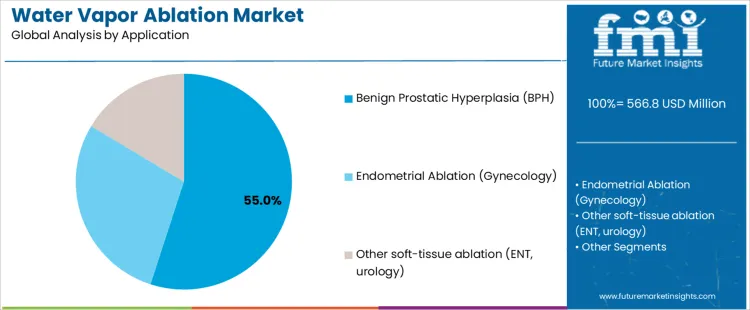
Benign prostatic hyperplasia (BPH) leads the application segment with 55% of the market share. BPH, a common condition in aging men, causes an enlarged prostate that can obstruct urine flow, leading to discomfort and other urinary symptoms. Water vapor ablation is an effective, minimally invasive solution for BPH, offering a reduced risk of complications compared to traditional surgical options. As the global aging population increases, the demand for effective treatments for BPH is expected to rise, driving the market for water vapor ablation devices. The appeal of water vapor ablation lies in its ability to deliver targeted, precise treatment with less recovery time and fewer side effects. While other applications such as endometrial ablation (gynecology) and soft-tissue ablation (ENT, urology) also contribute to market growth, BPH remains the dominant application due to its high prevalence and the continued preference for minimally invasive, outpatient treatments for prostate enlargement.
What are the Key Dynamics of the Global Water Vapor Ablation Market?
The global water vapor ablation market is growing as healthcare providers adopt minimally invasive energy based therapies that use controlled steam energy to ablate tissue. Water vapor ablation is applied in urology, oncology, gynecology and ENT procedures where targeted tissue removal is needed with reduced healing times. It offers an alternative to traditional surgical methods, with potential for fewer complications and improved patient comfort. Expansion of ambulatory care, rising preference for outpatient procedures and investment in advanced medical technology contribute to broader adoption in hospitals and specialised clinics worldwide.
What are the Key Drivers for the Global Water Vapor Ablation Market?
Rising demand for minimally invasive treatments that reduce patient recovery time is a primary driver of this market. Water vapor ablation systems can precisely target tissue while limiting collateral damage, making them attractive to clinicians and patients. Growth in chronic conditions such as benign prostatic hyperplasia, uterine fibroids and certain soft tissue lesions increases clinical use of ablation therapies. Technological advancements in device design, imaging integration and treatment planning improve outcomes and support procedural adoption. Expansion of healthcare infrastructure in emerging markets and increasing reimbursement coverage for advanced procedures also encourage hospitals and clinics to invest in water vapor ablation technologies.
What are the Restraints for the Global Water Vapor Ablation Market?
One restraint is the high cost of acquiring specialised ablation systems, which may limit uptake in smaller practices or regions with constrained healthcare budgets. Training requirements and the learning curve associated with new procedural techniques can slow adoption among clinicians who are experienced with traditional surgical methods. Variation in clinical evidence and standardisation of protocols across indications may influence clinician confidence and payer coverage. Regulatory approval processes differ by country and require robust clinical data, which can extend timelines before new applications are available. Limited long term outcome studies in some indications also affect decision making by providers and patients.
What is the Key Trends in the Global Water Vapor Ablation Market?
A key trend is integration of water vapor ablation with advanced imaging and navigation systems to enhance precision and real time treatment monitoring. Developers are focusing on devices that support adaptive protocols based on tissue characteristics and patient anatomy. Expansion of indications beyond core uses, such as exploring benign tumour management and soft tissue applications, reflects interest in broadening clinical utility. Collaboration between manufacturers and healthcare systems aims to establish training programs that improve procedural consistency and outcomes. Data collection from real world use is being used to refine practice patterns and demonstrate value to payers and providers, supporting wider adoption.
What is the Country-Wise Outlook for the Water Vapor Ablation Market?
The Water Vapor Ablation market is experiencing steady growth, driven by increasing demand for advanced medical technologies, particularly in the field of cardiac and neurological interventions. Water vapor ablation, an innovative technique used for tissue treatment, offers a non-invasive alternative to traditional surgical methods, delivering precision and reducing recovery time for patients. Countries such as India, China, and Brazil are witnessing significant market growth, propelled by an expanding healthcare sector, growing adoption of minimally invasive procedures, and advancements in medical technology. In more developed markets like the USA and the UK, the market growth is supported by increasing awareness about the benefits of non-invasive treatments and a growing focus on improving patient outcomes. As the demand for advanced therapeutic procedures rises and medical facilities adopt more cutting-edge technologies, the Water Vapor Ablation market is expected to see substantial growth globally, with the most significant advances taking place in emerging markets.
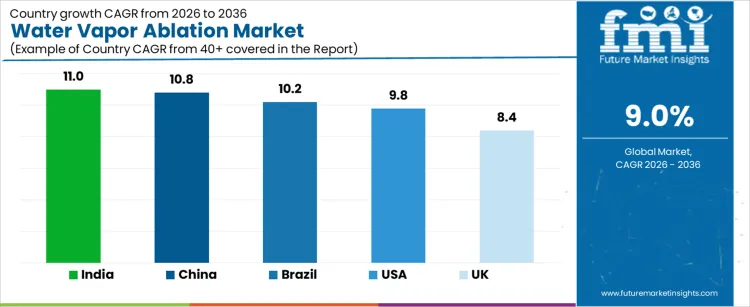
| Country | CAGR (2026–2036) |
|---|---|
| India | 11% |
| China | 10.8% |
| Brazil | 10.2% |
| USA | 9.8% |
| UK | 8.4% |
What is Driving the Growth of the Water Vapor Ablation Market in India?
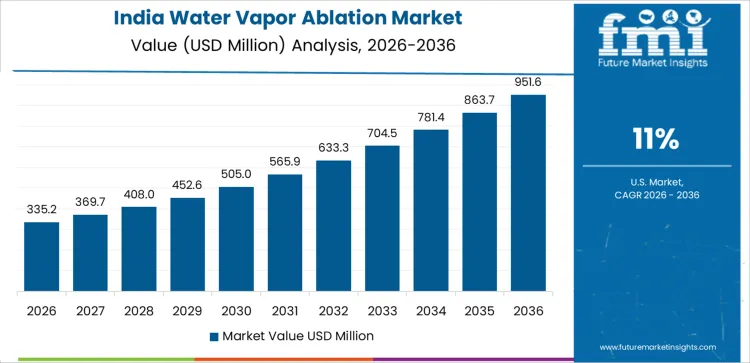
India’s Water Vapor Ablation market is projected to grow at a CAGR of 11%. The increasing prevalence of cardiovascular and neurological diseases, coupled with the rising demand for minimally invasive treatment options, is driving market growth in India. Water vapor ablation is gaining popularity due to its precision and ability to target specific tissues, offering a non-invasive alternative to traditional surgeries. The Indian healthcare sector is rapidly evolving, with hospitals and medical facilities increasingly adopting advanced medical technologies to improve patient care. With the expansion of the healthcare infrastructure, growing awareness about new medical treatments, and rising disposable incomes, the demand for water vapor ablation procedures is expected to continue its upward trajectory. Additionally, government initiatives to promote health technology adoption and the increasing focus on improving healthcare outcomes further fuel the growth of the market in India.
What is Contributing to the Growth of the Water Vapor Ablation Market in China?
China’s Water Vapor Ablation market is expected to grow at a CAGR of 10.8%. The country’s rapidly developing healthcare infrastructure, coupled with a large population and a rising burden of chronic diseases, is driving the demand for more advanced treatment methods, including water vapor ablation. This technology is gaining traction due to its ability to provide a precise, minimally invasive solution for various medical conditions, particularly in the fields of cardiology and neurology. The growing preference for non-invasive procedures that reduce recovery time and improve patient outcomes is also contributing to the market’s growth. Additionally, China’s investments in healthcare modernization, increasing focus on improving healthcare accessibility, and rising awareness about the benefits of advanced medical treatments are expected to further boost the adoption of water vapor ablation technologies in the coming years.
What is Driving the Water Vapor Ablation Market Growth in Brazil?
Brazil’s Water Vapor Ablation market is projected to grow at a CAGR of 10.2%. The increasing prevalence of cardiovascular diseases and neurological disorders, combined with a rising demand for minimally invasive treatment options, is driving the adoption of water vapor ablation in Brazil. The technique’s ability to provide effective treatment with reduced risk and recovery time is appealing to both medical practitioners and patients. Brazil’s growing healthcare sector, with its expanding network of modern hospitals and medical centers, is further supporting the market’s expansion. The increasing awareness about the benefits of advanced medical procedures and the demand for improved patient outcomes in Brazil are expected to continue driving the adoption of water vapor ablation technologies. Moreover, government initiatives to improve the accessibility of healthcare and the increasing investments in medical technology are likely to contribute to further market growth.
What is Influencing the Growth of the Water Vapor Ablation Market in the USA?
The USA’s Water Vapor Ablation market is projected to grow at a CAGR of 9.8%. The adoption of minimally invasive treatments, particularly in cardiology and neurology, is a key driver of the market in the USA. Water vapor ablation’s ability to target tissue with precision, while reducing the need for extensive surgery and minimizing recovery time, is making it a preferred treatment option. Additionally, the growing demand for advanced, non-invasive therapies in the USA, coupled with a strong focus on improving patient care and outcomes, is contributing to the market’s growth. The USA’s well-established healthcare infrastructure and technological innovation in the medical field are also factors driving the adoption of water vapor ablation technologies. As patients and healthcare providers continue to prioritize minimally invasive procedures, the demand for water vapor ablation solutions is expected to increase, further driving the market’s expansion.
What is Contributing to the Growth of the Water Vapor Ablation Market in the UK?
The UK’s Water Vapor Ablation market is expected to grow at a CAGR of 8.4%. The growing focus on reducing the burden of chronic diseases such as cardiovascular and neurological conditions, combined with increasing patient demand for non-invasive treatment options, is driving the adoption of water vapor ablation technologies in the UK. The technique’s ability to offer effective treatment with fewer complications and faster recovery times is gaining popularity among healthcare providers. Additionally, the UK’s strong healthcare system and ongoing investments in advanced medical technologies are further contributing to the market’s growth. As the demand for minimally invasive treatments continues to rise, water vapor ablation is likely to play an increasingly important role in the UK’s healthcare landscape. The market’s growth will be further supported by efforts to improve patient care, reduce healthcare costs, and enhance treatment outcomes in the region.
What is the Competitive Landscape for the Water Vapor Ablation Market?
Demand for water vapor ablation technology in gynecologic care is rising as clinicians and healthcare systems seek minimally invasive solutions for the treatment of conditions such as abnormal uterine bleeding and fibroid related symptoms. Water vapor ablation uses heated steam to target and ablate endometrial tissue with precision, offering shorter procedure times, reduced pain and faster recovery compared with some traditional surgical options. Rising awareness of patient preference for outpatient and hysteroscopic free procedures, aging populations in major healthcare markets and a shift toward value based care models that emphasise improved quality with lower overall cost drive broader adoption. Hospitals and specialty clinics in North America, Europe and Asia Pacific are increasingly incorporating water vapor ablation into care pathways as evidence grows for its effectiveness and as reimbursement frameworks evolve to support advanced, patient centric therapies.
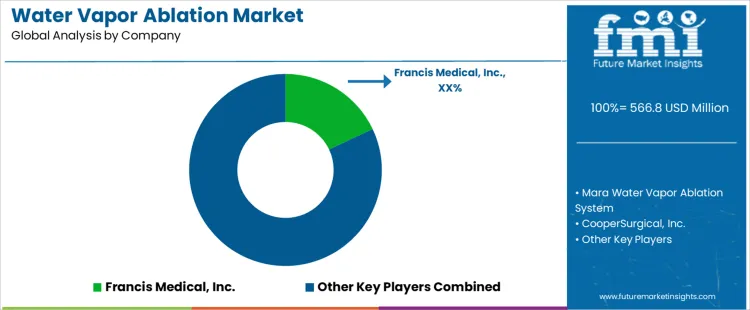
Francis Medical, Inc. is recognised as a leading player in the water vapor ablation market, with its technology widely used by clinicians seeking water based energy solutions. A notable system in this segment is the Mara Water Vapor Ablation System, which competes by focusing on ease of use, patient comfort and clinical outcomes. Other major competitors include large medical device firms such as CooperSurgical, Inc., Medtronic Plc and Johnson & Johnson, which bring broad portfolios of women’s health products and significant commercial reach. These companies and a set of others in the competitive landscape focus on product reliability, ease of integration into existing clinical workflows, clinician training and service support. Competition centers on clinical evidence, procedural efficiency, device safety and cost effectiveness. Firms that combine proven clinical performance with strong provider education and distribution networks are best positioned to capture growth as adoption of water vapor ablation technology increases in global women’s health markets.
Key Players of the Water Vapor Ablation Market
- Francis Medical, Inc.
- Mara Water Vapor Ablation System
- CooperSurgical, Inc.
- Medtronic Plc
- Johnson & Johnson
- Others
Scope of the Report
| Items | Values |
|---|---|
| Quantitative Units (2026) | USD Million |
| Device Type | Single-Use Ablation Probes, Reusable Consoles, Accessories & Disposables, Service & Training Contracts, Others |
| Application | Benign Prostatic Hyperplasia (BPH), Endometrial Ablation (Gynecology), Other Soft-Tissue Ablation (ENT, Urology) |
| End User | Hospitals & ORs, Urology Clinics/Specialty Clinics, Gynecology & Women's Health Clinics, Ambulatory Surgery Centers (ASCs), Distributors/OEM Channels, Others |
| Companies | Francis Medical, Inc., Mara Water Vapor Ablation System, CooperSurgical, Inc., Medtronic Plc, Johnson & Johnson, Others |
| Regions Covered | North America, Latin America, Western Europe, Eastern Europe, South Asia and Pacific, East Asia, Middle East & Africa |
| Countries Covered | United States, Canada, Mexico, Brazil, Argentina, Germany, France, United Kingdom, Italy, Spain, Netherlands, China, India, Japan, South Korea, ANZ, GCC Countries, South Africa |
| Additional Attributes | Dollar by sales by device type, application, end-user, and region. Includes market trends in water vapor ablation devices, performance in benign prostatic hyperplasia, gynecology, and other soft-tissue ablation applications, cost-effectiveness, sustainability practices, regulatory compliance, market share and competitive positioning of key companies, and the role of water vapor ablation technology in improving clinical outcomes, reducing recovery times, and enhancing patient comfort in minimally invasive procedures across various healthcare settings. |
Water Vapor Ablation Market Segmentation
Device Type
- Single-use ablation probes
- Reusable consoles
- Accessories & disposables
- Service & training contracts
- Others
Application
- Benign Prostatic Hyperplasia (BPH)
- Endometrial Ablation (Gynecology)
- Other soft-tissue ablation (ENT, urology)
End User
- Hospitals & ORs
- Urology clinics / Specialty clinics
- Gynecology & Women's health clinics
- Ambulatory Surgery Centers (ASCs)
- Distributors / OEM channels
- Others
Region
- Asia Pacific
- China
- Japan
- South Korea
- India
- Australia & New Zealand
- ASEAN
- Rest of Asia Pacific
- Europe
- Germany
- United Kingdom
- France
- Italy
- Spain
- Nordic
- BENELUX
- Rest of Europe
- North America
- United States
- Canada
- Mexico
- Latin America
- Brazil
- Chile
- Rest of Latin America
- Middle East & Africa
- Kingdom of Saudi Arabia
- Other GCC Countries
- Turkey
- South Africa
- Other African Union
- Rest of Middle East & Africa
Frequently Asked Questions
How big is the water vapor ablation market in 2026?
The global water vapor ablation market is estimated to be valued at USD 566.8 million in 2026.
What will be the size of water vapor ablation market in 2036?
The market size for the water vapor ablation market is projected to reach USD 1,341.8 million by 2036.
How much will be the water vapor ablation market growth between 2026 and 2036?
The water vapor ablation market is expected to grow at a 9.0% CAGR between 2026 and 2036.
What are the key product types in the water vapor ablation market?
The key product types in water vapor ablation market are single-use ablation probes, reusable consoles, accessories & disposables, service & training contracts and others.
Which application segment to contribute significant share in the water vapor ablation market in 2026?
In terms of application, benign prostatic hyperplasia (bph) segment to command 55.0% share in the water vapor ablation market in 2026.
Preview the report firsthand - request a free sample
Get SampleGet the brochure for pricing and purchase details.
Get PDFTable of Content
- Executive Summary
- Global Market Outlook
- Demand-side Trends
- Supply-side Trends
- Technology Roadmap Analysis
- Analysis and Recommendations
- Market Overview
- Market Coverage / Taxonomy
- Market Definition / Scope / Limitations
- Market Background
- Market Dynamics
- Drivers
- Restraints
- Opportunity
- Trends
- Scenario Forecast
- Demand in Optimistic Scenario
- Demand in Likely Scenario
- Demand in Conservative Scenario
- Opportunity Map Analysis
- Product Life Cycle Analysis
- Supply Chain Analysis
- Investment Feasibility Matrix
- Value Chain Analysis
- PESTLE and Porter’s Analysis
- Regulatory Landscape
- Regional Parent Market Outlook
- Production and Consumption Statistics
- Import and Export Statistics
- Market Dynamics
- Global Market Analysis 2021 to 2025 and Forecast, 2026 to 2036
- Historical Market Size Value (USD Million) Analysis, 2021 to 2025
- Current and Future Market Size Value (USD Million) Projections, 2026 to 2036
- Y-o-Y Growth Trend Analysis
- Absolute $ Opportunity Analysis
- Global Market Pricing Analysis 2021 to 2025 and Forecast 2026 to 2036
- Global Market Analysis 2021 to 2025 and Forecast 2026 to 2036, By Device Type
- Introduction / Key Findings
- Historical Market Size Value (USD Million) Analysis By Device Type , 2021 to 2025
- Current and Future Market Size Value (USD Million) Analysis and Forecast By Device Type , 2026 to 2036
- Single-use ablation probes
- Reusable consoles
- Accessories & disposables
- Service & training contracts
- Others
- Y-o-Y Growth Trend Analysis By Device Type , 2021 to 2025
- Absolute $ Opportunity Analysis By Device Type , 2026 to 2036
- Global Market Analysis 2021 to 2025 and Forecast 2026 to 2036, By Application
- Introduction / Key Findings
- Historical Market Size Value (USD Million) Analysis By Application, 2021 to 2025
- Current and Future Market Size Value (USD Million) Analysis and Forecast By Application, 2026 to 2036
- Benign Prostatic Hyperplasia (BPH)
- Endometrial Ablation (Gynecology)
- Other soft-tissue ablation (ENT, urology)
- Y-o-Y Growth Trend Analysis By Application, 2021 to 2025
- Absolute $ Opportunity Analysis By Application, 2026 to 2036
- Global Market Analysis 2021 to 2025 and Forecast 2026 to 2036, By End User
- Introduction / Key Findings
- Historical Market Size Value (USD Million) Analysis By End User, 2021 to 2025
- Current and Future Market Size Value (USD Million) Analysis and Forecast By End User, 2026 to 2036
- Hospitals & ORs
- Urology clinics / Specialty clinics
- Gynecology & Women's health clinics
- Ambulatory Surgery Centers (ASCs)
- Distributors / OEM channels
- Others
- Y-o-Y Growth Trend Analysis By End User, 2021 to 2025
- Absolute $ Opportunity Analysis By End User, 2026 to 2036
- Global Market Analysis 2021 to 2025 and Forecast 2026 to 2036, By Region
- Introduction
- Historical Market Size Value (USD Million) Analysis By Region, 2021 to 2025
- Current Market Size Value (USD Million) Analysis and Forecast By Region, 2026 to 2036
- North America
- Latin America
- Western Europe
- Eastern Europe
- East Asia
- South Asia and Pacific
- Middle East & Africa
- Market Attractiveness Analysis By Region
- North America Market Analysis 2021 to 2025 and Forecast 2026 to 2036, By Country
- Historical Market Size Value (USD Million) Trend Analysis By Market Taxonomy, 2021 to 2025
- Market Size Value (USD Million) Forecast By Market Taxonomy, 2026 to 2036
- By Country
- USA
- Canada
- Mexico
- By Device Type
- By Application
- By End User
- By Country
- Market Attractiveness Analysis
- By Country
- By Device Type
- By Application
- By End User
- Key Takeaways
- Latin America Market Analysis 2021 to 2025 and Forecast 2026 to 2036, By Country
- Historical Market Size Value (USD Million) Trend Analysis By Market Taxonomy, 2021 to 2025
- Market Size Value (USD Million) Forecast By Market Taxonomy, 2026 to 2036
- By Country
- Brazil
- Chile
- Rest of Latin America
- By Device Type
- By Application
- By End User
- By Country
- Market Attractiveness Analysis
- By Country
- By Device Type
- By Application
- By End User
- Key Takeaways
- Western Europe Market Analysis 2021 to 2025 and Forecast 2026 to 2036, By Country
- Historical Market Size Value (USD Million) Trend Analysis By Market Taxonomy, 2021 to 2025
- Market Size Value (USD Million) Forecast By Market Taxonomy, 2026 to 2036
- By Country
- Germany
- UK
- Italy
- Spain
- France
- Nordic
- BENELUX
- Rest of Western Europe
- By Device Type
- By Application
- By End User
- By Country
- Market Attractiveness Analysis
- By Country
- By Device Type
- By Application
- By End User
- Key Takeaways
- Eastern Europe Market Analysis 2021 to 2025 and Forecast 2026 to 2036, By Country
- Historical Market Size Value (USD Million) Trend Analysis By Market Taxonomy, 2021 to 2025
- Market Size Value (USD Million) Forecast By Market Taxonomy, 2026 to 2036
- By Country
- Russia
- Poland
- Hungary
- Balkan & Baltic
- Rest of Eastern Europe
- By Device Type
- By Application
- By End User
- By Country
- Market Attractiveness Analysis
- By Country
- By Device Type
- By Application
- By End User
- Key Takeaways
- East Asia Market Analysis 2021 to 2025 and Forecast 2026 to 2036, By Country
- Historical Market Size Value (USD Million) Trend Analysis By Market Taxonomy, 2021 to 2025
- Market Size Value (USD Million) Forecast By Market Taxonomy, 2026 to 2036
- By Country
- China
- Japan
- South Korea
- By Device Type
- By Application
- By End User
- By Country
- Market Attractiveness Analysis
- By Country
- By Device Type
- By Application
- By End User
- Key Takeaways
- South Asia and Pacific Market Analysis 2021 to 2025 and Forecast 2026 to 2036, By Country
- Historical Market Size Value (USD Million) Trend Analysis By Market Taxonomy, 2021 to 2025
- Market Size Value (USD Million) Forecast By Market Taxonomy, 2026 to 2036
- By Country
- India
- ASEAN
- Australia & New Zealand
- Rest of South Asia and Pacific
- By Device Type
- By Application
- By End User
- By Country
- Market Attractiveness Analysis
- By Country
- By Device Type
- By Application
- By End User
- Key Takeaways
- Middle East & Africa Market Analysis 2021 to 2025 and Forecast 2026 to 2036, By Country
- Historical Market Size Value (USD Million) Trend Analysis By Market Taxonomy, 2021 to 2025
- Market Size Value (USD Million) Forecast By Market Taxonomy, 2026 to 2036
- By Country
- Kingdom of Saudi Arabia
- Other GCC Countries
- Turkiye
- South Africa
- Other African Union
- Rest of Middle East & Africa
- By Device Type
- By Application
- By End User
- By Country
- Market Attractiveness Analysis
- By Country
- By Device Type
- By Application
- By End User
- Key Takeaways
- Key Countries Market Analysis
- USA
- Pricing Analysis
- Market Share Analysis, 2025
- By Device Type
- By Application
- By End User
- Canada
- Pricing Analysis
- Market Share Analysis, 2025
- By Device Type
- By Application
- By End User
- Mexico
- Pricing Analysis
- Market Share Analysis, 2025
- By Device Type
- By Application
- By End User
- Brazil
- Pricing Analysis
- Market Share Analysis, 2025
- By Device Type
- By Application
- By End User
- Chile
- Pricing Analysis
- Market Share Analysis, 2025
- By Device Type
- By Application
- By End User
- Germany
- Pricing Analysis
- Market Share Analysis, 2025
- By Device Type
- By Application
- By End User
- UK
- Pricing Analysis
- Market Share Analysis, 2025
- By Device Type
- By Application
- By End User
- Italy
- Pricing Analysis
- Market Share Analysis, 2025
- By Device Type
- By Application
- By End User
- Spain
- Pricing Analysis
- Market Share Analysis, 2025
- By Device Type
- By Application
- By End User
- France
- Pricing Analysis
- Market Share Analysis, 2025
- By Device Type
- By Application
- By End User
- India
- Pricing Analysis
- Market Share Analysis, 2025
- By Device Type
- By Application
- By End User
- ASEAN
- Pricing Analysis
- Market Share Analysis, 2025
- By Device Type
- By Application
- By End User
- Australia & New Zealand
- Pricing Analysis
- Market Share Analysis, 2025
- By Device Type
- By Application
- By End User
- China
- Pricing Analysis
- Market Share Analysis, 2025
- By Device Type
- By Application
- By End User
- Japan
- Pricing Analysis
- Market Share Analysis, 2025
- By Device Type
- By Application
- By End User
- South Korea
- Pricing Analysis
- Market Share Analysis, 2025
- By Device Type
- By Application
- By End User
- Russia
- Pricing Analysis
- Market Share Analysis, 2025
- By Device Type
- By Application
- By End User
- Poland
- Pricing Analysis
- Market Share Analysis, 2025
- By Device Type
- By Application
- By End User
- Hungary
- Pricing Analysis
- Market Share Analysis, 2025
- By Device Type
- By Application
- By End User
- Kingdom of Saudi Arabia
- Pricing Analysis
- Market Share Analysis, 2025
- By Device Type
- By Application
- By End User
- Turkiye
- Pricing Analysis
- Market Share Analysis, 2025
- By Device Type
- By Application
- By End User
- South Africa
- Pricing Analysis
- Market Share Analysis, 2025
- By Device Type
- By Application
- By End User
- USA
- Market Structure Analysis
- Competition Dashboard
- Competition Benchmarking
- Market Share Analysis of Top Players
- By Regional
- By Device Type
- By Application
- By End User
- Competition Analysis
- Competition Deep Dive
- Francis Medical, Inc.
- Overview
- Product Portfolio
- Profitability by Market Segments (Product/Age /Sales Channel/Region)
- Sales Footprint
- Strategy Overview
- Marketing Strategy
- Product Strategy
- Channel Strategy
- Mara Water Vapor Ablation System
- CooperSurgical, Inc.
- Medtronic Plc
- Johnson & Johnson
- Others
- Francis Medical, Inc.
- Competition Deep Dive
- Assumptions & Acronyms Used
- Research Methodology


