

- Market Size (2026)
- USD 2208.9 Mn
- Forecast (2036)
- USD 4724.9 Mn
- CAGR (2026 to 2036)
- 7.9%
Foley Catheter Market size, market forecast and outlook By FMI
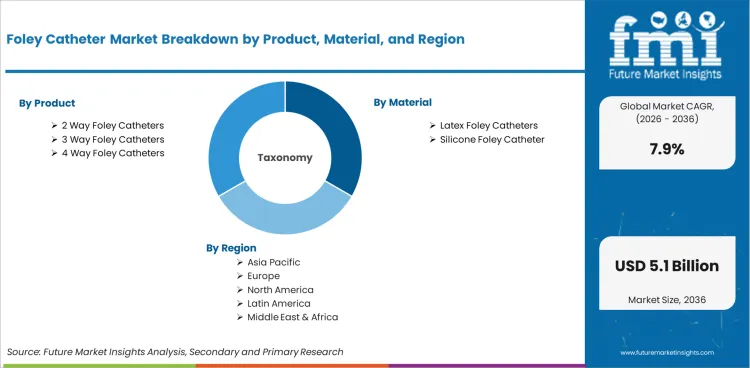
In 2026, the foley catheter market was valued at USD 2,208.9 million. Based on Future Market Insights analysis, demand for foley catheters is estimated to grow to USD 4,724.9 million by 2036. FMI projects a CAGR of 7.9% during the forecast period.
Summary of Foley Catheter Market
- Foley Catheter Market Definition
- The industry covers indwelling urinary drainage catheters used for continuous bladder drainage across hospitals, long term care facilities, and ambulatory surgical centers.
- Demand Drivers in the Market
- Rising surgical throughput and acute urinary retention cases are sustaining repeat catheter procurement in inpatient wards and ICUs.
- Ageing and chronic urology conditions are extending catheter days in long term care, increasing steady consumption outside acute hospitals.
- Infection prevention programs are tightening catheter protocols, shifting selection toward better material tolerance and drainage system compatibility.
- Key Segments Analyzed in the FMI Report
- By product: 2 way Foley catheters lead at 54.4% share in 2026, followed by 3 way Foley catheters at 36.3% share.
- By material: latex Foley catheters hold 49.1% share in 2026, followed by silicone Foley catheters at 45.3% share.
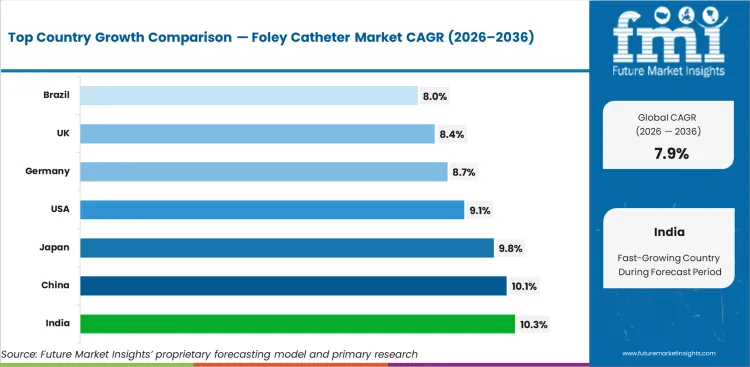
- Geography: India and China show the fastest growth at 10.3% and 10.1% CAGR, supported by capacity expansion and higher urology caseloads.
- Analyst Opinion at FMI
- Sabyasachi Ghosh, Principal Consultant at Future Market Insights, opines, ‘In the updated version of the Foley Catheter Market Report for 2026 to 2036, CXOs will find a clear view of how product design and material mix are being shaped by protocol led purchasing, long term care utilization, and contracting dynamics across major countries.’
- Strategic Implications and Executive Takeaways
- Shift product mix toward silicone lines for longer dwell pathways where tolerance and latex screening influence institutional selection.
- Defend hospital contracts using protocol fit evidence, drainage compatibility checks, and catheter day management outcomes tied to quality programs.
- Prioritize distributor depth and tender readiness in India and China where capacity buildout is lifting baseline catheter procurement.
- Methodology
- As per FMI, market sizing and splits were reconciled using company primary disclosures, procurement references, and published clinical use guidance.
- Segment shares were validated by mapping demand across hospitals, long term care facilities, and ambulatory surgical centers, then reconciling totals.
- Pricing impact from latex to silicone substitution was stress tested to confirm revenue sensitivity under realistic mix shift scenarios.
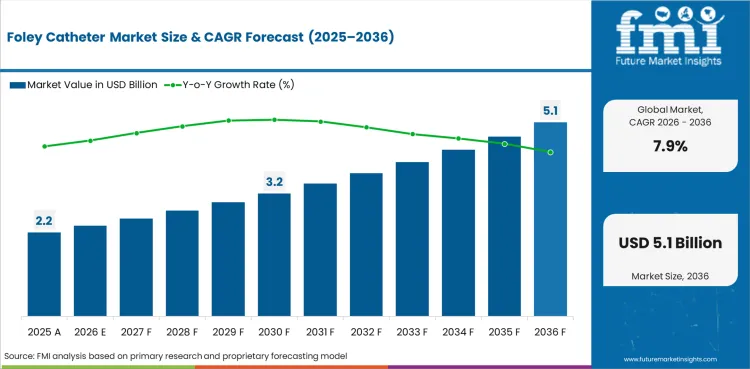
Key Takeaways, Market Size, and Forecast
| Metric | Value |
|---|---|
| Market Size (2026) | USD 2,208.9 Million |
| Market Size (2026) | USD 2,208.9 Million |
| Market Size (2036) | USD 4,724.9 Million |
| CAGR (2026–2036) | 7.9% |
| Incremental Opportunity (2026–2036) | USD 2,516.0 Million |
| Leading Product (2026) | 2 Way Foley Catheters |
| 2 Way Foley Catheters Share (2026) | 54.4% |
| Fastest-Growing Country | India |
| India CAGR | 10.3% |
| 2nd Fastest-Growing Country | China |
| China CAGR | 10.1% |
Absolute dollar growth of USD 174.50 million over the decade signals structural expansion rather than a pure replacement cycle. Based on FMI's report, growth is expected to be sustained by rising catheter utilisation across hospitals and long-term care settings, while infection prevention protocols, tender price ceilings, and nurse-led dwell time controls are expected to limit uncontrolled volume expansion.
"It's been nearly a century since the Foley set the standard, by replacing the balloon with soft wings, Lotus addresses residual urine and balloon-related trauma while keeping clinical workflow familiar. Our focus is scaling with the right partners to deliver consistently improved outcomes globally."said aid I. Hakki, MD, PhD, Founder & CEO of American Medical Systems (AMS) which is owned by Pfizer.
India (10.3% CAGR) and China (10.1% CAGR) are expected to lead growth through expanding hospital capacity and higher urology and post-surgical drainage volumes. Japan (9.8% CAGR) is expected to remain supported by ageing-linked urinary retention management. Mature markets such as the USA (9.1%), Germany (8.7%), the UK (8.4%), and Brazil (8.0%) are expected to generate a higher share of replacement demand, with incremental growth constrained by protocol tightening and budget-governed purchasing.
Foley Catheter Market definition
The market covers indwelling urinary catheters used for continuous bladder drainage in hospital, ambulatory, and long-term care settings. Foley catheters are sterile tubes inserted into the bladder and retained using an inflatable balloon. They are purchased by hospitals, surgical centres, and care facilities for urinary retention management, perioperative drainage, and clinically indicated longer-duration catheterisation. Demand is shaped by urology and surgical case volumes, catheter-associated infection prevention requirements, and facility protocols that govern well time and material choice. Revenue is generated through unit sales to institutional buyers, with selection influenced by lumen configuration, material, and indication.
Foley Catheter Market inclusions
The report includes global and regional market sizes and a 10-year forecast for 2026 to 2036. It covers segmental breakdowns by product (2 way, 3 way, 4 way), material (latex, silicone, others), indication (urinary incontinence, urethral stricture, chronic obstruction, neurogenic bladder, enlarged prostate gland/BPH, prostate cancer, others), and end user (hospitals, long-term care facilities, ambulatory surgical centers). Competitive positioning and country-level growth rate comparisons are also covered for major markets.
Foley Catheter Market exclusions
The scope excludes intermittent catheters and external catheters sold as standalone categories. It also excludes drainage bags, securement devices, insertion trays, antiseptic prep products, and other accessories when sold separately from the catheter unit. Urology procedural devices and surgical instruments used for catheter placement are excluded. The focus remains on Foley catheter units across the stated product configurations, material types, indications, and care settings, including procurement through institutional channels.
Foley Catheter Market research methodology
- Primary research: Interviews were conducted with hospital procurement leads, urology clinicians, infection control personnel, long-term care administrators, and manufacturer commercial teams to validate utilisation patterns and tender dynamics.
- Desk research: Public information from regulators, health system publications, company annual reports, investor presentations, and peer-reviewed clinical literature was reviewed to benchmark usage guidance and safety requirements.
- Market-sizing and forecasting: A hybrid model was developed using segment shares by product, material, indication, and end user, then reconciled through volume and pricing triangulation.
- Data validation and update cycle: Outputs were checked through variance review, consistency screening across assumptions, and structured peer review before finalization.
Segmental Analysis
Foley Catheter Market Analysis by product
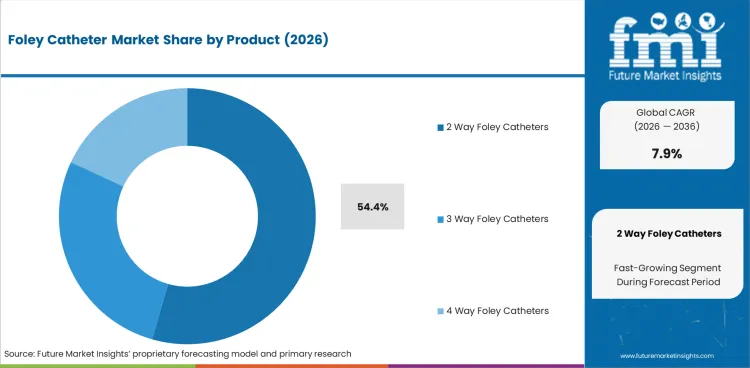
Based on FMI’s report, 2 way Foley catheters are estimated to hold 54.4% share in 2026. The lead position of 2 way designs is supported by their fit with routine drainage pathways in general wards, perioperative recovery, and standard catheter kits, which keeps them as the first choice in high turnover procurement. Demand for 3 way designs is driven by irrigation requirements in selected urology pathways, which ties share to procedure mix rather than general admissions.
- Wide acceptance for managing urinary retention: 2-way Foley balloon catheters lead because they are the standard for urinary retention drainage, easy insertion, reliable flow through large eyes, secure symmetric balloon retention, simple inflation valve, and quick size identification for routine wards.
- Demand-side lock-in: Hospitals and long-term care facilities align nurse training, insertion kits, and ward-level stocking plans to 2-way workflows, which raises switching costs once protocols and purchasing contracts are locked for multi-year cycles.
- External driver: Catheter stewardship and CAUTI performance tracking are increasing pressure to standardize documentation, traceability, and complaint response, which favors established 2-way SKUs that can be supported with consistent IFUs and validated handling protocols.
Foley Catheter Market Analysis by material
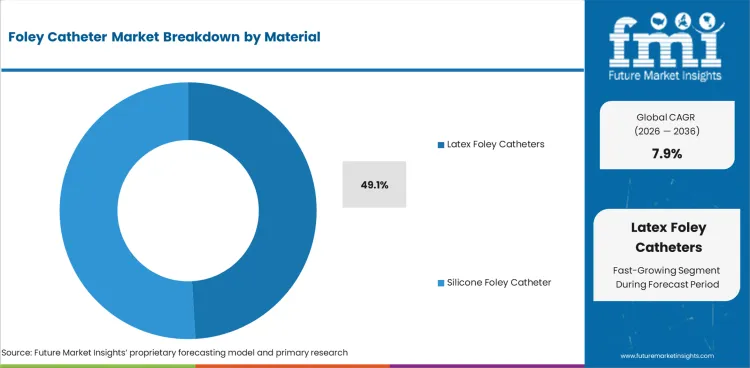
Latex Foley catheters account for 49.1% share in 2026, based on FMI’s report. Latex retains volume in short duration catheterization where unit cost and availability dominate tenders, particularly in high throughput hospital wards. Silicone demand is supported by longer dwell needs and latex sensitivity screening, which increases preference in long term care and chronic retention pathways where patient tolerance and dwell duration influence selection.
- Upgradation and preference: At Amsino, announced the launch of newly upgraded AMSure Foley Catheter Trays, now enhanced to include dual antiseptic skin prep, an updated SteriGuide IFU, and Bedal’s flexGRIP Securement Device. As healthcare facilities and providers seek safer, more efficient urinary management systems.
- Resist Bacterial Infection: The Gold Silicone-Coated Foley Catheter by Teleflex/Rüsch is an indwelling catheter. It features an innovative manufacturing process that provides the maximum amount of silicone coating available. The catheter itself is a latex catheter but it is coated internally and externally in 100% silicone to resist encrustation and bacterial colonization.
- Tender specification shift: Material clauses in tenders are being used to manage allergy exposure and standardize catheter performance expectations.
Foley Catheter Market Drivers, Restraints, and Opportunities
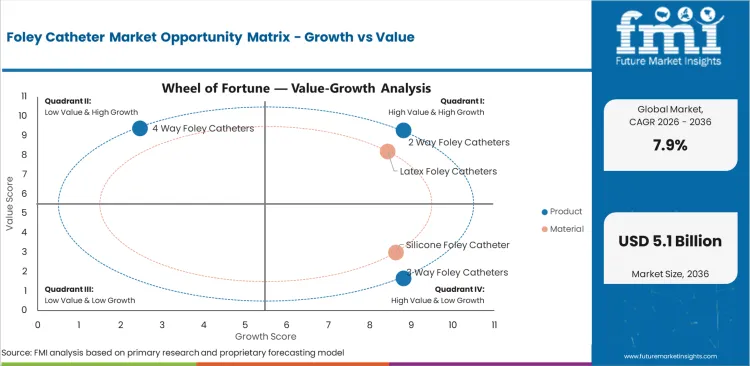
Future Market Insights analysis indicates that historical patterns point at a high-volume, protocol-governed category where demand is being anchored in inpatient drainage needs, post-operative monitoring, and long-term urinary management. Estimated valuation in 2026 is being supported by steady hospital and long-term care consumption, while procurement is being shaped by CAUTI prevention governance and tender pricing discipline.
While volume is being sustained by aging demographics and procedure throughput, value growth is being moderated by utilization controls, shorter dwell time targets, and price discipline under competitive tenders. The forecast trajectory reflects a new normal where replacement purchasing remains steady, but supplier selection is being tightened through documentation readiness, training support, and supply continuity expectations.
- Compliance-led upgrading: Growth is shifting toward catheter lines supported by traceability, clear IFUs, and training ecosystems that reduce protocol deviation risk during audits.
- Qualification lock-in restraint: Tender cycles and standardized care protocols slow switching once vendors are approved, keeping price pressure high for commoditized SKUs.
- Material conversion mechanism: Mix is expected to shift toward silicone where tolerance and infection prevention filters tighten, while latex remains anchored in cost-led tenders.
Regional Analysis
.webp "Top Country Growth Comparison Foley Catheter Market Cagr (2026 2036)")
Based on the regional analysis, Foley catheter market is segmented into North America, Latin America, Europe, East Asia, South Asia, Oceania and Middle East & Africa across 40+ countries. Regional performance is assessed using country-level demand signals linked to procurement rules, infection prevention governance, and care setting expansion, as per FMI. The full report also offers market attractiveness analysis based on regional trends.
| Country | CAGR |
|---|---|
| USA | 9.1% |
| India | 10.3% |
| Germany | 8.7% |
| UK | 8.4% |
| Japan | 9.8% |
| China | 10.1% |
| Brazil | 8.0% |
Source: Future Market Insights (FMI) analysis and primary research
North America Foley Catheter Market Analysis
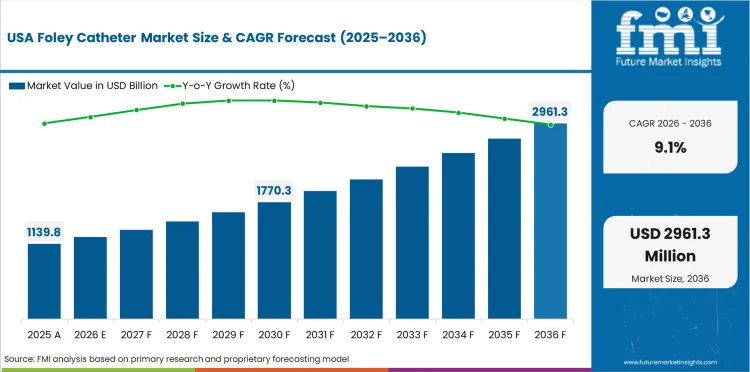
The region of North America is influenced by the discipline of hospital quality reporting and contracting, wherein catheter use is defined by CAUTI surveillance, nurse-driven removal practices, and group purchasing agreements. Market leaders in the North America region include Becton, Dickinson and Company due to its excellent acute care access, Cardinal Health due to its distribution-driven contract execution, and Teleflex Inc. due to its procedural channel positioning. According to FMI analysts, the growth of utilization is being influenced by inpatient throughput and long-term care growth, with more defined governance on avoidable catheter days.
- United States: Demand for Foley catheters in the United States is projected to rise at 9.1% CAGR through 2036. Growth is supported by hospital throughput and long-term care utilisation, while stewardship and CAUTI-prevention governance continue to reduce avoidable catheter days and tighten product standardisation in many systems.
FMI’s report includes a detailed analysis of the growth in the North American region, along with a country-wise assessment that includes the United States. Readers can also find regional trends, regulations, and market growth based on different segments and countries in the North America region.
Asia Pacific Foley Catheter Market Analysis
The Asia Pacific continues to be the largest volume consumption base, driven by the increasing capacity of hospitals, increased surgical procedures, and the aging population and consequent long-term care. Becton, Dickinson and Company continues to have wide distributor-supported coverage, B. Braun Melsungen AG competes on the basis of the depth of their hospital portfolios and training support, while Coloplast is differentiated on the basis of their strength in continence care. According to the report by FMI, tender-driven purchasing and standardization in public hospitals are expected to keep the pricing pressure dynamic.
- China: Demand for Foley catheters in China is projected to rise at 10.1% CAGR through 2036. Growth is anchored in public hospital volumes and wider access, while tender-led standardisation continues to shape pricing and supplier selection.
- India: Demand for Foley catheters in India is projected to rise at 10.3% CAGR through 2036. Growth is being pulled by public procurement and rising surgical volumes, with repeat ordering concentrated in hospitals and government purchasing channels.
- Japan: Demand for Foley catheters in Japan is projected to rise at 9.8% CAGR through 2036. Growth is supported by ageing-linked inpatient and long-term care demand, while infection control incentives continue to influence catheter duration governance in facilities.
The full report analyzes the Foley catheter market across East and South Asia from 2021-2036, covering pricing, trends, and growth drivers in China, Japan, South Korea, India, Indonesia, Malaysia, and Thailand. The assessment highlights trends that dictate regional demand and procurement behaviour.
Latin America Foley Catheter Market Analysis
Latin America is driven by mixed public and private procurement, where import exposure and regulatory compliance timelines influence supplier economics and availability. B. Braun Melsungen AG competes through hospital channel breadth, Becton, Dickinson and Company sustains distributor-led coverage, and Coloplast maintains continence-care positioning in larger urban systems. FMI opines that procurement cadence and registration continuity will remain central to supplier share stability across public systems.
- Brazil: Demand for Foley catheters in Brazil is projected to rise at 8.0% CAGR through 2036. Growth is supported by sustained public hospital demand and steady private utilisation, while registration and compliance requirements continue to shape supplier participation and continuity of supply.
The report consists of a detailed analysis for the market in Brazil, Mexico, Chile, Argentina, Peru and Rest of Latin America. Readers can find detailed information about several factors, such as the pricing analysis and regional trends, which are impacting growth in the Latin America region.
Europe Foley Catheter Market Analysis
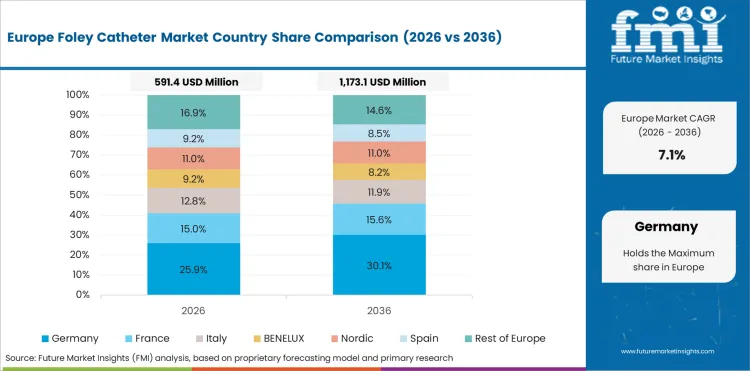
Europe is compliance-led and tender-driven, where traceability requirements and infection prevention governance shape purchasing criteria across hospitals and long-term care facilities. Coloplast holds strong access in continence pathways, B. Braun Melsungen AG is supported by hospital relationships, and Becton, Dickinson and Company competes through documentation readiness and channel coverage. Future Market Insights analysis indicates that supplier selection is being shaped by tender scoring tied to documentation, service coverage, and infection prevention alignment within hospital systems.
- Germany: Demand for Foley catheters in Germany is projected to rise at 8.7% CAGR through 2036. Growth is supported by ageing care needs and long-term care utilisation, while procurement and infection prevention governance continue to tighten catheter use policies in hospitals.
- United Kingdom: Demand for Foley catheters in the United Kingdom is projected to rise at 8.4% CAGR through 2036. Growth is channelled through framework-led procurement, with standardisation and infection control expectations shaping supplier access across trusts and care settings.
FMI’s analysis of Foley catheter market in Europe consists of country-wise assessment that includes the Germany, Italy, France, United Kingdom, Spain, Russia, Nordic, Benelux and Rest of Europe. Readers can know various regulations and latest trends in the regional market.
Competitive aligners for market players
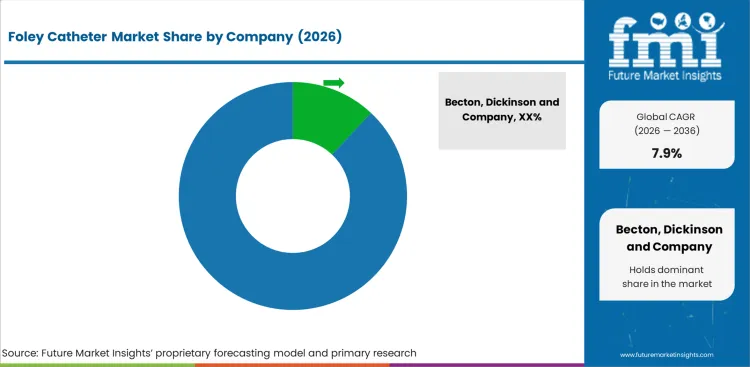
Market structure remains fragmented, yet practical competition is concentrated among a limited set of suppliers that can meet hospital-scale volumes, documentation needs, and service levels across acute and long-term care channels. FMI analysis indicates a clear scale leader at about 22% share, while the remaining demand is spread across several global and regional manufacturers. The key competitive factor is total landed cost within contracted supply, rather than peak rates over shorter time frames. Contract execution, rate of fill, and complaint response are likely to be decisive in contract renewal, as the majority of purchases are made within tender or framework arrangements and are subject to predictable review cycles, as reported by FMI.
Companies with extensive manufacturing footprints and regional regulatory approvals enjoy inherent advantages in supply chain reliability and SKU consolidation. Large medtech companies enjoy the benefits of distribution reach, established GPO membership, and the ability to consolidate adjacent urology and infection protection consumables in a single contracting gesture. Portfolio diversity in two-way and three-way business models, as well as latex and silicone product lines, helps to accommodate diverse ward practices without requiring buyers to make single-SKU trade-offs. Smaller companies rely more on distributor pull-through and sporadic contracting, leaving them vulnerable to price compression in competitive rebids, according to FMI’s report.
Customer concentration reinforces buyer leverage. Hospitals and integrated systems commonly dual-source retention catheters, maintain approved alternates by size and material, and write substitution clauses into agreements to prevent supply dependency. Long-term care operators often prioritise continuity of supply and predictable reorder cadence, then use distributor switching to discipline net pricing. This behaviour limits supplier pricing power for standard SKUs, while selective premiums are preserved only where a defined protocol requires a specific material, coating, or irrigation configuration, Future Market Insights analysis.
Recent Developments
The report includes full coverage of key trends from competitive benchmarking. Some of the recent developments covered in the reports:
- In Oct 2025, Lotus Medical Technologies LLC announced the next phase of global expansion for the Lotus Catheter, an FDA-cleared urinary catheter that replaces the traditional Foley balloon with soft, collapsible wings engineered to minimize trauma and promote near-complete bladder emptying, the primary risk factor for Catheter-associated Urinary Tract Infections (CAUTIs).
- In July 2025, At Amsino, they announced the launch of our newly upgraded AMSure Foley Catheter Trays. Now enhanced to include dual antiseptic skin prep, an updated SteriGuide IFU, and Bedal’s flexGRIP Securement Device.
- In February 2025, Silq Technologies and NuSil Technology have partnered to apply zwitterionic surface treatment to silicone-based medical implants. The collaboration aims to reduce infections, fibrosis, and thrombosis while enhancing device performance. Building on Silq’s FDA-cleared ClearTract® Foley catheter, the alliance expands potential applications across implantable devices, aligning with Avantor’s mission to advance patient care through innovation.
- In June 2024, Silq Technologies announced its ClearTract Foley Catheter has received an Innovative Technology contract from Vizient, Inc., the nation’s largest provider-driven healthcare performance improvement company.
Key Players in Foley Catheter Market
- Becton, Dickinson and Company
- Cardinal Health, Inc.
- B. Braun Melsungen AG
- Coloplast A/S
- Medtronic plc
- ConvaTec Group Plc
- Teleflex Incorporated
- BACTIGUARD AB
- Sterimed Group
- VOGT Medical Vertrieb GmbH
- Optimum Medical Limited
Scope of the Report
| Metric | Value |
|---|---|
| Quantitative units | USD 2,208.9 million (2026) to USD 4,724.9 million (2036), at a CAGR of 7.9% |
| Market definition | The Foley catheter market comprises global production and trade of indwelling urinary drainage catheters, including designs used for routine bladder drainage and irrigation support, where adoption is driven by inpatient catheterization needs, long stay care requirements, and procedure linked urinary drainage protocols. |
| Product segmentation | 2 Way Foley Catheters, 3 Way Foley Catheters, 4 Way Foley Catheters |
| Material segmentation | Latex Foley Catheter, Silicone Foley Catheter, Others |
| Indication coverage | Urinary Incontinence, Urethral Stricture, Chronic Obstruction, Neurogenic Bladder, Enlarged Prostate Gland/BPH, Prostate Cancer, Others |
| End user coverage | Hospitals, Long-term Care Facilities, Ambulatory Surgical Centers |
| Regions covered | North America, Latin America, Europe, East Asia, South Asia, Oceania, Middle East and Africa |
| Countries covered | United States, Canada, Mexico, Brazil, Argentina, Germany, France, United Kingdom, Italy, Spain, China, India, Japan, South Korea, Indonesia, Australia and 40 plus countries |
| Key companies profiled | Becton, Dickinson and Company, Cardinal Health, Inc., B. Braun Melsungen AG, Coloplast A/S, Medtronic plc, ConvaTec Group Plc, Teleflex Incorporated, BACTIGUARD AB, Sterimed Group, VOGT Medical Vertrieb GmbH, Optimum Medical Limited |
| Forecast period | 2026 to 2036 |
| Approach | Hybrid top down and bottom up market modeling validated through primary interviews with manufacturers and channel stakeholders, supported by procurement benchmarking and regulatory documentation review, as per FMI. |
Key Segments
Product
- 2 Way Foley Catheters
- 3 Way Foley Catheters
- 4 Way Foley Catheters
Material
- Latex Foley Catheter
- Hydrogel Coated
- Silicone Coated
- Silver Coated
- PTFE Coated
- Silicone Foley Catheter
- Hydrogel Coated
- Pure Silicone
- Silver Coated
- Others
Indication
- Urinary Incontinence
- Urethral Stricture
- Chronic Obstruction
- Neurogenic Bladder
- Enlarged Prostate Gland/BPH
- Prostate Cancer
- Others
End user
- Hospitals
- Long-term Care Facilities
- Ambulatory Surgical Centers
Region
- Asia Pacific
- India
- China
- Japan
- South Korea
- Indonesia
- Australia & New Zealand
- ASEAN
- Rest of Asia Pacific
- Europe
- Germany
- Italy
- France
- United Kingdom
- Spain
- Benelux
- Nordics
- Central & Eastern Europe
- Rest of Europe
- North America
- United States
- Canada
- Mexico
- Latin America
- Brazil
- Argentina
- Chile
- Rest of Latin America
- Middle East & Africa
- Kingdom of Saudi Arabia
- United Arab Emirates
- South Africa
- Turkey
- Rest of Middle East & Africa
Bibliography
- [1] Oct 2025, FDA-Cleared Lotus Catheter Accelerates Global Expansion, backed by Peer-Reviewed Zero-UTI Study and 500,000+ Uses
- [2] La Med- 2 Way Foley Catheter (Urological)- website
- [3] July 2025, Introducing Upgraded AMSure Foley Kits with FlexGRIP Technology – Raising the Bar in Urological Care.
- [4] Teleflex Rusch Gold 5cc Siliconized Coated Foley website
- [5] Jun 2024, Silq Technologies Receives Innovative Technology Contract from Vizient for Clear Tract Foley Catheter
This report addresses
- Market intelligence to enable structured strategic decision making across acute care, long stay, and ambulatory procedure settings
- Market size estimation and 10-year revenue forecasts from 2026 to 2036 for indwelling urinary drainage catheter demand
- Growth opportunity mapping across product designs, material choices, indications, and end user purchasing pools
- Segment and regional revenue forecasts covering inpatient care, long stay care, and day care procedure settings
- Competition strategy assessment including channel positioning, procurement fit, and compliance capability benchmarking
- Product reformulation and emission compliance tracking including catheter safety, labeling expectations, and antimicrobial positioning where relevant
- Regulatory and guideline impact analysis covering infection prevention requirements and catheter use governance in facilities
- Market report delivery in PDF, Excel, PPT, and interactive dashboard formats for executive and operational use
Frequently Asked Questions
How large is the demand for Foley catheters in the global market in 2026?
Demand is estimated to be valued at USD 2,208.9 million in 2026, as per FMI.
What will be the market size of Foley catheters in the global market by 2036?
Market size is projected to reach USD 4,724.9 million by 2036, based on FMI’s report.
What is the expected demand growth for Foley catheters in the global market between 2026 and 2036?
Demand is expected to grow at a CAGR of 7.9% between 2026 and 2036.
Which product type is poised to lead global sales by 2026?
2 Way Foley Catheters are expected to be the dominant product type, capturing 54.4% share in 2026.
How significant is the role of hospitals in driving Foley catheter adoption in 2026?
Hospitals are projected to hold 58.3% share of end user demand in 2026.
Which indication contributes the highest share to demand in 2026?
Urinary Incontinence is projected to account for 34.3% share of the indication split in 2026.
Preview the report firsthand - request a free sample
Get SampleGet the brochure for pricing and purchase details.
Get PDFTable of Content
- Executive Summary
- Global Market Outlook
- Demand-side Trends
- Supply-side Trends
- Technology Roadmap Analysis
- Analysis and Recommendations
- Market Overview
- Market Coverage / Taxonomy
- Market Definition / Scope / Limitations
- Research Methodology
- Chapter Orientation
- Analytical Framework
- Market Structure, Signals, and Trend Drivers
- Benchmarking and Cross-market Comparability
- Market Sizing, Forecasting, and Opportunity Mapping
- Research Design and Evidence Framework
- Desk Research Programme (Secondary Evidence)
- Company Annual and Sustainability Reports
- Peer-reviewed Journals and Academic Literature
- Corporate Websites, Product Literature, and Technical Notes
- Earnings Decks and Investor Briefings
- Statutory Filings and Regulatory Disclosures
- Technical White Papers and Standards Notes
- Trade Journals, Industry Magazines, and Analyst Briefs
- Conference Proceedings, Webinars, and Seminar Materials
- Government Statistics Portals and Public Data Releases
- Press Releases and Reputable Media Coverage
- Specialist Newsletters and Curated Briefings
- Sector Databases and Reference Repositories
- FMI Proprietary Databases and Historical Market Data
- Subscription Datasets and Paid Sources
- Social Channels, Communities, and Digital Listening Inputs
- Additional Desk Sources
- Expert Input and Fieldwork (Primary Evidence)
- Primary Modes
- Qualitative Interviews and Expert Elicitation
- Quantitative Surveys and Structured Data Capture
- Blended Approach
- Why Primary Evidence is Used
- Field Techniques
- Interviews
- Surveys
- Focus Groups
- Observational and In-context Research
- Social and Community Interactions
- Stakeholder Universe Engaged
- C-suite Leaders
- Board Members
- Presidents and Vice Presidents
- R&D and Innovation Heads
- Technical Specialists
- Domain Subject-matter Experts
- Scientists
- Physicians and Other Healthcare Professionals
- Governance, Ethics, and Data Stewardship
- Research Ethics
- Data Integrity and Handling
- Primary Modes
- Research Methods and Reference Sources
- Desk Research Programme (Secondary Evidence)
- Market Data Analysis and Forecast Development
- Data Collection
- Data Review and Validation
- Synthesis, Triangulation, and Analysis
- Research Quality and Validation
- Market Background
- Market Dynamics
- Drivers
- Restraints
- Opportunity
- Trends
- Scenario Forecast
- Demand in Optimistic Scenario
- Demand in Likely Scenario
- Demand in Conservative Scenario
- Opportunity Map Analysis
- Product Life Cycle Analysis
- Supply Chain Analysis
- Investment Feasibility Matrix
- Value Chain Analysis
- PESTLE and Porter’s Analysis
- Regulatory Landscape
- Regional Parent Market Outlook
- Production and Consumption Statistics
- Import and Export Statistics
- Market Dynamics
- Global Market Analysis 2021 to 2025 and Forecast, 2026 to 2036
- Historical Market Size Value (USD Million) Analysis, 2021 to 2025
- Current and Future Market Size Value (USD Million) Projections, 2026 to 2036
- Y-o-Y Growth Trend Analysis
- Absolute $ Opportunity Analysis
- Global Market Pricing Analysis 2021 to 2025 and Forecast 2026 to 2036
- Global Market Analysis 2021 to 2025 and Forecast 2026 to 2036, By Product Type
- Introduction / Key Findings
- Historical Market Size Value (USD Million) Analysis By Product Type , 2021 to 2025
- Current and Future Market Size Value (USD Million) Analysis and Forecast By Product Type , 2026 to 2036
- Ceramide
- Sphingomyelin
- Ganglioside GM3
- Ceramide
- Y-o-Y Growth Trend Analysis By Product Type , 2021 to 2025
- Absolute $ Opportunity Analysis By Product Type , 2026 to 2036
- Global Market Analysis 2021 to 2025 and Forecast 2026 to 2036, By Application
- Introduction / Key Findings
- Historical Market Size Value (USD Million) Analysis By Application, 2021 to 2025
- Current and Future Market Size Value (USD Million) Analysis and Forecast By Application, 2026 to 2036
- Therapeutic Area
- Non-therapeutic Area
- Therapeutic Area
- Y-o-Y Growth Trend Analysis By Application, 2021 to 2025
- Absolute $ Opportunity Analysis By Application, 2026 to 2036
- Global Market Analysis 2021 to 2025 and Forecast 2026 to 2036, By Region
- Introduction
- Historical Market Size Value (USD Million) Analysis By Region, 2021 to 2025
- Current Market Size Value (USD Million) Analysis and Forecast By Region, 2026 to 2036
- North America
- Latin America
- Western Europe
- Eastern Europe
- East Asia
- South Asia and Pacific
- Middle East & Africa
- Market Attractiveness Analysis By Region
- North America Market Analysis 2021 to 2025 and Forecast 2026 to 2036, By Country
- Historical Market Size Value (USD Million) Trend Analysis By Market Taxonomy, 2021 to 2025
- Market Size Value (USD Million) Forecast By Market Taxonomy, 2026 to 2036
- By Country
- USA
- Canada
- Mexico
- By Product Type
- By Application
- By Country
- Market Attractiveness Analysis
- By Country
- By Product Type
- By Application
- Key Takeaways
- Latin America Market Analysis 2021 to 2025 and Forecast 2026 to 2036, By Country
- Historical Market Size Value (USD Million) Trend Analysis By Market Taxonomy, 2021 to 2025
- Market Size Value (USD Million) Forecast By Market Taxonomy, 2026 to 2036
- By Country
- Brazil
- Chile
- Rest of Latin America
- By Product Type
- By Application
- By Country
- Market Attractiveness Analysis
- By Country
- By Product Type
- By Application
- Key Takeaways
- Western Europe Market Analysis 2021 to 2025 and Forecast 2026 to 2036, By Country
- Historical Market Size Value (USD Million) Trend Analysis By Market Taxonomy, 2021 to 2025
- Market Size Value (USD Million) Forecast By Market Taxonomy, 2026 to 2036
- By Country
- Germany
- UK
- Italy
- Spain
- France
- Nordic
- BENELUX
- Rest of Western Europe
- By Product Type
- By Application
- By Country
- Market Attractiveness Analysis
- By Country
- By Product Type
- By Application
- Key Takeaways
- Eastern Europe Market Analysis 2021 to 2025 and Forecast 2026 to 2036, By Country
- Historical Market Size Value (USD Million) Trend Analysis By Market Taxonomy, 2021 to 2025
- Market Size Value (USD Million) Forecast By Market Taxonomy, 2026 to 2036
- By Country
- Russia
- Poland
- Hungary
- Balkan & Baltic
- Rest of Eastern Europe
- By Product Type
- By Application
- By Country
- Market Attractiveness Analysis
- By Country
- By Product Type
- By Application
- Key Takeaways
- East Asia Market Analysis 2021 to 2025 and Forecast 2026 to 2036, By Country
- Historical Market Size Value (USD Million) Trend Analysis By Market Taxonomy, 2021 to 2025
- Market Size Value (USD Million) Forecast By Market Taxonomy, 2026 to 2036
- By Country
- China
- Japan
- South Korea
- By Product Type
- By Application
- By Country
- Market Attractiveness Analysis
- By Country
- By Product Type
- By Application
- Key Takeaways
- South Asia and Pacific Market Analysis 2021 to 2025 and Forecast 2026 to 2036, By Country
- Historical Market Size Value (USD Million) Trend Analysis By Market Taxonomy, 2021 to 2025
- Market Size Value (USD Million) Forecast By Market Taxonomy, 2026 to 2036
- By Country
- India
- ASEAN
- Australia & New Zealand
- Rest of South Asia and Pacific
- By Product Type
- By Application
- By Country
- Market Attractiveness Analysis
- By Country
- By Product Type
- By Application
- Key Takeaways
- Middle East & Africa Market Analysis 2021 to 2025 and Forecast 2026 to 2036, By Country
- Historical Market Size Value (USD Million) Trend Analysis By Market Taxonomy, 2021 to 2025
- Market Size Value (USD Million) Forecast By Market Taxonomy, 2026 to 2036
- By Country
- Kingdom of Saudi Arabia
- Other GCC Countries
- Turkiye
- South Africa
- Other African Union
- Rest of Middle East & Africa
- By Product Type
- By Application
- By Country
- Market Attractiveness Analysis
- By Country
- By Product Type
- By Application
- Key Takeaways
- Key Countries Market Analysis
- USA
- Pricing Analysis
- Market Share Analysis, 2025
- By Product Type
- By Application
- Canada
- Pricing Analysis
- Market Share Analysis, 2025
- By Product Type
- By Application
- Mexico
- Pricing Analysis
- Market Share Analysis, 2025
- By Product Type
- By Application
- Brazil
- Pricing Analysis
- Market Share Analysis, 2025
- By Product Type
- By Application
- Chile
- Pricing Analysis
- Market Share Analysis, 2025
- By Product Type
- By Application
- Germany
- Pricing Analysis
- Market Share Analysis, 2025
- By Product Type
- By Application
- UK
- Pricing Analysis
- Market Share Analysis, 2025
- By Product Type
- By Application
- Italy
- Pricing Analysis
- Market Share Analysis, 2025
- By Product Type
- By Application
- Spain
- Pricing Analysis
- Market Share Analysis, 2025
- By Product Type
- By Application
- France
- Pricing Analysis
- Market Share Analysis, 2025
- By Product Type
- By Application
- India
- Pricing Analysis
- Market Share Analysis, 2025
- By Product Type
- By Application
- ASEAN
- Pricing Analysis
- Market Share Analysis, 2025
- By Product Type
- By Application
- Australia & New Zealand
- Pricing Analysis
- Market Share Analysis, 2025
- By Product Type
- By Application
- China
- Pricing Analysis
- Market Share Analysis, 2025
- By Product Type
- By Application
- Japan
- Pricing Analysis
- Market Share Analysis, 2025
- By Product Type
- By Application
- South Korea
- Pricing Analysis
- Market Share Analysis, 2025
- By Product Type
- By Application
- Russia
- Pricing Analysis
- Market Share Analysis, 2025
- By Product Type
- By Application
- Poland
- Pricing Analysis
- Market Share Analysis, 2025
- By Product Type
- By Application
- Hungary
- Pricing Analysis
- Market Share Analysis, 2025
- By Product Type
- By Application
- Kingdom of Saudi Arabia
- Pricing Analysis
- Market Share Analysis, 2025
- By Product Type
- By Application
- Turkiye
- Pricing Analysis
- Market Share Analysis, 2025
- By Product Type
- By Application
- South Africa
- Pricing Analysis
- Market Share Analysis, 2025
- By Product Type
- By Application
- USA
- Market Structure Analysis
- Competition Dashboard
- Competition Benchmarking
- Market Share Analysis of Top Players
- By Regional
- By Product Type
- By Application
- Competition Analysis
- Competition Deep Dive
- Croda International PLC
- Overview
- Product Portfolio
- Profitability by Market Segments (Product/Age /Sales Channel/Region)
- Sales Footprint
- Strategy Overview
- Marketing Strategy
- Product Strategy
- Channel Strategy
- Evonik Industries AG
- Merck KGaA
- Thermo Fisher Scientific Inc.
- Cayman Chemical Company
- Lipoid GmbH
- Croda International PLC
- Competition Deep Dive
- Assumptions & Acronyms Used


