

- Industry Size (2026)
- USD 1.8 Bn
- Forecast (2036)
- USD 3.7 Bn
- CAGR (2026 to 2036)
- 7.4%
Ampoule Filling and Sealing Machine Market Forecast and Outlook 2026 to 2036
The ampoule filling and sealing machine market is positioned for sustained growth, supported by the structural expansion of injectable drug manufacturing across pharmaceutical and biopharmaceutical sectors. The market is expected to reach USD 3.7 billion by 2036, expanding at a compound annual growth rate of 7.4% from an estimated USD 1.8 billion in 2026, driven by increasing volumes of parenteral formulations and heightened emphasis on aseptic production standards.
Contract development and manufacturing organizations represent another significant growth avenue. As pharmaceutical companies continue to outsource sterile filling operations to manage capital expenditure and accelerate time to market, CDMOs are expanding capacity and upgrading equipment fleets. This is increasing demand for high‑throughput ampoule filling and sealing machines that support diverse client specifications while maintaining compliance across multiple regulatory jurisdictions.
Technological advancement remains a core market catalyst. Integration of robotics, vision‑based inspection systems, and digital control architectures is improving operational efficiency and reducing manual intervention in critical cleanroom environments. Manufacturers that incorporate predictive maintenance capabilities, remote diagnostics, and energy‑efficient designs are gaining competitive advantage as buyers prioritize lifecycle value and operational continuity.
Emerging pharmaceutical manufacturing hubs in Asia and Latin America present incremental growth opportunities as domestic drug production expands and export‑oriented facilities seek to align with global quality standards. In parallel, mature markets in North America and Europe are characterized by replacement demand and technology upgrades focused on throughput optimization and regulatory harmonization.
Quick Stats for the Ampoule Filling and Sealing Machine Market
- Ampoule Filling and Sealing Machine Market Value (2026): USD 1.8 billion
- Ampoule Filling and Sealing Machine Market Forecast Value (2036): USD 3.7 billion
- Ampoule Filling and Sealing Machine Market Global Forecast CAGR 2026 to 2036: 7.4%
- Ampoule Filling and Sealing Machine Market Leading Segment: Injectables Manufacturing Plants (58%)
- Key Growth Regions in Ampoule Filling and Sealing Machine Market: India
- Top Players in Ampoule Filling and Sealing Machine Market: Syntegon Technology, Groninger, IMA Group, OPTIMA Pharma, Marchesini Group, Bausch+Ströbel, Romaco, NJM Packaging, Cozzoli Machine Company, Dara Pharma
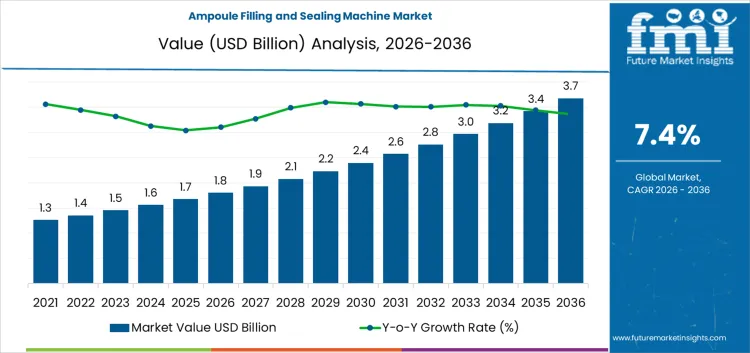
What is the Half-Decade Weighted Growth for the Ampoule Filling and Sealing Machine Market through 2036?
The half-decade weighted growth analysis of the ampoule filling and sealing machine market reveals consistent growth, with increasing contributions from both volume and technological advancements. The market will see moderate expansion in the first few years, with the value increasing from USD 1.8 billion in 2026 to USD 2 billion in 2028. This early growth is driven primarily by volume demand, as the pharmaceutical industry continues to invest in packaging technologies that ensure efficiency and sterility in drug manufacturing.
From 2029 to 2032, the market will begin to accelerate as new innovations and improvements in automation, machine speed, and accuracy drive demand for more advanced filling and sealing equipment. The market is projected to reach USD 2.7 billion by 2032, with a stronger contribution from technology-driven price increases as manufacturers introduce higher-value machines with better capabilities.
In the later half of the decade, the market will continue to expand, reaching USD 3.7 billion by 2036, driven by both the increasing volume of ampoule production and the growing adoption of more sophisticated, automated machines. The half-decade weighted growth analysis suggests that the combination of steady volume increases and ongoing technological advancements in machinery will be key to reaching the projected market size, with technological innovations playing a larger role in the second half of the forecast period.
Ampoule Filling and Sealing Machine Market Key Takeaways
| Metric | Value |
|---|---|
| Industry Sales Value (2026) | USD 1.8 billion |
| Industry Forecast Value (2036) | USD 3.7 billion |
| Industry Forecast CAGR 2026 to 2036 | 7.4% |
What Is Driving the Ampoule Filling and Sealing Machine Market?
The ampoule filling and sealing machine market developed from the pharmaceutical and fine chemical industries’ need for sterile, hermetically sealed single dose packaging. Traditional manual and semi automatic filling methods were labor intensive and inconsistent, leading to variability in fill volumes, contamination risk, and production inefficiencies. Early mechanized systems focused primarily on increasing throughput and reducing manual handling by automating basic fill and seal sequences. These early machines helped manufacturers meet higher production targets but often lacked the precision controls and integrated quality checks necessary for strict regulatory environments.
As injectable biologics, vaccines, and high potency formulations proliferated, the limitations of traditional machinery became more apparent. Companies responded by investing in fully automatic systems with improved dosing accuracy, contamination control, and synchronized sealing mechanisms that reduced operator exposure and improved sterility assurance. This evolution was particularly pronounced in markets with stringent regulatory oversight, where automated ampoule handling reduced deviations, minimized particulate generation, and supported compliance with cleanroom standards. Initial adoption was chiefly in high volume pharmaceutical manufacturing and contract manufacturing organizations where consistency and reliability were paramount.
Future demand for ampoule filling and sealing machines is expected to be shaped by continued growth in injectable pharmaceuticals, increasing biologics production, and regulatory expectations for precision and contamination control. The rise of biosimilars, vaccines, and advanced therapies that require single use sterile packaging will drive investment in machines that deliver higher throughput, tighter fill tolerance, and integrated inspection systems. Growth factors will include advances in servo driven dosing, in line visual inspection, and automated fault detection that improve yield and reduce rework. Industry emphasis on lean manufacturing and digital process controls will further position advanced filling and sealing equipment as central to efficient production lines.
Geographic expansion of pharmaceutical manufacturing in emerging markets will create demand for flexible, scalable systems that can accommodate multiple vial formats and product types. Barriers include high capital expenditure for cutting edge machines and the technical expertise required to operate and maintain sophisticated systems. Long term market expansion will depend on how effectively equipment suppliers deliver modular, upgradeable solutions that align with regulatory expectations, support diverse product portfolios, and enhance operational efficiency across global manufacturing networks.
What are the Key Segments in the Ampoule Filling and Sealing Machine Market?
The Ampoule Filling and Sealing Machine market is segmented by aseptic design and end use. Aseptic design segments include RABS-based systems, isolator-based systems, conventional aseptic, and others, with RABS-based systems holding the largest share at 48%. End-use segments include injectables manufacturing plants, contract development and manufacturing organizations (CDMOs), hospital or institutional pharmacies, and others, with injectables manufacturing plants leading the market at 58%. The market is driven by the increasing demand for injectables and the need for precise, sterile filling and sealing solutions in the pharmaceutical industry. The rise in biologics and specialty drugs is contributing to the growth of ampoule filling and sealing machines, as these products require high standards of aseptic processing. Key regions driving the market include North America, Europe, and Asia Pacific, where pharmaceutical manufacturing is expanding and regulatory standards for aseptic filling continue to tighten.
What is Driving Growth in the RABS-Based Systems Segment?
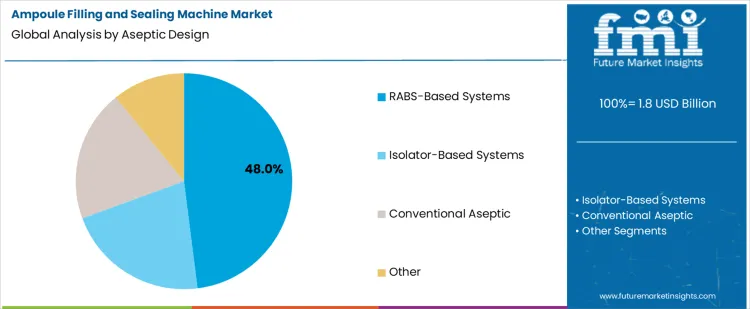
RABS-based systems are the leading aseptic design segment in the Ampoule Filling and Sealing Machine market, accounting for 48% of the market share. This growth is driven by the increasing demand for high-precision filling and sealing solutions in sterile environments. Restricted access barrier systems (RABS) provide a controlled environment that enhances the safety and sterility of the ampoule filling process, making them particularly suitable for aseptic manufacturing of injectables. RABS-based systems are preferred in applications where operator intervention is necessary but must be minimized to maintain sterility, making them ideal for many pharmaceutical production settings.
These systems offer significant benefits, such as reduced risk of contamination, better process control, and more flexible operation compared to fully isolated systems. The growing demand for biologics, injectables, and vaccines, especially in regions like North America and Europe, where regulatory standards are more stringent, is further driving the adoption of RABS-based systems. As pharmaceutical manufacturers seek to meet higher production demands while maintaining strict compliance with aseptic processing standards, RABS-based systems are expected to continue dominating the market.
What is Driving the Demand for Injectables Manufacturing Plants in the Market?
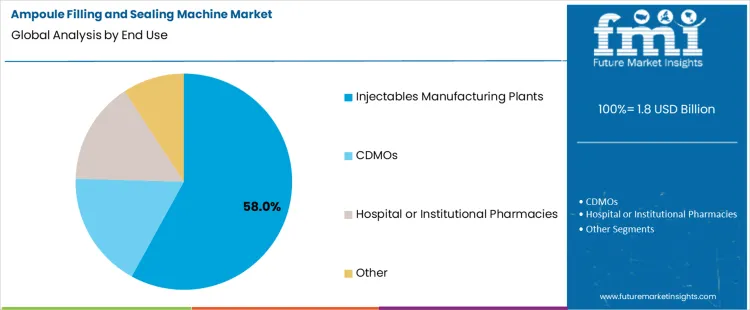
Injectables manufacturing plants represent the largest end-use segment in the Ampoule Filling and Sealing Machine market, holding 58% of the market share. This growth is primarily driven by the increasing production of injectable drugs, including biologics, vaccines, and other specialty treatments, which require high levels of sterility and precision in their manufacturing process. Ampoule filling and sealing machines are critical in ensuring that injectables are packaged in sterile, tamper-evident containers, making them safe for patient use. The demand for injectables is expanding globally, especially as new treatments for chronic diseases, cancer, and vaccines for emerging health threats are developed and brought to market.
The need for efficient, high-throughput, and compliant production lines for injectables is fueling the demand for advanced filling and sealing systems. The increasing number of contract manufacturers in regions like Asia Pacific, where pharmaceutical manufacturing is growing rapidly, is contributing to the strong demand from injectables manufacturing plants. As the demand for injectables continues to rise, the need for precise, sterile, and automated filling and sealing machines is expected to remain strong.
What are the Key Dynamics in the Ampoule Filling and Sealing Machine Market?
The ampoule filling and sealing machine market is expanding due to the growing demand for ampoules in the pharmaceutical, biotechnology, and healthcare industries. These machines are used to fill liquid medications, vaccines, and other sensitive products into glass or plastic ampoules, ensuring that they are sealed in a sterile environment. The market is driven by the increasing need for precision, efficiency, and reliability in pharmaceutical packaging. The rise in biologic drugs, vaccines, and the demand for single-dose packaging solutions are also fueling market growth. The growing trend of automation in pharmaceutical manufacturing, which enhances productivity and reduces human error, is contributing to the demand for advanced filling and sealing machines.
What are the Key Drivers of Growth in the Ampoule Filling and Sealing Machine Market?
Several factors are driving the growth of the ampoule filling and sealing machine market. First, the increasing demand for injectable drugs, particularly biologics, vaccines, and high-value therapeutics, is pushing pharmaceutical manufacturers to invest in efficient and reliable filling and sealing equipment. These machines ensure the sterile and precise packaging of these sensitive products, which is critical for maintaining their integrity. The growing focus on reducing contamination risks and improving the shelf life of injectable products further drives the need for advanced ampoule filling and sealing technologies. Moreover, the trend toward automation and the integration of advanced technologies, such as vision systems for quality control and robotics for improved accuracy and efficiency, is enhancing the performance of filling and sealing machines. The increasing adoption of single-dose packaging, driven by consumer convenience and the need for safer drug delivery, is further contributing to market growth.
What are the Key Restraints in the Ampoule Filling and Sealing Machine Market?
Despite its growth, the ampoule filling and sealing machine market faces several challenges. One key restraint is the high cost of these machines, particularly for small and medium-sized pharmaceutical manufacturers who may find the initial investment prohibitive. The complexity of integrating these machines into existing production lines can also be a barrier, as it often requires specialized training, maintenance, and support. The need for constant innovation and upgrades to meet evolving regulatory standards and the specific needs of new drug formulations can drive up costs for manufacturers. Furthermore, there are concerns regarding the environmental impact of glass ampoules, as they are not as eco-friendly as alternative packaging options, which could push some manufacturers to explore alternatives, potentially reducing demand for traditional ampoule filling and sealing machines.
What are the Key Trends in the Ampoule Filling and Sealing Machine Market?
Several trends are shaping the ampoule filling and sealing machine market. One key trend is the increasing adoption of automated and smart technologies that enhance the precision, speed, and reliability of filling and sealing processes. Automation, including the use of robotic arms and vision systems for real-time quality control, is improving the efficiency and consistency of ampoule packaging. Another trend is the development of more compact, versatile, and flexible machines that can accommodate a wider range of ampoule sizes, materials, and product types, making them suitable for diverse production needs.
There is growing interest in eco-friendly alternatives to glass ampoules, such as plastic ampoules and other sustainable packaging options, which is driving innovation in filling and sealing technologies. The trend toward single-use, sterile packaging solutions is also contributing to the demand for ampoule filling and sealing machines, particularly in the pharmaceutical industry, where patient safety and product integrity are paramount. Furthermore, the increasing focus on precision and quality control is leading to the integration of advanced systems that monitor every stage of the filling and sealing process to ensure optimal performance and compliance with regulatory standards.
What is the Country-Wise Analysis of the Ampoule Filling and Sealing Machine Market?
The ampoule filling and sealing machine market is experiencing growth as industries such as pharmaceuticals, biotechnology, and chemicals demand highly efficient equipment for packaging liquid medicines and vaccines. Ampoules are commonly used for the packaging of injectable drugs, and the increasing demand for sterile and reliable packaging solutions is driving the growth of filling and sealing machines. The market is supported by the rising pharmaceutical production, particularly in emerging economies. Countries like India, China, Saudi Arabia, the USA, and Germany are witnessing growth in this market, influenced by the expansion of the pharmaceutical sector, the need for high-quality packaging solutions, and government initiatives to boost healthcare infrastructure.
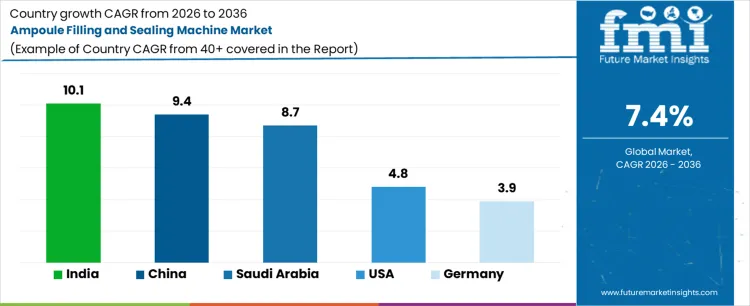
| Country | CAGR (%) |
|---|---|
| India | 10.1 |
| China | 9.4 |
| Saudi Arabia | 8.7 |
| USA | 4.8 |
| Germany | 3.9 |
What is Driving the Growth of the Ampoule Filling and Sealing Machine Market in India?
India’s ampoule filling and sealing machine market is growing at a CAGR of 10.1%, the highest among the countries analyzed. The market growth is primarily driven by India’s rapidly expanding pharmaceutical industry, which is one of the largest in the world. As the production of injectable drugs, vaccines, and other liquid medicines increases, the demand for efficient filling and sealing machines is rising. India’s focus on pharmaceutical manufacturing and export, as well as increasing investments in the healthcare sector, are key factors contributing to the demand for advanced packaging solutions. The government’s initiatives to improve healthcare infrastructure and the growing export of pharmaceutical products are expected to continue driving the growth of the market.
How is the Ampoule Filling and Sealing Machine Market Performing in China?
China’s ampoule filling and sealing machine market is growing at a CAGR of 9.4%. China’s pharmaceutical industry is one of the largest globally, and the demand for high-quality ampoule filling and sealing machines is being driven by the country’s increasing production of injectable drugs and vaccines. The government’s focus on improving healthcare and pharmaceutical manufacturing standards is further supporting the growth of this market. With China’s growing pharmaceutical export market and the expansion of healthcare facilities, the demand for automated and efficient filling and sealing machines is expected to rise. As the country’s pharmaceutical sector continues to modernize, the need for high-quality packaging solutions will continue to drive the market.
What Factors are Shaping the Ampoule Filling and Sealing Machine Market in Saudi Arabia?
Saudi Arabia’s ampoule filling and sealing machine market is growing at a CAGR of 8.7%. The growth in Saudi Arabia is driven by the expansion of the pharmaceutical and healthcare sectors, which are supported by the government’s focus on improving healthcare infrastructure and the production of medicines. Saudi Arabia’s push to diversify its economy through industrialization and healthcare development is fueling demand for reliable and efficient filling and sealing machines. The increasing number of pharmaceutical manufacturing units in the region, along with the need for high-quality packaging solutions for injectables, is further driving the growth of the market. As Saudi Arabia continues to invest in the healthcare sector, the demand for advanced filling and sealing technology is expected to continue increasing.
How is the Ampoule Filling and Sealing Machine Market Evolving in the USA?
The ampoule filling and sealing machine market in the USA is growing at a CAGR of 4.8%. While the growth rate is slower compared to other countries, the USA remains a key player in the global pharmaceutical manufacturing market. The demand for ampoule filling and sealing machines in the USA is driven by the country’s need for high-quality, reliable packaging solutions for injectable drugs, which are essential in the pharmaceutical and biotechnology industries. The USA’s strong pharmaceutical sector, government support for healthcare innovations, and continuous advancements in manufacturing technologies are contributing to market growth. As the demand for injectables and vaccines increases, the market for filling and sealing machines is expected to grow steadily in the USA.
What is Contributing to the Growth of the Ampoule Filling and Sealing Machine Market in Germany?
Germany’s ampoule filling and sealing machine market is growing at a CAGR of 3.9%. Germany, known for its strong pharmaceutical and healthcare industries, is witnessing increased demand for efficient packaging solutions for injectable medicines. The country’s focus on high manufacturing standards, precision, and automation in pharmaceutical production is driving the need for advanced filling and sealing machines. Germany’s pharmaceutical export market, along with its well-established healthcare infrastructure, is contributing to market growth. While the market growth is slower compared to other countries, Germany’s leadership in pharmaceutical manufacturing and technology is expected to sustain steady demand for ampoule filling and sealing machines in the coming years.
What is the Competitive Landscape for the Ampoule Filling and Sealing Machine Market?
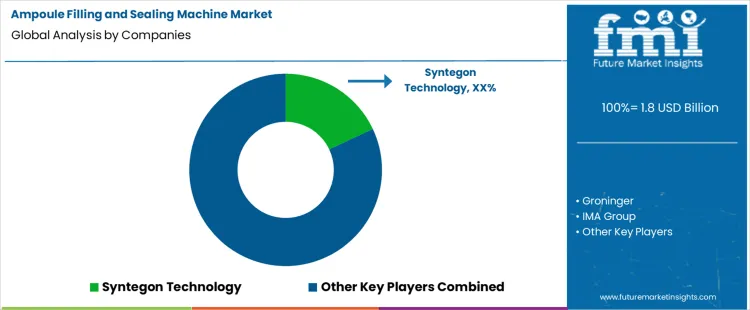
The ampoule filling and sealing machine market is growing as the pharmaceutical and healthcare industries demand more advanced and automated solutions for filling and sealing ampoules. Syntegon Technology leads the market, offering state-of-the-art filling and sealing machines designed for precision, reliability, and efficiency. Their technology is widely adopted for both large-scale production and smaller batch processing, with a focus on minimizing product loss and maximizing throughput. Groninger is another key player in the market, known for its innovative, high-performance ampoule filling and sealing systems. The company provides solutions that cater to a range of applications, emphasizing flexibility, hygiene, and scalability. IMA Group competes by offering highly automated and efficient filling and sealing machines, focusing on both high-volume and high-precision applications in the pharmaceutical industry.
OPTIMA Pharma is a significant competitor, providing high-quality, customizable ampoule filling systems that integrate the latest technologies for enhanced performance and ease of use. Marchesini Group offers a wide range of ampoule filling and sealing machines, with a focus on technology integration and user-friendly interfaces to streamline production processes. Bausch+Ströbel is actively involved in the market, offering advanced filling and sealing solutions with a focus on precision and automation to meet the demands of modern pharmaceutical production. Romaco provides innovative equipment for filling and sealing ampoules, ensuring high levels of accuracy and productivity. NJM Packaging focuses on offering flexible and efficient filling and sealing machines, catering to the needs of pharmaceutical and biotech companies. Cozzoli Machine Company and Dara Pharma are also key players, providing highly reliable ampoule filling systems designed for easy integration into pharmaceutical production lines, with an emphasis on scalability and cost-effectiveness.
To remain competitive in the ampoule filling and sealing machine market, companies focus on technological innovation, automation, and customization to meet the diverse needs of the pharmaceutical industry. Syntegon Technology continues to lead by advancing its machines with enhanced automation, real-time monitoring, and customizable features, ensuring higher efficiency and reduced downtime. Groninger is improving its solutions by focusing on precision and flexibility, allowing for faster changeovers and catering to both large-scale and small-batch production requirements. IMA Group is investing in automation technologies that improve the overall efficiency of ampoule filling lines, reducing labor costs and increasing throughput.
OPTIMA Pharma focuses on offering customizable, high-precision machines that can be tailored to specific filling and sealing needs. Marchesini Group is expanding its product line with machines that offer both high performance and ease of operation, making them ideal for a variety of pharmaceutical applications. Bausch+Ströbel is prioritizing the development of fully automated solutions that improve production efficiency while minimizing the risk of contamination. Romaco and NJM Packaging are enhancing their systems with more advanced features such as digital interfaces and real-time monitoring to ensure optimal performance. Cozzoli Machine Company and Dara Pharma focus on delivering high-quality, cost-effective solutions for smaller-scale production needs, ensuring flexibility and efficiency for their customers. These strategies, combined with the growing demand for faster, more efficient pharmaceutical manufacturing, position these companies to lead the ampoule filling and sealing machine market.
Key Players of the Ampoule Filling and Sealing Machine Market
- Syntegon Technology
- Groninger
- IMA Group
- OPTIMA Pharma
- Marchesini Group
- Bausch+Ströbel
- Romaco
- NJM Packaging
- Cozzoli Machine Company
- Dara Pharma
Scope of the Report
| Items | Values |
|---|---|
| Quantitative Units (2026) | USD Billion |
| Line Configuration | Standalone Filling & Sealing Machines, Integrated Wash-Fill-Seal Lines, High-Speed Rotary Lines, Other |
| Aseptic Design | RABS-Based Systems, Isolator-Based Systems, Conventional Aseptic, Other |
| End Use | Injectables Manufacturing Plants, CDMOs, Hospital or Institutional Pharmacies, Other |
| Sales Channel | Direct OEM Sales, EPC or Line Integrators, Distributors, Other |
| Companies | Syntegon Technology, Groninger, IMA Group, OPTIMA Pharma, Marchesini Group, Bausch+Ströbel, Romaco, NJM Packaging, Cozzoli Machine Company, Dara Pharma |
| Regions Covered | North America, Latin America, Western Europe, Eastern Europe, South Asia and Pacific, East Asia, Middle East & Africa |
| Countries Covered | United States, Canada, Mexico, Brazil, Argentina, Germany, France, United Kingdom, Italy, Spain, Netherlands, China, India, Japan, South Korea, ANZ, GCC Countries, South Africa |
| Additional Attributes | Dollar by sales by line configuration, aseptic design, end use, and sales channel. Includes market trends towards automation, regulatory compliance, cost-effectiveness, and the role of ampoule filling and sealing machines in enhancing efficiency and safety in pharmaceutical manufacturing. |
Ampoule Filling and Sealing Machine Market Segmentation
Line Configuration
- Standalone Filling & Sealing Machines
- Integrated Wash-Fill-Seal Lines
- High-Speed Rotary Lines
- Other
Aseptic Design
- RABS-Based Systems
- Isolator-Based Systems
- Conventional Aseptic
- Other
End Use
- Injectables Manufacturing Plants
- CDMOs
- Hospital or Institutional Pharmacies
- Other
Sales Channel
- Direct OEM Sales
- EPC or Line Integrators
- Distributors
- Other
Region
- Asia Pacific
- China
- Japan
- India
- Australia & New Zealand
- ASEAN
- Rest of Asia Pacific
- Europe
- Germany
- United Kingdom
- France
- Italy
- Spain
- Nordic
- BENELUX
- Rest of Europe
- North America
- United States
- Canada
- Mexico
- Latin America
- Brazil
- Argentina
- Rest of Latin America
- Middle East & Africa
- Kingdom of Saudi Arabia
- Other GCC Countries
- South Africa
- Rest of Middle East & Africa
Bibliography
- United States Food and Drug Administration (FDA). (2024). Guidance for Industry: Sterile Drug Products Produced by Aseptic Processing.
- European Medicines Agency (EMA). (2024). Annex 1: Manufacture of Sterile Medicinal Products.
- World Health Organization (WHO). (2024). WHO Technical Report Series: Sterile Pharmaceutical Manufacturing Practices.
- International Organization for Standardization (ISO). (2024). ISO 13408: Aseptic processing of health care products.
- International Society for Pharmaceutical Engineering (ISPE). (2024). Baseline Guide: Aseptic Processing and Filling Lines.
Frequently Asked Questions
How big is the ampoule filling and sealing machine market in 2026?
The global ampoule filling and sealing machine market is estimated to be valued at USD 1.8 billion in 2026.
What will be the size of ampoule filling and sealing machine market in 2036?
The market size for the ampoule filling and sealing machine market is projected to reach USD 3.7 billion by 2036.
How much will be the ampoule filling and sealing machine market growth between 2026 and 2036?
The ampoule filling and sealing machine market is expected to grow at a 7.4% CAGR between 2026 and 2036.
What are the key product types in the ampoule filling and sealing machine market?
The key product types in ampoule filling and sealing machine market are integrated wash–fill–seal lines, standalone filling & sealing machines, high-speed rotary lines and other.
Which aseptic design segment to contribute significant share in the ampoule filling and sealing machine market in 2026?
In terms of aseptic design, rabs-based systems segment to command 48.0% share in the ampoule filling and sealing machine market in 2026.
Preview the report firsthand - request a free sample
Get SampleGet the brochure for pricing and purchase details.
Get PDFTable of Content
- Executive Summary
- Global Market Outlook
- Demand-side Trends
- Supply-side Trends
- Technology Roadmap Analysis
- Analysis and Recommendations
- Market Overview
- Market Coverage / Taxonomy
- Market Definition / Scope / Limitations
- Market Background
- Market Dynamics
- Drivers
- Restraints
- Opportunity
- Trends
- Scenario Forecast
- Demand in Optimistic Scenario
- Demand in Likely Scenario
- Demand in Conservative Scenario
- Opportunity Map Analysis
- Product Life Cycle Analysis
- Supply Chain Analysis
- Investment Feasibility Matrix
- Value Chain Analysis
- PESTLE and Porter’s Analysis
- Regulatory Landscape
- Regional Parent Market Outlook
- Production and Consumption Statistics
- Import and Export Statistics
- Market Dynamics
- Global Market Analysis 2021 to 2025 and Forecast, 2026 to 2036
- Historical Market Size Value (USD Million) Analysis, 2021 to 2025
- Current and Future Market Size Value (USD Million) Projections, 2026 to 2036
- Y-o-Y Growth Trend Analysis
- Absolute $ Opportunity Analysis
- Global Market Pricing Analysis 2021 to 2025 and Forecast 2026 to 2036
- Global Market Analysis 2021 to 2025 and Forecast 2026 to 2036, By Line Configuration
- Introduction / Key Findings
- Historical Market Size Value (USD Million) Analysis By Line Configuration , 2021 to 2025
- Current and Future Market Size Value (USD Million) Analysis and Forecast By Line Configuration , 2026 to 2036
- Integrated Wash-Fill-Seal Lines
- Standalone Filling & Sealing Machines
- High-Speed Rotary Lines
- Other
- Integrated Wash-Fill-Seal Lines
- Y-o-Y Growth Trend Analysis By Line Configuration , 2021 to 2025
- Absolute $ Opportunity Analysis By Line Configuration , 2026 to 2036
- Global Market Analysis 2021 to 2025 and Forecast 2026 to 2036, By Aseptic Design
- Introduction / Key Findings
- Historical Market Size Value (USD Million) Analysis By Aseptic Design, 2021 to 2025
- Current and Future Market Size Value (USD Million) Analysis and Forecast By Aseptic Design, 2026 to 2036
- RABS-Based Systems
- Isolator-Based Systems
- Conventional Aseptic
- Other
- RABS-Based Systems
- Y-o-Y Growth Trend Analysis By Aseptic Design, 2021 to 2025
- Absolute $ Opportunity Analysis By Aseptic Design, 2026 to 2036
- Global Market Analysis 2021 to 2025 and Forecast 2026 to 2036, By End Use
- Introduction / Key Findings
- Historical Market Size Value (USD Million) Analysis By End Use, 2021 to 2025
- Current and Future Market Size Value (USD Million) Analysis and Forecast By End Use, 2026 to 2036
- Injectables Manufacturing Plants
- CDMOs
- Hospital or Institutional Pharmacies
- Other
- Injectables Manufacturing Plants
- Y-o-Y Growth Trend Analysis By End Use, 2021 to 2025
- Absolute $ Opportunity Analysis By End Use, 2026 to 2036
- Global Market Analysis 2021 to 2025 and Forecast 2026 to 2036, By Sales Channel
- Introduction / Key Findings
- Historical Market Size Value (USD Million) Analysis By Sales Channel, 2021 to 2025
- Current and Future Market Size Value (USD Million) Analysis and Forecast By Sales Channel, 2026 to 2036
- Direct OEM Sales
- EPC or Line Integrators
- Distributors
- Other
- Direct OEM Sales
- Y-o-Y Growth Trend Analysis By Sales Channel, 2021 to 2025
- Absolute $ Opportunity Analysis By Sales Channel, 2026 to 2036
- Global Market Analysis 2021 to 2025 and Forecast 2026 to 2036, By Region
- Introduction
- Historical Market Size Value (USD Million) Analysis By Region, 2021 to 2025
- Current Market Size Value (USD Million) Analysis and Forecast By Region, 2026 to 2036
- North America
- Latin America
- Western Europe
- Eastern Europe
- East Asia
- South Asia and Pacific
- Middle East & Africa
- Market Attractiveness Analysis By Region
- North America Market Analysis 2021 to 2025 and Forecast 2026 to 2036, By Country
- Historical Market Size Value (USD Million) Trend Analysis By Market Taxonomy, 2021 to 2025
- Market Size Value (USD Million) Forecast By Market Taxonomy, 2026 to 2036
- By Country
- USA
- Canada
- Mexico
- By Line Configuration
- By Aseptic Design
- By End Use
- By Sales Channel
- By Country
- Market Attractiveness Analysis
- By Country
- By Line Configuration
- By Aseptic Design
- By End Use
- By Sales Channel
- Key Takeaways
- Latin America Market Analysis 2021 to 2025 and Forecast 2026 to 2036, By Country
- Historical Market Size Value (USD Million) Trend Analysis By Market Taxonomy, 2021 to 2025
- Market Size Value (USD Million) Forecast By Market Taxonomy, 2026 to 2036
- By Country
- Brazil
- Chile
- Rest of Latin America
- By Line Configuration
- By Aseptic Design
- By End Use
- By Sales Channel
- By Country
- Market Attractiveness Analysis
- By Country
- By Line Configuration
- By Aseptic Design
- By End Use
- By Sales Channel
- Key Takeaways
- Western Europe Market Analysis 2021 to 2025 and Forecast 2026 to 2036, By Country
- Historical Market Size Value (USD Million) Trend Analysis By Market Taxonomy, 2021 to 2025
- Market Size Value (USD Million) Forecast By Market Taxonomy, 2026 to 2036
- By Country
- Germany
- UK
- Italy
- Spain
- France
- Nordic
- BENELUX
- Rest of Western Europe
- By Line Configuration
- By Aseptic Design
- By End Use
- By Sales Channel
- By Country
- Market Attractiveness Analysis
- By Country
- By Line Configuration
- By Aseptic Design
- By End Use
- By Sales Channel
- Key Takeaways
- Eastern Europe Market Analysis 2021 to 2025 and Forecast 2026 to 2036, By Country
- Historical Market Size Value (USD Million) Trend Analysis By Market Taxonomy, 2021 to 2025
- Market Size Value (USD Million) Forecast By Market Taxonomy, 2026 to 2036
- By Country
- Russia
- Poland
- Hungary
- Balkan & Baltic
- Rest of Eastern Europe
- By Line Configuration
- By Aseptic Design
- By End Use
- By Sales Channel
- By Country
- Market Attractiveness Analysis
- By Country
- By Line Configuration
- By Aseptic Design
- By End Use
- By Sales Channel
- Key Takeaways
- East Asia Market Analysis 2021 to 2025 and Forecast 2026 to 2036, By Country
- Historical Market Size Value (USD Million) Trend Analysis By Market Taxonomy, 2021 to 2025
- Market Size Value (USD Million) Forecast By Market Taxonomy, 2026 to 2036
- By Country
- China
- Japan
- South Korea
- By Line Configuration
- By Aseptic Design
- By End Use
- By Sales Channel
- By Country
- Market Attractiveness Analysis
- By Country
- By Line Configuration
- By Aseptic Design
- By End Use
- By Sales Channel
- Key Takeaways
- South Asia and Pacific Market Analysis 2021 to 2025 and Forecast 2026 to 2036, By Country
- Historical Market Size Value (USD Million) Trend Analysis By Market Taxonomy, 2021 to 2025
- Market Size Value (USD Million) Forecast By Market Taxonomy, 2026 to 2036
- By Country
- India
- ASEAN
- Australia & New Zealand
- Rest of South Asia and Pacific
- By Line Configuration
- By Aseptic Design
- By End Use
- By Sales Channel
- By Country
- Market Attractiveness Analysis
- By Country
- By Line Configuration
- By Aseptic Design
- By End Use
- By Sales Channel
- Key Takeaways
- Middle East & Africa Market Analysis 2021 to 2025 and Forecast 2026 to 2036, By Country
- Historical Market Size Value (USD Million) Trend Analysis By Market Taxonomy, 2021 to 2025
- Market Size Value (USD Million) Forecast By Market Taxonomy, 2026 to 2036
- By Country
- Kingdom of Saudi Arabia
- Other GCC Countries
- Turkiye
- South Africa
- Other African Union
- Rest of Middle East & Africa
- By Line Configuration
- By Aseptic Design
- By End Use
- By Sales Channel
- By Country
- Market Attractiveness Analysis
- By Country
- By Line Configuration
- By Aseptic Design
- By End Use
- By Sales Channel
- Key Takeaways
- Key Countries Market Analysis
- USA
- Pricing Analysis
- Market Share Analysis, 2025
- By Line Configuration
- By Aseptic Design
- By End Use
- By Sales Channel
- Canada
- Pricing Analysis
- Market Share Analysis, 2025
- By Line Configuration
- By Aseptic Design
- By End Use
- By Sales Channel
- Mexico
- Pricing Analysis
- Market Share Analysis, 2025
- By Line Configuration
- By Aseptic Design
- By End Use
- By Sales Channel
- Brazil
- Pricing Analysis
- Market Share Analysis, 2025
- By Line Configuration
- By Aseptic Design
- By End Use
- By Sales Channel
- Chile
- Pricing Analysis
- Market Share Analysis, 2025
- By Line Configuration
- By Aseptic Design
- By End Use
- By Sales Channel
- Germany
- Pricing Analysis
- Market Share Analysis, 2025
- By Line Configuration
- By Aseptic Design
- By End Use
- By Sales Channel
- UK
- Pricing Analysis
- Market Share Analysis, 2025
- By Line Configuration
- By Aseptic Design
- By End Use
- By Sales Channel
- Italy
- Pricing Analysis
- Market Share Analysis, 2025
- By Line Configuration
- By Aseptic Design
- By End Use
- By Sales Channel
- Spain
- Pricing Analysis
- Market Share Analysis, 2025
- By Line Configuration
- By Aseptic Design
- By End Use
- By Sales Channel
- France
- Pricing Analysis
- Market Share Analysis, 2025
- By Line Configuration
- By Aseptic Design
- By End Use
- By Sales Channel
- India
- Pricing Analysis
- Market Share Analysis, 2025
- By Line Configuration
- By Aseptic Design
- By End Use
- By Sales Channel
- ASEAN
- Pricing Analysis
- Market Share Analysis, 2025
- By Line Configuration
- By Aseptic Design
- By End Use
- By Sales Channel
- Australia & New Zealand
- Pricing Analysis
- Market Share Analysis, 2025
- By Line Configuration
- By Aseptic Design
- By End Use
- By Sales Channel
- China
- Pricing Analysis
- Market Share Analysis, 2025
- By Line Configuration
- By Aseptic Design
- By End Use
- By Sales Channel
- Japan
- Pricing Analysis
- Market Share Analysis, 2025
- By Line Configuration
- By Aseptic Design
- By End Use
- By Sales Channel
- South Korea
- Pricing Analysis
- Market Share Analysis, 2025
- By Line Configuration
- By Aseptic Design
- By End Use
- By Sales Channel
- Russia
- Pricing Analysis
- Market Share Analysis, 2025
- By Line Configuration
- By Aseptic Design
- By End Use
- By Sales Channel
- Poland
- Pricing Analysis
- Market Share Analysis, 2025
- By Line Configuration
- By Aseptic Design
- By End Use
- By Sales Channel
- Hungary
- Pricing Analysis
- Market Share Analysis, 2025
- By Line Configuration
- By Aseptic Design
- By End Use
- By Sales Channel
- Kingdom of Saudi Arabia
- Pricing Analysis
- Market Share Analysis, 2025
- By Line Configuration
- By Aseptic Design
- By End Use
- By Sales Channel
- Turkiye
- Pricing Analysis
- Market Share Analysis, 2025
- By Line Configuration
- By Aseptic Design
- By End Use
- By Sales Channel
- South Africa
- Pricing Analysis
- Market Share Analysis, 2025
- By Line Configuration
- By Aseptic Design
- By End Use
- By Sales Channel
- USA
- Market Structure Analysis
- Competition Dashboard
- Competition Benchmarking
- Market Share Analysis of Top Players
- By Regional
- By Line Configuration
- By Aseptic Design
- By End Use
- By Sales Channel
- Competition Analysis
- Competition Deep Dive
- Syntegon Technology
- Overview
- Product Portfolio
- Profitability by Market Segments (Product/Age /Sales Channel/Region)
- Sales Footprint
- Strategy Overview
- Marketing Strategy
- Product Strategy
- Channel Strategy
- Groninger
- IMA Group
- OPTIMA Pharma
- Marchesini Group
- Bausch+Ströbel
- Romaco
- NJM Packaging
- Cozzoli Machine Company
- Dara Pharma
- Syntegon Technology
- Competition Deep Dive
- Assumptions & Acronyms Used
- Research Methodology


