

- Market Size (2026)
- USD 42.44 Mn
- Forecast (2036)
- USD 112.31 Mn
- CAGR (2026 to 2036)
- 10.22%
How big is the aprocitentan market in 2026?
USD 42.44 million in 2026 and USD 112.31 million by 2036 at a 10.22% CAGR.
The aprocitentan industry value is forecast to grow from USD 38.30 million in 2025 to USD 112.31 million by 2036 at 10.22% CAGR, reflected by approved resistant-hypertension medicines influencing a defined API demand base. Powder is forecast to represent 71.0% share in 2026 as tablet manufacturers prefer controlled weighing and transfer. Direct sales are expected to secure 74.0% share in 2026, led by technical qualification and direct documentation review.
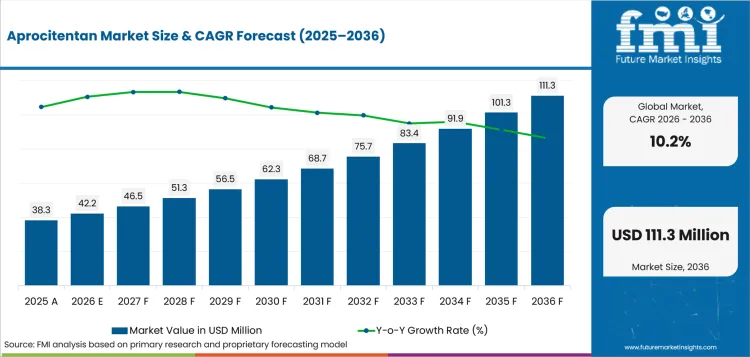
| Metric | Value |
|---|---|
| 2026 Market Size | USD 42.44 million |
| 2036 Market Size | USD 112.31 million |
| Forecast CAGR (2026-2036) | 10.22% |
| Leading Sales Channel | Direct Sales |
| Direct Sales Share (2026) | 74.0% |
| Leading Form | Powder |
| Powder Share (2026) | 71.0% |
| Fastest-growing Country | China |
| China CAGR by 2036 | 11.8% |
Summary of the Aprocitentan Market
- Demand and Growth Drivers
- FDA and European approval created a clear commercial route for aprocitentan API after clinical development.
- Resistant-hypertension treatment gives suppliers a defined specialist use case rather than general antihypertensive exposure.
- FDA removal of TRYVIO REMS requirements reduced dispensing burden across the United States channel.
- Product and Segment View
- Direct sales are expected to secure 74.0% share in 2026, supported by audit-heavy qualification and confidential technical packs.
- Powder is forecast to represent 71.0% share in 2026, led by controlled transfer and formulation handling.
- The >=99.5% purity grade is projected to hold 63.5% share in 2026, influenced by impurity-control requirements.
- Geography and Competitive Outlook
- China is projected to record 11.8% CAGR by 2036, backed by complex API synthesis capability.
- India is expected to expand at 11.2% CAGR by 2036, driven by export-oriented API and formulation strength.
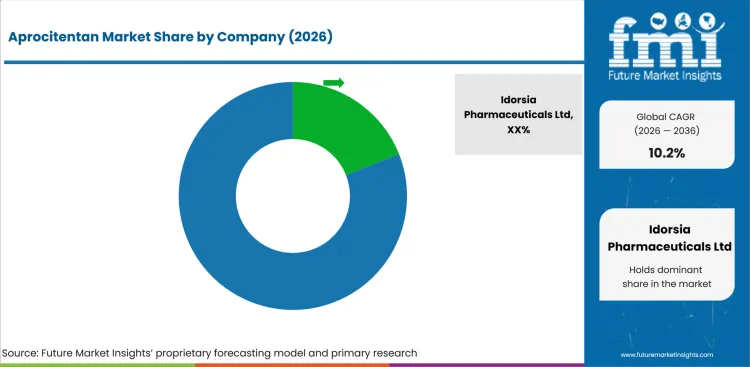
- Idorsia Pharmaceuticals leads verified commercial positioning through approval ownership and product access.
- Janssen Biotech and selected API firms compete around specialty commercialization support and regulated chemistry capability.
- Analyst Opinion
- Anurag Sharma, Principal Consultant for Healthcare at FMI, opines, “Aprocitentan is a specialty API market built around proof rather than bulk volume. The molecule is linked to resistant hypertension, so buyers will review impurity control and lawful process access before qualification. Idorsia has the clearest verified commercial position today. Other API firms can compete only after proving process credibility and buyer qualification.”
Commercial planning has gained stronger support as aprocitentan moved from clinical evidence into regulated product access. FDA stated in July 2024 that TRYVIO was evaluated in 730 adult patients taking at least 3 blood-pressure medicines. FDA later stated in March 2026 that REMS requirements had been eliminated in April 2025 for TRYVIO and other endothelin receptor antagonist medicines. EMA stated Jeraygo is used in adults whose blood pressure cannot be controlled by at least 3 other medicines. Suppliers with solid-form evidence and validated analytical files can gain stronger buyer confidence across specialist cardiovascular API sourcing.
Which factors support expansion in the aprocitentan market?
Specialist API revenue and compliant documentation support market value across regulated cardiovascular channels.
- Market value is supported by aprocitentan API revenue before wider country approvals add incremental demand.
- Supplier pricing reflects assay strength and impurity limits before scale chemistry improves cost confidence.
- Revenue improves as approved medicines create structured sourcing needs for resistant-hypertension products.
- Buyer trust rises as suppliers connect batch records and analytical methods with commercial material.
Why is the aprocitentan market growing?
Specialist hypertension care is creating demand for an approved add-on therapy with documented API quality.
Global hypertension burden supports targeted cardiovascular product planning. WHO reported 1.4 billion adults aged 30 to 79 living with hypertension in 2024, equal to 33% of adults in that age range. Aprocitentan serves only a focused treatment pool, yet unmet control needs strengthen approved add-on therapy value. Finished-dose holders need reliable API input, while qualified suppliers must prove impurity control and solid-form consistency before commercial supply.
How is the aprocitentan market segmented?
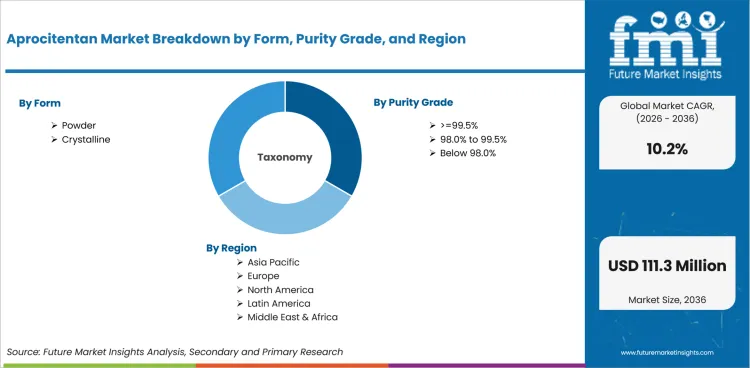
The aprocitentan industry is segmented by form, purity grade, application, sales channel, and buyer type.
- Powder is projected to secure 71.0% share in 2026, led by controlled weighing, transfer, and tablet-batch preparation.
- The >=99.5% purity grade is anticipated to hold 63.5% share in 2026 as regulated cardiovascular supply leaves little room for impurity uncertainty.
- Resistant hypertension is expected to capture 82.0% share in 2026, guided by approved-label use and specialist prescribing.
- Direct sales are forecast to represent 74.0% share in 2026, supported by audit review, technical packs, and direct buyer accountability.
- Originator and authorization-holder buyers are projected to account for 58.0% share in 2026, shaped by product-file control and supplier approval discipline.
Why does powder lead form demand?
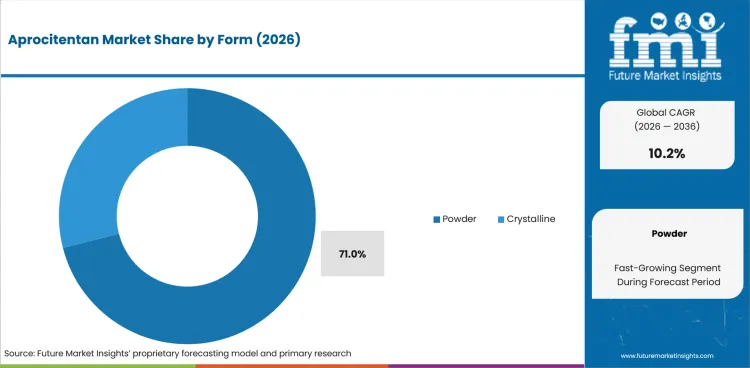
- Powder is projected to account for 71.0% share in 2026, influenced by controlled weighing, blending, transfer, and formulation planning.
- Crystalline material retains value for solid-form review. Commercial tablet teams favor powder handling for early regulated batches.
What keeps the >=99.5% grade ahead?
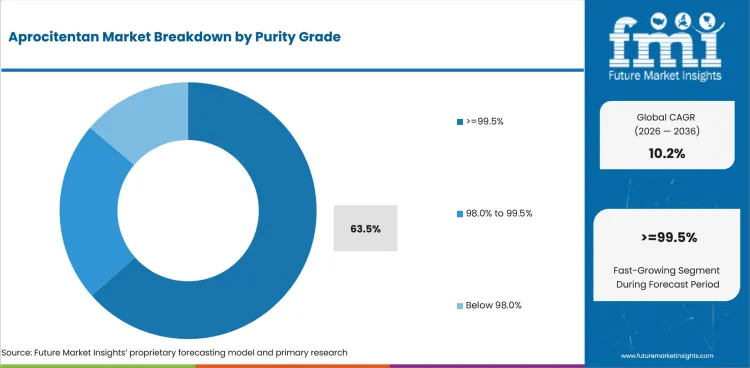
- The >=99.5% purity grade is anticipated to hold 63.5% share in 2026, led by impurity control and regulated-buyer confidence.
- Lower-purity material stays more suitable for research and early process work before commercial qualification.
Which application leads the aprocitentan market?
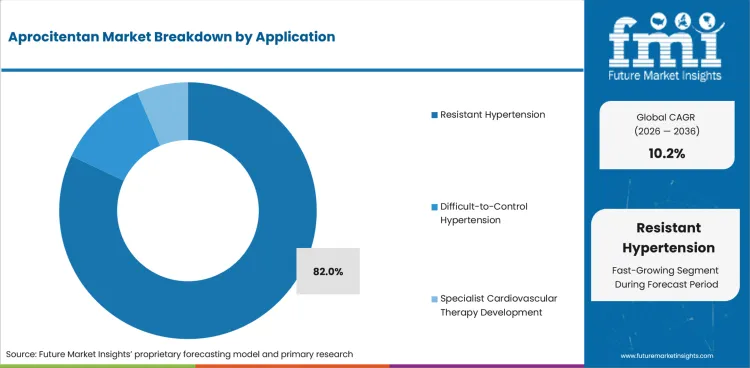
- Resistant hypertension is forecast to account for 82.0% share in 2026, reflected by approved use among adults needing added blood-pressure control.
- Difficult-to-control hypertension and specialist cardiovascular therapy development create secondary demand without displacing label-led supply.
Which sales channel leads the aprocitentan market?
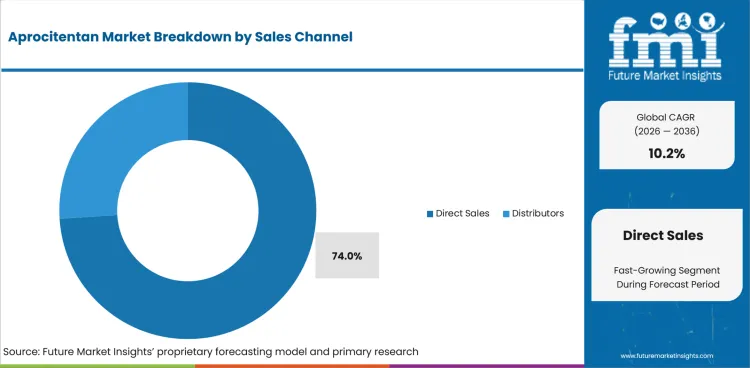
- Direct sales are expected to represent 74.0% share in 2026, shaped by confidential documentation, audit support, and product-file review.
- Distributor routes support limited regional or development access, with direct supplier accountability remaining stronger for regulated supply.
Which buyer type leads the aprocitentan market?
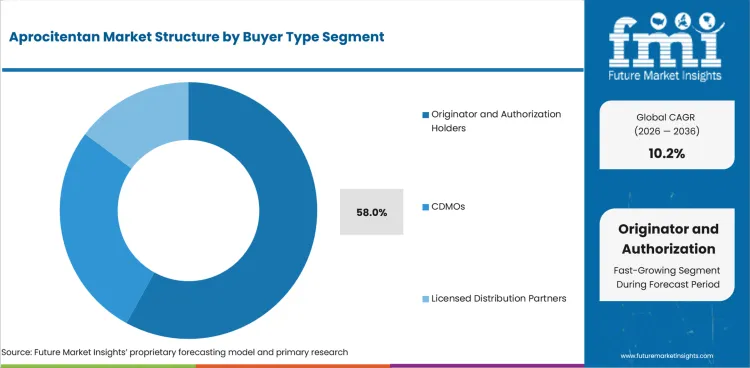
- Originator and authorization-holder buyers are projected to account for 58.0% share in 2026, led by approved-product control and supplier qualification.
- CDMOs and licensed partners gain selective roles as formulation files and scale-up packages mature.
What are the driver, restraints, and opportunities in the aprocitentan market?
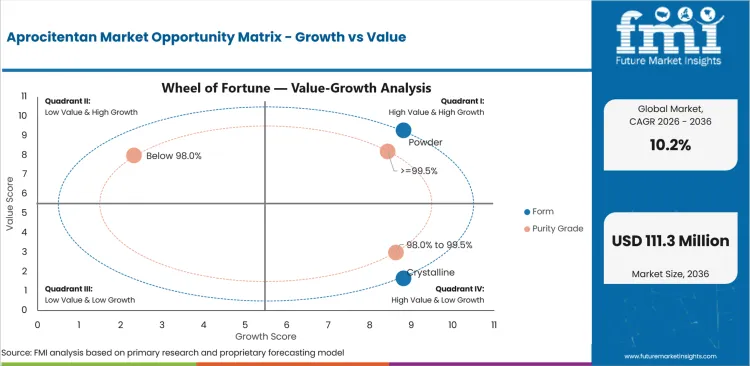
Approved specialist use and direct documentation support demand while patent control limits open API participation.
- Driver: Approved resistant-hypertension products create a defined demand base for aprocitentan API.
- Restraint: Authorization-holder control and patent discipline restrict open commercial API participation.
- Opportunity: Qualified chemistry suppliers can compete through solid-form data, impurity control, and validated documentation.
Aprocitentan Market Demand Outlook
Demand outlook is moving toward documentation-led API qualification for specialist cardiovascular medicines. WHO stated in 2025 that about 630 million adults with hypertension were diagnosed and treated in 2024. Resistant-hypertension medicines serve a smaller portion of that treated pool, yet approved add-on therapy creates value for API suppliers that can meet strict cardiovascular quality expectations. Suppliers will need consistent assay data and product-file alignment rather than bulk production scale alone.
Access Restraint and Diagnosis Burden Analysis
Access restraint is shaped by diagnosis gaps, specialist routing, and payer review before premium therapy adoption. WHO estimated 600 million adults with hypertension were unaware of their condition in 2024. Undiagnosed patients cannot enter resistant-hypertension pathways, which slows the clinical route from general disease burden to aprocitentan-linked API demand. Suppliers therefore face an access curve defined by medical identification, specialist prescribing, and finished-dose availability.
Documentation and Qualified Supply Opportunity Analysis
Opportunity is concentrated around regulatory evidence and commercial batch reliability. EMA recommended 104 human medicines in 2025, including 38 medicines with a new active substance. New active-substance review keeps technical evidence under close scrutiny, especially for specialist therapies. Aprocitentan suppliers that connect assay validation and lawful process records can build stronger qualification prospects.
Which countries are growing fastest in the aprocitentan market?
China 11.8% CAGR, India 11.2% CAGR, United States 10.8% CAGR, South Korea 10.6% CAGR, United Kingdom 10.4% CAGR, Germany 10.2% CAGR, France 10.0% CAGR, and Japan 9.4% CAGR through 2036.
.webp "Top Country Growth Comparison Aprocitentan Market Cagr (2026 2036)")
| Country | CAGR |
|---|---|
| China | 11.8% |
| India | 11.2% |
| United States | 10.8% |
| South Korea | 10.6% |
| United Kingdom | 10.4% |
| Germany | 10.2% |
| France | 10.0% |
| Japan | 9.4% |
Source: Future Market Insights, 2026.
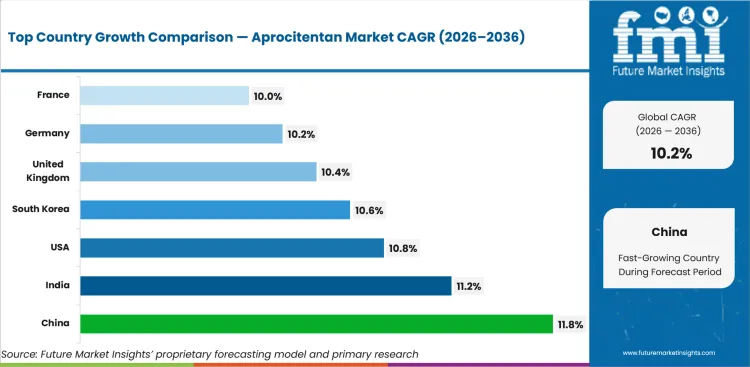
How do country-level CAGRs compare in the aprocitentan market?
China leads country expansion while Japan records the most cautious expansion outlook among profiled markets.
- China is forecast to record 11.8% CAGR by 2036, reflected by complex API synthesis supporting supplier screening.
- India is expected to expand at 11.2% CAGR from 2026 to 2036 through export-oriented API capability.
- The United States is projected to grow at 10.8% CAGR through 2036 due to TRYVIO approval and specialty access.
- South Korea is estimated to rise at 10.6% CAGR by 2036 with biopharma quality systems and cardiovascular care demand.
- The United Kingdom is forecast to grow at 10.4% CAGR through 2036, driven by national approval supporting controlled access.
- Germany is expected to post 10.2% CAGR by 2036, led by European authorization promoting specialist use.
- France is projected to expand at 10.0% CAGR through 2036, guided by hospital-led cardiovascular care and regulated supply.
- Japan is forecast to grow at 9.4% CAGR by 2036 as cautious access moderates specialist uptake.
How fast is the aprocitentan market growing in China?
An 11.8% CAGR through 2036 reflects API manufacturing depth and resistant-hypertension demand.
Country Market Snapshot Table
| Parameter | Value |
|---|---|
| Market Size in 2025 (Value) | USD 6.44 million |
| Market Size in 2026 (Value) | USD 7.20 million |
| Market Forecast in 2036 (Value) | USD 21.97 million |
| CAGR (2026 to 2036) | 11.8% |
| Years Considered | 2021 to 2036 |
| Base Year | 2025 |
| Forecast Period | 2026 to 2036 |
| Units Considered | Value (USD million) |
| Leading Sub-Region | Yangtze River Delta and Greater Bay Area pharma clusters |
China Aprocitentan Market Outlook
China aprocitentan demand is influenced by a large hypertension treatment base and advanced API synthesis capability. Domestic manufacturers are expected to evaluate specialty cardiovascular molecules through impurity control and filing-readiness.
Commercial access should remain authorization-linked until qualified suppliers build enough evidence for regulated buyers. Contract development and analytical method support can guide early demand before wider commercial supply develops.
Key Growth Drivers
- Large hypertension need supports specialist therapy planning. WHO country profiles reported 271.5 million adults aged 30 to 79 with hypertension in China in 2024.
- Aging demographics increase cardiovascular care intensity. World Bank indicators placed China’s population aged 65 and above at 14.66527% in 2024.
- Advanced small-molecule manufacturing capability helps domestic firms screen aprocitentan synthesis routes for future regulated supply.
- Regional pharma clusters support analytical testing and batch documentation for cardiovascular APIs.
Key Restraints
- Resistant-hypertension diagnosis requires specialist confirmation, slowing conversion from general hypertension treatment into aprocitentan-linked demand.
- Clinical control gaps can delay premium therapy access. A 2025 China hypertension study reported age-standardized prevalence at 31.2% for 2021 to 2022.
- Patent and authorization control limit immediate open-market supply opportunities for domestic API firms.
What makes China unique
China is unique due to large patient need, API process scale, and fast chemistry-development capacity.
Key Companies
- Crystal Pharmaceutical (Suzhou) Co. Ltd.
- WuXi STA
- Asymchem Laboratories
- Porton Pharma Solutions
- Zhejiang Huahai Pharmaceutical
- Aurisco Pharmaceutical
- Zhejiang Jiuzhou Pharmaceutical
Sales & Marketing Channels
- Direct technical sales
- CDMO technical discussions
- Distributor-assisted development quantities
- Regulatory consultant referrals
- Specialist API sourcing programs
- Formulation-holder qualification channels
Country Segment Breakdown Table
| Segment | Sub-Segments |
|---|---|
| By Form | Powder · Crystalline |
| By Purity Grade | >=99.5% · 98.0% to 99.5% · Below 98.0% |
| By Application | Resistant Hypertension · Difficult-to-Control Hypertension · Specialist Cardiovascular Therapy Development |
| By Sales Channel | Direct Sales · Distributors |
| By Buyer Type | Originator and Authorization Holders · CDMOs · Licensed Distribution Partners · Adjacent API Developers |
| Key Sub-Regions Covered, Pharma Manufacturing Areas | Shanghai · Suzhou · Hangzhou · Shenzhen · Guangzhou · Beijing |
Frequently Asked Questions
How fast is China aprocitentan market growing?
Sales in China are expected to scale at 11.8% CAGR from 2026 to 2036, guided by API manufacturing depth.
Who leads China aprocitentan market?
Crystal Pharmaceutical, WuXi STA, Asymchem, Porton, and Huahai are monitored based on complex API capability.
What is driving adoption in China aprocitentan market?
Large hypertension burden and API synthesis capability are moving domestic suppliers toward qualified aprocitentan screening.
What is the aprocitentan market outlook in India?
An 11.2% CAGR through 2036 is supported by complex API capability and expanding hypertension care demand.
Country Market Snapshot Table
| Parameter | Value |
|---|---|
| Market Size in 2025 (Value) | USD 4.81 million |
| Market Size in 2026 (Value) | USD 5.35 million |
| Market Forecast in 2036 (Value) | USD 15.47 million |
| CAGR (2026 to 2036) | 11.2% |
| Years Considered | 2021 to 2036 |
| Base Year | 2025 |
| Forecast Period | 2026 to 2036 |
| Units Considered | Value (USD million) |
| Leading Sub-Region | Hyderabad, Ahmedabad, Mumbai-Pune, and Bengaluru supply corridors |
India Aprocitentan Market Outlook
India aprocitentan demand is guided by complex small-molecule capability and specialist cardiovascular formulation activity. Manufacturers are expected to evaluate aprocitentan through impurity mapping and regulated-buyer documentation.
Qualified suppliers can gain interest through analytical method strength and audit readiness. Early opportunities should remain linked to development support and formulation partnerships.
Key Growth Drivers
- API export strength supports supplier credibility. India’s pharmaceutical exports reached USD 30.47 billion in 2024 to 2025, according to national trade reporting.
- Large hypertension need supports specialty cardiovascular interest. WHO country profiles reported 210.2 million Indian adults aged 30 to 79 with hypertension in 2024.
- Domestic formulation depth creates a route for future aprocitentan tablet development under qualified access.
- Established chemistry clusters help suppliers manage route scouting and regulated batch files.
Key Restraints
- Patient access remains uneven across specialist care networks, limiting faster conversion into premium add-on therapy.
- Aging-linked treatment demand is lower than in several developed markets. World Bank indicators placed India’s population aged 65 and above at 7.14652% in 2024.
- Intellectual-property review and authorization controls can slow open API commercialization.
What makes India unique
India is unique due to complex API capability and mature formulation partnerships.
Key Companies
- MSN Laboratories
- Hetero Drugs
- Laurus Labs
- Dr. Reddy’s Laboratories
- Aurobindo Pharma
- Divi’s Laboratories
- Cipla
Sales & Marketing Channels
- Direct technical sales
- CDMO qualification programs
- Export-linked API sourcing
- Formulation-holder engagement
- Regulatory dossier support channels
- Cardiovascular formulation networks
Country Segment Breakdown Table
| Segment | Sub-Segments |
|---|---|
| By Form | Powder · Crystalline |
| By Purity Grade | >=99.5% · 98.0% to 99.5% · Below 98.0% |
| By Application | Resistant Hypertension · Difficult-to-Control Hypertension · Specialist Cardiovascular Therapy Development |
| By Sales Channel | Direct Sales · Distributors |
| By Buyer Type | Originator and Authorization Holders · CDMOs · Licensed Distribution Partners · Adjacent API Developers |
| Key Sub-Regions Covered, API Manufacturing Areas | Hyderabad · Ahmedabad · Mumbai · Pune · Bengaluru · Visakhapatnam |
Frequently Asked Questions
How fast is India aprocitentan market growing?
Demand in India is ready to rise at 11.2% CAGR from 2026 to 2036 with complex API capability.
Who leads India aprocitentan market?
MSN Laboratories, Hetero Drugs, Laurus Labs, Dr. Reddy’s, and Aurobindo are monitored through API capability.
What is driving adoption in India aprocitentan market?
Pharmaceutical export strength and hypertension burden are moving suppliers toward qualified aprocitentan API screening.
How is the aprocitentan market performing in the United States?
A 10.8% CAGR through 2036 reflects TRYVIO approval and specialty access.
Country Market Snapshot Table
| Parameter | Value |
|---|---|
| Market Size in 2025 (Value) | USD 7.94 million |
| Market Size in 2026 (Value) | USD 8.80 million |
| Market Forecast in 2036 (Value) | USD 24.54 million |
| CAGR (2026 to 2036) | 10.8% |
| Years Considered | 2021 to 2036 |
| Base Year | 2025 |
| Forecast Period | 2026 to 2036 |
| Units Considered | Value (USD million) |
| Leading Sub-Region | Northeast and specialty pharmacy access networks |
United States Aprocitentan Market Outlook
United States demand is shaped by TRYVIO approval and REMS removal. API value is linked to finished-dose supply discipline and authorization-holder requirements.
Commercial growth should remain specialist-led as prescribers identify resistant-hypertension patients needing additional therapy. Suppliers serving this market need product-file alignment and validated analytical controls.
Key Growth Drivers
- High hypertension prevalence supports specialist treatment demand. CDC data reported 48.1% of adults, equal to 119.9 million people, had high blood pressure.
- Older-population share raises cardiovascular treatment intensity. World Bank indicators placed the United States population aged 65 and above at 17.92873% in 2024.
- TRYVIO approval created the earliest clear commercial signal for aprocitentan use with other antihypertensive medicines.
- Specialty pharmacy access supports controlled product distribution and structured patient routing.
Key Restraints
- Resistant-hypertension uptake needs specialist confirmation, payer review, and careful drug-interaction assessment.
- Uncontrolled hypertension remains high. CDC reported about 37 million United States adults had uncontrolled blood pressure at 140/90 mmHg or higher.
- Authorization-holder control keeps API sourcing concentrated around approved product files and qualified suppliers.
What makes the United States unique
United States is unique due to FDA approval and specialty pharmacy routing for TRYVIO.
Key Companies
- Idorsia Pharmaceuticals US Inc.
- Janssen Biotech Inc.
- Walgreens Specialty Pharmacy
- Cencora
- McKesson
- Cardinal Health
- Catalent
Sales & Marketing Channels
- Specialty pharmacy networks
- Direct authorization-holder sourcing
- Managed-care access support
- CDMO qualification
- Distributor-linked development support
- Hospital formulary pathways
Country Segment Breakdown Table
| Segment | Sub-Segments |
|---|---|
| By Form | Powder · Crystalline |
| By Purity Grade | >=99.5% · 98.0% to 99.5% · Below 98.0% |
| By Application | Resistant Hypertension · Difficult-to-Control Hypertension · Specialist Cardiovascular Therapy Development |
| By Sales Channel | Direct Sales · Distributors |
| By Buyer Type | Originator and Authorization Holders · CDMOs · Licensed Distribution Partners · Adjacent API Developers |
| Key Sub-Regions Covered, Specialty Access Areas | New York · Boston · Philadelphia · Chicago · San Francisco · Raleigh-Durham |
Frequently Asked Questions
How fast is United States aprocitentan market growing?
Industry in the United States is projected to increase at 10.8% CAGR from 2026 to 2036 through specialty access.
Who leads United States aprocitentan market?
Idorsia Pharmaceuticals US, Janssen Biotech, Cencora, McKesson, and Catalent participate through access or supply support.
What is driving adoption in United States aprocitentan market?
TRYVIO approval and specialty pharmacy access are moving resistant-hypertension use forward.
What is driving aprocitentan growth in South Korea?
A 10.6% CAGR through 2036 is supported by biopharma quality systems and cardiovascular care demand.
Country Market Snapshot Table
| Parameter | Value |
|---|---|
| Market Size in 2025 (Value) | USD 2.98 million |
| Market Size in 2026 (Value) | USD 3.30 million |
| Market Forecast in 2036 (Value) | USD 9.04 million |
| CAGR (2026 to 2036) | 10.6% |
| Years Considered | 2021 to 2036 |
| Base Year | 2025 |
| Forecast Period | 2026 to 2036 |
| Units Considered | Value (USD million) |
| Leading Sub-Region | Seoul-Incheon and Gyeonggi biopharma corridor |
South Korea Aprocitentan Market Outlook
South Korea demand is influenced by cardiovascular disease management and strong pharmaceutical manufacturing discipline. Aprocitentan API interest should build through formulation review and regulated supply evaluation.
Domestic firms can support development and partner qualification once lawful access routes mature. Early sales will likely remain controlled through specialist buyers and authorization-linked channels.
Key Growth Drivers
- Hypertension burden supports advanced cardiovascular therapy planning. Korea Hypertension Fact Sheet 2024 reported about 13 million Korean adults with hypertension.
- Older-population share increases demand for chronic cardiovascular management. World Bank indicators placed South Korea’s population aged 65 and above at 19.27351% in 2024.
- Local biopharma quality systems support analytical testing and documentation for regulated API opportunities.
- Specialist hospital networks create a route for resistant-hypertension therapy evaluation.
Key Restraints
- Market entry can be cautious as new resistant-hypertension therapies require specialist confidence and reimbursement review.
- Control gaps still restrict predictable uptake. WHO country profiles reported 3.2 million adults aged 30 to 79 with uncontrolled hypertension in South Korea in 2024.
- Commercial API sourcing remains limited by originator control and product-file qualification.
What makes South Korea unique
South Korea is unique due to advanced pharmaceutical quality systems and specialist hospital access.
Key Companies
- Hanmi Pharm
- Daewoong Pharmaceutical
- Chong Kun Dang
- Yuhan Corporation
- Dong-A ST
- Celltrion Pharm
- Samsung Biologics
Sales & Marketing Channels
- Hospital-led therapy access
- Direct technical sales
- CDMO qualification channels
- Specialist distributor networks
- Regulatory consultant support
- Cardiovascular care networks
Country Segment Breakdown Table
| Segment | Sub-Segments |
|---|---|
| By Form | Powder · Crystalline |
| By Purity Grade | >=99.5% · 98.0% to 99.5% · Below 98.0% |
| By Application | Resistant Hypertension · Difficult-to-Control Hypertension · Specialist Cardiovascular Therapy Development |
| By Sales Channel | Direct Sales · Distributors |
| By Buyer Type | Originator and Authorization Holders · CDMOs · Licensed Distribution Partners · Adjacent API Developers |
| Key Sub-Regions Covered, Biopharma Areas | Seoul · Incheon · Gyeonggi · Daejeon · Osong · Busan |
Frequently Asked Questions
How fast is South Korea aprocitentan market growing?
Sector in South Korea is projected at 10.6% CAGR from 2026 to 2036 as quality systems support supply review.
Who leads South Korea aprocitentan market?
Hanmi Pharm, Daewoong Pharmaceutical, Chong Kun Dang, Yuhan, and Dong-A ST are monitored through domestic capability.
What is driving adoption in South Korea aprocitentan market?
Hypertension burden and specialist hospital access are supporting controlled aprocitentan therapy evaluation.
How is the aprocitentan market performing in the United Kingdom?
A 10.4% CAGR through 2036 reflects national approval and specialist hypertension care.
Country Market Snapshot Table
| Parameter | Value |
|---|---|
| Market Size in 2025 (Value) | USD 3.26 million |
| Market Size in 2026 (Value) | USD 3.60 million |
| Market Forecast in 2036 (Value) | USD 9.68 million |
| CAGR (2026 to 2036) | 10.4% |
| Years Considered | 2021 to 2036 |
| Base Year | 2025 |
| Forecast Period | 2026 to 2036 |
| Units Considered | Value (USD million) |
| Leading Sub-Region | London, South East, and NHS specialist centers |
United Kingdom Aprocitentan Market Outlook
United Kingdom demand is guided by Jeraygo approval and specialist hypertension management. API need will remain tied to authorized finished-dose supply and regulated distributor control.
Adoption should build through clinician confidence and payer review. Suppliers targeting this market need strong batch documentation and clear quality agreements.
Key Growth Drivers
- National health data supports specialist care planning. Health Survey for England 2024 reported hypertension among 30% of adults aged 16 and above.
- WHO country profiles reported 12.6 million adults aged 30 to 79 with hypertension in the United Kingdom in 2024.
- Jeraygo approval created a regulated access route for aprocitentan in resistant hypertension.
- Specialist cardiovascular centers support targeted use among patients not controlled by several medicines.
Key Restraints
- Payer review and specialist prescribing discipline can slow early adoption beyond high-need patients.
- Control challenges remain substantial. British hypertension reporting published in 2025 indicated only 35% of people receiving treatment achieved blood-pressure control.
- Authorization-holder control reduces open API sourcing and keeps commercial material under close qualification.
What makes the United Kingdom unique
United Kingdom is unique due to national approval and controlled access routing.
Key Companies
- Idorsia Pharmaceuticals Deutschland GmbH
- AstraZeneca
- GSK
- Quotient Sciences
- Almac Group
- Catalent UK
- Recipharm
Sales & Marketing Channels
- Hospital formulary pathways
- Specialty distributor support
- Direct authorization-holder sourcing
- CDMO technical programs
- Regulatory consultant networks
- NHS specialist access routes
Country Segment Breakdown Table
| Segment | Sub-Segments |
|---|---|
| By Form | Powder · Crystalline |
| By Purity Grade | >=99.5% · 98.0% to 99.5% · Below 98.0% |
| By Application | Resistant Hypertension · Difficult-to-Control Hypertension · Specialist Cardiovascular Therapy Development |
| By Sales Channel | Direct Sales · Distributors |
| By Buyer Type | Originator and Authorization Holders · CDMOs · Licensed Distribution Partners · Adjacent API Developers |
| Key Sub-Regions Covered, Specialist Access Areas | London · South East · Manchester · Birmingham · Cambridge · Oxford |
Frequently Asked Questions
How fast is United Kingdom aprocitentan market growing?
Demand in the United Kingdom is ready to rise at 10.4% CAGR from 2026 to 2036 through national approval.
Who leads United Kingdom aprocitentan market?
Idorsia, AstraZeneca, GSK, Almac, Catalent UK, and Recipharm are monitored led by access or supply roles.
What is driving adoption in United Kingdom aprocitentan market?
National authorization and specialist hypertension management are moving controlled aprocitentan use forward.
What is the aprocitentan market forecast for Germany?
A 10.2% CAGR through 2036 reflects European authorization and advanced pharmaceutical manufacturing capacity.
Country Market Snapshot Table
| Parameter | Value |
|---|---|
| Market Size in 2025 (Value) | USD 3.13 million |
| Market Size in 2026 (Value) | USD 3.45 million |
| Market Forecast in 2036 (Value) | USD 9.11 million |
| CAGR (2026 to 2036) | 10.2% |
| Years Considered | 2021 to 2036 |
| Base Year | 2025 |
| Forecast Period | 2026 to 2036 |
| Units Considered | Value (USD million) |
| Leading Sub-Region | North Rhine-Westphalia, Bavaria, and Baden-Wurttemberg |
Germany Aprocitentan Market Outlook
Germany demand is shaped by European authorization and strong pharmaceutical manufacturing controls. API sales should remain closely linked to regulated product files and qualified supply.
Domestic production and quality-service capability can support formulation and technical evaluation. Market access will be selective as buyers prioritize proven documentation and originator-aligned supply.
Key Growth Drivers
- Cardiovascular treatment demand is supported by national disease data. Robert Koch Institute reporting published in 2026 placed diagnosed hypertension prevalence among German adults at 36.3%.
- Aging demographics strengthen chronic-care need. World Bank indicators placed Germany’s population aged 65 and above at 23.19559% in 2024.
- European authorization provides a route for specialist aprocitentan use in resistant hypertension.
- Domestic pharma quality systems support analytical validation and controlled API assessment.
Key Restraints
- Strict reimbursement review can slow movement beyond high-need resistant-hypertension patients.
- Control gaps remain a barrier. WHO country profiles reported 9.3 million adults aged 30 to 79 with uncontrolled hypertension in Germany in 2024.
- API supply participation remains restricted by authorization-holder qualification and patent discipline.
What makes Germany unique
Germany is unique due to specialist cardiovascular care and high-quality pharmaceutical infrastructure.
Key Companies
- Idorsia Pharmaceuticals Deutschland GmbH
- Bayer
- Boehringer Ingelheim
- Merck KGaA
- Evonik Health Care
- Vetter Pharma
- Rentschler Biopharma
Sales & Marketing Channels
- Direct authorization-holder sourcing
- Hospital-linked specialist channels
- CDMO qualification
- Technical distributor support
- Regulatory affairs networks
- European product-maintenance channels
Country Segment Breakdown Table
| Segment | Sub-Segments |
|---|---|
| By Form | Powder · Crystalline |
| By Purity Grade | >=99.5% · 98.0% to 99.5% · Below 98.0% |
| By Application | Resistant Hypertension · Difficult-to-Control Hypertension · Specialist Cardiovascular Therapy Development |
| By Sales Channel | Direct Sales · Distributors |
| By Buyer Type | Originator and Authorization Holders · CDMOs · Licensed Distribution Partners · Adjacent API Developers |
| Key Sub-Regions Covered, Pharmaceutical Areas | North Rhine-Westphalia · Bavaria · Baden-Wurttemberg · Hesse · Berlin · Hamburg |
Frequently Asked Questions
How fast is Germany aprocitentan market growing?
Industry in Germany is expected to rise at 10.2% CAGR from 2026 to 2036 through specialist access.
Who leads Germany aprocitentan market?
Idorsia Germany, Bayer, Boehringer Ingelheim, Merck, Evonik, and Vetter are monitored through pharma capability.
What is driving adoption in Germany aprocitentan market?
European authorization and cardiovascular treatment demand are supporting specialist aprocitentan therapy planning.
How is the aprocitentan market performing in France?
A 10.0% CAGR through 2036 reflects European access and hospital-led cardiovascular treatment.
Country Market Snapshot Table
| Parameter | Value |
|---|---|
| Market Size in 2025 (Value) | USD 2.91 million |
| Market Size in 2026 (Value) | USD 3.20 million |
| Market Forecast in 2036 (Value) | USD 8.30 million |
| CAGR (2026 to 2036) | 10.0% |
| Years Considered | 2021 to 2036 |
| Base Year | 2025 |
| Forecast Period | 2026 to 2036 |
| Units Considered | Value (USD million) |
| Leading Sub-Region | Ile-de-France, Auvergne-Rhone-Alpes, and Grand Est |
France Aprocitentan Market Outlook
France demand is influenced by European authorization and established cardiovascular treatment pathways. Aprocitentan API value should remain linked to approved finished-dose planning and controlled distribution.
Supplier participation will depend on batch evidence and validated analytical support. Hospital-led adoption can support measured demand as clinicians evaluate resistant-hypertension patients.
Key Growth Drivers
- National health reporting supports specialist demand assessment. Santé publique France reported 17 million adults living with hypertension in France in 2026.
- Aging demographics lift cardiovascular care intensity. World Bank indicators placed France’s population aged 65 and above at 22.14656% in 2024.
- European authorization gives prescribers a regulated route for aprocitentan in resistant hypertension.
- Domestic pharmaceutical services support documentation and qualified supply evaluation.
Key Restraints
- Price review and hospital protocol adoption can slow early sales among new specialist therapies.
- Uncontrolled disease remains substantial. WHO country profiles reported 9.8 million adults aged 30 to 79 with uncontrolled hypertension in France in 2024.
- API opportunity remains concentrated around authorization-linked sourcing rather than open commercial trading.
What makes France unique
France is unique due to hospital-led care and domestic pharmaceutical service capability.
Key Companies
- Sanofi
- Servier
- Seqens
- EuroAPI
- Delpharm
- Fareva
- Ipsen
Sales & Marketing Channels
- Hospital pharmacy pathways
- Direct product-file sourcing
- CDMO support
- Distributor-assisted specialist access
- Regulatory consultant networks
- European access support channels
Country Segment Breakdown Table
| Segment | Sub-Segments |
|---|---|
| By Form | Powder · Crystalline |
| By Purity Grade | >=99.5% · 98.0% to 99.5% · Below 98.0% |
| By Application | Resistant Hypertension · Difficult-to-Control Hypertension · Specialist Cardiovascular Therapy Development |
| By Sales Channel | Direct Sales · Distributors |
| By Buyer Type | Originator and Authorization Holders · CDMOs · Licensed Distribution Partners · Adjacent API Developers |
| Key Sub-Regions Covered, Hospital Access Areas | Ile-de-France · Auvergne-Rhone-Alpes · Grand Est · Hauts-de-France · Nouvelle-Aquitaine · Occitanie |
Frequently Asked Questions
How fast is France aprocitentan market growing?
France is projected to increase at 10.0% CAGR from 2026 to 2036 through European access and hospital-led care.
Who leads France aprocitentan market?
Sanofi, Servier, Seqens, EuroAPI, Delpharm, Fareva, and Ipsen are monitored through pharma roles.
What is driving adoption in France aprocitentan market?
European authorization and specialist hospital pathways are supporting measured aprocitentan demand.
What is the aprocitentan market forecast for Japan?
A 9.4% CAGR through 2036 reflects aging-linked cardiovascular need and cautious specialist access.
Country Market Snapshot Table
| Parameter | Value |
|---|---|
| Market Size in 2025 (Value) | USD 2.29 million |
| Market Size in 2026 (Value) | USD 2.50 million |
| Market Forecast in 2036 (Value) | USD 6.14 million |
| CAGR (2026 to 2036) | 9.4% |
| Years Considered | 2021 to 2036 |
| Base Year | 2025 |
| Forecast Period | 2026 to 2036 |
| Units Considered | Value (USD million) |
| Leading Sub-Region | Tokyo, Kansai, and Kanto specialist networks |
Japan Aprocitentan Market Outlook
Japan demand is shaped by aging-related cardiovascular care and careful review of new specialty therapies. Aprocitentan access should develop through specialist assessment and controlled finished-dose planning.
API suppliers serving Japan must emphasize solid-form control and high-quality documentation. Demand expansion should remain measured as clinical confidence and access decisions develop.
Key Growth Drivers
- Hypertension burden supports specialist cardiovascular therapy assessment. WHO country profiles reported 32.4 million adults aged 30 to 79 with hypertension in Japan in 2024.
- Aging demographics raise chronic disease management intensity. World Bank indicators placed Japan’s population aged 65 and above at 29.78077% in 2024.
- High-quality pharmaceutical standards support strict review of aprocitentan API documentation.
- Specialist cardiovascular networks can support controlled adoption among patients needing added blood-pressure therapy.
Key Restraints
- Conservative approval and reimbursement review can lengthen the path from clinical interest to commercial API demand.
- Control gaps limit easy conversion into premium therapy. WHO country profiles reported 20.8 million adults aged 30 to 79 with uncontrolled hypertension in Japan in 2024.
- Supplier qualification remains narrow until authorization pathways and product-file access mature.
What makes Japan unique
Japan is unique due to high aging intensity and careful specialty-drug access culture.
Key Companies
- Takeda Pharmaceutical
- Astellas Pharma
- Daiichi Sankyo
- Otsuka Pharmaceutical
- Shionogi
- Eisai
- Mitsubishi Tanabe Pharma
Sales & Marketing Channels
- Specialist hospital channels
- Direct technical sourcing
- Regulatory affairs partnerships
- CDMO evaluation
- Controlled distributor support
- Cardiovascular specialist networks
Country Segment Breakdown Table
| Segment | Sub-Segments |
|---|---|
| By Form | Powder · Crystalline |
| By Purity Grade | >=99.5% · 98.0% to 99.5% · Below 98.0% |
| By Application | Resistant Hypertension · Difficult-to-Control Hypertension · Specialist Cardiovascular Therapy Development |
| By Sales Channel | Direct Sales · Distributors |
| By Buyer Type | Originator and Authorization Holders · CDMOs · Licensed Distribution Partners · Adjacent API Developers |
| Key Sub-Regions Covered, Specialist Care Areas | Tokyo · Osaka · Yokohama · Nagoya · Kobe · Fukuoka |
Frequently Asked Questions
How fast is Japan aprocitentan market growing?
Sector in Japan is projected at 9.4% CAGR from 2026 to 2036 as specialist cardiovascular care develops.
Who leads Japan aprocitentan market?
Takeda, Astellas, Daiichi Sankyo, Otsuka, Shionogi, and Eisai are monitored through specialty pharma capability.
What is driving adoption in Japan aprocitentan market?
Aging demographics and specialist cardiovascular care are supporting careful aprocitentan therapy evaluation.
Who are the leading companies in the aprocitentan market?
Idorsia Pharmaceuticals, Janssen Biotech, Crystal Pharmaceutical, MSN Laboratories, Hetero Drugs, and Laurus Labs.
- Established authorization holders hold an advantage through approved-product control and regulated access.
- Specialist API firms gain buyer attention by proving impurity control and lawful process evidence.
- CDMOs gain selective roles through formulation support and batch documentation.
- Distributor participation remains narrower than direct supply due to technical and legal qualification needs.
Competition in the market is shaped by approval ownership, product-file control, and technical evidence. Idorsia Pharmaceuticals has the strongest verified position through TRYVIO and Jeraygo. Janssen Biotech remains connected to specialty commercialization support. Crystal Pharmaceutical, MSN Laboratories, Hetero Drugs, and Laurus Labs can gain attention through complex small-molecule development. Buyer qualification remains documentation-led.
Manufacturing credibility has become a competitive separator as aprocitentan moves through regulated channels. Buyers assess whether a supplier can provide validated analytical methods and solid-form control. Scale alone is not enough if filing support or stability evidence remains weak. Strong suppliers will win through quality confidence before price competition.
Smaller and regional participants can compete through route development and analytical specialization. China and India offer chemistry depth, while Germany, France, Japan, South Korea, and the United Kingdom emphasize regulated access and quality assurance. Companies with stronger regulatory files and direct buyer engagement should gain more durable qualification outcomes. Firms relying only on synthesis claims are expected to face weaker acceptance.
How do top aprocitentan companies compare?
Idorsia scores strongest on approval ownership while API firms compete through process evidence and documentation.
| Company | Relevance to Market Title | Regulatory Filing Depth | API Process Capability | Buyer Qualification Support | Channel Reach | Geographic Footprint |
|---|---|---|---|---|---|---|
| Idorsia Pharmaceuticals Ltd | Very High | Very Strong | Strong | Very Strong | Strong | Global |
| Idorsia Pharmaceuticals US Inc. | Very High | Very Strong | Moderate | Very Strong | Strong | United States |
| Idorsia Pharmaceuticals Deutschland GmbH | Very High | Very Strong | Moderate | Strong | Strong | Europe |
| Janssen Biotech Inc. | High | Strong | Moderate | Strong | Strong | United States |
| Crystal Pharmaceutical (Suzhou) Co. Ltd. | High | Moderate | Very Strong | Strong | Moderate | China |
| MSN Laboratories | High | Moderate | Strong | Strong | Moderate | India |
| Hetero Drugs | Moderate to High | Moderate | Strong | Moderate | Strong | India |
| Laurus Labs | Moderate to High | Moderate | Strong | Moderate | Moderate | India |
Source: Future Market Insights competitive analysis, 2026.
Who are the key players in the aprocitentan market?
Idorsia Pharmaceuticals is listed with Janssen Biotech, Crystal Pharmaceutical, MSN Laboratories, Hetero Drugs, and Laurus Labs among other suppliers.
Key global companies leading the aprocitentan market include:
- Idorsia Pharmaceuticals Ltd
- Idorsia Pharmaceuticals US Inc.
- Idorsia Pharmaceuticals Deutschland GmbH
- Janssen Biotech Inc.
- Crystal Pharmaceutical (Suzhou) Co. Ltd.
- MSN Laboratories
- Hetero Drugs
- Laurus Labs
- WuXi STA
- Asymchem Laboratories
Key Developments in Aprocitentan Market
- In January 2025, United Kingdom medicine regulators approved Jeraygo for adults whose blood pressure cannot be controlled by other medicines.
- In April 2025, FDA removed REMS requirements for TRYVIO and other endothelin receptor antagonist medicines.
- In September 2025 and December 2025, Idorsia reported Jeraygo approvals in Switzerland and Canada, extending regulated access beyond the United States and European Union.
Key Players in the Aprocitentan Market
Authorization Holders and Commercial Access Companies
- Idorsia Pharmaceuticals Ltd
- Idorsia Pharmaceuticals US Inc.
- Idorsia Pharmaceuticals Deutschland GmbH
- Janssen Biotech Inc.
Complex API and Development Companies
- Crystal Pharmaceutical (Suzhou) Co. Ltd.
- MSN Laboratories
- Hetero Drugs
- Laurus Labs
- WuXi STA
- Asymchem Laboratories
Regional Pharmaceutical and CDMO Companies
- Porton Pharma Solutions
- Dr. Reddy’s Laboratories
- Aurobindo Pharma
- Divi’s Laboratories
- Catalent
- Thermo Fisher Scientific
Aprocitentan Market - Report Scope
| Parameter | Details |
|---|---|
| Forecast period | 2026 to 2036 |
| Historical period | 2021 to 2025 |
| Quantitative unit | Revenue in USD million |
| By form | Powder, crystalline |
| By purity grade | >=99.5%, 98.0% to 99.5%, below 98.0% |
| By application | Resistant hypertension, difficult-to-control hypertension, specialist cardiovascular therapy development |
| By sales channel | Direct sales, distributors |
| By buyer type | Originator and authorization holders, CDMOs, licensed distribution partners, adjacent API developers |
| Regions covered | North America, Latin America, Europe, East Asia, South Asia and Pacific, Middle East and Africa |
| Countries covered | China, India, United States, South Korea, United Kingdom, Germany, France, Japan |
| Key companies profiled | Idorsia Pharmaceuticals, Janssen Biotech, Crystal Pharmaceutical, MSN Laboratories, Hetero Drugs, Laurus Labs |
| Approach | Bottom-up API revenue approach using approved-product access, purity-grade requirements, supplier qualification, country-level demand, and channel presence |
Source: Future Market Insights, 2026.
Aprocitentan Market - Scope & Definition
| Attribute | Detail |
|---|---|
| Market Definition | Commercially supplied aprocitentan active pharmaceutical ingredient used in approved or authorization-linked hypertension medicines |
| Functions Covered | Endothelin receptor antagonist API input, finished-dose manufacturing support, controlled assay delivery, and regulated quality documentation |
| Applications Covered | Resistant hypertension, difficult-to-control hypertension, and specialist cardiovascular therapy development |
| End-Use Industries | Pharmaceutical manufacturing, specialty cardiovascular medicines, CDMO services, regulated formulation supply, and licensed distribution |
| Grades Covered | High-purity commercial API and development-grade material for method or process work |
| Inclusions | Powder API, crystalline API, purity grades, direct supply, distributor routes, qualified buyers, and country-level demand |
| Exclusions | Finished tablets, prescription retail revenue, hospital services, excipients, packaging, unrelated endothelin APIs, and non-commercial research quantities |
Aprocitentan Market - Research Methodology
| Method | Description |
|---|---|
| Primary Research | FMI analyst interviews with API sourcing managers, formulation buyers, regulatory consultants, CDMO specialists, and cardiovascular therapy channel experts |
| Desk Research | Review of FDA materials, EMA records, national medicine approvals, official company sources, public health datasets, and pharmaceutical trade references |
| Market Sizing & Forecasting | Bottom-up API revenue approach using launch timing, API value per finished-dose unit, application mix, purity-grade requirements, country access differences, and direct-buying preference |
| Data Validation | Cross-verification using approval status, specialist prescribing constraints, originator commercialization updates, buyer qualification practices, and adjacent endothelin antagonist API behavior |
Aprocitentan Market Breakdown by Form, Purity Grade, Application, Sales Channel, Buyer Type, and Region
Aprocitentan Market Segmented by Form:
- Powder
- Crystalline
Aprocitentan Market Segmented by Purity Grade:
- >=99.5%
- 98.0% to 99.5%
- Below 98.0%
Aprocitentan Market Segmented by Application:
- Resistant Hypertension
- Difficult-to-Control Hypertension
- Specialist Cardiovascular Therapy Development
Aprocitentan Market Segmented by Sales Channel:
- Direct Sales
- Distributors
Aprocitentan Market Segmented by Buyer Type:
- Originator and Authorization Holders
- CDMOs
- Licensed Distribution Partners
- Adjacent API Developers
Aprocitentan Market by Region:
- North America
- Latin America
- Europe
- East Asia
- South Asia and Pacific
- Middle East and Africa
Research Sources and Bibliography
- Centers for Disease Control and Prevention. (2026, June 2). High blood pressure facts.
- European Medicines Agency. (2024, July 24). Jeraygo: EPAR medicine overview.
- European Medicines Agency. (2026, January 15). Human medicines in 2025.
- Federal Reserve Bank of St. Louis. (2025, July 2). Population ages 65 and above: World Bank World Development Indicators series.
- Fryar, C. D., Kit, B. K., & Carroll, M. D. (2024, October). Hypertension prevalence, treatment, and control among adults: United States, August 2021–August 2023. National Center for Health Statistics.
- Idorsia Pharmaceuticals Ltd. (2026, June). Aprocitentan: Current status and milestones.
- Korean Society of Hypertension. (2025). Korea hypertension fact sheet 2024: Nationwide trends and current status.
- Medicines and Healthcare products Regulatory Agency. (2025, January 17). Aprocitentan approved to treat adults with hypertension whose blood pressure cannot be controlled by other medications.
- National Health Service Digital. (2026, January 27). Health Survey for England, 2024: Adults’ health.
- Pharmaceuticals Export Promotion Council of India. (2025, March). Handbook of export statistics.
- Press Information Bureau. (2025, December 17). Indian pharmaceutical products are globally recognized for quality and affordability.
- Robert Koch Institute. (2026, May 19). Hypertension: Prevalence from 18 years.
- Santé publique France. (2026, January 26). High blood pressure: Data.
- Swissmedic. (2025, December 19). Summary report on authorisation: Jeraygo.
- U.S. Food and Drug Administration. (2024, July 1). Drug trials snapshots: TRYVIO.
- U.S. Food and Drug Administration. (2026, March 4). Endothelin receptor antagonist REMS information.
- World Health Organization. (2025, September). Global report on hypertension 2025: High stakes, turning evidence into action.
- World Health Organization. (2025, September 25). Hypertension.
This bibliography is provided for reader reference and is not exhaustive. The full report contains the complete reference list and detailed citations.
This Report Answers
- Market size estimates for 2026 and forecasts through 2036 for the aprocitentan market.
- Insights across regional and country-level markets.
- Analysis of demand drivers, specialist therapy access, API qualification, and documentation requirements.
- Evaluation of leading form, purity grade, application, sales channel, and buyer type segments.
- Assessment of regulatory approvals and buyer qualification impacts.
- Identification of opportunities across API quality control and direct sales channels.
- Evaluation of supply dynamics and commercial documentation structures.
- Country-level growth analysis covering China, India, United States, South Korea, United Kingdom, Germany, France, and Japan.
- Assessment of competition, including approval holders and regulated supply participants.
- Analysis of market accessand commercial qualification trends.
- Regional outlooks across North America, Europe, East Asia, and South Asia and Pacific.
- Delivery of market data, forecasts, and supporting analysis in PDF and Excel formats.
Frequently Asked Questions
What is the growth prospect for aprocitentan?
Demand for aprocitentan is expected to rise at a considerable pace as approved resistant-hypertension medicines create specialist API demand.
Which companies are expected to shape the aprocitentan market?
Idorsia Pharmaceuticals, Janssen Biotech, Crystal Pharmaceutical, MSN Laboratories, Hetero Drugs, and Laurus Labs are expected to shape competition based on approval ownership and API capability.
Why are leading pharmaceutical companies investing in aprocitentan?
Leading pharmaceutical companies are investing in aprocitentan to support specialist hypertension treatment and regulated cardiovascular API supply.
Why are direct sales important in the aprocitentan market?
Direct sales support confidential technical review and qualification control.
Which forms are gaining attention in aprocitentan?
Powder and crystalline forms are gaining attention as manufacturers evaluate handling behaviour and solid-form evidence.
How do regulations influence aprocitentan supply?
Regulations influence supply through approval status and supplier qualification.
Why is purity important for aprocitentan?
Purity is important since regulated cardiovascular products require strong impurity control and validated analytical methods.
What role do CDMOs play in aprocitentan supply?
CDMOs support formulation development and controlled batch documentation.CDMOs support formulation development and controlled batch documentation.
How do specialist channels support aprocitentan adoption?
Specialist channels support adoption by linking therapy access with resistant-hypertension diagnosis and payer approval.
Preview the report firsthand - request a free sample
Get SampleGet the brochure for pricing and purchase details.
Get PDFTable of Content
- Key Takeaways
- Market Size and CAGR
- Top Growth Driver
- Fastest Growing Segment
- Leading Region
- Key Companies
- Emerging Opportunities
- Executive Summary
- Global Market Outlook
- Demand-side Trends
- Supply-side Trends
- Technology Roadmap Analysis
- Analysis and Recommendations
- Analyst Perspective (What is happening? Why now? What should investors know?)
- Key Questions Answered
- How large is the market?
- What is the CAGR?
- What are key trends?
- Which region dominates?
- Who are the leaders?
- Market Overview
- Market Coverage / Taxonomy
- Market Definition / Scope / Limitations
- Research Methodology
- Chapter Orientation
- Analytical Lens and Working Hypotheses
- Market Structure, Signals, and Trend Drivers
- Benchmarking and Cross-market Comparability
- Market Sizing, Forecasting, and Opportunity Mapping
- Research Design and Evidence Framework
- Desk Research Programme (Secondary Evidence)
- Expert Input and Fieldwork (Primary Evidence)
- Tooling, Models, and Reference Databases
- Data Engineering and Model Build
- Quality Assurance and Audit Trail
- Market Background
- Market Dynamics (Drivers, Restraints, Opportunity, Trends)
- Scenario Forecast (Optimistic, Likely, Conservative)
- Impact Analysis
- AI Impact
- Sustainability Impact
- Regulatory Impact
- Technology Impact
- Consumer / Buyer Analysis
- Purchase Drivers
- Adoption Barriers
- Buyer Journey
- Opportunity Map Analysis
- Product Life Cycle Analysis
- Supply Chain Analysis
- Investment Feasibility Matrix
- Value Chain Analysis
- PESTLE and Porter's Analysis
- Regulatory Landscape
- Regional Parent Market Outlook
- Production and Consumption Statistics
- Import and Export Statistics
- Global Market Analysis and Forecast, 2021 to 2036
- Historical Market Size Value (USD Million) Analysis, 2021 to 2025
- Current and Future Market Size Value (USD Million) Projections, 2026 to 2036
- Y-o-Y Growth Trend Analysis
- Absolute $ Opportunity Analysis
- Global Market Pricing Analysis, 2021 to 2036
- Global Market Analysis and Forecast, By Form, 2021 to 2036
- Introduction / Key Findings
- Historical Market Size Value (USD Million) Analysis By Form, 2021 to 2025
- Current and Future Market Size Value (USD Million) Analysis and Forecast By Form, 2026 to 2036
- Powder
- Crystalline
- Powder
- Y-o-Y Growth Trend Analysis By Form, 2021 to 2025
- Absolute $ Opportunity Analysis By Form, 2026 to 2036
- Global Market Analysis and Forecast, By Purity Grade, 2021 to 2036
- Introduction / Key Findings
- Historical Market Size Value (USD Million) Analysis By Purity Grade, 2021 to 2025
- Current and Future Market Size Value (USD Million) Analysis and Forecast By Purity Grade, 2026 to 2036
- >=99.5%
- 98.0% to 99.5%
- Below 98.0%
- >=99.5%
- Y-o-Y Growth Trend Analysis By Purity Grade, 2021 to 2025
- Absolute $ Opportunity Analysis By Purity Grade, 2026 to 2036
- Global Market Analysis and Forecast, By Application, 2021 to 2036
- Introduction / Key Findings
- Historical Market Size Value (USD Million) Analysis By Application, 2021 to 2025
- Current and Future Market Size Value (USD Million) Analysis and Forecast By Application, 2026 to 2036
- Resistant Hypertension
- Difficult-to-Control Hypertension
- Specialist Cardiovascular Therapy Development
- Resistant Hypertension
- Y-o-Y Growth Trend Analysis By Application, 2021 to 2025
- Absolute $ Opportunity Analysis By Application, 2026 to 2036
- Global Market Analysis and Forecast, By Sales Channel, 2021 to 2036
- Introduction / Key Findings
- Historical Market Size Value (USD Million) Analysis By Sales Channel, 2021 to 2025
- Current and Future Market Size Value (USD Million) Analysis and Forecast By Sales Channel, 2026 to 2036
- Direct Sales
- Distributors
- Direct Sales
- Y-o-Y Growth Trend Analysis By Sales Channel, 2021 to 2025
- Absolute $ Opportunity Analysis By Sales Channel, 2026 to 2036
- Global Market Analysis and Forecast, By Buyer Type, 2021 to 2036
- Introduction / Key Findings
- Historical Market Size Value (USD Million) Analysis By Buyer Type, 2021 to 2025
- Current and Future Market Size Value (USD Million) Analysis and Forecast By Buyer Type, 2026 to 2036
- Originator and Authorization Holders
- CDMOs
- Licensed Distribution Partners
- Originator and Authorization Holders
- Y-o-Y Growth Trend Analysis By Buyer Type, 2021 to 2025
- Absolute $ Opportunity Analysis By Buyer Type, 2026 to 2036
- Global Market Analysis and Forecast, By Region, 2021 to 2036
- Introduction
- Historical Market Size Value (USD Million) Analysis By Region, 2021 to 2025
- Current Market Size Value (USD Million) Analysis and Forecast By Region, 2026 to 2036
- North America
- Latin America
- Western Europe
- Eastern Europe
- East Asia
- South Asia and Pacific
- Middle East & Africa
- Market Attractiveness Analysis By Region
- North America Market Analysis and Forecast, By Country, 2021 to 2036
- Historical Market Size Value (USD Million) Trend Analysis By Market Taxonomy, 2021 to 2025
- Market Size Value (USD Million) Forecast By Market Taxonomy, 2026 to 2036
- By Country
- USA
- Canada
- Mexico
- By Form
- By Purity Grade
- By Application
- By Sales Channel
- By Buyer Type
- By Country
- Market Attractiveness Analysis
- By Country
- By Form
- By Purity Grade
- By Application
- By Sales Channel
- By Buyer Type
- Key Takeaways
- Latin America Market Analysis and Forecast, By Country
- Historical Market Size Value (USD Million) Trend Analysis By Market Taxonomy, 2021 to 2025
- Market Size Value (USD Million) Forecast By Market Taxonomy, 2026 to 2036
- By Country
- Brazil
- Chile
- Rest of Latin America
- By Form
- By Purity Grade
- By Application
- By Sales Channel
- By Buyer Type
- By Country
- Market Attractiveness Analysis
- By Country
- By Form
- By Purity Grade
- By Application
- By Sales Channel
- By Buyer Type
- Key Takeaways
- Western Europe Market Analysis and Forecast, By Country
- Historical Market Size Value (USD Million) Trend Analysis By Market Taxonomy, 2021 to 2025
- Market Size Value (USD Million) Forecast By Market Taxonomy, 2026 to 2036
- By Country
- Germany
- UK
- Italy
- Spain
- France
- Nordic
- BENELUX
- Rest of Western Europe
- By Form
- By Purity Grade
- By Application
- By Sales Channel
- By Buyer Type
- By Country
- Market Attractiveness Analysis
- By Country
- By Form
- By Purity Grade
- By Application
- By Sales Channel
- By Buyer Type
- Key Takeaways
- Eastern Europe Market Analysis and Forecast, By Country
- Historical Market Size Value (USD Million) Trend Analysis By Market Taxonomy, 2021 to 2025
- Market Size Value (USD Million) Forecast By Market Taxonomy, 2026 to 2036
- By Country
- Russia
- Poland
- Hungary
- Balkan & Baltic
- Rest of Eastern Europe
- By Form
- By Purity Grade
- By Application
- By Sales Channel
- By Buyer Type
- By Country
- Market Attractiveness Analysis
- By Country
- By Form
- By Purity Grade
- By Application
- By Sales Channel
- By Buyer Type
- Key Takeaways
- East Asia Market Analysis and Forecast, By Country
- Historical Market Size Value (USD Million) Trend Analysis By Market Taxonomy, 2021 to 2025
- Market Size Value (USD Million) Forecast By Market Taxonomy, 2026 to 2036
- By Country
- China
- Japan
- South Korea
- By Form
- By Purity Grade
- By Application
- By Sales Channel
- By Buyer Type
- By Country
- Market Attractiveness Analysis
- By Country
- By Form
- By Purity Grade
- By Application
- By Sales Channel
- By Buyer Type
- Key Takeaways
- South Asia and Pacific Market Analysis and Forecast, By Country
- Historical Market Size Value (USD Million) Trend Analysis By Market Taxonomy, 2021 to 2025
- Market Size Value (USD Million) Forecast By Market Taxonomy, 2026 to 2036
- By Country
- India
- ASEAN
- Australia & New Zealand
- Rest of South Asia and Pacific
- By Form
- By Purity Grade
- By Application
- By Sales Channel
- By Buyer Type
- By Country
- Market Attractiveness Analysis
- By Country
- By Form
- By Purity Grade
- By Application
- By Sales Channel
- By Buyer Type
- Key Takeaways
- Middle East & Africa Market Analysis and Forecast, By Country
- Historical Market Size Value (USD Million) Trend Analysis By Market Taxonomy, 2021 to 2025
- Market Size Value (USD Million) Forecast By Market Taxonomy, 2026 to 2036
- By Country
- Kingdom of Saudi Arabia
- Other GCC Countries
- Türkiye
- South Africa
- Other African Union
- Rest of Middle East & Africa
- By Form
- By Purity Grade
- By Application
- By Sales Channel
- By Buyer Type
- By Country
- Market Attractiveness Analysis
- By Country
- By Form
- By Purity Grade
- By Application
- By Sales Channel
- By Buyer Type
- Key Takeaways
- Key Countries Market Analysis
- USA
- Pricing Analysis
- Market Share Analysis, 2025
- By Form
- By Purity Grade
- By Application
- By Sales Channel
- By Buyer Type
- Canada
- Pricing Analysis
- Market Share Analysis, 2025
- By Form
- By Purity Grade
- By Application
- By Sales Channel
- By Buyer Type
- Mexico
- Pricing Analysis
- Market Share Analysis, 2025
- By Form
- By Purity Grade
- By Application
- By Sales Channel
- By Buyer Type
- Brazil
- Pricing Analysis
- Market Share Analysis, 2025
- By Form
- By Purity Grade
- By Application
- By Sales Channel
- By Buyer Type
- Chile
- Pricing Analysis
- Market Share Analysis, 2025
- By Form
- By Purity Grade
- By Application
- By Sales Channel
- By Buyer Type
- Germany
- Pricing Analysis
- Market Share Analysis, 2025
- By Form
- By Purity Grade
- By Application
- By Sales Channel
- By Buyer Type
- UK
- Pricing Analysis
- Market Share Analysis, 2025
- By Form
- By Purity Grade
- By Application
- By Sales Channel
- By Buyer Type
- Italy
- Pricing Analysis
- Market Share Analysis, 2025
- By Form
- By Purity Grade
- By Application
- By Sales Channel
- By Buyer Type
- Spain
- Pricing Analysis
- Market Share Analysis, 2025
- By Form
- By Purity Grade
- By Application
- By Sales Channel
- By Buyer Type
- France
- Pricing Analysis
- Market Share Analysis, 2025
- By Form
- By Purity Grade
- By Application
- By Sales Channel
- By Buyer Type
- India
- Pricing Analysis
- Market Share Analysis, 2025
- By Form
- By Purity Grade
- By Application
- By Sales Channel
- By Buyer Type
- ASEAN
- Pricing Analysis
- Market Share Analysis, 2025
- By Form
- By Purity Grade
- By Application
- By Sales Channel
- By Buyer Type
- Australia & New Zealand
- Pricing Analysis
- Market Share Analysis, 2025
- By Form
- By Purity Grade
- By Application
- By Sales Channel
- By Buyer Type
- China
- Pricing Analysis
- Market Share Analysis, 2025
- By Form
- By Purity Grade
- By Application
- By Sales Channel
- By Buyer Type
- Japan
- Pricing Analysis
- Market Share Analysis, 2025
- By Form
- By Purity Grade
- By Application
- By Sales Channel
- By Buyer Type
- South Korea
- Pricing Analysis
- Market Share Analysis, 2025
- By Form
- By Purity Grade
- By Application
- By Sales Channel
- By Buyer Type
- Russia
- Pricing Analysis
- Market Share Analysis, 2025
- By Form
- By Purity Grade
- By Application
- By Sales Channel
- By Buyer Type
- Poland
- Pricing Analysis
- Market Share Analysis, 2025
- By Form
- By Purity Grade
- By Application
- By Sales Channel
- By Buyer Type
- Hungary
- Pricing Analysis
- Market Share Analysis, 2025
- By Form
- By Purity Grade
- By Application
- By Sales Channel
- By Buyer Type
- Kingdom of Saudi Arabia
- Pricing Analysis
- Market Share Analysis, 2025
- By Form
- By Purity Grade
- By Application
- By Sales Channel
- By Buyer Type
- Türkiye
- Pricing Analysis
- Market Share Analysis, 2025
- By Form
- By Purity Grade
- By Application
- By Sales Channel
- By Buyer Type
- South Africa
- Pricing Analysis
- Market Share Analysis, 2025
- By Form
- By Purity Grade
- By Application
- By Sales Channel
- By Buyer Type
- USA
- Market Structure Analysis
- Competition Dashboard
- Competition Benchmarking
- Market Share Analysis of Top Players
- By Regional
- By Form
- By Purity Grade
- By Application
- By Sales Channel
- By Buyer Type
- Emerging Startups
- Innovation Benchmarking
- Competition Analysis
- Competition Deep Dive
- Idorsia Pharmaceuticals Ltd
- Overview
- Product Portfolio
- Profitability by Market Segments (Product/Region/Sales Channel)
- Sales Footprint
- Strategy Overview
- Marketing Strategy
- Product Strategy
- Channel Strategy
- MSN Laboratories
- Hetero Drugs
- Janssen Biotech Inc.
- Crystal Pharmaceutical (Suzhou) Co. Ltd.
- MSN Laboratories
- Idorsia Pharmaceuticals Ltd
- Case Studies
- Success Stories
- Recent Developments
- Competition Deep Dive
- Assumptions & Acronyms Used


