

- Market Size (2026)
- USD 27.85 Mn
- Forecast (2036)
- USD 36.81 Mn
- CAGR (2026 to 2036)
- 2.83%
Amiodarone Market Size, Market Forecast and Outlook By FMI
USD 27.85 million in 2026 and USD 36.81 million by 2036 at a 2.83% CAGR.
Amiodarone industry value is forecast to increase from USD 26.97 million in 2025 and USD 27.85 million in 2026 to USD 36.81 million by 2036, reflecting a 2.83% CAGR from 2026 to 2036 as generic medicine continuity and regulated API sourcing support repeat demand. Synthetic API is expected to secure 93.5% share in 2026, led by established chemical synthesis routes and pharmacopoeial supply requirements. Oral solids are forecast to hold 78.0% share in 2026, supported by tablet-led maintenance therapy after specialist initiation.
Summary of the Amiodarone Market
- Demand and Growth Drivers
- Serious arrhythmia treatment use keeps amiodarone API inside repeat purchase cycles.
- Generic tablet production supports steady API qualification across finished-dose files. This makes supplier qualification, regulatory documentation, and continuity of supply important for buyers.
- Hospital injectable use protects a smaller supply path with higher continuity pressure. Procurement teams therefore look for evidence of quality consistency, audit readiness, and reliable batch support.
- Product and Segment View
- Synthetic API is forecast to represent 93.5% share in 2026, led by established synthesis routes and quality-file familiarity.
- Oral solids are projected to hold 78.0% share in 2026, supported by tablet-led maintenance therapy.
- Generic pharmaceutical manufacturers are expected to secure 61.0% share in 2026, influenced by multisource finished-dose demand.
- Geography and Competitive Outlook
- India is projected to record 3.8% CAGR by 2036, backed by API export documentation and finished-dose manufacturing depth.
- China is expected to expand at 3.6% CAGR by 2036, reflected by regulated-market API supply standards and domestic manufacturing scale.
- Cambrex and Zhejiang Hengkang compete depending on direct API listings and pharmacopoeial compatibility.
- CTX Life Sciences and Piramal Pharma Solutions compete through India-linked API filing support and export-facing documentation.
- Analyst Opinion
- Anurag Sharma, Principal Consultant for Healthcare at FMI, observes, “Amiodarone is a controlled API opportunity. Finished products carry serious safety warnings, so buyers place quality records ahead of price negotiation. Oral tablets create repeat demand, while injectables keep hospital supply sensitive to shortage and release risk. Suppliers with batch discipline and stable documentation should hold stronger buyer access.”
- Which factors support expansion in the Amiodarone market?
- Finished-dose maintenance, hospital stocking, and supplier-file readiness support market value across regulated API channels. The commercial impact is strongest where clinical use, formulation fit, and compliance history affect supplier choice.
- Market value is supported by finished oral tablet production before injectables add hospital continuity demand. This makes supplier qualification, regulatory documentation, and continuity of supply important for buyers.
- Supplier pricing reflects impurity control and pharmacopoeial alignment before logistics costs affect buyer decisions.
- Revenue improves as generic manufacturers keep qualified API sources active for older rhythm-disorder products. Procurement teams therefore look for evidence of quality consistency, audit readiness, and reliable batch support.
- Buyer confidence rises as API suppliers provide DMF support and batch release history. The commercial impact is strongest where clinical use, formulation fit, and compliance history affect supplier choice.
Amiodarone demand outlook is defined by controlled clinical use rather than rapid therapy expansion. DailyMed tablet labeling identifies oral strengths of 100 mg, 200 mg, 300 mg, and 400 mg, giving generic manufacturers a stable finished-dose base for regulated filings. WHO eEML lists amiodarone in 50 mg per mL injectable form and 100 mg, 200 mg, and 400 mg oral solid forms, supporting continued health-system recognition. FDA shortage material states drug shortages can arise from manufacturing problems and discontinuations, making supplier reliability a direct value factor for mature hospital APIs.
Why is the Amiodarone market growing?
Adult rhythm-disorder treatment continuity and hospital injectable needs are supporting measured expansion.
Amiodarone demand is growing through continuity of care and regulated sourcing discipline. WHO eEML lists amiodarone across 50 mg per mL injectable form and 100 mg, 200 mg, and 400 mg oral solid forms, giving health systems a clear product basis for repeated supply planning. DailyMed tablet labeling also identifies 37.3% iodine by weight, making impurity and thyroid-safety documentation more important for buyer review. Cambrex’s October 2025 announcement of a USD 120 million API capacity investment at Charles City, Iowa, adds a supplier-side capacity signal for drug-substance resilience. API sellers able to pair established chemistry with regulated documentation can defend accounts in a mature and safety-sensitive molecule market.
How is the Amiodarone market segmented?
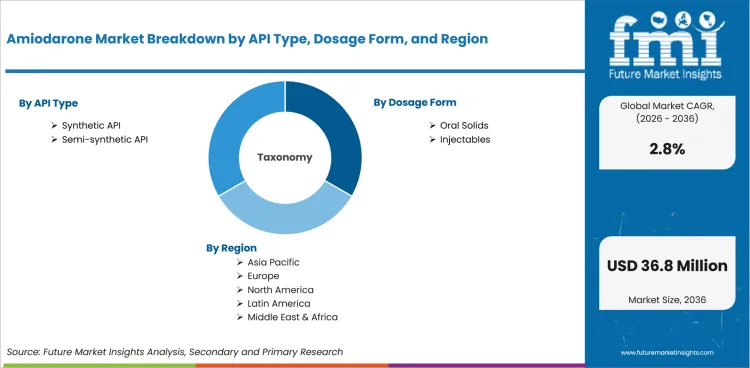
Amiodarone industry is segmented by API type, dosage form, end user, sales channel, and therapeutic use.
- Synthetic API is projected to secure 93.5% share in 2026, led by repeatable process chemistry and lower qualification risk for regulated generic files.
- Oral solids are anticipated to hold 78.0% share in 2026, supported by maintenance therapy and repeat supply into generic finished products.
- Generic pharmaceutical manufacturers are expected to capture 61.0% share in 2026, guided by multisource finished-dose production and dossier maintenance needs.
- Direct API sales are forecast to represent 56.0% share in 2026, shaped by audit communication and buyer preference for supplier-level technical support.
- Serious ventricular arrhythmias are projected to account for 52.5% share in 2026, led by label-defined use in life-threatening recurrent rhythm disorders.
Why does synthetic API dominate Amiodarone supply?
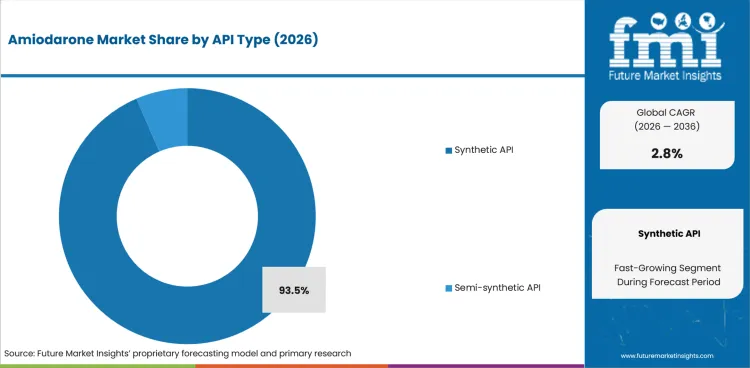
- Synthetic API is projected to account for 93.5% share in 2026, influenced by established amiodarone hydrochloride chemistry and regulated-market familiarity.
- Semi-synthetic API demand stays limited as buyers prefer established routes with predictable impurity profiles and documentation suited for multisource finished products.
Which dosage form leads Amiodarone demand?
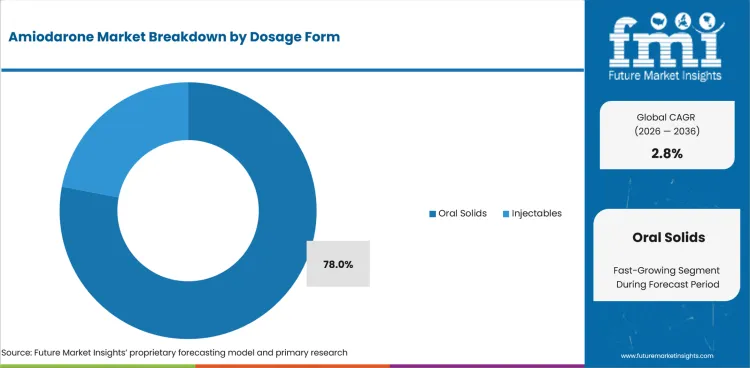
- Oral solids are anticipated to hold 78.0% share in 2026, guided by tablet-led maintenance therapy and easier finished-dose file continuity.
- Injectables hold a smaller but sensitive position as emergency hospital use requires dependable stock and stronger release discipline.
Which end user leads Amiodarone API demand?
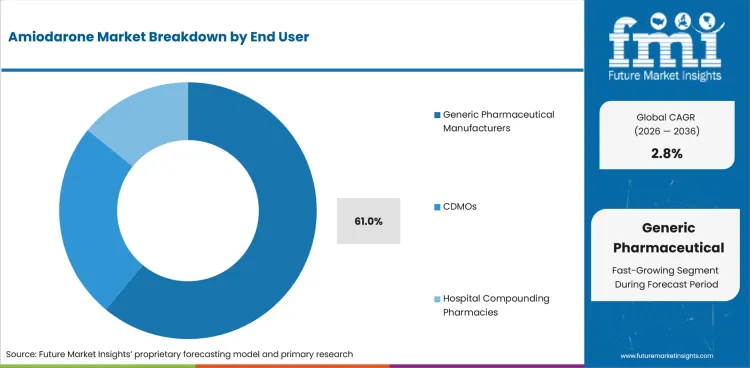
- Generic pharmaceutical manufacturers are forecast to secure 61.0% share in 2026, reflected by multisource tablet and injectable products requiring stable API qualification.
- CDMOs gain value as finished-dose sponsors outsource production while retaining responsibility for product files and change-control review.
Which sales channel leads Amiodarone API sourcing?
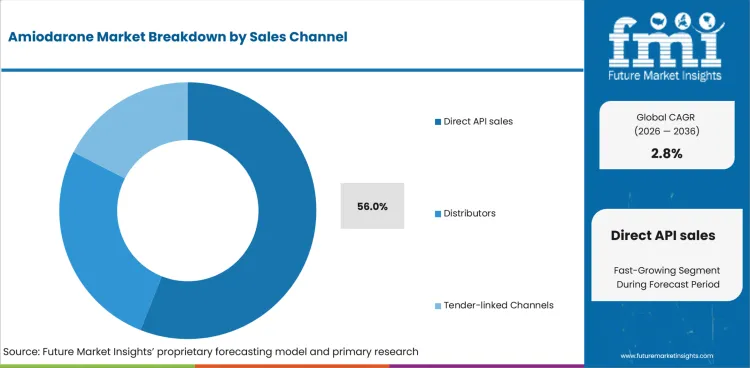
- Direct API sales are expected to represent 56.0% share in 2026, shaped by documentation access and batch communication.
- Distributors support smaller formulation buyers needing initial document comparison and regional delivery assistance. This makes supplier qualification, regulatory documentation, and continuity of supply important for buyers.
Which therapeutic use leads Amiodarone demand?
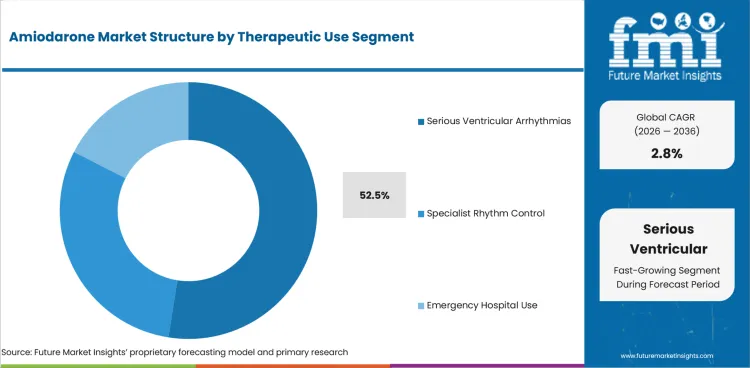
- Serious ventricular arrhythmias are projected to account for 52.5% share in 2026, led by label-defined use in recurrent ventricular fibrillation and unstable ventricular tachycardia.
- Specialist rhythm control supports added volume through cardiology-supervised use, with safety warnings limiting casual prescribing. Procurement teams therefore look for evidence of quality consistency, audit readiness, and reliable batch support.
What are the drivers, restraints, and opportunities in the Amiodarone market?
Serious arrhythmia treatment and generic product continuity support demand while toxicity warnings limit volume acceleration.
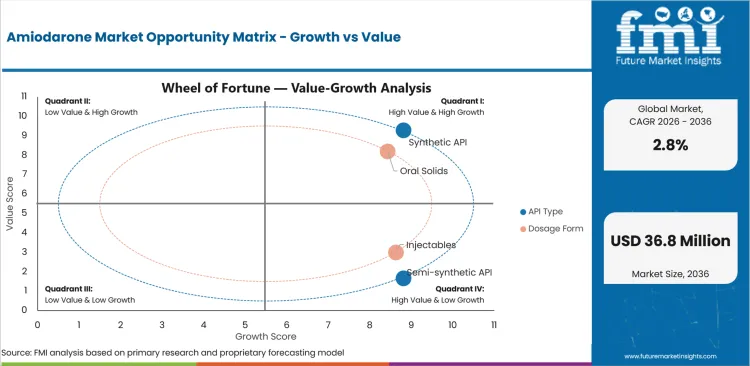
- Driver: Serious cardiovascular treatment use keeps API demand active in regulated medicine chains.
- Restraint: Toxicity warnings limit prescribing expansion and keep use under specialist control. The commercial impact is strongest where clinical use, formulation fit, and compliance history affect supplier choice.
- Opportunity: Qualified API suppliers can win accounts through DMF support or EP alignment, and supply resilience.
Hospital Antiarrhythmic Stocking
Hospital antiarrhythmic stocking supports repeat API demand. DailyMed injection labeling identifies amiodarone hydrochloride injection as 50 mg per mL, giving hospital products a standardized concentration for emergency-use supply planning. Generic manufacturers and sterile product clients need API partners that can support batch evidence and release continuity for a smaller but sensitive route.
Safety-Limited Prescribing
Safety warnings restrain faster demand expansion. DailyMed tablet labeling reports clinically manifest pulmonary toxicity at rates as high as 17% in some patient series and fatal outcomes about 10% of the time. Product labels also call for baseline chest X-ray and pulmonary-function testing, which keeps prescribing cautious and specialist-led.
Documentation-First Supplier Access
Documentation-first sourcing creates the clearest supplier opportunity. Cambrex’s 2025 product list includes Amiodarone HCl as an anti-arrhythmic API with CAS 19774-82-4, while CDSCO’s September 2025 written confirmation includes Amiodarone Hydrochloride Ph.Eur. linked to CTX Life Sciences manufacturing and packing. Buyers can use public evidence to screen suppliers before price negotiation.
Who are the leading companies in the Amiodarone market?
Cambrex, Zhejiang Hengkang, CTX Life Sciences, Piramal Pharma Solutions and Amber Lifesciences.
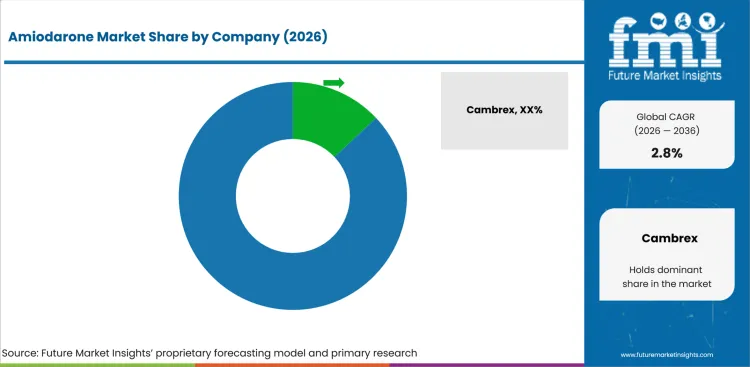
- Established API suppliers hold an advantage through pharmacopoeial fit and audit-ready documentation.
- India-linked API suppliers gain stronger access through written confirmations and export-facing filing support. This makes supplier qualification, regulatory documentation, and continuity of supply important for buyers.
- China-linked suppliers compete through cost control and established chemical synthesis capacity.
- Finished-dose firms influence API demand through tablet and injectable product files. Procurement teams therefore look for evidence of quality consistency, audit readiness, and reliable batch support.
API suppliers in the market compete by combining regulated chemistry with buyer documentation support. Cambrex lists Amiodarone HCl as an anti-arrhythmic API and identifies oral tablets along with intravenous solutions as finished-dose routes. CTX Life Sciences presents Amiodarone Hydrochloride API with DMF and GMP support, while CDSCO records support its India-linked manufacturing route. Zhejiang Hengkang supports China-linked regulated-market positioning through pharmacopoeial standards. Suppliers able to respond quickly to filing questions should gain stronger repeat access.
Manufacturing scale has become a competitive separator even in mature APIs. Amiodarone demand is not novelty-led therapy demand, although hospital stock sensitivity and injectable shortages keep supply resilience valuable. Buyers should prefer suppliers with validated analytical methods and clear change-control pathways.
Smaller and regional players can retain share through local documentation support and reliable distribution. Japan-linked handling, India-linked written confirmations, and European product-information familiarity help suppliers reduce buyer risk. Companies relying only on low pricing may face weak acceptance if impurity control or DMF support is thin. Documentation depth should define the strongest commercial positions.
How do top Amiodarone companies compare?
Cambrex and CTX Life Sciences show stronger public supplier evidence while Zhejiang Hengkang supports China-linked pharmacopoeial compatibility.
| Company | Relevance to Market Title | Regulatory Documentation Support | API Portfolio Fit | Buyer Documentation Support | Channel Reach | Geographic Footprint |
|---|---|---|---|---|---|---|
| Cambrex | Very High | Very Strong | Very Strong | Very Strong | Strong | Global |
| Zhejiang Hengkang Pharmaceutical | Very High | Strong | Very Strong | Strong | Strong | China and export markets |
| CTX Life Sciences | Very High | Very Strong | Very Strong | Very Strong | Strong | India and export markets |
| Piramal Pharma Solutions | High | Strong | Strong | Strong | Strong | Global |
| Amber Lifesciences | Moderate to High | Moderate | Strong | Moderate | Moderate | India and export markets |
| Koa Shoji | Moderate | Moderate | Moderate | Strong | Moderate | Japan |
| Sanofi | High | Very Strong | Finished-dose linked | Very Strong | Very Strong | Global |
| Teva | High | Very Strong | Finished-dose linked | Very Strong | Very Strong | Global |
Source: Future Market Insights competitive analysis, 2026.
Who are the key players in the Amiodarone market?
Cambrex, Zhejiang Hengkang Pharmaceutical and CTX Life Sciences are listed with Piramal Pharma Solutions and Amber Lifesciences among other suppliers.
Key global companies leading the Amiodarone market include:
- Cambrex
- Zhejiang Hengkang Pharmaceutical
- CTX Life Sciences
- Piramal Pharma Solutions
- Amber Lifesciences
- Koa Shoji
- Sanofi
- Teva
- Baxter
- Fresenius Kabi
Key Developments in Amiodarone Market
- In October 2025, Cambrex announced a USD 120 million investment at its Charles City, Iowa API facility. Project details indicate a planned 40% increase in large-scale capacity and nearly one million liters of manufacturing capability.
- In September 2025, CDSCO issued written confirmation material covering CTX Life Sciences and listing Amiodarone Hydrochloride Ph.Eur. under manufacturing and packing scope.
- In January 2025, Cambrex’s product list identified Amiodarone HCl as an anti-arrhythmic active pharmaceutical ingredient, supporting buyer recognition of its generic API portfolio.
Key Players in the Amiodarone Market
Direct API Suppliers
- Cambrex
- Zhejiang Hengkang Pharmaceutical
- CTX Life Sciences
- Piramal Pharma Solutions
Regional API and Channel Firms
- Amber Lifesciences
- Koa Shoji
- Ami Life Sciences
- Hikal
Finished-Dose Influencers
- Sanofi
- Teva
- Baxter
- Fresenius Kabi
Which countries are growing fastest in the Amiodarone market?
India 3.8% CAGR, China 3.6% CAGR, South Korea 3.1% CAGR, United States 2.6% CAGR, United Kingdom 2.4% CAGR, Germany 2.2% CAGR, France 2.1% CAGR, and Japan 2.0% CAGR through 2036.
.webp "Top Country Growth Comparison Amiodarone Market Cagr (2026 2036)")
| Country | CAGR |
|---|---|
| India | 3.8% |
| China | 3.6% |
| South Korea | 3.1% |
| United States | 2.6% |
| United Kingdom | 2.4% |
| Germany | 2.2% |
| France | 2.1% |
| Japan | 2.0% |
Source: Future Market Insights, 2026.
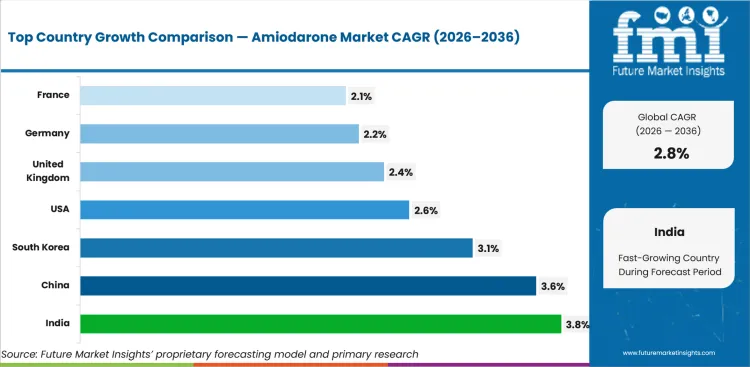
How do country-level CAGRs compare in the Amiodarone market?
India leads country growth while Japan records the most cautious expansion outlook among profiled markets.
- India is forecast to record 3.8% CAGR by 2036 as API documentation and export-facing supply support faster growth.
- China is expected to expand at 3.6% CAGR from 2026 to 2036 due to domestic manufacturing scale and pharmacopoeial supply positioning.
- South Korea is projected to grow at 3.1% CAGR through 2036 as quality-sensitive formulation demand supports qualified API imports.
- United States is estimated to rise at 2.6% CAGR by 2036 with generic tablet and injectable continuity shaping demand.
- United Kingdom is expected to advance at 2.4% CAGR over the forecast period as formulary-led hospital use supports steady purchases.
- Germany is forecast to grow at 2.2% CAGR through 2036 as regulated generic maintenance shapes buyer behavior.
- France is projected to post 2.1% CAGR by 2036 as safety governance and reimbursement pressure keep expansion measured.
- Japan is expected to register 2.0% CAGR through 2036 as specialist supervision and high-trust sourcing slow faster switching.
How fast is the Amiodarone market growing in India?
A 3.8% CAGR through 2036 reflects API documentation strength and export-facing finished-dose supply.
Country Market Snapshot Table
| Parameter | Value |
|---|---|
| Market Size in 2025 (Value) | USD 2.39 million |
| Market Size in 2026 (Value) | USD 2.48 million |
| Market Forecast in 2036 (Value) | USD 3.61 million |
| CAGR (2026 to 2036) | 3.8% |
| Years Considered | 2021 to 2036 |
| Base Year | 2025 |
| Forecast Period | 2026 to 2036 |
| Units Considered | Value (USD million) |
| Leading Sub-Region | Gujarat and western API manufacturing corridor |
India Amiodarone Market Outlook
India Amiodarone demand is shaped by API manufacturing depth and generic formulation demand. Local suppliers serve domestic buyers while supporting clients seeking regulated-market documentation.
API buyers in India place high value on written confirmations and pharmacopoeial compatibility. Export-facing manufacturers should benefit from buyers seeking source diversification and lower qualification risk.
Key Growth Drivers
- Export-facing API demand benefits from India’s regulated-market reach, supported by pharmaceutical exports of USD 30.5 billion across 191 countries in 2024-25.
- Bulk-drug capacity strengthens supplier confidence, demonstrated through 48 approved greenfield projects and ₹4,814.1 crore actual investment under the bulk-drug PLI program.
- Regulated buyers can screen local API partners more confidently as India-linked suppliers provide export documentation and batch records.
- Local formulation depth supports repeat API qualification across oral solid and injectable finished-dose supply. The commercial impact is strongest where clinical use, formulation fit, and compliance history affect supplier choice.
Key Restraints
- Price-control exposure can restrict supplier margin flexibility, measured through the 0.64956% WPI-linked ceiling-price revision applied to scheduled formulations from 2026 under NPPA rules.
- Competition among API suppliers can reduce margin room for additional quality documentation work.
- Buyers serving strict markets may request impurity and change-control evidence before qualification. This makes supplier qualification, regulatory documentation, and continuity of supply important for buyers.
What makes India unique
India is unique due to export-facing API manufacturing and regulated generic supplier depth.
Key Companies
- CTX Life Sciences
- Piramal Pharma Solutions
- Amber Lifesciences
- Ami Life Sciences
- Cadila Healthcare
- Hikal
- Sanofi India
- Neon Laboratories
Sales & Marketing Channels
- Direct API sales
- Export distributors
- CDMO supply agreements
- Regulated-market documentation channels
- Tender-linked formulation routes
- Hospital generic supply channels
Country Segment Breakdown Table
| Segment | Sub-Segments |
|---|---|
| By API Type | Synthetic API · Semi-synthetic API |
| By Dosage Form | Oral Solids · Injectables |
| By End User | Generic Pharmaceutical Manufacturers · Branded Pharmaceutical Manufacturers · CDMOs · Hospital Compounding Pharmacies |
| By Sales Channel | Direct API Sales · Distributors · CDMO Supply Agreements · Tender-linked Channels |
| By Therapeutic Use | Serious Ventricular Arrhythmias · Specialist Rhythm Control · Emergency Hospital Use |
| Key Sub-Regions Covered, API Manufacturing Corridors | Gujarat · Maharashtra · Telangana · Andhra Pradesh · Himachal Pradesh · Karnataka |
Frequently Asked Questions
How fast is India Amiodarone market growing?
Demand in India is forecast to expand at 3.8% CAGR from 2026 to 2036, guided by API documentation and export supply.
Who leads India Amiodarone market?
CTX Life Sciences, Piramal Pharma Solutions, Amber Lifesciences, Ami Life Sciences, and Cadila Healthcare compete based on API supply and formulation links.
What is driving adoption in India Amiodarone market?
API documentation depth and generic formulation activity are supporting buyer confidence in qualified local supply.
What is the Amiodarone market outlook in China?
A 3.6% CAGR through 2036 reflects domestic API scale and regulated-market compatibility.
Country Market Snapshot Table
| Parameter | Value |
|---|---|
| Market Size in 2025 (Value) | USD 3.22 million |
| Market Size in 2026 (Value) | USD 3.34 million |
| Market Forecast in 2036 (Value) | USD 4.75 million |
| CAGR (2026 to 2036) | 3.6% |
| Years Considered | 2021 to 2036 |
| Base Year | 2025 |
| Forecast Period | 2026 to 2036 |
| Units Considered | Value (USD million) |
| Leading Sub-Region | Zhejiang and coastal pharmaceutical manufacturing corridors |
China Amiodarone Market Outlook
China Amiodarone demand is supported by API manufacturing scale and domestic finished-dose needs. Export-facing suppliers can strengthen buyer access through USP or EP compatibility and stable batch records.
Regulatory modernization supports supplier confidence, although price competition keeps margin pressure high. Buyers should favor manufacturers able to show impurity control and repeat production quality.
Key Growth Drivers
- Regulatory modernization supports faster pharmaceutical review systems, reflected in the 30-day clinical trial review pathway introduced for eligible innovative drugs.
- Input access supports chemical medicine manufacturing, as China’s 2025 tariff schedule applies trade-rate arrangements with 34 countries or regions and continues lower tariffs for selected drugs and pharmaceutical raw materials.
- Zhejiang-based API supply gives buyers a known manufacturing route for amiodarone hydrochloride. Procurement teams therefore look for evidence of quality consistency, audit readiness, and reliable batch support.
- Export buyers can use China-linked suppliers for cost control if documentation and batch history meet regulated-market needs.
Key Restraints
- Quality review pressure can slow supplier acceptance, indicated by NMPA issuing 2 GMP annexes covering pharmaceutical excipients and pharmaceutical packaging materials in 2025.
- Price-led competition can weaken supplier margin for documentation support and stability work. The commercial impact is strongest where clinical use, formulation fit, and compliance history affect supplier choice.
- Buyers outside China may ask for extra pharmacopoeial proof before accepting a lower-priced source. This makes supplier qualification, regulatory documentation, and continuity of supply important for buyers.
What makes China unique
China is unique due to scale in chemical API production and the ability to serve both domestic and export-facing buyers.
Key Companies
- Zhejiang Hengkang Pharmaceutical
- Zhejiang Medicine
- Sinopharm Group
- Shanghai Pharmaceuticals
- North China Pharmaceutical
- CSPC Pharmaceutical Group
- China Resources Pharmaceutical
Sales & Marketing Channels
- Direct API sales
- Domestic formulation supply
- Export distributors
- Regulated-market customer audits
- CDMO supply agreements
- Tender-linked finished-dose channels
Country Segment Breakdown Table
| Segment | Sub-Segments |
|---|---|
| By API Type | Synthetic API · Semi-synthetic API |
| By Dosage Form | Oral Solids · Injectables |
| By End User | Generic Pharmaceutical Manufacturers · Branded Pharmaceutical Manufacturers · CDMOs · Hospital Compounding Pharmacies |
| By Sales Channel | Direct API Sales · Distributors · CDMO Supply Agreements · Tender-linked Channels |
| By Therapeutic Use | Serious Ventricular Arrhythmias · Specialist Rhythm Control · Emergency Hospital Use |
| Key Sub-Regions Covered, API Manufacturing Corridors | Zhejiang · Jiangsu · Shanghai · Shandong · Guangdong · Beijing-Tianjin-Hebei |
Frequently Asked Questions
How fast is China Amiodarone market growing?
China is expected to grow at 3.6% CAGR from 2026 to 2036, supported by API scale and export compatibility.
Who leads China Amiodarone market?
Zhejiang Hengkang and large domestic pharmaceutical groups compete due to formulation reach and regulated-market supply links.
What is driving adoption in China Amiodarone market?
API manufacturing scale and pharmacopoeial positioning are supporting continued demand from domestic and export-facing buyers.
How is the Amiodarone market performing in South Korea?
A 3.1% CAGR through 2036 reflects quality-sensitive formulation demand and strict product verification.
Country Market Snapshot Table
| Parameter | Value |
|---|---|
| Market Size in 2025 (Value) | USD 0.82 million |
| Market Size in 2026 (Value) | USD 0.85 million |
| Market Forecast in 2036 (Value) | USD 1.15 million |
| CAGR (2026 to 2036) | 3.1% |
| Years Considered | 2021 to 2036 |
| Base Year | 2025 |
| Forecast Period | 2026 to 2036 |
| Units Considered | Value (USD million) |
| Leading Sub-Region | Seoul-Gyeonggi pharmaceutical and hospital corridor |
South Korea Amiodarone Market Outlook
South Korea Amiodarone demand is shaped by formulation quality expectations and regulated product verification. Local buyers need API sources that can support Korean product files and import documentation.
Hospital-focused demand stays modest, although quality expectations create value for trusted suppliers. API vendors that support pharmacopoeial records and clear certificates can build stronger buyer confidence.
Key Growth Drivers
- Regulatory review reform strengthens Korean formulation planning, measured by MFDS’s target to shorten approval and review timelines to 240 days for new drugs and innovative medical devices.
- Filing visibility improves for overseas suppliers as MFDS reports 59 English drug-approval articles in its products information channel.
- Korean formulation clients favor API suppliers able to provide impurity documentation and regulatory communication. Procurement teams therefore look for evidence of quality consistency, audit readiness, and reliable batch support.
- Import channels support demand as local buyers qualify suppliers from India, China, and global API networks.
Key Restraints
- Imported API onboarding can require deeper verification, since MFDS approval review covers 2 pharmaceutical groups: drug products and pharmaceutical ingredients.
- Smaller market size limits volume-led API bargaining compared with India or China.
- Imported API dependence can expose buyers to documentation delays and freight disruption. The commercial impact is strongest where clinical use, formulation fit, and compliance history affect supplier choice.
What makes South Korea unique
South Korea is unique due to quality-sensitive formulation demand and strong certificate verification culture.
Key Companies
- Yuhan Corporation
- Hanmi Pharmaceutical
- Daewoong Pharmaceutical
- JW Pharmaceutical
- Chong Kun Dang
- Celltrion Pharm
- Dong-A ST
Sales & Marketing Channels
- Imported API distributors
- Direct API sales
- Hospital generic channels
- CDMO supply agreements
- Regulated filing support channels
- Wholesaler-led formulation supply
Country Segment Breakdown Table
| Segment | Sub-Segments |
|---|---|
| By API Type | Synthetic API · Semi-synthetic API |
| By Dosage Form | Oral Solids · Injectables |
| By End User | Generic Pharmaceutical Manufacturers · Branded Pharmaceutical Manufacturers · CDMOs · Hospital Compounding Pharmacies |
| By Sales Channel | Direct API Sales · Distributors · CDMO Supply Agreements · Tender-linked Channels |
| By Therapeutic Use | Serious Ventricular Arrhythmias · Specialist Rhythm Control · Emergency Hospital Use |
| Key Sub-Regions Covered, Pharmaceutical Corridors | Seoul · Gyeonggi · Incheon · Daejeon · Chungcheong · Busan |
Frequently Asked Questions
How fast is South Korea Amiodarone market growing?
South Korea is projected to grow at 3.1% CAGR from 2026 to 2036, shaped by quality-driven formulation demand.
Who leads South Korea Amiodarone market?
Yuhan, Hanmi, Daewoong, JW Pharmaceutical, Chong Kun Dang, and Dong-A ST compete depending on formulation and hospital supply reach.
What is driving adoption in South Korea Amiodarone market?
Certificate verification and quality-sensitive sourcing are supporting qualified API demand.
What is the Amiodarone market outlook in the United States?
A 2.6% CAGR through 2036 is supported by generic product continuity and hospital injectable supply needs.
Country Market Snapshot Table
| Parameter | Value |
|---|---|
| Market Size in 2025 (Value) | USD 7.18 million |
| Market Size in 2026 (Value) | USD 7.37 million |
| Market Forecast in 2036 (Value) | USD 9.53 million |
| CAGR (2026 to 2036) | 2.6% |
| Years Considered | 2021 to 2036 |
| Base Year | 2025 |
| Forecast Period | 2026 to 2036 |
| Units Considered | Value (USD million) |
| Leading Sub-Region | Midwest and national hospital distribution networks |
United States Amiodarone Market Outlook
United States Amiodarone demand is shaped by generic finished-dose continuity and hospital injectable supply management. Generic manufacturers need API sources that can support ANDA maintenance and change-control review.
Hospital systems keep injectables under closer supply attention. API suppliers with validated quality records and clear batch support should hold stronger account access.
Key Growth Drivers
- Tablet demand has a wide finished-dose base. DailyMed lists amiodarone hydrochloride tablets in 100 mg, 200 mg, 300 mg, and 400 mg strengths.
- Injectable demand supports emergency-use continuity. DailyMed labeling lists amiodarone hydrochloride injection as 50 mg per mL for serious ventricular rhythm disorders.
- Generic manufacturers need reliable API files for ANDA maintenance and finished-dose change review. This makes supplier qualification, regulatory documentation, and continuity of supply important for buyers.
- Cambrex gives buyers a domestic supplier signal through Amiodarone HCl listing and USA API capacity investments.
Key Restraints
- Safety warnings keep use specialist-led, with DailyMed reporting pulmonary toxicity rates as high as 17% and fatal outcomes in about 10% of cases.
- Injectable supply risk can disrupt hospital channels as buyers depend on qualified sterile-product continuity. Procurement teams therefore look for evidence of quality consistency, audit readiness, and reliable batch support.
- Buyer qualification cycles can delay new API supplier onboarding in approved products. The commercial impact is strongest where clinical use, formulation fit, and compliance history affect supplier choice.
What makes the United States unique
United States is unique due to transparent labeling and hospital shortage tracking.
Key Companies
- Cambrex
- Teva Pharmaceuticals USA
- Sanofi US
- Baxter
- Fresenius Kabi USA
- Hikma Pharmaceuticals USA
- Slate Run Pharmaceuticals
Sales & Marketing Channels
- Direct API sales
- ANDA-linked supplier files
- Hospital injectable distributors
- CDMO supply agreements
- Wholesaler networks
- Shortage-managed hospital channels
Country Segment Breakdown Table
| Segment | Sub-Segments |
|---|---|
| By API Type | Synthetic API · Semi-synthetic API |
| By Dosage Form | Oral Solids · Injectables |
| By End User | Generic Pharmaceutical Manufacturers · Branded Pharmaceutical Manufacturers · CDMOs · Hospital Compounding Pharmacies |
| By Sales Channel | Direct API Sales · Distributors · CDMO Supply Agreements · Tender-linked Channels |
| By Therapeutic Use | Serious Ventricular Arrhythmias · Specialist Rhythm Control · Emergency Hospital Use |
| Key Sub-Regions Covered, Hospital and API Networks | Midwest · Northeast · South Atlantic · California · Texas · National hospital systems |
Frequently Asked Questions
How fast is United States Amiodarone market growing?
United States demand is anticipated to grow at 2.6% CAGR from 2026 to 2036, guided by generic continuity and hospital stock needs.
Who leads United States Amiodarone market?
Cambrex, Teva, Sanofi, Baxter, Fresenius Kabi, Hikma, and Slate Run influence demand through API supply or hospital channels.
What is driving adoption in United States Amiodarone market?
Generic product maintenance and injectable stock management are supporting repeated API qualification.
What is driving Amiodarone growth in the United Kingdom?
A 2.4% CAGR through 2036 reflects formulary-led continuity and hospital-supervised use.
Country Market Snapshot Table
| Parameter | Value |
|---|---|
| Market Size in 2025 (Value) | USD 1.89 million |
| Market Size in 2026 (Value) | USD 1.94 million |
| Market Forecast in 2036 (Value) | USD 2.46 million |
| CAGR (2026 to 2036) | 2.4% |
| Years Considered | 2021 to 2036 |
| Base Year | 2025 |
| Forecast Period | 2026 to 2036 |
| Units Considered | Value (USD million) |
| Leading Sub-Region | England hospital and community pharmacy channels |
United Kingdom Amiodarone Market Outlook
United Kingdom Amiodarone demand is supported by formulary discipline and hospital monitoring. Oral and injectable products serve cardiology-led use, making supply continuity more important than active promotion.
API demand is mostly indirect through finished-dose partners serving NHS-linked channels. Suppliers that support product information and steady generic availability can gain stronger buyer trust.
Key Growth Drivers
- NICE BNF supports hospital-led injection practice with an initial 5 mg per kg dose over 20 to 120 minutes under ECG monitoring and a maximum 1.2 g per day.
- MHRA Safety Roundup in July 2025 noted phased rollout of a 10 ml CONNECT barrel for Amiodarone pre-filled syringe products, showing continued emergency-medicine device support.
- Formulary discipline supports continued generic tablet and injection demand across hospital channels. This makes supplier qualification, regulatory documentation, and continuity of supply important for buyers.
- Finished-dose suppliers need API documentation that can support product information changes and batch release. Procurement teams therefore look for evidence of quality consistency, audit readiness, and reliable batch support.
Key Restraints
- Dose supervision limits casual use, with NICE listing initial intravenous dosing at 5 mg/kg over 20-120 minutes under ECG monitoring and a maximum of 1.2 g per day.
- Emergency-use handling can complicate hospital supply as syringe compatibility checks require careful product transition.
- NHS cost discipline keeps buyers focused on reliable supply and price control rather than supplier switching.
What makes the United Kingdom unique
United Kingdom is unique due to NICE BNF guidance, NHS-linked formulary control, and emergency syringe compatibility monitoring.
Key Companies
- Sanofi UK
- Teva UK
- Accord Healthcare
- Mylan UK
- Wockhardt UK
- Aurum Pharmaceuticals
- Fresenius Kabi UK
Sales & Marketing Channels
- NHS hospital channels
- Generic distributors
- Community pharmacy supply
- Direct API sales to formulation partners
- Tender-linked channels
- Emergency medicine routes
Country Segment Breakdown Table
| Segment | Sub-Segments |
|---|---|
| By API Type | Synthetic API · Semi-synthetic API |
| By Dosage Form | Oral Solids · Injectables |
| By End User | Generic Pharmaceutical Manufacturers · Branded Pharmaceutical Manufacturers · CDMOs · Hospital Compounding Pharmacies |
| By Sales Channel | Direct API Sales · Distributors · CDMO Supply Agreements · Tender-linked Channels |
| By Therapeutic Use | Serious Ventricular Arrhythmias · Specialist Rhythm Control · Emergency Hospital Use |
| Key Sub-Regions Covered, Hospital Supply Areas | England · Scotland · Wales · Northern Ireland · London · Midlands |
Frequently Asked Questions
How fast is United Kingdom Amiodarone market growing?
United Kingdom demand is projected to increase at 2.4% CAGR from 2026 to 2036, led by formulary-led continuity.
Who leads United Kingdom Amiodarone market?
Sanofi UK, Teva UK, Accord Healthcare, Wockhardt UK, Mylan UK, and Fresenius Kabi UK influence finished-dose supply.
What is driving adoption in United Kingdom Amiodarone market?
Hospital supervision and BNF dosing guidance support continued oral and injectable demand.
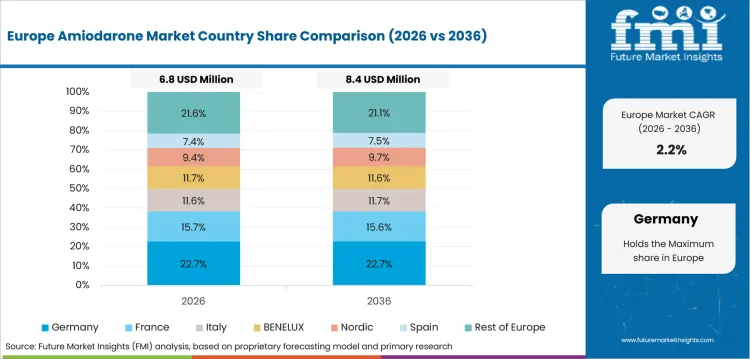
How is the Amiodarone market performing in Germany?
A 2.2% CAGR through 2036 reflects regulated generic maintenance and strong product-information systems.
Country Market Snapshot Table
| Parameter | Value |
|---|---|
| Market Size in 2025 (Value) | USD 2.13 million |
| Market Size in 2026 (Value) | USD 2.18 million |
| Market Forecast in 2036 (Value) | USD 2.70 million |
| CAGR (2026 to 2036) | 2.2% |
| Years Considered | 2021 to 2036 |
| Base Year | 2025 |
| Forecast Period | 2026 to 2036 |
| Units Considered | Value (USD million) |
| Leading Sub-Region | North Rhine-Westphalia and Bavaria hospital channels |
Germany Amiodarone Market Outlook
Germany Amiodarone demand is shaped by regulated generic maintenance and product-information transparency. Buyers require dependable API sources that can support European product updates and finished-dose files.
Hospital and pharmacy channels favor continuity and reliable product status. API suppliers can gain access through pharmacopoeial alignment and clear change-control support.
Key Growth Drivers
- Product-information access supports regulated generic maintenance, with AMIce medicinal-product records covering 332,971 entries and weekday updates in its public database module.
- AMIce strengthens finished-dose traceability, covering authorization data from 3 German drug regulatory authorities, BfArM along with PEI, and BVL.
- Generic manufacturers can use public product-information systems to align supply decisions with approved finished-dose records.
- European sourcing discipline supports API suppliers that show USP or EP standards and stable batch release history.
Key Restraints
- Administrative data limits supplier screening depth, with BfArM stating AMIce medicinal-product records cover mainly administrative fields such as authorization number and ATC code.
- Mature reimbursement pressure limits rapid value acceleration for older generic medicines. The commercial impact is strongest where clinical use, formulation fit, and compliance history affect supplier choice.
- German buyers may request additional evidence before accepting non-European API sources. This makes supplier qualification, regulatory documentation, and continuity of supply important for buyers.
What makes Germany unique
Germany is unique due to AMIce transparency and strong European product-information culture.
Key Companies
- Ratiopharm
- Hexal
- Sanofi-Aventis Deutschland
- STADA Arzneimittel
- Bayer
- Fresenius Kabi Deutschland
- Zentiva Germany
Sales & Marketing Channels
- Hospital pharmacies
- Generic wholesalers
- Direct API sales
- European distributors
- CDMO supply agreements
- Tender-linked medicine channels
Country Segment Breakdown Table
| Segment | Sub-Segments |
|---|---|
| By API Type | Synthetic API · Semi-synthetic API |
| By Dosage Form | Oral Solids · Injectables |
| By End User | Generic Pharmaceutical Manufacturers · Branded Pharmaceutical Manufacturers · CDMOs · Hospital Compounding Pharmacies |
| By Sales Channel | Direct API Sales · Distributors · CDMO Supply Agreements · Tender-linked Channels |
| By Therapeutic Use | Serious Ventricular Arrhythmias · Specialist Rhythm Control · Emergency Hospital Use |
| Key Sub-Regions Covered, Hospital and Generic Channels | North Rhine-Westphalia · Bavaria · Baden-Württemberg · Hesse · Berlin · Hamburg |
Frequently Asked Questions
How fast is Germany Amiodarone market growing?
Germany is expected to rise at 2.2% CAGR from 2026 to 2036, backed by regulated generic maintenance.
Who leads Germany Amiodarone market?
Ratiopharm, Hexal, Sanofi-Aventis Deutschland, STADA, Bayer, Fresenius Kabi Deutschland, and Zentiva influence supply.
What is driving adoption in Germany Amiodarone market?
Product-information transparency and generic continuity support qualified API sourcing.
What is the Amiodarone market forecast for France?
A 2.1% CAGR through 2036 reflects safety-governance pressure and controlled cardiology use.
Country Market Snapshot Table
| Parameter | Value |
|---|---|
| Market Size in 2025 (Value) | USD 1.74 million |
| Market Size in 2026 (Value) | USD 1.78 million |
| Market Forecast in 2036 (Value) | USD 2.19 million |
| CAGR (2026 to 2036) | 2.1% |
| Years Considered | 2021 to 2036 |
| Base Year | 2025 |
| Forecast Period | 2026 to 2036 |
| Units Considered | Value (USD million) |
| Leading Sub-Region | Île-de-France and national hospital supply networks |
France Amiodarone Market Outlook
France Amiodarone demand is guided by safety documentation and regulated hospital access. Finished-dose suppliers need API partners able to respond to product-information updates and batch record requirements.
Demand stays steady through cardiology use and generic medicine continuity. Safety governance can limit faster uptake, especially for products linked to thyroid and cardiac monitoring concerns.
Key Growth Drivers
- Oral-solid demand benefits from reimbursed generic access, with France’s public medicine database listing Amiodarone Biogaran 200 mg scored tablets at 65% reimbursement.
- Generic access remains supported through pharmacy availability, shown by France’s public database listing a 30-tablet pack presentation for amiodarone tablets.
- Hospital channels require stable supply as amiodarone products serve treatment and prevention of rhythm disorders.
- Generic suppliers can strengthen buyer confidence through consistent documentation and timely leaflet updates.
Key Restraints
- Reimbursement discipline can limit value acceleration, reflected by a listed pharmacy price of EUR 8.47 including dispensing honorarium for Amiodarone Biogaran 200 mg tablets.
- Interaction monitoring keeps prescribing cautious across patients needing specialist rhythm control. Procurement teams therefore look for evidence of quality consistency, audit readiness, and reliable batch support.
- Safety monitoring concerns can slow aggressive substitution or supplier switching.
What makes France unique
France is unique due to safety-governance discipline and hospital-centered cardiology use.
Key Companies
- Sanofi France
- Teva Santé
- Biogaran
- Viatris France
- Arrow Génériques
- Zentiva France
- Fresenius Kabi France
Sales & Marketing Channels
- Hospital pharmacies
- Community pharmacy networks
- Generic wholesalers
- Direct API sales to formulation partners
- European distributors
- Tender-linked channels
Country Segment Breakdown Table
| Segment | Sub-Segments |
|---|---|
| By API Type | Synthetic API · Semi-synthetic API |
| By Dosage Form | Oral Solids · Injectables |
| By End User | Generic Pharmaceutical Manufacturers · Branded Pharmaceutical Manufacturers · CDMOs · Hospital Compounding Pharmacies |
| By Sales Channel | Direct API Sales · Distributors · CDMO Supply Agreements · Tender-linked Channels |
| By Therapeutic Use | Serious Ventricular Arrhythmias · Specialist Rhythm Control · Emergency Hospital Use |
| Key Sub-Regions Covered, Hospital Supply Areas | Île-de-France · Auvergne-Rhône-Alpes · Provence-Alpes-Côte d’Azur · Hauts-de-France · Nouvelle-Aquitaine · Occitanie |
Frequently Asked Questions
How fast is France Amiodarone market growing?
France is forecast to expand at 2.1% CAGR from 2026 to 2036, supported by controlled cardiology demand.
Who leads France Amiodarone market?
Sanofi France, Teva Santé, Biogaran, Viatris France, Arrow Génériques, and Zentiva France influence finished-dose supply.
What is driving adoption in France Amiodarone market?
Safety-governance systems and hospital use support continued demand for qualified API supply.
What is the Amiodarone market forecast for Japan?
A 2.0% CAGR through 2036 reflects specialist supervision and high-trust sourcing.
Country Market Snapshot Table
| Parameter | Value |
|---|---|
| Market Size in 2025 (Value) | USD 1.42 million |
| Market Size in 2026 (Value) | USD 1.45 million |
| Market Forecast in 2036 (Value) | USD 1.77 million |
| CAGR (2026 to 2036) | 2.0% |
| Years Considered | 2021 to 2036 |
| Base Year | 2025 |
| Forecast Period | 2026 to 2036 |
| Units Considered | Value (USD million) |
| Leading Sub-Region | Tokyo and Osaka hospital networks |
Japan Amiodarone Market Outlook
Japan Amiodarone demand is shaped by specialist care, product-information discipline, and trusted supplier relationships. Buyers give high weight to safety updates and long-term source reliability.
Market value expands slowly due to controlled use. Suppliers with Japan-specific documentation support and local handling partners can gain steadier account retention.
Key Growth Drivers
- Electronic documentation strengthens product-information access, with PMDA stating paper-based package inserts were abolished in principle from August 2021 and inserts should be browsed electronically.
- Safety-information discipline supports specialist confidence, with PMDA precautions covering 4 safety sections being, warnings, contraindications, important precautions, and clinically significant adverse reactions.
- Local handling partners support buyer confidence for API supply and finished-dose continuity. The commercial impact is strongest where clinical use, formulation fit, and compliance history affect supplier choice.
- Hospitals and specialists keep demand stable for serious rhythm-disorder treatment products. This makes supplier qualification, regulatory documentation, and continuity of supply important for buyers.
Key Restraints
- Package-insert monitoring can extend supplier review, with PMDA precaution review covering 4 safety fields before additional measures are recommended to national authorities.
- High-trust sourcing practices can extend supplier approval timelines. Procurement teams therefore look for evidence of quality consistency, audit readiness, and reliable batch support.
- Smaller volume limits aggressive API price competition and faster supplier turnover.
What makes Japan unique
Japan is unique due to specialist-led product use and safety-information discipline.
Key Companies
- Sanofi K.K.
- Koa Shoji
- Teva Takeda Pharma
- Nichi-Iko Pharmaceutical
- Towa Pharmaceutical
- Sawai Pharmaceutical
- Nipro Pharma
Sales & Marketing Channels
- Local API handlers
- Hospital wholesalers
- Generic distributors
- Direct API sales to formulation partners
- CDMO supply agreements
- Specialist hospital channels
Country Segment Breakdown Table
| Segment | Sub-Segments |
|---|---|
| By API Type | Synthetic API · Semi-synthetic API |
| By Dosage Form | Oral Solids · Injectables |
| By End User | Generic Pharmaceutical Manufacturers · Branded Pharmaceutical Manufacturers · CDMOs · Hospital Compounding Pharmacies |
| By Sales Channel | Direct API Sales · Distributors · CDMO Supply Agreements · Tender-linked Channels |
| By Therapeutic Use | Serious Ventricular Arrhythmias · Specialist Rhythm Control · Emergency Hospital Use |
| Key Sub-Regions Covered, Hospital Supply Areas | Tokyo · Osaka · Kanagawa · Aichi · Fukuoka · Hokkaido |
Frequently Asked Questions
How fast is Japan Amiodarone market growing?
Japan is expected to advance at 2.0% CAGR from 2026 to 2036, led by specialist-controlled use.
Who leads Japan Amiodarone market?
Sanofi K.K., Koa Shoji, Teva Takeda Pharma, Towa, Sawai, and Nipro Pharma influence supply through finished products or sourcing support.
What is driving adoption in Japan Amiodarone market?
Specialist supervision and high documentation expectations support qualified API demand.
Amiodarone Market - Report Scope
| Parameter | Details |
|---|---|
| Forecast period | 2026 to 2036 |
| Historical period | 2021 to 2025 |
| Quantitative unit | Revenue in USD million |
| By API type | Synthetic API, semi-synthetic API |
| By dosage form | Oral solids, injectables |
| By end user | Generic pharmaceutical manufacturers, branded pharmaceutical manufacturers, CDMOs, hospital compounding pharmacies |
| By sales channel | Direct API sales, distributors, CDMO supply agreements, tender-linked channels |
| By therapeutic use | Serious ventricular arrhythmias, specialist rhythm control, emergency hospital use |
| Regions covered | North America, Latin America, Europe, East Asia, South Asia and Pacific, Middle East and Africa |
| Countries covered | India, China, South Korea, United States, United Kingdom, Germany, France, Japan |
| Key companies profiled | Cambrex, Zhejiang Hengkang, CTX Life Sciences, Piramal Pharma Solutions, Amber Lifesciences, Koa Shoji |
| Approach | Bottom-up API-boundary approach using finished-dose files, dosage mix, supplier evidence, documentation depth, and country-level demand |
Source: Future Market Insights, 2026.
Amiodarone Market - Scope & Definition
| Attribute | Detail |
|---|---|
| Market Definition | Commercially supplied amiodarone hydrochloride API used in oral tablet and injectable finished dosage forms |
| Functions Covered | Antiarrhythmic API supply, rhythm-disorder treatment support, hospital injectable continuity, generic medicine production |
| Applications Covered | Oral tablets and injectable finished dosage products requiring amiodarone hydrochloride API |
| End-Use Industries | Generic pharmaceuticals, branded pharmaceuticals, CDMOs, hospital-linked compounding and sterile supply |
| Grades Covered | USP grade, EP grade, Ph.Eur. grade, IP grade, and regulated-market API specifications |
| Inclusions | Synthetic and semi-synthetic amiodarone hydrochloride API supplied for oral solids and injectables across regulated channels |
| Exclusions | Finished branded medicine revenue, cardiology devices, ablation procedures, patient monitoring services, excipients, packaging materials, and other antiarrhythmic APIs |
Amiodarone Market - Research Methodology
| Method | Description |
|---|---|
| Primary Research | FMI analyst interviews with API suppliers, generic manufacturers, CDMOs, distributors, and hospital-linked formulation buyers |
| Desk Research | Review of DailyMed labels, WHO medicine-list material, NICE BNF guidance, FDA shortage records, regulator pages, and verified company product catalogs |
| Market Sizing & Forecasting | Hybrid bottom-up and top-down sizing using product-label breadth, API supplier evidence, dosage mix, country growth differences, and channel behavior |
| Data Validation | Cross-verification using finished-dose labels, API product lists, written confirmations, hospital supply records, and country-level regulatory signals |
Amiodarone Market Breakdown by API Type, Dosage Form, End User, Sales Channel, Therapeutic Use, and Region
Amiodarone Market Segmented by API Type
- Synthetic API
- Semi-synthetic API
Amiodarone Market Segmented by Dosage Form
- Oral Solids
- Injectables
Amiodarone Market Segmented by End User
- Generic Pharmaceutical Manufacturers
- Branded Pharmaceutical Manufacturers
- CDMOs
- Hospital Compounding Pharmacies
Amiodarone Market Segmented by Sales Channel
- Direct API Sales
- Distributors
- CDMO Supply Agreements
- Tender-linked Channels
Amiodarone Market Segmented by Therapeutic Use
- Serious Ventricular Arrhythmias
- Specialist Rhythm Control
- Emergency Hospital Use
Amiodarone Market by Region
- North America
- Latin America
- Europe
- East Asia
- South Asia and Pacific
- Middle East and Africa
Research Sources and Bibliography
- American Society of Health-System Pharmacists. (2026, March 17). Drug shortage detail: Amiodarone injection.
- Cambrex. (2025, January). Product list: Active pharmaceutical ingredients.
- Cambrex. (2025, October 22). Cambrex unveils USD 120 million investment to expand API manufacturing and strengthen USA drug supply resilience.
- Cambrex. (2026, March 23). Cambrex advances USA and European expansions.
- Cambrex. (2026). Amiodarone HCl API product catalog.
- Central Drugs Standard Control Organisation. (2025, September 23). Written confirmation WC-0097 for CTX Life Sciences Pvt. Ltd.
- Federal Institute for Drugs and Medical Devices. (2025, January). Database description for AMIce medicinal products.
- Federal Institute for Drugs and Medical Devices. (2026). Medicinal Product Information System AMIce.
- French Public Medicines Database. (2026). AMIODARONE BIOGARAN 200 mg, comprimé sécable.
- Ministry of Chemicals and Fertilizers. (2026, March 13). Production Linked Incentive Scheme. Press Information Bureau.
- Ministry of Chemicals and Fertilizers. (2026, March 21). India’s pharmaceuticals in global healthcare. Press Information Bureau.
- Ministry of Food and Drug Safety. (2026, May 28). MFDS opens a new era of innovation in medical product approval and review.
- National Institute for Health and Care Excellence. (2026). Amiodarone hydrochloride: British National Formulary.
- National Medical Products Administration. (2025, June 11). Announcement on issuing the pharmaceutical excipients annex and pharmaceutical packaging materials annex of good manufacturing practice for drugs.
- National Medical Products Administration. (2025, October 14). Announcement on optimizing the review and approval process for clinical trials of innovative drugs.
- National Pharmaceutical Pricing Authority. (2026, March 27). Price revision as per annual Wholesale Price Index for scheduled formulations.
- PharmNet.Bund. (2025, February 13). Drug information system.
- Pharmaceuticals and Medical Devices Agency. (2026). Information regarding newly introduced electronic package inserts.
- Pharmaceuticals and Medical Devices Agency. (2026). Revisions of precautions.
- USA Food and Drug Administration. (2025, October 23). Drug shortages.
- USA National Library of Medicine. (2026, March). DailyMed: Amiodarone hydrochloride tablet.
- USA National Library of Medicine. (2026). DailyMed: Amiodarone hydrochloride injection, solution.
- United Kingdom Medicines and Healthcare products Regulatory Agency. (2025, July 1). Aurum pre-filled syringes phased introduction of new 10 ml CONNECT syringe barrel.
- World Health Organization. (2026, February 12). The selection and use of essential medicines: Report of the WHO Expert Committee on Selection and Use of Essential Medicines, 2025.
This bibliography is provided for reader reference and is not exhaustive. The full report contains the complete reference list and detailed citations.
This Report Answers
- Market size estimates for 2026 and forecasts through 2036 for the Amiodarone market.
- Insights across regulated regional and country-level markets.
- Analysis of demand drivers and supplier qualification behavior.
- Evaluation of API type, dosage form, end user, sales channel, and therapeutic use segments.
- Assessment of safety warnings and hospital stock considerations.
- Identification of opportunities across DMF support and supply resilience.
- Evaluation of API supply dynamics and country channel structures.
- Country-level growth analysis covering India, China, South Korea, the United States, the United Kingdom, Germany, France, and Japan.
- Assessment of competition including direct API suppliers and finished-dose influencers.
- Analysis of supplier documentation and buyer confidence factors.
- Regional outlooks across North America, Europe, East Asia, and South Asia and Pacific.
- Delivery of market data, forecasts, and supporting analysis in PDF and Excel formats.
Frequently Asked Questions
What is the growth prospect for Amiodarone?
Demand for Amiodarone is expected to rise at a considerable pace as generic medicine continuity and hospital antiarrhythmic use support repeat API sourcing.
Which companies are expected to shape the Amiodarone market?
Cambrex, Zhejiang Hengkang, CTX Life Sciences, Piramal Pharma Solutions, Amber Lifesciences, Koa Shoji, Sanofi, and Teva are expected to shape market competition through API supply, documentation, and finished-dose influence.
Why are API suppliers investing in Amiodarone documentation?
API suppliers are investing in documentation to support regulated generic files and change-control expectations across mature medicine channels.
Why are oral solids important in the Amiodarone market?
Oral solids are important as tablets support maintenance therapy and create repeat API pull from generic manufacturers.
Why do injectables matter in a smaller dosage segment?
Injectables matter as emergency cardiac care requires dependable hospital stock and stronger sterile-supply coordination.
How do safety warnings influence Amiodarone demand?
Safety warnings keep prescribing under specialist supervision and limit faster volume expansion.
Why does synthetic API lead Amiodarone supply?
Synthetic API leads due to established process chemistry and buyer familiarity with regulated supply routes.
How do distributors support Amiodarone API buyers?
Distributors help smaller formulation buyers compare suppliers and coordinate regional delivery before full qualification.
Which country grows fastest in the Amiodarone market?
India grows fastest at 3.8% CAGR from 2026 to 2036, supported by API documentation and export-facing supply.
Preview the report firsthand - request a free sample
Get SampleGet the brochure for pricing and purchase details.
Get PDFTable of Content
- Key Takeaways
- Market Size and CAGR
- Top Growth Driver
- Fastest Growing Segment
- Leading Region
- Key Companies
- Emerging Opportunities
- Executive Summary
- Global Market Outlook
- Demand-side Trends
- Supply-side Trends
- Technology Roadmap Analysis
- Analysis and Recommendations
- Analyst Perspective (What is happening? Why now? What should investors know?)
- Key Questions Answered
- How large is the market?
- What is the CAGR?
- What are key trends?
- Which region dominates?
- Who are the leaders?
- Market Overview
- Market Coverage / Taxonomy
- Market Definition / Scope / Limitations
- Research Methodology
- Chapter Orientation
- Analytical Lens and Working Hypotheses
- Market Structure, Signals, and Trend Drivers
- Benchmarking and Cross-market Comparability
- Market Sizing, Forecasting, and Opportunity Mapping
- Research Design and Evidence Framework
- Desk Research Programme (Secondary Evidence)
- Expert Input and Fieldwork (Primary Evidence)
- Tooling, Models, and Reference Databases
- Data Engineering and Model Build
- Quality Assurance and Audit Trail
- Market Background
- Market Dynamics (Drivers, Restraints, Opportunity, Trends)
- Scenario Forecast (Optimistic, Likely, Conservative)
- Impact Analysis
- AI Impact
- Sustainability Impact
- Regulatory Impact
- Technology Impact
- Consumer / Buyer Analysis
- Purchase Drivers
- Adoption Barriers
- Buyer Journey
- Opportunity Map Analysis
- Product Life Cycle Analysis
- Supply Chain Analysis
- Investment Feasibility Matrix
- Value Chain Analysis
- PESTLE and Porter's Analysis
- Regulatory Landscape
- Regional Parent Market Outlook
- Production and Consumption Statistics
- Import and Export Statistics
- Global Market Analysis and Forecast, 2021 to 2036
- Historical Market Size Value (USD Million) Analysis, 2021 to 2025
- Current and Future Market Size Value (USD Million) Projections, 2026 to 2036
- Y-o-Y Growth Trend Analysis
- Absolute $ Opportunity Analysis
- Global Market Pricing Analysis, 2021 to 2036
- Global Market Analysis and Forecast, By API Type, 2021 to 2036
- Introduction / Key Findings
- Historical Market Size Value (USD Million) Analysis By API Type, 2021 to 2025
- Current and Future Market Size Value (USD Million) Analysis and Forecast By API Type, 2026 to 2036
- Synthetic API
- Semi-synthetic API
- Synthetic API
- Y-o-Y Growth Trend Analysis By API Type, 2021 to 2025
- Absolute $ Opportunity Analysis By API Type, 2026 to 2036
- Global Market Analysis and Forecast, By Dosage Form, 2021 to 2036
- Introduction / Key Findings
- Historical Market Size Value (USD Million) Analysis By Dosage Form, 2021 to 2025
- Current and Future Market Size Value (USD Million) Analysis and Forecast By Dosage Form, 2026 to 2036
- Oral Solids
- Injectables
- Oral Solids
- Y-o-Y Growth Trend Analysis By Dosage Form, 2021 to 2025
- Absolute $ Opportunity Analysis By Dosage Form, 2026 to 2036
- Global Market Analysis and Forecast, By End User, 2021 to 2036
- Introduction / Key Findings
- Historical Market Size Value (USD Million) Analysis By End User, 2021 to 2025
- Current and Future Market Size Value (USD Million) Analysis and Forecast By End User, 2026 to 2036
- Generic Pharmaceutical Manufacturers
- Branded Pharmaceutical Manufacturers
- CDMOs
- Hospital Compounding Pharmacies
- Generic Pharmaceutical Manufacturers
- Y-o-Y Growth Trend Analysis By End User, 2021 to 2025
- Absolute $ Opportunity Analysis By End User, 2026 to 2036
- Global Market Analysis and Forecast, By Sales Channel, 2021 to 2036
- Introduction / Key Findings
- Historical Market Size Value (USD Million) Analysis By Sales Channel, 2021 to 2025
- Current and Future Market Size Value (USD Million) Analysis and Forecast By Sales Channel, 2026 to 2036
- Direct API sales
- Distributors
- CDMO Supply Agreements
- Tender-linked Channels
- Direct API sales
- Y-o-Y Growth Trend Analysis By Sales Channel, 2021 to 2025
- Absolute $ Opportunity Analysis By Sales Channel, 2026 to 2036
- Global Market Analysis and Forecast, By Therapeutic Use, 2021 to 2036
- Introduction / Key Findings
- Historical Market Size Value (USD Million) Analysis By Therapeutic Use, 2021 to 2025
- Current and Future Market Size Value (USD Million) Analysis and Forecast By Therapeutic Use, 2026 to 2036
- Serious Ventricular Arrhythmias
- Specialist Rhythm Control
- Emergency Hospital Use
- Serious Ventricular Arrhythmias
- Y-o-Y Growth Trend Analysis By Therapeutic Use, 2021 to 2025
- Absolute $ Opportunity Analysis By Therapeutic Use, 2026 to 2036
- Global Market Analysis and Forecast, By Region, 2021 to 2036
- Introduction
- Historical Market Size Value (USD Million) Analysis By Region, 2021 to 2025
- Current Market Size Value (USD Million) Analysis and Forecast By Region, 2026 to 2036
- North America
- Latin America
- Western Europe
- Eastern Europe
- East Asia
- South Asia and Pacific
- Middle East & Africa
- Market Attractiveness Analysis By Region
- North America Market Analysis and Forecast, By Country, 2021 to 2036
- Historical Market Size Value (USD Million) Trend Analysis By Market Taxonomy, 2021 to 2025
- Market Size Value (USD Million) Forecast By Market Taxonomy, 2026 to 2036
- By Country
- USA
- Canada
- Mexico
- By API Type
- By Dosage Form
- By End User
- By Sales Channel
- By Therapeutic Use
- By Country
- Market Attractiveness Analysis
- By Country
- By API Type
- By Dosage Form
- By End User
- By Sales Channel
- By Therapeutic Use
- Key Takeaways
- Latin America Market Analysis and Forecast, By Country
- Historical Market Size Value (USD Million) Trend Analysis By Market Taxonomy, 2021 to 2025
- Market Size Value (USD Million) Forecast By Market Taxonomy, 2026 to 2036
- By Country
- Brazil
- Chile
- Rest of Latin America
- By API Type
- By Dosage Form
- By End User
- By Sales Channel
- By Therapeutic Use
- By Country
- Market Attractiveness Analysis
- By Country
- By API Type
- By Dosage Form
- By End User
- By Sales Channel
- By Therapeutic Use
- Key Takeaways
- Western Europe Market Analysis and Forecast, By Country
- Historical Market Size Value (USD Million) Trend Analysis By Market Taxonomy, 2021 to 2025
- Market Size Value (USD Million) Forecast By Market Taxonomy, 2026 to 2036
- By Country
- Germany
- UK
- Italy
- Spain
- France
- Nordic
- BENELUX
- Rest of Western Europe
- By API Type
- By Dosage Form
- By End User
- By Sales Channel
- By Therapeutic Use
- By Country
- Market Attractiveness Analysis
- By Country
- By API Type
- By Dosage Form
- By End User
- By Sales Channel
- By Therapeutic Use
- Key Takeaways
- Eastern Europe Market Analysis and Forecast, By Country
- Historical Market Size Value (USD Million) Trend Analysis By Market Taxonomy, 2021 to 2025
- Market Size Value (USD Million) Forecast By Market Taxonomy, 2026 to 2036
- By Country
- Russia
- Poland
- Hungary
- Balkan & Baltic
- Rest of Eastern Europe
- By API Type
- By Dosage Form
- By End User
- By Sales Channel
- By Therapeutic Use
- By Country
- Market Attractiveness Analysis
- By Country
- By API Type
- By Dosage Form
- By End User
- By Sales Channel
- By Therapeutic Use
- Key Takeaways
- East Asia Market Analysis and Forecast, By Country
- Historical Market Size Value (USD Million) Trend Analysis By Market Taxonomy, 2021 to 2025
- Market Size Value (USD Million) Forecast By Market Taxonomy, 2026 to 2036
- By Country
- China
- Japan
- South Korea
- By API Type
- By Dosage Form
- By End User
- By Sales Channel
- By Therapeutic Use
- By Country
- Market Attractiveness Analysis
- By Country
- By API Type
- By Dosage Form
- By End User
- By Sales Channel
- By Therapeutic Use
- Key Takeaways
- South Asia and Pacific Market Analysis and Forecast, By Country
- Historical Market Size Value (USD Million) Trend Analysis By Market Taxonomy, 2021 to 2025
- Market Size Value (USD Million) Forecast By Market Taxonomy, 2026 to 2036
- By Country
- India
- ASEAN
- Australia & New Zealand
- Rest of South Asia and Pacific
- By API Type
- By Dosage Form
- By End User
- By Sales Channel
- By Therapeutic Use
- By Country
- Market Attractiveness Analysis
- By Country
- By API Type
- By Dosage Form
- By End User
- By Sales Channel
- By Therapeutic Use
- Key Takeaways
- Middle East & Africa Market Analysis and Forecast, By Country
- Historical Market Size Value (USD Million) Trend Analysis By Market Taxonomy, 2021 to 2025
- Market Size Value (USD Million) Forecast By Market Taxonomy, 2026 to 2036
- By Country
- Kingdom of Saudi Arabia
- Other GCC Countries
- Türkiye
- South Africa
- Other African Union
- Rest of Middle East & Africa
- By API Type
- By Dosage Form
- By End User
- By Sales Channel
- By Therapeutic Use
- By Country
- Market Attractiveness Analysis
- By Country
- By API Type
- By Dosage Form
- By End User
- By Sales Channel
- By Therapeutic Use
- Key Takeaways
- Key Countries Market Analysis
- USA
- Pricing Analysis
- Market Share Analysis, 2025
- By API Type
- By Dosage Form
- By End User
- By Sales Channel
- By Therapeutic Use
- Canada
- Pricing Analysis
- Market Share Analysis, 2025
- By API Type
- By Dosage Form
- By End User
- By Sales Channel
- By Therapeutic Use
- Mexico
- Pricing Analysis
- Market Share Analysis, 2025
- By API Type
- By Dosage Form
- By End User
- By Sales Channel
- By Therapeutic Use
- Brazil
- Pricing Analysis
- Market Share Analysis, 2025
- By API Type
- By Dosage Form
- By End User
- By Sales Channel
- By Therapeutic Use
- Chile
- Pricing Analysis
- Market Share Analysis, 2025
- By API Type
- By Dosage Form
- By End User
- By Sales Channel
- By Therapeutic Use
- Germany
- Pricing Analysis
- Market Share Analysis, 2025
- By API Type
- By Dosage Form
- By End User
- By Sales Channel
- By Therapeutic Use
- UK
- Pricing Analysis
- Market Share Analysis, 2025
- By API Type
- By Dosage Form
- By End User
- By Sales Channel
- By Therapeutic Use
- Italy
- Pricing Analysis
- Market Share Analysis, 2025
- By API Type
- By Dosage Form
- By End User
- By Sales Channel
- By Therapeutic Use
- Spain
- Pricing Analysis
- Market Share Analysis, 2025
- By API Type
- By Dosage Form
- By End User
- By Sales Channel
- By Therapeutic Use
- France
- Pricing Analysis
- Market Share Analysis, 2025
- By API Type
- By Dosage Form
- By End User
- By Sales Channel
- By Therapeutic Use
- India
- Pricing Analysis
- Market Share Analysis, 2025
- By API Type
- By Dosage Form
- By End User
- By Sales Channel
- By Therapeutic Use
- ASEAN
- Pricing Analysis
- Market Share Analysis, 2025
- By API Type
- By Dosage Form
- By End User
- By Sales Channel
- By Therapeutic Use
- Australia & New Zealand
- Pricing Analysis
- Market Share Analysis, 2025
- By API Type
- By Dosage Form
- By End User
- By Sales Channel
- By Therapeutic Use
- China
- Pricing Analysis
- Market Share Analysis, 2025
- By API Type
- By Dosage Form
- By End User
- By Sales Channel
- By Therapeutic Use
- Japan
- Pricing Analysis
- Market Share Analysis, 2025
- By API Type
- By Dosage Form
- By End User
- By Sales Channel
- By Therapeutic Use
- South Korea
- Pricing Analysis
- Market Share Analysis, 2025
- By API Type
- By Dosage Form
- By End User
- By Sales Channel
- By Therapeutic Use
- Russia
- Pricing Analysis
- Market Share Analysis, 2025
- By API Type
- By Dosage Form
- By End User
- By Sales Channel
- By Therapeutic Use
- Poland
- Pricing Analysis
- Market Share Analysis, 2025
- By API Type
- By Dosage Form
- By End User
- By Sales Channel
- By Therapeutic Use
- Hungary
- Pricing Analysis
- Market Share Analysis, 2025
- By API Type
- By Dosage Form
- By End User
- By Sales Channel
- By Therapeutic Use
- Kingdom of Saudi Arabia
- Pricing Analysis
- Market Share Analysis, 2025
- By API Type
- By Dosage Form
- By End User
- By Sales Channel
- By Therapeutic Use
- Türkiye
- Pricing Analysis
- Market Share Analysis, 2025
- By API Type
- By Dosage Form
- By End User
- By Sales Channel
- By Therapeutic Use
- South Africa
- Pricing Analysis
- Market Share Analysis, 2025
- By API Type
- By Dosage Form
- By End User
- By Sales Channel
- By Therapeutic Use
- USA
- Market Structure Analysis
- Competition Dashboard
- Competition Benchmarking
- Market Share Analysis of Top Players
- By Regional
- By API Type
- By Dosage Form
- By End User
- By Sales Channel
- By Therapeutic Use
- Emerging Startups
- Innovation Benchmarking
- Competition Analysis
- Competition Deep Dive
- Cambrex
- Overview
- Product Portfolio
- Profitability by Market Segments (Product/Region/Sales Channel)
- Sales Footprint
- Strategy Overview
- Marketing Strategy
- Product Strategy
- Channel Strategy
- Zhejiang Hengkang Pharmaceutical
- CTX Life Sciences
- Piramal Pharma Solutions
- Amber Lifesciences
- Koa Shoji
- Cambrex
- Case Studies
- Success Stories
- Recent Developments
- Competition Deep Dive
- Assumptions & Acronyms Used


