

- Market Size (2026)
- USD 4.7 Bn
- Forecast (2036)
- USD 10.9 Bn
- CAGR (2026 to 2036)
- 8.8%
How big is Radiopharmaceutical Theranostics Market in 2026?
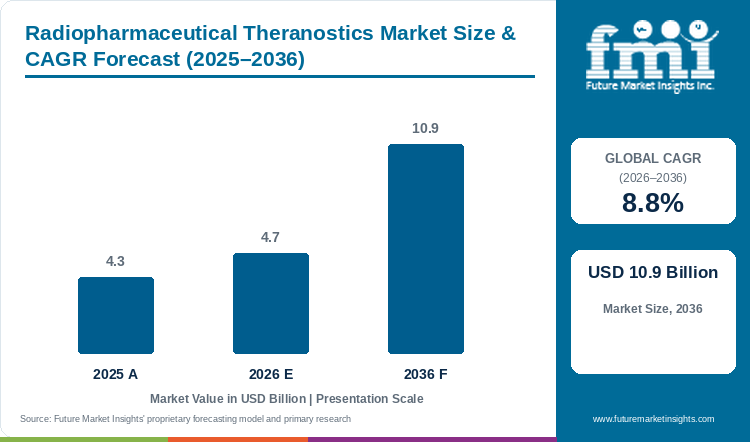
Sales in the radiopharmaceutical theranostics market are projected to grow at 8.8% CAGR through 2036. Market size rises from USD 4.3 billion in 2025 to USD 4.7 billion in 2026 and is expected to reach USD 10.9 billion by 2036.
As per FMI, the global radiopharmaceutical theranostics market was valued at USD 4.3 billion in 2025 and is projected to grow from USD 4.7 billion in 2026 to USD 10.9 billion by 2036, at a CAGR of 8.8% from 2026 to 2036. Therapeutic Radiopharmaceuticals accounted for 63.9% of product type revenue in 2026, as one eligible patient can require several treatment doses after target-positive imaging. The FDA expansion of Pluvicto was supported by a 468-patient PSMAfore trial, where median radiographic progression-free survival reached 9.3 months as compared to 5.6 months with a change in ARPI.[1] This earlier treatment route is bringing more patients into PSMA PET selection before chemotherapy. In November 2025, Novartis opened a 10,000-square-foot California facility and reported on-time delivery above 99.9% for the western United States.[28] More than 900,000 patients had also received a PYLARIFY PSMA PET scan between May 2021 and September 2026.[15] Availability of imaging, repeat therapeutic doses and nearby production is expected to support the radiopharmaceutical theranostics market growth.
Key Market Trends & Insights
- By Product Type, Therapeutic Radiopharmaceuticals accounted for 63.9% of revenue in 2026, supported by repeat treatment-course dosing across approved patient indications.
- By Molecular Target, PSMA represented the leading 57.6% share in 2026, driven by connected diagnostic imaging and targeted therapeutic patient selection.
- By Indication, Prostate Cancer held 60.1% of revenue in 2026. The demand is supported by a PSMA PET pathway that identifies expression before the therapeutic dose is ordered.
- By End User, Hospitals accounted for 51.8% in 2026. Hospitals remain the main treatment location because radioactive-material licensing, trained staff, radiation safety and administration schedules are required in one care setting.
Regional Highlights
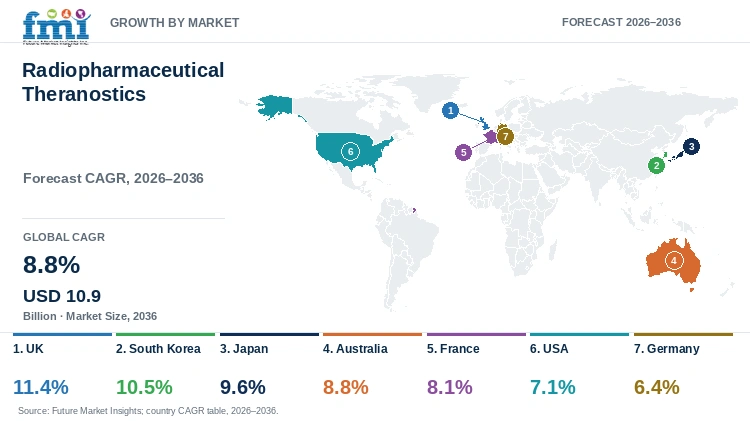
- Fastest-growing profiled country: UK (11.4% CAGR, 2026 to 2036).
- By country: South Korea (10.5%) and Japan (9.6%) follow, while Germany records the lowest profiled CAGR at 6.4%.
Market Size & Forecast
| Metric | Value |
|---|---|
| 2025 Market Size | USD 4.3 Billion |
| Estimated Market Size (2026) | USD 4.7 Billion |
| Projected Market Size (2036) | USD 10.9 Billion |
| CAGR (2026-2036) | 8.8% |
| Added Revenue (2026-2036) | USD 6.2 Billion |
| Market Expansion Multiple | 2.32x |
The addressable market remains lower than the total cancer population, as treatment starts only after target-positive imaging and availability of a qualified administration site. In the UK, PSMAfore evidence used for the February 2026 authorization showed 59% reduction in the risk of radiographic progression or death, supporting treatment before taxane chemotherapy.[4] South Korea is expanding access through infrastructure and has stated a target of 30 treatment-capable hospitals compared with 10 at the time of the July 2026 agreement.[11] Apart from that, Gozellix can be used for up to six hours after radiolabeling, due to which diagnostic doses can travel farther from the radiopharmacy to PET imaging centers[8]. Thus, market demand increases when patients complete molecular imaging, clinical eligibility, dose availability and a treatment appointment. Failure at any one stage may limiting the conversion of positive scans into completed therapeutic cycles.
Diagnostic-to-Treatment Opportunity
Table 1: Diagnostic-to-Treatment Indicators for the Radiopharmaceutical Theranostics Market (patients, sites, doses, time, and percentages), mixed reporting years from 2025 to 2026
| Indicator | Data Point | Market Meaning | Source |
|---|---|---|---|
| PSMAfore trial | 468 patients; median rPFS 9.3 months versus 5.6 months | Supports use before taxane chemotherapy and moves PSMA PET selection earlier. | [1] |
| Pluvicto regimen | 7.4 GBq every six weeks for six doses | One eligible patient can create repeated therapeutic dose demand. | [1] |
| PYLARIFY imaging base | More than 900,000 patients scanned since May 2021 | Shows a large existing PSMA PET funnel for treatment evaluation. | [15] |
| California RLT facility | 10,000 square feet; reported delivery rate above 99.9% | Regional production reduces delivery distance for time-sensitive doses. | [28] |
| South Korea treatment sites | 10 sites at announcement; target of 30 sites | Site expansion can convert more eligible referrals into administered treatment. | [11] |
| Gozellix preparation window | Up to six hours after radiolabeling | A longer window can extend diagnostic distribution to more PET centers. | [8] |
Basis: Market values and segment shares are report estimates. Supporting indicators use the reporting year stated in each source. Added revenue equals USD 10.9 billion less USD 4.7 billion; the expansion multiple equals USD 10.9 billion divided by USD 4.7 billion.
Analyst Perspective
“Earlier eligibility will raise demand where PSMA imaging and treatment appointments are available within the same patient route. Regional production will gain preference as hospitals require dependable dose delivery for completing scheduled treatment cycles.”
- Anurag Sharma, Principal Consultant, Future Market Insights.
How is the radiopharmaceutical theranostics market segmented?
Radiopharmaceutical theranostics market is segmented by four primary commercial axes and region: product type, molecular target, indication, end user, and region. In 2026, therapeutic radiopharmaceuticals are projected at 63.9%, PSMA at 57.6%, prostate cancer at 60.1%, and hospitals at 51.8%.
Product Type includes Therapeutic Radiopharmaceuticals, Diagnostic Companion Imaging Agents, and Theranostic Kits and Precursors. Molecular Target includes PSMA, Somatostatin Receptor, Fibroblast Activation Protein and Other Emerging Targets. Indication includes Prostate Cancer, Neuroendocrine Tumors, Other Solid Tumors and Hematologic Malignancies. End User includes Hospitals, Cancer Research and Specialty Centers, and Diagnostic Imaging Centers. An FMI analyst notes that these categories cover the products sold, molecular targets treated, clinical applications and facilities using radiopharmaceutical theranostics.
Why do Therapeutic Radiopharmaceuticals lead the Product Type category?
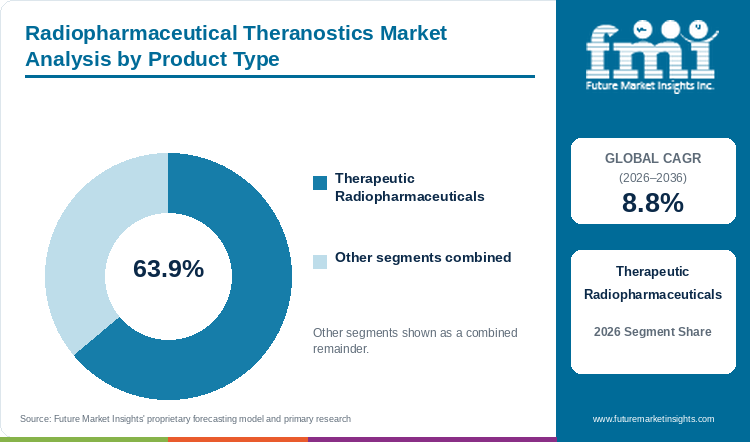
Therapeutic Radiopharmaceuticals are projected to hold 63.9% of product type revenue in 2026, supported by repeat treatment-course dosing across approved indications.
Table 2: Product Type Share for the Radiopharmaceutical Theranostics Market (percentage share), 2026
| Product Type | Share (2026) |
|---|---|
| Therapeutic Radiopharmaceuticals | 63.9% |
| Other Segments Combined | 36.1%* |
| Total | 100.0% |
*Calculated as the balance remaining after deducting the leading segment's reported share from 100.0%.
Table 3: Product Type Leadership and Market Growth for the Radiopharmaceutical Theranostics Market (segment and CAGR percentage), 2026 to 2036
| Metric | Value |
|---|---|
| Global CAGR (2026 to 2036) | 8.8% |
| Leading Segment | Therapeutic Radiopharmaceuticals |
Therapeutic radiopharmaceuticals are radioactive medicines used after diagnostic imaging identifies the required molecular target in a patient. These medicines deliver radiation directly to PSMA, SSTR and other expressed targets, due to which the product is used across several treatment doses. In September 2026, Curium received FDA approval for BEXLUTRY for adults with SSTR-positive GEP-NETs, adding another lutetium-177 treatment product.[25] In the FMI report, this segment leads as treatment-course demand is higher than the one-time requirement for diagnostic selection. Availability of approved PSMA and SSTR medicines is expected to support the Therapeutic Radiopharmaceuticals segment growth.
- Therapeutic Radiopharmaceuticals account for 63.9% share in 2026, supported by repeat treatment-course dosing across approved indications.
- Treatment demand depends on continuing clinical eligibility, scheduled doses, and timely delivery to the authorized treatment site.
What makes PSMA central to the Molecular Target category?
By molecular target, PSMA is estimated to hold 57.6% share in 2026, driven by connected diagnostic imaging and targeted therapeutic patient selection.
PSMA is a molecular target which is used for prostate cancer imaging and radioligand treatment. PSMA PET identifies patients having sufficient target expression and the same result is used before a therapeutic dose is scheduled. In March 2026, the U.S. FDA approved PYLARIFY TruVu as an optimized PSMA-targeted PET imaging formulation for prostate cancer evaluation.[27] According to FMI, PSMA leads because imaging and treatment are connected with the same target. Expansion of PSMA-directed treatment into earlier prostate cancer settings is anticipated to drive the PSMA segment.
- PSMA accounts for 57.6% share in 2026, driven by connected diagnostic imaging and targeted therapeutic patient selection.
- Approved PSMA PET selection is part of the treatment pathway, so imaging access directly affects therapeutic eligibility.
How does Prostate Cancer anchor the Indication category?
In 2026, prostate cancer is expected to lead indication revenue with 60.1% share, reflecting expanding PSMA-directed clinical adoption across metastatic disease.
Prostate Cancer is one of the major application areas for radiopharmaceutical theranostics, as PSMA expression can be identified through PET imaging and followed with targeted treatment. Movement into earlier treatment settings is bringing more patients into imaging, oncology referral and dose planning. FMI research indicates that Prostate Cancer leads the indication category owing to the established PSMA imaging-to-treatment route. Rising prostate cancer diagnosis along with expansion of PSMA-directed products across metastatic disease is expected to propel the segment over the forecast period.
- Prostate Cancer accounts for 60.1% share in 2026, reflecting expanding PSMA-directed clinical adoption across metastatic disease.
- Referral timing changes by disease stage, prior treatment, PSMA status, and the authorized use in each jurisdiction.
Why are Hospitals the leading End User?
Hospitals are projected to hold 51.8% of end-user revenue in 2026, owing to integrated clinical care, nuclear medicine facilities, and radiation-safety licensing.
Hospitals combines oncology review, nuclear medicine, radiation safety and dose administration at one place. Radiopharmaceutical doses requires licensed handling, trained staff and a fixed treatment appointment, due to which hospitals remain the main treatment location. To ensure clinical quality and radiation safety, the Society of Nuclear Medicine and Molecular Imaging designates qualified hospital sites as Radiopharmaceutical Therapy Centers of Excellence.[6]. FMI data suggests that Hospitals lead the End User category owing to presence of the required clinical and radiation-safety facilities. Expansion of regional dose supply and qualified hospital sites is expected to support the segment growth.
- Hospitals account for 51.8% share in 2026, owing to integrated clinical care, nuclear medicine facilities, and radiation-safety licensing.
- Treatment capacity depends on qualified staff, radioactive-material licensing, safe handling, and an available administration schedule.
What are the drivers, restraints and opportunities in the radiopharmaceutical theranostics market?
Earlier treatment eligibility expands demand while manufacturing qualification and care-site readiness restrain conversion and more dependable diagnostic distribution creates an access opportunity.
- Driver: Earlier treatment eligibility increases linked imaging and therapy purchases.
- Restraint: Manufacturing and care-site qualification can delay recurring product orders.
- Opportunity: Longer preparation windows can improve authorized diagnostic distribution.
Earlier Eligibility Moves Referrals Forward
Earlier use of PSMA-directed treatment is bringing patient-selection imaging and therapeutic doses forward in prostate cancer care. In July 2026, the U.S. FDA approved lutetium Lu 177 vipivotide tetraxetan with androgen receptor pathway inhibitor therapy, expanding treatment into the pre-chemotherapy metastatic setting.[2] Patients entering before taxane chemotherapy requires PSMA PET imaging, oncology review and dose scheduling before receiving the medicine. As a result, diagnostic and therapeutic purchases are taking place at an earlier stage of treatment. Growing number of eligible patients is expected to drive the radiopharmaceutical theranostics market growth.
Manufacturing Readiness Controls Launch Timing
One of the primary factor restraining regular product availability is manufacturing control and inspection requirement. In August 2026, ITM received a complete response letter for ITM-11 relating to manufacturing-control and third-party facility items, while no additional clinical or nonclinical data was requested.[9]. Radiopharmaceutical products requires approved production, release testing and timely delivery because the use period is limited. Delay in manufacturing approval or delivery may cancel a treatment appointment, which in turn may hamper the growth of the market.
Longer Preparation Windows Extend Distribution
Longer preparation windows are creating distribution opportunities for diagnostic radiopharmaceuticals. In April 2025, Telix partnered with Cardinal Health for Gozellix commercial distribution across radiopharmacy networks.[30]. This period allows radiopharmacies to move unit doses across a wider distance before the approved use time ends. More PET imaging centers can therefore schedule patient-selection scans without preparing the product onsite. Expansion of radiopharmacy networks is expected to create new avenues for the radiopharmaceutical theranostics market.
Which country CAGRs are profiled in the radiopharmaceutical theranostics market?
Table 4: Country CAGR Comparison for the Radiopharmaceutical Theranostics Market (CAGR percentage), 2026 to 2036
| Country | CAGR |
|---|---|
| UK | 11.4% |
| South Korea | 10.5% |
| Japan | 9.6% |
| Australia | 8.8% |
| France | 8.1% |
| USA | 7.1% |
| Germany | 6.4% |
How do country-level CAGRs compare in the radiopharmaceutical theranostics market?
As per the analysis from FMI, country growth rates are different owing to variation in authorization, isotope supply, reimbursement and treatment-site capacity. The UK at 11.4% and South Korea at 10.5% are expected to rise faster as compared to the other profiled countries. Japan and Australia demand is supported by linked diagnostic and therapeutic product approval, whereas France and Germany depends more on isotope availability and hospital use. The USA has a large PSMA imaging base, however, treatment sales will continue to depend on eligible patients and available dose appointments.
- In the UK, an expanded medicine authorization and a favorable funding decision are different commercial milestones.
- In South Korea, a government-company investment agreement targets a domestic RLT ecosystem, but its manufacturing and training plans must be implemented.
- In Japan, coordinated therapeutic and diagnostic approvals make the entire preparation pathway relevant to purchasing.[12]
- In Australia, the June 2026 registration broadens an approved use; it does not by itself verify reimbursement or delivery coverage.
- In France, a reimbursement recommendation must be interpreted within the disease stage and prior-treatment conditions actually assessed.[14]
- In the USA, a newly effective hospital payment arrangement for a diagnostic formulation is distinct from its commercial launch.
- In Germany, benefit assessment and access to isotope production are separate determinants of market adoption.[16]
Full report country CAGRs cover: North America; Latin America; Western Europe; Eastern Europe; East Asia; South Asia and Pacific; Middle East and Africa.
Country-wise Analysis
- UK demand is projected to grow at 11.4% CAGR from 2026 to 2036, owing to earlier authorized use of PSMA-directed treatment. In June 2026, NHS England announced precision radiotherapy expansion for prostate cancer, creating additional specialized treatment appointments across regional cancer centers.[3] Patients can move toward PSMA imaging before taxane chemotherapy after the stated treatment conditions are met. Presence of established nuclear medicine centers and increasing number of eligible patients is anticipated to support the UK radiopharmaceutical theranostics market growth.
- South Korea is estimated to register 10.5% CAGR over the forecast period. In July 2026, the Ministry of Health and Welfare announced a plan to increase treatment-capable hospitals from 10 to 30 and support domestic production, cold-chain logistics and specialist training.[11] Increasing local treatment capacity will allow more hospitals to schedule radioligand doses, which is expected to drive demand in South Korea.
- Radiopharmaceutical theranostics demand in Japan is projected to rise at 9.6% CAGR through 2036. On September 19, 2025, Japan's Pharmaceuticals and Medical Devices Agency approved Pluvicto along with diagnostic imaging agents Locametz and GalliaPharm for PSMA-positive metastatic prostate cancer.[32] Around 95,000 annual prostate cancer diagnoses and more than 10,000 estimated new mCRPC patients provides a patient base for PSMA testing and treatment. These factors are expected to support the Japan market growth.
- Australia radiopharmaceutical theranostics market is estimated to expand at 8.8% CAGR through 2036. In June 2026, the Therapeutic Goods Administration registered Pluvicto, specifying a dosing schedule of 7,400 MBq every six weeks for up to six doses under qualified radiopharmaceutical personnel.[13] The repeated treatment schedule creates demand for dose supply, trained staff and available nuclear medicine appointments. Increasing use of PSMA imaging for identifying eligible patients is likely to propel the Australia market.
- France is forecast to expand at 8.1% CAGR between 2026 and 2036. In June 2025, ITM and Institut Laue-Langevin extended their collaboration, giving ITM priority access to half of the available irradiation capacity at the high-flux reactor.[10] Availability of non-carrier-added lutetium-177 supports production of therapeutic radiopharmaceuticals. Presence of isotope supply and hospital oncology centers is expected to fuel the France market growth.
- Radiopharmaceutical theranostics sales in the USA are projected to expand at 7.1% CAGR through 2036. In September 2026, the Centers for Medicare & Medicaid Services granted transitional pass-through payment status for PYLARIFY TruVu under hospital outpatient prospective payment systems.[15] A large PSMA imaging base increases the number of patients being evaluated for targeted treatment. Increasing hospital outpatient payment support and availability of radioligand treatment centers is likely to fuel the USA market growth.
- Germany radiopharmaceutical theranostics sector is projected to record 6.4% CAGR during the assessment period. In May 2025, ITM signed an agreement to supply non-carrier-added lutetium-177 for three Radiopharm programs targeting PD-L1, HER2 and B7-H3 in solid tumors.[31] Presence of isotope production and development of new target programs is anticipated to support market growth. However, reimbursement and availability of qualified hospitals will affect the pace of product adoption.
Who are the notable companies in the radiopharmaceutical theranostics market?
Novartis AG, Bayer AG, Eli Lilly and Company, Bristol Myers Squibb Company, AstraZeneca plc, Lantheus Holdings, Inc., Telix Pharmaceuticals Limited, Curium, ITM Isotope Technologies Munich SE, Clarity Pharmaceuticals Ltd. are the notable companies profiled in this market.
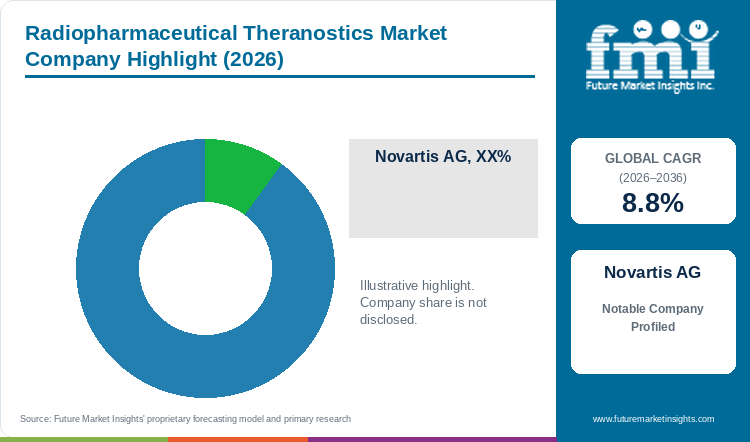
Radiopharmaceutical theranostics market includes therapeutic product manufacturers, diagnostic imaging companies, isotope producers and clinical-stage developers. Novartis AG, Bayer AG and Curium offers approved therapeutic products across PSMA, SSTR and bone-targeted applications. Lantheus Holdings, Inc. and Telix Pharmaceuticals Limited are focusing on PSMA imaging products, whereas ITM Isotope Technologies Munich SE is engaged in isotope production and therapeutic development. Other prominent companies are developing actinium and copper-based radioligands for different molecular targets. As noted by FMI, companies having an approved product and dependable dose supply are positioned ahead of development-only participants. Product approvals, manufacturing expansion and distribution agreements are expected to intensify competition over the forecast period.
- Established therapeutic franchises and integrated producers: Novartis AG, Bayer AG, and Curium. Their documented offerings span PSMA-directed therapy, bone-targeted radium-223 and SSTR-directed treatment; these are distinct clinical pathways.
- Diagnostic-led theranostic networks: Lantheus Holdings, Inc. and Telix Pharmaceuticals Limited. Both have documented PSMA imaging products. Lantheus also reported final BRAVNETSA approval in September 2026; Telix’s cited TLX591 program remains investigational.
- Isotope-backed therapeutic development platforms: Eli Lilly and Company, Bristol Myers Squibb Company, AstraZeneca plc, ITM Isotope Technologies Munich SE, and Clarity Pharmaceuticals Ltd. Their relevant roles arise through acquired radioligand platforms or direct isotope-linked development, with product-specific approval limits.
Competitive Benchmarking: Radiopharmaceutical Theranostics Market
Table 5: Competitive Benchmarking for the Radiopharmaceutical Theranostics Market (qualitative capability ratings), 2026
| Company | Therapeutic Translation | PSMA/SSTR Imaging | Isotope-to-Dose Supply | Geographic Reach |
|---|---|---|---|---|
| Novartis AG | High | High | High | High |
| Bayer AG | High | Low | Low | Medium |
| Eli Lilly and Company | Medium | Low | Medium | Medium |
| Bristol Myers Squibb Company | Medium | Low | Medium | Medium |
| AstraZeneca plc | Medium | Low | Medium | Medium |
| Lantheus Holdings, Inc. | High | High | High | Medium |
| Telix Pharmaceuticals Limited | Medium | High | High | High |
| Curium | High | High | High | High |
| ITM Isotope Technologies Munich SE | Medium | Low | High | Medium |
| Clarity Pharmaceuticals Ltd. | Medium | Low | Low | Medium |
Scoring basis: Therapeutic Translation is High for a documented approved in-scope treatment and Medium for human clinical development; Low would indicate a documented preclinical-only position. PSMA/SSTR Imaging is High for an authorized in-scope agent or kit and Medium for a documented clinical-stage product; Low would indicate a verified limitation in relevant target coverage. Isotope-to-Dose Supply is High for a documented regular production or distribution network and Medium for a named development-stage or single-site manufacturing capability; Low would indicate a documented restriction to laboratory-scale supply. These ratings are not comparative efficacy or revenue rankings. Announced development capacity is not treated as operational regular production. Low signifies a documented limitation; unavailable public information is left Unscored.
Clarity’s copper-67 therapy is relevant to the Other Isotopes category. Its copper-64 imaging partner is discussed only as context for the matched platform, because copper-64 is not among the diagnostic isotope categories covered here. Bayer’s radium-223 product is bone-targeted and should not be classified as a PSMA radioligand. The benchmark therefore leaves unverified in-scope imaging capability Unscored rather than inferring it from a company’s therapeutic program.
Key Developments in the Radiopharmaceutical Theranostics Market
- In September 2026, Lantheus Holdings, Inc. announced final FDA approval of BRAVNETSA for adults with SSTR-positive GEP-NETs through the abbreviated new drug application pathway. This is a final approval rather than the earlier tentative decision. It adds a therapeutic option, while reliable supply and launch execution remain separate market requirements. [22]
- In August 2026, Curium announced a definitive agreement to merge with Lantheus Holdings, Inc. The proposed combination links Curium’s manufacturing and theranostics activities with Lantheus’s U.S. diagnostic business. Closing was expected in the first half of 2027 subject to customary approvals. Lantheus remains an independent company until completion; projected combination benefits are not current capabilities. [26]
- In July 2026, Novartis AG received an expanded U.S. authorization for Pluvicto with ARPI therapy in PSMA-positive metastatic androgen pathway modulation-naïve or -sensitive prostate cancer. The FDA retained PSMA PET-based patient selection. The action extends the relevant treatment setting, but does not itself establish comparable eligibility or funding in other countries.
Key Players in the Radiopharmaceutical Theranostics Market
Established therapeutic franchises and integrated producers
- Novartis AG
- Bayer AG
- Curium
Diagnostic-led theranostic networks
- Lantheus Holdings, Inc.
- Telix Pharmaceuticals Limited
Isotope-backed therapeutic development platforms
- Eli Lilly and Company
- Bristol Myers Squibb Company
- AstraZeneca plc
- ITM Isotope Technologies Munich SE
- Clarity Pharmaceuticals Ltd.
Radiopharmaceutical Theranostics Market - Report Scope
Table 6: Report Scope for the Radiopharmaceutical Theranostics Market (coverage fields and definitions), 2026 to 2036
| Coverage field | Report scope |
|---|---|
| Market breakdown | Product Type, Molecular Target, Indication, End User |
| Quantitative Units | USD Billion |
| Market Definition | Revenue includes direct sales of therapeutic radiopharmaceuticals and the named companion-imaging products, kits and precursors within the listed segmentation; bundled transactions contribute only their identifiable in-scope product component. Revenue excludes downstream finished-product value attributable to already counted inputs to avoid double counting, together with imaging and administration fees, hospital services, equipment, aftermarket services, unrelated radiopharmaceuticals and adjacent or substitute therapies; unlisted copper-64 imaging is contextual rather than included diagnostic revenue. |
| Regions Covered | North America; Latin America; Western Europe; Eastern Europe; East Asia; South Asia and Pacific; Middle East and Africa |
| Countries Covered | UK, South Korea, Japan, Australia, France, USA, Germany |
| Key Companies Profiled | Novartis AG; Bayer AG; Eli Lilly and Company; Bristol Myers Squibb Company; AstraZeneca plc; Lantheus Holdings, Inc.; Telix Pharmaceuticals Limited; Curium; ITM Isotope Technologies Munich SE; Clarity Pharmaceuticals Ltd. |
| Forecast Period | 2026 to 2036 |
| Approach | Primary and secondary research with market triangulation. |
Radiopharmaceutical Theranostics Market - Research Methodology
Table 7: Research Methodology for the Radiopharmaceutical Theranostics Market (research methods and approach), 2026 edition
| Method | Approach |
|---|---|
| Primary Research | The research study includes primary interviews with manufacturers, service providers, technology developers, distributors, end users, procurement teams and industry experts. Interviews covers purchasing decision, product evaluation, pricing, adoption barriers and approval requirement. |
| Desk Research | Desk research covers government publications, regulators, associations, technical literature, standards, company filings, product information and official company announcements. Sources are checked for date, geography and direct relevance to the market. |
| Market Sizing and Forecasting | Market sizing combines the base value with segment structure, pricing, volume, adoption, company participation and country demand. Forecast considers regulation, technology adoption, supply availability, investment and barriers to wider use. |
| Data Validation | Estimates are checked with public data, company activity, industry developments and primary interviews. Adjacent products, overlapping revenue and unsupported claims are excluded from the market total. |
Radiopharmaceutical Theranostics Market by Segments
Radiopharmaceutical Theranostics Market segmented by Product Type:
- Therapeutic Radiopharmaceuticals
- Lutetium-177 Radioligands
- Actinium-225 Alpha Emitters
- Radium-223 and Other Isotopes
- Diagnostic Companion Imaging Agents
- Gallium-68 PET Tracers
- Fluorine-18 PET Tracers
- SPECT Imaging Agents
- Theranostic Kits and Precursors
- Cold Kits for Radiolabeling
- Chelator and Linker Reagents
Radiopharmaceutical Theranostics Market segmented by Molecular Target:
- PSMA
- PSMA-Targeted Lutetium-177 Therapy
- PSMA PET Diagnostics
- Somatostatin Receptor
- SSTR-Targeted Lutetium-177 Therapy
- SSTR PET Diagnostics
- Fibroblast Activation Protein
- FAP-Targeted Radioligands
- FAPI Imaging Agents
- Other Emerging Targets
- HER2 and CAIX Radioligands
- Integrin and Neurotensin Targets
Radiopharmaceutical Theranostics Market segmented by Indication:
- Prostate Cancer
- Metastatic Castration-Resistant Prostate Cancer
- Hormone-Sensitive Prostate Cancer
- Neuroendocrine Tumors
- Gastroenteropancreatic NETs
- Lung and Other NETs
- Other Solid Tumors
- Breast and Lung Cancers
- Pancreatic and Colorectal Cancers
- Hematologic Malignancies
- Lymphoma Radioimmunotherapy
- Leukemia Conditioning Regimens
Radiopharmaceutical Theranostics Market segmented by End User:
- Hospitals
- Academic Medical Centers
- Community Hospital Nuclear Medicine Units
- Cancer Research and Specialty Centers
- Comprehensive Cancer Centers
- Dedicated Theranostics Clinics
- Diagnostic Imaging Centers
- Outpatient PET Imaging Centers
- Radiopharmacy-Linked Imaging Networks
Radiopharmaceutical Theranostics Market by Region
- North America
- United States
- Canada
- Latin America
- Brazil
- Mexico
- Argentina
- Chile
- Western Europe
- Germany
- France
- United Kingdom
- Italy
- Spain
- Benelux
- Nordics
- Eastern Europe
- Poland
- Czech Republic
- Romania
- Hungary
- East Asia
- China
- Japan
- South Korea
- South Asia and Pacific
- India
- ASEAN
- Australia and New Zealand
- Middle East and Africa
- GCC Countries
- South Africa
- Türkiye
- Israel
Research Sources and Bibliography
- [1] U.S. Food and Drug Administration (2025, March 28). FDA expands Pluvicto’s metastatic castration-resistant prostate cancer indication.
- [2] U.S. Food and Drug Administration (2026, July 31). FDA approves lutetium Lu 177 vipivotide tetraxetan with androgen receptor pathway inhibitor therapy….
- [3] NHS England. (2026, June 10). NHS to offer multi-beam precision radiotherapy to thousands with prostate cancer.
- [4] Novartis (2026, February 16). Pluvicto receives MHRA authorisation for new indication for eligible patients with PSMA-positive metastatic castration-resistant prostate cancer.
- [5] U.S. Food and Drug Administration. (2026). LUTATHERA prescribing information: approved for pediatric patients 12 years and older with GEP-NETs.
- [6] Society of Nuclear Medicine and Molecular Imaging. (2026). Radiopharmaceutical Therapy Centers of Excellence. Radiopharmaceutical Therapy Centers of Excellence Expand Across United States and Canada.
- [7] Society of Nuclear Medicine and Molecular Imaging (2025). Radiopharmaceutical unbundling included in CMS hospital outpatient prospective payment system.
- [8] Telix Pharmaceuticals Limited (2025, March 21). FDA Approves New Prostate Cancer Imaging Agent Gozellix®.
- [9] ITM Isotope Technologies Munich SE (2026, August 10). ITM Receives Complete Response Letter for 177Lu-edotreotide (ITM-11).
- [10] Institut Laue-Langevin and ITM (2025, June 16). ITM and ILL Extend Collaboration on the Manufacturing and Supply of Medical Lutetium-177 Radioisotope.
- [11] Ministry of Health and Welfare, Republic of Korea, via BioIn (2026, July 21). Novartis to invest KRW 140 billion in building South Korea’s RLT supply chain [English translation].
- [12] Novartis Japan (2025, September 19). Novartis receives approval for Pluvicto injection for PSMA-positive metastatic castration-resistant prostate cancer [English translation].
- [13] Therapeutic Goods Administration. (2026). PLUVICTO Australian product information. Novartis Pharmaceuticals Australia Pty Ltd. Prescription medicines registration, June 9, 2026.
- [14] Haute Autorité de santé. (2026). PLUVICTO medicine information and reimbursement records. (lutécium (177Lu) vipivotide tétraxétan): Cancer de la prostate.
- [15] Lantheus Holdings, Inc. (2026, September 30). Lantheus Announces CMS Grants Transitional Pass-Through Status for PYLARIFY® TruVu (piflufolastat F 18).
- [16] Gemeinsamer Bundesausschuss. (2026). Lutetium-177 vipivotide tetraxetan assessment information. Benefit assessment decision [English description].
- [17] Bayer (2026, February 26). XOFIGO plus enzalutamide demonstrates overall survival benefit in PEACE-3 trial in patients with metastatic castration-resistant prostate cancer with bone metastases.
- [18] Eli Lilly and Company (2025). POINT Biopharma radioligand oncology platform updates and manufacturing investments.
- [19] Eli Lilly and Company (2025). Clinical pipeline progress in next-generation therapeutic radiopharmaceuticals.
- [20] Bristol Myers Squibb Company (2025). RayzeBio actinium-based radiopharmaceutical development programs.
- [21] AstraZeneca plc (2025). Fusion Pharmaceuticals targeted alpha therapy platform and clinical development.
- [22] Lantheus Holdings, Inc. (2026, September 22). Lantheus Receives Final FDA Approval for BRAVNETSA™ (Lutetium Lu 177 Dotatate)….
- [23] Telix Pharmaceuticals Limited (2026, July 21). Telix Q2 2026 Revenue US$247M, Strong Momentum and Pipeline Progress.
- [24] European Medicines Agency (2026, March 2). Pylclari: European public assessment report.
- [25] Curium (2026, September 16). Curium announces FDA approval of BEXLUTRY lutetium Lu 177 dotatate injection for adults with SSTR-positive GEP-NETs.
- [26] Curium (2026, August 3). Curium Announces Definitive Agreement to Merge with Lantheus.
- [27] Lantheus Holdings, Inc. (2026, March 6). Lantheus Announces FDA Approval of PYLARIFY TruVu™ (piflufolastat F 18) Injection.
- [28] Novartis (2025, November 10). Novartis opens new radioligand therapy manufacturing facility in California as part of $23B US expansion plan.
- [29] Clarity Pharmaceuticals Ltd. (2026, August 5). SECuRE update: 8 GBq Cu-67 SAR-bisPSMA dose level with two additional complete responses.
- [30] Telix Pharmaceuticals Limited. (2025, April 8). Telix announces Cardinal Health for Gozellix commercial distribution.
- [31] ITM Isotope Technologies Munich SE. (2025, May 19). ITM and Radiopharm sign supply agreement for non-carrier-added lutetium-177.
- [32] Pharmaceuticals and Medical Devices Agency. (2025, September 19). Diagnostic radiopharmaceuticals approved in Japan for determining eligibility for therapeutic radiopharmaceuticals.
- [33] Curium. (2026, February 26). Pharmacokinetics and dosimetry data for lutetium-177 zadavotide guraxetan at ASCO GU 2026.
- [34] ITM Isotope Technologies Munich SE. (2026, June 1). Phase 3 COMPETE data supporting single-timepoint dosimetry.
- [35] Telix Pharmaceuticals Limited. (2026, May 15). Telix announces collaborations to explore PSMA PET imaging in emerging prostate cancer treatment approaches.
This bibliography is provided for reader reference and is not exhaustive. The full report contains the complete reference list and detailed citations.
This Report Answers
- How large is the Radiopharmaceutical Theranostics Market in 2026 and what is forecast for 2036?
- Which treatment-pathway changes support demand for radiopharmaceutical theranostics?
- Why do Therapeutic Radiopharmaceuticals lead the Product Type category?
- Why does PSMA lead the Molecular Target category?
- How do the profiled country growth rates differ from 2026 to 2036?
- Which companies provide therapeutic products and the associated diagnostic or isotope capabilities?
Frequently Asked Questions
How large is the Radiopharmaceutical Theranostics Market in 2026?
Future Market Insights estimates the radiopharmaceutical theranostics market at USD 4.7 billion in 2026 and projects it to reach USD 10.9 billion by 2036.
What CAGR is projected for the Radiopharmaceutical Theranostics Market?
As per FMI analysis, demand is projected to expand at 8.8% CAGR between 2026 and 2036.
Which product type leads the market in 2026?
Therapeutic Radiopharmaceuticals lead with 63.9% of product type revenue in 2026, owing to repeat treatment-course dosing.
Which molecular target holds the leading share in 2026?
PSMA accounts for 57.6% of molecular target revenue in 2026 as the same target connects patient imaging with treatment selection.
Which country has the fastest profiled growth through 2036?
The UK is projected to expand at 11.4% CAGR from 2026 to 2036, supported by earlier PSMA-directed treatment eligibility.
Who are the key players in the radiopharmaceutical theranostics market?
Key players include Novartis AG, Bayer AG, Eli Lilly and Company, Bristol Myers Squibb Company, AstraZeneca plc, Lantheus Holdings, Inc., Telix Pharmaceuticals Limited, Curium, ITM Isotope Technologies Munich SE and Clarity Pharmaceuticals Ltd.
Preview the report firsthand - request a free sample
Get SampleGet the brochure for pricing and purchase details.
Get PDFTable of Content
- Key Takeaways
- Market Size and CAGR
- Top Growth Driver
- Fastest Growing Segment
- Leading Region
- Key Companies
- Emerging Opportunities
- Executive Summary
- Global Market Outlook
- Demand-side Trends
- Supply-side Trends
- Technology Roadmap Analysis
- Analysis and Recommendations
- Analyst Perspective (What is happening? Why now? What should investors know?)
- Key Questions Answered
- How large is the market?
- What is the CAGR?
- What are key trends?
- Which region dominates?
- Who are the leaders?
- Market Overview
- Market Coverage / Taxonomy
- Market Definition / Scope / Limitations
- Research Methodology
- Chapter Orientation
- Analytical Lens and Working Hypotheses
- Market Structure, Signals, and Trend Drivers
- Benchmarking and Cross-market Comparability
- Market Sizing, Forecasting, and Opportunity Mapping
- Research Design and Evidence Framework
- Desk Research Programme (Secondary Evidence)
- Expert Input and Fieldwork (Primary Evidence)
- Tooling, Models, and Reference Databases
- Data Engineering and Model Build
- Quality Assurance and Audit Trail
- Market Background
- Market Dynamics (Drivers, Restraints, Opportunity, Trends)
- Scenario Forecast (Optimistic, Likely, Conservative)
- Impact Analysis
- AI Impact
- Sustainability Impact
- Regulatory Impact
- Technology Impact
- Consumer / Buyer Analysis
- Purchase Drivers
- Adoption Barriers
- Buyer Journey
- Opportunity Map Analysis
- Product Life Cycle Analysis
- Supply Chain Analysis
- Investment Feasibility Matrix
- Value Chain Analysis
- PESTLE and Porter's Analysis
- Regulatory Landscape
- Regional Parent Market Outlook
- Production and Consumption Statistics
- Import and Export Statistics
- Global Market Analysis and Forecast, 2021 to 2036
- Historical Market Size Value (USD Billion) Analysis, 2021 to 2025
- Current and Future Market Size Value (USD Billion) Projections, 2026 to 2036
- Y-o-Y Growth Trend Analysis
- Absolute $ Opportunity Analysis
- Global Market Pricing Analysis, 2021 to 2036
- Global Market Analysis and Forecast, By Product Type, 2021 to 2036
- Introduction / Key Findings
- Historical Market Size Value (USD Billion) Analysis By Product Type, 2021 to 2025
- Current and Future Market Size Value (USD Billion) Analysis and Forecast By Product Type, 2026 to 2036
- Therapeutic Radiopharmaceuticals
- Lutetium-177 Radioligands
- Actinium-225 Alpha Emitters
- Radium-223 and Other Isotopes
- Diagnostic Companion Imaging Agents
- Gallium-68 PET Tracers
- Fluorine-18 PET Tracers
- SPECT Imaging Agents
- Theranostic Kits and Precursors
- Cold Kits for Radiolabeling
- Chelator and Linker Reagents
- Y-o-Y Growth Trend Analysis By Product Type, 2021 to 2025
- Absolute $ Opportunity Analysis By Product Type, 2026 to 2036
- Global Market Analysis and Forecast, By Molecular Target, 2021 to 2036
- Introduction / Key Findings
- Historical Market Size Value (USD Billion) Analysis By Molecular Target, 2021 to 2025
- Current and Future Market Size Value (USD Billion) Analysis and Forecast By Molecular Target, 2026 to 2036
- PSMA
- PSMA-Targeted Lutetium-177 Therapy
- PSMA PET Diagnostics
- Somatostatin Receptor
- SSTR-Targeted Lutetium-177 Therapy
- SSTR PET Diagnostics
- Fibroblast Activation Protein
- FAP-Targeted Radioligands
- FAPI Imaging Agents
- Other Emerging Targets
- HER2 and CAIX Radioligands
- Integrin and Neurotensin Targets
- Y-o-Y Growth Trend Analysis By Molecular Target, 2021 to 2025
- Absolute $ Opportunity Analysis By Molecular Target, 2026 to 2036
- Global Market Analysis and Forecast, By Indication, 2021 to 2036
- Introduction / Key Findings
- Historical Market Size Value (USD Billion) Analysis By Indication, 2021 to 2025
- Current and Future Market Size Value (USD Billion) Analysis and Forecast By Indication, 2026 to 2036
- Prostate Cancer
- Metastatic Castration-Resistant Prostate Cancer
- Hormone-Sensitive Prostate Cancer
- Neuroendocrine Tumors
- Gastroenteropancreatic NETs
- Lung and Other NETs
- Other Solid Tumors
- Breast and Lung Cancers
- Pancreatic and Colorectal Cancers
- Hematologic Malignancies
- Lymphoma Radioimmunotherapy
- Leukemia Conditioning Regimens
- Y-o-Y Growth Trend Analysis By Indication, 2021 to 2025
- Absolute $ Opportunity Analysis By Indication, 2026 to 2036
- Global Market Analysis and Forecast, By End User, 2021 to 2036
- Introduction / Key Findings
- Historical Market Size Value (USD Billion) Analysis By End User, 2021 to 2025
- Current and Future Market Size Value (USD Billion) Analysis and Forecast By End User, 2026 to 2036
- Hospitals
- Academic Medical Centers
- Community Hospital Nuclear Medicine Units
- Cancer Research and Specialty Centers
- Comprehensive Cancer Centers
- Dedicated Theranostics Clinics
- Diagnostic Imaging Centers
- Outpatient PET Imaging Centers
- Radiopharmacy-Linked Imaging Networks
- Y-o-Y Growth Trend Analysis By End User, 2021 to 2025
- Absolute $ Opportunity Analysis By End User, 2026 to 2036
- Global Market Analysis and Forecast, By Region, 2021 to 2036
- Introduction
- Historical Market Size Value (USD Billion) Analysis By Region, 2021 to 2025
- Current Market Size Value (USD Billion) Analysis and Forecast By Region, 2026 to 2036
- North America
- Latin America
- Western Europe
- Eastern Europe
- East Asia
- South Asia and Pacific
- Middle East and Africa
- Market Attractiveness Analysis By Region
- North America Market Analysis and Forecast, By Country, 2021 to 2036
- Historical Market Size Value (USD Billion) Trend Analysis By Market Taxonomy, 2021 to 2025
- Market Size Value (USD Billion) Forecast By Market Taxonomy, 2026 to 2036
- By Country
- United States
- Canada
- By Product Type
- By Molecular Target
- By Indication
- By End User
- By Country
- Market Attractiveness Analysis
- By Country
- By Product Type
- By Molecular Target
- By Indication
- By End User
- Key Takeaways
- Latin America Market Analysis and Forecast, By Country
- Historical Market Size Value (USD Billion) Trend Analysis By Market Taxonomy, 2021 to 2025
- Market Size Value (USD Billion) Forecast By Market Taxonomy, 2026 to 2036
- By Country
- Brazil
- Mexico
- Argentina
- Chile
- By Product Type
- By Molecular Target
- By Indication
- By End User
- By Country
- Market Attractiveness Analysis
- By Country
- By Product Type
- By Molecular Target
- By Indication
- By End User
- Key Takeaways
- Western Europe Market Analysis and Forecast, By Country
- Historical Market Size Value (USD Billion) Trend Analysis By Market Taxonomy, 2021 to 2025
- Market Size Value (USD Billion) Forecast By Market Taxonomy, 2026 to 2036
- By Country
- Germany
- France
- United Kingdom
- Italy
- Spain
- Benelux
- Nordics
- By Product Type
- By Molecular Target
- By Indication
- By End User
- By Country
- Market Attractiveness Analysis
- By Country
- By Product Type
- By Molecular Target
- By Indication
- By End User
- Key Takeaways
- Eastern Europe Market Analysis and Forecast, By Country
- Historical Market Size Value (USD Billion) Trend Analysis By Market Taxonomy, 2021 to 2025
- Market Size Value (USD Billion) Forecast By Market Taxonomy, 2026 to 2036
- By Country
- Poland
- Czech Republic
- Romania
- Hungary
- By Product Type
- By Molecular Target
- By Indication
- By End User
- By Country
- Market Attractiveness Analysis
- By Country
- By Product Type
- By Molecular Target
- By Indication
- By End User
- Key Takeaways
- East Asia Market Analysis and Forecast, By Country
- Historical Market Size Value (USD Billion) Trend Analysis By Market Taxonomy, 2021 to 2025
- Market Size Value (USD Billion) Forecast By Market Taxonomy, 2026 to 2036
- By Country
- China
- Japan
- South Korea
- By Product Type
- By Molecular Target
- By Indication
- By End User
- By Country
- Market Attractiveness Analysis
- By Country
- By Product Type
- By Molecular Target
- By Indication
- By End User
- Key Takeaways
- South Asia and Pacific Market Analysis and Forecast, By Country
- Historical Market Size Value (USD Billion) Trend Analysis By Market Taxonomy, 2021 to 2025
- Market Size Value (USD Billion) Forecast By Market Taxonomy, 2026 to 2036
- By Country
- India
- ASEAN
- Australia and New Zealand
- By Product Type
- By Molecular Target
- By Indication
- By End User
- By Country
- Market Attractiveness Analysis
- By Country
- By Product Type
- By Molecular Target
- By Indication
- By End User
- Key Takeaways
- Middle East and Africa Market Analysis and Forecast, By Country
- Historical Market Size Value (USD Billion) Trend Analysis By Market Taxonomy, 2021 to 2025
- Market Size Value (USD Billion) Forecast By Market Taxonomy, 2026 to 2036
- By Country
- GCC Countries
- South Africa
- Türkiye
- Israel
- By Product Type
- By Molecular Target
- By Indication
- By End User
- By Country
- Market Attractiveness Analysis
- By Country
- By Product Type
- By Molecular Target
- By Indication
- By End User
- Key Takeaways
- Key Countries Market Analysis
- United States
- Pricing Analysis
- Market Share Analysis, 2025
- By Product Type
- By Molecular Target
- By Indication
- By End User
- Canada
- Pricing Analysis
- Market Share Analysis, 2025
- By Product Type
- By Molecular Target
- By Indication
- By End User
- Mexico
- Pricing Analysis
- Market Share Analysis, 2025
- By Product Type
- By Molecular Target
- By Indication
- By End User
- Brazil
- Pricing Analysis
- Market Share Analysis, 2025
- By Product Type
- By Molecular Target
- By Indication
- By End User
- Chile
- Pricing Analysis
- Market Share Analysis, 2025
- By Product Type
- By Molecular Target
- By Indication
- By End User
- Germany
- Pricing Analysis
- Market Share Analysis, 2025
- By Product Type
- By Molecular Target
- By Indication
- By End User
- United Kingdom
- Pricing Analysis
- Market Share Analysis, 2025
- By Product Type
- By Molecular Target
- By Indication
- By End User
- Italy
- Pricing Analysis
- Market Share Analysis, 2025
- By Product Type
- By Molecular Target
- By Indication
- By End User
- Spain
- Pricing Analysis
- Market Share Analysis, 2025
- By Product Type
- By Molecular Target
- By Indication
- By End User
- France
- Pricing Analysis
- Market Share Analysis, 2025
- By Product Type
- By Molecular Target
- By Indication
- By End User
- India
- Pricing Analysis
- Market Share Analysis, 2025
- By Product Type
- By Molecular Target
- By Indication
- By End User
- ASEAN
- Pricing Analysis
- Market Share Analysis, 2025
- By Product Type
- By Molecular Target
- By Indication
- By End User
- Australia and New Zealand
- Pricing Analysis
- Market Share Analysis, 2025
- By Product Type
- By Molecular Target
- By Indication
- By End User
- China
- Pricing Analysis
- Market Share Analysis, 2025
- By Product Type
- By Molecular Target
- By Indication
- By End User
- Japan
- Pricing Analysis
- Market Share Analysis, 2025
- By Product Type
- By Molecular Target
- By Indication
- By End User
- South Korea
- Pricing Analysis
- Market Share Analysis, 2025
- By Product Type
- By Molecular Target
- By Indication
- By End User
- Poland
- Pricing Analysis
- Market Share Analysis, 2025
- By Product Type
- By Molecular Target
- By Indication
- By End User
- Hungary
- Pricing Analysis
- Market Share Analysis, 2025
- By Product Type
- By Molecular Target
- By Indication
- By End User
- Türkiye
- Pricing Analysis
- Market Share Analysis, 2025
- By Product Type
- By Molecular Target
- By Indication
- By End User
- South Africa
- Pricing Analysis
- Market Share Analysis, 2025
- By Product Type
- By Molecular Target
- By Indication
- By End User
- Australia
- Pricing Analysis
- Market Share Analysis, 2025
- By Product Type
- By Molecular Target
- By Indication
- By End User
- United States
- Market Structure Analysis
- Competition Dashboard
- Competition Benchmarking
- Market Share Analysis of Top Players
- By Regional
- By Product Type
- By Molecular Target
- By Indication
- By End User
- Emerging Startups
- Innovation Benchmarking
- Competition Analysis
- Competition Deep Dive
- Novartis AG
- Overview
- Product Portfolio
- Profitability by Market Segments
- Sales Footprint
- Strategy Overview
- Marketing Strategy
- Product Strategy
- Channel Strategy
- Bayer AG
- Eli Lilly and Company
- Bristol Myers Squibb Company
- AstraZeneca plc
- Lantheus Holdings, Inc.
- Telix Pharmaceuticals Limited
- Curium
- ITM Isotope Technologies Munich SE
- Clarity Pharmaceuticals Ltd.
- Novartis AG
- Case Studies
- Success Stories
- Recent Developments
- Competition Deep Dive
- Assumptions & Acronyms Used


