

- Industry Size (2026)
- USD 201.0 Mn
- Forecast (2036)
- USD 456.0 Mn
- CAGR (2026 to 2036)
- 8.5%
Aroma-Infused Liners Market Forecast and Outlook 2026 to 2036
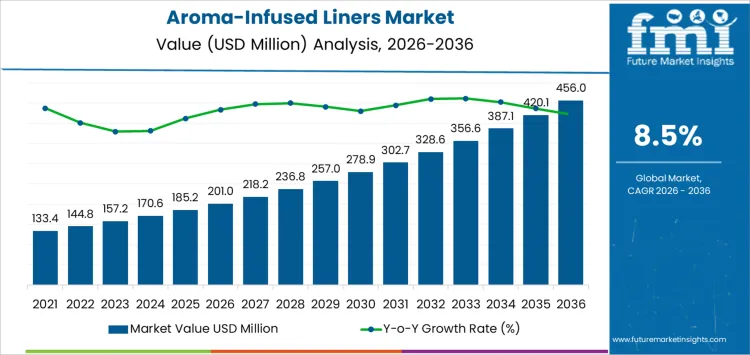
In 2026, the aroma-infused liners market is valued at USD 201 million and is forecast to reach USD 456 million by 2036, expanding at a CAGR of 8.5%. The first five-year growth block from 2026 to 2031 takes the market to roughly USD 303 million, reflecting structured adoption across hygiene products, packaging liners, and specialty consumer applications. During this phase, demand growth is driven by controlled integration of fragrance layers into existing liner formats. Manufacturers focus on compatibility, scent longevity, and production consistency, resulting in steady yeAR-on-year gains rather than abrupt volume shifts.
By contrast, the 2031 to 2036 block represents a higher value expansion phase, with the market advancing from about USD 303 million to USD 456 million. This period shows wider commercialization as aroma-infused liners move into repeat procurement cycles across established end uses. Annual absolute additions increase as scale efficiencies improve and fragrance embedding becomes standardized within liner production. Growth in this block reflects volume scaling and broader geographic penetration, with demand supported by stable downstream consumption rather than experimental product launches or short-term promotional uptake.
Quick Stats of the Aroma-Infused Liners Market:
- Aroma-Infused Liners Market Value (2026): USD 201.0 million
- Aroma-Infused Liners Market Forecast Value (2036): USD 456.0 million
- Aroma-Infused Liners Market Forecast CAGR (2026–2036): 8.5%
- Leading Application: Fresh Produce, Bakery & Pastries, Meat & Poultry, Ready Meals
- Key Growth Regions: India, China, Brazil, United States, Germany, Japan
- Top Players: Smurfit Kappa, Mondi, Amcor, UFlex, Sealed Air, Avery Dennison
What is the Growth Forecast for the Aroma-Infused Liners Market through 2036?
From 2026 to 2031, the aroma-infused liners market grows from USD 201 million to approximately USD 279 million, marking the first clear inflection in demand behavior. Early expansion is driven by validation of scent retention, material compatibility, and controlled release performance across hygiene products, packaging inserts, and specialty liners. Growth during this phase remains uneven, with yeAR-on-year gains widening gradually as buyers move from trial adoption to limited portfolio integration. The inflection reflects rising confidence in functional reliability rather than rapid volume scaling, supported by improved formulation stability and supplier qualification.
Between 2031 and 2036, the market expands from about USD 279 million to USD 456 million, representing a second and more pronounced inflection point. This phase is defined by broader standardization of aroma-infused liners across high-volume applications such as personal care, PET products, and odor-management packaging. Growth accelerates as scent integration becomes a baseline feature rather than a differentiator. Annual value additions increase sharply, driven by repeat purchasing, larger contract sizes, and expansion into mass-market formats, signaling a shift from selective use to embedded adoption across manufacturing programs.
Aroma Infused Liners Market Key Takeaways
| Metric | Value |
|---|---|
| Market Value (2026) | USD 201.0 million |
| Forecast Value (2036) | USD 456.0 million |
| Forecast CAGR (2026–2036) | 8.5% |
How Are Functional Packaging and Ambient Experience Driving the Aroma-Infused Liners Market from 2026 to 2036?
Aroma-infused liners found early adoption in packaging and storage applications where ambient scent supported product presentation and user experience. Apparel, footwear, personal care, and consumer goods brands used liners to impart a controlled fragrance during storage and transit. Historical demand reflected interest in freshness perception, odor masking, and brand differentiation without direct product contact. Buyers selected liners based on scent longevity, material compatibility, and stability under varying temperature and humidity conditions. Use expanded through retail packaging, storage boxes, and protective inserts supplied at scale.
From 2026 to 2036 demand is expected to extend into logistics, subscription packaging, and premium consumer goods. Growth reflects demand for subtle scent release that enhances unboxing and storage without residue transfer. Manufacturers develop liners with microencapsulated fragrances activated gradually over time. Buyers evaluate consistency, regulatory compliance, and recyclability alongside scent performance. Demand depends on packaging innovation cycles, brand experience strategies, and acceptance of functional liners across consumer and commercial packaging formats.
What Is the Demand for the Aroma-Infused Liners Market by Application and Product Type for 2026 to 2036?
From 2026 to 2036, the aroma-infused liners market evolves as food producers focus on freshness perception, controlled scent migration, and quality retention during storage and transport. Applications span fresh produce, bakery and pastries, meat and poultry, and ready meals, where aroma plays a role in consumer appeal and product identity. Paper-based liners lead product type adoption with a 40% share, reflecting preference for breathable structures that support aroma diffusion while aligning with packaging sustainability expectations. Demand patterns are shaped by food handling practices, shelf-life management needs, and integration with existing secondary packaging formats.
Why are aroma-infused liners increasingly used across fresh produce, bakery, meat, and ready-meal applications from 2026 to 2036?
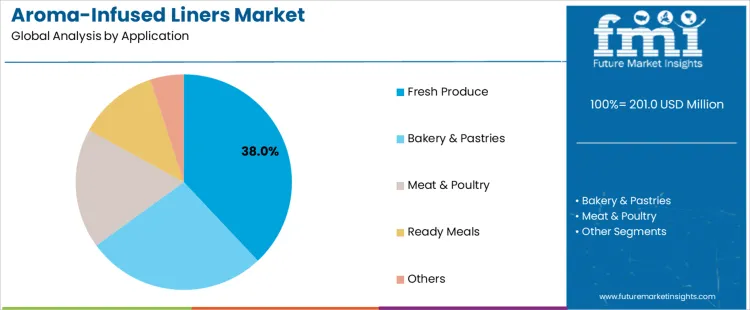
Aroma-infused liners gain traction across food applications because they help maintain product-specific sensory cues during distribution and display. Consumption is notable in fresh produce where subtle aroma reinforcement supports perceived freshness during transit and retail handling. Usage in bakery and pastries centers on preserving baked notes that can dissipate through standard packaging. Meat and poultry applications focus on odor management and masking of off-notes during chilled storage. Ready meals adopt liners to protect aroma integrity until heating or opening. Procurement decisions emphasize compatibility with crates, cartons, and trays already used in supply chains. Buyers favor liners that release aroma gradually without direct food contact. Price sensitivity remains moderate as liners contribute to product differentiation rather than primary containment. Specification control focuses on migration behavior, temperature stability, and food-contact safety compliance. Demand remains consistent from 2026 to 2036 as producers seek packaging enhancements that support sensory quality without reformulating food products.
Why do paper-based liners account for 40% of demand in the aroma-infused liners market by product type from 2026 to 2036?
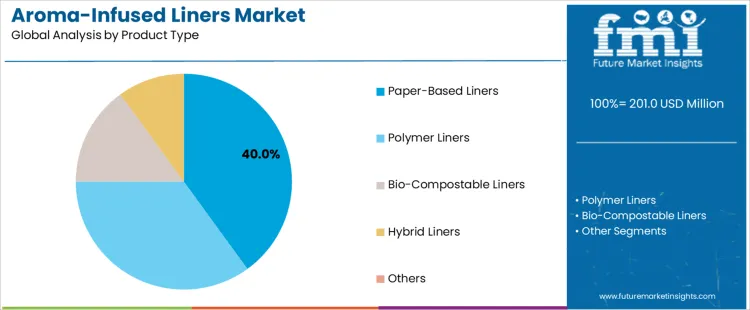
Paper-based liners account for 40% of demand because they combine porosity, printability, and aroma-carrying capability within a familiar packaging substrate. Consumption is strong in produce boxes, bakery cartons, and prepared food trays where airflow and moisture balance matter. Usage remains steady as paper structures allow controlled aroma release while avoiding condensation buildup. Procurement favors paper liners that integrate easily into packing lines and support recycling streams. Buyers prioritize liners treated with food-safe aroma systems that withstand handling and temperature variation. Price sensitivity stays moderate since paper-based options align with cost expectations for secondary packaging. Specification control emphasizes fiber strength, coating uniformity, and aroma retention during storage. Demand continues from 2026 to 2036 as brands favor paper-based formats to balance sensory enhancement with regulatory acceptance and packaging material familiarity across food supply chains.
How Are Aroma Infused Liners Being Integrated into Operational Waste and Packaging Systems?
Use expands in settings where odor presence affects daily handling and storage conditions. Commercial kitchens rely on scented liners to manage organic waste held between collection cycles. Hospitals apply them in service corridors to reduce residual smells near patient areas. Hotels place aroma infused liners in housekeeping carts to maintain neutral working environments. Event venues use them in temporary waste stations where airflow is limited. These applications reflect functional integration into operational routines rather than aesthetic enhancement, with adoption shaped by handling duration, waste composition, and human exposure patterns.
What Practical Conditions Encourage Use of Aroma Infused Liners Across Facilities?
Selection aligns with environments that experience repeated odor exposure during routine operations. Property managers specify scented liners for restrooms with high turnover. Distribution centers handling mixed waste streams apply liners to prevent odor transfer during transport. Food service operators choose mild aroma profiles to improve staff comfort without masking spoilage indicators. Cleaning teams favor liners that reduce the need for additional deodorizing products. These conditions support steady use where odor management contributes to workflow efficiency and acceptable working conditions.
Which Factors Limit Broader Reliance on Aroma Infused Liners in Institutional Use?
Sensitivity concerns influence purchasing decisions in facilities serving vulnerable populations. Some operators report reduced scent effectiveness during extended storage periods. Budget constraints lead high volume users to favor standard liners over scented options. Regulatory requirements restrict additive use in food adjacent environments. Storage conditions can weaken aroma stability before use. These factors result in selective deployment where operational benefit must outweigh cost, compliance, and user tolerance considerations.
What is the Demand for Aroma Infused Liners by Country?
<
| Country | CAGR (%) |
|---|---|
| United States | 7.8% |
| Germany | 6.9% |
| China | 10.5% |
| India | 11.7% |
| Brazil | 8.4% |
| Japan | 5.2% |
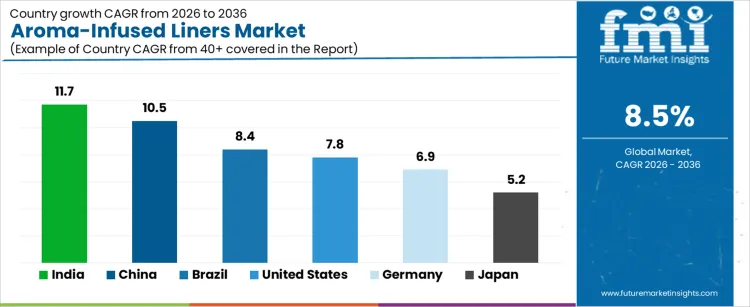
The demand for aroma infused liners varies across countries, reflecting differences in consumer goods production, packaging practices, and hygiene product usage. India leads with an 11.7% CAGR, supported by expanding personal care manufacturing, rising packaged consumer goods volumes, and broader acceptance of value added packaging formats. China follows at 10.5%, driven by scale driven production of hygiene products and increased use of scented liners in household and retail packaging. Brazil records 8.4%, shaped by growth in consumer goods and regional packaging investments. The United States grows at 7.8%, supported by established adoption in hygiene and specialty packaging. Germany posts 6.9%, reflecting steady industrial usage, while Japan grows at 5.2%, influenced by mature demand patterns and stable end use sectors.
How Is Consumer Packaging Innovation Driving Adoption in the United States?
In the United States, revenue from the Aroma Infused Liners Market is expanding at a CAGR of 7.8% through 2035, driven by rising use of scented liners in personal care, hygiene, and packaged consumer goods. Brand owners are incorporating aroma infused liners to enhance user experience and reinforce product differentiation at the point of use. Demand is concentrated in feminine hygiene, adult care, and specialty packaging applications where odor control and sensory attributes are valued. Domestic converters supply a wide range of liner formats, supported by established material standards and procurement systems. Stable consumption patterns and recurring supply contracts are sustaining predictable purchasing activity across large consumer goods manufacturers nationwide.
- Personal care packaging demand supports liner adoption.
- Odor control applications remain a primary use case.
- Domestic converters maintain consistent supply availability.
- Brand differentiation strategies sustain steady procurement volumes.
How Does Quality Focus Support Consistent Growth in Germany?
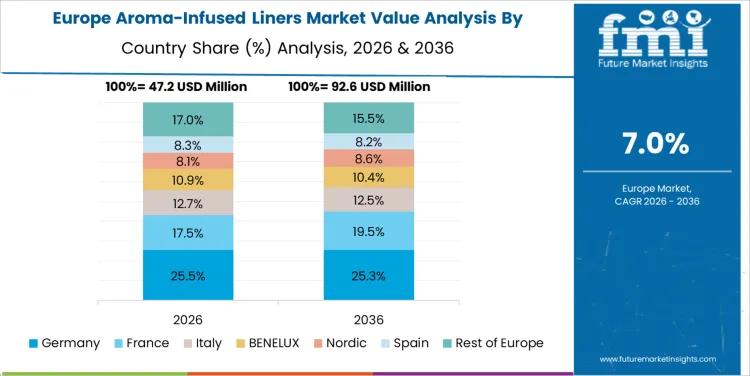
Germany continues to record expansion in the Aroma Infused Liners Market at a CAGR of 6.9% through 2035, supported by structured packaging standards and strong emphasis on product quality. Manufacturers are integrating aroma infused liners within hygiene and specialty packaging formats to improve end user experience. Demand is centered on feminine hygiene products, medical disposables, and premium consumer packaging. Technical expertise in materials processing supports controlled fragrance release and consistent liner performance. Stable demand from established brands and compliance focused production practices are sustaining measured procurement activity across domestic manufacturing facilities.
- Quality driven packaging standards support adoption.
- Hygiene products remain the core application segment.
- Technical expertise enables controlled fragrance integration.
- Established brands anchor baseline demand.
How Is Expanding Consumer Goods Production Influencing Demand in China?
In China, revenue from the Aroma Infused Liners Market is growing at a CAGR of 10.5% through 2035, driven by expanding consumer goods manufacturing and rising demand for value added packaging components. Hygiene product manufacturers are increasing use of scented liners to improve product appeal and address odor management requirements. Domestic liner producers are scaling capacity to meet growing volume demand, while fragrance suppliers strengthen local partnerships. Urban consumption growth and broader distribution of personal care products are supporting rapid adoption across large scale production environments nationwide.
- Growth in hygiene product manufacturing drives liner usage.
- Value added packaging supports product differentiation.
- Domestic capacity expansion improves supply responsiveness.
- Urban consumer demand sustains volume growth.
Why Is Hygiene Product Expansion Accelerating Growth in India?
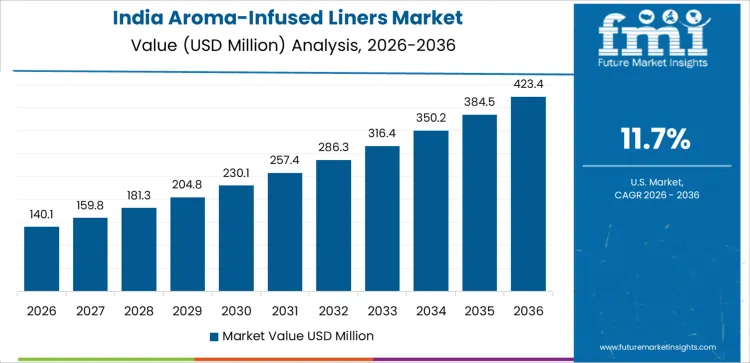
India is witnessing strong expansion in the Aroma Infused Liners Market at a CAGR of 11.7% through 2035, supported by rapid growth in hygiene product manufacturing and increasing consumer awareness. Producers are adopting aroma infused liners to improve odor control and user comfort across feminine hygiene and adult care segments. Rising penetration of branded hygiene products and wider retail distribution are supporting material demand. Domestic converters are entering the segment with cost focused offerings, while fragrance integration capabilities continue to improve. Expanding consumption across urban and semi urban markets is sustaining strong procurement momentum nationwide.
- Hygiene product penetration supports liner adoption.
- Odor control needs drive material selection.
- Domestic converters improve cost accessibility.
- Expanding retail distribution sustains demand growth.
How Are Product Differentiation Efforts Supporting Growth in Brazil?
Brazil is seeing steady growth in the Aroma Infused Liners Market at a CAGR of 8.4% through 2035, supported by rising demand for differentiated hygiene and personal care products. Manufacturers are incorporating scented liners to enhance product appeal and address odor management requirements. Growth in middle income consumption and packaged goods availability is supporting adoption. Imports remain relevant for specialized liner materials, while local converters expand basic production capabilities. Brand experimentation with fragrance variants continues to generate incremental demand across hygiene and specialty packaging applications nationwide.
- Product differentiation supports liner usage growth.
- Hygiene applications remain the primary demand source.
- Imports supply specialized material requirements.
- Consumer goods expansion sustains procurement activity.
How Does Mature Consumption Shape Demand Stability in Japan?
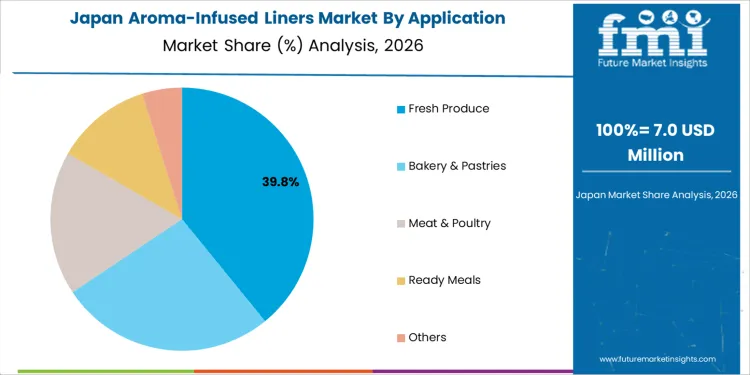
Japan is maintaining measured growth in the Aroma Infused Liners Market at a CAGR of 5.2% through 2035, supported by mature hygiene product consumption and consistent quality expectations. Manufacturers apply aroma infused liners selectively to enhance comfort and product refinement. Demand is concentrated within feminine hygiene, adult care, and medical disposable segments. Domestic producers supply a significant share of liner materials, aligned with local performance standards. Stable consumption patterns and replacement driven purchasing are sustaining predictable procurement across established consumer goods manufacturers nationwide.
- Mature hygiene markets support steady liner usage.
- Comfort focused product design drives selective adoption.
- Domestic suppliers maintain reliable material availability.
- Replacement demand sustains procurement consistency.
How Is Demand for Aroma Infused Liners Emerging Across Packaging Applications and Which Suppliers Influence Adoption?
Aroma infused liners are gaining attention as brands look to add subtle scent cues during product opening without direct contact with the product. Personal care, apparel, gift packaging, and specialty food segments use these liners to reinforce brand identity and enhance unboxing experiences. Smurfit Kappa and Mondi support this demand through fiber based liner systems adapted for cartons and inserts where scent release remains controlled during transport. Amcor contributes through flexible liner structures used in pouches and secondary packaging. UFlex supports cost sensitive applications through laminated liners designed for mass production. Sealed Air participates where protective packaging integrates aroma delivery in premium shipments. Avery Dennison supports pressure sensitive liner technology used in labels and wraps.
Supplier selection is influenced by scent stability, migration control, and compatibility with recycling streams. Packaging designers prioritize liners that retain aroma during storage yet release scent at the point of opening. Brand owners emphasize regulatory compliance and absence of residue transfer. Applications extend to subscription boxes, luxury retail packaging, promotional kits, and seasonal gift packs. Demand visibility follows growth in experiential packaging, direct to consumer shipping, and premium branding strategies that rely on sensory differentiation without altering core product formulations.
Key Players in the Aroma Infused Liners Market
- Smurfit Kappa
- Mondi
- Amcor
- UFlex
- Sealed Air
- Avery Dennison
Scope of the Report
| Items | Values |
|---|---|
| Quantitative Units (2026) | USD million |
| Application | Fresh Produce; Bakery and Pastries; Meat and Poultry; Ready Meals; Other Applications |
| Product Type | Paper Based Liners; Polymer Liners; Bio Compostable Liners; Hybrid Liners; Other Liner Types |
| Technology | Microencapsulation; Heat Activated Aroma; Pressure Release Aroma; Slow Release Aroma; Other Technologies |
| Regions Covered | Asia Pacific; Europe; North America; Latin America; Middle East and Africa |
| Countries Covered | China; Japan; South Korea; India; Australia and New Zealand; ASEAN; Germany; United Kingdom; France; Italy; Spain; Nordic; BENELUX; United States; Canada; Mexico; Brazil; Chile; Kingdom of Saudi Arabia; Turkey; South Africa; plus additional countries across Asia Pacific, Europe, Latin America, and Middle East and Africa |
| Key Companies Profiled | Smurfit Kappa; Mondi; Amcor; UFlex; Sealed Air; Avery Dennison |
| Additional Attributes | Dollar by sales across applications and liner types; integration of aroma infused liners into food packaging, hygiene products, waste management, and specialty consumer packaging; demand patterns influenced by odor control, freshness perception, and ambient scent management; adoption of paper based and polymer liner structures for controlled aroma diffusion and storage stability; role of microencapsulation and release technologies in managing scent longevity and activation timing; compatibility with existing cartons, trays, pouches, and secondary packaging systems; influence of regulatory compliance, food contact safety, and recyclability requirements on liner adoption across regions |
Aroma Infused Liners Market Segmentation
By Application
- Fresh Produce
- Bakery & Pastries
- Meat & Poultry
- Ready Meals
- Others
By Product Type
- Paper-Based Liners
- Polymer Liners
- Bio-Compostable Liners
- Hybrid Liners
- Others
By Technology
- Microencapsulation
- Heat-Activated Aroma
- Pressure-Release Aroma
- Slow-Release Aroma
- Others
Region
- Asia Pacific
- China
- Japan
- South Korea
- India
- Australia & New Zealand
- ASEAN
- Rest of Asia Pacific
- Europe
- Germany
- United Kingdom
- France
- Italy
- Spain
- Nordic
- BENELUX
- Rest of Europe
- North America
- United States
- Canada
- Mexico
- Latin America
- Brazil
- Chile
- Rest of Latin America
- Middle East & Africa
- Kingdom of Saudi Arabia
- Other GCC Countries
- Turkey
- South Africa
- Other African Union
- Rest of Middle East & Africa
Frequently Asked Questions
How big is the aroma-infused liners market in 2026?
The global aroma-infused liners market is estimated to be valued at USD 201.0 million in 2026.
What will be the size of aroma-infused liners market in 2036?
The market size for the aroma-infused liners market is projected to reach USD 456.0 million by 2036.
How much will be the aroma-infused liners market growth between 2026 and 2036?
The aroma-infused liners market is expected to grow at a 8.5% CAGR between 2026 and 2036.
What are the key product types in the aroma-infused liners market?
The key product types in aroma-infused liners market are fresh produce, bakery & pastries, meat & poultry, ready meals and others.
Which product type segment to contribute significant share in the aroma-infused liners market in 2026?
In terms of product type, paper-based liners segment to command 40.0% share in the aroma-infused liners market in 2026.
Preview the report firsthand - request a free sample
Get SampleGet the brochure for pricing and purchase details.
Get PDFTable of Content
- Executive Summary
- Global Market Outlook
- Demand-side Trends
- Supply-side Trends
- Technology Roadmap Analysis
- Analysis and Recommendations
- Market Overview
- Market Coverage / Taxonomy
- Market Definition / Scope / Limitations
- Market Background
- Market Dynamics
- Drivers
- Restraints
- Opportunity
- Trends
- Scenario Forecast
- Demand in Optimistic Scenario
- Demand in Likely Scenario
- Demand in Conservative Scenario
- Opportunity Map Analysis
- Product Life Cycle Analysis
- Supply Chain Analysis
- Investment Feasibility Matrix
- Value Chain Analysis
- PESTLE and Porter’s Analysis
- Regulatory Landscape
- Regional Parent Market Outlook
- Production and Consumption Statistics
- Import and Export Statistics
- Market Dynamics
- Global Market Analysis 2021 to 2025 and Forecast, 2026 to 2036
- Historical Market Size Value (USD Million) Analysis, 2021 to 2025
- Current and Future Market Size Value (USD Million) Projections, 2026 to 2036
- Y-o-Y Growth Trend Analysis
- Absolute $ Opportunity Analysis
- Global Market Pricing Analysis 2021 to 2025 and Forecast 2026 to 2036
- Global Market Analysis 2021 to 2025 and Forecast 2026 to 2036, By Application
- Introduction / Key Findings
- Historical Market Size Value (USD Million) Analysis By Application , 2021 to 2025
- Current and Future Market Size Value (USD Million) Analysis and Forecast By Application , 2026 to 2036
- Fresh Produce
- Bakery & Pastries
- Meat & Poultry
- Ready Meals
- Others
- Y-o-Y Growth Trend Analysis By Application , 2021 to 2025
- Absolute $ Opportunity Analysis By Application , 2026 to 2036
- Global Market Analysis 2021 to 2025 and Forecast 2026 to 2036, By Product Type
- Introduction / Key Findings
- Historical Market Size Value (USD Million) Analysis By Product Type, 2021 to 2025
- Current and Future Market Size Value (USD Million) Analysis and Forecast By Product Type, 2026 to 2036
- Paper-Based Liners
- Polymer Liners
- Bio-Compostable Liners
- Hybrid Liners
- Others
- Y-o-Y Growth Trend Analysis By Product Type, 2021 to 2025
- Absolute $ Opportunity Analysis By Product Type, 2026 to 2036
- Global Market Analysis 2021 to 2025 and Forecast 2026 to 2036, By Technology
- Introduction / Key Findings
- Historical Market Size Value (USD Million) Analysis By Technology, 2021 to 2025
- Current and Future Market Size Value (USD Million) Analysis and Forecast By Technology, 2026 to 2036
- Microencapsulation
- Heat-Activated Aroma
- Pressure-Release Aroma
- Slow-Release Aroma
- Others
- Y-o-Y Growth Trend Analysis By Technology, 2021 to 2025
- Absolute $ Opportunity Analysis By Technology, 2026 to 2036
- Global Market Analysis 2021 to 2025 and Forecast 2026 to 2036, By Region
- Introduction
- Historical Market Size Value (USD Million) Analysis By Region, 2021 to 2025
- Current Market Size Value (USD Million) Analysis and Forecast By Region, 2026 to 2036
- North America
- Latin America
- Western Europe
- Eastern Europe
- East Asia
- South Asia and Pacific
- Middle East & Africa
- Market Attractiveness Analysis By Region
- North America Market Analysis 2021 to 2025 and Forecast 2026 to 2036, By Country
- Historical Market Size Value (USD Million) Trend Analysis By Market Taxonomy, 2021 to 2025
- Market Size Value (USD Million) Forecast By Market Taxonomy, 2026 to 2036
- By Country
- USA
- Canada
- Mexico
- By Application
- By Product Type
- By Technology
- By Country
- Market Attractiveness Analysis
- By Country
- By Application
- By Product Type
- By Technology
- Key Takeaways
- Latin America Market Analysis 2021 to 2025 and Forecast 2026 to 2036, By Country
- Historical Market Size Value (USD Million) Trend Analysis By Market Taxonomy, 2021 to 2025
- Market Size Value (USD Million) Forecast By Market Taxonomy, 2026 to 2036
- By Country
- Brazil
- Chile
- Rest of Latin America
- By Application
- By Product Type
- By Technology
- By Country
- Market Attractiveness Analysis
- By Country
- By Application
- By Product Type
- By Technology
- Key Takeaways
- Western Europe Market Analysis 2021 to 2025 and Forecast 2026 to 2036, By Country
- Historical Market Size Value (USD Million) Trend Analysis By Market Taxonomy, 2021 to 2025
- Market Size Value (USD Million) Forecast By Market Taxonomy, 2026 to 2036
- By Country
- Germany
- UK
- Italy
- Spain
- France
- Nordic
- BENELUX
- Rest of Western Europe
- By Application
- By Product Type
- By Technology
- By Country
- Market Attractiveness Analysis
- By Country
- By Application
- By Product Type
- By Technology
- Key Takeaways
- Eastern Europe Market Analysis 2021 to 2025 and Forecast 2026 to 2036, By Country
- Historical Market Size Value (USD Million) Trend Analysis By Market Taxonomy, 2021 to 2025
- Market Size Value (USD Million) Forecast By Market Taxonomy, 2026 to 2036
- By Country
- Russia
- Poland
- Hungary
- Balkan & Baltic
- Rest of Eastern Europe
- By Application
- By Product Type
- By Technology
- By Country
- Market Attractiveness Analysis
- By Country
- By Application
- By Product Type
- By Technology
- Key Takeaways
- East Asia Market Analysis 2021 to 2025 and Forecast 2026 to 2036, By Country
- Historical Market Size Value (USD Million) Trend Analysis By Market Taxonomy, 2021 to 2025
- Market Size Value (USD Million) Forecast By Market Taxonomy, 2026 to 2036
- By Country
- China
- Japan
- South Korea
- By Application
- By Product Type
- By Technology
- By Country
- Market Attractiveness Analysis
- By Country
- By Application
- By Product Type
- By Technology
- Key Takeaways
- South Asia and Pacific Market Analysis 2021 to 2025 and Forecast 2026 to 2036, By Country
- Historical Market Size Value (USD Million) Trend Analysis By Market Taxonomy, 2021 to 2025
- Market Size Value (USD Million) Forecast By Market Taxonomy, 2026 to 2036
- By Country
- India
- ASEAN
- Australia & New Zealand
- Rest of South Asia and Pacific
- By Application
- By Product Type
- By Technology
- By Country
- Market Attractiveness Analysis
- By Country
- By Application
- By Product Type
- By Technology
- Key Takeaways
- Middle East & Africa Market Analysis 2021 to 2025 and Forecast 2026 to 2036, By Country
- Historical Market Size Value (USD Million) Trend Analysis By Market Taxonomy, 2021 to 2025
- Market Size Value (USD Million) Forecast By Market Taxonomy, 2026 to 2036
- By Country
- Kingdom of Saudi Arabia
- Other GCC Countries
- Turkiye
- South Africa
- Other African Union
- Rest of Middle East & Africa
- By Application
- By Product Type
- By Technology
- By Country
- Market Attractiveness Analysis
- By Country
- By Application
- By Product Type
- By Technology
- Key Takeaways
- Key Countries Market Analysis
- USA
- Pricing Analysis
- Market Share Analysis, 2025
- By Application
- By Product Type
- By Technology
- Canada
- Pricing Analysis
- Market Share Analysis, 2025
- By Application
- By Product Type
- By Technology
- Mexico
- Pricing Analysis
- Market Share Analysis, 2025
- By Application
- By Product Type
- By Technology
- Brazil
- Pricing Analysis
- Market Share Analysis, 2025
- By Application
- By Product Type
- By Technology
- Chile
- Pricing Analysis
- Market Share Analysis, 2025
- By Application
- By Product Type
- By Technology
- Germany
- Pricing Analysis
- Market Share Analysis, 2025
- By Application
- By Product Type
- By Technology
- UK
- Pricing Analysis
- Market Share Analysis, 2025
- By Application
- By Product Type
- By Technology
- Italy
- Pricing Analysis
- Market Share Analysis, 2025
- By Application
- By Product Type
- By Technology
- Spain
- Pricing Analysis
- Market Share Analysis, 2025
- By Application
- By Product Type
- By Technology
- France
- Pricing Analysis
- Market Share Analysis, 2025
- By Application
- By Product Type
- By Technology
- India
- Pricing Analysis
- Market Share Analysis, 2025
- By Application
- By Product Type
- By Technology
- ASEAN
- Pricing Analysis
- Market Share Analysis, 2025
- By Application
- By Product Type
- By Technology
- Australia & New Zealand
- Pricing Analysis
- Market Share Analysis, 2025
- By Application
- By Product Type
- By Technology
- China
- Pricing Analysis
- Market Share Analysis, 2025
- By Application
- By Product Type
- By Technology
- Japan
- Pricing Analysis
- Market Share Analysis, 2025
- By Application
- By Product Type
- By Technology
- South Korea
- Pricing Analysis
- Market Share Analysis, 2025
- By Application
- By Product Type
- By Technology
- Russia
- Pricing Analysis
- Market Share Analysis, 2025
- By Application
- By Product Type
- By Technology
- Poland
- Pricing Analysis
- Market Share Analysis, 2025
- By Application
- By Product Type
- By Technology
- Hungary
- Pricing Analysis
- Market Share Analysis, 2025
- By Application
- By Product Type
- By Technology
- Kingdom of Saudi Arabia
- Pricing Analysis
- Market Share Analysis, 2025
- By Application
- By Product Type
- By Technology
- Turkiye
- Pricing Analysis
- Market Share Analysis, 2025
- By Application
- By Product Type
- By Technology
- South Africa
- Pricing Analysis
- Market Share Analysis, 2025
- By Application
- By Product Type
- By Technology
- USA
- Market Structure Analysis
- Competition Dashboard
- Competition Benchmarking
- Market Share Analysis of Top Players
- By Regional
- By Application
- By Product Type
- By Technology
- Competition Analysis
- Competition Deep Dive
- Assumptions & Acronyms Used
- Research Methodology


