


Basalt Dust Market : Global Industry Analysis 2016 - 2025 and Opportunity Assessment 2026 - 2036
The Basalt Dust Market is segmented by Grade (Agricultural Soil Remineralizer, Industrial Filler Grade, Construction Blend Grade, and Other), Application (Soil Amendment, Enhanced Rock Weathering, Cement / Concrete Additive, and Asphalt / Other), End Use (Agriculture, Construction, Industrial Manufacturing, and Municipal / Other), Source (Quarry By-product and Dedicated Milled Basalt), Sales Channel, and Region. Forecast for 2026 to 2036.
How big is the basalt dust market in 2026?
USD 560.6 million in 2026 and USD 1,606.2 million by 2036 at an 11.1% CAGR.
The basalt dust industry value is forecast to grow from USD 504.5905 million in 2025 to USD 1,606.2 million by 2036 at 11.1% CAGR as quarry fines gain value in soil remineralization, carbon removal, and mineral blend applications. Quarry By-product is forecast to represent 68.0% share in 2026 due to lower sourcing cost and better project economics. Agriculture is projected to hold 61.0% share in 2026, led by field spreading across farm and carbon project use.
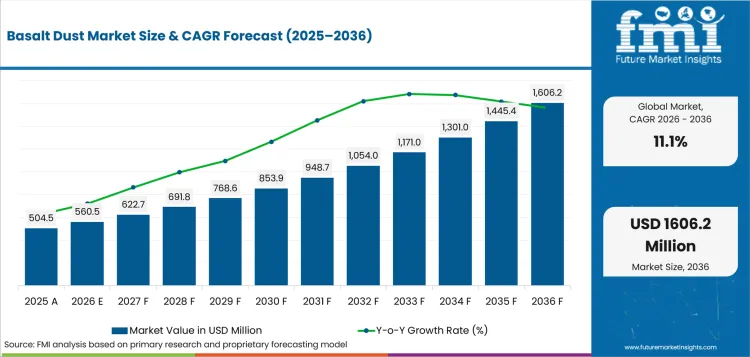
Summary of the Basalt Dust MarketDemand and Growth Drivers
- Demand and Growth Drivers
- Carbon removal buyers are funding enhanced weathering projects that require tested silicate dust and field application records.
- Farmers are testing basalt dust as a slow-release mineral input for soil balance and crop-field conditioning.
- Quarry operators are seeking higher-value outlets for fines that otherwise remain in low-margin mineral streams.
- Product and Segment View
- Quarry By-product is forecast to represent 68.0% share in 2026, led by lower raw material cost and easier access to existing fines.
- Agriculture is projected to hold 61.0% share in 2026, supported by repeat field spreading and land access for carbon projects.
- Direct sales are expected to secure 57.0% share in 2026, influenced by buyer need for traceable delivery and batch documentation.
- Geography and Competitive Outlook
- India is projected to record 13.1% CAGR by 2036, backed by Deccan basalt resources and smallholder carbon project activity.
- China is expected to expand at 12.3% CAGR by 2036 through mineral processing scale and construction-material testing.
- UNDO, Lithos Carbon, and Terradot compete through field-scale enhanced weathering and corporate carbon buyer relationships.
- InPlanet, Mati Carbon, Alt Carbon, and Silica focus on smallholder farm networks, tropical spreading conditions, and verified credit delivery.
- Analyst Opinion
- Nikhil Kaitwade, Principal Consultant for Chemicals at FMI, observes, “Basalt dust is a sourcing and proof market before it is a scale market. The material is available in many regions, yet carbon-grade and farm-grade supply must pass chemistry, particle-size, and traceability checks. Buyers need quarry evidence, soil guidance, and field records before committing to larger volumes. Suppliers that connect quarry fines with agronomy support and carbon accounting will hold a stronger position.”
Market outlook is shaped by quarry feedstock availability, field verification needs, and demand for documented soil inputs. USGS estimated that the United States produced 1.5 billion tons of crushed stone worth USD 26 billion in 2024, showing a large quarry-side pool for screened fines. DOE research notes that enhanced rock weathering on croplands could remove 0.5 to 2 Pg C each year through crushed alkaline minerals such as basalt. Aggregates Europe reported 2,916 million tonnes of total aggregates production across EU-27, UK, and EFTA countries in 2024, which gives mineral suppliers a broad base for upgrading fines into higher-value uses.
The basalt dust market is expected to witness strong growth through 2036, driven by demand from farms, quarry operators, carbon project developers, and construction-material buyers. Market expansion is further supported by rising use of basalt dust as a documented soil and carbon-management input.
Which factors support expansion in the basalt dust market?
Documented quarry fines, farm spreading networks, and carbon-removal accounting support market value across soil and mineral applications.
- Market value is supported by upgraded quarry fines before construction and agriculture channels add incremental revenue.
- Supplier pricing reflects milling energy and transport distance before particle size affects repeat buyer approval.
- Revenue improves as carbon projects convert screened basalt fines into field-spread mineral inputs with documentation.
- Buyer trust rises when mineral chemistry, heavy-metal screening, and delivery records are easier to compare.
Why is the basalt dust market growing?
Carbon buyers, farmers, and quarry operators are converging around measured mineral use.
Growth outlook has become more structured as basalt dust moves from quarry by-product supply into verified field programs. USDA listed a climate-smart enhanced rock weathering project with an approximate funding ceiling of USD 4,999,900, showing official support for field testing in agricultural settings. This strengthens demand for screened basalt dust because project buyers need mineral chemistry, application plans, and monitoring evidence. Suppliers that combine quarry sourcing with agronomy support can create stronger repeat demand than sellers offering bulk fines alone.
How is the basalt dust market segmented?
The basalt dust industry is segmented by grade, application, end use, source, and sales channel.
- Agricultural Soil Remineralizer is projected to secure 44.0% share in 2026, led by farms recognizing basalt dust as a mineral input for soil conditioning and nutrient balance.
- Soil Amendment is anticipated to hold 42.0% share in 2026, supported by repeat spreading practices that use existing farm input logistics.
- Agriculture is expected to represent 61.0% share in 2026, reflected in the land base needed for field spreading and carbon project trials.
- Quarry By-product is forecast to account for 68.0% share in 2026, guided by lower feedstock cost and the ability to upgrade existing fines.
- Direct sales are projected to capture 57.0% share in 2026, influenced by buyers needing traceable deliveries and batch documentation.
Why does Agricultural Soil Remineralizer dominate the basalt dust market by grade?
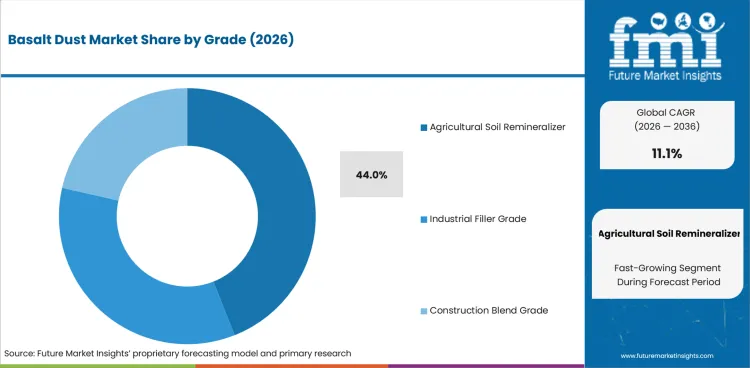
- Agricultural Soil Remineralizer is projected to account for 44.0% share in 2026, led by farms valuing basalt dust for slow mineral release and soil conditioning.
- Industrial filler grade needs tighter particle control and cleaner documentation, which raises processing cost before suppliers can serve coatings or compounders.
Which application leads the basalt dust market?
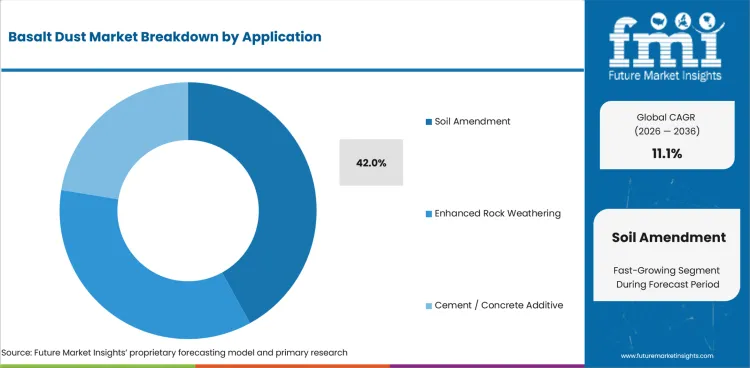
- Soil Amendment is expected to represent 42.0% share in 2026, supported by broad field spreading and easier comparison with lime or mineral blends.
- Enhanced rock weathering gains higher project value, although it needs soil sampling and carbon accounting that make adoption more service-heavy.
Which end use leads the basalt dust market?
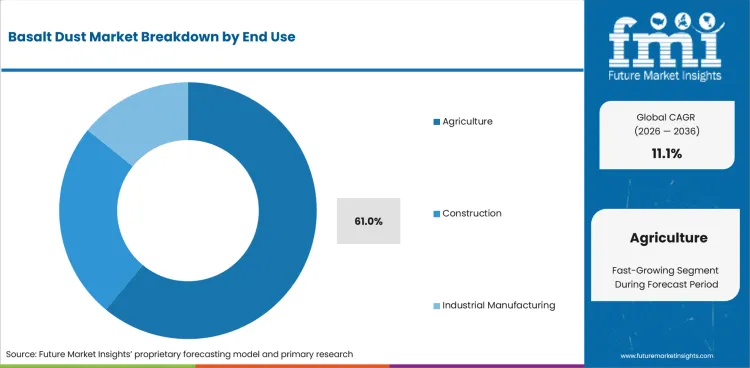
- Agriculture is anticipated to hold 61.0% share in 2026, reflected in farms providing the main land base for basalt dust application.
- Construction buyers create added demand for mineral blends, yet purchase decisions depend more on local specifications and filler performance.
Which source dominates the basalt dust market?
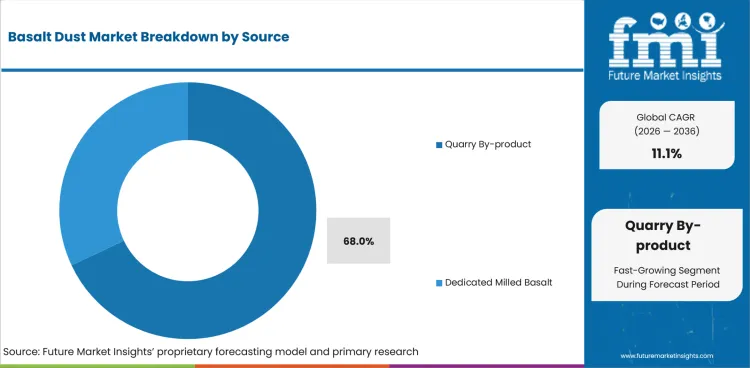
- Quarry By-product is forecast to represent 68.0% share in 2026, guided by existing fines that lower raw material cost for farm and carbon projects.
- Dedicated milled basalt offers tighter specifications, although milling energy and transport cost can weaken project economics.
Which sales channel leads the basalt dust market?
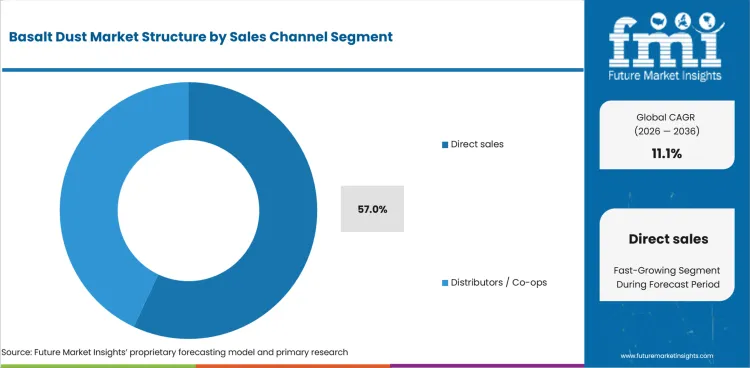
- Direct sales are projected to account for 57.0% share in 2026, influenced by carbon and construction buyers requesting supply records.
- Distributors and co-ops can improve farm access, although large carbon projects usually retain direct contracts for audit control.
What are the driver, restraints, and opportunities in the basalt dust market?
Measured carbon removal and soil-use demand support growth while verification cost limits faster project scaling.
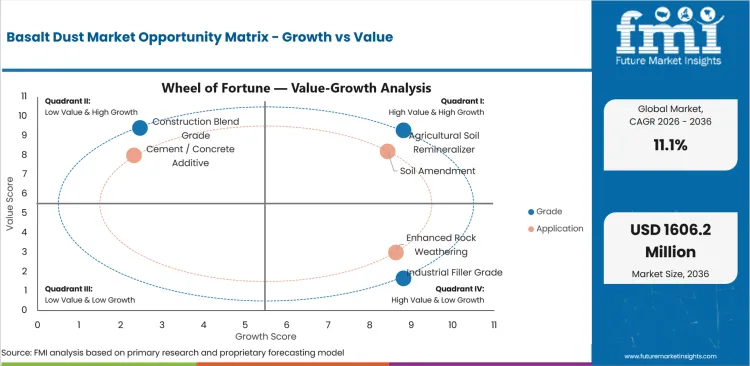
- Driver: Carbon removal buyers are moving toward basalt dust projects that can prove source chemistry and field application records.
- Restraint: Verification cost can slow adoption because sampling, soil monitoring, and carbon accounting increase project work.
- Opportunity: Quarry fines upgrading can create higher-value mineral outlets when suppliers combine testing, logistics, and agronomy support.
Basalt Dust Market Demand Outlook
Demand outlook is moving toward verified field use, local quarry partnerships, and application-specific mineral specifications. Farmers require practical guidance on handling, timing, and expected soil effects before repeat orders develop. A September 2025 Frontiers in Climate field trial in Scotland surface-applied crushed basalt at rates up to 126 t ha-1, showing why project buyers ask for application-rate evidence before approving wider field use. Carbon buyers require evidence that mineral spreading can be tracked and monitored across project boundaries. Construction users will test basalt fines only when material behavior aligns with local specifications and quality documentation.
Buyer Segmentation and Purchase Behavior Analysis
Farm buyers, carbon project developers, construction formulators, and industrial mineral users purchase basalt dust for different reasons. USDA said its Partnerships for Climate-Smart Commodities program is investing USD 3.1 billion in 141 selected projects, supporting a wider buyer base for farm trials and measured soil-carbon procurement. Farmers focus on delivered cost, spreading convenience, and visible agronomy support. Carbon project developers focus on batch traceability, silicate chemistry, field records, and verifier acceptance. Construction buyers focus on moisture, fineness, filler behavior, and compatibility with cement or asphalt systems.
Voice of Customer and Decision-driver Analysis
Purchase decisions are shaped by proof rather than product description alone. Buyers ask whether the basalt source is tested, whether dust levels are safe to handle, and whether deliveries fit normal field or plant schedules. MPA reported in August 2025 that asphalt and dry stone represented 37.8 Mt, or 33% of total crushed rock aggregate sales in Britain, which shows why construction buyers compare fine-mineral behavior before accepting new basalt streams. Suppliers can reduce friction by offering test certificates, recommended application ranges, delivery planning, and documentation templates.
Which countries are growing fastest in the basalt dust market?
India 13.1% CAGR, China 12.3% CAGR, United States 11.8% CAGR, United Kingdom 11.5% CAGR, Germany 10.9% CAGR, France 10.6% CAGR, Japan 9.8% CAGR, and South Korea 9.7% CAGR through 2036.
.webp "Top Country Growth Comparison Basalt Dust Market Cagr (2026 2036)")
| Country | CAGR |
|---|---|
| India | 13.1% |
| China | 12.3% |
| United States | 11.8% |
| United Kingdom | 11.5% |
| Germany | 10.9% |
| France | 10.6% |
| Japan | 9.8% |
| South Korea | 9.7% |
Source: Future Market Insights, 2026.
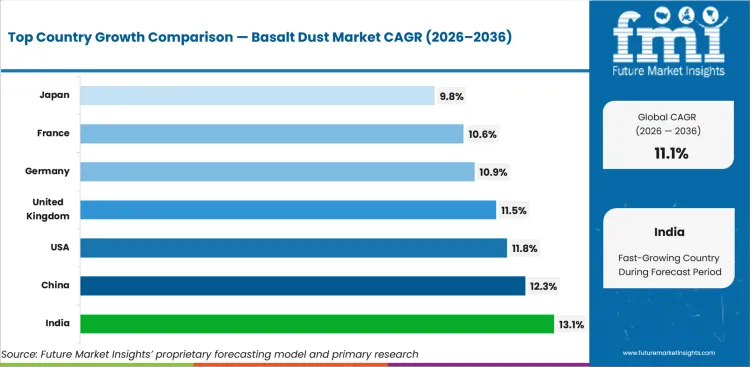
How do country-level CAGRs compare in the basalt dust market?
India leads country growth while South Korea records the most cautious expansion outlook among profiled markets.
- India is projected to record 13.1% CAGR by 2036 as Deccan basalt and smallholder agriculture support field programs.
- China is projected to record 12.3% CAGR by 2036 as mineral processing scale supports construction and soil trials.
- The United States is expected to expand at 11.8% CAGR from 2026 to 2036 due to quarry supply and corporate carbon procurement.
- The United Kingdom is estimated to rise at 11.5% CAGR by 2036 with visible enhanced weathering projects.
- Germany is forecast to record 10.9% CAGR by 2036 as certification discipline shapes buyer screening.
- France is expected to advance at 10.6% CAGR over the forecast period through local quarry logistics.
- Japan is forecast to grow at 9.8% CAGR through 2036 as verified carbon-credit buying supports indirect demand.
- South Korea is projected to post 9.7% CAGR by 2036 as construction-material procurement shapes early use.
How fast is the basalt dust market growing in India?
A 13.1% CAGR through 2036 reflects basalt-rich geology and farm-linked carbon project interest.
Country Market Snapshot Table
| Parameter | Value |
|---|---|
| Market Size in 2025 (Value) | USD 79.6 million |
| Market Size in 2026 (Value) | USD 90.0 million |
| Market Forecast in 2036 (Value) | USD 308.2 million |
| CAGR (2026 to 2036) | 13.1% |
| Years Considered | 2021 to 2036 |
| Base Year | 2025 |
| Forecast Period | 2026 to 2036 |
| Units Considered | Value (USD million) |
| Leading Sub-Region | Deccan basalt and smallholder agriculture corridors |
India Basalt Dust Market Outlook
- India basalt dust demand is shaped by Deccan basalt availability, soil-health programs, and farm networks that can explain field spreading practices. Carbon project developers view the country as a practical testing base for smallholder enhanced weathering models.
- Suppliers must connect quarry screening with farmer education before wider adoption improves. Basalt dust buyers will favor batches with clear mineral chemistry, safe handling guidance, and delivery plans aligned with crop calendars.
Key Growth Drivers
- Deccan volcanic formations give suppliers a visible basalt resource base. The province covers nearly 500,000 km² across western and central India.
- Soil-health advisory systems support mineral input education. The government reported more than 25 crore Soil Health Cards distributed by July 2025.
- Smallholder networks can support repeat spreading when agronomy advisers explain dosage, dust handling, and field timing in local languages.
- Carbon project developers can combine farmer outreach with direct quarry procurement to reduce uncertainty around material origin and application practice.
Key Restraints
- Small average farm sizes raise coordination work. The Agriculture Census placed the average operational holding at 1.08 ha.
- Long inland delivery distances can weaken project economics when quarry fines move far from basalt belts to cropland clusters.
- Farmer trust can develop slowly if basalt dust is promoted through carbon language without practical soil management advice.
What makes India unique
India is unique due to Deccan basalt resources, large farm networks, and rising interest in smallholder carbon projects.
Key Companies
- Mati Carbon
- Alt Carbon
- InPlanet
- Terradot
- Local quarry operators
- Agricultural co-operatives
- Carbon project aggregators
Sales & Marketing Channels
- Direct carbon project contracts
- Quarry-to-farm supply agreements
- Farmer producer organizations
- Agronomy adviser networks
- Co-operative input channels
- Rural distributor partners
Country Segment Breakdown Table
| Segment | Sub-Segments |
|---|---|
| By Grade | Agricultural Soil Remineralizer · Industrial Filler Grade · Construction Blend Grade · Other |
| By Application | Soil Amendment · Enhanced Rock Weathering · Cement / Concrete Additive · Asphalt / Other |
| By End Use | Agriculture · Construction · Industrial Manufacturing · Municipal / Other |
| By Source | Quarry By-product · Dedicated Milled Basalt |
| By Sales Channel | Direct · Distributors / Co-ops |
| Key Sub-Regions Covered, Basalt and Agricultural Corridors | Maharashtra · Gujarat · Madhya Pradesh · Karnataka · Telangana · Tamil Nadu |
Frequently Asked Questions
How fast is India basalt dust market growing?
Sales in India are projected to rise at 13.1% CAGR from 2026 to 2036, supported by basalt resources and farm-linked carbon projects.
Who leads India basalt dust market?
Mati Carbon, Alt Carbon, InPlanet, and local quarry suppliers compete through farm outreach and carbon project sourcing.
What is driving adoption in India basalt dust market?
Basalt availability, soil-health guidance, and carbon finance are moving suppliers toward documented field-spreading models.
What is the basalt dust market outlook in China?
A 12.3% CAGR through 2036 reflects large mineral-processing scale and construction-material testing.
Country Market Snapshot Table
| Parameter | Value |
|---|---|
| Market Size in 2025 (Value) | USD 99.7 million |
| Market Size in 2026 (Value) | USD 112.0 million |
| Market Forecast in 2036 (Value) | USD 357.3 million |
| CAGR (2026 to 2036) | 12.3% |
| Years Considered | 2021 to 2036 |
| Base Year | 2025 |
| Forecast Period | 2026 to 2036 |
| Units Considered | Value (USD million) |
| Leading Sub-Region | Yangtze River Delta and western mineral belts |
China Basalt Dust Market Outlook
- China basalt dust demand is influenced by non-metallic mineral processing scale and construction-material procurement discipline. Adoption is expected to begin through industrial filler and blend testing before verified farm carbon projects gain wider visibility.
- Carbon-market development can create future interest in measurable removal pathways. Suppliers will need verified chemistry and project documentation before basalt dust claims gain stronger commercial acceptance.
Key Growth Drivers
- Industrial supply scale supports mineral dust testing. The National Bureau of Statistics reported a 96.6% industrial product sales rate in May 2024.
- Carbon-accounting depth is expanding. China reported 728 million tonnes of cumulative allowance trading by September 2025.
- Provincial quarry networks can supply mineral dust close to construction and agricultural buyers when local screening standards are clear.
- Large construction-material buyers can test basalt fines as part of broader mineral blend work in cement, concrete, and asphalt applications.
Key Restraints
- Construction cycles can slow filler-grade demand. Official data showed non-metallic mineral products output down 0.6% in May 2024.
- Verified enhanced weathering protocols remain less visible than industrial material standards in public country-level sources.
- Regional transport distances can limit the cost benefit of low-value basalt fines when quarry and spreading sites are far apart.
What makes China unique
China is unique due to mineral-processing scale and a carbon market that can influence future removal procurement.
Key Companies
- Provincial quarry operators
- China Resources Cement-related mineral businesses
- Local non-metallic mineral processors
- Construction material formulators
- Agricultural input distributors
- Carbon pilot developers
Sales & Marketing Channels
- Direct industrial mineral sales
- Provincial quarry networks
- Construction material formulators
- Agricultural input distributors
- Research pilot partnerships
- Carbon market-linked procurement
Country Segment Breakdown Table
| Segment | Sub-Segments |
|---|---|
| By Grade | Agricultural Soil Remineralizer · Industrial Filler Grade · Construction Blend Grade · Other |
| By Application | Soil Amendment · Enhanced Rock Weathering · Cement / Concrete Additive · Asphalt / Other |
| By End Use | Agriculture · Construction · Industrial Manufacturing · Municipal / Other |
| By Source | Quarry By-product · Dedicated Milled Basalt |
| By Sales Channel | Direct · Distributors / Co-ops |
| Key Sub-Regions Covered, Basalt and Agricultural Corridors | Guangxi · Guangdong · Sichuan · Yunnan · Jiangsu · Inner Mongolia |
Frequently Asked Questions
How fast is China basalt dust market growing?
China is expected to grow at 12.3% CAGR from 2026 to 2036 as mineral processing and material testing expand.
Who leads China basalt dust market?
Local quarry operators, mineral processors, and construction-material suppliers shape competition more than global ERW specialists.
What is driving adoption in China basalt dust market?
Mineral processing scale, construction blend testing, and carbon-accounting development support demand formation.
What supports basalt dust demand in the United States?
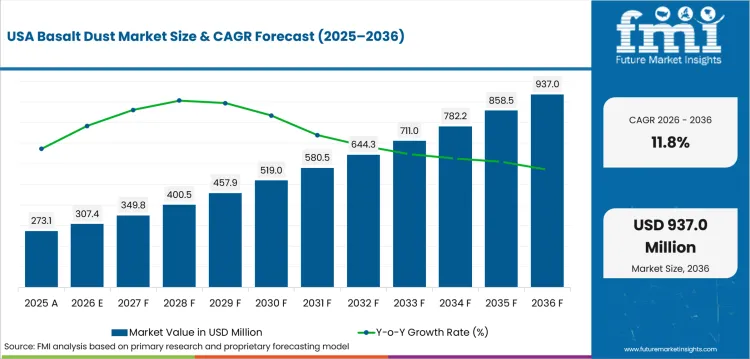
An 11.8% CAGR through 2036 reflects quarry supply, farm acreage, and early carbon-removal buying.
Country Market Snapshot Table
| Parameter | Value |
|---|---|
| Market Size in 2025 (Value) | USD 114.5 million |
| Market Size in 2026 (Value) | USD 128.0 million |
| Market Forecast in 2036 (Value) | USD 390.5 million |
| CAGR (2026 to 2036) | 11.8% |
| Years Considered | 2021 to 2036 |
| Base Year | 2025 |
| Forecast Period | 2026 to 2036 |
| Units Considered | Value (USD million) |
| Leading Sub-Region | Midwest farming states and western quarry belts |
United States Basalt Dust Market Outlook
- United States basalt dust demand is shaped by quarry networks, agricultural spreading capacity, and corporate carbon-removal procurement. Demand is strongest when suppliers connect crushed stone fines with crop-region logistics and field measurement support.
- Project buyers will screen basalt dust by chemistry, traceability, delivery distance, and application records. Suppliers with quarry partnerships and agronomy support can improve repeat order confidence.
Key Growth Drivers
- The quarry base is broad. USGS estimated around 1,400 companies producing crushed stone in 2024.
- Climate-smart project funding supports field testing. USDA listed an enhanced rock weathering project with an approximate funding ceiling of USD 4,999,900.
- Midwest crop regions can add basalt spreading to existing lime and fertilizer logistics without changing core farm operations.
- Corporate carbon buyers create early demand for documented enhanced weathering credits with quarry-to-field traceability.
Key Restraints
- Farmland coordination is complex. The 2022 Census of Agriculture reported 1.9 million farms across 880 million acres.
- State-by-state soil rules can slow field application approvals and increase buyer review work before contract signing.
- Long haul distances can reduce both carbon benefit and delivered-price advantage for low-value mineral dust.
What makes United States unique
The United States combines carbon-credit demand with large quarry output and wide farm acreage.
Key Companies
- Lithos Carbon
- Terradot
- Eion
- UNDO
- Martin Marietta Materials
- Vulcan Materials
- CRH Americas Materials
Sales & Marketing Channels
-
Direct carbon project contracts
- Quarry-to-farm supply agreements
- Agronomy adviser channels
- Farmer network partnerships
- Carbon registry project developers
- Construction material distributors
Country Segment Breakdown Table
| Segment | Sub-Segments |
|---|---|
| By Grade | Agricultural Soil Remineralizer · Industrial Filler Grade · Construction Blend Grade · Other |
| By Application | Soil Amendment · Enhanced Rock Weathering · Cement / Concrete Additive · Asphalt / Other |
| By End Use | Agriculture · Construction · Industrial Manufacturing · Municipal / Other |
| By Source | Quarry By-product · Dedicated Milled Basalt |
| By Sales Channel | Direct · Distributors / Co-ops |
| Key Sub-Regions Covered, Basalt and Agricultural Corridors | Midwest · Pacific Northwest · California · Texas · Appalachia · New England |
Frequently Asked Questions
How fast is United States basalt dust market growing?
Demand in the United States is projected to increase at 11.8% CAGR from 2026 to 2036 through carbon and soil uses.
Who leads United States basalt dust market?
Lithos Carbon, Terradot, Eion, and large aggregate producers influence supply and project execution.
What is driving adoption in United States basalt dust market?
Quarry fines, cropland logistics, and corporate carbon procurement are moving basalt dust toward documented field use.
How is the basalt dust market performing in the United Kingdom?
An 11.5% CAGR through 2036 reflects visible enhanced weathering projects and quarry-farm logistics.
Country Market Snapshot Table
| Parameter | Value |
|---|---|
| Market Size in 2025 (Value) | USD 48.4 million |
| Market Size in 2026 (Value) | USD 54.0 million |
| Market Forecast in 2036 (Value) | USD 160.4 million |
| CAGR (2026 to 2036) | 11.5% |
| Years Considered | 2021 to 2036 |
| Base Year | 2025 |
| Forecast Period | 2026 to 2036 |
| Units Considered | Value (USD million) |
| Leading Sub-Region | Scotland and northern England farm-quarry corridors |
United Kingdom Basalt Dust Market Outlook
- United Kingdom basalt dust demand is shaped by field-scale enhanced weathering work and corporate carbon offtake contracts. The market favors suppliers that can coordinate quarry sourcing, farm contractors, and measurement evidence.
- Rainfall can support mineral weathering, although seasonal spreading windows require careful planning. Buyers will value basalt dust suppliers that document batch records and field application data.
Key Growth Drivers
- Agricultural land supports field access. Defra reported 16.8 million hectares of utilised agricultural area in the United Kingdom at June 2025.
- Heavy-side material logistics are active. MPA reported 5.1 million tonnes of asphalt in Q2 2024 and crushed rock sales up 4.0% from the prior quarter.
- Corporate offtake buyers are funding measured ERW projects that require stronger traceability than ordinary mineral dust sales.
- Farm contractor networks can add basalt dust to existing soil spreading schedules when delivery windows and handling guidance are clear.
Key Restraints
- Wet-field logistics can restrict operations. The Met Office reported November 2025 UK rainfall at 162.1 mm and 31% above average.
- Public scrutiny of carbon accounting can slow project approval when removal claims are not explained in practical language.
- Limited quarry-farm pairing in some regions can increase freight cost before basalt dust reaches suitable fields.
What makes United Kingdom unique
The United Kingdom has one of the clearest public records for field-scale basalt dust carbon-removal projects.
Key Companies
- UNDO
- UK quarry operators
- Farm contractor networks
- Carbon project verifiers
- Agronomy service providers
- Corporate carbon buyers
Sales & Marketing Channels
- Direct ERW project developers
- Quarry partnerships
- Farm contractor networks
- Corporate carbon buyer programs
- Agricultural co-op introductions
- Sustainability procurement channels
Country Segment Breakdown Table
| Segment | Sub-Segments |
|---|---|
| By Grade | Agricultural Soil Remineralizer · Industrial Filler Grade · Construction Blend Grade · Other |
| By Application | Soil Amendment · Enhanced Rock Weathering · Cement / Concrete Additive · Asphalt / Other |
| By End Use | Agriculture · Construction · Industrial Manufacturing · Municipal / Other |
| By Source | Quarry By-product · Dedicated Milled Basalt |
| By Sales Channel | Direct · Distributors / Co-ops |
| Key Sub-Regions Covered, Basalt and Agricultural Corridors | Scotland · Northern England · Wales · East Anglia · Midlands · Southwest England |
Frequently Asked Questions
How fast is United Kingdom basalt dust market growing?
The United Kingdom is projected to grow at 11.5% CAGR from 2026 to 2036 through enhanced weathering projects.
Who leads United Kingdom basalt dust market?
UNDO is the most visible company example, while quarry partners and farm contractors shape project delivery.
What is driving adoption in United Kingdom basalt dust market?
Corporate offtakes, quarry access, and farm contractor networks are supporting measured basalt spreading.
What is the basalt dust market forecast for Germany?
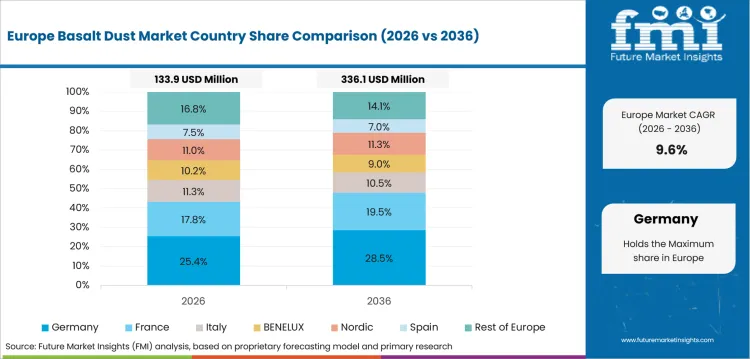
A 10.9% CAGR through 2036 reflects specification-led mineral supply and EU certification influence.
Country Market Snapshot Table
| Parameter | Value |
|---|---|
| Market Size in 2025 (Value) | USD 55.9 million |
| Market Size in 2026 (Value) | USD 62.0 million |
| Market Forecast in 2036 (Value) | USD 174.5 million |
| CAGR (2026 to 2036) | 10.9% |
| Years Considered | 2021 to 2036 |
| Base Year | 2025 |
| Forecast Period | 2026 to 2036 |
| Units Considered | Value (USD million) |
| Leading Sub-Region | North Rhine-Westphalia and Bavaria industrial corridors |
Germany Basalt Dust Market Outlook
- Germany basalt dust demand is expected to develop through documented mineral specifications and controlled field or construction trials. Buyers will compare basalt dust with existing industrial mineral inputs before accepting wider use.
- Carbon-removal demand will require certification clarity and third-party proof. Suppliers with laboratory support, repeatable particle control, and compliance files should have a stronger position.
Key Growth Drivers
- Aggregates Europe reported Germany at 511 million tonnes of total aggregates production in 2024, including 190 million tonnes of crushed rock.
- The European Commission states Germany has over 276,000 farms with an average size of around 61 hectares, which supports structured agricultural trials.
- Industrial filler buyers value reliable mineral chemistry and particle-size consistency before adding new basalt grades to purchasing lists.
- Construction material firms can test basalt fines in low-clinker mix designs when quality files match procurement requirements.
Key Restraints
- Construction weakness can slow filler-grade demand. FIEC reported that German construction investment fell by 3.3% on a price-adjusted basis in 2024.
- Certification caution can slow carbon-removal claims because the EU framework requires third-party verification before certified removal units are issued.
- Conservative industrial procurement can extend qualification cycles when suppliers cannot prove repeatable chemistry across quarry batches.
What makes Germany unique
Germany is a specification-led market where documentation can be as important as mineral availability.
Key Companies
- Regional quarry operators
- Industrial mineral processors
- Construction material laboratories
- Agricultural distributor networks
- EU carbon project developers
- Public research pilots
Sales & Marketing Channels
- Direct industrial mineral sales
- Construction material laboratories
- Agricultural distributor networks
- EU carbon project developers
- Public research pilot channels
- Technical distributor networks
Country Segment Breakdown Table
| Segment | Sub-Segments |
|---|---|
| By Grade | Agricultural Soil Remineralizer · Industrial Filler Grade · Construction Blend Grade · Other |
| By Application | Soil Amendment · Enhanced Rock Weathering · Cement / Concrete Additive · Asphalt / Other |
| By End Use | Agriculture · Construction · Industrial Manufacturing · Municipal / Other |
| By Source | Quarry By-product · Dedicated Milled Basalt |
| By Sales Channel | Direct · Distributors / Co-ops |
| Key Sub-Regions Covered, Basalt and Agricultural Corridors | North Rhine-Westphalia · Bavaria · Baden-Württemberg · Lower Saxony · Saxony · Hesse |
Frequently Asked Questions
How fast is Germany basalt dust market growing?
Germany is forecast to rise at 10.9% CAGR from 2026 to 2036 through technical mineral and carbon-screened demand.
Who leads Germany basalt dust market?
Regional mineral processors and quarry operators are best positioned due to lab access and local industrial relationships.
What is driving adoption in Germany basalt dust market?
Aggregate capacity, agricultural trial structure, and EU certification discipline support measured market development.
How fast is the basalt dust market growing in France?
A 10.6% CAGR through 2036 reflects local quarry logistics and soil amendment potential.
Country Market Snapshot Table
| Parameter | Value |
| Market Size in 2025 (Value) | USD 44.3 million |
| Market Size in 2026 (Value) | USD 49.0 million |
| Market Forecast in 2036 (Value) | USD 134.2 million |
| CAGR (2026 to 2036) | 10.6% |
| Years Considered | 2021 to 2036 |
| Base Year | 2025 |
| Forecast Period | 2026 to 2036 |
| Units Considered | Value (USD million) |
| Leading Sub-Region | Auvergne-Rhône-Alpes and western agricultural regions |
France Basalt Dust Market Outlook
- France basalt dust demand is shaped by short mineral logistics chains and agricultural input channels that can support local trial programs. Early demand should form around soil amendment and construction blend applications.
- Carbon-grade use will need field evidence and certification discipline before broad adoption. Suppliers that connect quarry teams with agronomy advisers can build stronger buyer confidence.
Key Growth Drivers
- Aggregates Europe reported France at 306 million tonnes of total aggregates production in 2024, including 173 million tonnes of crushed rock.
- Agreste stated that France represented 18% of Europe’s utilised agricultural area in 2024, supporting a broad base for soil input trials.
- Local quarry networks can reduce delivered-cost pressure when basalt fines move to nearby farms or ready-mix users.
- Soil health and low-carbon construction trials create two practical demand channels for screened mineral dust.
Key Restraints
- Organic soil-input trials can face cautious farm budgets. FiBL and IFOAM reported France had 2,711,567 hectares under organic management in 2024, equal to 10.1% of farmland.
- Farmers need practical proof before replacing familiar lime or remineralization practices with basalt dust.
- Fragmented local supply can make national-scale consistency harder when quarry chemistry differs across regions.
What makes France unique
France stands out for short mineral logistics chains and agricultural channels that can support local dust upgrading.
Key Companies
- Local quarry operators
- Agricultural co-operatives
- Construction material formulators
- Regional mineral distributors
- Carbon project aggregators
- Research institutions
Sales & Marketing Channels
- Local quarry sales teams
- Agricultural co-operatives
- Construction material formulators
- Regional distributor networks
- Carbon project aggregators
- Farm contractor networks
Country Segment Breakdown Table
| Segment | Sub-Segments |
|---|---|
| By Grade | Agricultural Soil Remineralizer · Industrial Filler Grade · Construction Blend Grade · Other |
| By Application | Soil Amendment · Enhanced Rock Weathering · Cement / Concrete Additive · Asphalt / Other |
| By End Use | Agriculture · Construction · Industrial Manufacturing · Municipal / Other |
| By Source | Quarry By-product · Dedicated Milled Basalt |
| By Sales Channel | Direct · Distributors / Co-ops |
| Key Sub-Regions Covered, Basalt and Agricultural Corridors | Auvergne-Rhône-Alpes · Nouvelle-Aquitaine · Occitanie · Brittany · Grand Est · Normandy |
Frequently Asked Questions
How fast is France basalt dust market growing?
France is expected to expand at 10.6% CAGR from 2026 to 2036 through soil and construction blend uses.
Who leads France basalt dust market?
Local quarry operators, co-operatives, and construction material formulators shape the main competitive channels.
What is driving adoption in France basalt dust market?
Quarry proximity, agricultural area, and soil-health trials are moving basalt dust toward local buyers.
What is the basalt dust market outlook in Japan?
A 9.8% CAGR through 2036 reflects carbon-credit buying and selective high-spec mineral use.
Country Market Snapshot Table
| Parameter | Value |
|---|---|
| Market Size in 2025 (Value) | USD 32.8 million |
| Market Size in 2026 (Value) | USD 36.0 million |
| Market Forecast in 2036 (Value) | USD 91.7 million |
| CAGR (2026 to 2036) | 9.8% |
| Years Considered | 2021 to 2036 |
| Base Year | 2025 |
| Forecast Period | 2026 to 2036 |
| Units Considered | Value (USD million) |
| Leading Sub-Region | Tokyo procurement networks and overseas credit channels |
Japan Basalt Dust Market Outlook
- Japan basalt dust demand is more visible through carbon-credit procurement than large domestic spreading. Buyers are likely to favor verified overseas projects and high-spec mineral inputs instead of bulk local tonnage.
- Construction material trials may create selective use for filler-grade basalt dust. Product documentation, safety files, and verified carbon records will shape buyer confidence.
Key Growth Drivers
- Japanese offtake demand is visible. Alt Carbon stated its MOL relationship covers 10,000 tonnes of carbon dioxide removal credits.
- OECD reporting states Japan had 4.6 million hectares of agricultural land in 2023, giving only a limited base for domestic spreading scale.
- Corporate net-zero procurement can finance overseas basalt dust projects through verified carbon removal offtakes.
- Construction material buyers may test mineral fillers when suppliers provide strong particle and chemistry documentation.
Key Restraints
- Domestic land limits broad ERW rollout. OECD reporting shows agriculture uses about 12% of Japan’s land area.
- Inter-island logistics can raise delivered cost for low-value mineral dust before it reaches suitable users.
- Overseas credit reliance can make local basalt dust demand less direct than in large agricultural economies.
What makes Japan unique
Japan acts as a quality-focused buyer and carbon-credit financier rather than a volume spreading market.
Key Companies
- Alt Carbon
- Mitsui O.S.K. Lines
- Japanese trading houses
- Construction material suppliers
- Overseas ERW project developers
- Sustainability procurement teams
Sales & Marketing Channels
- Corporate carbon offtake contracts
- Trading house partnerships
- Construction material suppliers
- Sustainability procurement teams
- Overseas ERW project developers
- Technical mineral distributors
Country Segment Breakdown Table
| Segment | Sub-Segments |
|---|---|
| By Grade | Agricultural Soil Remineralizer · Industrial Filler Grade · Construction Blend Grade · Other |
| By Application | Soil Amendment · Enhanced Rock Weathering · Cement / Concrete Additive · Asphalt / Other |
| By End Use | Agriculture · Construction · Industrial Manufacturing · Municipal / Other |
| By Source | Quarry By-product · Dedicated Milled Basalt |
| By Sales Channel | Direct · Distributors / Co-ops |
| Key Sub-Regions Covered, Basalt and Agricultural Corridors | Tokyo · Osaka · Nagoya · Yokohama · Fukuoka · Hokkaido |
Frequently Asked Questions
How fast is Japan basalt dust market growing?
Japan is forecast to rise at 9.8% CAGR from 2026 to 2036, led by verified credit buying and technical use.
Who leads Japan basalt dust market?
Alt Carbon and overseas ERW suppliers have visible relevance through Japanese carbon-credit buyer relationships.
What is driving adoption in Japan basalt dust market?
Corporate procurement, overseas offtakes, and technical mineral testing support early demand.
How is basalt dust demand developing in South Korea?
A 9.7% CAGR through 2036 reflects construction-material interest and carbon-aware industrial procurement.
Country Market Snapshot Table
| Parameter | Value |
|---|---|
| Market Size in 2025 (Value) | USD 27.0 million |
| Market Size in 2026 (Value) | USD 29.6 million |
| Market Forecast in 2036 (Value) | USD 74.7 million |
| CAGR (2026 to 2036) | 9.7% |
| Years Considered | 2021 to 2036 |
| Base Year | 2025 |
| Forecast Period | 2026 to 2036 |
| Units Considered | Value (USD million) |
| Leading Sub-Region | Gyeonggi and Busan construction-material corridors |
South Korea Basalt Dust Market Outlook
- South Korea basalt dust demand is expected to form around construction blends, filler-grade mineral use, and carbon-aware industrial procurement. Domestic agricultural spreading opportunities are more limited than in larger land-based markets.
- Technical documentation will matter strongly for buyers in cement, infrastructure, and industrial material channels. Suppliers must show particle control and safe handling before procurement teams consider wider adoption.
Key Growth Drivers
- The Korea Cement Association represents 9 member companies, 11 kiln plants, 23 grinding stations, and cement production capacity of 51 mtpa.
- The Ministry of Data and Statistics reported South Korea’s agricultural area at 1.500 million hectares in 2025.
- Industrial procurement favors certified suppliers that can provide batch chemistry, particle-size files, and compliance documentation.
- Infrastructure material buyers can test basalt dust when mineral filler behavior supports pavement or cementitious blend requirements.
Key Restraints
- Land availability restricts broad farm spreading. OECD reporting places agricultural land at 1.6 million hectares and 16% of total land.
- High logistics cost can limit movement of low-value dust across dense urban and coastal supply chains.
- Public evidence for direct domestic ERW companies is limited, which can slow buyer confidence in verified removal claims.
What makes South Korea unique
South Korea is unique due to advanced construction-material procurement and limited agricultural spreading space.
Key Companies
- Korean cement producers
- Regional quarry operators
- Construction material formulators
- Industrial mineral distributors
- Carbon procurement teams
- Research pilot partners
Sales & Marketing Channels
- Direct industrial mineral sales
- Cement and concrete laboratories
- Construction procurement teams
- Government research pilots
- Agricultural input distributors
- Sustainability procurement units
Country Segment Breakdown Table
| Segment | Sub-Segments |
|---|---|
| By Grade | Agricultural Soil Remineralizer · Industrial Filler Grade · Construction Blend Grade · Other |
| By Application | Soil Amendment · Enhanced Rock Weathering · Cement / Concrete Additive · Asphalt / Other |
| By End Use | Agriculture · Construction · Industrial Manufacturing · Municipal / Other |
| By Source | Quarry By-product · Dedicated Milled Basalt |
| By Sales Channel | Direct · Distributors / Co-ops |
| Key Sub-Regions Covered, Basalt and Agricultural Corridors | Seoul Capital Area · Busan · Ulsan · Incheon · Daegu · Jeju |
Frequently Asked Questions
How fast is South Korea basalt dust market growing?
South Korea is forecast to grow at 9.7% CAGR from 2026 to 2036 through construction and industrial mineral demand.
Who leads South Korea basalt dust market?
Cement producers, quarry operators, and construction material formulators influence basalt dust adoption.
What is driving adoption in South Korea basalt dust market?
Cement capacity, technical procurement, and carbon-aware materials testing support early demand.
Who are the leading companies in the basalt dust market?
UNDO, Lithos Carbon, Terradot, InPlanet, Mati Carbon, Alt Carbon and Silica.
- Enhanced weathering specialists hold an advantage through field documentation and carbon buyer relationships.
- Quarry-linked suppliers gain relevance by offering local fines with tested chemistry and controlled particle size.
- Farm-facing project developers gain adoption when they combine carbon finance with agronomy support.
- Construction-material suppliers can benefit where basalt fines meet local filler and blend specifications.
Carbon-removal developers in the market compete by combining field application capability with buyer-grade verification. UNDO has stronger United Kingdom visibility through field-scale basalt spreading agreements. Lithos Carbon and Terradot have stronger relevance in the Americas through farm networks and corporate removal buyers. InPlanet, Mati Carbon, and Alt Carbon compete through tropical and smallholder project models where local field support is central.
Feedstock control has become a competitive separator as basalt dust demand moves beyond simple quarry fines. Suppliers need screening, milling, mineral chemistry, and logistics discipline before they can serve carbon or construction buyers. Large aggregate companies influence supply access, although project-grade basalt dust still requires application-specific documentation. Scale alone is not enough if material chemistry or delivery records fail buyer review.
Smaller and regional players can win through local quarry access and field service partnerships. India and the United Kingdom create stronger conditions for project developers that can connect basalt supply with farm spreading. Germany and South Korea create harder conditions because technical procurement and documentation requirements are stricter. Companies with verifiable material records and practical field support should gain more durable contracts.
How do top basalt dust companies compare?
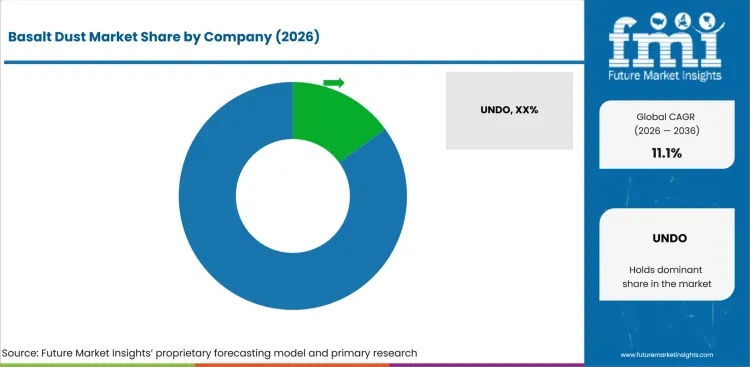
UNDO and Lithos Carbon score strongest on project execution while quarry-linked suppliers influence feedstock access.
| Company | Relevance to Market Title | Carbon Project Depth | Quarry / Feedstock Access | Field Application Support | Channel Reach | Geographic Footprint |
|---|---|---|---|---|---|---|
| UNDO | Very High | Very Strong | Strong | Very Strong | Strong | United Kingdom and international |
| Lithos Carbon | Very High | Very Strong | Strong | Very Strong | Strong | United States |
| Terradot | Very High | Very Strong | Strong | Strong | Very Strong | Americas |
| InPlanet | High | Strong | Moderate | Strong | Moderate | Tropical agriculture markets |
| Mati Carbon | High | Strong | Moderate | Very Strong | Moderate | India-linked smallholder markets |
| Alt Carbon | High | Strong | Moderate | Strong | Moderate | South Asia and Japan-linked offtakes |
| Silica | Moderate to High | Moderate | Moderate | Moderate | Moderate | Project-based |
| Eion | Moderate to High | Strong | Moderate | Moderate | Moderate | United States |
| Martin Marietta Materials | Moderate | Low to Moderate | Very Strong | Low to Moderate | Very Strong | United States |
| Vulcan Materials | Moderate | Low to Moderate | Very Strong | Low to Moderate | Very Strong | United States |
Source: Future Market Insights competitive analysis, 2026.
Who are the key players in the basalt dust market?
UNDO, Lithos Carbon, Terradot, InPlanet, Mati Carbon, Alt Carbon, Silica and Eion are listed with quarry-linked suppliers among other participants.
Key global companies leading the basalt dust market include:
- UNDO
- Lithos Carbon
- Terradot
- InPlanet
- Mati Carbon
- Alt Carbon
- Silica
- Eion
- Martin Marietta Materials
- Vulcan Materials
Key Developments in Basalt Dust Market
- In September 2024, UNDO signed a follow-on enhanced rock weathering agreement with Microsoft to remove 15,000 tonnes of carbon dioxide and spread 40,000 tonnes of basalt in the United Kingdom.
- In December 2024, Frontier buyers signed a USD 27 million agreement with Terradot for 90,000 tons of carbon dioxide removal from 2025 to 2029 using basalt sourced from quarries across southern Brazil.
- In November 2025, Alt Carbon announced Asia’s largest verified enhanced weathering credit issuance to Mitsui O.S.K. Lines under a multi-year relationship covering 10,000 tonnes of carbon dioxide removal credits.
Key Players in the Basalt Dust Market
Enhanced Weathering Specialists
- UNDO
- Lithos Carbon
- Terradot
- InPlanet
- Mati Carbon
- Alt Carbon
- Silica
- Eion
Quarry and Mineral Supply Participants
- Martin Marietta Materials
- Vulcan Materials
- CRH
- Sibelco
Regional Project and Channel Participants
- Agricultural co-operatives
- Local quarry operators
- Carbon project aggregators
- Farm contractor networks
Basalt Dust Market - Scope & Definition
| Attribute | Detail |
|---|---|
| Market Definition | Finely crushed basalt powder and screened fines sold for soil remineralization, enhanced rock weathering, cement blends, concrete additives, industrial fillers, and asphalt blends. |
| Functions Covered | Soil remineralization, carbon-removal support, mineral filling, cementitious blending, asphalt blending, and dust-grade material reuse. |
| Applications Covered | Soil amendment, enhanced rock weathering, cement / concrete additive, asphalt / other mineral blend applications. |
| End-Use Industries | Agriculture, construction, industrial manufacturing, municipal users, and carbon project development. |
| Grades Covered | Agricultural Soil Remineralizer, Industrial Filler Grade, Construction Blend Grade, and Other. |
| Inclusions | Quarry by-product basalt dust, dedicated milled basalt, direct sales, distributor sales, co-op supply, and project-grade basalt dust sold across selected applications. |
| Exclusions | Coarse crushed stone, basalt fiber, basalt rebar, decorative landscaping stone, volcanic ash products, limestone dust, fly ash, slag powder, and carbon credits sold without physical basalt dust supply. |
Basalt Dust Market - Research Methodology
| Method | Description |
|---|---|
| Primary Research | FMI analyst interviews with quarry operators, agronomy advisers, carbon project developers, farmer networks, construction material buyers, and mineral distributors across key markets. |
| Desk Research | Review of quarry production data, carbon-removal policy documents, enhanced weathering research, company project disclosures, and mineral application references. |
| Market Sizing & Forecasting | Bottom-up material-boundary approach using basalt fines availability, milling cost, field spreading economics, country-level carbon activity, and application split. |
| Data Validation | Cross-verification using crushed stone supply, carbon removal procurement, agriculture use cases, construction material demand, and company project activity. |
Basalt Dust Market - Report Scope
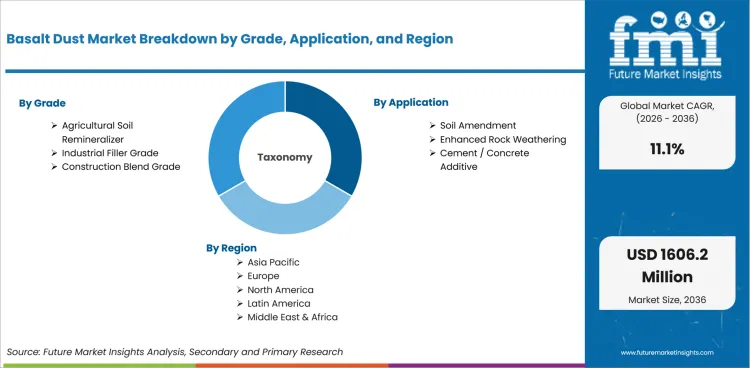
| Parameter | Details |
|---|---|
| Forecast period | 2026 to 2036 |
| Historical period | 2021 to 2025 |
| Quantitative unit | Revenue in USD million |
| By grade | Agricultural Soil Remineralizer, Industrial Filler Grade, Construction Blend Grade, Other |
| By application | Soil Amendment, Enhanced Rock Weathering, Cement / Concrete Additive, Asphalt / Other |
| By end use | Agriculture, Construction, Industrial Manufacturing, Municipal / Other |
| By source | Quarry By-product, Dedicated Milled Basalt |
| By sales channel | Direct, Distributors / Co-ops |
| Regions covered | North America, Latin America, Europe, East Asia, South Asia and Pacific, Middle East and Africa |
| Countries covered | India, China, United States, United Kingdom, Germany, France, Japan, South Korea |
| Key companies profiled | UNDO, Lithos Carbon, Terradot, InPlanet, Mati Carbon, Alt Carbon, Silica, Eion |
| Approach | Bottom-up material-boundary approach using basalt fines availability, application demand, country-level adoption, and project-grade supply indicators |
Source: Future Market Insights, 2026.
Basalt Dust Market Breakdown by Grade, Application, End Use, Source, Sales Channel, and Region
Basalt Dust Market Segmented by Grade
- Agricultural Soil Remineralizer
- Industrial Filler Grade
- Construction Blend Grade
- Other
Basalt Dust Market Segmented by Application
- Soil Amendment
- Enhanced Rock Weathering
- Cement / Concrete Additive
- Asphalt / Other
Basalt Dust Market Segmented by End Use
- Agriculture
- Construction
- Industrial Manufacturing
- Municipal / Other
Basalt Dust Market Segmented by Source
- Quarry By-product
- Dedicated Milled Basalt
Basalt Dust Market Segmented by Sales Channel
- Direct
- Distributors / Co-ops
Basalt Dust Market by Region
- North America
- Latin America
- Europe
- East Asia
- South Asia and Pacific
- Middle East and Africa
Research Sources and Bibliography
- Aggregates Europe - UEPG. (2026, March 2). Figures: 2024 aggregates production data.
- Alt Carbon. (2025, November 15). Alt Carbon makes Asia’s largest verified enhanced weathering credit issuance to Mitsui O.S.K. Lines.
- Department for Environment, Food & Rural Affairs. (2025, June 1). Agricultural land use in the United Kingdom at 1 June 2025.
- European Commission. (2026, February 3). EU sets world’s first voluntary standard for permanent carbon removals, carbon farming and carbon storage in products.
- European Commission Directorate-General for Agriculture and Rural Development. (2025). Germany - CAP Strategic Plan facts and figures.
- Fédération de l’Industrie Européenne de la Construction. (2025). Germany construction activity profile.
- FiBL & IFOAM - Organics International. (2026). France organic sector factsheet.
- Frontier. (2024, December 12). Terradot signs USD 27 million deal with Frontier buyers to scale enhanced rock weathering in Brazil.
- Google. (2024, December 12). Our new deal to remove CO2 from the atmosphere by crushing rocks.
- Korea Cement Association. (2025). Korea Cement Association industry profile.
- Met Office. (2025, December 1). Northern Ireland records third wettest autumn on record as provisional November and autumn statistics released.
- Mineral Products Association. (2024, August 1). Patchy improvement in heavy-side materials markets amid construction weakness.
- McBride, A. L., Skov, K., Wade, P., Betz, J., Stubbs, A., Bierowiec, T., Albahri, T., Cazzagon, G., Chen, C.-J., Frew, A., Healey, M., Idam, I., Jones, L., Kelland, M. E., Mann, J., Manning, D., Mitchell, C., Murphy, M. J., Radkova, A., ... Liu, X. (2025, September 5). Quantifying potential carbon dioxide removal via enhanced weathering using porewater from a field trial in Scotland. Frontiers in Climate, 7, 1606574.
- Mineral Products Association. (2025, August 13). Government-funded report triggers call for action on falling aggregate reserves.
- Ministry of Agriculture and Farmers Welfare. (2025, March 13). Annual report 2024-25.
- Ministry of Data and Statistics. (2026). 2025 agricultural area survey results.
- Ministry of Ecology and Environment of the People’s Republic of China. (2025, November). China’s policies and actions for addressing climate change.
- National Bureau of Statistics of China. (2024, June 25). Industrial production operation in May 2024.
- Organisation for Economic Co-operation and Development. (2025, October 30). Agricultural policy monitoring and evaluation 2025: Japan.
- Organisation for Economic Co-operation and Development. (2025, October 30). Agricultural policy monitoring and evaluation 2025: Korea.
- Press Information Bureau, Government of India. (2025, August 16). Soil Health Card scheme progress update.
- Press Information Bureau, Government of India. (2026, March 27). Record foodgrain and horticulture output amid agriculture-sector improvements.
- USA Department of Agriculture. (2025, May 20). Partnerships for Climate-Smart Commodities project summaries.
- USA Department of Agriculture, National Agricultural Statistics Service. (2024, February 13). 2022 Census of Agriculture.
- USA Department of Energy, Biological and Environmental Research. (2025). Interactions between enhanced rock weathering and soil organic carbon cycling in coordinated national-scale field trials.
- USA Geological Survey. (2025). Sand and gravel (construction). In Mineral commodity summaries 2025.
- USA Geological Survey. (2025). Stone (crushed). In Mineral commodity summaries 2025.
- USA Geological Survey. (2026). Mineral commodity summaries 2026.
- UNDO. (2024, September 24). UNDO signs follow-on enhanced rock weathering carbon removal deal with Microsoft.
This bibliography is provided for reader reference and is not exhaustive. The full report contains the complete reference list and detailed citations.
This Report Answers
- Market size estimates for 2026 and forecasts through 2036 for the basalt dust market.
- Analysis of demand drivers, field-use patterns, quarry supply trends, and purchasing behavior.
- Evaluation of grade, application, end-use, source, and sales-channel segments.
- Assessment of quarry fines upgrading, carbon-removal verification, and farm adoption impacts on market development.
- Identification of growth opportunities across soil amendment, enhanced weathering, construction blends, and industrial fillers.
- Evaluation of supply chain dynamics, project documentation trends, and mineral sourcing structures.
- Country-level growth analysis covering India, China, the United States, the United Kingdom, Germany, France, Japan, and South Korea.
- Assessment of the competitive landscape, including enhanced weathering specialists and quarry-linked market participants.
- Analysis of buyer preferences, field documentation needs, and emerging growth opportunities.
- Regional outlooks across North America, Europe, East Asia, South Asia and Pacific, Latin America, and Middle East and Africa.
- Delivery of market data, forecasts, and supporting analysis in PDF and Excel formats.
Frequently Asked Questions
What is the growth prospect for basalt dust?
Demand for basalt dust is expected to rise at a considerable pace as farms, carbon projects, and mineral buyers adopt documented basalt fines.
Which companies are expected to shape the basalt dust market?
UNDO, Lithos Carbon, Terradot, InPlanet, Mati Carbon, Alt Carbon, Silica, and Eion are expected to shape market competition through enhanced weathering projects and verified field operations.
Why are carbon project developers investing in basalt dust?
Carbon project developers are investing in basalt dust because enhanced rock weathering can connect mineral spreading with measured carbon-removal claims.
Why are quarry by-products important in the basalt dust market?
Quarry by-products are important because existing fines reduce raw material cost and support local project economics.
Which application formats are gaining attention in basalt dust?
Soil amendment and enhanced rock weathering are gaining attention as buyers seek mineral inputs with field and carbon-management value.
How do regulations influence basalt dust adoption?
Regulations influence adoption through soil application rules, carbon-removal certification, dust handling requirements, and project verification standards.
Why is documentation important for basalt dust suppliers?
Documentation is important because buyers compare mineral chemistry, particle size, heavy-metal screening, and delivery records before approving supply.
What role does agriculture play in basalt dust demand?
Agriculture provides the main land base for basalt dust spreading, especially where soil remineralization and enhanced weathering overlap.
How do direct channels support basalt dust sales?
Direct channels support basalt dust sales by helping suppliers provide batch records, project documentation, and delivery proof to carbon and construction buyers.


